 plumi
Measuring biodiversity: OCR A‑Level Biology A questions
OCR A-Level Biology A past-paper questions on 4.2.1.3 Measuring biodiversity, 2016–2025, with mark schemes and examiner’s reports where available.
Paper
All papers
Exam
All years
Calculations
Q17(d)(i)
The whole paper ↗
Q18(b)(i)
The whole paper ↗
Q18(b)(ii)
The whole paper ↗Q18(c)(i)
The whole paper ↗Q18(c)(ii)
The whole paper ↗Q18(c)(vi)
The whole paper ↗- Your answer
Q18(c)(i)
The whole paper ↗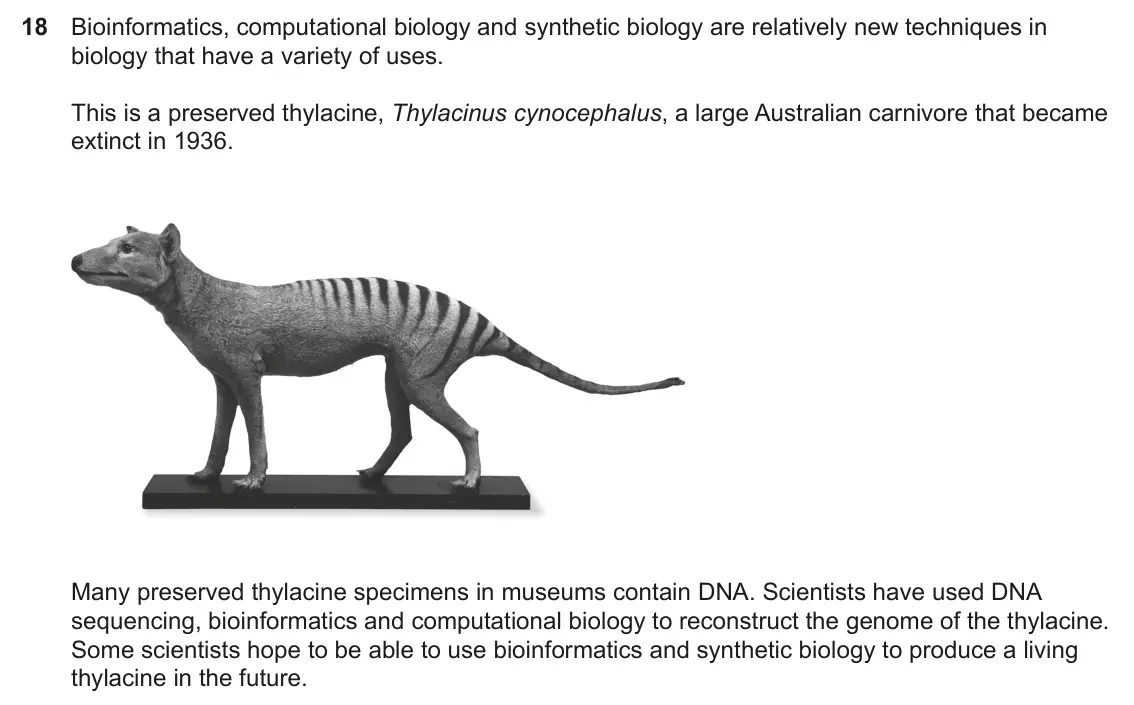
Q18(c)(ii)
The whole paper ↗- Your answer
- Your answer
Q1(a)(ii)
The whole paper ↗Q1(a)(iii)
The whole paper ↗Q4(b)(iv)
The whole paper ↗
- Your answer
Q4(b)
The whole paper ↗- Your answer
Q20(b)(i)
The whole paper ↗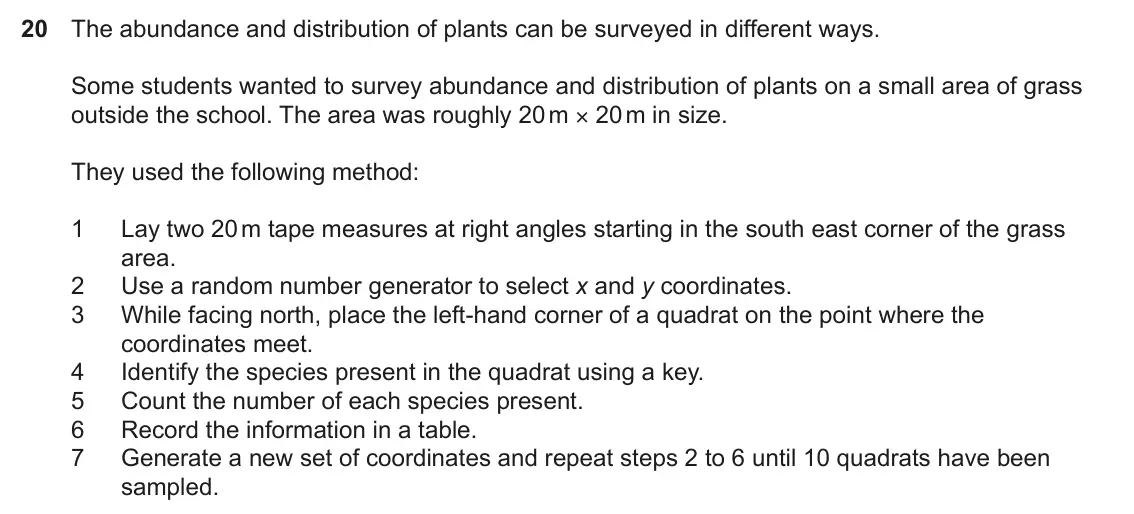
Q20(b)(ii)
The whole paper ↗Q5(b)
The whole paper ↗
All 39 questions on Measuring biodiversity, as a list
- June 2025, Paper 2, Q17(d)(i) (2 marks): Outline how genetic diversity in a species such as Przewalski’s horse can be measured. [2]
- June 2025, Paper 2, Q18(b)(i) (1 mark): State the species richness in quadrat A. [1]
- June 2025, Paper 2, Q18(b)(ii) (1 mark): Compare the species evenness in quadrats A and B. [1]
- June 2025, Paper 2, Q18(c)(i) (3 marks): Calculate the Simpson’s Index of Diversity for the wildflower meadow. f n p 2 n d - R Use the formula: D 1 = N You may use the table above for working out. Give
- June 2025, Paper 2, Q18(c)(ii) (2 marks): Explain the significance of the value for D calculated in part (i). [2]
- June 2025, Paper 2, Q18(c)(vi) (1 mark): Identify one problem with the way in which the students categorised their flying insect species that could reduce confidence in the calculated value for Simpson
- June 2025, AS Paper 1, Q18 (1 mark): Scientists studied the genetic diversity of four different wolf populations in a national park in Canada. The data are shown in the table. Population Number of
- June 2024, Paper 2, Q18(c)(i) (2 marks): Describe the evidence in the table that supports the conclusion that low genetic diversity contributed to the extinction of the thylacine. [2]
- June 2024, Paper 2, Q18(c)(ii) (1 mark): Identify one piece of evidence that does not support the conclusion that low genetic diversity contributed to the extinction of the thylacine. [1]
- June 2024, AS Paper 1, Q17 (1 mark): Which statement describes species evenness? A The number of different species B The number of organisms in a community C The number of organisms of a particular
- June 2024, AS Paper 1, Q18 (1 mark): Students carried out fieldwork in two different woodlands. They marked out an area measuring 10 m by 10 m in each woodland. For each plant species present they
- June 2024, AS Paper 2, Q1(a)(ii) (3 marks): This table shows their findings. Number of (n / N)2 Species organisms n / N (n) Foxglove 3 0.13 0.02 Meadow buttercup 7 Oxeye daisy 9 Yellow rattle 4 ∑(n / N)2
- June 2024, AS Paper 2, Q1(a)(iii) (1 mark): State what can be concluded about the diversity of the field from your answer in (a)(ii). [1]
- June 2023, Paper 3, Q4(b)(iv) (2 marks): New Zealand has a high species biodiversity compared to many countries. Species biodiversity includes the concepts of species richness and species evenness. Exp
- June 2023, AS Paper 1, Q3 (1 mark): Simpson’s Index of Diversity (D) can be used to estimate the biodiversity of a habitat. D = 1 – (∑( N) 2) n Scientists calculated D for a grassland habitat. One
- June 2023, AS Paper 2, Q4(b) (3 marks): A study was carried out to monitor the population of three penguin species on an island near Antarctica. The graph shows the results of this study. 1600 Key: Ad
- June 2022, Paper 2, Q7 (1 mark): On a biology field trip, a student calculated that an area of ancient woodland had a Simpson’s Index of Diversity of 0.85. Which interpretation of a Simpson’s I
- June 2022, Paper 2, Q20(b)(i) (3 marks): Calculate the Simpson’s Index of Diversity (D) for the students’ data. n 2 f d n p Use the formula: D = 1 – / N D = [3]
- June 2022, Paper 2, Q20(b)(ii) (2 marks): The students found grass species difficult to distinguish from one another so they decided to record any grass species as ‘grass’. Explain how the students’ dec
- June 2022, Paper 3, Q5(b) (2 marks): DNA analysis can be used to assess genetic biodiversity within populations. A scientist assessed genetic biodiversity in four populations, A to D, of yellow hor
- June 2022, AS Paper 1, Q3 (1 mark): The table shows the numbers of different species of invertebrates found in four different areas in a woodland. Invertebrate species Area Woodlice Spiders Beetle
- June 2022, AS Paper 1, Q22(b)(i) (2 marks): Calculate the proportion of polymorphic gene loci in the European zoo population. Proportion = [2]
- June 2022, AS Paper 1, Q22(b)(ii) (2 marks): A second group of scientists carried out a separate investigation to calculate the proportion of polymorphic gene loci of cheetahs in European zoos and found th
- June 2022, AS Paper 1, Q22(b)(iii) (3 marks): Suggest and explain reasons why, in the 21st Century, only 10% of the gene loci are polymorphic in wild populations of cheetah. [3]
- November 2021, Paper 2, Q14 (1 mark): Which of the following best defines the term species richness? A the distribution of species over an area B the number of species in an area C the relative abun
- November 2021, Paper 2, Q15 (1 mark): Biodiversity can be considered at different levels. An area of woodland habitat has a high Simpson’s Index of Diversity. Which of the following describes an are
- November 2021, AS Paper 1, Q6 (1 mark): To determine the biodiversity of butterflies in a meadow, the number of different species of butterfly were sampled in a meadow on 12 consecutive days. The resu
- November 2021, AS Paper 2, Q5(a)(ii) (3 marks): The results for Area A are shown in the table below. 2 ⎛⎞ n n n = Number of Species organisms ⎝⎠ N N Common woodlouse 9 Black sexton beetle 6 Spotted wolf spide
- November 2021, AS Paper 2, Q5(a)(iii) (1 mark): The students found the Simpson’s Index of Diversity for Area B to be 0.84. Compare the stability of the community living in Area B with that of the community li
- November 2020, Paper 2, Q18(a)(i) (2 marks): Calculate the proportion of genetic polymorphic gene loci of species B. 12] proportion =
- November 2020, Paper 2, Q18(a)(ii) (3 marks): Evaluate the conclusion that species B shows greater genetic polymorphism than species A. .. [3]
- June 2019, Paper 2, Q18(c)(i) (3 marks): The students calculated the Simpson’s Index of Diversity (D) for the mature area to be 0.489. Use the information in Table 18 to work out the Simpson’s Index of
- June 2018, Paper 2, Q20(b)(i) (1 mark): State one way in which genetic diversity can be measured. [1]
- June 2018, Paper 3, Q5(b) (2 marks): A scientist sampled the species of trees present in two different habitats containing Pinus glabra. The results of the sampling are shown in Table 5. Number of
- June 2018, AS Paper 2, Q6(a)(i) (3 marks): Calculate the Simpson’s Index of Diversity for Upper End Meadow. Use the information in Table 6 and the formula: 2 n D = 1 − ∑ N n = number of organisms of this
- June 2018, AS Paper 2, Q6(c) (1 mark): The students found 50 animals in a soil sample collected from Upper End Meadow and identified them as follows: • 2 click beetles • 24 leatherjackets • 23 meadow
- June 2017, Paper 2, Q6 (1 mark): Which of the statements, A to D, best defines the term species evenness? A the number of species in an area B the relative abundance of each species in an area
- June 2017, AS Paper 1, Q4 (1 mark): The genetic diversity of a population can be estimated using the following formula: proportion of polymorphic gene loci = number of polymorphic gene loci total
- June 2016, AS Paper 1, Q9 (1 mark): Two different fields, field G and H, were sampled for three common species of wildflower. The results are shown below. Number of individuals Species Field G Fie
Questions, mark schemes and examiner’s reports are © OCR, from their published past papers. Plumi isn’t affiliated with any exam board. Want whole papers? OCR A-Level Biology A past papers, or our free OCR-style practice pack.
The Plumi iPad app also offers exam-style questions with AI feedback on your handwritten working.