 plumi
Heart action and ECGs: OCR A‑Level Biology A questions
OCR A-Level Biology A past-paper questions on 3.1.2.4 Heart action and ECGs, 2016–2025, with mark schemes and examiner’s reports where available.
Paper
All papers
Exam
All years
Calculations
Q20(c)
The whole paper ↗Q20(d)
The whole paper ↗Q20(e)(i)
The whole paper ↗Q20(e)(ii)
The whole paper ↗Q2(b)
The whole paper ↗
Q25(c)(i)
The whole paper ↗Q25(c)(ii)
The whole paper ↗Q4(c)
The whole paper ↗Q26(c)
The whole paper ↗Q1(c)
The whole paper ↗
Q16(a)(i)
The whole paper ↗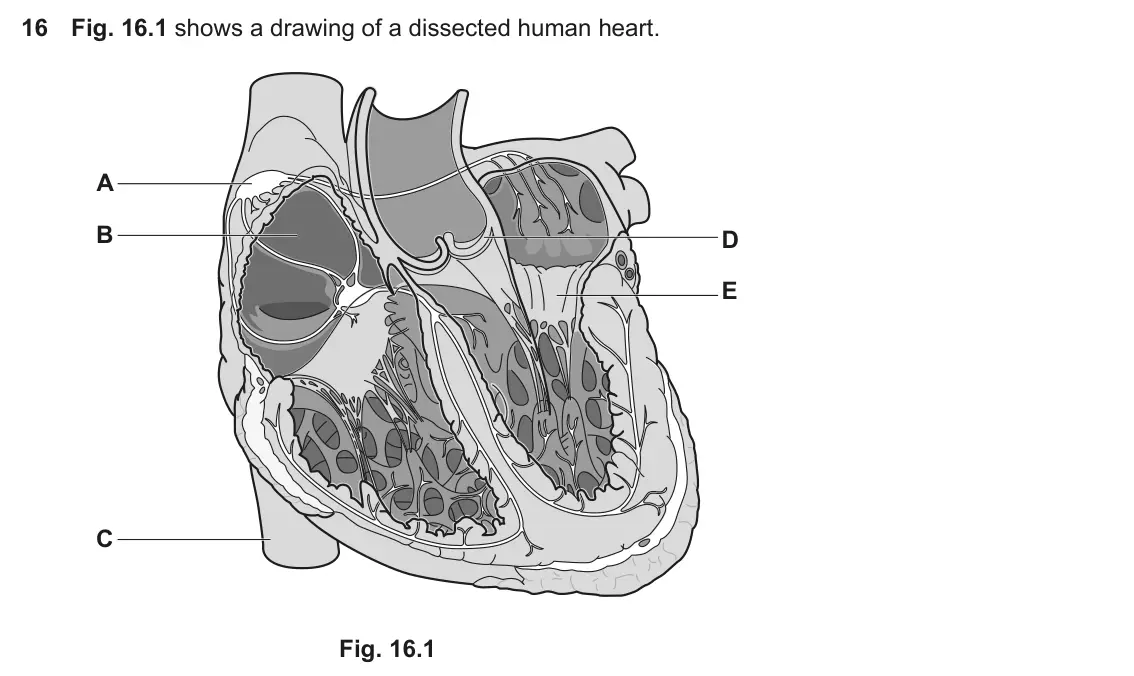
- Your answer
- Your answer
- Your answer
Q16(b)
The whole paper ↗Q21(b)(i)
The whole paper ↗
Q21(b)(ii)
The whole paper ↗Q21(b)(iii)
The whole paper ↗- Your answer
Q21(a)(iii)
The whole paper ↗
All 25 questions on Heart action and ECGs, as a list
- June 2025, Paper 1, Q20(c) (4 marks): This is a drawing of a dissected human heart. J K L M Identify the structures labelled J to M. J K L M [4]
- June 2025, Paper 1, Q20(d) (6 marks): (d)* This is an electrocardiogram (ECG) trace of a single heartbeat. R T P Q S Describe how contraction of the heart muscle at rest is initiated and relate this
- June 2025, Paper 1, Q20(e)(i) (1 mark): Fig. 20.2 shows an ECG trace from a patient with abnormal heart activity. Fig. 20.2 Identify this abnormality. Give a reason for your identification. Abnormalit
- June 2025, Paper 1, Q20(e)(ii) (1 mark): Fig. 20.3 shows an ECG trace from another patient with abnormal heart activity. Fig. 20.3 Identify this abnormality. Give a reason for your identification. Abno
- June 2025, Paper 3, Q2(b) (4 marks): A scientist studied the health outcomes of people with high blood pressure that were treated with either: • a new beta blocker treatment or • one of four establ
- June 2025, AS Paper 1, Q25(c)(i) (2 marks): Calculate the heart rate of the Asian elephant. Give your answer to the nearest whole number. Heart rate = beats per minute [2]
- June 2025, AS Paper 1, Q25(c)(ii) (2 marks): Describe how the ECG trace would appear differently if the elephant had tachycardia. [2]
- June 2024, AS Paper 2, Q4(c) (6 marks): (c)* Heart action in a mammalian heart starts at the sino-atrial node (SAN). Describe how heart action is initiated and coordinated by the SAN and explain why t
- June 2023, AS Paper 1, Q26(c) (2 marks): An electrocardiogram (ECG) trace from a bird and an ECG trace from a human have many differences. The ECG trace below is from a bird. Time = 1 second Describe h
- June 2022, Paper 3, Q1(c) (2 marks): Fig. 1.2 shows two electrocardiogram (ECG) traces: • an ECG of normal heart activity • an ECG of a person with a type of heart disease Normal Heart disease Fig.
- November 2021, Paper 1, Q16(a)(i) (5 marks): Identify the structures labelled A to E on Fig. 16.1. A B C D E [5]
- November 2021, AS Paper 1, Q3 (1 mark): Which of the options, A to D, on the diagram below shows the time at which the SAN sends out a wave of excitation to initiate a heartbeat? 20 Aorta 15 Pressure
- November 2021, AS Paper 1, Q13 (1 mark): The ECG traces below show four abnormal heartbeats recorded for six seconds. A B C D Which of the traces, A to D, shows atrial fibrillation? Your answer [1]
- November 2020, AS Paper 1, Q9 (1 mark): The trace below is an electrocardiogram (ECG) of an abnormal heart activity. 4 5 0 1 2 3 time (s) What is the name for this abnormal heart activity? A bradycard
- June 2019, Paper 1, Q16(b) (3 marks): The heart supplies oxygenated blood to the tissues. max is a measurement of the maximum volume of oxygen that an individual can use VO2 during intense exercise
- June 2019, Paper 1, Q21(b)(i) (2 marks): Identify patients X, Y and Z by labelling the traces in Fig. 21.2. [2]
- June 2019, Paper 1, Q21(b)(ii) (2 marks): Sketch a trace for a patient who has entered atrial fibrillation. 1.0 s [2]
- June 2019, Paper 1, Q21(b)(iii) (2 marks): Suggest why reduced heart rate is sometimes seen in people who are very aerobically fit. [2]
- June 2018, Paper 1, Q7 (1 mark): Which of the statements, A to D, explains why diastole follows systole in the mammalian heart? A Cardiac muscle is myogenic. B Cardiac muscle takes a short time
- June 2018, Paper 1, Q21(a)(iii) (3 marks): TTX is also known to reduce the speed of conduction in the Purkyne fibres of the heart. Suggest and explain what effect this would have on the heart rate. [3]
- June 2018, AS Paper 2, Q2(a)(i) (1 mark): Using the traces shown in Fig. 2.1, name the heart rhythm abnormality that the patient is suffering from. [1]
- June 2018, AS Paper 2, Q2(a)(ii) (3 marks): The equation for working out cardiac output is: cardiac output = stroke volume × heart rate Stroke volume is the volume of blood pumped per heart beat. The stro
- June 2018, AS Paper 2, Q2(a)(iii) (2 marks): Explain how the heart is controlling the electrical activity at Y on Fig. 2.1(b). [2]
- June 2017, Paper 3, Q6 (6 marks): 6* A student investigated the heart rates of smokers and non-smokers. • Each test subject had their resting heart rate measured using an electronic heart rate m
- June 2017, AS Paper 1, Q12 (1 mark): In the graph below, the top electrocardiogram (ECG) trace shows normal heart activity and the ECG trace below shows abnormal heart activity. What is the heart c
Questions, mark schemes and examiner’s reports are © OCR, from their published past papers. Plumi isn’t affiliated with any exam board. Want whole papers? OCR A-Level Biology A past papers, or our free OCR-style practice pack.
The Plumi iPad app also offers exam-style questions with AI feedback on your handwritten working.