 plumi
Blood vessels and tissue fluid: OCR A‑Level Biology A questions
OCR A-Level Biology A past-paper questions on 3.1.2.2 Blood vessels and tissue fluid, 2016–2025, with mark schemes and examiner’s reports where available.
Paper
All papers
Exam
All years
Calculations
Q20(a)
The whole paper ↗Q20(b)
The whole paper ↗- Your answer
Q18(c)(i)
The whole paper ↗Q18(c)(ii)
The whole paper ↗- Your answer
Q4(a)(i)
The whole paper ↗Q4(a)(ii)
The whole paper ↗Q4(a)(iii)
The whole paper ↗Q4(b)(i)
The whole paper ↗Q4(b)(ii)
The whole paper ↗Q16(a)(iii)
The whole paper ↗
Q2(d)(i)
The whole paper ↗Q2(d)(ii)
The whole paper ↗Q23(a)(i)
The whole paper ↗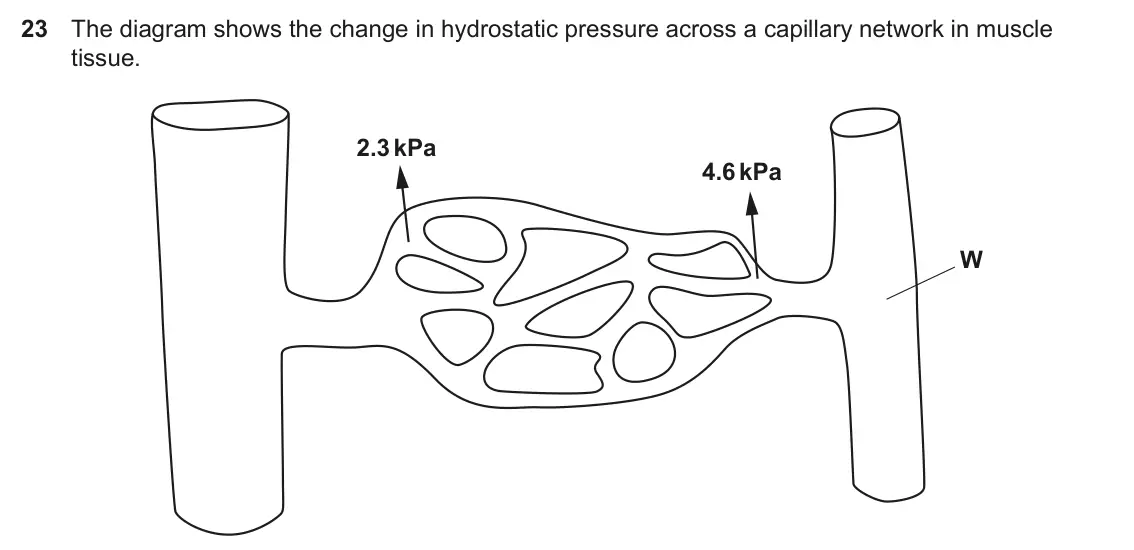
Q23(a)(ii)
The whole paper ↗Q23(a)(iii)
The whole paper ↗Q23(b)
The whole paper ↗Q21(a)(i)
The whole paper ↗
Q21(a)(ii)
The whole paper ↗
All 34 questions on Blood vessels and tissue fluid, as a list
- June 2025, Paper 1, Q20(a) (3 marks): The table compares features of different types of blood vessel in mammals. Blood vessel type Feature E F G H Diameter of lumen largest large small smallest Thic
- June 2025, Paper 1, Q20(b) (1 mark): Unlike most other veins, pulmonary veins do not have valves. Suggest why valves are not needed in pulmonary veins. [1]
- June 2024, Paper 1, Q6 (1 mark): Lymph and tissue fluid are both formed from the blood. Which statement describes the composition of these fluids? A Lymph contains more protein than tissue flui
- June 2024, Paper 1, Q18(c)(i) (2 marks): The net pressure at the arteriole end is +1.3 kPa. Calculate the net pressure at the venule end. Net pressure at venule end = kPa [2]
- June 2024, Paper 1, Q18(c)(ii) (2 marks): Use the information in the table to explain the formation of tissue fluid and its return to the blood. [2]
- June 2024, AS Paper 1, Q6 (1 mark): Which option is a feature of tissue fluid? A Tissue fluid carries oxygen away from muscle cells B Tissue fluid does not contain erythrocytes C Tissue fluid form
- June 2024, AS Paper 2, Q4(a)(i) (1 mark): Scientists can measure the size of an aneurysm. An investigation measured the ratio of collagen to elastin in the blood vessel wall in five patients with an ane
- June 2024, AS Paper 2, Q4(a)(ii) (3 marks): Students looked at data on aneurysms in different groups of people of the same age. The table shows their findings. Observed frequency of Expected frequency of
- June 2024, AS Paper 2, Q4(a)(iii) (2 marks): The table shows part of a statistical table for the chi squared test. Probability (%) 10 5 1 0.5 df 1 2.706 3.841 6.635 7.879 2 4.605 5.991 9.210 10.60 3 6.251
- June 2024, AS Paper 2, Q4(b)(i) (2 marks): Explain the role of valves in veins. [2]
- June 2024, AS Paper 2, Q4(b)(ii) (3 marks): The smooth muscle content in some arteriole walls is more than double the smooth muscle content in the walls of some arteries. Explain how arterioles are better
- June 2023, Paper 1, Q16(a)(iii) (3 marks): Fig. 16.2 shows how blood pressure varies throughout pregnancy. Fig. 16.2 92 90 88 Mean arterial 86 pressure 84 (mmHg) 82 80 78 9–12 13–16 17–20 21–24 25–28 29–
- June 2022, Paper 3, Q2(d)(i) (2 marks): State whether L is an artery or a vein and give two pieces of evidence from Fig. 2.2 that allow you to reach your decision. L Evidence 1 Evidence 2 [2]
- June 2022, Paper 3, Q2(d)(ii) (1 mark): State the substance labelled N. [1]
- June 2022, AS Paper 1, Q23(a)(i) (1 mark): On the diagram, draw an arrow to show the direction of movement of blood through the [1] capillary network.
- June 2022, AS Paper 1, Q23(a)(ii) (2 marks): On the diagram, draw an arrow to show the direction in which oncotic pressure is acting and suggest a value for oncotic pressure. Write the value for oncotic pr
- June 2022, AS Paper 1, Q23(a)(iii) (1 mark): Name the structure labelled W. [1]
- June 2022, AS Paper 1, Q23(b) (3 marks): Describe how oncotic pressure is established. [3]
- November 2021, Paper 1, Q21(a)(i) (1 mark): State the effect on the water potential of the blood if the concentration of glucose increases. [1]
- November 2021, Paper 1, Q21(a)(ii) (2 marks): Explain why the oncotic pressure of the blood depends only on the concentration of large plasma proteins. [2]
- November 2021, Paper 1, Q21(b)(i) (2 marks): In one type of capillary the reflectance factor was found to be 0.75. Use this information and the data in the table to calculate a value for the net driving fo
- November 2021, Paper 1, Q21(b)(ii) (2 marks): Nephrotic syndrome is a kidney disease where protein is excreted in the urine. One group of patients with nephrotic syndrome had a plasma albumin concentration
- November 2021, Paper 1, Q21(b)(iii) (4 marks): A medical student concluded that a patient with kidney disease and a plasma albumin concentration of 0.015 g dm–3 would show signs of swelling, such as swollen
- November 2021, Paper 1, Q21(c) (2 marks): The table below contains statements about the composition of lymph and tissue fluid. Place ticks (✓) in the boxes in the table to indicate whether the statement
- November 2021, AS Paper 1, Q2 (1 mark): Which of the options, A to D, would result in the formation of tissue fluid? A hydrostatic pressure 1 oncotic pressure B hydrostatic pressure = oncotic pressure
- November 2021, AS Paper 2, Q2(c) (6 marks): (c)* Three types of blood vessels found in mammals are arteries, veins and capillaries. Fig. 2.3 shows data on these blood vessels. Elastic layer 330 μm Artery
- November 2020, AS Paper 1, Q7 (1 mark): The table below shows the different percentages of three different components of blood vessels. elastin (%) smooth muscle (%) collagen (%) A 8 33 58 B 17 39 43
- June 2019, Paper 1, Q19(a) (3 marks): Explain why the visible blood vessels are likely to be veins. [3]
- June 2018, Paper 3, Q6(a) (6 marks): The process of ultrafiltration in the kidney shares similarities with the formation of tissue fluid. (a)* Describe the similarities and differences between ultr
- June 2018, AS Paper 2, Q4(a)(ii) (2 marks): Dissolved ions diffuse between blood plasma and tissue fluid. Pressure differences at the arterial and venous ends of capillaries are responsible for the format
- June 2017, AS Paper 1, Q9 (1 mark): Which of the options, A to D, is a correct statement about tissue fluid? A Tissue fluid carries carbon dioxide to muscle cells. B Oncotic pressure in the capill
- June 2017, AS Paper 1, Q17 (1 mark): A student studied the structure of a blood vessel and found: • an outer layer of collagen fibres, • a thick middle layer of smooth muscle and elastic tissue, •
- June 2016, AS Paper 1, Q12 (1 mark): Pressure varies in different parts of the mammalian circulatory system. Blood in Blood in Tissue fluid Lymph aorta vena cava Pressure Which of the following opt
- June 2016, AS Paper 1, Q24(c)(ii) (2 marks): With reference to the structure of blood vessels, explain why oxygen is not released until the blood reaches the capillaries. [2]
Questions, mark schemes and examiner’s reports are © OCR, from their published past papers. Plumi isn’t affiliated with any exam board. Want whole papers? OCR A-Level Biology A past papers, or our free OCR-style practice pack.
The Plumi iPad app also offers exam-style questions with AI feedback on your handwritten working.