 plumi
Genetic diagrams and the chi-squared test: OCR A‑Level Biology A questions
OCR A-Level Biology A past-paper questions on 6.1.2.2 Genetic diagrams and the chi-squared test, 2016–2025, with mark schemes and examiner’s reports where available.
Paper
All papers
Exam
All years
Calculations
Q17(b)(ii)
The whole paper ↗
Q20(a)(i)
The whole paper ↗
Q20(a)(ii)
The whole paper ↗- Your answer
Q3(c)
The whole paper ↗
Q19(a)(i)
The whole paper ↗
Q19(a)(ii)
The whole paper ↗Q19(b)(i)
The whole paper ↗Q19(b)(ii)
The whole paper ↗Q19(b)(iii)
The whole paper ↗Q19(c)
The whole paper ↗- Your answer
Q1(c)(i)
The whole paper ↗
Q1(c)(ii)
The whole paper ↗Q4(a)(ii)
The whole paper ↗
Q4(b)(i)
The whole paper ↗Q4(b)(ii)
The whole paper ↗Q17(a)(i)
The whole paper ↗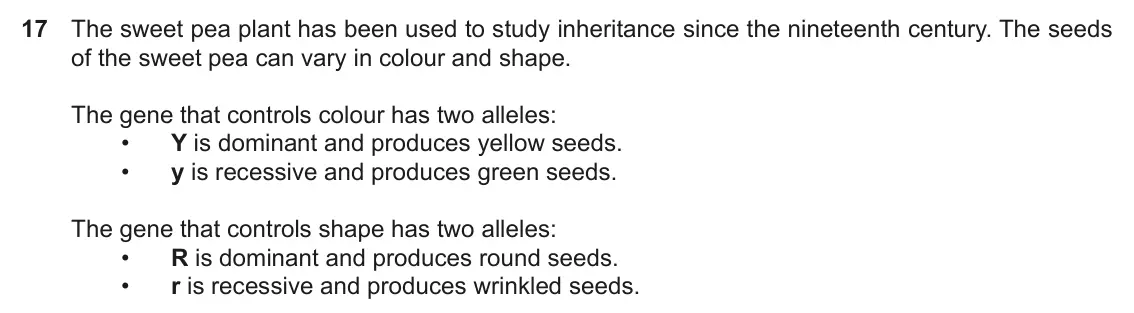
Q17(a)(ii)
The whole paper ↗Q17(b)(i)
The whole paper ↗
All 22 questions on Genetic diagrams and the chi-squared test, as a list
- June 2025, Paper 2, Q17(b)(ii) (1 mark): Suggest why female mammals cannot produce male offspring by parthenogenesis. [1]
- June 2025, Paper 2, Q20(a)(i) (3 marks): Sweet pea is another species of plant. • Sweet pea flower colour is coded for by a gene with two alleles: blue (B) and red (b). • Sweet pea pollen shape is code
- June 2025, Paper 2, Q20(a)(ii) (2 marks): Explain why epistasis affects the offspring ratio in a genetic cross. [2]
- June 2023, Paper 2, Q4 (1 mark): Scientists crossed two plants that were heterozygous for two different genes. Both plants had the same genotype, AaBb. The genotypes and ratios of the offspring
- June 2023, Paper 3, Q3(c) (4 marks): Two characteristics that farmers have selectively bred in maize are colour and kernel (fruit) shape. Colour is determined by a gene with two alleles: • Allele A
- November 2021, Paper 2, Q19(a)(i) (1 mark): The chromosomes used to determine sex inheritance are given different letters in birds and mammals. Identify one other way in which the sex determination in bir
- November 2021, Paper 2, Q19(a)(ii) (4 marks): A pigeon is a bird. The colour of pigeon feathers is determined by a single gene on the Z chromosome. The feather colour gene has three alleles. ZA = red ZB = b
- November 2021, Paper 2, Q19(b)(i) (2 marks): A student performed a chi squared calculation on the phenotypes of the actual nine children. Part of the calculation is shown in Table 19.1. (O–E)2 Observed Exp
- November 2021, Paper 2, Q19(b)(ii) (1 mark): Table 19.2 shows part of a statistical table for the chi squared test. 99 95 90 10 5.0 1.0 0.5 p% v = 1 .0001 .0039 .0158 2.706 3.841 6.635 7.879 2 .0201 0.103
- November 2021, Paper 2, Q19(b)(iii) (2 marks): The calculated value for χ2 was below the critical value. The student concluded that their expected ratio of 2 : 1 : 1 was incorrect and should be rejected. Eva
- November 2021, Paper 2, Q19(c) (2 marks): Hypophosphatemic rickets is a sex-linked condition. The diagram shows the occurrence of hypophosphatemic rickets in a single family. healthy male healthy female
- November 2020, Paper 2, Q7 (1 mark): Scientists self-pollinated some pea plants that were heterozygous for the gene controlling height. 7 They expected a 3:1 ratio of tall plants to short plants in
- June 2018, Paper 3, Q1(c)(i) (3 marks): Identify the following: The genotype of the white onion plant The genotype of the red onion plant The phenotype of the offspring [3]
- June 2018, Paper 3, Q1(c)(ii) (1 mark): State the type of gene interaction shown by the genes A/a and B/b. [1]
- June 2018, Paper 3, Q4(a)(ii) (4 marks): Fig. 4 shows the inheritance pattern of agammaglobulinemia in a family. Key 1 2 male with agammaglobulinemia female with agammaglobulinemia 3 6 4 5 healthy male
- June 2018, Paper 3, Q4(b)(i) (1 mark): Two carriers of Vici syndrome have six children. Calculate how many of the six children you would expect to: • have Vici syndrome • be carriers of Vici syndrome
- June 2018, Paper 3, Q4(b)(ii) (1 mark): A daughter of these parents and a male carrier of Vici syndrome have a child. Calculate the probability of the child having Vici syndrome. Answer = [1]
- June 2017, Paper 2, Q17(a)(i) (1 mark): List the gametes that would be produced by a sweet pea plant that was heterozygous for both seed colour and shape. [1]
- June 2017, Paper 2, Q17(a)(ii) (2 marks): List the genotypes of the offspring that were produced from Mendel’s cross and state the corresponding phenotypes. genotypes phenotypes [2]
- June 2017, Paper 2, Q17(b)(i) (3 marks): Use the chi-squared formula | = E You may use the table below for working out. |2 = [3] 14 Table 17 shows a |2 probability table. Degrees Probability (p) of 0.9
- June 2017, Paper 2, Q17(b)(ii) (3 marks): After analysing the results, the students stated that the inheritance of the seed colour and shape in their investigation was different from that in Mendel’s in
- June 2017, Paper 2, Q17(b)(iii) (3 marks): A ratio that is different from the expected 9 : 3 : 3 : 1, in a cross such as this, can be the result of epistasis. Suggest and explain one reason, other than e
Questions, mark schemes and examiner’s reports are © OCR, from their published past papers. Plumi isn’t affiliated with any exam board. Want whole papers? OCR A-Level Biology A past papers, or our free OCR-style practice pack.
The Plumi iPad app also offers exam-style questions with AI feedback on your handwritten working.