 plumi
Evolution and the Hardy–Weinberg principle: OCR A‑Level Biology A questions
OCR A-Level Biology A past-paper questions on 6.1.2.4 Evolution and the Hardy–Weinberg principle, 2016–2025, with mark schemes and examiner’s reports where available.
Paper
All papers
Exam
All years
Calculations
Q20(b)(i)
The whole paper ↗
Q20(b)(ii)
The whole paper ↗Q4(b)(i)
The whole paper ↗
Q5(c)
The whole paper ↗
Q20(a)(i)
The whole paper ↗
Q20(a)(ii)
The whole paper ↗Q20(a)(iii)
The whole paper ↗Q20(c)
The whole paper ↗Q18(b)(ii)
The whole paper ↗
Q18(b)(iii)
The whole paper ↗- Your answer
Q20(b)(ii)
The whole paper ↗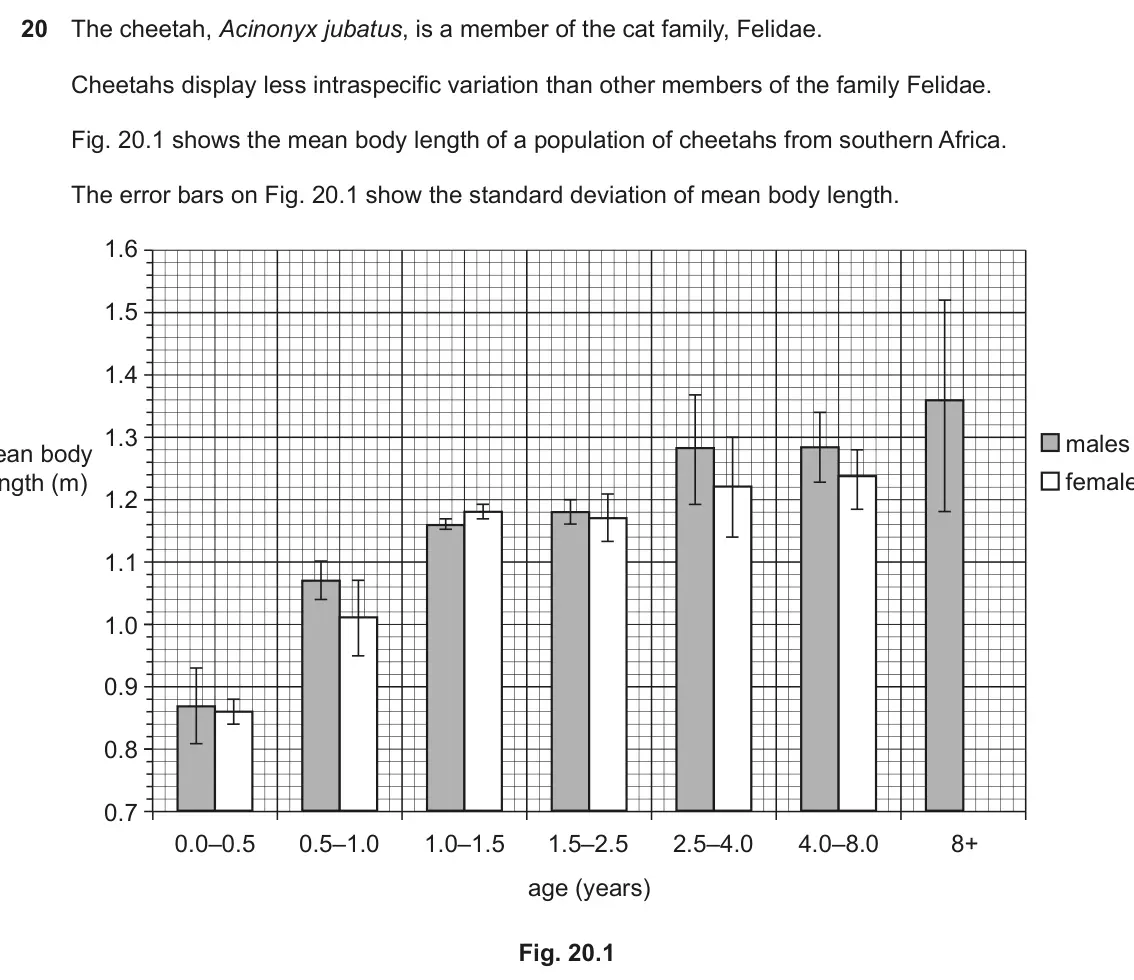
Q20(b)(iii)
The whole paper ↗Q3(b)
The whole paper ↗
All 14 questions on Evolution and the Hardy–Weinberg principle, as a list
- June 2025, Paper 2, Q20(b)(i) (3 marks): Use the Hardy–Weinberg principle to calculate the number of heterozygous individuals in the greenhouse. Use the equations: p + q = 1 p2 + 2pq + q2 = 1 Number of
- June 2025, Paper 2, Q20(b)(ii) (1 mark): Estimates made by using the Hardy–Weinberg principle can be inaccurate. Use the information above to suggest one reason why the answer calculated in part (b)(i)
- June 2023, Paper 3, Q4(b)(i) (1 mark): State the term for a large decrease in population size that reduces the gene pool. [1]
- June 2022, Paper 3, Q5(c) (2 marks): The Hardy-Weinberg principle can be used to calculate allele and genotype frequencies in populations. The common morning glory plant, Ipomoea purpurea, has a ra
- November 2021, Paper 2, Q20(a)(i) (1 mark): Identify the modal beak size of G. fuliginosa. Size = arbitrary units [1]
- November 2021, Paper 2, Q20(a)(ii) (2 marks): Calculate the range of G. fuliginosa beak size as a proportion of the range of G. fortis beak size. Give your answer to 2 significant figures. Proportion = [2]
- November 2021, Paper 2, Q20(a)(iii) (3 marks): The scientists concluded that the data showed evidence of disruptive selection in the population of G. fortis. In disruptive selection, extreme phenotypes are s
- November 2021, Paper 2, Q20(c) (6 marks): Charles Darwin visited the Galapagos Islands in the 1820s. The organisms living on the Galapagos Islands provided Darwin with evidence that helped him to develo
- November 2020, Paper 2, Q18(b)(ii) (3 marks): Since 1940, people have believed that the ability to roll the tongue is caused by a single gene with two alleles. R is dominant and allows tongue-rolling. r is
- November 2020, Paper 2, Q18(b)(iii) (2 marks): Individuals within populations vary. Much of this variation is under genetic control. The Hardy-Weinberg principle might not give an accurate estimate of the pr
- June 2019, Paper 2, Q13 (1 mark): The ability to roll one’s tongue is under the control of a single gene. The gene has two alleles R and r. People who can roll their tongues can have the genotyp
- June 2018, Paper 2, Q20(b)(ii) (2 marks): It is thought that the modern cheetah population has low genetic diversity because the population, relatively recently, experienced a genetic bottleneck. Explai
- June 2018, Paper 2, Q20(b)(iii) (2 marks): Scientists are concerned about genetic drift in the remaining cheetah populations. Explain why genetic drift is likely to be of particular concern in the popula
- June 2017, Paper 3, Q3(b) (3 marks): One subspecies of tiger is the Bengal tiger. One in 10 000 Bengal tiger births results in a white Bengal tiger. White Bengal tigers (shown in Fig. 3.1b on the i
Questions, mark schemes and examiner’s reports are © OCR, from their published past papers. Plumi isn’t affiliated with any exam board. Want whole papers? OCR A-Level Biology A past papers, or our free OCR-style practice pack.
The Plumi iPad app also offers exam-style questions with AI feedback on your handwritten working.