 plumi
Cloning in plants: OCR A‑Level Biology A questions
OCR A-Level Biology A past-paper questions on 6.2.1.1 Cloning in plants, 2016–2025, with mark schemes and examiner’s reports where available.
Paper
All papers
Exam
All years
Calculations
- Your answer
- Your answer
Q6(a)
The whole paper ↗
Q6(c)(i)
The whole paper ↗Q6(c)(ii)
The whole paper ↗Q16(c)
The whole paper ↗
Q3(a)
The whole paper ↗Q21(a)
The whole paper ↗
Q21(b)
The whole paper ↗Q21(c)
The whole paper ↗Q21(d)(i)
The whole paper ↗Q21(d)(ii)
The whole paper ↗Q20(a)(i)
The whole paper ↗
Q20(a)(ii)
The whole paper ↗Q20(b)
The whole paper ↗Q3(c)
The whole paper ↗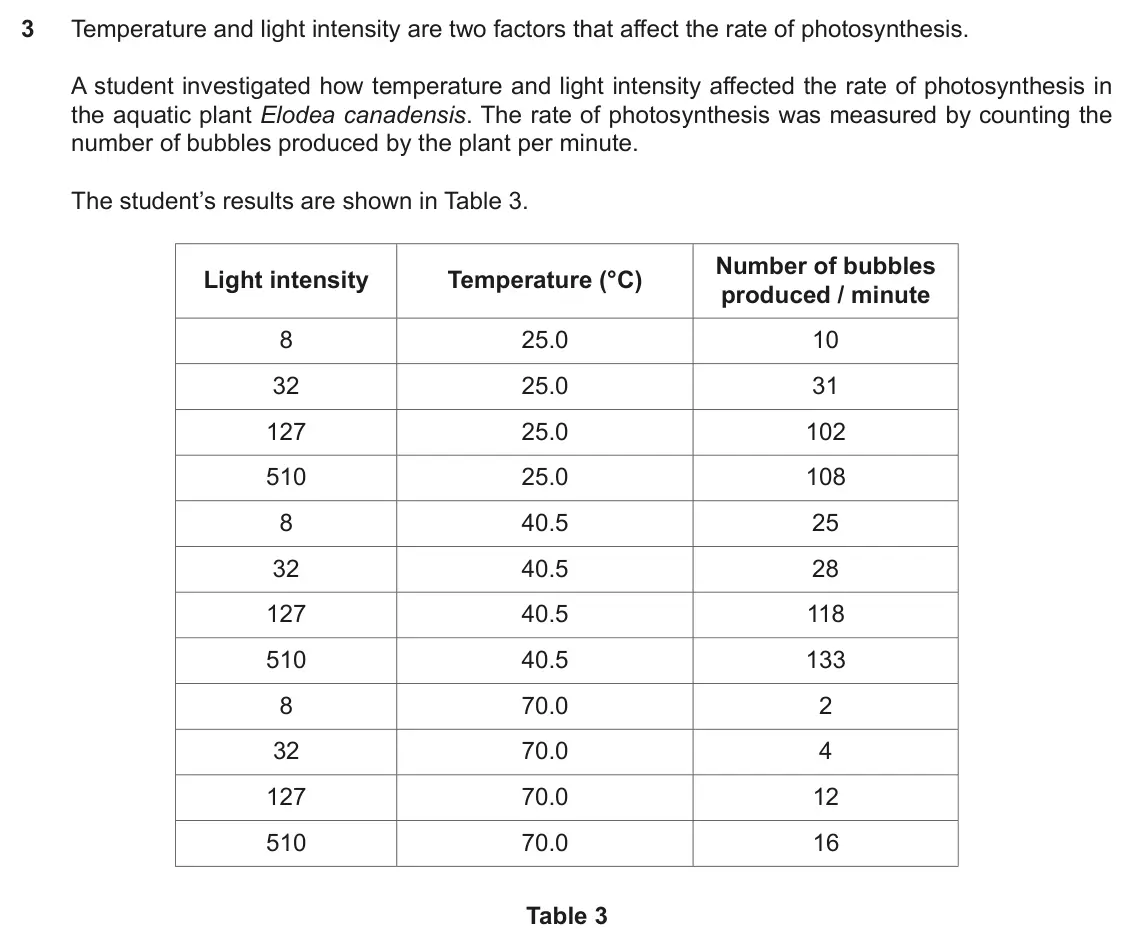
Q18(b)(i)
The whole paper ↗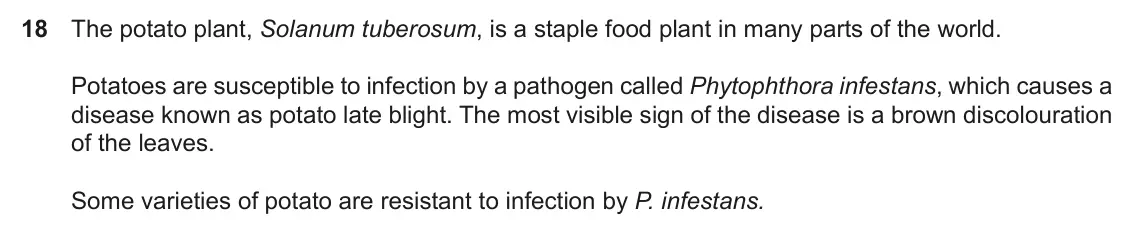
Q18(b)(ii)
The whole paper ↗
All 18 questions on Cloning in plants, as a list
- June 2025, Paper 2, Q8 (1 mark): Plants can be cloned by taking cuttings. New cuttings often experience water stress during the first few weeks. Which of these practical procedures are used to
- June 2024, Paper 2, Q10 (1 mark): Plants can be cloned artificially by taking cuttings. Which of the following are important steps when cloning a plant by taking a cutting? 1 Keep it regularly w
- June 2024, Paper 3, Q6(a) (4 marks): Describe how artificial clones of plants are produced using micropropagation. [4]
- June 2024, Paper 3, Q6(c)(i) (2 marks): State the name of structure X and outline how a gardener could produce many cloned plants from structure X. [2]
- June 2024, Paper 3, Q6(c)(ii) (2 marks): State the name of structure Y and describe the process by which a new plant can form naturally from structure Y. [2]
- June 2023, Paper 2, Q16(c) (6 marks): Many organisms undergo asexual reproduction by mitosis. (c)* Asexual reproduction is also known as cloning. Many organisms can be artificially cloned for commer
- June 2022, Paper 3, Q3(a) (3 marks): A student wrote a method for taking a cutting to clone a plant: • Select a stem with many flowers and leaves. • Make a slanting cut in the stem, below some leav
- November 2021, Paper 2, Q21(a) (1 mark): Strawberry plants produce clones using runners. This is an example of natural cloning. State one other method of natural cloning in plants. [1]
- November 2021, Paper 2, Q21(b) (1 mark): Name the type of plant tissue from which natural clones are produced. [1]
- November 2021, Paper 2, Q21(c) (2 marks): Tissue culture greatly increases the number of cloned plants that can be produced from a single parent plant. Outline how it is possible to produce many clones
- November 2021, Paper 2, Q21(d)(i) (2 marks): Calculate the percentage increase in mean shoot length caused by adding 5 mg dm–3 BAP. Give your answer to 2 significant figures. Percentage increase = % [2]
- November 2021, Paper 2, Q21(d)(ii) (3 marks): The valid investigation that generated the results shown above featured an independent variable, a dependent variable and several controlled variables. State th
- June 2019, Paper 2, Q20(a)(i) (4 marks): Describe how to clone a plant by taking a cutting. [4]
- June 2019, Paper 2, Q20(a)(ii) (6 marks): Plant cloning is often used by farmers to produce new plants. A plant that is often cloned by taking cuttings is lavender, Lavandula angustifolia. (ii)* The far
- June 2019, Paper 2, Q20(b) (3 marks): Cloning plants is also known as vegetative propagation. Identify three advantages of vegetative propagation in agriculture. 1 2 3 [3]
- June 2018, Paper 3, Q3(c) (4 marks): Scientists are able to clone desirable plants that show a high rate of photosynthesis. The following passage describes how plants are cloned. Complete the passa
- June 2017, Paper 2, Q18(b)(i) (2 marks): Suggest why it is important to use clones in an investigation such as this. [2]
- June 2017, Paper 2, Q18(b)(ii) (2 marks): State how a clone of potatoes could be produced for this investigation and explain why it is important to carry out this procedure under aseptic conditions. pro
Questions, mark schemes and examiner’s reports are © OCR, from their published past papers. Plumi isn’t affiliated with any exam board. Want whole papers? OCR A-Level Biology A past papers, or our free OCR-style practice pack.
The Plumi iPad app also offers exam-style questions with AI feedback on your handwritten working.