 plumi
Classification and evolution: OCR A‑Level Biology A questions
Every OCR A-Level Biology A exam question on 4.2.2 Classification and evolution, 2016–2025, with its mark scheme and examiner’s report.
Find questions1,984
Calculations

Q19(b)(iii)
The whole paper ↗
Q19(c)
The whole paper ↗
Q21(a)
The whole paper ↗
Q21(b)
The whole paper ↗
Q21(c)(i)
The whole paper ↗
Q21(c)(ii)
The whole paper ↗
Q4(a)(i)
The whole paper ↗
Q4(a)(ii)
The whole paper ↗
Q4(b)
The whole paper ↗
Q4(c)
The whole paper ↗
Q4(d)
The whole paper ↗
Q4(e)
The whole paper ↗
Q5(a)(i)
The whole paper ↗
Q5(a)(ii)
The whole paper ↗
Q18(a)(i)
The whole paper ↗
Q18(a)(ii)
The whole paper ↗
Q18(a)(iii)
The whole paper ↗
Q18(a)(iv)
The whole paper ↗
All 97 questions on Classification and evolution, as a list
- June 2025, Paper 2, Q7 (1 mark): The image shows an organism called Euglena gracilis. Contractile vacuole Flagellum Chloroplast Nucleus Which kingdom does Euglena belong to? A Animalia B Planta
- June 2025, Paper 2, Q19(b)(iii) (2 marks): Explain why the existence of a predator can improve the long-term survival of a species such as the puffin. [2]
- June 2025, Paper 2, Q19(c) (6 marks): The Farne Islands are a group of small islands off the coast of Northern England. The Farne Islands are a National Nature Reserve and Site of Special Scientific
- June 2025, Paper 2, Q21(a) (2 marks): Explain why the evolution of antibiotic resistance has implications for human populations. [2]
- June 2025, Paper 2, Q21(b) (2 marks): Explain how antibiotic resistance in bacteria provides evidence for the theory of evolution by natural selection. [2]
- June 2025, Paper 2, Q21(c)(i) (5 marks): Complete the sentences using the most appropriate terms. Mutations in DNA are random, so the more time that has passed the more mutations will have occurred. Th
- June 2025, Paper 2, Q21(c)(ii) (3 marks): Explain how fossils can be used to support the theory of evolution by natural selection. [3]
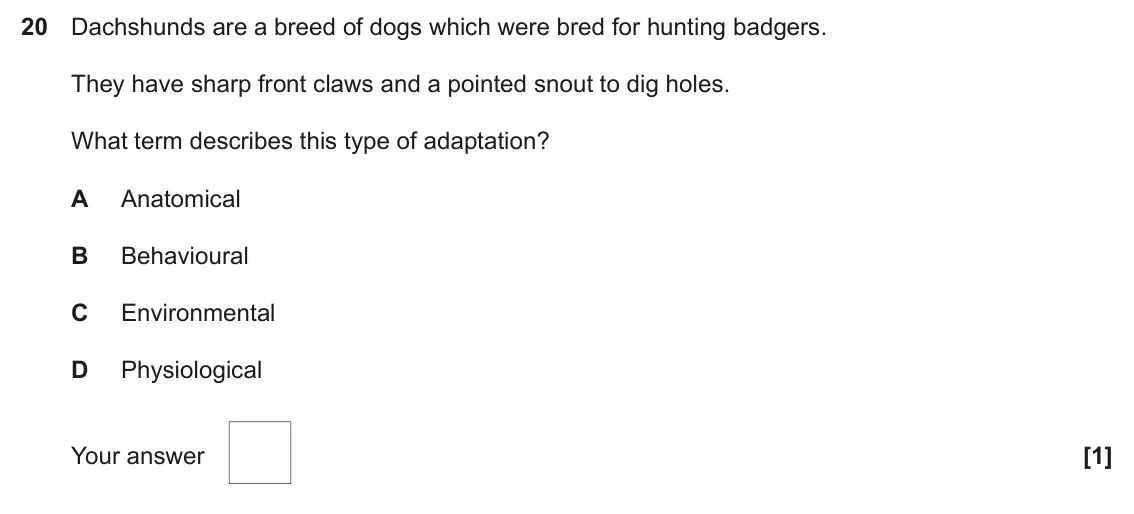
- June 2025, AS Paper 1, Q20 (1 mark): Dachshunds are a breed of dogs which were bred for hunting badgers. They have sharp front claws and a pointed snout to dig holes. What term describes this type
- June 2025, AS Paper 2, Q4(a)(i) (1 mark): The European dust mite is an insect with the binomial name Dermatophagoides pteronyssinus. State one advantage of the binomial naming system. [1]
- June 2025, AS Paper 2, Q4(a)(ii) (2 marks): Complete the table with the names of the taxa for the European dust mite. Taxa Name Kingdom Genus Species [2]
- June 2025, AS Paper 2, Q4(b) (2 marks): Organisms were originally classified into five kingdoms. State two general features of organisms classified in the Plantae kingdom that are not features of orga
- June 2025, AS Paper 2, Q4(c) (1 mark): State the relationship between classification and phylogeny. [1]
- June 2025, AS Paper 2, Q4(d) (2 marks): State two differences between the five kingdom and three domain classification systems. 1 2 [2]
- June 2025, AS Paper 2, Q4(e) (6 marks): (e)* Darwin observed birds called finches on the Galapagos Islands. All the different species of finches evolved from one species of finch that arrived from mai
- June 2025, AS Paper 2, Q5(a)(i) (1 mark): Using the axes, sketch the shape of the graph you would expect the student to find. Number of clownfish 0 6 7 8 9 10 11 12 Length (cm) [1]
- June 2025, AS Paper 2, Q5(a)(ii) (1 mark): Individuals in a population show variation. Name two causes of variation. Cause 1 Cause 2 [1]
- June 2024, Paper 2, Q18(a)(i) (1 mark): Name the classification taxon represented by the column headed A. [1]
- June 2024, Paper 2, Q18(a)(ii) (3 marks): Using the information in the table, describe the evolutionary and genetic relationships between the species that are listed. [3]
- June 2024, Paper 2, Q18(a)(iii) (2 marks): Explain why it is difficult to decide which of the other species would be the most appropriate to use as a source of DNA for constructing a thylacine genome. [2
- June 2024, Paper 2, Q18(a)(iv) (1 mark): All the species in the table belong to the animal kingdom. Other than the presence or absence of vacuoles, state two features of the cells of these multicellula
- June 2024, AS Paper 1, Q20 (1 mark): Bats are mammals that hunt insects while flying. Dolphins are mammals that hunt fish while swimming. Some bats and all dolphins use a technique known as echoloc
- June 2023, Paper 2, Q14 (1 mark): Organisms are named using the binomial system. What is the correct way to represent the binomial name for domestic dogs? A Canis familiaris B Canis familiaris C
- June 2023, Paper 3, Q4(b)(ii) (2 marks): Adaptations can be categorised into three different types: • anatomical • behavioural • physiological. The table lists four traits that kakapos have evolved. Co
- June 2023, Paper 3, Q7(a) (3 marks): The table shows a comparison of some features of the three domains. Feature Archaea Bacteria Eukarya Type of DNA polymerase SFB and SFD SFA and SFC SFB Type of
- June 2023, AS Paper 1, Q5 (1 mark): The giraffe is a species of mammal with the species name ‘camelopardalis’ and the genus name ‘Giraffa’. What is the correct format for the binomial name of the
- June 2023, AS Paper 1, Q6 (1 mark): Which kingdom contains species that are heterotrophic and composed of hyphae? A Fungi B Plantae C Prokaryotae D Protoctista Your answer [1]
- June 2023, AS Paper 1, Q24(a) (2 marks): Diatoms are single-celled organisms that have glass-like cell walls, which can be preserved as fossils. The graph shows the fossil record for two species of dia
- June 2023, AS Paper 1, Q24(b) (3 marks): A student analyses the estimated ages of 16 species of diatom. The estimated ages show how long ago the species evolved from an ancestor. The student compares e
- June 2023, AS Paper 1, Q24(c) (3 marks): Diatoms are members of the domain Eukarya. Complete the sentences about domains using the most appropriate terms. The process of sorting of organisms into taxon
- June 2022, Paper 2, Q14 (1 mark): Evolutionary relationships can be determined by comparing certain biological molecules between species. Which option is commonly used to determine evolutionary
- June 2022, Paper 2, Q19(a)(i) (5 marks): In the space provided, plot the results from the table as a suitable graph. [5]
- June 2022, Paper 2, Q19(a)(ii) (2 marks): Variation can be caused by genetic and environmental factors. Explain why your graph shows that at least some of the variation in body length in Atlantic cod is
- June 2022, AS Paper 2, Q6(a)(i) (1 mark): With reference to Fig. 6.1, suggest a purpose for the adaptation of attaching and stacking the old exoskeleton heads. [1]
- June 2022, AS Paper 2, Q6(a)(ii) (1 mark): Name the genus of the gum-leaf skeletoniser moth. [1]
- June 2022, AS Paper 2, Q6(a)(iii) (1 mark): The table shows some taxonomic descriptions for the gum-leaf skeletoniser moth. They are not in the correct hierarchical sequence. Complete the table to show th
- June 2022, AS Paper 2, Q6(b) (4 marks): The peppered moth, Biston betularia, has two forms, a pale form and a dark form, both shown in Fig. 6.2. Pale form Dark form Fig. 6.2 Predators of the peppered
- June 2022, AS Paper 2, Q6(c) (2 marks): Fig. 6.3 shows two types of mole and some information about each type. Placental mole family Talpidae Found in: North America, Asia and Europe Habitat: Lives in
- November 2021, Paper 2, Q12 (1 mark): Brassica rapa is a plant that occurs in wild-type and dwarf varieties. A student investigated the growth of B. rapa. Seeds of both varieties were planted and th
- November 2021, Paper 2, Q16(d) (3 marks): DNA sequencing has allowed scientists to create a strain of Escherichia coli bacteria with an entirely artificial genome. Complete the passage using the most ap
- November 2021, Paper 2, Q20(b)(iii) (2 marks): Comparing anatomy between species such as beak size in finches can be used to provide evidence to support the theory of evolution by natural selection. Describe
- November 2021, Paper 2, Q20(d) (2 marks): Alfred Russel Wallace is another important figure in the understanding of evolution. Outline the way in which Wallace contributed to the acceptance of Darwin’s
- November 2021, Paper 3, Q3(e) (1 mark): Many crop plants are eaten by herbivorous insects. Humans use insecticides to reduce the consumption of crop plants by insects. Explain why an insecticide might
- November 2021, AS Paper 1, Q16 (1 mark): The harlequin ladybird, Harmonia axyridis, has many different distinct forms, two of which can be seen below. Which of the terms, A to D, best describes this ty
- November 2021, AS Paper 1, Q24(a)(ii) (1 mark): Staphylococcus aureus is the binomial name for a species of bacterium. State one advantage of referring to Staphylococcus aureus in this way. [1]
- November 2021, AS Paper 2, Q4(b) (2 marks): The malarial pathogen, Plasmodium, is a protoctist. State two features of organisms that belong to the Kingdom Protoctista. 1 2 [2]
- November 2020, Paper 2, Q8 (1 mark): Polar bears, Ursus maritimus, and giant pandas, Ailuropoda melanoleuca, both belong to the family Ursidae. Which of the following, A to D, is not true about the
- November 2020, Paper 2, Q21(b)(i) (4 marks): At various times, algae have been classified in different kingdoms. Using the information given above, draw a conclusion about which kingdom is the most appropr
- November 2020, Paper 2, Q21(b)(ii) (1 mark): Suggest one piece of evidence not given above that could be used to provide strong support for the classification of algae in a particular kingdom. [1]
- November 2020, AS Paper 1, Q6 (1 mark): Antifreeze proteins are a group of globular proteins that prevent ice crystal formation in living cells. These proteins are found in four different kingdoms and
- November 2020, AS Paper 1, Q20 (1 mark): There are four different human blood groups: A, B, AB and O. This is because there are three different alleles coding for different proteins in red blood cells.
- November 2020, AS Paper 1, Q26(a)(i) (1 mark): Name the genus of the protoctist in the table. [1]
- November 2020, AS Paper 1, Q26(a)(ii) (2 marks): Use the information in the table to determine the kingdom and cell wall molecule for S. tuberosum and C. pallens. Write your answers in the table below. species
- November 2020, AS Paper 1, Q26(b) (2 marks): Explain how a specific molecule is used to show that two different species have evolved from a recent common ancestor. [2]
- June 2019, Paper 2, Q7 (1 mark): The adult wandering albatross, Diomedea exulans, has wingspans that range from 2.5 m to 3.5 m. Which of the following describes the variation in wingspan of the
- June 2019, Paper 3, Q2(c)(i) (1 mark): Describe the relationship between body mass and lifespan shown in Fig. 2.3. [1]
- June 2019, Paper 3, Q2(c)(ii) (1 mark): What conclusion can you draw from Fig. 2.3 about the lifespan of naked mole rats in comparison to other mammals? [1]
- June 2019, Paper 3, Q3(a) (1 mark): Adaptations can be grouped into three general categories. Which category of adaptation is represented by cold-tolerant molecules? [1]
- June 2019, AS Paper 1, Q14 (1 mark): Which of the following statements, A to D, could explain the data shown for 1999–2000? A the malarial parasite had developed resistance to insecticides B the ve
- June 2019, AS Paper 1, Q16 (1 mark): The two histograms represent the frequency distribution for the two different types of variation. Q R number of number of organisms organisms characteristic cha
- June 2019, AS Paper 1, Q17 (1 mark): Some of the taxonomic groups for the beach sunflower, Helianthus debilis, are shown in the table below. Kingdom Plantae Phylum Magnoliophyta W Magnoliopsida Ord
- June 2019, AS Paper 2, Q3(a)(i) (1 mark): Name the genus of the Scottish wildcat. [1]
- June 2019, AS Paper 2, Q3(a)(ii) (2 marks): The information above states that ‘the isolated population of wildcats in the British Isles developed slightly different characteristics from the mainland popul
- June 2019, AS Paper 2, Q3(a)(iii) (2 marks): Suggest why the Scottish wildcat and the European wildcat cannot yet be classified as different species. [2]
- June 2018, Paper 2, Q7 (1 mark): Which of the following statements about antibiotic resistance is correct? A All antibiotics cause mutations in bacterial DNA. B Antibiotic resistance in bacteri
- June 2018, Paper 2, Q20(a)(i) (2 marks): At between 2.5 and 4 years old, the mean length of female cheetahs is less than that of males. Calculate how much shorter than males female cheetahs are. Show y
- June 2018, Paper 2, Q20(a)(ii) (2 marks): Using only Fig. 20.1 and your answer to (i), what can be concluded about the significance of the difference between the length of male and female cheetahs aged
- June 2018, Paper 2, Q20(a)(iii) (1 mark): A student looked at Fig. 20.1 and wrote: “The longest male cheetah that was measured was 1.52 m long”. Explain whether the information in Fig. 20.1 supports the
- June 2018, Paper 2, Q20(a)(iv) (2 marks): State the likely causes of variation in body length in cheetahs. [2]
- June 2018, Paper 2, Q20(c)(i) (1 mark): The mongoose is a smaller mammal and also has proportionally longer fur. State one other difference, visible in Fig. 20.2, between a fossa and a mongoose. [1]
- June 2018, Paper 2, Q22(c) (1 mark): Bacteria that are able to digest and metabolise the hydrocarbons in crude oil are more common in areas, such as around the coast of Alaska and the Gulf of Mexic
- June 2018, Paper 3, Q5(a)(i) (1 mark): Place a tick (3) in the box next to the species most closely related to Pinus glabra. Diplodia pinea Ilex glabra Pinus resinosa Annona glabra [1]
- June 2018, Paper 3, Q5(a)(ii) (2 marks): Explain why Pinus glabra and humans, Homo sapiens, are classified in the same domain but in different kingdoms. [2]
- June 2018, AS Paper 1, Q21(a) (1 mark): Name the genus of the Titicaca water frog. [1]
- June 2018, AS Paper 1, Q25(a) (1 mark): State the pattern of variation shown by leaf hair density. [1]
- June 2018, AS Paper 1, Q25(b) (3 marks): Leaf hair density can be measured in the laboratory. Outline a practical method that could be used to determine the density of hairs on the underside of a leaf.
- June 2018, AS Paper 1, Q25(c)(i) (2 marks): Complete Table 25 by calculating the difference between the ranks and then squaring the difference. [2] [Answer on Table 25]
- June 2018, AS Paper 1, Q25(c)(ii) (2 marks): Use the formula below to calculate Spearman’s rank correlation coefficient for this data. 2 6 d R r 1 = - s 2 n n ( 1 ) - [2]
- June 2018, AS Paper 1, Q25(d)(i) (2 marks): Suggest reasons for this positive correlation. [2]
- June 2018, AS Paper 1, Q25(e) (2 marks): Another group of students repeated this investigation and calculated rs = 0.589. The critical value of rs at the 5% level for 9 degrees of freedom is 0.600. The
- June 2017, Paper 2, Q15 (1 mark): The image below shows a European badger, Meles meles, which is a member of the family Mustelidae. The American badger belongs to a different genus within the sa
- June 2017, Paper 2, Q19(a) (2 marks): Humans and chimpanzees are currently classified within the same family. Chimpanzees were once classified separately from humans in the Family Pongidae along wit
- June 2017, Paper 2, Q19(b)(i) (2 marks): Calculate the rate of DNA change using the data in Fig. 19.3. Give your answer to three significant figures. Answer % per million years [2]
- June 2017, Paper 2, Q19(b)(ii) (2 marks): The mutation rate in mammals can vary by as much as 20% between species. Use Fig. 19.3 to calculate the time since the phylogeny of humans diverged from chimpan
- June 2017, Paper 2, Q19(b)(iii) (6 marks): Two species of chimpanzees, the chimpanzee and the bonobo, are the closest living relatives of humans. Fig. 19.1 is a diagram representing the current classific
- June 2017, Paper 3, Q3(a)(i) (1 mark): Adaptations can be divided into three types. State the type of adaptation represented by the tiger’s stripes. [1]
- June 2017, Paper 3, Q3(a)(ii) (6 marks): Tigers, Panthera tigris, are predatory mammals. They have evolved striped patterns on their fur (as shown in Fig. 3.1a on the insert), which provide camouflage
- June 2017, AS Paper 1, Q15 (1 mark): Biologists use both phylogeny and classification to understand how different species are related. Which of the options, A to D, is a statement about phylogeny?
- June 2017, AS Paper 1, Q24(a)(i) (1 mark): Name the cell component that appears in organisms of all three domains that Woese suggested. [1]
- June 2017, AS Paper 1, Q24(a)(ii) (2 marks): One of the domains he suggested is called Eukarya. Name the other two domains. 1 2 [2]
- June 2017, AS Paper 1, Q24(a)(iii) (2 marks): State two defining features of all members of the domain Eukarya. [2]
- June 2017, AS Paper 1, Q24(b) (2 marks): Woese carried out a detailed study of RNA molecules in order to draw his conclusions. Suggest two ways in which the scientific community are likely to have vali
- June 2016, AS Paper 1, Q10 (1 mark): Which of the following options, A to D, lists the three domains of life? A Archaea, Bacteria and Eukaryota B Bacteria, Prokaryota and Eukaryota C Prokaryotae, P
- June 2016, AS Paper 1, Q23(a) (2 marks): Complete the table below, showing the classification of the Sumatran rhinoceros. Kingdom Phylum Chordata Mammalia Perissodactyla Family Rhinocerotidae Dicerorhi
- June 2016, AS Paper 1, Q23(b) (1 mark): The name Dicerorhinus sumatrensis is part of the binomial naming system. State an advantage of using this system rather than using the common name, Sumatran rhi
- June 2016, AS Paper 2, Q4(a)(i) (1 mark): To which genus does this fungus belong? [1]
- June 2016, AS Paper 2, Q6(a)(i) (1 mark): A student made the following suggestion: I think that the colonies on the agar containing penicillin that survived and grew did so because those bacteria evolve
- June 2016, AS Paper 2, Q6(a)(ii) (1 mark): Name the process that increases the proportion of penicillin-resistant bacteria in the population. [1]
Questions, mark schemes and examiner’s reports are © OCR, from their published past papers. Plumi isn’t affiliated with any exam board. Want whole papers? Every OCR A-Level Biology A paper, or our free OCR-style practice pack.
Rather write your answers by hand on iPad? Plumi marks them against the same mark schemes.