 plumi
Biodiversity: OCR A‑Level Biology A questions
Every OCR A-Level Biology A exam question on 4.2.1 Biodiversity, 2016–2025, with its mark scheme and examiner’s report.
Find questions1,984
Calculations
Q17(d)(i)
The whole paper ↗
Q18(a)(i)
The whole paper ↗
Q18(a)(ii)
The whole paper ↗
Q18(b)(i)
The whole paper ↗
Q18(b)(ii)
The whole paper ↗
Q18(c)(i)
The whole paper ↗
Q18(c)(ii)
The whole paper ↗
Q18(c)(iii)
The whole paper ↗
Q18(c)(iv)
The whole paper ↗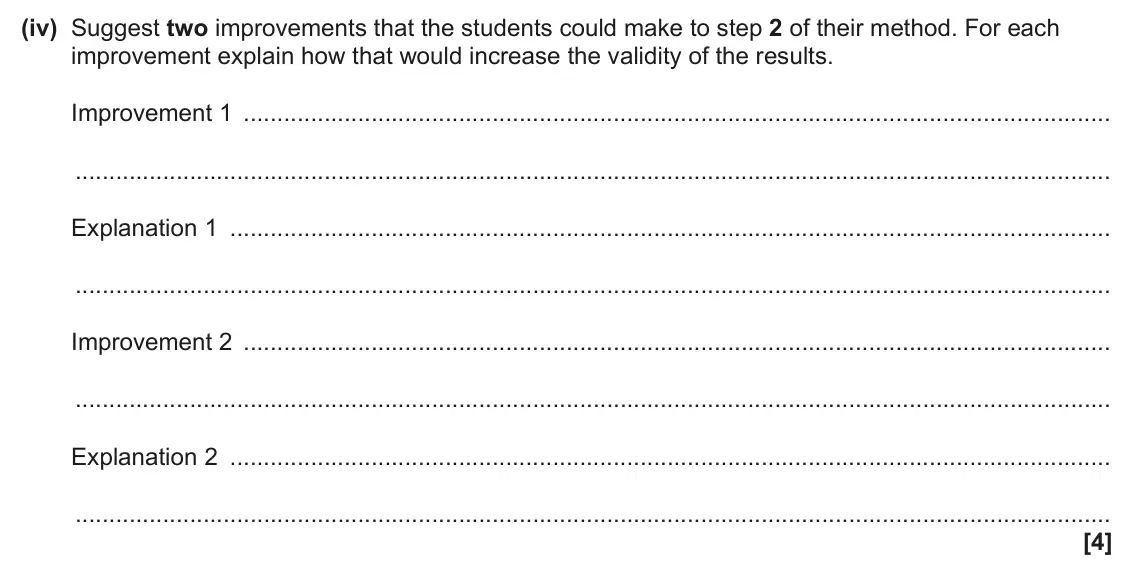
Q18(c)(v)
The whole paper ↗
Q18(c)(vi)
The whole paper ↗
Q19(a)(i)
The whole paper ↗
Q19(a)(iv)
The whole paper ↗
Q19(b)(i)
The whole paper ↗

Q25(b)
The whole paper ↗
Q18(c)(i)
The whole paper ↗
Q18(c)(ii)
The whole paper ↗
Q2(a)
The whole paper ↗
All 111 questions on Biodiversity, as a list
- June 2025, Paper 2, Q17(d)(i) (2 marks): Outline how genetic diversity in a species such as Przewalski’s horse can be measured. [2]
- June 2025, Paper 2, Q18(a)(i) (1 mark): State why sampling is necessary when measuring the abundance of organisms in a habitat. [1]
- June 2025, Paper 2, Q18(a)(ii) (2 marks): Explain why it is important that sampling is random. [2]
- June 2025, Paper 2, Q18(b)(i) (1 mark): State the species richness in quadrat A. [1]
- June 2025, Paper 2, Q18(b)(ii) (1 mark): Compare the species evenness in quadrats A and B. [1]
- June 2025, Paper 2, Q18(c)(i) (3 marks): Calculate the Simpson’s Index of Diversity for the wildflower meadow. f n p 2 n d - R Use the formula: D 1 = N You may use the table above for working out. Give
- June 2025, Paper 2, Q18(c)(ii) (2 marks): Explain the significance of the value for D calculated in part (i). [2]
- June 2025, Paper 2, Q18(c)(iii) (2 marks): Describe how the students should select their sampling areas for steps 1 and 6. [2]
- June 2025, Paper 2, Q18(c)(iv) (4 marks): Suggest two improvements that the students could make to step 2 of their method. For each improvement explain how that would increase the validity of the result
- June 2025, Paper 2, Q18(c)(v) (2 marks): Suggest and explain one limitation with step 7 of the students’ method. [2]
- June 2025, Paper 2, Q18(c)(vi) (1 mark): Identify one problem with the way in which the students categorised their flying insect species that could reduce confidence in the calculated value for Simpson
- June 2025, Paper 2, Q19(a)(i) (3 marks): Identify evidence from the information above that supports each of the following claims: Puffins are important for aesthetic reasons Puffins are important for e
- June 2025, Paper 2, Q19(a)(iv) (1 mark): There are two types of conservation: in situ and ex situ. State the type of conservation taking place on the Farne Islands and give a reason for your choice. Ty
- June 2025, Paper 2, Q19(b)(i) (1 mark): It is important not to disturb the burrows and there is not enough money avai
- June 2025, AS Paper 1, Q18 (1 mark): Scientists studied the genetic diversity of four different wolf populations in a national park in Canada. The data are shown in the table. Population Number of
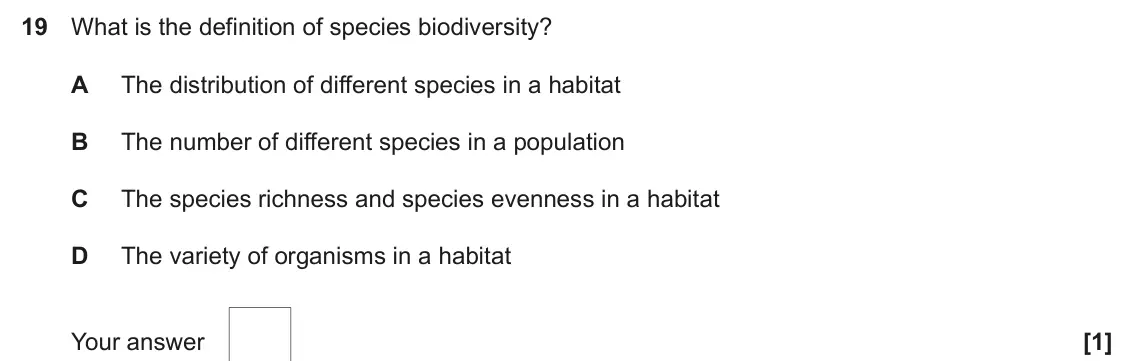
- June 2025, AS Paper 1, Q19 (1 mark): What is the definition of species biodiversity? A The distribution of different species in a habitat B The number of different species in a population C The spe
- June 2025, AS Paper 1, Q25(b) (1 mark): Name an international agreement that might use data about the changing numbers of the Asian elephant to monitor its conservation status. [1]
- June 2024, Paper 2, Q18(c)(i) (2 marks): Describe the evidence in the table that supports the conclusion that low genetic diversity contributed to the extinction of the thylacine. [2]
- June 2024, Paper 2, Q18(c)(ii) (1 mark): Identify one piece of evidence that does not support the conclusion that low genetic diversity contributed to the extinction of the thylacine. [1]
- June 2024, Paper 3, Q2(a) (4 marks): A student plans to sample the plant species in the area shown below to assess the area’s species biodiversity. Grassland River Grassland with shrubs and bushes
- June 2024, Paper 3, Q2(b)(i) (2 marks): Outline the differences between the bird and mammal results shown in the graph. [2]
- June 2024, Paper 3, Q2(b)(ii) (4 marks): A student looking at the graph concluded that ‘climate change is not a major threat to species biodiversity’. Evaluate this conclusion. [4]
- June 2024, AS Paper 1, Q17 (1 mark): Which statement describes species evenness? A The number of different species B The number of organisms in a community C The number of organisms of a particular
- June 2024, AS Paper 1, Q18 (1 mark): Students carried out fieldwork in two different woodlands. They marked out an area measuring 10 m by 10 m in each woodland. For each plant species present they
- June 2024, AS Paper 1, Q19 (1 mark): In situ and ex situ conservation methods maintain biodiversity. Which example describes an ex situ conservation method? A Collecting and storing seeds of clover
- June 2024, AS Paper 1, Q26(a) (3 marks): Explain how agriculture can have a negative effect on biodiversity. [3]
- June 2024, AS Paper 1, Q26(b) (1 mark): State one factor other than agriculture that can have a negative effect on biodiversity. [1]
- June 2024, AS Paper 2, Q1(a)(i) (1 mark): Name the type of sampling method used in a transect line. [1]
- June 2024, AS Paper 2, Q1(a)(ii) (3 marks): This table shows their findings. Number of (n / N)2 Species organisms n / N (n) Foxglove 3 0.13 0.02 Meadow buttercup 7 Oxeye daisy 9 Yellow rattle 4 ∑(n / N)2
- June 2024, AS Paper 2, Q1(a)(iii) (1 mark): State what can be concluded about the diversity of the field from your answer in (a)(ii). [1]
- June 2024, AS Paper 2, Q1(b) (1 mark): The students then used a sweep net to sample animals in two different parts of a river. They did this by holding the sweep net in the water and at the same time
- June 2024, AS Paper 2, Q1(c) (1 mark): Black oak trees are an example of a keystone species within an oak woodland ecosystem in England. Suggest what would happen to the ecosystem if the black oak tr
- June 2023, Paper 3, Q4(a) (6 marks): The Convention on International Trade in Endangered Species (CITES) came into effect in 1975. (a)* Fig. 4.1 shows the percentage of species threatened with exti
- June 2023, Paper 3, Q4(b)(iv) (2 marks): New Zealand has a high species biodiversity compared to many countries. Species biodiversity includes the concepts of species richness and species evenness. Exp
- June 2023, AS Paper 1, Q3 (1 mark): Simpson’s Index of Diversity (D) can be used to estimate the biodiversity of a habitat. D = 1 – (∑( N) 2) n Scientists calculated D for a grassland habitat. One
- June 2023, AS Paper 1, Q4 (1 mark): What is an example of in situ conservation? A A botanical garden B A breeding programme in a zoo C A marine conservation zone D A seed bank Your answer [1]
- June 2023, AS Paper 2, Q4(a) (2 marks): The Humboldt penguin is protected by the Convention on International Trade in Endangered Species (CITES). • The Humboldt penguin lives on the Pacific coast of S
- June 2023, AS Paper 2, Q4(b) (3 marks): A study was carried out to monitor the population of three penguin species on an island near Antarctica. The graph shows the results of this study. 1600 Key: Ad
- June 2022, Paper 2, Q7 (1 mark): On a biology field trip, a student calculated that an area of ancient woodland had a Simpson’s Index of Diversity of 0.85. Which interpretation of a Simpson’s I
- June 2022, Paper 2, Q18(a)(i) (2 marks): Calculate the rate of change in wildebeest population between 1975 and 2007. Rate = animals per year [2]
- June 2022, Paper 2, Q18(a)(ii) (6 marks): The Maasai Mara is a grassland ecosystem in east Africa with a large range of wildlife. The human population in the area is increasing. An increasing human popu
- June 2022, Paper 2, Q18(b) (3 marks): Maintaining biodiversity in the Maasai Mara is important. The following are some statements about biodiversity in the Maasai Mara: A People visit the Maasai Mar
- June 2022, Paper 2, Q20(b)(i) (3 marks): Calculate the Simpson’s Index of Diversity (D) for the students’ data. n 2 f d n p Use the formula: D = 1 – / N D = [3]
- June 2022, Paper 2, Q20(b)(ii) (2 marks): The students found grass species difficult to distinguish from one another so they decided to record any grass species as ‘grass’. Explain how the students’ dec
- June 2022, Paper 3, Q5(b) (2 marks): DNA analysis can be used to assess genetic biodiversity within populations. A scientist assessed genetic biodiversity in four populations, A to D, of yellow hor
- June 2022, AS Paper 1, Q3 (1 mark): The table shows the numbers of different species of invertebrates found in four different areas in a woodland. Invertebrate species Area Woodlice Spiders Beetle
- June 2022, AS Paper 1, Q8 (1 mark): International trade in parts of the rhinoceros including rhino horn has been illegal since 1977. Which organisation regulates this trade? A CBD B CITES C CSS D
- June 2022, AS Paper 1, Q22(a) (2 marks): Name and define two other levels of biodiversity. Name Definition Name Definition [2]
- June 2022, AS Paper 1, Q22(b)(i) (2 marks): Calculate the proportion of polymorphic gene loci in the European zoo population. Proportion = [2]
- June 2022, AS Paper 1, Q22(b)(ii) (2 marks): A second group of scientists carried out a separate investigation to calculate the proportion of polymorphic gene loci of cheetahs in European zoos and found th
- June 2022, AS Paper 1, Q22(b)(iii) (3 marks): Suggest and explain reasons why, in the 21st Century, only 10% of the gene loci are polymorphic in wild populations of cheetah. [3]
- November 2021, Paper 2, Q13 (1 mark): Moving North from a large solitary tree in the school field, some students studied changes in plant species. They laid a tape measure due North from the base of
- November 2021, Paper 2, Q14 (1 mark): Which of the following best defines the term species richness? A the distribution of species over an area B the number of species in an area C the relative abun
- November 2021, Paper 2, Q15 (1 mark): Biodiversity can be considered at different levels. An area of woodland habitat has a high Simpson’s Index of Diversity. Which of the following describes an are
- November 2021, Paper 2, Q17(c)(i) (1 mark): State why the management of heather moorland is known as in situ conservation. [1]
- November 2021, AS Paper 1, Q1 (1 mark): Which of the options, A to D, describes the role of CITES? A making conservation a part of normal farming practices B restricting the trade in individuals of en
- November 2021, AS Paper 1, Q6 (1 mark): To determine the biodiversity of butterflies in a meadow, the number of different species of butterfly were sampled in a meadow on 12 consecutive days. The resu
- November 2021, AS Paper 2, Q5(a)(i) (3 marks): Explain how a pitfall trap can be set up and used to sample invertebrate biodiversity. [3]
- November 2021, AS Paper 2, Q5(a)(ii) (3 marks): The results for Area A are shown in the table below. 2 ⎛⎞ n n n = Number of Species organisms ⎝⎠ N N Common woodlouse 9 Black sexton beetle 6 Spotted wolf spide
- November 2021, AS Paper 2, Q5(a)(iii) (1 mark): The students found the Simpson’s Index of Diversity for Area B to be 0.84. Compare the stability of the community living in Area B with that of the community li
- November 2021, AS Paper 2, Q5(b)(i) (2 marks): Suggest two improvements you could make to these instructions. Improvement 1 Improvement 2 [2]
- November 2021, AS Paper 2, Q5(b)(ii) (4 marks): Results of the four most abundant species from the study are shown in the graph below. 80 Key: 70 heather crowberry 60 bracken 50 cotton grass Percentage 40 cov
- November 2021, AS Paper 2, Q5(c) (4 marks): Many birds found in moorland habitats, including the lapwing and curlew, are ‘red listed’ as species of high conservation concern. It is for this reason that ma
- November 2020, Paper 2, Q18(a)(i) (2 marks): Calculate the proportion of genetic polymorphic gene loci of species B. 12] proportion =
- November 2020, Paper 2, Q18(a)(ii) (3 marks): Evaluate the conclusion that species B shows greater genetic polymorphism than species A. .. [3]
- November 2020, Paper 3, Q5(a) (3 marks): The ecologists sampled the area to estimate insect biodiversity. Describe how the ecologists should choose the number and locations of their samples to ensure t
- November 2020, Paper 3, Q5(b)(i) (2 marks): Calculate the population sizes of the two insect species using each of the formulae below. Write your answers in the table. population size = n1 × n2 Lincoln es
- November 2020, Paper 3, Q5(b)(ii) (2 marks): The Lincoln and Chapman formulae give different estimates for population size. Give two further conclusions about the difference in population estimates given b
- November 2020, Paper 3, Q5(d) (2 marks): Conservation agreements can be national (within a particular country) or international. Three conservation agreements are listed in the table below. Place ticks
- November 2020, AS Paper 1, Q5 (1 mark): The image below shows Dawlish Warren, which is a conservation area in the UK. Which of the following is an aesthetic reason for maintaining biodiversity in Dawl
- November 2020, AS Paper 1, Q13 (1 mark): A student is investigating species richness of plants along a sand dune from the sea edge moving inland. They are testing the hypothesis that ‘species richness
- June 2019, Paper 2, Q1 (1 mark): Which of the following is most likely to increase biodiversity? A captive breeding programmes B climate change C human population growth D monoculture Your answ
- June 2019, Paper 2, Q18(c)(i) (3 marks): The students calculated the Simpson’s Index of Diversity (D) for the mature area to be 0.489. Use the information in Table 18 to work out the Simpson’s Index of
- June 2019, Paper 2, Q18(c)(ii) (3 marks): Use the example of the students’ fieldwork to explain how biodiversity can be considered at different levels. [3] for the next question
- June 2019, AS Paper 1, Q15 (1 mark): The sea marigold, Calendula maritima, is a rare species that is critically endangered and has been included in an ex situ conservation project. Which of the fol
- June 2019, AS Paper 2, Q3(b)(i) (1 mark): Suggest one reason why the wildcat was hunted. [1]
- June 2019, AS Paper 2, Q3(b)(ii) (6 marks): (ii)* Current estimates of the Scottish wildcat population vary. Recent reports by the Scottish Wildcat Association indicate that fewer than 100 individuals, po
- June 2019, AS Paper 2, Q3(c)(i) (1 mark): An example of ex-situ conservation. [1]
- June 2019, AS Paper 2, Q3(c)(ii) (1 mark): Helps to prevent the domestic and wild cats mixing freely with the Scottish wildcats in the haven. [1]
- June 2019, AS Paper 2, Q3(c)(iii) (1 mark): Contributes to maintaining a healthy population in the wildcat haven. [1]
- June 2019, AS Paper 2, Q3(c)(iv) (1 mark): Contributes to maintaining the genetic purity of the Scottish wildcat. [1]
- June 2018, Paper 2, Q12 (1 mark): Turtle doves, Streptopelia turtur, were once common in farmland in the UK but their numbers have recently been in decline. Farmers can claim money from the UK g
- June 2018, Paper 2, Q17(b)(i) (3 marks): Discuss whether the information in Fig. 17 supports the scientists’ claim. You should refer to the data in Fig. 17 in your answer. [3]
- June 2018, Paper 2, Q17(b)(ii) (2 marks): Scientists working in the local area monitored water temperatures and populations of other water animals around the island between 1976 and 2010. Suggest two fu
- June 2018, Paper 2, Q20(b)(i) (1 mark): State one way in which genetic diversity can be measured. [1]
- June 2018, Paper 2, Q22(d) (2 marks): Listed below are three approaches, A, B and C, that can be taken to maintain biodiversity: A ex situ conservation B in situ conservation C preservation For each
- June 2018, Paper 3, Q5(b) (2 marks): A scientist sampled the species of trees present in two different habitats containing Pinus glabra. The results of the sampling are shown in Table 5. Number of
- June 2018, Paper 3, Q5(c)(ii) (3 marks): Suggest how the scientist could achieve the following during their investigation: Sample all stages of succession in the habitat Minimise sampling bias Sample i
- June 2018, AS Paper 1, Q15 (1 mark): The Millennium Seed Bank has over two billion seeds in storage. Which of the options, A to D, describes the type of conservation carried out at the Millennium S
- June 2018, AS Paper 1, Q25(d)(ii) (3 marks): For this investigation, the students randomly selected leaves from ten downy birch trees at varying distances from the river. Suggest three ways in which the st
- June 2018, AS Paper 2, Q5(a)(i) (1 mark): Give one aim of CITES. [1]
- June 2018, AS Paper 2, Q5(a)(ii) (2 marks): Between 1913 and 2013 the approximate worldwide population of living elephants dropped from 10 000 000 to 500 000. Calculate how many orders of magnitude smalle
- June 2018, AS Paper 2, Q5(b) (2 marks): Fig. 5 shows the approximate percentages of elephants that were killed illegally in three different regions of Africa. Eastern Africa 100 80 number of 60 illega
- June 2018, AS Paper 2, Q6(a)(i) (3 marks): Calculate the Simpson’s Index of Diversity for Upper End Meadow. Use the information in Table 6 and the formula: 2 n D = 1 − ∑ N n = number of organisms of this
- June 2018, AS Paper 2, Q6(a)(ii) (1 mark): Name a piece of equipment that you could use for the random sampling of the plants shown in Table 6. [1]
- June 2018, AS Paper 2, Q6(c) (1 mark): The students found 50 animals in a soil sample collected from Upper End Meadow and identified them as follows: • 2 click beetles • 24 leatherjackets • 23 meadow
- June 2017, Paper 2, Q6 (1 mark): Which of the statements, A to D, best defines the term species evenness? A the number of species in an area B the relative abundance of each species in an area
- June 2017, AS Paper 1, Q4 (1 mark): The genetic diversity of a population can be estimated using the following formula: proportion of polymorphic gene loci = number of polymorphic gene loci total
- June 2017, AS Paper 1, Q13 (1 mark): Tropical rainforests have a very high biodiversity of plant species. Which of the statements, A to D, is an economic benefit of high biodiversity? A High plant
- June 2017, AS Paper 2, Q5(a)(i) (2 marks): Calculate the total percentage decrease in the number of butterflies on farmland between 1992 and 2012. Show your working. Give your answer to the nearest whole
- June 2017, AS Paper 2, Q5(a)(ii) (2 marks): Using the data given in Fig. 5, compare the changes in the number of butterflies on farmland and on woodland between 1992 and 2012. [2]
- June 2017, AS Paper 2, Q5(a)(iii) (1 mark): Both habitats experienced the same weather conditions. Suggest a reason for the difference in the rates of decline in butterfly numbers in woodland and farmland
- June 2017, AS Paper 2, Q5(a)(iv) (2 marks): A student made the following statement: ‘These data show that the change in butterfly numbers was caused by changes in weather conditions in England.’ Comment o
- June 2017, AS Paper 2, Q5(a)(v) (1 mark): State one variable that scientists should control when carrying out surveys such as this. [1]
- June 2017, AS Paper 2, Q5(b) (2 marks): Butterfly species in severe decline on farmland include gatekeeper, large skipper, small copper, wall brown, small tortoiseshell and white-letter hairstreak. Bu
- June 2017, AS Paper 2, Q5(c)(i) (1 mark): What is the term given to this type of biodiversity? [1]
- June 2017, AS Paper 2, Q5(c)(ii) (1 mark): Give one possible benefit to the species of this type of biodiversity. [1]
- June 2016, AS Paper 1, Q9 (1 mark): Two different fields, field G and H, were sampled for three common species of wildflower. The results are shown below. Number of individuals Species Field G Fie
- June 2016, AS Paper 1, Q23(c)(i) (2 marks): Suggest two reasons why this species is critically endangered in the wild. [2]
- June 2016, AS Paper 1, Q23(c)(ii) (2 marks): The remaining populations of D. sumatrensis are all small and are scattered in isolated areas. These are factors that might speed up the extinction of the speci
- June 2016, AS Paper 1, Q23(c)(iii) (1 mark): Captive breeding programmes with D. sumatrensis have been unsuccessful. Suggest one other way in which zoos can contribute to the conservation of the Sumatran r
Questions, mark schemes and examiner’s reports are © OCR, from their published past papers. Plumi isn’t affiliated with any exam board. Want whole papers? Every OCR A-Level Biology A paper, or our free OCR-style practice pack.
Rather write your answers by hand on iPad? Plumi marks them against the same mark schemes.