Skip to content
Try on iPad

Style

Get started

Representation of numbers: Eduqas GCSE Computer Science questions

Eduqas GCSE Computer Science past-paper questions on 4.2 Representation of numbers, 2018–2025, with mark schemes and examiner’s reports where available.

Getting your paper ready…

Eduqas GCSE Computer ScienceRepresentation of numbers312 questions

Paper
All papers
Exam
All years
Calculations
Difficulty
More filters
Exam boards
Eduqas

Loading the full question list…

312 questions

More options
  1. Q6(a)(i)June 2025 · Component 11 markWarm-up

    4.2 Representation of numbers

    1
    Original question 6(a)(i): The smallest denary value that can be represented by a single digit hexadecimal number. [1]

    Loading the question…

    The whole paper ↗
  2. Q6(a)(ii)June 2025 · Component 12 marksCore

    4.2 Representation of numbers

    2
    Original question 6(a)(ii): The largest unsigned binary value that can be stored in a 4-bit register. Convert the value into denary. [2]

    Loading the question…

    The whole paper ↗
  3. Q6(b)June 2025 · Component 12 marksCore

    4.2 Representation of numbers

    3
    Original question 6(b): Carry out binary addition on the following 8-bit binary numbers: • 01101010 • 10000111 [2]

    Loading the question…

    The whole paper ↗
  4. Q6(c)June 2025 · Component 13 marksStretch

    4.2 Representation of numbers

    4
    Original question 6(c): Demonstrate how an arithmetic shift right is carried out on the following 4-bit binary number. Describe the impact of the shift. [3] 0001

    Loading the question…

    The whole paper ↗
  5. Q7(a)(i)June 2024 · Component 11 markWarm-up

    4.2 Representation of numbers

    5
    Original question 7(a)(i): 7. (a) Convert the following numbers into hexadecimal. (i) 18310 [1]

    Loading the question…

    The whole paper ↗
  6. Q7(a)(ii)June 2024 · Component 11 markWarm-up

    4.2 Representation of numbers

    6
    Original question 7(a)(ii): (ii) 010010112 [1]

    Loading the question…

    The whole paper ↗
  7. Q7(b)June 2024 · Component 14 marksChallenge

    4.2 Representation of numbers

    7
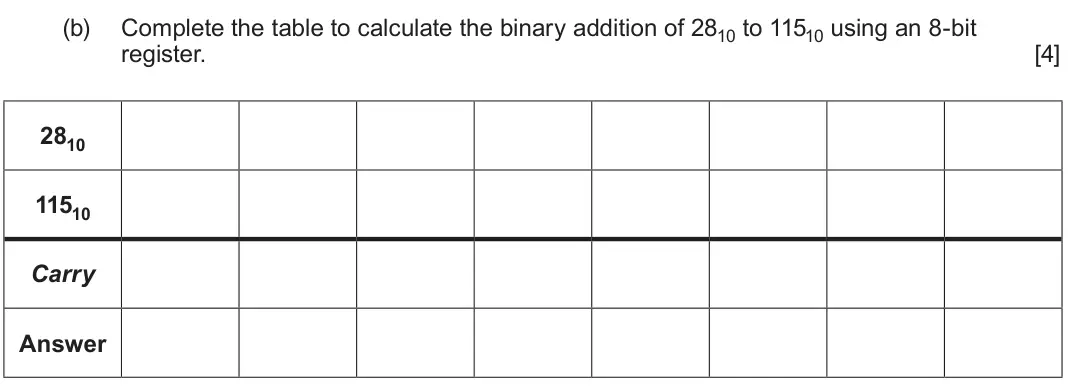
    Original question 7(b): Complete the table to calculate the binary addition of 2810 to 11510 using an 8-bit register. [4] 2810 11510 Carry Answer

    Loading the question…

    The whole paper ↗
  8. Q7(c)June 2024 · Component 13 marksStretch

    4.2 Representation of numbers

    8
    Original question 7(c): Using a suitable binary addition example, demonstrate the concept of overflow. [3]

    Loading the question…

    The whole paper ↗
  9. Q6(a)June 2023 · Component 13 marksStretch

    4.2 Representation of numbers

    9
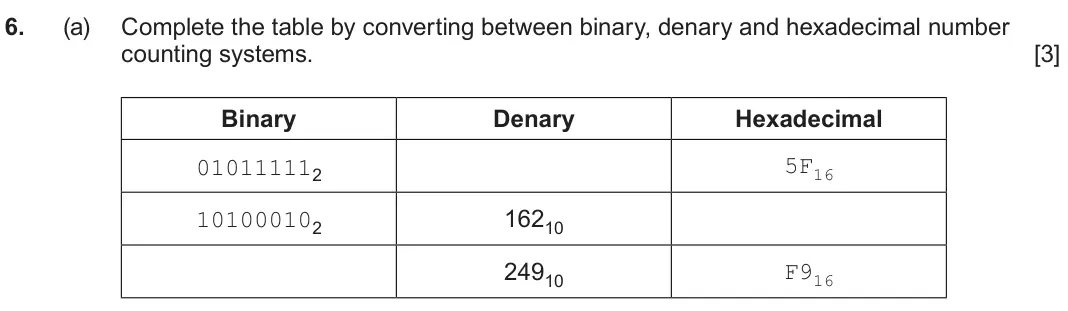
    Original question 6(a): Complete the table by converting between binary, denary and hexadecimal number counting systems. [3] Binary Denary Hexadecimal 010111112 5F16 101000102 16210 24

    Loading the question…

    The whole paper ↗
  10. Q6(b)(i)June 2023 · Component 14 marksChallenge

    4.2 Representation of numbers

    10
    Original question 6(b)(i): Show how 1710 would be subtracted from 5610 using two’s complementation. [4]

    Loading the question…

    The whole paper ↗
  11. Q6(b)(ii)June 2023 · Component 12 marksCore

    4.2 Representation of numbers

    11
    Original question 6(b)(ii): Describe what would happen if the answer to Question 6.(b)(i) was attempted to be stored in a 5-bit register. [2]

    Loading the question…

    The whole paper ↗
  12. Q5(a)(i)June 2022 · Component 11 markWarm-up

    4.2 Representation of numbers

    12
    Original question 5(a)(i): occurs when the execution of a set of instructions returns a value larger than its range. [1]

    Loading the question…

    The whole paper ↗
  13. Q5(a)(ii)June 2022 · Component 11 markWarm-up

    4.2 Representation of numbers

    13
    Original question 5(a)(ii): is the condition in a computer program where the result of a calculation is smaller than the computer can actually represent in memory. [1]

    Loading the question…

    The whole paper ↗
  14. Q5(b)June 2022 · Component 13 marksStretch

    4.2 Representation of numbers

    14
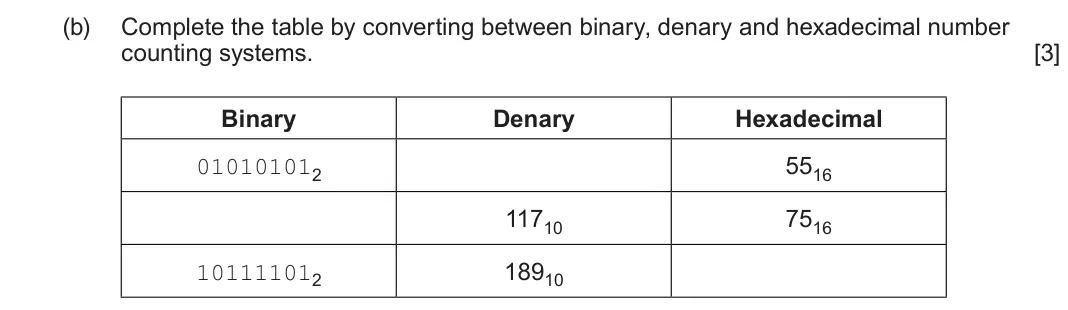
    Original question 5(b): Complete the table by converting between binary, denary and hexadecimal number counting systems. [3] Binary Denary Hexadecimal 010101012 5516 11710 7516 1011110

    Loading the question…

    The whole paper ↗
  15. Q5(c)June 2022 · Component 14 marksChallenge

    4.2 Representation of numbers

    15
    Original question 5(c): Show how 910 would be subtracted from 2110 using two’s complementation, binary addition and a 5-bit register. [4]

    Loading the question…

    The whole paper ↗
  16. Q5(d)(i)June 2022 · Component 11 markWarm-up

    4.2 Representation of numbers

    16
    Original question 5(d)(i): Shift the following binary number right 2 places. [1] 010001002

    Loading the question…

    The whole paper ↗
  17. Q5(d)(ii)June 2022 · Component 12 marksCore

    4.2 Representation of numbers

    17
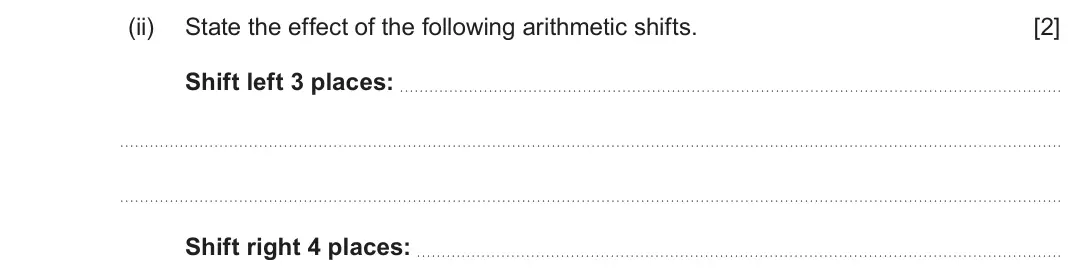
    Original question 5(d)(ii): State the effect of the following arithmetic shifts. [2] ​ Shift left 3 places: ​ Shift right 4 places:

    Loading the question…

    The whole paper ↗
  18. Q5(a)(i)Autumn 2020 · Component 12 marksCore

    4.2 Representation of numbers

    18
    Original question 5(a)(i): Convert 01101011010111012 into hexadecimal. [2]

    Loading the question…

    The whole paper ↗
  19. Q5(a)(ii)Autumn 2020 · Component 12 marksCore

    4.2 Representation of numbers

    19
    Original question 5(a)(ii): Convert BE16 into denary. [2]

    Loading the question…

    The whole paper ↗
  20. Q5(b)(i)Autumn 2020 · Component 12 marksCore

    4.2 Representation of numbers

    20
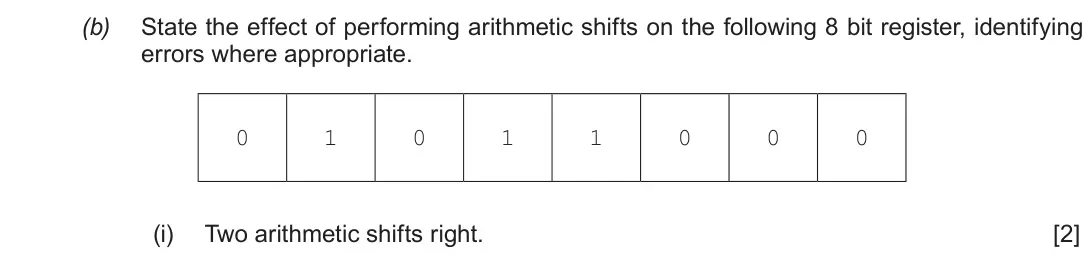
    Original question 5(b)(i): Two arithmetic shifts right. [2]

    Loading the question…

    The whole paper ↗
All 30 questions on Representation of numbers, as a list
  1. June 2025, Component 1, Q6(a)(i) (1 mark): The smallest denary value that can be represented by a single digit hexadecimal number. [1]
  2. June 2025, Component 1, Q6(a)(ii) (2 marks): The largest unsigned binary value that can be stored in a 4-bit register. Convert the value into denary. [2]
  3. June 2025, Component 1, Q6(b) (2 marks): Carry out binary addition on the following 8-bit binary numbers: • 01101010 • 10000111 [2]
  4. June 2025, Component 1, Q6(c) (3 marks): Demonstrate how an arithmetic shift right is carried out on the following 4-bit binary number. Describe the impact of the shift. [3] 0001
  5. June 2024, Component 1, Q7(a)(i) (1 mark): 7. (a) Convert the following numbers into hexadecimal. (i) 18310 [1]
  6. June 2024, Component 1, Q7(a)(ii) (1 mark): (ii) 010010112 [1]
  7. June 2024, Component 1, Q7(b) (4 marks): Complete the table to calculate the binary addition of 2810 to 11510 using an 8-bit register. [4] 2810 11510 Carry Answer
  8. June 2024, Component 1, Q7(c) (3 marks): Using a suitable binary addition example, demonstrate the concept of overflow. [3]
  9. June 2023, Component 1, Q6(a) (3 marks): Complete the table by converting between binary, denary and hexadecimal number counting systems. [3] Binary Denary Hexadecimal 010111112 5F16 101000102 16210 24
  10. June 2023, Component 1, Q6(b)(i) (4 marks): Show how 1710 would be subtracted from 5610 using two’s complementation. [4]
  11. June 2023, Component 1, Q6(b)(ii) (2 marks): Describe what would happen if the answer to Question 6.(b)(i) was attempted to be stored in a 5-bit register. [2]
  12. June 2022, Component 1, Q5(a)(i) (1 mark): occurs when the execution of a set of instructions returns a value larger than its range. [1]
  13. June 2022, Component 1, Q5(a)(ii) (1 mark): is the condition in a computer program where the result of a calculation is smaller than the computer can actually represent in memory. [1]
  14. June 2022, Component 1, Q5(b) (3 marks): Complete the table by converting between binary, denary and hexadecimal number counting systems. [3] Binary Denary Hexadecimal 010101012 5516 11710 7516 1011110
  15. June 2022, Component 1, Q5(c) (4 marks): Show how 910 would be subtracted from 2110 using two’s complementation, binary addition and a 5-bit register. [4]
  16. June 2022, Component 1, Q5(d)(i) (1 mark): Shift the following binary number right 2 places. [1] 010001002
  17. June 2022, Component 1, Q5(d)(ii) (2 marks): State the effect of the following arithmetic shifts. [2] ​ Shift left 3 places: ​ Shift right 4 places:
  18. Autumn 2020, Component 1, Q5(a)(i) (2 marks): Convert 01101011010111012 into hexadecimal. [2]
  19. Autumn 2020, Component 1, Q5(a)(ii) (2 marks): Convert BE16 into denary. [2]
  20. Autumn 2020, Component 1, Q5(b)(i) (2 marks): Two arithmetic shifts right. [2]
  21. Autumn 2020, Component 1, Q5(b)(ii) (2 marks): Two arithmetic shifts left. [2]
  22. June 2019, Component 1, Q7(a)(i) (1 mark): Convert the denary number 11210 to an 8 bit binary number. [1]
  23. June 2019, Component 1, Q7(a)(ii) (1 mark): Convert the binary number 010110112 to a denary number. [1]
  24. June 2019, Component 1, Q7(b)(i) (2 marks): Convert the denary number 8710 to hexadecimal, showing your workings. [2]
  25. June 2019, Component 1, Q7(b)(ii) (2 marks): Explain why hexadecimal notation is used. [2]
  26. June 2019, Component 1, Q7(c) (3 marks): Two 8 bit binary numbers, 110100102 and 111111002, are added and the answer is stored in an 8 bit register. Show how this will produce an error and give the nam
  27. June 2018, Component 1, Q3(c) (2 marks): Bit patterns can be used to represent the different states of an embedded system. These bits can be manipulated by several different operations. Perform an arit
  28. June 2018, Component 1, Q8(a) (3 marks): Complete the table below, converting between denary, binary and hexadecimal numbers. [3] Denary Binary Hexadecimal 4110 001010012 2916 5810 3A16 101011112 AF16
  29. June 2018, Component 1, Q8(b) (3 marks): Complete the table to calculate the binary addition of 1410 to 6710 using an 8-bit register. [3] 6710 1410 Answer
  30. June 2018, Component 1, Q8(c) (3 marks): Using a suitable example, explain the concept of overflow in relation to binary addition. [3]

Questions, mark schemes and examiner’s reports are © WJEC Eduqas, from their published past papers. Plumi isn’t affiliated with any exam board. Want whole papers? Eduqas GCSE Computer Science past papers.

The Plumi iPad app also offers exam-style questions with AI feedback on your handwritten working.