 plumi
Capacitance: Eduqas A‑Level Physics questions
Every Eduqas A-Level Physics exam question on 2.4 Capacitance, 2016–2025, with its mark scheme and examiner’s report.
Find questions1,592
Calculations
Q4(a)
The whole paper ↗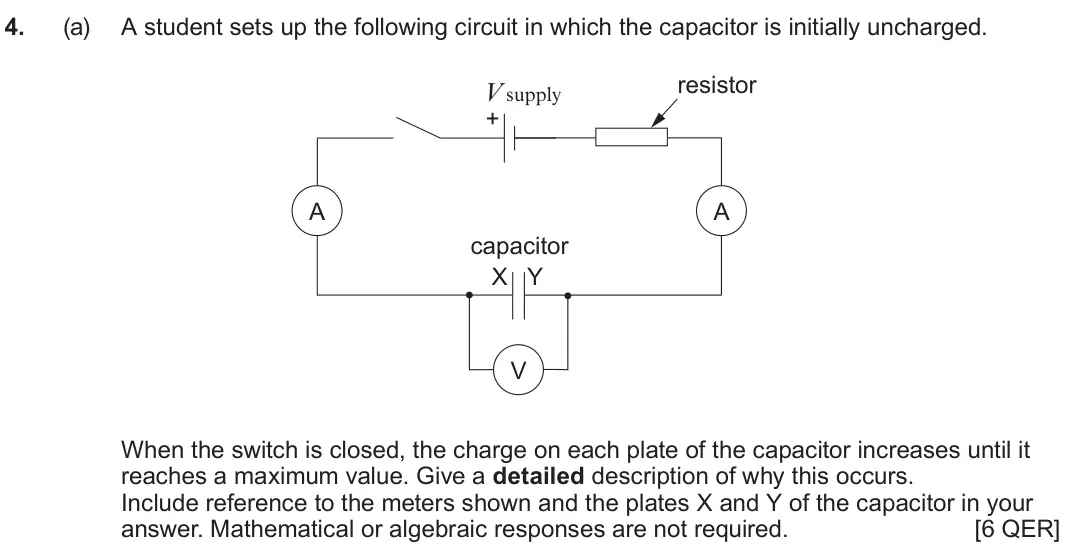
Q4(b)(i)
The whole paper ↗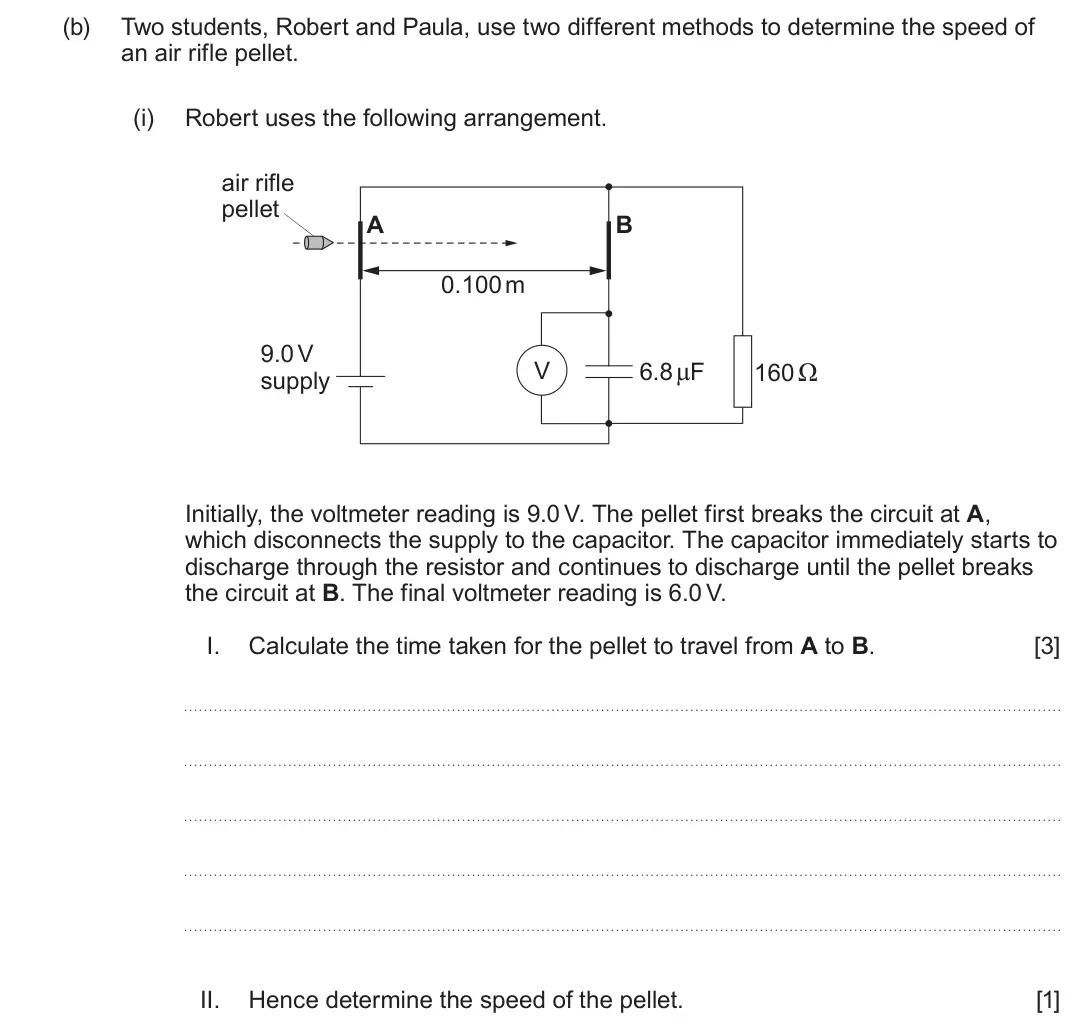
Q4(a)
The whole paper ↗
Q4(b)(i)
The whole paper ↗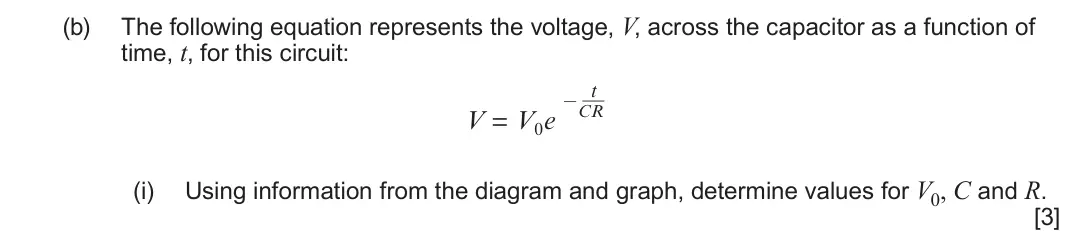
Q4(b)(ii)
The whole paper ↗
Q4(c)(i)
The whole paper ↗
Q4(c)(ii)
The whole paper ↗
Q3(a)
The whole paper ↗
Q3(b)
The whole paper ↗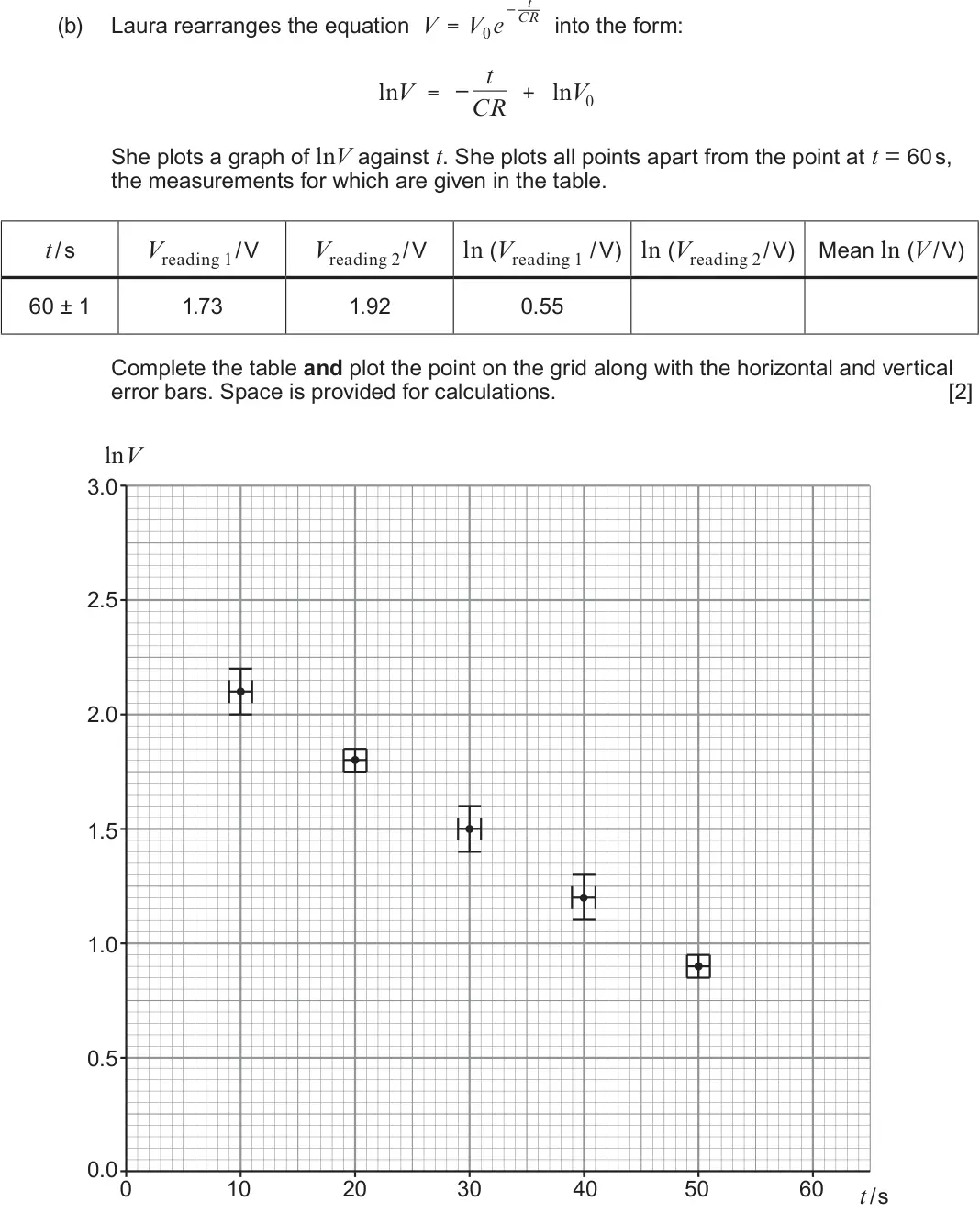
Q3(c)(i)
The whole paper ↗
Q3(c)(ii)
The whole paper ↗
Q3(d)(i)
The whole paper ↗
Q3(d)(ii)
The whole paper ↗
Q2(a)
The whole paper ↗
Q2(b)(i)
The whole paper ↗
Q2(b)(ii)
The whole paper ↗
Q2(b)(iii)
The whole paper ↗
Q2(c)
The whole paper ↗
Q2(a)(i)
The whole paper ↗
Q2(a)(ii)
The whole paper ↗
All 41 questions on Capacitance, as a list
- June 2025, Component 2, Q4(a) (6 marks): A student sets up the following circuit in which the capacitor is initially uncharged. resistor V supply + A A capacitor X Y V When the switch is closed, the ch
- June 2025, Component 2, Q4(b)(i) (4 marks): Robert uses the following arrangement. air rifle pellet A B 0.100 m 9.0 V V 6.8 μF 160 Ω supply Initially, the voltmeter reading is 9.0 V. The pellet first brea
- June 2024, Component 2, Q4(a) (2 marks): Use the graph to confirm that the charge on the capacitor is approximately 100 mC at time t = 0 s. [2]
- June 2024, Component 2, Q4(b)(i) (3 marks): Using information from the diagram and graph, determine values for V0, C and R. [3]
- June 2024, Component 2, Q4(b)(ii) (3 marks): Hence determine the pd across the capacitor when t is equal to the time constant, and confirm that your answer is consistent with the milliammeter reading at th
- June 2024, Component 2, Q4(c)(i) (2 marks): 2 QV is a formula for the energy, U, stored in a capacitor. Show clearly that U = 1 2 CV 2 is an equivalent formula. [2]
- June 2024, Component 2, Q4(c)(ii) (2 marks): Determine the energy stored in the capacitor at t = 60 s. [2]
- June 2023, Component 2, Q3(a) (3 marks): Briefly outline the experimental steps Laura should take to obtain her results. [3]
- June 2023, Component 2, Q3(b) (2 marks): Laura rearranges the equation V = V0 e into the form: t lnV = –CR + lnV0 She plots a graph of lnV against t. She plots all points apart from the point at t = 60
- June 2023, Component 2, Q3(c)(i) (3 marks): Draw lines of maximum and minimum gradients and determine the gradients of both lines. [3]
- June 2023, Component 2, Q3(c)(ii) (2 marks): Hence calculate the mean gradient and the percentage uncertainty in its value. [2]
- June 2023, Component 2, Q3(d)(i) (5 marks): Determine a value for the capacitance, C, of the capacitor along with its absolute uncertainty. Assume that the resistor has a tolerance (uncertainty) of 5%. Gi
- June 2023, Component 2, Q3(d)(ii) (2 marks): Determine the pd, V, of the power supply along with the absolute uncertainty in its value. [2]
- Autumn 2021, Component 2, Q2(a) (3 marks): Show how the unit of the time constant, RC, can be given as the ‘second’. [3]
- Autumn 2021, Component 2, Q2(b)(i) (2 marks): Sketch a diagram of the circuit he would use to obtain data. [2]
- Autumn 2021, Component 2, Q2(b)(ii) (4 marks): Calculate the charge on the capacitor after 20 seconds. [4]
- Autumn 2021, Component 2, Q2(b)(iii) (2 marks): The reading on the voltmeter after 20 seconds is noted as 1.1 V. Determine whether or not this is consistent with your answer to part (b)(ii). [2]
- Autumn 2021, Component 2, Q2(c) (1 mark): Calculate the number of electrons transferred from the positive plate to the negative plate of the capacitor when it is fully charged. [1]
- Autumn 2020, Component 2, Q2(a)(i) (2 marks): Zack notes that, for all of the capacitors, the joulemeter reading for the first trial was different from the reading for the second trial. Using values from on
- Autumn 2020, Component 2, Q2(a)(ii) (2 marks): Determine the percentage tolerance of the capacitors. [2]
- Autumn 2020, Component 2, Q2(b)(i) (3 marks): Using the values of the gradients given on the grid and an appropriate equation, determine the maximum and minimum values for V. [3]
- Autumn 2020, Component 2, Q2(b)(ii) (3 marks): Hence determine the pd, V, along with its absolute uncertainty. [3]
- Autumn 2020, Component 2, Q2(c) (3 marks): Zack’s teacher suggests that he should carry out another experiment. Zack decides to discharge the 6.8 μF capacitor through a 5.6 MΩ resistor. He notes that it
- June 2019, Component 2, Q3(a) (2 marks): Two parallel plate capacitors, X and Y, have equal plate areas. The capacitance of X is greater than the capacitance of Y. Suggest two possible reasons for the
- June 2019, Component 2, Q3(b)(i) (3 marks): Calculate the total capacitance of this combination of capacitors. [3]
- June 2019, Component 2, Q3(b)(ii) (2 marks): Explain why: pd across C2 = 1.5 × pd across C3 [2]
- June 2019, Component 2, Q3(b)(iii) (1 mark): Hence, calculate the pd across C3 given that 100 V is applied between A and B. [1]
- June 2019, Component 2, Q3(b)(iv) (2 marks): Explain which of the three capacitors stores the greatest charge, and calculate the size of this charge. [2]
- June 2019, Component 2, Q3(c) (5 marks): A 1.6 mF capacitor is charged from a 300 V d.c supply. Engineers wish to use the energy stored in this capacitor to heat a small coil embedded in a thermally in
- June 2018, Component 2, Q6(a) (1 mark): Define the capacitance of a capacitor. [1]
- June 2018, Component 2, Q6(b)(i) (3 marks): Write down the charges on each of the plates Q, R and S. Give a reason for your answer to the charge on plate S. [3] Charge on Q: Charge on R: Charge on S: Reas
- June 2018, Component 2, Q6(b)(ii) (2 marks): Calculate the pd across A and B. [2]
- June 2018, Component 2, Q6(b)(iii) (2 marks): A Physics student makes the following comment: For capacitors in series, a capacitor of higher capacitance stores more energy than a capacitor of smaller capaci
- June 2018, Component 2, Q6(c) (4 marks): Some computer keyboards work on the principle of varying capacitance. When a key is pressed, a spring is compressed and the separation of two parallel metal pla
- June 2017, Component 2, Q3(a) (2 marks): The plates of the capacitor are labelled Y and Z. When the switch is moved to S1, explain how each plate becomes charged in terms of the movement of charges in
- June 2017, Component 2, Q3(b)(i) (1 mark): The initial current in the circuit was 88 μA. Show that this is consistent with the value R = 68 kΩ. [1]
- June 2017, Component 2, Q3(b)(ii) (2 marks): Katie took single readings of pd. She used a voltmeter with a resolution of 0.01 V. Explain why it was not appropriate to include error bars when plotting pd. [
- June 2017, Component 2, Q3(b)(iii) (1 mark): She uses a stopwatch of resolution 1 second. State how this is represented on the graph. [1]
- June 2017, Component 2, Q3(b)(iv) (2 marks): Show that the time constant of the circuit is approximately 30 s. [2]
- June 2017, Component 2, Q3(b)(v) (4 marks): The resistor manufacturer states that the resistors are accurate to ± 3% of their given values. Use this information to calculate C along with its absolute unce
- June 2017, Component 2, Q3(b)(vi) (3 marks): Determine a value for pd at a time t = 55 s and state whether this is consistent with the trend shown by the graph. [3]
Questions, mark schemes and examiner’s reports are © WJEC Eduqas, from their published past papers. Plumi isn’t affiliated with any exam board. Want whole papers? Every Eduqas A-Level Physics paper.
Rather write your answers by hand on iPad? Plumi marks them against the same mark schemes.