 plumi
Waves on a string (core practical 5): Edexcel International A Level Physics questions
Edexcel International A Level Physics past-paper questions on 2.3.2.3 Waves on a string (core practical 5), 2019–2025, with mark schemes and examiner’s reports where available.
Paper
All papers
Exam
All years
Calculations
- Your answer
Q17(c)(i)
The whole paper ↗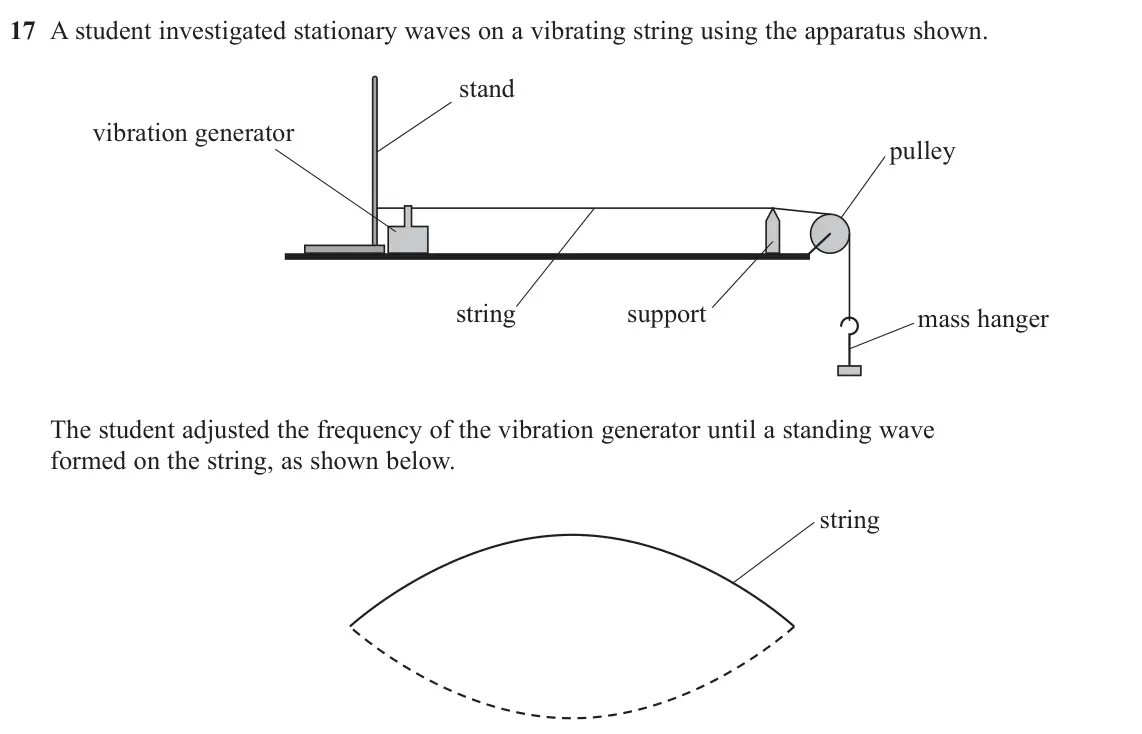
Q17(c)(ii)
The whole paper ↗Q18(c)(i)
The whole paper ↗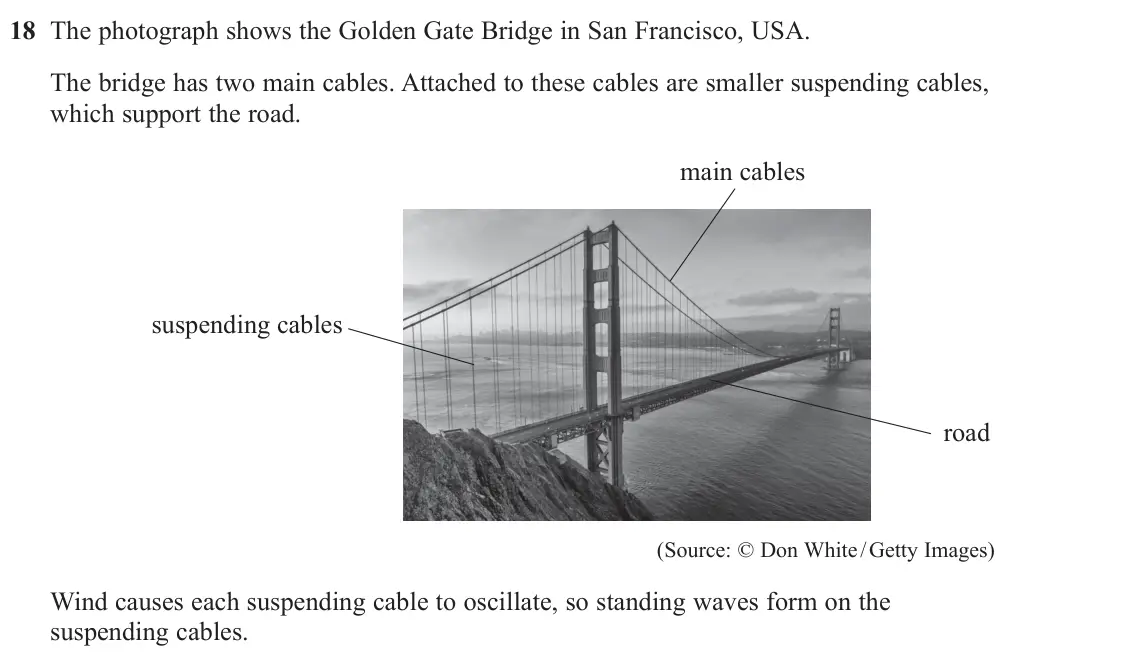
Q18(c)(ii)
The whole paper ↗- Your answer
Q15(c)
The whole paper ↗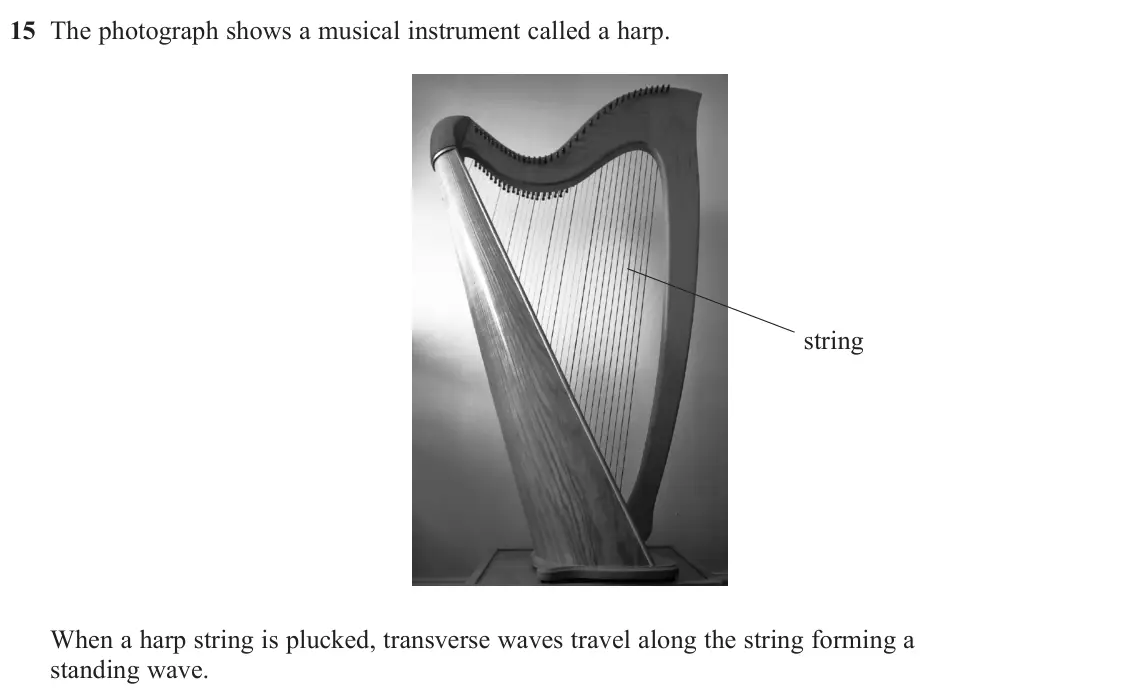
- Your answer
Q18(b)
The whole paper ↗
Q15(b)
The whole paper ↗
Q15(b)(i)
The whole paper ↗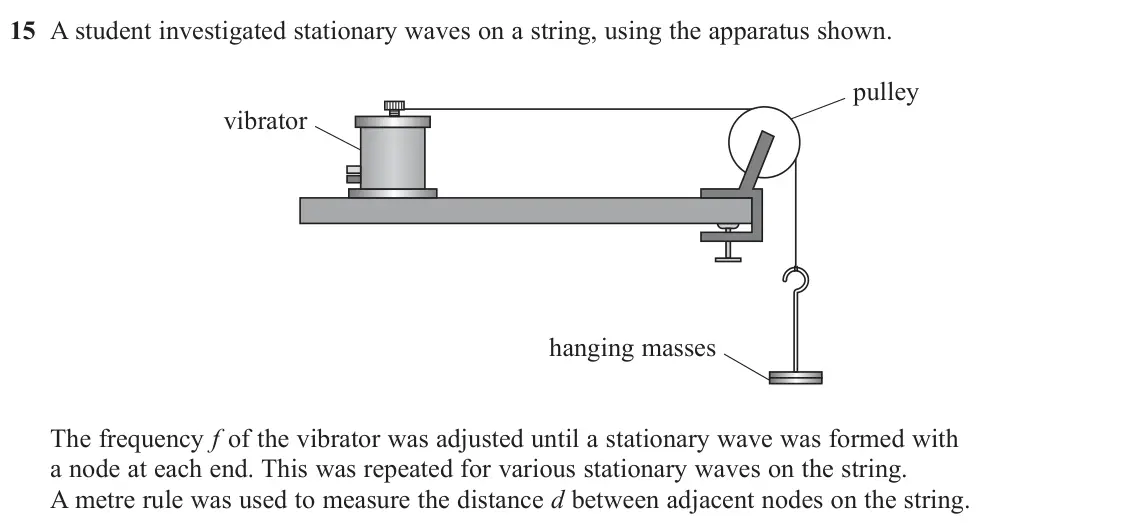
Q15(b)(ii)
The whole paper ↗- Your answer
- Your answer
Q21(b)
The whole paper ↗
Q17(b)
The whole paper ↗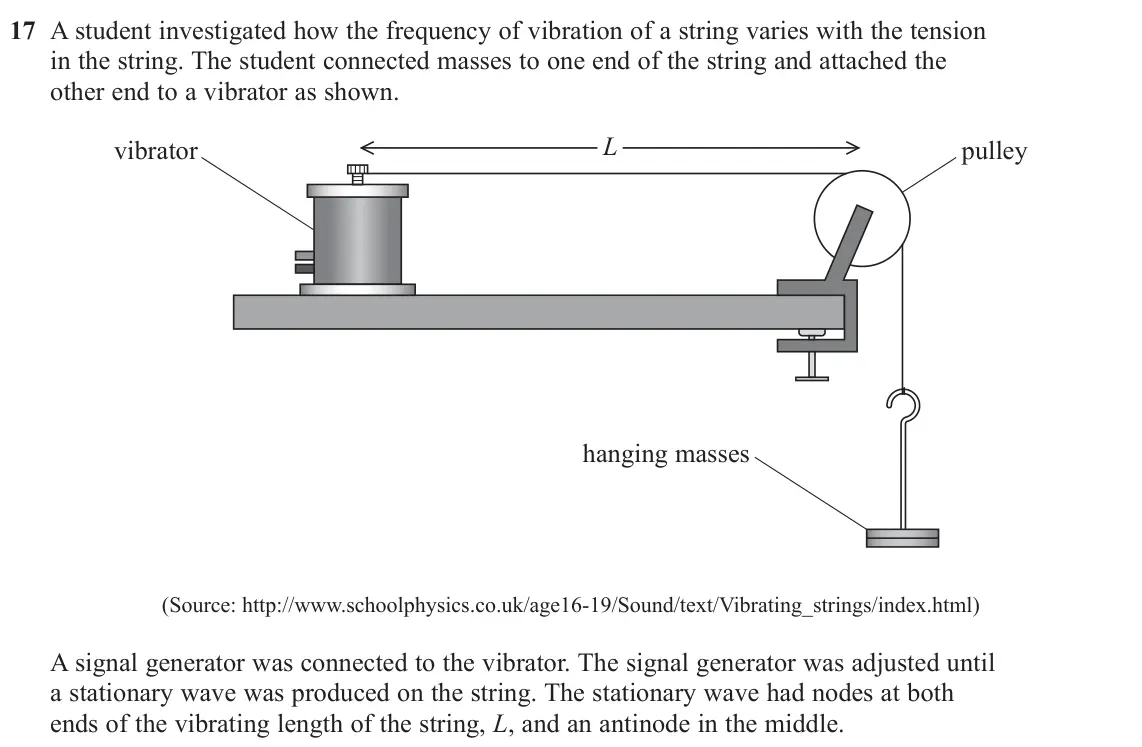
Q17(c)
The whole paper ↗Q17(d)
The whole paper ↗Q11(b)
The whole paper ↗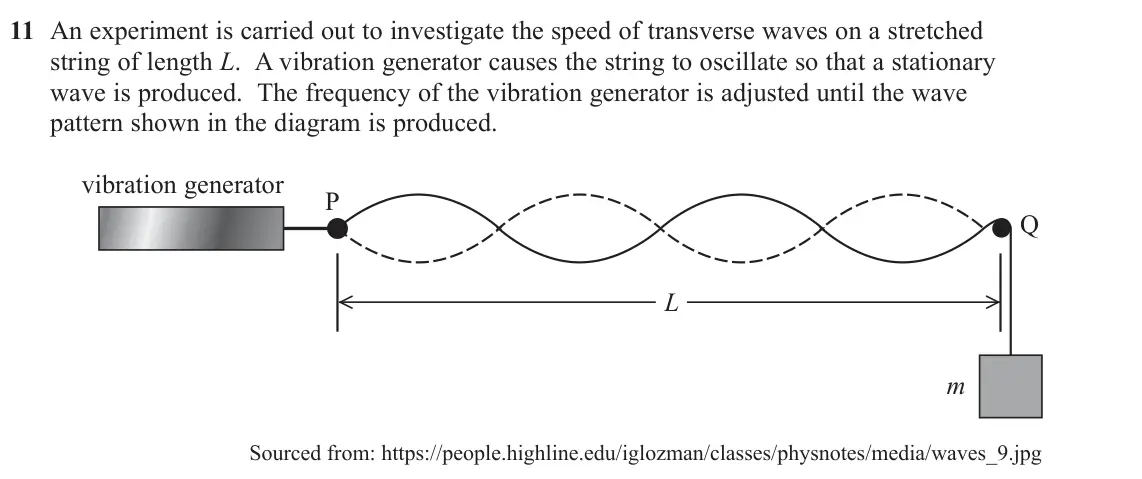
Q11(c)
The whole paper ↗
All 23 questions on Waves on a string (core practical 5), as a list
- June 2025, AS Unit 2, Q4 (1 mark): A student sets up the apparatus shown. length l stand pulley string mass m When the string is plucked, it vibrates with a frequency f. Which of the following si
- January 2025, AS Unit 2, Q17(c)(i) (3 marks): Explain why the graph is a straight line with a gradient of 2 4l μ (3)
- January 2025, AS Unit 2, Q17(c)(ii) (3 marks): The student’s graph is shown below. 3000 2500 2000 f 2 / Hz2 1500 1000 500 0 0.0 1.0 2.0 3.0 4.0 5.0 6.0 T / N Determine the mass per unit length μ of the strin
- October 2024, AS Unit 2, Q18(c)(i) (2 marks): One of the suspending cables on the bridge has a mass of 2.10 × 10 3 kg and a length of 87.0 m. Show that the mass per unit length μ of the cable is about 24 kg
- October 2024, AS Unit 2, Q18(c)(ii) (6 marks): The lowest frequency of the humming sound produced by the bridge is 280 Hz. The total mass of the road on the bridge is 140 × 10 6 kg. The weight of the road is
- June 2024, AS Unit 2, Q8 (1 mark): There is tension T in a string of length l. When the string is displaced and then released, waves move on the string with speed v. A string of length 2l has the
- January 2024, AS Unit 2, Q15(c) (4 marks): One string produces sound with a frequency of 196 Hz. The wavelength of the wave on the string is 0.72 m. The tension in the string is 41 N. This string breaks
- October 2023, AS Unit 2, Q8 (1 mark): A string is placed under tension T. A wave travels along the string. A second string has the same mass but twice the length. A wave travels along this string wi
- June 2023, AS Unit 2, Q18(b) (4 marks): The simplest stationary wave that can be formed on the string has a node (N) at each end and an antinode (A) at the centre, as shown. A N N The frequency of thi
- October 2022, AS Unit 2, Q15(b) (4 marks): A wire is stretched between two fixed points. The wire is made to vibrate and a stationary wave is created. This produces a sound wave in the air. The fixed end
- January 2022, AS Unit 2, Q15(b)(i) (5 marks): Determine the total mass of the hanging masses used in the investigation. mass per unit length of string = 4.5 × 10⁻⁴ kg m–1 (5) Total mass of hanging masses =
- January 2022, AS Unit 2, Q15(b)(ii) (2 marks): The string was replaced with one that had twice the mass per unit length. The length of the string and the mass of the hanging masses did not change. Add a line
- October 2021, AS Unit 2, Q6 (1 mark): The speed of waves on a vibrating string is investigated using the apparatus shown. L pulley vibrator L 3 hanging masses length of string between vibrator and p
- June 2021, AS Unit 2, Q4 (1 mark): A student investigates how different variables affect the speed of waves on a vibrating string. Which of the following would increase the speed of waves along t
- January 2021, AS Unit 2, Q21(b) (3 marks): On a violin, a stationary wave is created when a string is plucked. A violin string has a fixed length but the tension can be adjusted. When a string is plucked
- October 2020, AS Unit 2, Q17(b) (5 marks): The student changed the weight W applied to the string and adjusted the frequency f of the signal generator until the same stationary wave was set up on the str
- October 2020, AS Unit 2, Q17(c) (2 marks): Describe a method that can be used to confirm that the frequency value stated on the signal generator is correct. (2)
- October 2020, AS Unit 2, Q17(d) (3 marks): When W is 80.0 N, f is 659 Hz. Calculate the mass per unit length of the string. length L = 0.328 m (3) Mass per unit length =
- January 2020, AS Unit 2, Q11(b) (3 marks): Calculate the speed of waves on the string. mass m = 0.20 kg mass per unit length of string = 4.5 × 10⁻³ kg m–1 (3) Speed =
- January 2020, AS Unit 2, Q11(c) (2 marks): The frequency of the vibration generator is reduced until the wave pattern shown below is produced. P Q Explain the effect that this would have on the speed of
- June 2019, AS Unit 2, Q6 (1 mark): A string is stretched between two fixed points and set into oscillation. The frequency of the vibrating string is not dependent on A the amplitude of the string
- June 2019, AS Unit 3, Q4(a) (3 marks): Calculate μ given the equation below. mg f λ = μ (3) μ =
- June 2019, AS Unit 3, Q4(b)(ii) (4 marks): For each of these sources of uncertainty, describe an experimental technique the student could have used to obtain an accurate measurement. (4)
Questions, mark schemes and examiner’s reports are © Pearson Edexcel, from their published past papers. Plumi isn’t affiliated with any exam board. Want whole papers? Edexcel International A Level Physics past papers.
The Plumi iPad app also offers exam-style questions with AI feedback on your handwritten working.