 plumi
Uncertainties, errors and improvements: Edexcel International A Level Physics questions
Edexcel International A Level Physics past-paper questions on P.1.4 Uncertainties, errors and improvements, 2019–2025, with mark schemes and examiner’s reports where available.
Paper
All papers
Exam
All years
Calculations
Q1(a)(ii)
The whole paper ↗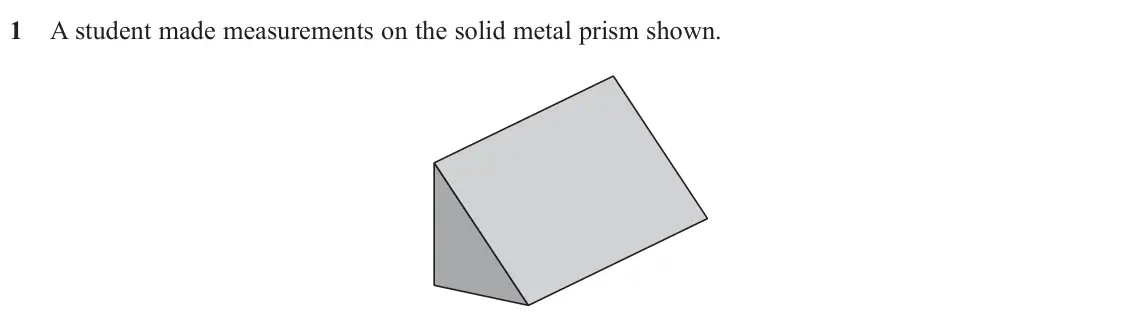
Q1(b)(i)
The whole paper ↗Q1(b)(iv)
The whole paper ↗Q2(b)(ii)
The whole paper ↗
Q4(a)
The whole paper ↗
Q4(a)(i)
The whole paper ↗
Q4(a)(iv)
The whole paper ↗Q4(b)(i)
The whole paper ↗Q4(b)(ii)
The whole paper ↗Q4(b)(iii)
The whole paper ↗Q1(a)
The whole paper ↗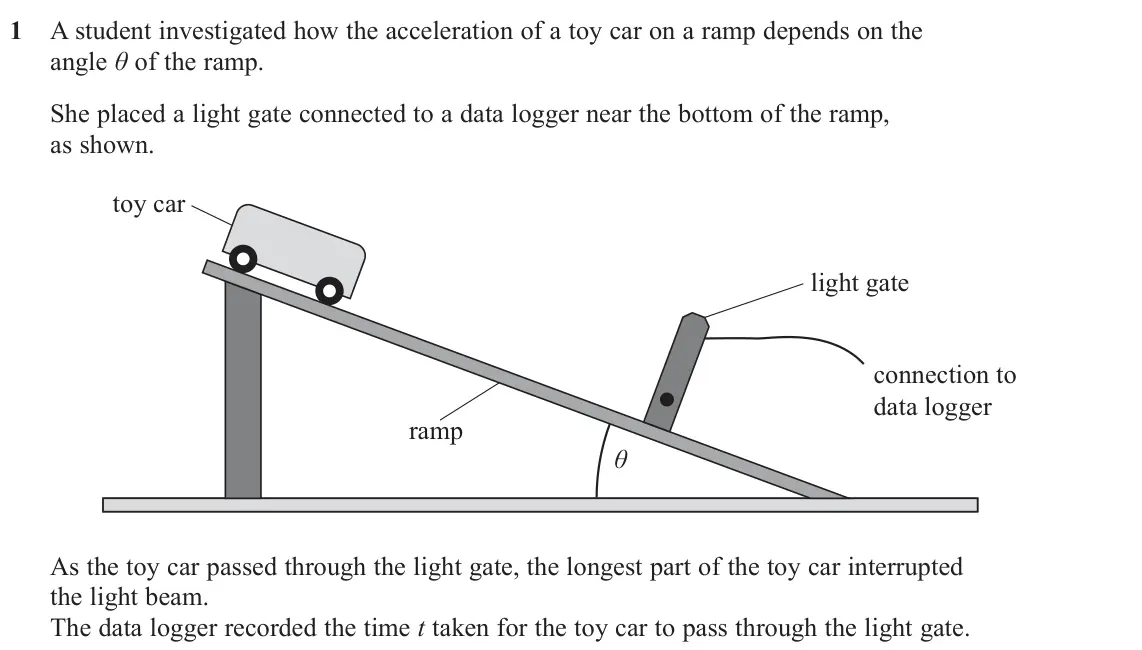
Q1(b)(ii)
The whole paper ↗Q4(c)(ii)
The whole paper ↗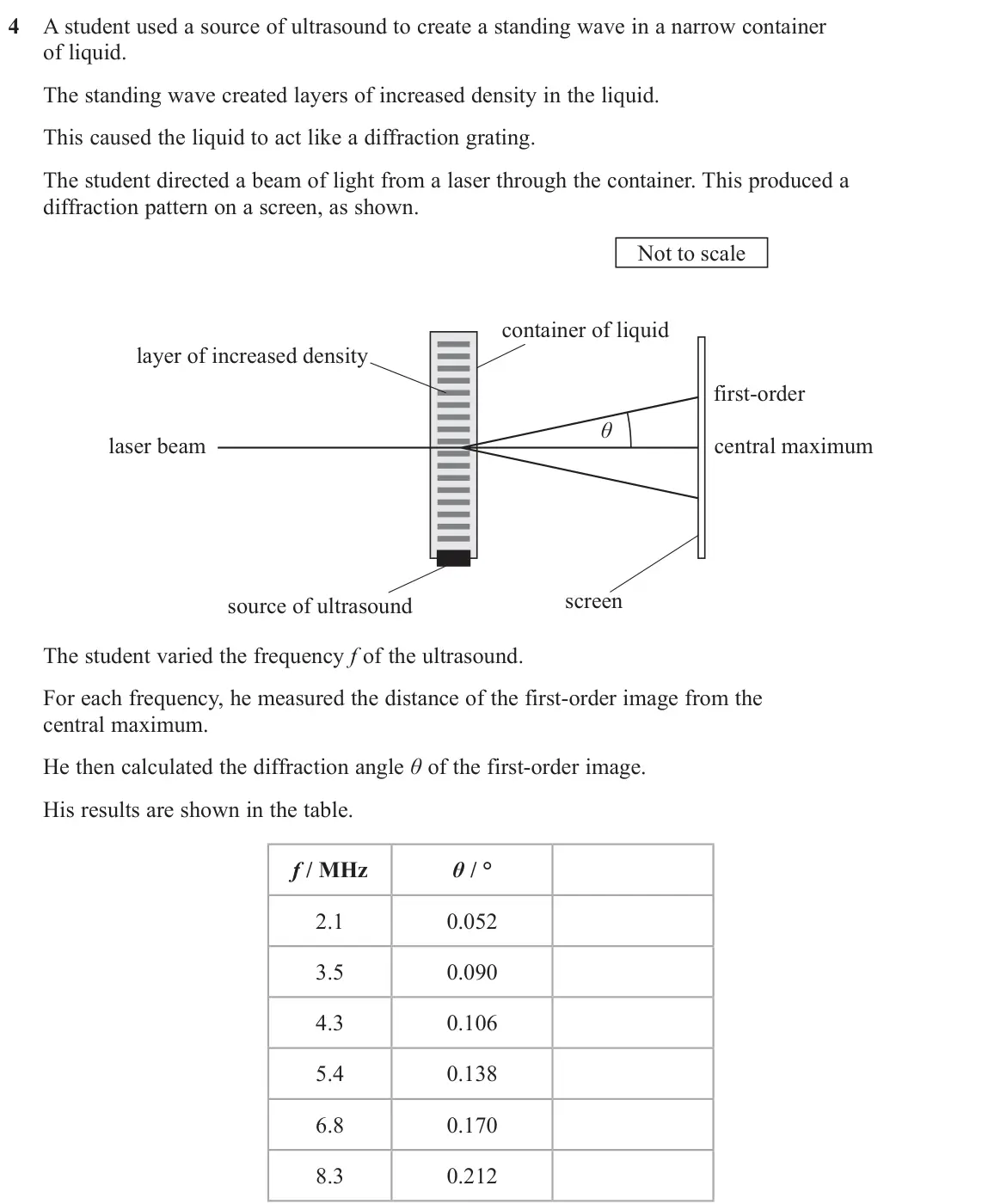
Q1(c)(ii)
The whole paper ↗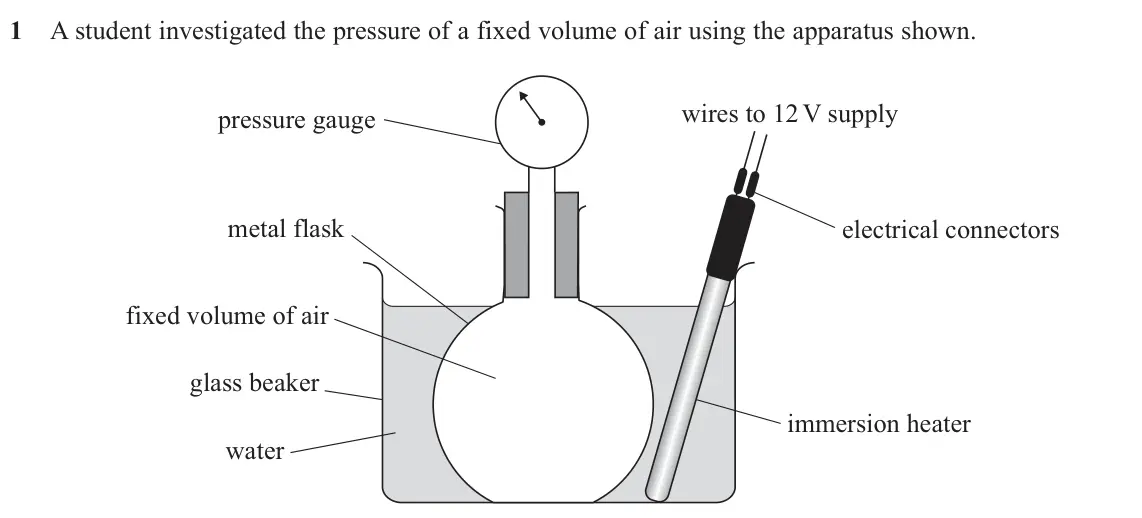
Q3(b)(v)
The whole paper ↗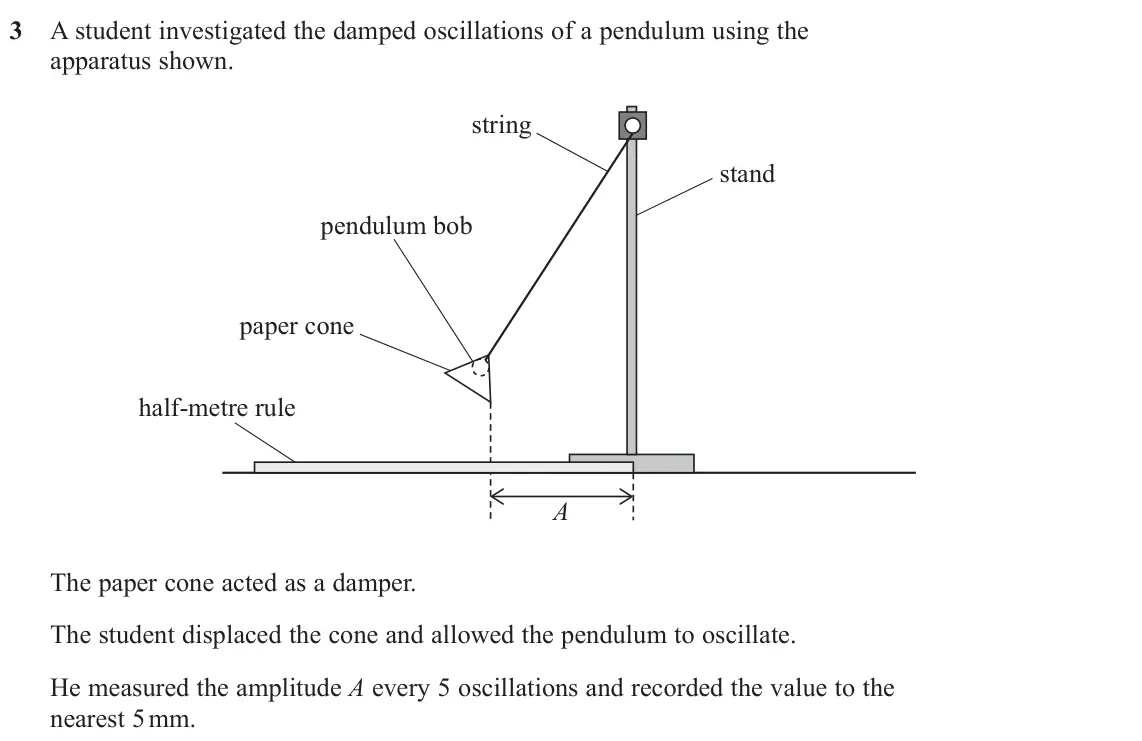
Q4(a)
The whole paper ↗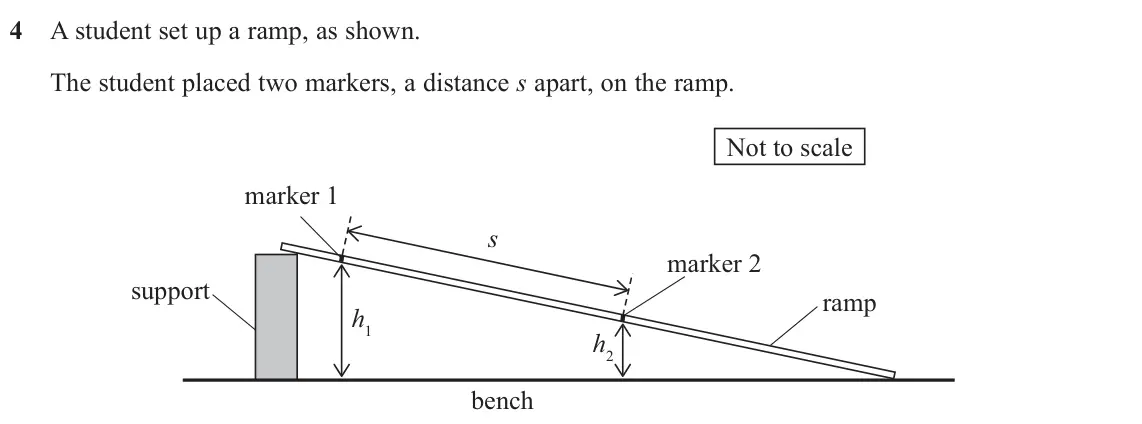
Q4(b)
The whole paper ↗Q4(c)(ii)
The whole paper ↗Q4(c)(iii)
The whole paper ↗Q14(a)
The whole paper ↗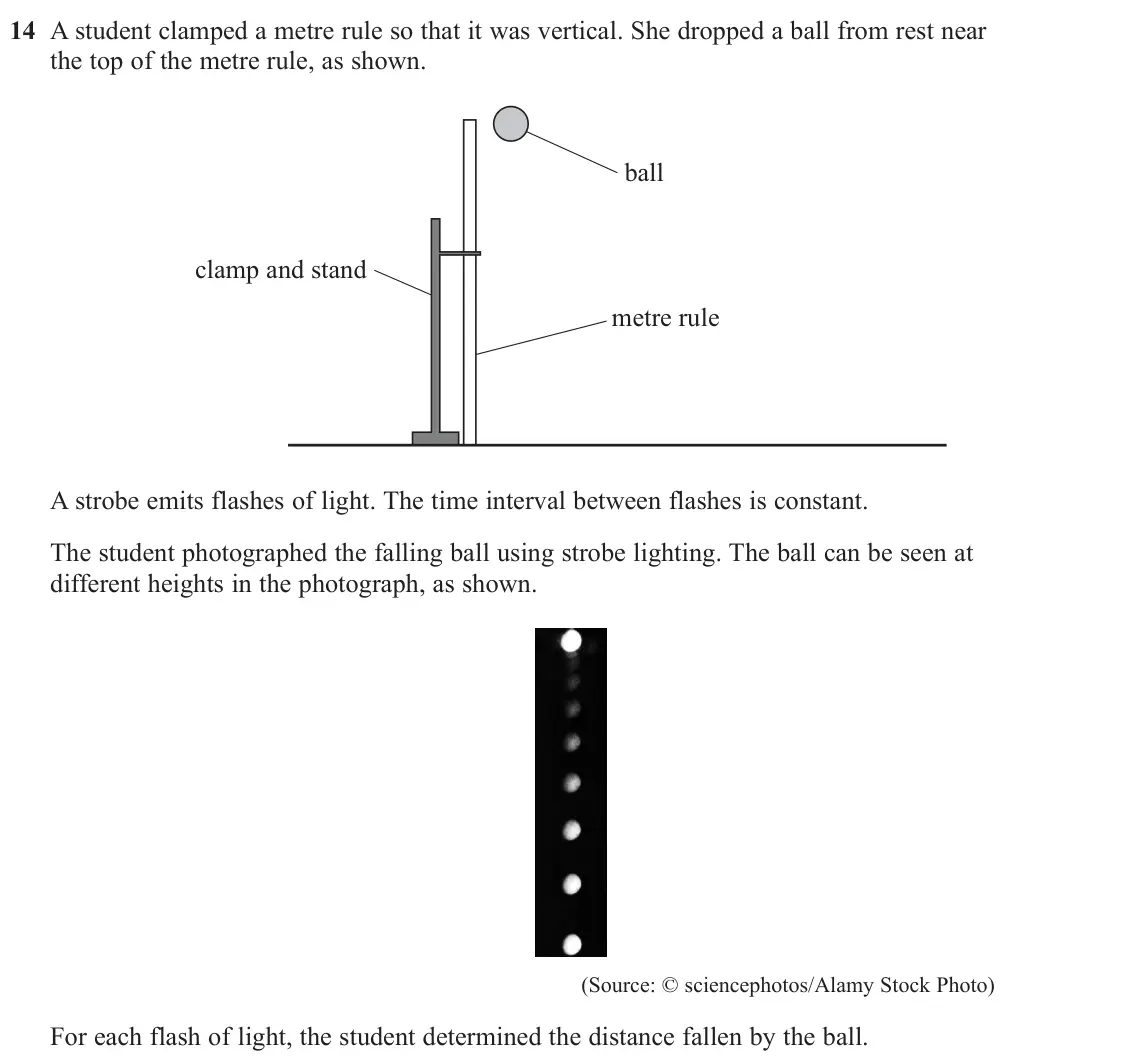
All 182 questions on Uncertainties, errors and improvements, as a list
- June 2025, AS Unit 3, Q1(a)(ii) (2 marks): Determine the percentage uncertainty in this reading. (2) Percentage uncertainty =
- June 2025, AS Unit 3, Q1(b)(i) (2 marks): Explain one technique he should use to determine accurate values for these lengths. (2)
- June 2025, AS Unit 3, Q1(b)(iv) (2 marks): The percentage uncertainty in this calculated value of the density of the metal is 0.9%. The accepted value for the density of copper is 8.94 g cm –3. Deduce wh
- June 2025, AS Unit 3, Q2(b)(ii) (2 marks): Determine the percentage uncertainty in the mean value of t. (2) Percentage uncertainty =
- June 2025, AS Unit 3, Q4(a) (2 marks): The student used the metre rule to determine the distance L between the level of the water and the top of the transparent cylinder. Explain how to reduce a sour
- June 2025, Unit 6, Q4(a)(i) (3 marks): Explain why timing multiple oscillations improves the measurement of T. (3)
- June 2025, Unit 6, Q4(a)(iv) (2 marks): Determine the percentage uncertainty in the mean value of T. (2) Percentage uncertainty =
- June 2025, Unit 6, Q4(b)(i) (2 marks): The student used vernier calipers to measure d. Explain one technique he should use to determine an accurate value for d. (2)
- June 2025, Unit 6, Q4(b)(ii) (3 marks): Show that the percentage uncertainty in the term D is about 2%. 2 2 d D = 59.4 mm ± 0.2 mm d = 13.9mm ± 0.1 mm (3)
- June 2025, Unit 6, Q4(b)(iii) (2 marks): The student determined the value of the constant N experimentally and estimated its percentage uncertainty. He determined the value of v as 0.276 with a percent
- January 2025, AS Unit 3, Q1(a) (2 marks): The student measured the length l of the toy car using digital calipers. Determine the percentage uncertainty in the measurement of l. (2) Percentage uncertaint
- January 2025, AS Unit 3, Q1(b)(ii) (2 marks): Determine the percentage uncertainty in the mean value of t. (2) Percentage uncertainty in mean value of t =
- January 2025, AS Unit 3, Q4(c)(ii) (2 marks): The student is told that the liquid is either petroleum, castor oil or glycerol. The table shows the speed of sound v in these liquids. Liquid v / m s –1 petrol
- January 2025, Unit 6, Q1(c)(ii) (2 marks): Determine the percentage uncertainty in the mean value of θ. (2) Percentage uncertainty =
- January 2025, Unit 6, Q3(b)(v) (2 marks): Explain why the value of A0 determined from the graph may not be the true value of A0. (2)
- January 2025, Unit 6, Q4(a) (3 marks): The student used a metre rule to measure the heights h1 and h2 . She calculated the difference in height ∆h as 21 mm ± 1 mm. Explain why it was appropriate to r
- January 2025, Unit 6, Q4(b) (3 marks): The student placed a small glass sphere at marker 1. She released the sphere and used a stopwatch to measure the time t taken for the sphere to reach marker 2.
- January 2025, Unit 6, Q4(c)(ii) (3 marks): Show that the percentage uncertainty in the student’s value of g is about 7%. (3)
- January 2025, Unit 6, Q4(c)(iii) (2 marks): Deduce whether the student’s value of g is accurate. (2)
- October 2024, AS Unit 1, Q14(a) (2 marks): She took one photograph using a strobe app on a mobile phone. She took a second photograph using a laboratory strobe. The time interval between flashes was the
- October 2024, AS Unit 3, Q1(a)(i) (2 marks): The student recorded a single measurement of d as 12.7 mm. Determine the percentage uncertainty in this measurement. (2) Percentage uncertainty =
- October 2024, AS Unit 3, Q1(a)(ii) (2 marks): The student repeated the measurements of d at different orientations and calculated the mean. Explain another technique she should use to determine an accurate
- October 2024, AS Unit 3, Q1(c) (2 marks): The student determined the viscosity of the liquid as 0.72 Pa s with a percentage uncertainty of 6%. The viscosity of castor oil is 0.65 Pa s. Deduce whether th
- October 2024, AS Unit 3, Q3(c)(ii) (2 marks): Determine the percentage uncertainty in the mean value of n. (2) Percentage uncertainty =
- October 2024, Unit 6, Q2(a)(ii) (2 marks): Determine the percentage uncertainty in the mean value of T. (2) Percentage uncertainty =
- October 2024, Unit 6, Q4(a) (2 marks): The student used digital calipers to measure a. Explain one technique she should use to measure a. (2)
- October 2024, Unit 6, Q4(b)(i) (3 marks): The student increased D and measured 20 T several times again. Explain how increasing D affects the percentage uncertainty in the measurement of 20 T. (3)
- October 2024, Unit 6, Q4(b)(iii) (3 marks): Show that the percentage uncertainty in E is about 5%. (3)
- October 2024, Unit 6, Q4(b)(iv) (2 marks): The value of E for beech wood is 11.9 GPa. Deduce whether the metre rule could be made from beech wood. (2)
- June 2024, AS Unit 1, Q8 (1 mark): A student is determining the acceleration of free-fall, g. The student uses a stopwatch to measure the time taken for a ball bearing to fall a measured distance
- June 2024, AS Unit 3, Q1(b) (2 marks): The student investigated how the breaking force of the rubber bands changed at low temperature. The student placed five identical rubber bands in a freezer at –
- June 2024, AS Unit 3, Q2(c) (2 marks): The student wrote a laboratory report about her investigation. She reported that the most significant source of error was being unable to judge the exact point
- June 2024, AS Unit 3, Q3(c)(ii) (2 marks): Determine the percentage uncertainty in the mean value of v. (2) Percentage uncertainty =
- June 2024, AS Unit 3, Q3(d) (2 marks): The student modified the apparatus to determine the speed of sound in water. –1 with a 4% uncertainty. He determined the speed of sound in water to be 1444 m s
- June 2024, AS Unit 3, Q4(a)(i) (2 marks): The student recorded a single measurement of d as 0.27 mm. Determine the percentage uncertainty in this measurement. (2) Percentage uncertainty =
- June 2024, AS Unit 3, Q4(a)(ii) (2 marks): The student repeated the measurement of d at different positions and orientations and calculated the mean. Explain another technique she should use to determine
- June 2024, Unit 6, Q1(c)(ii) (2 marks): Determine the percentage uncertainty in the mean value of h. (2) Percentage uncertainty =
- June 2024, Unit 6, Q4(a)(i) (2 marks): The student used a micrometer screw gauge to measure the thickness t of the plastic protractor. Explain one technique she should use when measuring t. (2)
- June 2024, Unit 6, Q4(a)(ii) (2 marks): The student determined a value of t as 1.41 mm. Explain why a micrometer screw gauge is an appropriate instrument for this measurement. Your answer should inclu
- June 2024, Unit 6, Q4(b)(ii) (4 marks): Show that the uncertainty in V is about 0.2 cm 3. (4)
- June 2024, Unit 6, Q4(c) (2 marks): The student determined the density of the plastic as 1.04 g cm –3 with a percentage uncertainty of 3%. The accepted value of the density of Perspex is 1.18 g cm
- January 2024, AS Unit 3, Q1(a)(ii) (2 marks): Determine the percentage uncertainty in the mass of the stack of paper. (2) Percentage uncertainty =
- January 2024, AS Unit 3, Q1(b) (2 marks): The student used vernier calipers to measure the thickness y of the stack of paper. Explain one technique he should use to determine an accurate value for y. (2
- January 2024, AS Unit 3, Q1(c)(ii) (2 marks): Explain why making measurements on the whole stack of paper is better than making measurements on a single sheet of paper. (2)
- January 2024, AS Unit 3, Q2(b)(ii) (2 marks): Explain why repeat measurements are appropriate for this measurement. (2)
- January 2024, AS Unit 3, Q3(b)(ii) (2 marks): Explain how the student could modify the arrangement of the apparatus to reduce the percentage uncertainty in this value. (2)
- January 2024, AS Unit 3, Q3(c)(ii) (2 marks): Determine the percentage uncertainty in the mean value of d. (2) Percentage uncertainty =
- January 2024, AS Unit 3, Q3(d) (2 marks): In a different experiment, the student applied force to stretch the hair. He determined the average breaking stress for hair as 181 MPa with a percentage uncert
- January 2024, AS Unit 3, Q4(a) (4 marks): Explain how two sources of error can be reduced in this investigation. (4)
- January 2024, Unit 6, Q4(a)(i) (2 marks): The student used vernier calipers to measure the diameter d. Explain one technique she should use to measure d. (2)
- January 2024, Unit 6, Q4(a)(ii) (2 marks): The student estimated that the thickness t of the centre of the lens was approximately 5 mm. Explain the most appropriate instrument the student should use for
- January 2024, Unit 6, Q4(b) (4 marks): The student placed the circular convex lens in a holder. She set up the apparatus, as shown. screen filament bulb u v circular convex lens wire mesh holder The
- January 2024, Unit 6, Q4(c)(ii) (2 marks): Determine the percentage uncertainty in n. (2) Percentage uncertainty in n =
- January 2024, Unit 6, Q4(c)(iii) (2 marks): The refractive index of crown glass is 1.52 Deduce whether the lens could be made of crown glass. (2)
- October 2023, AS Unit 3, Q1(c) (2 marks): Determine the percentage uncertainty in the mean length. (2) Percentage uncertainty =
- October 2023, AS Unit 3, Q1(d)(ii) (3 marks): The student is told the cube is made from copper, bronze or brass. The table shows the densities of these metals. Metal Density / kg m –3 copper 8940 bronze 862
- October 2023, AS Unit 3, Q3(b)(iii) (3 marks): The student suggested that the value of k should be equal to the gravitational field strength. Discuss whether it is likely that k is the gravitational field st
- October 2023, AS Unit 3, Q4(a)(iv) (2 marks): Calculate the percentage difference between h and the accepted value for the Planck constant. (2) Percentage difference =
- October 2023, AS Unit 3, Q4(b) (4 marks): The student’s investigation involves a small random error and a large systematic error. For each of these, suggest a source of the error and a realistic modific
- October 2023, Unit 6, Q4(a)(i) (2 marks): Explain one technique she should use to measure t. (2)
- October 2023, Unit 6, Q4(a)(iii) (2 marks): Determine the percentage uncertainty in t. (2) Percentage uncertainty in t =
- October 2023, Unit 6, Q4(a)(iv) (2 marks): Folding the rubber band and measuring the total thickness of four layers would reduce the percentage uncertainty in t. Explain the effect of folding the rubber
- October 2023, Unit 6, Q4(a)(v) (2 marks): The student used a metre rule to measure the length x and used the micrometer screw gauge to measure the width w of the rubber band. She determined the volume o
- October 2023, Unit 6, Q4(b)(i) (2 marks): Show that the uncertainty in D D = 3.45 cm ± 0.01 cm (2)
- October 2023, Unit 6, Q4(b)(ii) (2 marks): Show that the uncertainty in A is about 0.05 cm 2 = 9.36 cm 2 ± 0.06 cm 2 d 2 ± 0.07 cm 2 Dd = 10.56 cm (2)
- October 2023, Unit 6, Q4(c) (3 marks): The student determined the density of the rubber band and the density of the rubber bung. She also determined the corresponding percentage uncertainty in each v
- June 2023, AS Unit 3, Q1(a)(ii) (2 marks): Determine the percentage uncertainty in this value of t. (2) Percentage uncertainty in t =
- June 2023, AS Unit 3, Q1(a)(iii) (2 marks): Explain how she should reduce a source of error in this measurement of t. (2)
- June 2023, AS Unit 3, Q3(a)(ii) (2 marks): Describe how the student should measure the diameter of a ring as accurately as possible. (2)
- June 2023, AS Unit 3, Q3(b)(ii) (2 marks): Determine the percentage uncertainty in the mean value of a. (2) Percentage uncertainty in the mean value of a =
- June 2023, AS Unit 3, Q3(c)(ii) (2 marks): The percentage uncertainty in the calculated value of h is 6%. Comment on the accuracy of your calculated value of h. (2)
- June 2023, AS Unit 3, Q4(b)(i) (2 marks): Identify two sources of uncertainty with this method. (2)
- June 2023, AS Unit 3, Q4(b)(ii) (1 mark): Suggest a modification to reduce the effect of one of these sources of uncertainty. (1)
- June 2023, Unit 6, Q4(a)(ii) (3 marks): She recorded the following measurements. 5T / s 3.43 3.36 3.28 3.49 Calculate the mean value of T and its uncertainty in seconds. (3) Mean value of T = s ± s
- June 2023, Unit 6, Q4(c)(ii) (3 marks): Show that the percentage uncertainty in ρ is about 4%. (3)
- June 2023, Unit 6, Q4(c)(iii) (2 marks): The density of glycerol is 1260 kg m –3. Deduce whether the liquid could be glycerol. (2)
- January 2023, AS Unit 3, Q1(a)(ii) (2 marks): Determine the percentage uncertainty in the measurement of R. (2) Percentage uncertainty =
- January 2023, AS Unit 3, Q1(b)(ii) (1 mark): Identify a possible source of systematic error in your method. (1)
- January 2023, AS Unit 3, Q3(c)(ii) (2 marks): The student estimated the percentage uncertainty in his calculated value of the density of modelling clay to be 4%. The density of polymer clay is 1760 kg m –3.
- January 2023, AS Unit 3, Q4(a)(ii) (2 marks): Determine the percentage uncertainty in the mean value of time. (2) Percentage uncertainty =
- January 2023, AS Unit 3, Q4(b) (2 marks): The student adjusted the launching device to vary the mean force F applied to the car. For larger values of F there was a greater percentage uncertainty in the
- January 2023, Unit 5, Q20(b)(ii) (2 marks): The physicists concluded that their value for G was within reasonable agreement with the standard value of G. Evaluate the validity of their conclusion. G = 6.6
- January 2023, Unit 6, Q2(b) (2 marks): The student suggested that using a video recording of the motion would improve the determination of T. Comment on this suggestion. (2)
- January 2023, Unit 6, Q4(a)(i) (2 marks): Explain one technique she should use to reduce the uncertainty in the measurement of d. (2)
- January 2023, Unit 6, Q4(a)(ii) (3 marks): She recorded the following measurements. d / mm 8.53 8.56 8.55 8.53 Determine the mean value of d and its uncertainty in mm. (3) Mean value of d = mm ± mm
- January 2023, Unit 6, Q4(b)(i) (3 marks): Show that the uncertainty in d2 is about 1 mm2. d = 10.70 mm ± 0.06 mm (3)
- January 2023, Unit 6, Q4(b)(ii) (4 marks): Show that the percentage uncertainty in A is about 0.4 %. s2 = 881 mm2 ± 2 mm2 (4)
- January 2023, Unit 6, Q4(c) (2 marks): The student measured the total mass m10 of 10 identical metal rings as 63 g. Explain why measuring the total mass of 10 metal rings is better than measuring the
- January 2023, Unit 6, Q4(d)(ii) (3 marks): The density of stainless steel ranges from 7.48 g cm–3 to 7.95 g cm–3. Deduce whether the metal rings could be made from stainless steel. (3)
- October 2022, AS Unit 3, Q1(a)(ii) (2 marks): Calculate the percentage uncertainty in your value. (2) Percentage uncertainty =
- October 2022, AS Unit 3, Q1(c) (3 marks): In the experiment, the student applied a small force with her hand to start glider A moving. The student repeated the experiment and calculated the mean values
- October 2022, AS Unit 3, Q1(d) (2 marks): Another student used a stopwatch to measure the time taken for the gliders to travel a known distance. Explain the advantage of using light gates and a data log
- October 2022, AS Unit 3, Q3(a)(ii) (2 marks): Identify a possible source of uncertainty in the measurement of u, and how it can be dealt with. (2)
- October 2022, AS Unit 3, Q4(d) (2 marks): The student’s teacher suggested that using a plastic beam with a smaller value of h would improve the measurement of d. Justify the teacher’s statement. (2)
- October 2022, Unit 6, Q2(c) (2 marks): Explain a source of uncertainty in this investigation. (2)
- October 2022, Unit 6, Q4(a)(ii) (3 marks): The student recorded the following measurements. dX / mm 0.31 0.32 0.31 0.33 0.30 Determine the mean value of dX and its uncertainty in mm. (3) Mean value of dX
- October 2022, Unit 6, Q4(b)(ii) (3 marks): Show that the percentage uncertainty in ρ is about 9%. (3)
- October 2022, Unit 6, Q4(c) (3 marks): The student measured the resistances R1 and R2 of different lengths of wire Y using an ohmmeter. Each resistance was measured once. The student’s values are giv
- October 2022, Unit 6, Q4(d) (3 marks): The student wanted to confirm that the metal of the wire is constantan. The student compared his calculated values of ρ and RL to published values for constanta
- June 2022, AS Unit 1, Q5 (1 mark): A student determined a value for g by dropping a metal sphere from rest. The student measured the distance fallen and the time taken for the sphere to fall. The
- June 2022, AS Unit 3, Q1(c) (2 marks): Determine whether the coins could be made from brass. density of brass = 8550 kg m–3 ± 2% (2)
- June 2022, AS Unit 3, Q1(d) (4 marks): The surfaces of the coins are uneven, which introduces a systematic error. Describe an alternative method the student could have used to determine the average v
- June 2022, AS Unit 3, Q2(a) (3 marks): When the measured value of θ1 is 35°, the measured value of θ2 is 62°. Calculate the percentage uncertainty in each of these values. (3) Percentage uncertainty
- June 2022, AS Unit 3, Q2(c) (2 marks): The line of best fit on the graph does not pass through the origin. Describe a possible cause for this error, and how the student could reduce the effect of thi
- June 2022, AS Unit 3, Q4(c)(iii) (2 marks): The student used a light gate and data logger to measure v. The measured value was 1.98 m s–1. Comment on the value of v determined using your graph. (2)
- June 2022, Unit 5, Q20(b)(ii) (2 marks): Assess whether this method would produce an accurate value for c. (2)
- June 2022, Unit 6, Q1(a)(ii) (2 marks): The student heated the liquid. He started a stopwatch and recorded the temperature of the liquid. He recorded the time at fixed intervals of temperature, as the
- June 2022, Unit 6, Q1(c) (2 marks): Another student performed the investigation using a temperature probe connected to a data logger. Give two reasons why this would improve the investigation. (2)
- June 2022, Unit 6, Q2(b) (2 marks): A student recorded the motion of the pendulums using a video camera. Suggest how this may improve the measurement of P. (2)
- June 2022, Unit 6, Q4(a)(ii) (2 marks): The student determined a more accurate value for d. Explain one technique she could have used. (2)
- June 2022, Unit 6, Q4(a)(iii) (3 marks): The student recorded the following measurements. d / mm 6.57 6.58 6.54 6.52 Determine the mean value of d and its uncertainty in mm. (3) Mean value of d = mm ±
- June 2022, Unit 6, Q4(b) (4 marks): The student was given a different size metal nut. She measured the distances shown. d s She calculated the shaded area A of the metal using the formula 2 s2 – π
- June 2022, Unit 6, Q4(c)(ii) (3 marks): The density of steel ranges from 7.85 g cm–3 to 8.03 g cm–3. Deduce whether the metal nut could be made from steel. (3)
- January 2022, AS Unit 2, Q15(a) (1 mark): The resolution of the metre rule was 1 mm, but the measurements were recorded to the nearest 0.5 cm. Suggest why. (1)
- January 2022, AS Unit 3, Q1(b)(i) (3 marks): Calculate the mean value for v and the percentage uncertainty in v. (3) Mean v = m s–1 Percentage uncertainty in v = %
- January 2022, AS Unit 3, Q1(b)(iii) (1 mark): A second student carried out the same experiment and determined a similar value for the acceleration of the trolley on the ramp. State why this does not show th
- January 2022, AS Unit 3, Q2(c) (1 mark): The LDR is connected to the ohmmeter using two connecting wires. The ohmmeter reading includes the resistance of the two connecting wires. State why the student
- January 2022, AS Unit 3, Q3(d)(ii) (2 marks): The value of g obtained from the graph is 9.64 m s–2. The student concluded that the value of g obtained is accurate. Evaluate the student’s conclusion. (2)
- January 2022, AS Unit 3, Q4(b)(i) (2 marks): Explain why this method gives a value for t with low uncertainty. (2)
- January 2022, AS Unit 3, Q4(b)(ii) (2 marks): The value of t obtained using this method was 0.80 mm with an uncertainty of 2%. Deduce whether this value is consistent with the value of t obtained from the g
- January 2022, AS Unit 3, Q5(b) (2 marks): The student tried the same experiment using a rubber hammer. The rubber hammer compressed as it hit the wood making a sound that lasted for a longer time. Expla
- January 2022, AS Unit 3, Q5(c) (2 marks): The student was given the following equation and data to find a value for the speed of sound in oak. E v = ρ Young modulus E of oak = 11.2 GPa ± 0.5 GPa Density
- January 2022, Unit 6, Q2(b) (2 marks): Explain a possible source of error in this investigation. (2)
- January 2022, Unit 6, Q4(a)(ii) (2 marks): The student measured the height h2 of the finish line. She recorded the difference in height Δh between the start line and finish line as 65 mm ± 1 mm. Explain
- January 2022, Unit 6, Q4(b)(i) (2 marks): Calculate the mean value of t and its uncertainty. (2) Mean value of t = ±
- January 2022, Unit 6, Q4(b)(ii) (2 marks): The student made the ramp less steep by reducing the value of h1. Explain how this might improve the measurement of t. (2)
- January 2022, Unit 6, Q4(c) (4 marks): Two students each carried out this procedure for another value of Δh. They recorded the following times for the same value of Δh. Student t / s Mean t / s A 2.4
- January 2022, Unit 6, Q4(d)(ii) (2 marks): Determine the percentage uncertainty in the value of g. (2) Percentage uncertainty =
- January 2022, Unit 6, Q4(d)(iii) (2 marks): Deduce whether the value of g is accurate. (2)
- October 2021, AS Unit 2, Q12(b)(ii) (2 marks): The antinode is slightly further from the water than the end of the glass tube. Explain how this would affect the accuracy of your calculated value for the spee
- October 2021, AS Unit 3, Q1(b) (2 marks): The photograph shows the steady reading of V on the voltmeter when the thermistor was at room temperature. (Source: PAL) Calculate the percentage uncertainty in
- October 2021, AS Unit 3, Q3(c)(i) (3 marks): Calculate the percentage uncertainty in the mean diameter of the nylon fishing line. (3) Percentage uncertainty =
- October 2021, AS Unit 3, Q4(c) (3 marks): The student researched the range of values for the coefficients of restitution e of different metals. stainless steel 0.63 < e < 0.93 cast iron 0.3 < e < 0.6 De
- October 2021, AS Unit 3, Q4(d) (2 marks): Explain how friction between the cube and the surface of the ramp would affect the value obtained for e. (2)
- October 2021, Unit 6, Q1(b) (2 marks): Explain one improvement the student could make to reduce the uncertainty in the measurement of ∆θ for each value of I. (2)
- October 2021, Unit 6, Q2(c) (3 marks): Another student suggests determining T by setting up a light gate attached to a data logger. Discuss whether this modification would improve the investigation.
- October 2021, Unit 6, Q4(a)(ii) (2 marks): The difference between p and q was recorded as 26 mm ± 1 mm. Explain why the uncertainty in this value is given as 1 mm. (2)
- October 2021, Unit 6, Q4(b)(iii) (2 marks): She recorded the following measurements. d / mm 2.35 2.37 2.34 2.35 2.33 Calculate the mean value of d in mm and its uncertainty. (2) Mean value of d = mm ± mm
- October 2021, Unit 6, Q4(d) (4 marks): The table shows values of G for different types of steel. Type of steel Structural steel Carbon steel G / 109 N m−2 79.3 77.0 Deduce whether the data provided i
- June 2021, AS Unit 3, Q1(c) (2 marks): The student then followed the same method using thicker sheets of acetate. Explain why using thicker sheets of acetate would reduce the uncertainty in her value
- June 2021, AS Unit 3, Q2(a) (2 marks): Suggest two reasons for the variation in the lengths the student measured. (2)
- June 2021, AS Unit 3, Q2(b)(ii) (2 marks): Calculate the percentage uncertainty in l. (2) Percentage uncertainty =
- June 2021, AS Unit 3, Q2(d) (2 marks): The percentage uncertainty in the student’s value for the speed of sound is equal to the percentage uncertainty in l. The accepted value for the speed of sound
- June 2021, AS Unit 3, Q3(a) (3 marks): The student measured the diameter of the sphere using a micrometer. 45 0 5 10 15 40 35 Calculate the percentage uncertainty in the diameter of the sphere shown
- June 2021, AS Unit 3, Q3(d) (4 marks): The resolution of the force meter was 0.01 N. The distance moved between the rubber bands was 25.0 cm. The time measured was 0.78 s. The percentage uncertainty
- June 2021, AS Unit 3, Q4(b)(iv) (2 marks): The student states that the value for the Planck constant obtained from the graph is accurate. Evaluate the student’s statement. (2)
- June 2021, AS Unit 3, Q4(c) (4 marks): Each LED in the investigation emits a narrow range of wavelengths. The wavelength value stated by the manufacturer is the wavelength of light that is emitted wi
- June 2021, Unit 6, Q2(b) (3 marks): One significant source of error in this experiment is the uncertainty in the mass reading due to the water moving as it boils. Explain how another significant s
- June 2021, Unit 6, Q3(a)(ii) (2 marks): Describe two techniques he should use to reduce the uncertainty in the value of the time period. (2)
- June 2021, Unit 6, Q4(a)(ii) (2 marks): The student recorded the following values of d, measured at different points across the lens. 5.10 cm 5.11 cm 5.10 cm She concluded that because her measurement
- June 2021, Unit 6, Q4(b) (2 marks): The student measured the thickness x of the edge of the lens using the micrometer screw gauge. She recorded the following measurements. x / mm 2.11 2.10 2.13 2.
- June 2021, Unit 6, Q4(c)(ii) (2 marks): Show that the percentage uncertainty in (t – x) is approximately 0.5%. (2)
- June 2021, Unit 6, Q4(c)(iii) (4 marks): Show that the uncertainty in d2 + (t – x)2 is approximately 0.11 cm. (4)
- June 2021, Unit 6, Q4(c)(iv) (3 marks): The table shows data for some materials used to make lenses. Material Pyrex Crown glass Flint glass Refractive index 1.47 1.52 1.66 Deduce whether this lens cou
- January 2021, AS Unit 2, Q13(b) (2 marks): When the lights were switched back on, the student discovered that it was impossible to calculate the resistance of the LDR using this circuit. The teacher said
- January 2021, AS Unit 3, Q2(b) (2 marks): The student repeated the process for a second semicircular block of a different transparent material. Her measured value for C was 41 ± 0.5° Calculate the range
- January 2021, AS Unit 3, Q2(d) (3 marks): The student used rays of white light. Explain why using monochromatic light would increase the validity of the conclusion made in (c). (3)
- January 2021, AS Unit 3, Q2(e) (3 marks): The photograph shows a spectrometer. This can be used to measure angles when investigating refraction. collimator transparent material telescope Vernier scale L
- January 2021, AS Unit 3, Q4(a) (1 mark): Calculate the percentage uncertainty in the measurement of the potential difference. (1) Percentage uncertainty =
- January 2021, AS Unit 3, Q5(d) (2 marks): Explain one modification to this investigation that would improve the accuracy of the values of R0 and α determined in (c). (2)
- January 2021, Unit 6, Q2(d) (2 marks): The student repeated the investigation but used a data logger instead of a stopwatch and an ammeter. Suggest why using a data logger would improve this investig
- January 2021, Unit 6, Q4(b)(ii) (2 marks): The following measurements were obtained. t / mm 2.15 2.06 2.13 2.08 2.10 Calculate the mean value of t in mm and its uncertainty. . (2) mean t = mm ± mm
- January 2021, Unit 6, Q4(c)(ii) (1 mark): Show that the uncertainty in C is approximately 0.2 cm. (1)
- January 2021, Unit 6, Q4(d) (4 marks): The volume V of the transparent material is given by 2 C L – Vi V = 4π where L is the length of the container and Vi is the internal volume of the container. De
- January 2021, Unit 6, Q4(e) (4 marks): The table shows the densities of some common materials used to manufacture this type of container. Only borosilicate is safe to heat directly with a Bunsen burn
- October 2020, AS Unit 2, Q17(c) (2 marks): Describe a method that can be used to confirm that the frequency value stated on the signal generator is correct. (2)
- October 2020, Unit 6, Q1(c) (3 marks): Another student suggested that using a piece of card twice as long would improve the investigation. Assess this suggestion. (3)
- October 2020, Unit 6, Q4(a)(iii) (3 marks): Calculate the area of the slot and its uncertainty in cm2. Assume the slot is rectangular. a = 0.47 ± 0.01 cm b = 2.19 ± 0.005 cm (3) Area of the slot = ± cm2
- October 2020, Unit 6, Q4(b)(ii) (3 marks): Calculate the uncertainty in the value of the shaded area. (3) Uncertainty = cm2
- October 2020, Unit 6, Q4(c)(ii) (3 marks): Calculate the percentage uncertainty in the value of ρ. (3) Percentage uncertainty =
- October 2020, Unit 6, Q4(d) (2 marks): The student thinks that the slotted mass is made from brass, which has a density of 8.5 g cm−3. Determine whether the slotted mass could be made of brass. (2)
- January 2020, AS Unit 3, Q2(c) (2 marks): The graph shows that the beaker would have a depth under the water surface with no mass added. Identify the source of the systematic error and how it could be c
- January 2020, AS Unit 3, Q3(d)(i) (3 marks): The uncertainty in the measurement of the angles was ± 0.5°. Calculate the maximum and minimum values of n. (3) Maximum value of n = Minimum value of n =
- January 2020, AS Unit 3, Q3(d)(ii) (2 marks): Calculate the percentage uncertainty in the student’s value of n. (2) Percentage uncertainty =
- January 2020, AS Unit 3, Q5(b) (4 marks): To determine the breaking stress, a student used 100 g slotted masses hung vertically from the sample. The maximum mass that the sample could hold before breaki
- June 2019, AS Unit 1, Q16(c) (6 marks): Explain why the sample of wire used in this experiment should be long and thin. (6)
- June 2019, AS Unit 2, Q17(b)(ii) (2 marks): The teacher suggested using a microphone connected to an oscilloscope to determine where the loud and quiet zones were located along the line XY. She said that
- June 2019, AS Unit 3, Q1(b) (1 mark): The student measured the diameter. The reading obtained was 20.5 ± 0.05 mm. Calculate the percentage uncertainty in the measurement of the diameter. (1) Percent
- June 2019, AS Unit 3, Q1(d)(ii) (2 marks): Calculate the percentage uncertainty in the mean diameter of the second metal sphere. (2) Percentage uncertainty in the mean diameter =
- June 2019, AS Unit 3, Q1(f) (2 marks): The student calculated the density of the second metal sphere to be 7.75 × 10³ kg m–3 with an uncertainty of 2%. Determine whether the two spheres could be made
- June 2019, AS Unit 3, Q4(b)(i) (2 marks): Identify two significant sources of uncertainty in the student’s measurements. (2)
- June 2019, AS Unit 3, Q4(b)(ii) (4 marks): For each of these sources of uncertainty, describe an experimental technique the student could have used to obtain an accurate measurement. (4)
Questions, mark schemes and examiner’s reports are © Pearson Edexcel, from their published past papers. Plumi isn’t affiliated with any exam board. Want whole papers? Edexcel International A Level Physics past papers.
The Plumi iPad app also offers exam-style questions with AI feedback on your handwritten working.