 plumi
Thermionic emission, accelerators and detectors: Edexcel International A Level Physics questions
Edexcel International A Level Physics past-paper questions on 4.5.1.2 Thermionic emission, accelerators and detectors, 2019–2025, with mark schemes and examiner’s reports where available.
Paper
All papers
Exam
All years
Calculations
- Your answer
Q16(a)
The whole paper ↗
Q16(b)(i)
The whole paper ↗Q16(b)(ii)
The whole paper ↗Q14(a)
The whole paper ↗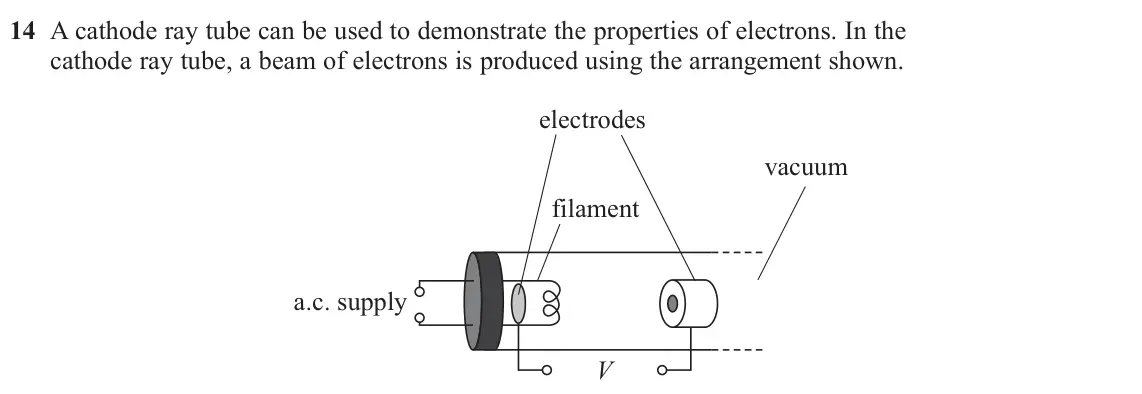
Q14(b)
The whole paper ↗Q17(a)
The whole paper ↗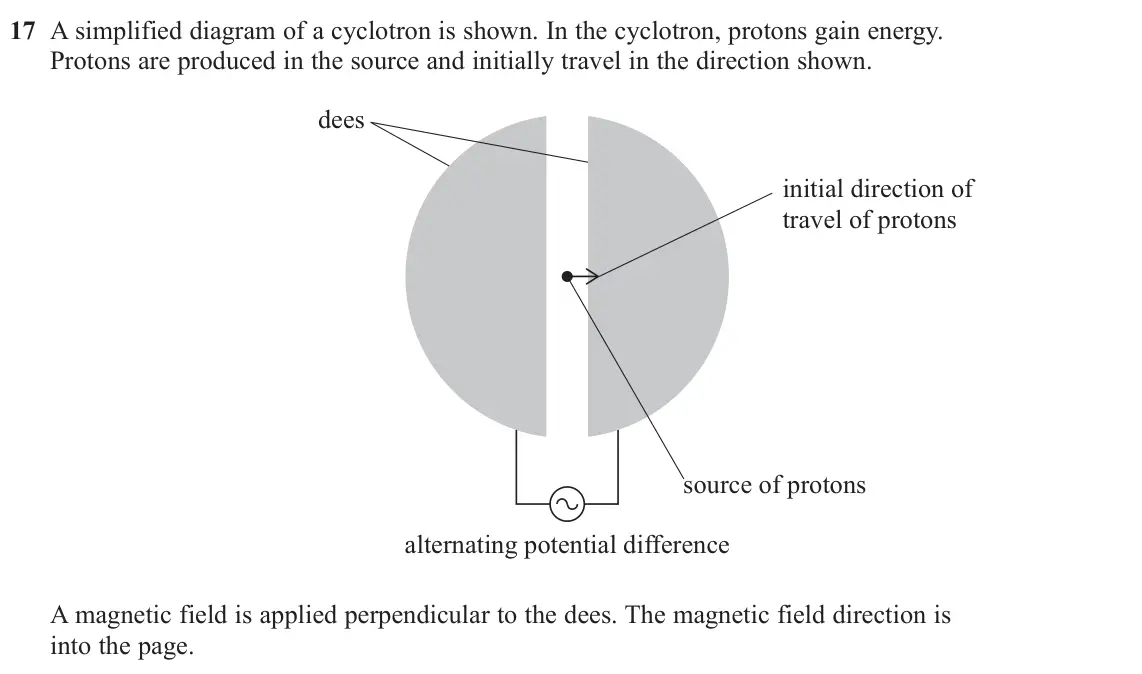
Q17(b)
The whole paper ↗Q17(c)
The whole paper ↗- Your answer
- Your answer
Q16(b)(i)
The whole paper ↗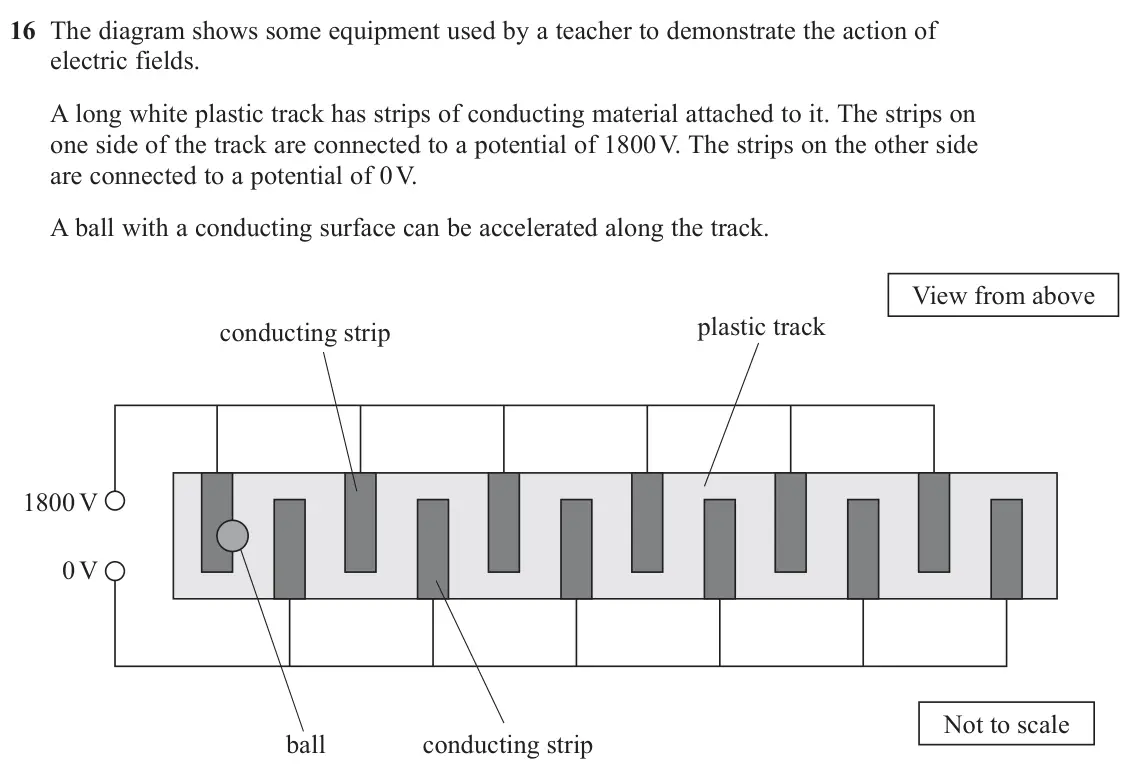
Q16(b)(ii)
The whole paper ↗- Your answer
Q16(b)
The whole paper ↗
- Your answer
Q22(b)(i)
The whole paper ↗
Q22(b)(ii)
The whole paper ↗- Your answer
All 55 questions on Thermionic emission, accelerators and detectors, as a list
- June 2025, Unit 4, Q6 (1 mark): In an electron gun, a current heats a metal filament to release electrons. Which of the following is the name of this process? A beta decay B ionisation C photo
- June 2025, Unit 4, Q16(a) (6 marks): Explain how these machines use a potential difference to accelerate charged particles. (6)
- June 2025, Unit 4, Q16(b)(i) (4 marks): In the linac, a potential difference of 0.40 MV is applied to the tubes. The protons pass through 4 gaps. Show that the speed of the protons is about 2 × 10 7 m
- June 2025, Unit 4, Q16(b)(ii) (3 marks): In the cyclotron, the protons leave the dees when the radius of their path is 29 cm. Deduce whether the speed of the protons as they leave the cyclotron is the
- January 2025, Unit 4, Q14(a) (2 marks): Explain why electrons are released when there is a current in the filament. (2)
- January 2025, Unit 4, Q14(b) (4 marks): In one cathode ray tube, the electrons in the beam had a de Broglie wavelength –11 m. of 2.65 × 10 Calculate the potential difference V required to accelerate t
- January 2025, Unit 4, Q17(a) (2 marks): Add to the diagram to show the path of the protons as they gain energy in the cyclotron. (2)
- January 2025, Unit 4, Q17(b) (3 marks): The frequency f of the alternating potential difference applied to the dees is given by the equation Bq f m 2π where m is the mass of the proton B is the magnet
- January 2025, Unit 4, Q17(c) (6 marks): Explain how the cyclotron increases the energy of the protons. You should refer to the alternating potential difference and the magnetic field. (6)
- October 2024, Unit 4, Q1 (1 mark): An electron gun produces a beam of electrons in a vacuum tube. The electrons are released from a metal filament using a current. Which of the following causes e
- October 2024, Unit 4, Q8 (1 mark): Cyclotrons accelerate charged particles to high speeds. Cyclotrons use electric fields and magnetic fields. Which of the following statements is not correct? A
- October 2024, Unit 4, Q16(b)(i) (3 marks): The shaded section of the diagram between X and Y corresponds to the drift tube in a linac. Give one similarity and two differences in the way this section of t
- October 2024, Unit 4, Q16(b)(ii) (3 marks): In the model, the lengths corresponding to drift tubes are constant. Explain why the lengths of the drift tubes in a linac are not constant. (3)
- June 2024, Unit 4, Q5 (1 mark): Cyclotrons use electric fields and magnetic fields to give particles very high energy. Which of the following statements is true for charged particles in cyclot
- June 2024, Unit 4, Q16(b) (6 marks): The diagram shows the start section of a linac and the end section of a linac. electron a.c. supply path drift tube start section electron source end section Ex
- January 2024, Unit 4, Q2 (1 mark): What is the process by which electrons are released from a heated filament? A excitation B ionisation C photoelectric emission D thermionic emission
- January 2024, Unit 4, Q15 (4 marks): A beam of electrons was directed through a thin piece of graphite towards a fluorescent screen, using the apparatus shown. vacuum cathode anode fluorescent scre
- January 2024, Unit 4, Q22(b)(i) (4 marks): Explain how the cyclotron produces a beam of high energy particles. You should refer to the alternating potential difference and the magnetic field. (4)
- January 2024, Unit 4, Q22(b)(ii) (4 marks): The first cyclotron was made by Lawrence in 1929. This cyclotron was able to produce a beam of protons with a maximum kinetic energy of 80 keV. Calculate the ma
- October 2023, Unit 4, Q3 (1 mark): The tubes of a linear accelerator (linac) get progressively longer along the length of the linac. Which of the following is the reason for this? A The frequency
- October 2023, Unit 4, Q22(b)(i) (3 marks): Show that the maximum speed of the electrons as they emerge from the anode is about 1.7 × 10 7 m s –1. (3)
- June 2023, Unit 4, Q1 (1 mark): In an electron gun, electrons are released from a heated filament. Which of the following is the name of this process? A annihilation B ionisation C photoelectr
- June 2023, Unit 4, Q12(a) (2 marks): Derive the following equation for the particle. r = p BQ (2)
- June 2023, Unit 4, Q12(b) (4 marks): The particle is an alpha particle of energy 5.4 MeV. Calculate B. mass of alpha particle = 6.64 × 10 –27 kg r = 0.096 m (4) B =
- June 2023, Unit 4, Q13(a) (4 marks): The diagram shows a linac. gap particle path a.c. supply source of drift tube charged particles Explain the use of electric fields in a linac. You should refer
- June 2023, Unit 4, Q13(b) (2 marks): The diagram shows a cyclotron. source of a.c. supply charged particles gap dees particle path Explain why a magnetic field is applied at right angles to the dee
- January 2023, Unit 4, Q7 (1 mark): Which of the following statements is true for a cyclotron? A A cyclotron can be used to accelerate neutrons. B A cyclotron uses a magnetic field to increase the
- January 2023, Unit 4, Q17(a)(iii) (3 marks): When the electric field between the plates is switched off the electrons move in a circular path of radius 39 cm, due to the magnetic field. 11 C kg −1. The acc
- October 2022, Unit 4, Q3 (1 mark): Which of the following describes why electrons are released from the metal filament during thermionic emission? A The metal filament is heated by an electric cu
- October 2022, Unit 4, Q8 (1 mark): A linac is a particle accelerator. It consists of drift tubes of increasing length with potential differences (p.d.) applied between them. Which of the followin
- October 2022, Unit 4, Q18(c) (3 marks): After passing through the velocity selector, a beam of oxygen ions with the same velocity enters a region of uniform magnetic flux density. Different isotopes o
- June 2022, Unit 4, Q8 (1 mark): In a cyclotron, a charged particle is accelerated in a spiral path. spiral path dees Which of the following increases as the radius of the spiral path increases
- June 2022, Unit 4, Q13(a) (6 marks): Explain why the distances between consecutive tubes increase in the first section of the linac but are almost equally spaced in the last section of the linac. (
- June 2022, Unit 4, Q14(a) (4 marks): Determine the momentum of the negative pion. magnetic flux density of field in the detector = 7.0 T (4) Momentum =
- January 2022, Unit 4, Q5 (1 mark): Electrons are released from the heated metal filament. Which of the following is the name of this process? A ionisation B photoelectric emission C relativistic
- January 2022, Unit 4, Q9 (1 mark): A charged particle is accelerated in a spiral path in a cyclotron. spiral path dees Which of the following changes would increase the amount of energy transferr
- January 2022, Unit 4, Q16(a) (2 marks): Explain the process that enables a particle detector to detect charged particles. (2)
- January 2022, Unit 4, Q17(d)(ii) (3 marks): Deduce whether the website’s claim is correct. muon charge = −1.6 × 10⁻¹⁹ C 3.10 GeV/c = 1.65 × 10⁻¹⁸ N s (3)
- October 2021, Unit 4, Q17(a) (4 marks): The diagram represents a LINAC. SOURCE a.c. supply Explain why this arrangement works with a constant frequency a.c. supply. (4)
- October 2021, Unit 4, Q18(d) (3 marks): The momentum of the pion is 1.2 × 10⁻¹⁹ N s. Calculate the radius of the path of the pion. magnetic flux density = 3.5 T (3) Radius =
- June 2021, Unit 4, Q12(b) (4 marks): A mercury ion with kinetic energy 6.42 × 10⁻¹⁵ J leaves a drift tube, as shown. drift tube drift tube path of mercury ion Calculate the momentum of the mercury
- June 2021, Unit 4, Q18(c)(ii) (3 marks): For relativistic particles such as this positron, momentum obeys the relationship E = pc where E = particle energy, p = particle momentum and c = speed of light
- January 2021, Unit 4, Q6 (1 mark): A positron and a muon travel at the same speed through a magnetic field. The magnetic field is directed into the page. Which of the following diagrams best repr
- January 2021, Unit 4, Q15(a) (6 marks): Explain the role of electric and magnetic fields in the production of high-speed charged particles by a cyclotron. (6)
- January 2021, Unit 4, Q15(b) (4 marks): The cyclotron could produce beams of alpha particles with kinetic energy up to 16 MeV. Calculate the magnetic flux density required by the cyclotron when alpha
- October 2020, Unit 4, Q17(a) (1 mark): The radon atoms do not leave tracks. State a reason for this. (1)
- October 2020, Unit 4, Q18(a) (2 marks): The electrons used in the linac are produced by the filament in an electron gun, as shown in the diagram. filament anode low p.d. – + high p.d. Name and describ
- October 2020, Unit 4, Q18(b)(i) (3 marks): Calculate the energy of the electron as it emerges. potential difference between adjacent drift tubes = 80 kV (3) Energy of the electron =
- October 2020, Unit 4, Q18(b)(ii) (2 marks): For very high energy electrons, successive drift tubes have the same length. Explain why. (2)
- October 2020, Unit 4, Q18(d) (4 marks): Electrons emerging from a standing wave linac must be directed towards the patient. Magnets are used to rotate the path of the electron beam through 270°. elect
- October 2020, Unit 5, Q18(b)(i) (1 mark): State how ions of this energy could be produced. (1)
- January 2020, Unit 4, Q10 (1 mark): In an electron deflection tube, electrons are released by passing a current through a metal filament. What is the name of the process that releases the electron
- January 2020, Unit 4, Q19(a)(i) (3 marks): Derive this expression. (3)
- January 2020, Unit 4, Q19(a)(ii) (4 marks): In Lawrence’s cyclotron, an alternating potential difference was used to accelerate particles to high energies. Explain the significance of the expression obtai
- January 2020, Unit 4, Q19(b) (5 marks): In a cyclotron, in which Lawrence’s expression applies, protons were accelerated to a speed of 1.5×10⁷ m s–1. Determine the time taken to accelerate a proton to
Questions, mark schemes and examiner’s reports are © Pearson Edexcel, from their published past papers. Plumi isn’t affiliated with any exam board. Want whole papers? Edexcel International A Level Physics past papers.
The Plumi iPad app also offers exam-style questions with AI feedback on your handwritten working.