 plumi
Particle interactions, tracks and high energies: Edexcel International A Level Physics questions
Edexcel International A Level Physics past-paper questions on 4.5.1.3 Particle interactions, tracks and high energies, 2019–2025, with mark schemes and examiner’s reports where available.
Paper
All papers
Exam
All years
Calculations
- Your answer
Q14(c)
The whole paper ↗
- Your answer
Q18(b)(iv)
The whole paper ↗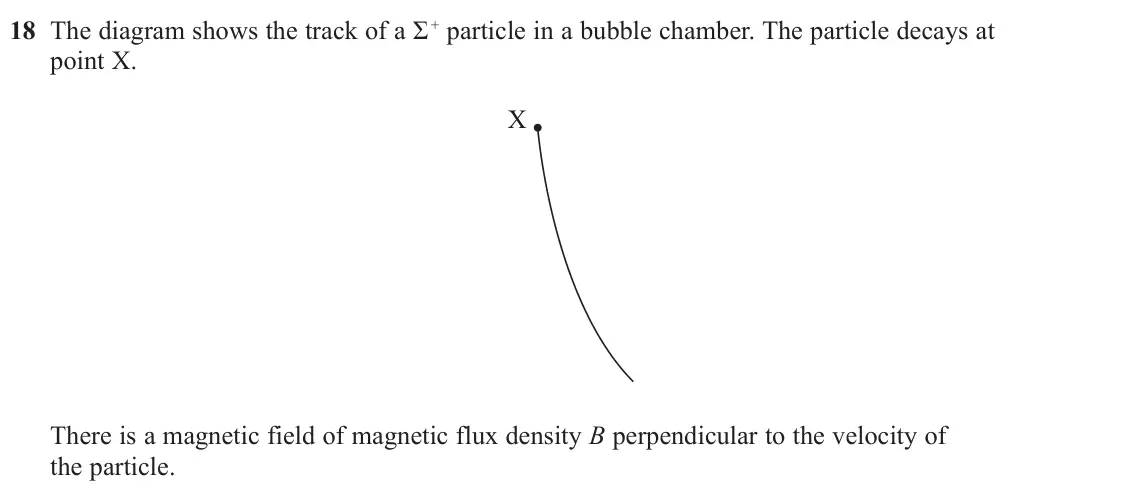
Q16(c)
The whole paper ↗
- Your answer
- Your answer
Q13(b)
The whole paper ↗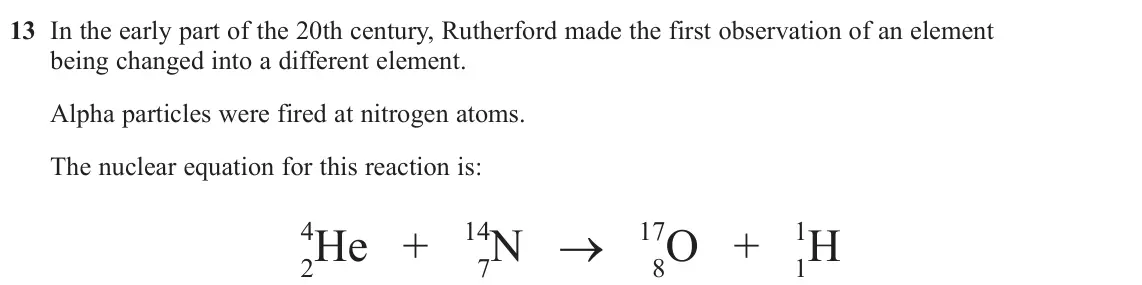
- Your answer
Q18(b)(i)
The whole paper ↗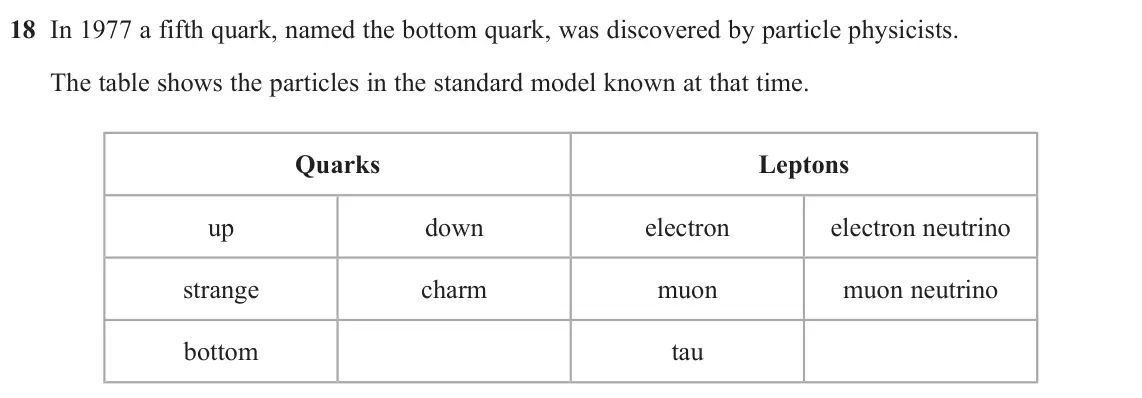
Q13(b)
The whole paper ↗
- Your answer
Q13(b)
The whole paper ↗
Q14(b)
The whole paper ↗
Q16(b)(ii)
The whole paper ↗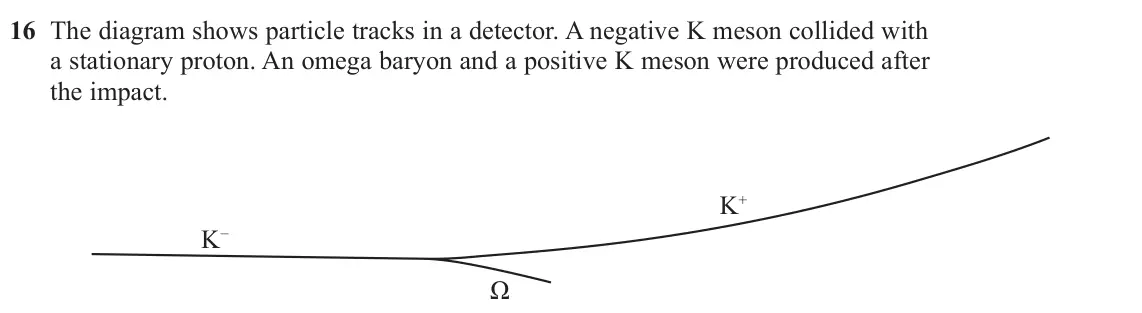
Q16(c)
The whole paper ↗- Your answer
Q17(c)
The whole paper ↗
Q18(a)
The whole paper ↗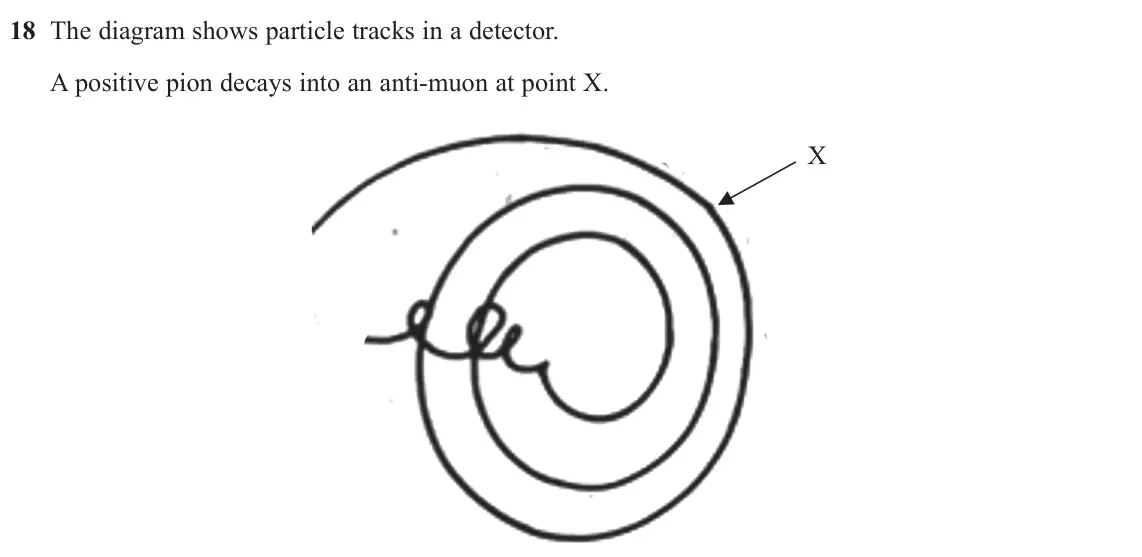
All 26 questions on Particle interactions, tracks and high energies, as a list
- June 2025, Unit 4, Q8 (1 mark): In high-energy collisions, electrons are used to investigate the structure of nucleons. Which of the following is the reason why the electrons need a very high
- June 2025, Unit 4, Q14(c) (3 marks): The photograph shows tracks produced by particles in a particle detector when a K – collided with a stationary proton. The tracks produced by the K + and Ω – ar
- January 2025, Unit 4, Q8 (1 mark): The diagram shows a particle track in a bubble chamber. X Y Which of the following is a valid conclusion from this track? A The particle is negatively charged.
- October 2024, Unit 4, Q18(b)(iv) (4 marks): The diagram shows the track of the Σ + particle in the bubble chamber. X Add to the diagram to show all tracks visible in the bubble chamber after the decay at
- June 2024, Unit 4, Q16(c) (3 marks): Explain why high energies are required to investigate the structure of protons. (3)
- January 2024, Unit 4, Q4 (1 mark): The structure of nucleons can be investigated using high energy electrons. Which of the following is the reason high energies are needed? A to cause annihilatio
- January 2024, Unit 4, Q12 (3 marks): The diagram shows tracks produced by particles in a bubble chamber. P A charged particle interacts with a stationary proton at P. This produces two neutral part
- October 2023, Unit 4, Q6 (1 mark): A particle detector shows tracks produced by two particles X and Y. The particles were created by the decay of a kaon at O. X Y O Which of the following can be
- October 2023, Unit 5, Q13(b) (2 marks): Explain why the alpha particle must have an energy greater than the minimum energy for the reaction to take place. (2)
- June 2023, Unit 4, Q5 (1 mark): Scientists use particles with high energy to investigate the structure of nucleons. Which of the following statements is not a reason why particles with high en
- January 2023, Unit 4, Q18(b)(i) (4 marks): Explain the advantage of colliding beams of particles. (4)
- October 2022, Unit 4, Q13(b) (3 marks): Protons and anti-protons were accelerated in the Spp–S to very high energies before they collided. Explain why the protons and anti-protons needed high energies
- June 2022, Unit 4, Q6 (1 mark): Electrons can be used to probe the nuclei of atoms. Which of the following best explains this? A Electrons can be accelerated to very high energies. B Electrons
- June 2022, Unit 4, Q13(b) (3 marks): In some experiments, a high-energy electron collides with a stationary atom. In other experiments beams of high-energy electrons, travelling in opposite directi
- June 2022, Unit 4, Q14(b) (2 marks): State two ways that the diagram shows the kaon is neutral. (2)
- January 2022, Unit 4, Q16(b)(ii) (1 mark): A magnetic field acts in the detector. State the direction of the magnetic field. (1)
- January 2022, Unit 4, Q16(c) (6 marks): The rest mass of the omega baryon is significantly larger than the rest mass of the proton. Discuss how energy and momentum are conserved during this collision.
- October 2021, Unit 4, Q8 (1 mark): Which of the following statements does not help to explain why electrons can be used to probe the nuclei of atoms? A Electrons can be accelerated to high energi
- October 2021, Unit 4, Q17(c) (3 marks): A student correctly suggests that this collision cannot lead to both particles being omega baryons, as this breaks a conservation law. Discuss the student’s sug
- October 2021, Unit 4, Q18(a) (2 marks): State two ways in which the diagram shows that an anti‑muon must also have a positive charge. (2)
- October 2021, Unit 4, Q18(b) (3 marks): Explain how the diagram shows that the anti‑muon is travelling in a clockwise path. (3)
- June 2021, Unit 4, Q10 (1 mark): The structure of nucleons can be investigated using electrons with high energies. Which of the following is the reason why high energies are required? A to allo
- June 2021, Unit 4, Q18(b) (3 marks): Deduce the direction of the magnetic field. (3) Direction of magnetic field =
- January 2021, Unit 5, Q19(a)(iii) (2 marks): Explain why there is a range of energies for the beta particles emitted in the decay of a sample of potassium-40. (2)
- October 2020, Unit 4, Q17(c) (3 marks): The photograph shows another pair of tracks following radon decay. Deduce which track is for the first alpha particle emitted. (3)
- January 2020, Unit 4, Q19(c) (3 marks): Explain why high energy particles are required to investigate the structure of nucleons. (3)
Questions, mark schemes and examiner’s reports are © Pearson Edexcel, from their published past papers. Plumi isn’t affiliated with any exam board. Want whole papers? Edexcel International A Level Physics past papers.
The Plumi iPad app also offers exam-style questions with AI feedback on your handwritten working.