 plumi
Mass-energy, creation and annihilation, MeV and GeV: Edexcel International A Level Physics questions
Edexcel International A Level Physics past-paper questions on 4.5.2.1 Mass-energy, creation and annihilation, MeV and GeV, 2019–2025, with mark schemes and examiner’s reports where available.
Paper
All papers
Exam
All years
Calculations
- Your answer
Q14(b)
The whole paper ↗
- Your answer
- Your answer
Q14(b)(ii)
The whole paper ↗
Q14(b)(iii)
The whole paper ↗Q16(a)
The whole paper ↗
Q22(a)(ii)
The whole paper ↗
Q21(c)
The whole paper ↗
- Your answer
Q18(b)(ii)
The whole paper ↗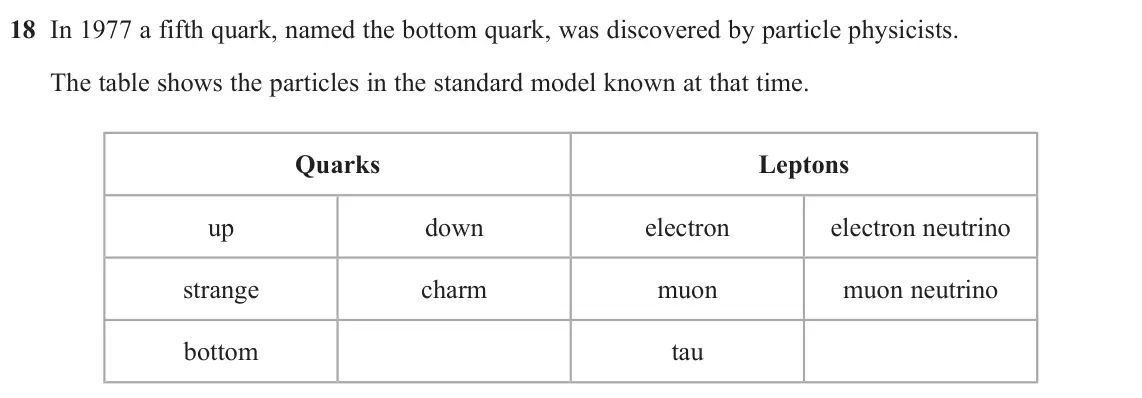
Q18(b)(iii)
The whole paper ↗Q16(b)
The whole paper ↗
Q13(a)
The whole paper ↗
Q13(b)
The whole paper ↗Q18(b)
The whole paper ↗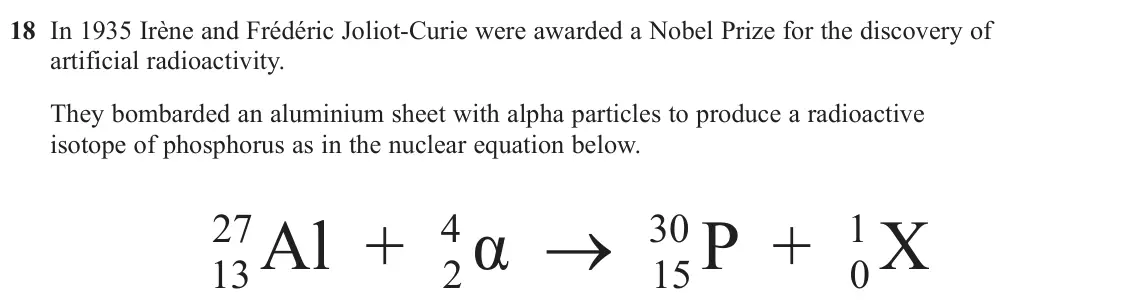
Q13(b)
The whole paper ↗
Q14(d)
The whole paper ↗
Q16(c)
The whole paper ↗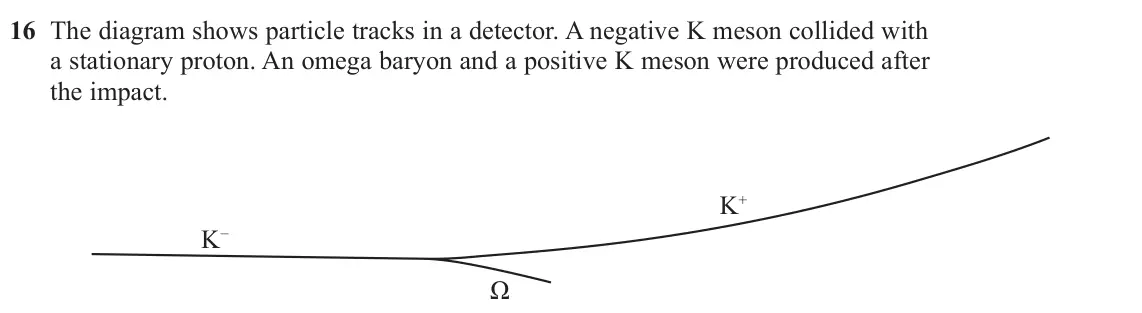
All 34 questions on Mass-energy, creation and annihilation, MeV and GeV, as a list
- June 2025, Unit 4, Q7 (1 mark): An electron and a positron collide and annihilate, producing two photons. Which of the following is the energy, in joules, of one of these photons? A 9.11 × 10
- June 2025, Unit 4, Q14(b) (3 marks): Before its discovery, the mass of the Ω – was predicted to be 2.9714 × 10 –27 kg. The most recent accepted value for the mass of the Ω – is 1672 MeV/c 2. Calcul
- January 2025, Unit 4, Q7 (1 mark): In pair production, a high energy photon creates a particle‑antiparticle pair. In one interaction, a photon produces an electron and a positron. Which of the fo
- October 2024, Unit 4, Q10 (1 mark): A proton and an anti-proton travel in opposite directions towards each other. Each particle has energy of 450 GeV. When the particles collide, they annihilate a
- October 2024, Unit 4, Q11 (3 marks): In 2021 scientists identified Amaterasu, the second most energetic cosmic ray particle ever detected on Earth. Amaterasu had an energy of 2.4 × 10²⁰ eV. A newsp
- June 2024, Unit 4, Q14(b)(ii) (3 marks): Scientists search for new particles using high energy particle collisions. The highest energy particle collisions involve colliding protons moving in opposite d
- June 2024, Unit 4, Q14(b)(iii) (1 mark): Leptoquarks have not yet been observed. Suggest why leptoquarks have not yet been observed. (1)
- June 2024, Unit 4, Q16(a) (3 marks): The high energy electrons produced will have energy 60 GeV. Show that these electrons will be travelling at relativistic speeds. (3)
- January 2024, Unit 4, Q22(a)(ii) (3 marks): The mass of a K – meson is 494 MeV / c 2. Calculate the mass of a K – meson in kg. (3) – meson mass = kg K
- October 2023, Unit 4, Q21(c) (3 marks): Calculate the mass, in kg, of a muon. (3) Mass of muon = kg
- June 2023, Unit 4, Q7 (1 mark): A particle has mass 6.5 MeV / c 2. Which of the following gives the mass, in kg, of the particle? 19 6 5 . 1 6 . 10 A 2 8 3 10 13 6 5 . 1 6 . 10 B 2 8 3 10 2 C
- January 2023, Unit 4, Q18(b)(ii) (3 marks): In the collider experiment, the protons and anti-protons each had total energy 900 GeV. Calculate the maximum kinetic energy, in joules, of a top quark produced
- January 2023, Unit 4, Q18(b)(iii) (3 marks): Deduce whether a top quark with kinetic energy 1.2 × 10 relativistic speed. 2 rest mass of top quark = 173 GeV/c (3)
- January 2023, Unit 5, Q16(b) (3 marks): The theory suggests that the mass of the new type of neutrino particle is 4.8 × 10 8 GeV/c 2. Calculate the mass of this particle in kg. (3) Mass of particle =
- October 2022, Unit 4, Q13(a) (4 marks): The mass of the Z boson is 91 GeV/c 2. Show that the mass of the Z boson is nearly 100 times greater than the mass of a proton. (4)
- October 2022, Unit 4, Q13(b) (3 marks): Protons and anti-protons were accelerated in the Spp–S to very high energies before they collided. Explain why the protons and anti-protons needed high energies
- October 2022, Unit 5, Q18(b) (4 marks): Radioactive phosphorus was one of the first artificially produced isotopes to be used in the diagnosis of cancerous tumours. The isotope 32P is injected into a
- June 2022, Unit 4, Q13(b) (3 marks): In some experiments, a high-energy electron collides with a stationary atom. In other experiments beams of high-energy electrons, travelling in opposite directi
- June 2022, Unit 4, Q14(d) (3 marks): Calculate the mass of a proton in GeV/c2. (3) Mass = GeV/c2
- January 2022, Unit 4, Q16(c) (6 marks): The rest mass of the omega baryon is significantly larger than the rest mass of the proton. Discuss how energy and momentum are conserved during this collision.
- January 2022, Unit 4, Q17(c) (3 marks): A website states: “The rest mass of a muon is 106 MeV / c2, which is a little over 200 times that of an electron.” Deduce whether this statement is correct. (3)
- January 2022, Unit 4, Q17(d)(i) (2 marks): Explain why the unit GeV / c is a valid unit for momentum. (2)
- October 2021, Unit 4, Q17(b)(i) (4 marks): An omega baryon has a mass equivalent to 3272 times the mass of an electron. Show that the mass of an omega baryon is about 1700 MeV/c2. (4)
- October 2021, Unit 4, Q17(b)(ii) (3 marks): Calculate the kinetic energy of one of the omega baryons. (3) Kinetic energy =
- June 2021, Unit 4, Q18(c)(i) (3 marks): Show that the positron must have been travelling at a relativistic speed. Assume that all of its energy is kinetic energy. (3)
- June 2021, Unit 4, Q18(d) (4 marks): A positron travelling at a non-relativistic speed of 1.5 × 10⁷ m s−1 collides with an electron travelling at the same speed in the opposite direction. This coll
- January 2021, Unit 4, Q4 (1 mark): A particle has a mass of 3.17 × 10⁻²⁷ kg. Which of the following gives the mass in GeV/c2? 3 17 . × 10 × 10 × 1 6 . × 10 − 27 9 − 19 A 3 00 . × 10 8 3 17 . × 10
- January 2021, Unit 4, Q13(a) (2 marks): Explain how energy is conserved in this decay. (2)
- October 2020, Unit 4, Q12(a) (1 mark): Name the process involved in producing the gamma photons. (1)
- October 2020, Unit 4, Q12(b) (4 marks): Calculate the maximum wavelength of the gamma photons produced. (4) Wavelength =
- October 2020, Unit 4, Q14(c) (3 marks): We now know that the nucleus is positively charged. An alpha particle with kinetic energy of 6.29 MeV approaches a platinum nucleus and is repelled. The proton
- October 2020, Unit 5, Q14(b) (2 marks): The energy radiated from the Sun results in a decrease in the mass of the Sun. Calculate the decrease in the mass of the Sun due to this radiation over a period
- October 2020, Unit 5, Q18(b)(ii) (5 marks): It is claimed that calcium ions with an energy of 245 MeV are travelling at relativistic speeds. Assess the validity of this claim. mass of calcium ion = 47.95
- January 2020, Unit 4, Q6 (1 mark): A gamma photon of energy 18 MeV produces a particle and its antiparticle. Which of the following will give the maximum possible mass of the particle in kg? − 19
Questions, mark schemes and examiner’s reports are © Pearson Edexcel, from their published past papers. Plumi isn’t affiliated with any exam board. Want whole papers? Edexcel International A Level Physics past papers.
The Plumi iPad app also offers exam-style questions with AI feedback on your handwritten working.