 plumi
The quark-lepton model and antiparticles: Edexcel International A Level Physics questions
Edexcel International A Level Physics past-paper questions on 4.5.2.3 The quark-lepton model and antiparticles, 2019–2025, with mark schemes and examiner’s reports where available.
Paper
All papers
Exam
All years
Calculations
Q14(a)(i)
The whole paper ↗
- Your answer
- Your answer
- Your answer
Q18(b)(i)
The whole paper ↗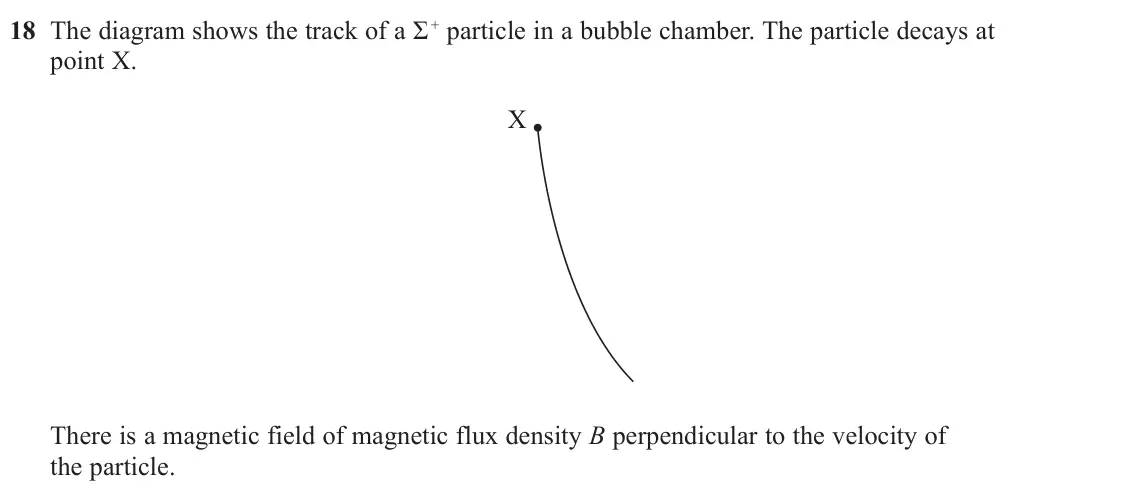
Q11(b)
The whole paper ↗
Q14(a)
The whole paper ↗
Q14(b)(i)
The whole paper ↗Q22(a)(i)
The whole paper ↗
Q21(a)
The whole paper ↗
- Your answer
- Your answer
Q11(a)
The whole paper ↗
Q18(a)(i)
The whole paper ↗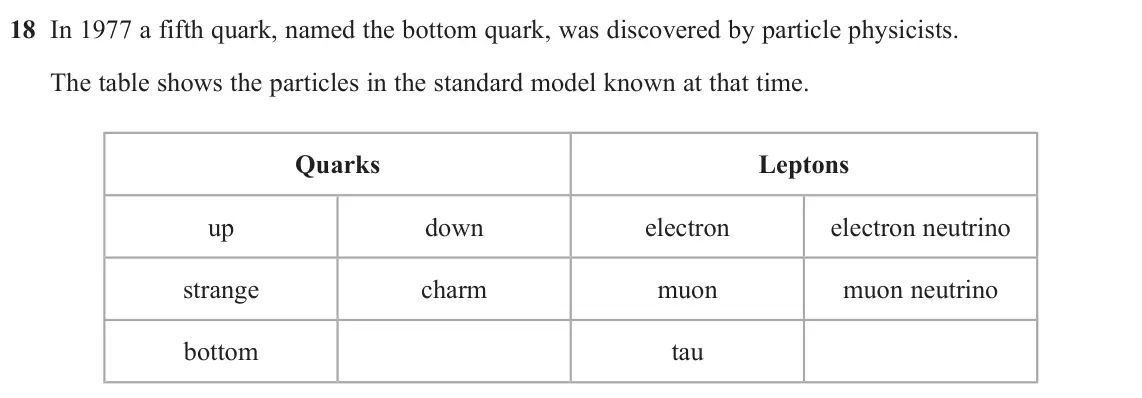
Q18(a)(ii)
The whole paper ↗- Your answer
- Your answer
Q11(a)
The whole paper ↗Q11(b)
The whole paper ↗
All 34 questions on The quark-lepton model and antiparticles, as a list
- June 2025, Unit 4, Q14(a)(i) (1 mark): State the quark structure of a meson. (1)
- January 2025, Unit 4, Q2 (1 mark): The standard quark‑lepton model includes particles called mesons. Which of the following is a meson? A photon B pion C positron D proton
- January 2025, Unit 4, Q4 (1 mark): The positron is the antiparticle of the electron. Which row of the table gives a similarity and a difference between a positron and an electron? Similarity Diff
- October 2024, Unit 4, Q3 (1 mark): Which row of the table shows a fundamental particle and a non-fundamental particle? Fundamental Non-fundamental A alpha neutron B lepton meson C proton electron
- October 2024, Unit 4, Q18(b)(i) (1 mark): The Σ + particle is made of two up quarks and one strange quark. State what type of particle Σ + is. (1)
- June 2024, Unit 4, Q11(b) (2 marks): A book about the Chadwick experiment includes the following statement: “Chadwick’s experiment established that the neutron was a new fundamental particle and no
- June 2024, Unit 4, Q14(a) (2 marks): State the quark structure of baryons and of mesons. (2) Baryon Meson
- June 2024, Unit 4, Q14(b)(i) (5 marks): One type of leptoquark has charge +5e/3 Determine the baryon number and the lepton number for this leptoquark. Include the suggested quark and lepton in your wo
- January 2024, Unit 4, Q22(a)(i) (2 marks): The following table lists some quarks and their charge. Quark Charge / e + 2 Up (u) 3 − 1 Down (d) 3 − 1 Strange (s) 3 Explain the quark structure of a K – meso
- October 2023, Unit 4, Q21(a) (1 mark): Give a possible quark structure of a pion. (1)
- June 2023, Unit 4, Q6 (1 mark): Which of the following is a fundamental particle? A neutrino B neutron C pion D proton
- June 2023, Unit 4, Q11 (5 marks): In 2022, CERN announced the discovery of a new particle known as a pentaquark which is made of five quarks. The table shows the charges on some quarks. Quark Ch
- January 2023, Unit 4, Q1 (1 mark): The table shows the charges on up quarks and down quarks. Quark Charge / e + 2 u 3 – 1 d 3 Which row of the table shows the quark structure of protons and neutr
- January 2023, Unit 4, Q11(a) (1 mark): State one difference between a positron and an electron. (1)
- January 2023, Unit 4, Q18(a)(i) (3 marks): Explain why the existence of a sixth quark was predicted. (3)
- January 2023, Unit 4, Q18(a)(ii) (1 mark): A short time after formation, most quarks combine to make particles known as hadrons. There are two categories of hadron. Name the two categories of hadron. (1)
- October 2022, Unit 4, Q1 (1 mark): Which row of the table describes the mass and charge of an anti-proton? Mass / kg Charge / C A −27 −19 1.67 × 10 1.6 × 10 B −27 −19 1.67 × 10 −1.6 × 10 C −27 −1
- October 2022, Unit 4, Q7 (1 mark): The table shows the relative charges on up and down quarks. 2 u 3 e − 1 3 e d Which of the following could be the quark composition for a baryon with a charge o
- October 2022, Unit 4, Q11(a) (1 mark): Pions belong to a group of particles known as mesons. State the quark structure of mesons. (1)
- October 2022, Unit 4, Q11(b) (1 mark): Muons belong to a family of particles known as leptons. State one property of leptons. (1)
- June 2022, Unit 4, Q1 (1 mark): Which of the following is a fundamental particle? A pion B proton C neutrino D neutron
- June 2022, Unit 4, Q14(c) (2 marks): The table shows the charge for the up quark and the down quark as a fraction of the charge on the proton. Quark Charge u +2/3 d –1/3 Deduce the quark structure
- June 2022, Unit 5, Q13(b) (2 marks): Occasionally 40K decays by emitting a β+ particle. Give two similarities between a β– particle and a β+ particle. (2)
- January 2022, Unit 4, Q2 (1 mark): Which row in the table gives the charge and mass of an antiproton? Charge / C Mass / kg A 1.6 × 10⁻¹⁹ −9.11 × 10⁻³¹ B −1.6 × 10⁻¹⁹ 9.11 × 10⁻³¹ C 1.6 × 10⁻¹⁹ −1
- January 2022, Unit 4, Q16(b)(i) (2 marks): Describe the structure of a baryon and a meson. (2)
- January 2022, Unit 4, Q17(a) (2 marks): The muon belongs to the same family of particles as the electron. State how the muon is classified in the standard model. (2)
- October 2021, Unit 4, Q1 (1 mark): Which of the following is a fundamental particle? A atom B baryon C neutrino D pion
- October 2021, Unit 4, Q9 (1 mark): Which of the following is the quark structure for a π– particle? A d d d B u u d C u d D u d
- June 2021, Unit 4, Q1 (1 mark): Which of the following is a fundamental particle? A antiproton B muon C neutron D pion
- June 2021, Unit 4, Q4 (1 mark): In 2015, a pentaquark was discovered. The pentaquark was made of 5 quarks, c, c–, d, u, u. The pentaquark can form a baryon-meson combination. Which row of the
- June 2021, Unit 4, Q18(a) (3 marks): State the properties of a positron that show it is the antiparticle to the electron. (3)
- January 2021, Unit 4, Q14(b) (2 marks): After muons were discovered in 1936 they were known for many years as mu mesons. Explain why muons are not described as mesons in the standard model. (2)
- October 2020, Unit 4, Q13 (4 marks): In 1964 George Zweig proposed a model for matter. Zweig suggested that mesons and baryons are made from a set of fundamental particles he called aces. In this m
- January 2020, Unit 4, Q12 (6 marks): The following passage is taken from an article about the history of particle physics. Mystery Particle By 1932 scientists knew of the existence of the subatomic
Questions, mark schemes and examiner’s reports are © Pearson Edexcel, from their published past papers. Plumi isn’t affiliated with any exam board. Want whole papers? Edexcel International A Level Physics past papers.
The Plumi iPad app also offers exam-style questions with AI feedback on your handwritten working.