 plumi
Force-extension graphs, elastic and plastic deformation: Edexcel International A Level Physics questions
Edexcel International A Level Physics past-paper questions on 1.4.2.3 Force-extension graphs, elastic and plastic deformation, 2019–2025, with mark schemes and examiner’s reports where available.
Paper
All papers
Exam
All years
Calculations
Q15(b)
The whole paper ↗
- Your answer
- Your answer
Q18(b)
The whole paper ↗
- Your answer
Q11(a)
The whole paper ↗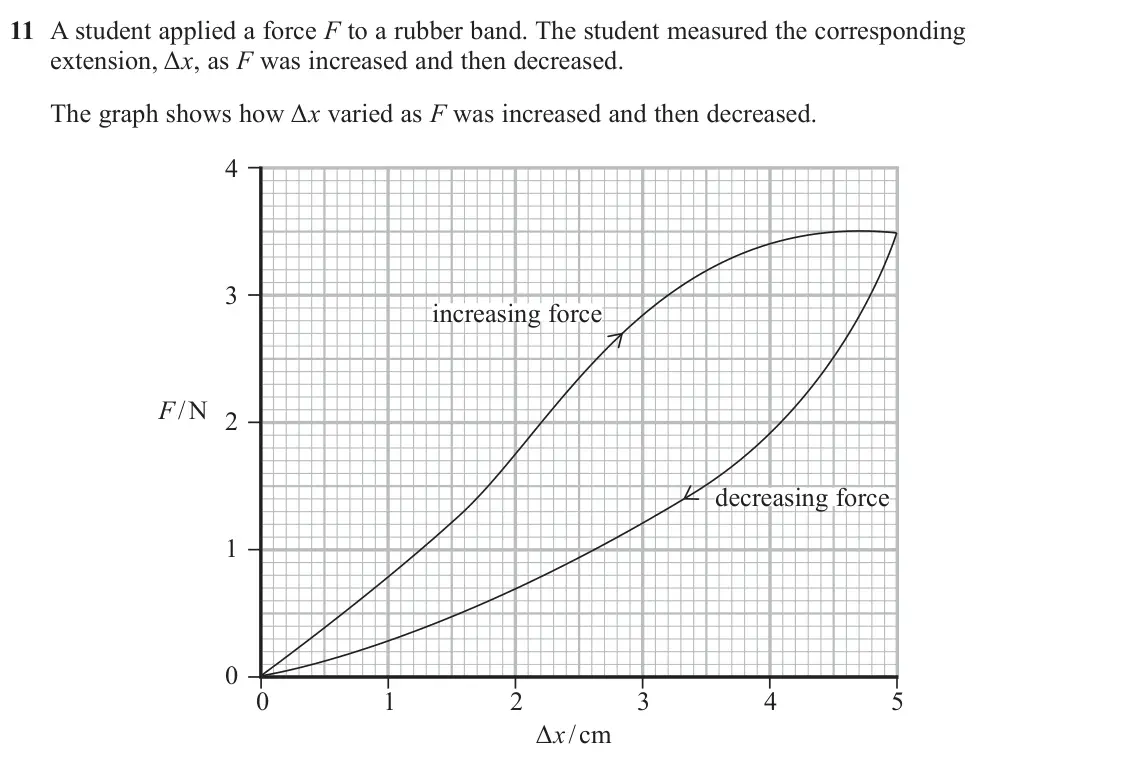
Q11(b)
The whole paper ↗- Your answer
Q20(a)
The whole paper ↗
- Your answer
Q14(a)
The whole paper ↗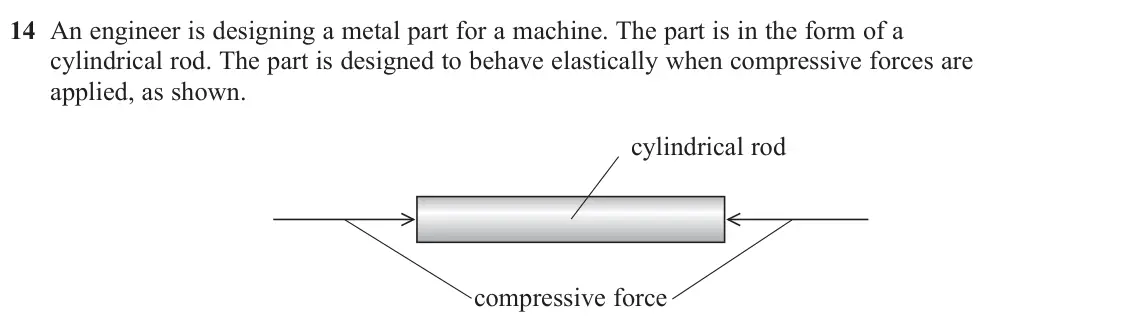
Q12(b)(i)
The whole paper ↗
Q12(a)
The whole paper ↗
Q14(a)
The whole paper ↗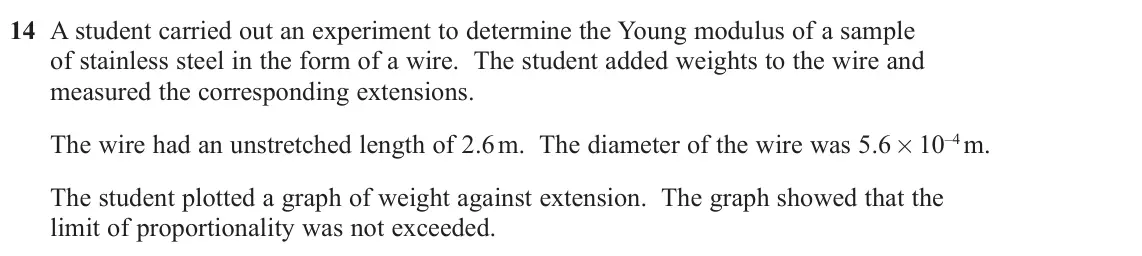
Q14(b)(i)
The whole paper ↗Q18(b)
The whole paper ↗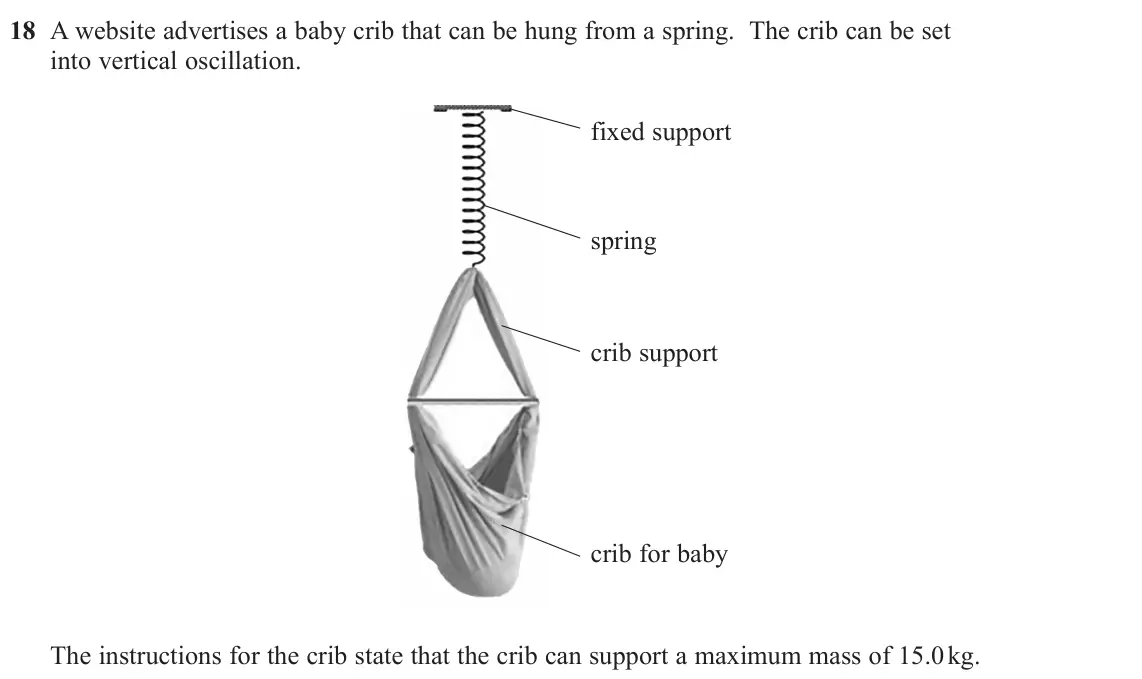
Q3(a)
The whole paper ↗
Q3(b)
The whole paper ↗Q18(c)(i)
The whole paper ↗
Q16(a)(i)
The whole paper ↗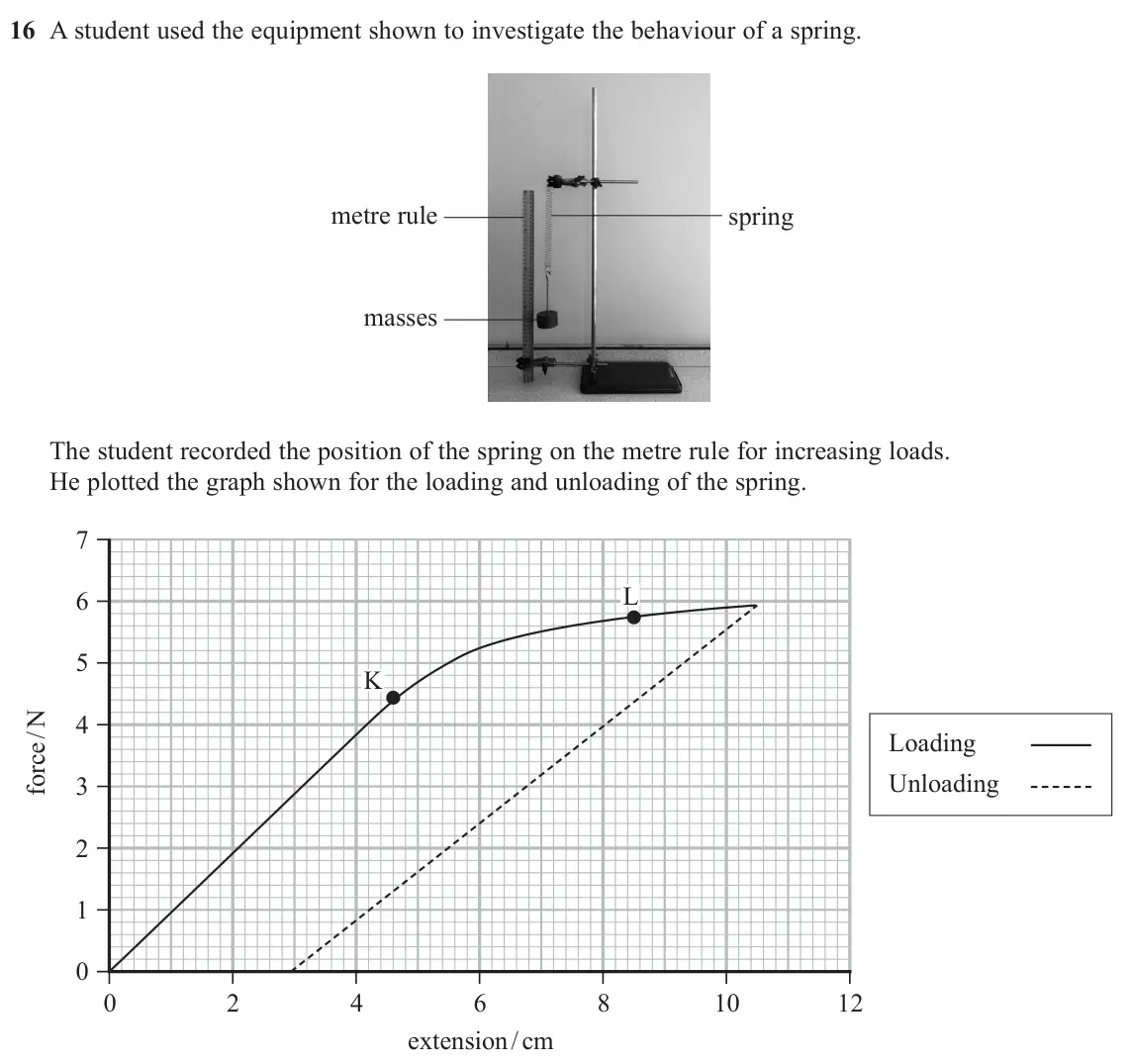
All 27 questions on Force-extension graphs, elastic and plastic deformation, as a list
- June 2025, AS Unit 1, Q15(b) (1 mark): The brick undergoes elastic deformation. State what is meant by elastic deformation. (1)
- January 2025, AS Unit 1, Q4 (1 mark): A spring is stretched beyond its elastic limit. The applied force is then removed. Which of the following describes the behaviour of the spring? A The extension
- October 2024, AS Unit 1, Q7 (1 mark): A student applies a force to stretch a thin metal wire. Which of the following describes the wire at the elastic limit? A The wire is elastically deformed. B Th
- October 2024, AS Unit 1, Q18(b) (4 marks): The scientist investigated a thread of length 25.0 m. Determine the length of this thread when stretched to its limit of proportionality. Young modulus of spide
- January 2024, AS Unit 1, Q9 (1 mark): A force is applied to stretch two wires, P and Q, until the wires break. Each wire is made of a different metal. The stress-strain graph for each wire is shown.
- January 2024, AS Unit 1, Q11(a) (1 mark): State how the graph shows that the rubber band deformed elastically. (1)
- January 2024, AS Unit 1, Q11(b) (3 marks): The work done on the rubber band as F increased is greater than the work done by the rubber band as F was decreased. There is a difference in these values becau
- October 2023, AS Unit 1, Q3 (1 mark): Which of the following could be used to describe the elastic limit of a material? A The stress above which the material will not obey Hooke’s law. B The stress
- June 2023, AS Unit 1, Q20(a) (1 mark): The force on the cable must not cause the material of the cable to reach its yield point. State what is meant by the yield point of a material. (1)
- June 2023, Unit 5, Q6 (1 mark): Buildings in earthquake zones often have a structure that includes ductile materials. These materials help to damp oscillations of the building during an earthq
- January 2023, AS Unit 1, Q14(a) (1 mark): State what is meant by elastic deformation. (1)
- October 2022, AS Unit 1, Q12(b)(i) (2 marks): Show that the stiffness of the wire is about 1.3 × 10⁴ N m–1. (2)
- June 2022, AS Unit 1, Q12(a) (1 mark): State what is meant by the elastic limit. (1)
- October 2021, AS Unit 1, Q14(a) (1 mark): State what is meant by the limit of proportionality. (1)
- October 2021, AS Unit 1, Q14(b)(i) (2 marks): Determine the gradient of the graph. (2) Gradient =
- October 2021, Unit 5, Q18(b) (2 marks): The maximum mass that the spring can support before being damaged is 25.0 kg. Explain why the instructions state that the maximum mass is only 15.0 kg. (2)
- January 2021, AS Unit 3, Q3(a) (5 marks): Describe a method he could have used to take the measurements. Your answer should include a diagram. (5)
- January 2021, AS Unit 3, Q3(b) (3 marks): The student measured the extension as he was loading and unloading the rubber band. The graph shows his results. 10.0 9.0 8.0 7.0 loading 6.0 unloading 5.0 4.0
- January 2021, Unit 5, Q18(c)(i) (1 mark): State what is meant by an elastic material. (1)
- October 2020, AS Unit 1, Q16(a)(i) (1 mark): State the significance of point K. (1)
- October 2020, AS Unit 1, Q16(a)(ii) (2 marks): Explain the significance of point L. (2)
- October 2020, AS Unit 1, Q16(a)(iii) (1 mark): The graph for the unloading of the spring is also shown on the axes. Suggest why the unloading graph has a different gradient to the loading graph. (1)
- October 2020, AS Unit 1, Q16(b) (1 mark): A second student repeated the investigation but forgot to subtract the original length of the spring from his measurements. Sketch, on the axes below, the shape
- January 2020, AS Unit 1, Q9 (1 mark): A length of steel wire is fixed at one end. An increasing force is applied to the other end of the wire. The force extension graph for the wire is shown. P Q R
- January 2020, AS Unit 1, Q17(b) (2 marks): When the glider was moved to the right by more than 0.5 m, the graph began to curve. Explain why the shape of the graph changed. (2)
- June 2019, AS Unit 1, Q17(b) (6 marks): Climbing rope manufacturers recommend that ropes are replaced every 5 years. The force-extension graphs, up to the breaking point, for a one metre length of a r
- January 2019, AS Unit 1, Q17(c) (3 marks): Manufacturers recommend leaving concrete blocks to dry for at least 28 days before use. Discuss why. (3)
Questions, mark schemes and examiner’s reports are © Pearson Edexcel, from their published past papers. Plumi isn’t affiliated with any exam board. Want whole papers? Edexcel International A Level Physics past papers.
The Plumi iPad app also offers exam-style questions with AI feedback on your handwritten working.