 plumi
Free and forced oscillations and damping: Edexcel International A Level Physics questions
Edexcel International A Level Physics past-paper questions on 5.5.2.3 Free and forced oscillations and damping, 2019–2025, with mark schemes and examiner’s reports where available.
Paper
All papers
Exam
All years
Calculations
Q15(c)
The whole paper ↗
- Your answer
- Your answer
Q3(b)(i)
The whole paper ↗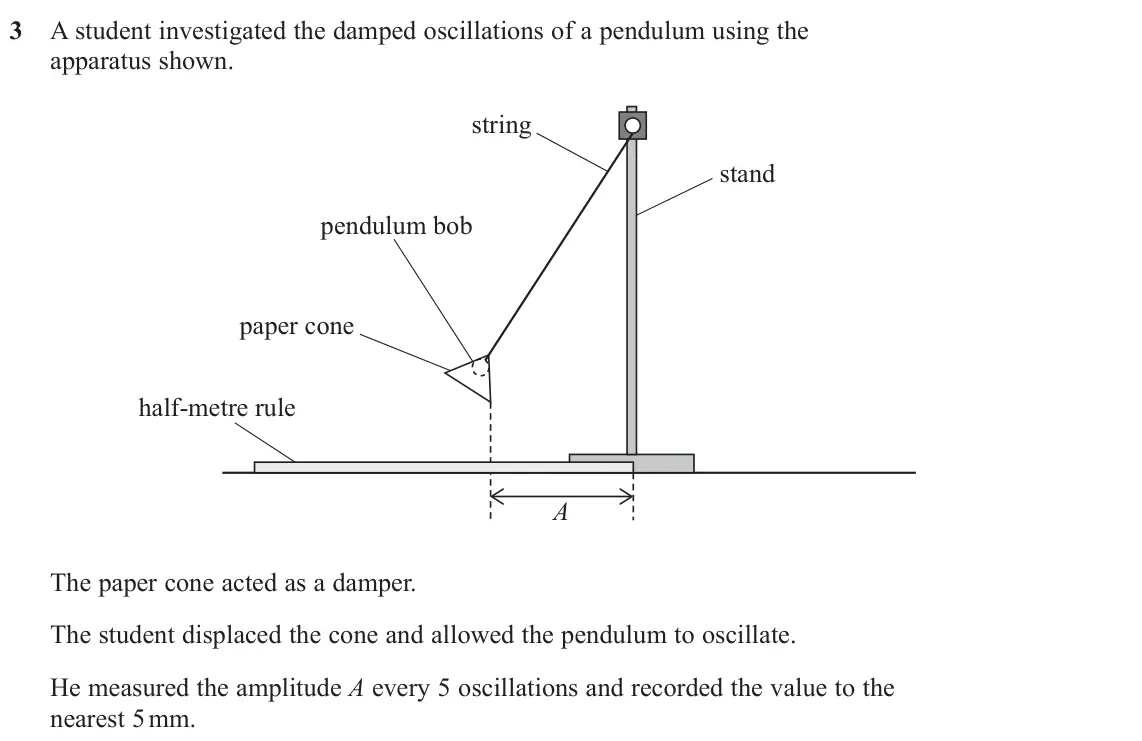
Q3(b)(iii)
The whole paper ↗Q3(b)(iv)
The whole paper ↗- Your answer
Q2(b)
The whole paper ↗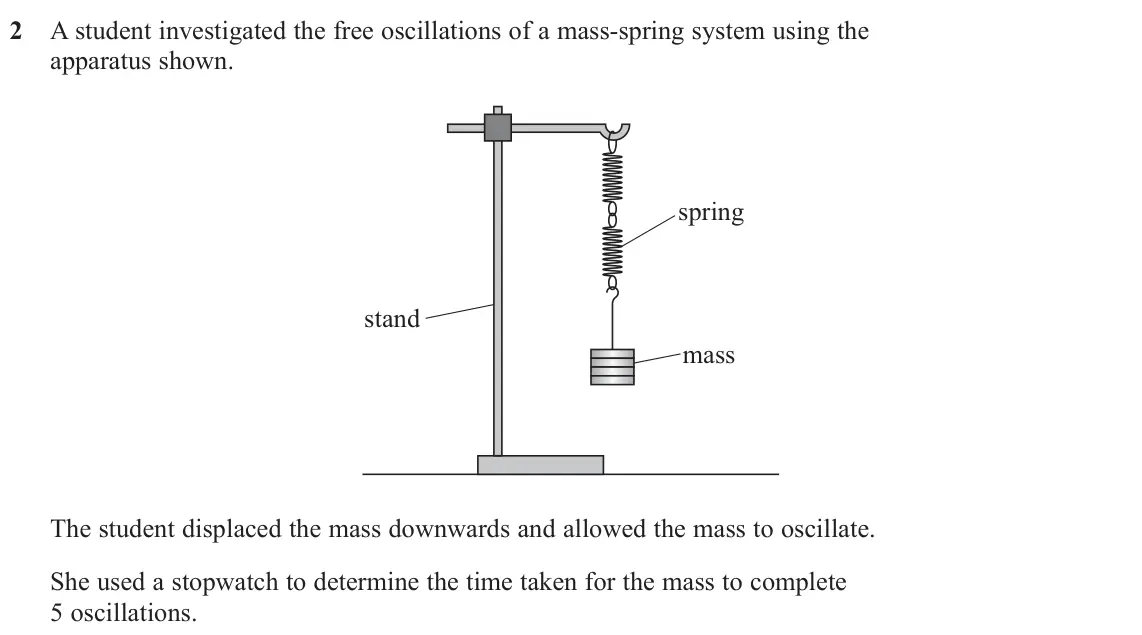
- Your answer
Q20(b)(iii)
The whole paper ↗
Q20(c)
The whole paper ↗- Your answer
- Your answer
Q19(b)(i)
The whole paper ↗
Q19(c)
The whole paper ↗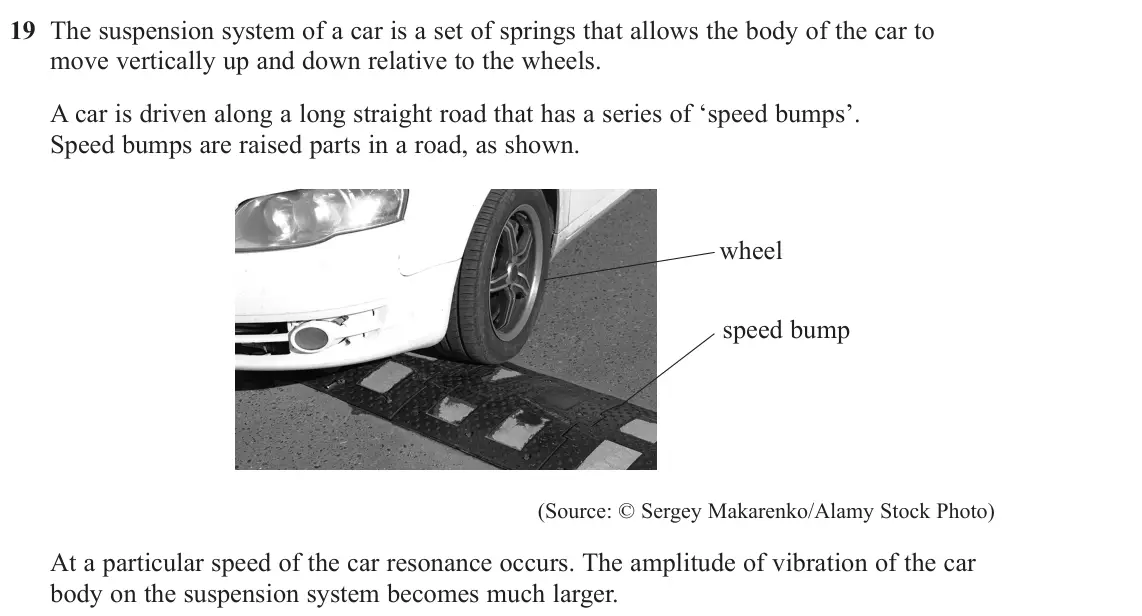
Q3(a)
The whole paper ↗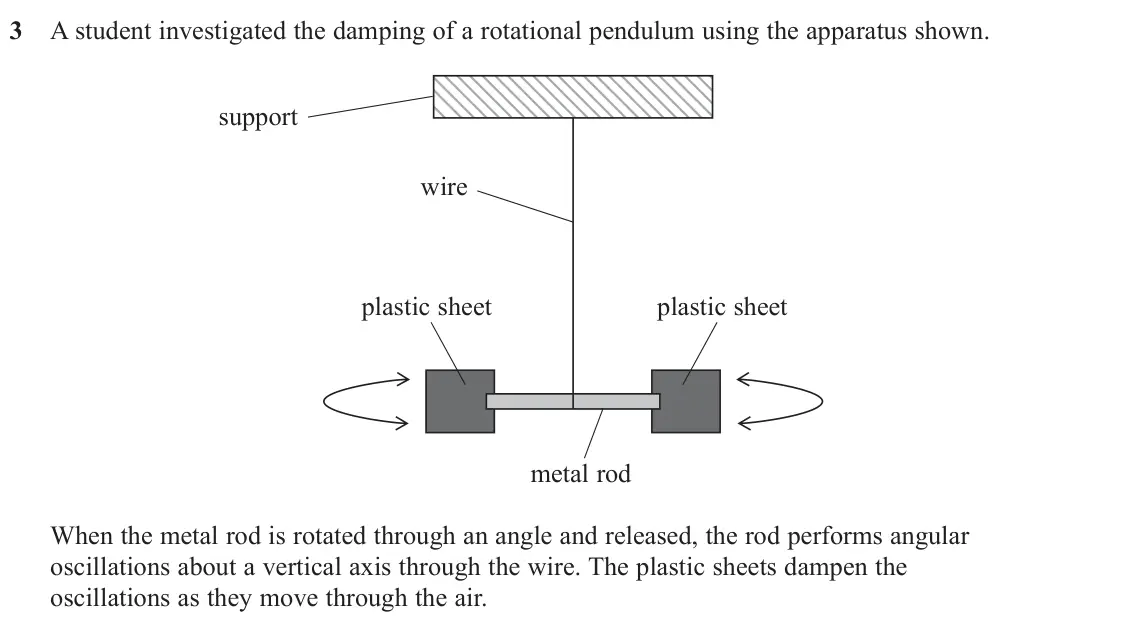
Q3(b)(ii)
The whole paper ↗- Your answer
Q18(c)(iii)
The whole paper ↗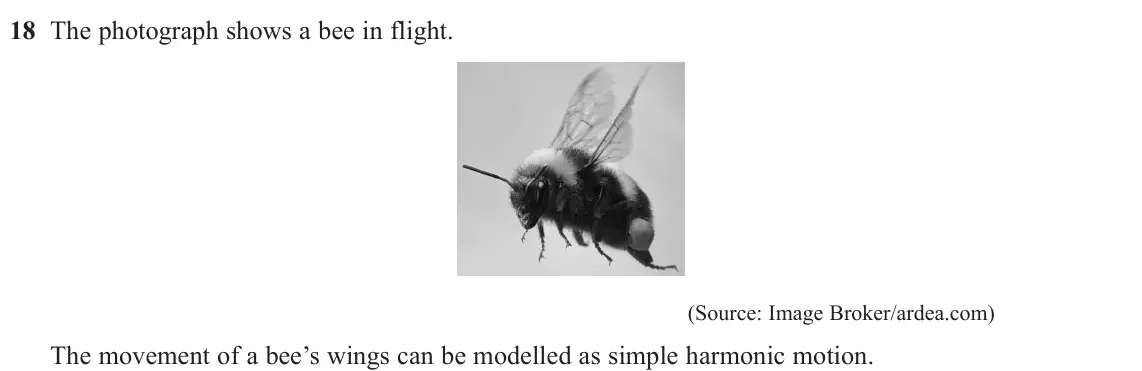
All 22 questions on Free and forced oscillations and damping, as a list
- June 2025, Unit 5, Q15(c) (2 marks): Explain how damping causes the amplitude of oscillation of the car body to decrease. (2)
- January 2025, Unit 5, Q2 (1 mark): Ductile materials can be used in buildings to reduce the amplitude of forced oscillations during an earthquake. Which of the following is the reason that ductil
- January 2025, Unit 5, Q8 (1 mark): A pendulum is made by attaching a light paper cone to a thin string, as shown. string paper cone The pendulum is displaced and set into oscillation. Plasticine
- January 2025, Unit 5, Q15 (6 marks): * 15 The Millennium Bridge, as shown, is a suspension bridge for people to cross the River Thames in London. (Source: © cowardlion/Shutterstock) The bridge deve
- January 2025, Unit 6, Q3(b)(i) (2 marks): Explain how a graph of ln A against n can be used to determine the value of λ. (2)
- January 2025, Unit 6, Q3(b)(iii) (3 marks): Determine the value of λ from the graph. (3) λ =
- January 2025, Unit 6, Q3(b)(iv) (3 marks): Determine the value of A0 from the graph. (3) A0 =
- October 2024, Unit 5, Q2 (1 mark): During an earthquake, steel‑framed buildings remove energy from the oscillation of the building. Which of the following is the reason for this? A Steel is a duc
- October 2024, Unit 6, Q2(b) (6 marks): The student modified the apparatus to investigate damped oscillations of the mass‑spring system. She placed a circular piece of card between the masses to act a
- June 2024, Unit 5, Q4 (1 mark): A mass is forced into oscillation by a vibration generator. After a short time the oscillation becomes steady. Which of the following statements about the stead
- June 2024, Unit 5, Q20(b)(iii) (2 marks): When the building oscillates, the floor moves but the lead box tends to remain at rest. Suggest why the lead box tends to remain at rest. (2)
- June 2024, Unit 5, Q20(c) (2 marks): As the floor moves, the rollers force oil through holes in the steel plate. Explain why this reduces the amplitude of oscillation of the building. (2)
- October 2023, Unit 5, Q4 (1 mark): A mass suspended from a spring is oscillating vertically. The oscillations are damped. Which of the following statements is correct? A The damping force is alwa
- June 2023, Unit 5, Q6 (1 mark): Buildings in earthquake zones often have a structure that includes ductile materials. These materials help to damp oscillations of the building during an earthq
- June 2023, Unit 5, Q19(b)(i) (3 marks): Explain this observation. (3)
- January 2023, Unit 5, Q19(c) (2 marks): Explain how damping reduces the large amplitude of vibration of the car on its suspension. (2)
- January 2023, Unit 6, Q3(a) (2 marks): The relationship between the maximum displacement angle θ and number of oscillations n is given by θ = θ0e–λn where θ0 is the initial displacement angle and λ i
- January 2023, Unit 6, Q3(b)(ii) (3 marks): Determine the value of λ from the graph. (3) λ =
- October 2022, Unit 5, Q10 (1 mark): The suspension system of a car was tested by forcing the car into vertical oscillations. The forcing frequency was gradually increased and corresponding amplitu
- January 2021, Unit 5, Q18(c)(iii) (2 marks): The bee’s wings oscillate at a frequency of 240 Hz, but the muscles only oscillate at a frequency of 60 Hz. Suggest how impulses applied at 60 Hz can maintain a
- October 2020, Unit 5, Q19(a) (2 marks): The graph shows how the energy absorbed by a water molecule depends on the frequency of the radiation. Energy absorbed 0.1 1 10 100 frequency / GHz A website su
- October 2020, Unit 5, Q20(d) (3 marks): The mass is submerged in water as shown. The mass is set into oscillation as before. Explain how the water would affect the amplitude of oscillation of the mass
Questions, mark schemes and examiner’s reports are © Pearson Edexcel, from their published past papers. Plumi isn’t affiliated with any exam board. Want whole papers? Edexcel International A Level Physics past papers.
The Plumi iPad app also offers exam-style questions with AI feedback on your handwritten working.