 plumi
Yield and rate in industry: Edexcel International A Level Chemistry questions
Edexcel International A Level Chemistry past-paper questions on 9.B.3 Yield and rate in industry, 2019–2025, with mark schemes and examiner’s reports where available.
Paper
All papers
Exam
All years
Calculations
Q17(c)(ii)
The whole paper ↗
Q21(e)(i)
The whole paper ↗
Q21(e)(iii)
The whole paper ↗Q2(a)
The whole paper ↗ Your answer
Q2(b)
The whole paper ↗Your answerQ19(b)
The whole paper ↗
Q19(c)(i)
The whole paper ↗Q19(c)(ii)
The whole paper ↗Q19(c)(iv)
The whole paper ↗Q19(c)(v)
The whole paper ↗Q11(a)
The whole paper ↗ Your answer
Q11(b)
The whole paper ↗Your answerQ21(b)
The whole paper ↗
Q22(b)(i)
The whole paper ↗
Q22(c)
The whole paper ↗Q22(e)(i)
The whole paper ↗Q22(h)
The whole paper ↗Q18(d)
The whole paper ↗
Q22(e)(i)
The whole paper ↗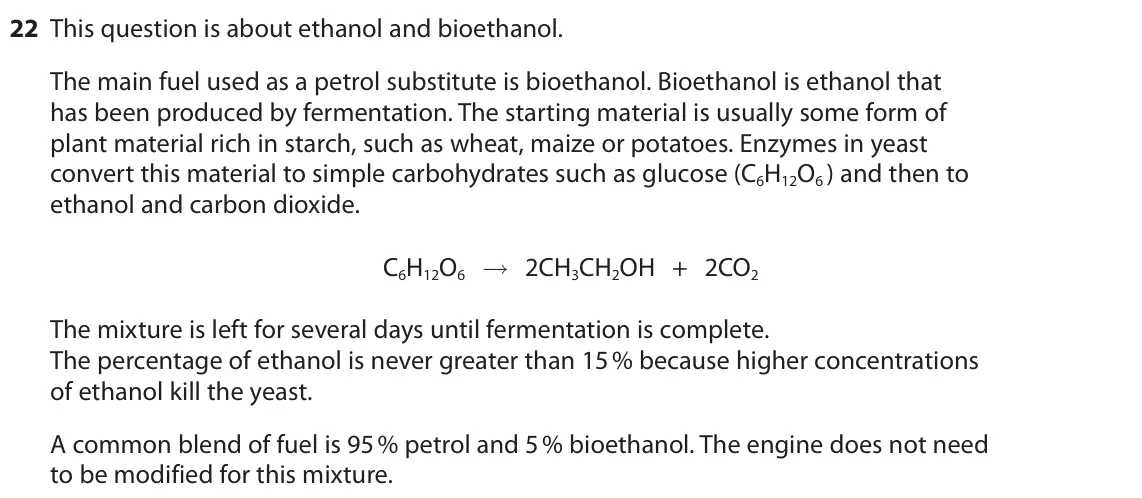
Q22(f)(ii)
The whole paper ↗
All 23 questions on Yield and rate in industry, as a list
- June 2025, AS Unit 2, Q17(c)(ii) (4 marks): Methanol can be produced from the captured carbon dioxide by reaction with hydrogen using a copper catalyst. The equation for the reaction is shown. CO2(g) + 3H
- January 2025, AS Unit 2, Q21(e)(i) (2 marks): Suggest two possible advantages, other than increasing the yield, of a one‑step synthesis reaction. (2)
- January 2025, AS Unit 2, Q21(e)(iii) (5 marks): A one‑step process is being developed. This is carried out at 101 kPa and 800 °C. CH4 + ½O2 CH3OH ΔH = –164.3 kJ mol–1 Deduce how the reaction conditions coul
- October 2024, AS Unit 2, Q2(a) (1 mark): What would be the effect of lowering the temperature? (1) A rate increases, yield increases B rate increases, yield decreases C rate decreases, yield increases
- October 2024, AS Unit 2, Q2(b) (1 mark): What would be the effect of increasing the pressure? (1) A rate increases, yield increases B rate increases, yield decreases C rate decreases, yield increases D
- June 2024, AS Unit 2, Q19(b) (2 marks): Under these conditions, the conversion of ethene to ethanol is 5 % at equilibrium but the overall yield of ethanol for the process is 95 %. Suggest what happens
- June 2024, AS Unit 2, Q19(c)(i) (2 marks): Explain why the temperature used is a compromise. (2)
- June 2024, AS Unit 2, Q19(c)(ii) (2 marks): Explain why a manufacturer might suggest a pressure of greater than the compromise pressure of 7 MPa. (2)
- June 2024, AS Unit 2, Q19(c)(iv) (1 mark): Give one other reason for not operating the process at a pressure greater than 7 MPa. Do not include safety considerations in your answer. (1)
- June 2024, AS Unit 2, Q19(c)(v) (2 marks): Increasing the amount of water in the reaction mixture, without changing the pressure, might also be suggested. Suggest one advantage and one disadvantage of in
- October 2023, AS Unit 2, Q11(a) (1 mark): What is the effect of a decrease in temperature? (1) A rate increases and yield decreases B rate increases and yield increases C rate decreases and yield decrea
- October 2023, AS Unit 2, Q11(b) (1 mark): What is the effect of an increase in pressure? (1) A rate increases and yield decreases B rate increases and yield increases C rate decreases and yield decrease
- June 2023, AS Unit 2, Q21(b) (2 marks): An alternative method for producing methanal uses a silver catalyst at a temperature of 650 °C. The reaction is shown. CH3OH(g) → HCHO(g) + H2(g) Suggest one ad
- January 2023, AS Unit 2, Q22(b)(i) (1 mark): Suggest one reason why CO2 is removed. (1)
- January 2023, AS Unit 2, Q22(c) (2 marks): In Stage 2, the hydrogen from Stage 1 reacts with nitrogen (from the air) to produce ammonia. The conditions for this reaction are: • a temperature of 700 K • a
- January 2023, AS Unit 2, Q22(e)(i) (1 mark): Give one reason why a high temperature is needed in this reaction. (1)
- January 2023, AS Unit 2, Q22(h) (2 marks): Suggest two reasons why it is more profitable to carry out all four stages at the same site, instead of using different sites for each stage in the industrial p
- June 2022, AS Unit 2, Q18(d) (2 marks): Ethanol can be manufactured by reacting ethene with steam. C2H4(g) + H2O(g) C2H5OH(g) ΔrH = −45 kJ mol−1 This reaction is usually carried out in industry at 3
- October 2021, AS Unit 2, Q22(e)(i) (6 marks): Typical conditions are 300 °C and 60 atm with a catalyst of phosphoric acid. Explain why these conditions are used, by describing the effect of changing the tem
- October 2021, AS Unit 2, Q22(f)(ii) (2 marks): Under these conditions, only about 5 % of the ethene is converted into ethanol as it passes over the catalyst. Suggest how the overall yield of this process can
- January 2021, AS Unit 2, Q19(a) (6 marks): Explain the chemical reasons for the conditions used and why such a low initial yield is acceptable in the industrial process. (6)
- October 2020, AS Unit 2, Q17(a)(i) (2 marks): Explain why high pressure is used. (2)
- October 2020, AS Unit 2, Q17(a)(ii) (3 marks): Discuss the factors leading to a choice of 250 °C in this process. (3)
Questions, mark schemes and examiner’s reports are © Pearson Edexcel, from their published past papers. Plumi isn’t affiliated with any exam board. Want whole papers? Edexcel International A Level Chemistry past papers.
The Plumi iPad app also offers exam-style questions with AI feedback on your handwritten working.