 plumi
Weak acids and Ka: Edexcel International A Level Chemistry questions
Edexcel International A Level Chemistry past-paper questions on 14.1.3 Weak acids and Ka, 2019–2025, with mark schemes and examiner’s reports where available.
Paper
All papers
Exam
All years
Calculations
Q17(a)(i)
The whole paper ↗
Q17(a)(ii)
The whole paper ↗Q17(a)(iii)
The whole paper ↗Q17(b)(i)
The whole paper ↗- Your answer
Q19(a)(i)
The whole paper ↗
Q19(a)(ii)
The whole paper ↗Q19(a)(iv)
The whole paper ↗- Your answer
Q19(b)(iii)
The whole paper ↗Q18(a)(i)
The whole paper ↗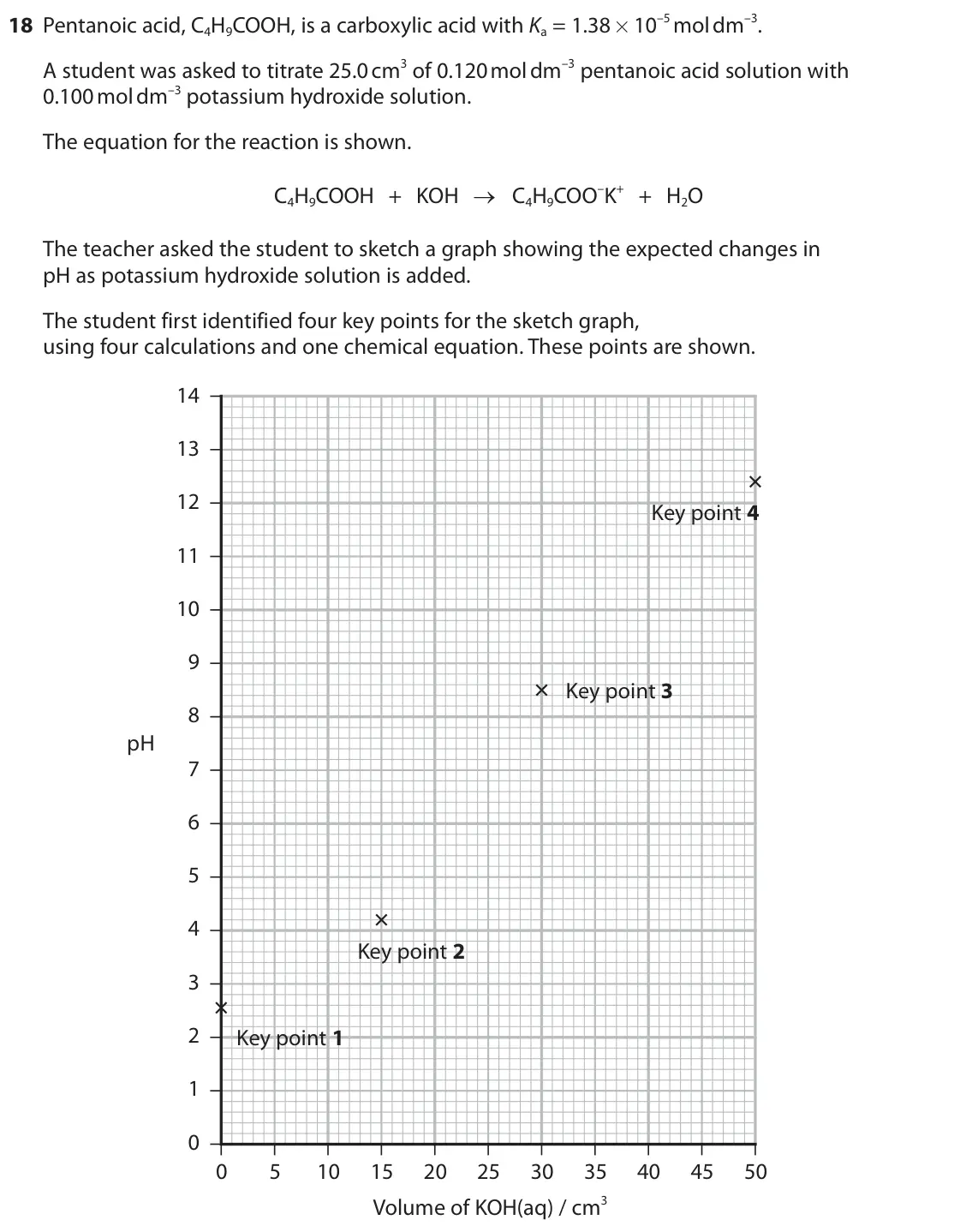
Q21(c)(i)
The whole paper ↗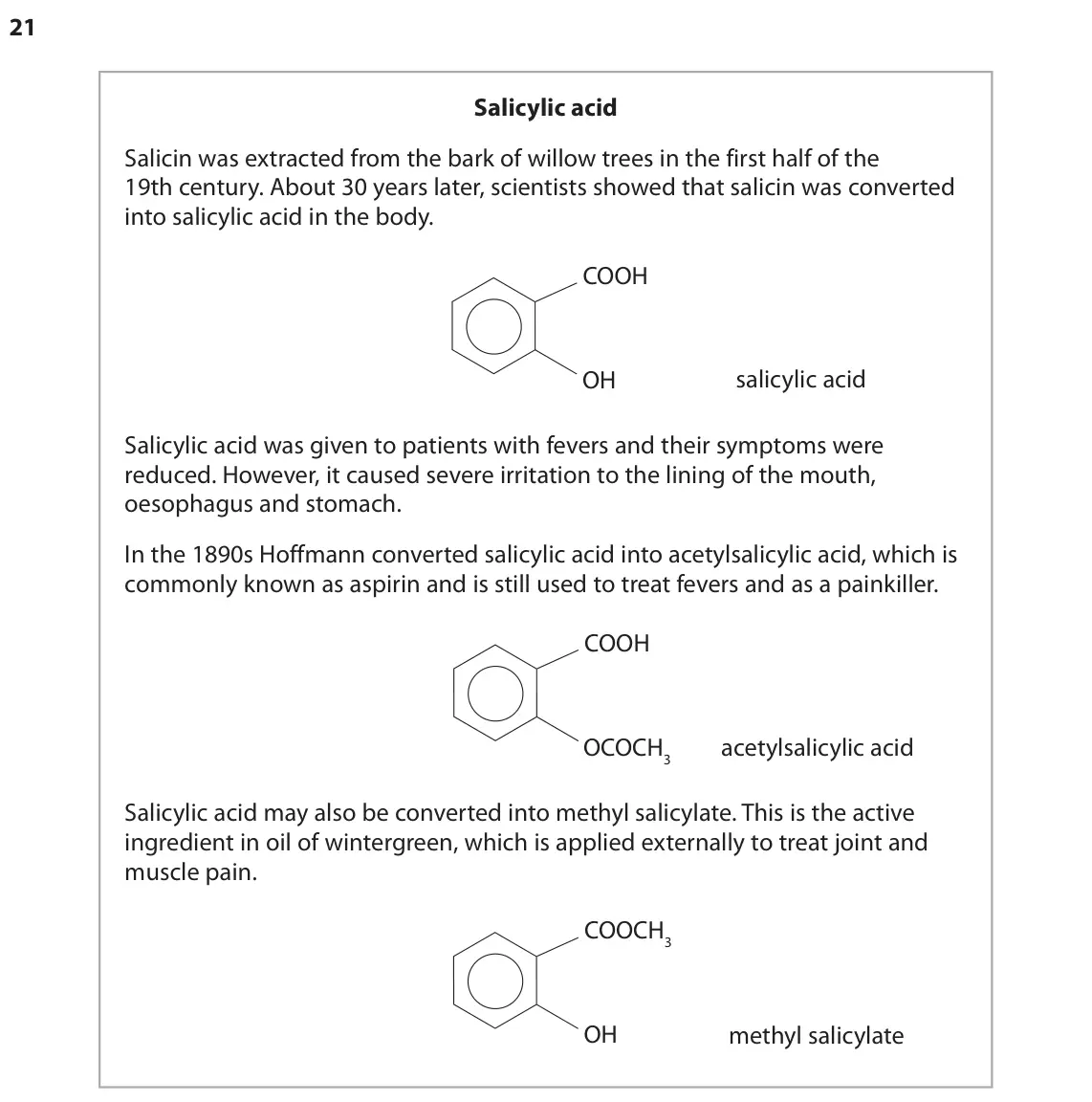
Q21(c)(ii)
The whole paper ↗Q22(b)(ii)
The whole paper ↗
Q22(c)
The whole paper ↗- Your answer
Q21(a)(i)
The whole paper ↗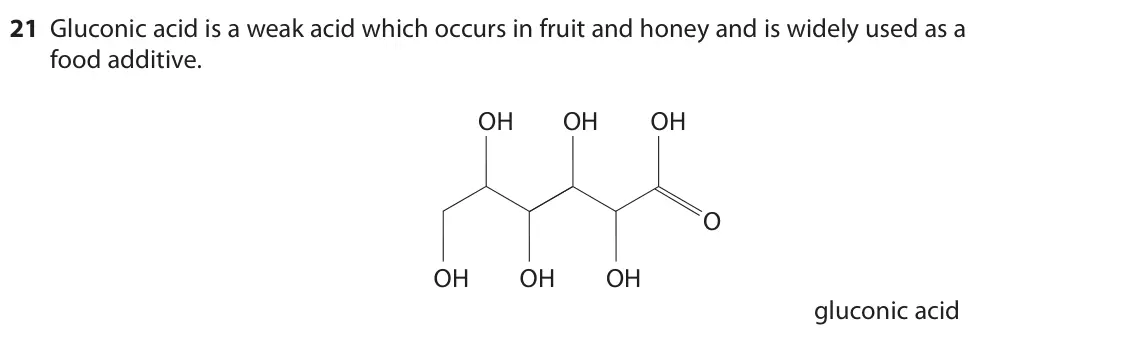
Q21(a)(ii)
The whole paper ↗Q15(d)(i)
The whole paper ↗
Q15(d)(ii)
The whole paper ↗
All 34 questions on Weak acids and Ka, as a list
- June 2025, Unit 4, Q17(a)(i) (1 mark): Write the expression for Ka for ethanoic acid, CH3COOH. (1)
- June 2025, Unit 4, Q17(a)(ii) (2 marks): Calculate the pH of a 0.25 mol dm−3 solution of ethanoic acid. (2)
- June 2025, Unit 4, Q17(a)(iii) (1 mark): State one assumption you have made when calculating the pH in (a)(ii). (1)
- June 2025, Unit 4, Q17(b)(i) (1 mark): Suggest a reason why chloroethanoic acid, CH2ClCOOH, is a stronger acid than ethanoic acid. (1)
- January 2025, Unit 4, Q12 (1 mark): The pH of a dilute solution of a weak carboxylic acid can be calculated from its Ka value. Which is not a relevant assumption in the calculation of pH? A the io
- June 2024, Unit 4, Q19(a)(i) (2 marks): Complete the table. (2)
- June 2024, Unit 4, Q19(a)(ii) (1 mark): The structure of C5H5NH+ is shown. N+ H Write the Ka expression for this weak acid. (1)
- June 2024, Unit 4, Q19(a)(iv) (6 marks): A student measured the pH of separate 0.050 mol dm–3 solutions of CH2ClCOOH and of CHCl2COOH, using a pH meter. The student also calculated the pH of these solu
- January 2024, Unit 4, Q8 (1 mark): Equimolar solutions of four acids are prepared. Which solution has the lowest pH? Use electronegativity values from the Data Booklet. A CH3COOH B CH2ClCOOH C CH
- January 2024, Unit 4, Q19(b)(iii) (3 marks): Calculate the pH of 0.500 mol dm–3 propanoic acid at 25 °C. Ka (propanoic acid) = 1.30 × 10⁻⁵ mol dm–3 at 25 °C. (3)
- October 2023, Unit 4, Q18(a)(i) (3 marks): At Key point 1, before any potassium hydroxide has been added, the pH = 2.9. Use a calculation to justify this value. (3)
- October 2023, Unit 5, Q21(c)(i) (1 mark): Complete the equation to show the dissociation of acetylsalicylic acid in aqueous solution. (1) COOH ⇌ OCOCH3
- October 2023, Unit 5, Q21(c)(ii) (3 marks): The dissociation of acetylsalicylic acid is different in the acidic conditions found in the stomach compared with the slightly alkaline conditions in the small
- June 2023, Unit 4, Q22(b)(ii) (1 mark): Write the expression for the Ka of the conjugate acid of Tris (C4H12NO3 (1)
- June 2023, Unit 4, Q22(c) (4 marks): A solution of chloroethanoic acid is prepared for titration with Tris. 0.0150 g of chloroethanoic acid (Mr = 94.5) is dissolved in 1500 cm3 of distilled water.
- January 2023, Unit 4, Q11 (1 mark): A 1 mol dm–3 solution of ethanoic acid is gradually diluted by the addition of distilled water. What happens to the degree of dissociation of the acid and the p
- January 2023, Unit 4, Q21(a)(i) (1 mark): Write the equation for the acid dissociation constant, Ka, of gluconic acid. Use RCOOH for gluconic acid. (1)
- January 2023, Unit 4, Q21(a)(ii) (4 marks): Calculate the pH of the solution of gluconic acid. [Mr (gluconic acid) = 196 Ka (gluconic acid) = 1.38 × 10⁻⁴ mol dm–3] (4)
- October 2022, Unit 4, Q15(d)(i) (4 marks): Calculate the mass, in g, of lactic acid, HA , required to make 1.00 dm3 of an aqueous solution with a pH of 3.00 . Assume: • [HA]initial = [HA]equilibrium [H+]
- October 2022, Unit 4, Q15(d)(ii) (2 marks): In practice, the initial concentration of lactic acid does not equal its equilibrium concentration. Explain how this affects the mass of acid needed to make a s
- October 2022, Unit 4, Q15(d)(iii) (1 mark): Lactic acid is a stronger acid than ethanoic acid. H H H O O O H C C H C C C O H O H H H H lactic acid ethanoic acid Give a possible reason why lactic acid is t
- June 2022, Unit 4, Q7 (1 mark): What is the pH of a 0.010 mol dm−3 aqueous solution of carbonic acid? [Ka of carbonic acid = 4.5 × 10⁻⁷ mol dm−3 at 298 K] A 2.00 B 4.17 C 6.35 D 8.35
- January 2022, Unit 4, Q19(a)(ii) (2 marks): Explain why the reaction between propanal and HCN in the absence of KCN is very slow, referring to the value of Ka. No calculation is required. [For HCN, Ka = 4
- January 2022, Unit 4, Q20(a)(i) (1 mark): Write the equation for the acid dissociation constant, Ka, of hexanoic acid. (1)
- January 2022, Unit 4, Q20(a)(ii) (4 marks): Calculate the pH of a 0.100 mol dm–3 solution of hexanoic acid. [pKa of hexanoic acid = 4.88] (4)
- October 2021, Unit 4, Q20(a)(i) (1 mark): Write the equation for the dissociation of the hydrogensulfate ion in aqueous solution. State symbols are not required. (1)
- October 2021, Unit 4, Q20(a)(ii) (5 marks): A solution of sodium hydrogensulfate has pH = 1.13 Calculate the concentration of this solution, in g dm−3. − = 1.92] [pKa of HSO4 (5)
- October 2021, Unit 4, Q20(a)(iii) (2 marks): State the assumptions you have used in (a)(ii). (2)
- January 2021, Unit 4, Q9(a) (1 mark): What is the pH of a 0.100 mol dm−3 solution of chloroethanoic acid? (1) A 0.27 B 1.95 C 2.90 D 3.90
- January 2021, Unit 4, Q18(b)(iii) (2 marks): In an aqueous solution of sulfuric acid, the following equilibria exist. H2SO4(aq) + H2O(l) U H3O+(aq) + HSO4 −(aq) Ka very large −(aq) + H2O(l) U H3O+(aq) + SO
- October 2020, Unit 4, Q18(b)(ii) (2 marks): Explain why very little dissociation of the H2PO4 phosphoric(V) acid. (2)
- October 2020, Unit 4, Q18(c)(i) (1 mark): Using Equation 1, write an expression for the acid dissociation constant, Ka1 , for phosphoric(V) acid, H3PO4 . (1)
- October 2020, Unit 4, Q18(c)(ii) (4 marks): A 0.500 mol dm−3 solution of phosphoric(V) acid has a pH of 1.20. Calculate the value of Ka1 , stating its units. Assume that there is no further dissociation o
- January 2020, Unit 4, Q10 (1 mark): How are 20 cm3 of 0.05 mol dm–3 H2SO4(aq) and 20 cm3 of 0.10 mol dm–3 CH3COOH(aq) alike? Both solutions A have the same pH B have the same total concentration o
Questions, mark schemes and examiner’s reports are © Pearson Edexcel, from their published past papers. Plumi isn’t affiliated with any exam board. Want whole papers? Edexcel International A Level Chemistry past papers.
The Plumi iPad app also offers exam-style questions with AI feedback on your handwritten working.