 plumi
Redox titration calculations: Edexcel International A Level Chemistry questions
Edexcel International A Level Chemistry past-paper questions on 16.2.1 Redox titration calculations, 2019–2025, with mark schemes and examiner’s reports where available.
Paper
All papers
Exam
All years
Calculations
Q2(b)
The whole paper ↗ Your answer
Q2(d)
The whole paper ↗Your answerQ3(b)
The whole paper ↗ Your answer
Q16(c)(i)
The whole paper ↗
Q16(c)(ii)
The whole paper ↗Q16(c)(iii)
The whole paper ↗Q16(d)(iii)
The whole paper ↗Q21(b)
The whole paper ↗
Q3(a)(v)
The whole paper ↗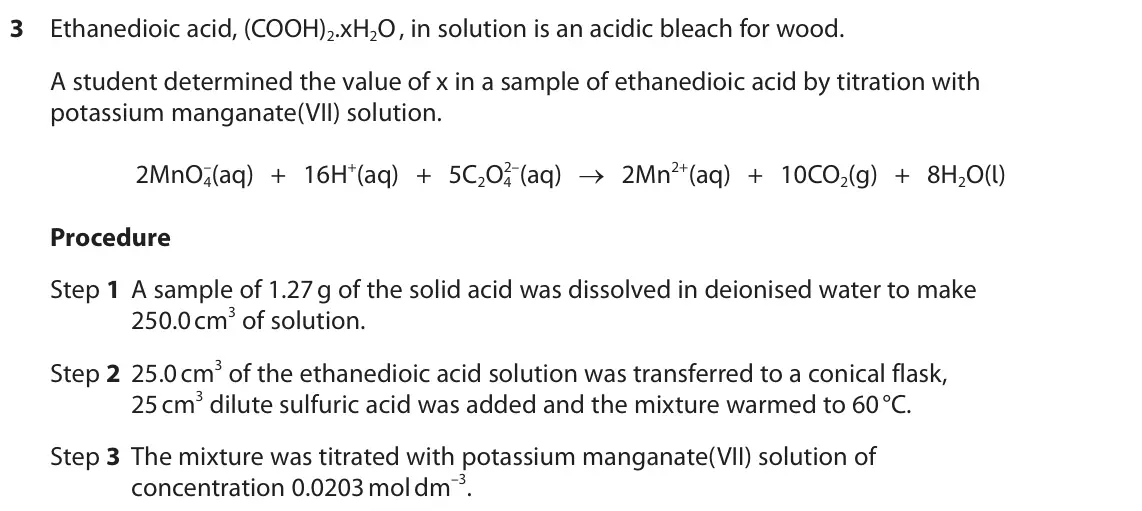
Q3(a)
The whole paper ↗ Your answer
Q3(b)
The whole paper ↗Your answerQ16(b)(i)
The whole paper ↗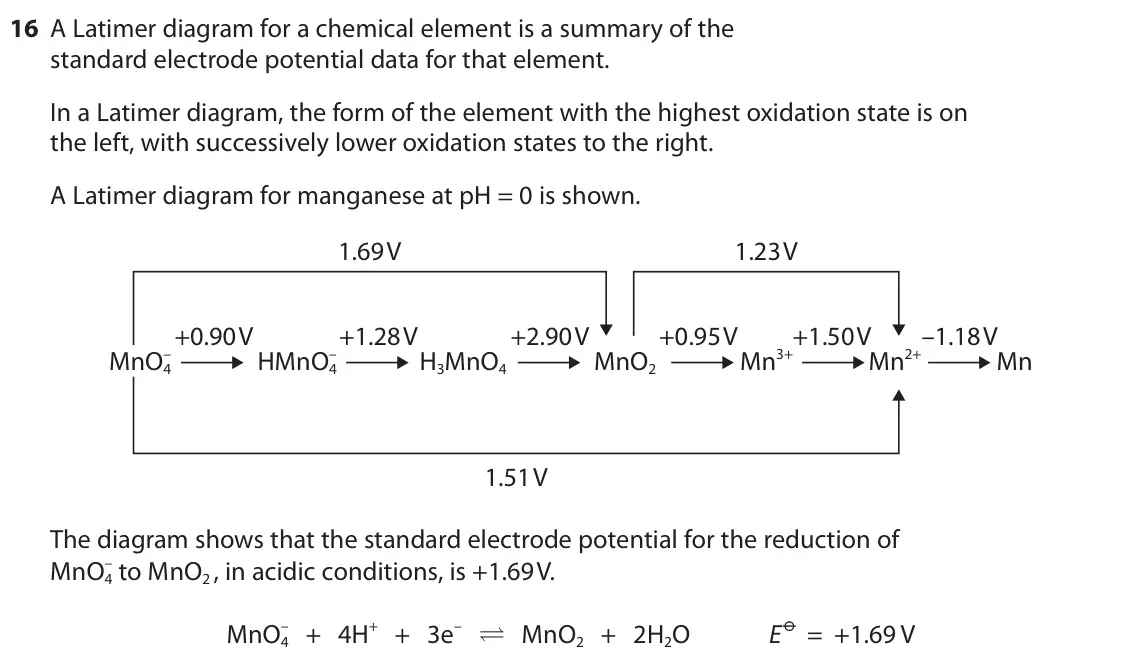
Q16(b)(ii)
The whole paper ↗Q16(b)(iii)
The whole paper ↗Q3(c)(ii)
The whole paper ↗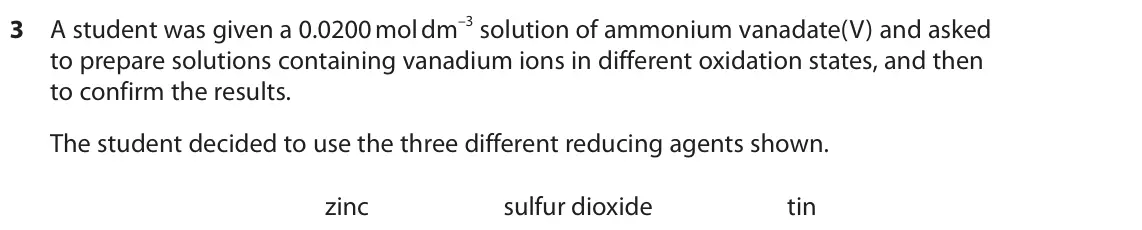
Q3(c)(iii)
The whole paper ↗Q18(c)
The whole paper ↗
Q19(f)
The whole paper ↗
All 40 questions on Redox titration calculations, as a list
- June 2025, Unit 5, Q2(b) (1 mark): What is the concentration, in mol dm (1) −1 A 1.90 × 10 −3 B 7.58 × 10 −3 C 4.74 × 10 −4 D 1.90 × 10
- June 2025, Unit 5, Q2(d) (1 mark): Which row shows the correct changes in oxidation states? (1) manganese iron II → VII III → II A II → VII II → III B VII → II III → II C VII → II II → III D Use
- June 2025 (A), Unit 5, Q3(b) (1 mark): 25.0 cm3 of a 0.0200 mol dm–3 solution of ethanedioate ions is titrated with an acidified solution containing 0.0400 mol dm–3 manganate(VII) ions. What volume,
- June 2025 (A), Unit 5, Q16(c)(i) (2 marks): State the changes that would be observed in Step 1. (2)
- June 2025 (A), Unit 5, Q16(c)(ii) (2 marks): Calculate the moles of manganese(IV) oxide in the 50 cm3 sample. (2)
- June 2025 (A), Unit 5, Q16(c)(iii) (4 marks): Calculate the concentration of dissolved oxygen, in ppm, in the sample collected. [Assume the density of water = 1.0 g cm–3] (4)
- June 2025 (A), Unit 5, Q16(d)(iii) (2 marks): Deduce the effect, if any, on the value of dissolved oxygen obtained in (c)(iii) if the nitrate(III) ions are not removed prior to Step 2. No calculation is req
- January 2025, Unit 5, Q21(b) (6 marks): Many moss killers contain iron(II) sulfate, FeSO4, as the active compound. Potassium manganate(VII) can be used to determine the amount of iron(II) sulfate pres
- October 2024, Unit 5, Q16 (6 marks): Iron is generally prescribed when a person is suffering from anaemia. Many people find it easier to take medicine in liquid form rather than solid tablets. An i
- October 2024, Unit 6, Q3(a)(v) (4 marks): The mean titre was 19.90 cm3. Determine the value of x in (COOH)2.xH2O. (4)
- June 2024, Unit 5, Q3(a) (1 mark): Which shows the changes in the oxidation states for iron and manganese? (1) Iron Manganese II → III VII → II A II → III VII → IV B III → II II → VII C III → II
- June 2024, Unit 5, Q3(b) (1 mark): A 25.00 cm3 sample of FeSO4 dissolved in acid required 22.50 cm3 of 0.100 mol dm–3 KMnO4 for complete reaction. What is the concentration of the FeSO4 solution?
- January 2024, Unit 5, Q16(b)(i) (1 mark): State the colour change at the end‑point of the titration. (1)
- January 2024, Unit 5, Q16(b)(ii) (4 marks): Calculate the accurate concentration of the potassium manganate(VII), in mol dm–3, giving your answer to an appropriate number of significant figures. (4)
- January 2024, Unit 5, Q16(b)(iii) (3 marks): A second titration carried out without the addition of sulfuric acid resulted in the formation of a brown suspension. Explain how the value of the mean titre wo
- January 2024, Unit 6, Q3(c)(ii) (4 marks): Information about the experiment is shown. • 25.0 cm3 of 0.0200 mol dm–3 ammonium vanadate(V) was reduced by tin • 20.00 cm3 of 0.0100 mol dm–3 potassium mangan
- January 2024, Unit 6, Q3(c)(iii) (2 marks): Explain the effect on the titre of leaving the tin in the reaction mixture. (2)
- October 2023, Unit 5, Q18(c) (3 marks): When 25.0 cm3 of a 0.100 mol dm−3 solution of X2O5 reacts with a reducing agent, X is reduced to a lower oxidation state. To oxidise X back to its original oxid
- October 2023, Unit 5, Q19(f) (5 marks): Potassium dichromate(VI) oxidises iron(II) ions to iron(III) ions in acid solution. 2− + 6Fe2+ + 14H+ → 2Cr3+ + 6Fe3+ + 7H2O Cr2O7 Iron(III) ions do not react w
- June 2023, Unit 5, Q22 (6 marks): The amount of calcium ethanedioate, CaC2O4 , present in a sample of spinach is determined by redox titration. 11.4 g of spinach leaves are stirred in 50.0 cm3 o
- January 2023, Unit 5, Q18(d)(i) (3 marks): Calculate the ratio of the number of moles of manganate(VII) ions, MnO4 to the number of moles of vanadium(III) ions, V3+, in this oxidation. You must show all
- January 2023, Unit 5, Q18(d)(ii) (2 marks): Write the equation for the reaction between manganate(VII) ions and vanadium(III) ions in acidic solution. State symbols are not required. (2)
- January 2023, Unit 6, Q3(b) (4 marks): The ionic half‑equations for the reactions of the iron(II) ions and the manganate(VII) ions are shown. Fe2+ → Fe3+ + e– – + 8H+ + 5e– → Mn2+ + 4H2O MnO4 Calcula
- October 2022, Unit 5, Q19(c)(i) (1 mark): Give the colour of the solution at the end‑point of the titration. (1)
- October 2022, Unit 5, Q19(c)(ii) (2 marks): Suggest why the VO2+ ions formed do not affect the titration. (2)
- October 2022, Unit 5, Q19(c)(iii) (7 marks): Calculate the percentage by mass of vanadium in the ferrovanadium. (7)
- June 2022, Unit 5, Q15(a)(i) (1 mark): State the colour of each chromium species in the reaction. (1) 2− Cr2O7 Cr3+
- June 2022, Unit 5, Q15(a)(iii) (5 marks): Calculate the percentage by mass of potassium dichromate(VI) in the cement sample. (5)
- June 2022, Unit 6, Q3(c)(iv) (3 marks): The redox equation for the reaction between copper(II) ions and iodide ions is shown. 2Cu2+(aq) + 4I–(aq) → 2CuI(s) + I2(aq) The reaction of sodium thiosulfate
- January 2022, Unit 5, Q8(a) (1 mark): What concentration of thiosulfate ions, in mol dm−3 , is required to give a titre of approximately 20 cm3 ? (1) A 0.010 B 0.020 C 0.040 D 0.080
- January 2022, Unit 5, Q8(b) (1 mark): What is the most suitable volume of 0.1 mol dm−3 potassium iodide solution, in cm3 , to add to the 10.0 cm3 of chlorine solution? (1) A 7.6 B 8.0 C 8.4 D 10.0
- January 2022, Unit 5, Q13(b)(ii) (6 marks): Calculate the final oxidation state of the cerium ion formed in the reaction. (6)
- October 2021, Unit 5, Q20(c)(ii) (5 marks): Use the results to determine the final oxidation state of nitrogen in the titration. You must show your working. [Mr value: Mg(NO3)2∙6H2O = 256.3] (5)
- October 2021, Unit 5, Q20(c)(iii) (2 marks): Write the overall ionic equation for the titration reaction using your answer to (ii) and the relevant half‑equations from the list below. (2) TiO2+ + 2H+ + e
- October 2021, Unit 6, Q1(d)(iv) (5 marks): Only Cu2+ ions in the solution react with the aqueous potassium iodide. 2Cu2+ + 4I– ® 2CuI + I2 The iodine reacts with sodium thiosulfate solution. 2– + I2 ® S4
- June 2021, Unit 5, Q18(b)(ii) (5 marks): One student used 1.53 g of the wire (weighed directly on the balance pan) and obtained a mean titre of 27.35 cm3. Using half-equations 3 and 5 from the table, c
- January 2021, Unit 5, Q19(d) (6 marks): The rare mineral mitscherlichite has the chemical formula K2CuCl4⦁nH2O. 4.26 g of mitscherlichite was dissolved in distilled water and the solution made up to 2
- January 2021, Unit 6, Q2(f) (6 marks): In Method 2, 50.0 cm3 of potassium chlorate(V) was mixed with 150 cm3 of 0.0750 mol dm–3 of iron(II) sulfate. The iron (II) sulfate was in excess. The whole of
- October 2020, Unit 5, Q19 (1 mark): In acidic conditions, manganate(VII) ions are reduced to manganese(II) ions, Mn2+. In neutral conditions, manganate(VII) ions are reduced to manganese(IV) oxide
- October 2020, Unit 5, Q25(f) (5 marks): The Lanthanides The lanthanides form a series in the Periodic Table comprising the elements from lanthanum, La (Z = 57) to lutetium, Lu (Z = 71). They have impo
Questions, mark schemes and examiner’s reports are © Pearson Edexcel, from their published past papers. Plumi isn’t affiliated with any exam board. Want whole papers? Edexcel International A Level Chemistry past papers.
The Plumi iPad app also offers exam-style questions with AI feedback on your handwritten working.