 plumi
London forces, dipole-dipole forces and hydrogen bonds: Edexcel International A Level Chemistry questions
Edexcel International A Level Chemistry past-paper questions on 7.1.1 London forces, dipole-dipole forces and hydrogen bonds, 2019–2025, with mark schemes and examiner’s reports where available.
Paper
All papers
Exam
All years
Calculations
Q23(b)(v)
The whole paper ↗
Q15(b)
The whole paper ↗
Q17(a)(iii)
The whole paper ↗
Q19(a)(ii)
The whole paper ↗
Q15(a)
The whole paper ↗
- Your answer
- Your answer
- Your answer
- Your answer
- Your answer
- Your answer
- Your answer
Q20(b)
The whole paper ↗
Q22(c)(iii)
The whole paper ↗
Q24(a)(ii)
The whole paper ↗
- Your answer
- Your answer
- Your answer
- Your answer
Q24(a)
The whole paper ↗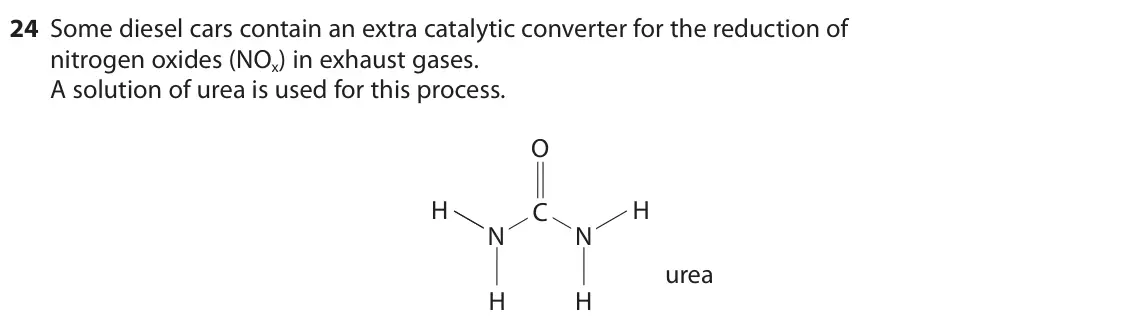
All 26 questions on London forces, dipole-dipole forces and hydrogen bonds, as a list
- June 2025, AS Unit 1, Q23(b)(v) (2 marks): Ethene and poly(ethene) have different melting temperatures. Molecule Melting temperature (K) ethene 104.1 poly(ethene) 400 Explain why their melting temperatur
- June 2025, Unit 4, Q15(b) (3 marks): Butanoic acid is very soluble in water. This is due to strong intermolecular forces between butanoic acid molecules and water molecules. Complete the diagram by
- June 2025, Unit 5, Q17(a)(iii) (2 marks): Trimethylamine is a gas at room temperature but readily dissolves in water. Draw a diagram of the intermolecular force that leads to trimethylamine being solubl
- October 2024, AS Unit 2, Q19(a)(ii) (1 mark): State why the London forces in hydrogen iodide are stronger than those in hydrogen chloride and hydrogen bromide. (1)
- October 2024, Unit 5, Q15(a) (2 marks): Butylamine is miscible with water. Draw a labelled diagram to show one of the intermolecular interactions between a butylamine molecule and a molecule of water.
- January 2024, AS Unit 2, Q1 (1 mark): Which compound has intermolecular hydrogen bonding? A HF B H2Te C AsH3 D SnH4
- January 2024, AS Unit 2, Q2 (1 mark): In which process are intermolecular hydrogen bonds broken? A H2(g) → 2H(g) B H2O(l) → H2O(g) C H2(l) → H2(g) D H2(g) + ½O2(g) → H2O(g)
- January 2024, AS Unit 2, Q3 (1 mark): A compound contains • molecules with non-polar bonds • permanent dipole-permanent dipole forces between its molecules. What could be the formula of this compoun
- January 2024, AS Unit 2, Q4 (1 mark): Which alkane has the strongest London forces in the liquid phase? A (CH3)4C B CH3CH2CH2CH2CH3 C (C2H5)4C D CH3(CH2)7CH3
- October 2023, AS Unit 2, Q4 (1 mark): Which row in the table shows the forces between the molecules in the liquid state? Permanent dipole‑dipole Molecule London forces Hydrogen bonding interaction A
- June 2023, AS Unit 2, Q5 (1 mark): The boiling temperature of hexane is 69 °C and that of cyclohexane is 81 °C. The main reason that cyclohexane has a higher boiling temperature is that cyclohexa
- June 2023, AS Unit 2, Q7 (1 mark): Hydrogen bonds are formed when methanol dissolves in water. Which structure best represents a hydrogen bond between methanol and water? H H O : A H C H O H H H
- June 2023, AS Unit 2, Q20(b) (6 marks): Two alternatives to hydrocarbon fuels are hydrogen and ammonia. Hydrogen burns to form water as the only product but hydrogen is extremely hard to liquefy. Ammo
- June 2023, AS Unit 2, Q22(c)(iii) (2 marks): Commercial disinfectants are often made more viscous by adding propane‑1,2,3‑triol to the aqueous solution. Suggest how propane-1,2,3-triol makes disinfectants
- June 2023, Unit 5, Q24(a)(ii) (3 marks): Explain why PAM is able to absorb large amounts of water. Include a diagram in your answer. (3)
- January 2023, AS Unit 2, Q4 (1 mark): Which compound has London forces as the only intermolecular force? A HF B OF2 C PF3 D CF4 Use this space for any rough working. Anything you write in this space
- January 2023, AS Unit 2, Q5 (1 mark): Which compound has intermolecular hydrogen bonding? A (CH3)3N B (CH3)3CF C (CH3)3COH D (CH3)3CCHO
- October 2022, AS Unit 2, Q12 (1 mark): Which compound does not form hydrogen bonds between its molecules? A HCl B H2O C HF D NH3
- January 2022, AS Unit 2, Q7 (1 mark): Which intermolecular forces exist between the molecules of the compound shown? HO O A hydrogen bonding and London forces only B hydrogen bonding and permanent d
- January 2022, AS Unit 2, Q24(a) (3 marks): Urea has a melting temperature of 133 °C. Explain why this value is higher than expected for a relatively small molecule. (3)
- October 2021, AS Unit 2, Q22(d)(i) (1 mark): Give a possible reason why ethanol is able to absorb water. (1)
- October 2021, Unit 4, Q11 (1 mark): Ethanal and propane have the same molar mass but ethanal has a much higher boiling temperature. Ethanal is fully miscible in water but propane is almost insolub
- June 2021, AS Unit 2, Q20(a) (6 marks): Some data for three small molecules are shown. Boiling temperature Molecule Mr / °C Fluorine 38.0 −188 Hydrogen chloride 36.5 −85 Methanol 32.0 65 Explain the l
- June 2021, Unit 5, Q11 (1 mark): Hydrogen bonds are formed when methylamine dissolves in water. Which structure best represents a hydrogen bond between methylamine and water? H H O A H C N H H
- January 2021, AS Unit 2, Q3 (1 mark): Which of these pure compounds has hydrogen bonding in the liquid state? A 1,1,1-trichloroethane, CH3CCl3 B trimethylamine, (CH3)3N C hydrogen fluoride, HF D hyd
- June 2019, AS Unit 2, Q16(b) (1 mark): Which diagram best represents a hydrogen bond between two water molecules? (1) 180° O H H H A O H 180° O H H H B O H H 104.5° C O O H H H 104.5° H O H D H O H
Questions, mark schemes and examiner’s reports are © Pearson Edexcel, from their published past papers. Plumi isn’t affiliated with any exam board. Want whole papers? Edexcel International A Level Chemistry past papers.
The Plumi iPad app also offers exam-style questions with AI feedback on your handwritten working.