 plumi
Cell membrane structure and permeability: Edexcel International A Level Biology questions
Edexcel International A Level Biology past-paper questions on 2.1.3 Cell membrane structure and permeability, 2019–2025, with mark schemes and examiner’s reports where available.
Paper
All papers
Exam
All years
Calculations
Q6(a)(i)
The whole paper ↗ Your answer
Q6(a)(ii)
The whole paper ↗Your answerQ6(a)(iii)
The whole paper ↗Your answerQ6(b)
The whole paper ↗Q6(c)
The whole paper ↗Q6(d)(i)
The whole paper ↗Q6(d)(ii)
The whole paper ↗Q2(a)(i)
The whole paper ↗
Q2(b)(i)
The whole paper ↗Q2(b)(ii)
The whole paper ↗Q2(b)(iii)
The whole paper ↗Q7(a)
The whole paper ↗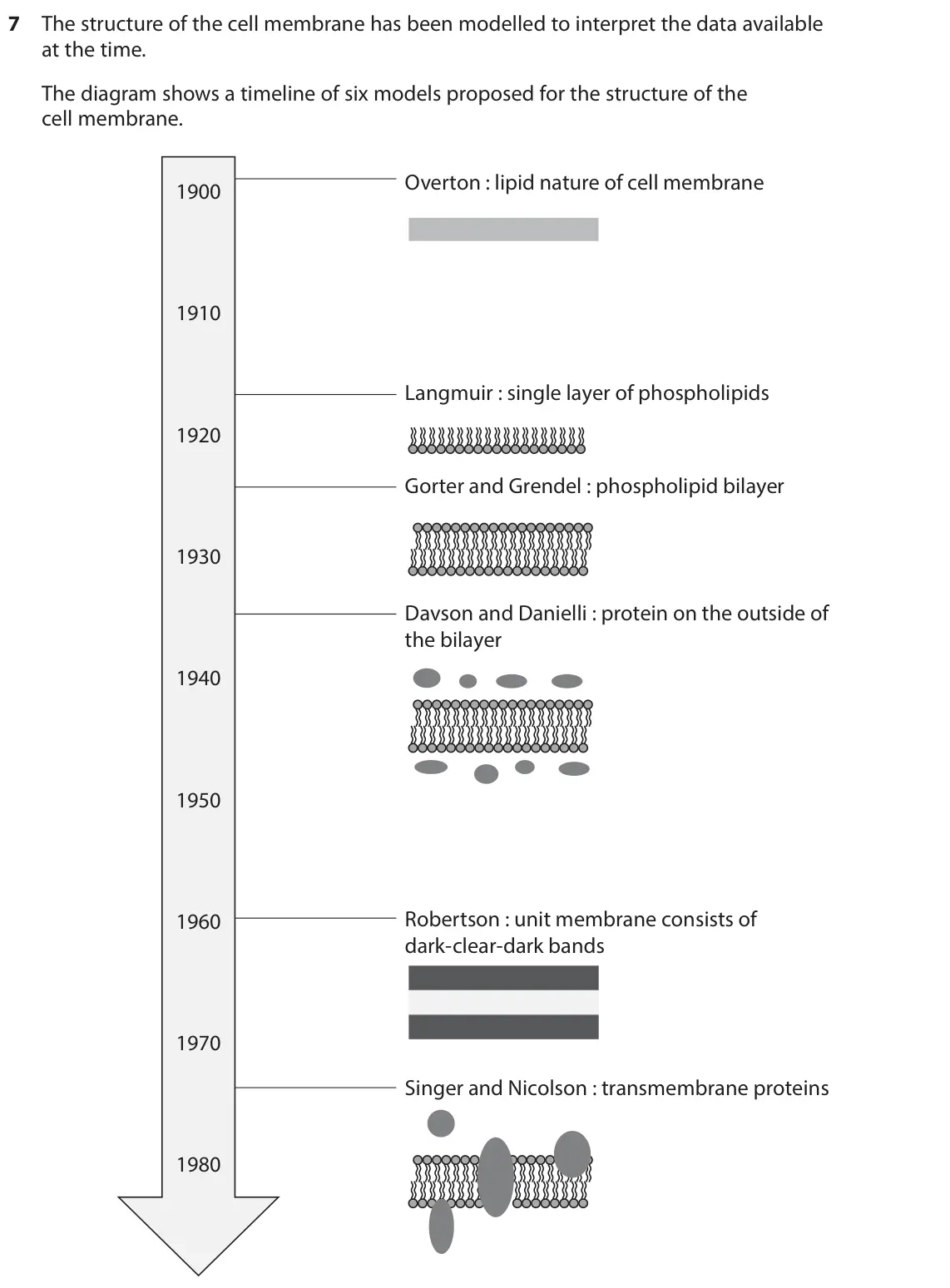
Q7(b)
The whole paper ↗Q7(c)
The whole paper ↗Q7(d)
The whole paper ↗Q7(f)
The whole paper ↗Q1(a)
The whole paper ↗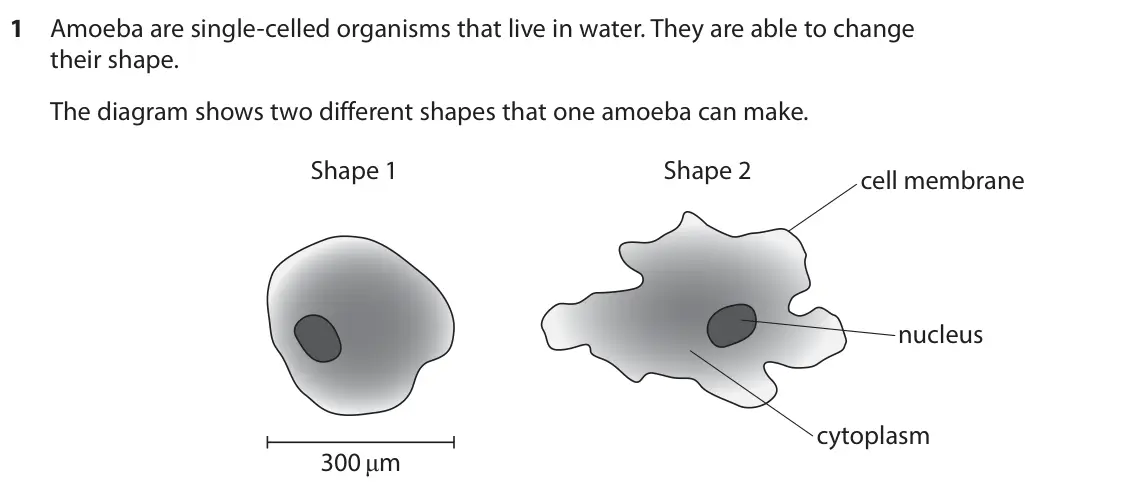
Q6(c)(ii)
The whole paper ↗
Q6(a)
The whole paper ↗
Q6(b)
The whole paper ↗
All 64 questions on Cell membrane structure and permeability, as a list
- June 2025, AS Unit 1, Q6(a)(i) (1 mark): Which structure prevents large polar (hydrophilic) molecules from diffusing through the membrane? (1) A Q B R C T D V
- June 2025, AS Unit 1, Q6(a)(ii) (1 mark): Which structure allows ions to diffuse through the membrane? (1) A P B S C T D U
- June 2025, AS Unit 1, Q6(a)(iii) (1 mark): Which structure allows the membrane to be fluid? (1) A P B Q C S D U
- June 2025, AS Unit 1, Q6(b) (1 mark): The diagram shows a cholesterol molecule. polar (hydrophilic) region non-polar (hydrophobic) region Which diagram shows the correct position of a cholesterol mo
- June 2025, AS Unit 1, Q6(c) (3 marks): The graph shows the effect of temperature and cholesterol on membrane fluidity. without cholesterol with cholesterol Membrane fluidity Temperature Describe the e
- June 2025, AS Unit 1, Q6(d)(i) (1 mark): Calculate the ratio of protein : lipid in membrane A. Give your answer to 2 decimal places. (1) Answer : 1
- June 2025, AS Unit 1, Q6(d)(ii) (3 marks): Compare and contrast the composition of these three membranes. (3)
- June 2025, AS Unit 3, Q2(a)(i) (5 marks): Justify each step of a method that could be used to obtain the results shown in the graph. (5)
- June 2025, AS Unit 3, Q2(b)(i) (2 marks): Complete the key by naming the molecules. (2)
- June 2025, AS Unit 3, Q2(b)(ii) (1 mark): Complete diagram A by labelling the inside and outside of the cell. (1)
- June 2025, AS Unit 3, Q2(b)(iii) (1 mark): Draw an arrow next to diagram A to show the net movement of betalain during the experiment. (1)
- January 2025, AS Unit 1, Q7(a) (2 marks): Overton suggested that some types of solute could cross the lipid membrane, whereas other types of solute could not. Explain the difference between these two ty
- January 2025, AS Unit 1, Q7(b) (2 marks): Langmuir’s model was a single layer of phospholipids. Explain why the phospholipids in a cell membrane cannot be arranged in a single layer. (2)
- January 2025, AS Unit 1, Q7(c) (2 marks): Gorter and Grendel suggested that there were various types of phospholipid but they were all arranged in a bilayer. Give two ways in which phospholipids can be
- January 2025, AS Unit 1, Q7(d) (2 marks): The Davson and Danielli model was the first to include proteins. Explain why some membrane proteins would not be able to carry out their transport functions if
- January 2025, AS Unit 1, Q7(f) (2 marks): In 1972, Singer and Nicolson proposed the fluid mosaic model of the cell membrane. Explain why their model has been given this name. (2)
- October 2024, AS Unit 1, Q1(a) (1 mark): An amoeba changes shape by pushing cytoplasm against the cell membrane, forming long thin projections. State the property of the cell membrane that enables the
- June 2024, AS Unit 1, Q6(c)(ii) (2 marks): The absorption of glucose into the bloodstream requires membrane transport proteins. Explain why glucose cannot diffuse into the bloodstream. (2)
- January 2024, AS Unit 1, Q6(a) (1 mark): Name the current model for the structure of the cell membrane. (1)
- January 2024, AS Unit 1, Q6(b) (3 marks): Describe the arrangement of phospholipids in the cell membrane in this model. (3)
- January 2024, AS Unit 1, Q6(c)(i) (3 marks): Lipid nanoparticles are very small. Calculate the diameter of a lipid nanoparticle with a volume of 0.108 µm3. Use the formula = 4 3 V r 3 Use π = 3.0 (3) Ans
- January 2024, AS Unit 1, Q6(c)(iii) (3 marks): Explain the arrangements of phospholipids in this lipid nanoparticle that carries mRNA to tissues in the body. (3)
- January 2024, AS Unit 3, Q2(a) (2 marks): Name three types of molecule present in structure A. (2) 1 2 3
- January 2024, AS Unit 3, Q2(b) (3 marks): Some of the evidence for the structure of cell membranes comes from studies of permeability. The solubility of substances A to E in olive oil was determined. Th
- January 2024, AS Unit 3, Q2(c)(i) (3 marks): Explain the results of this investigation. (3)
- January 2024, AS Unit 3, Q2(c)(ii) (5 marks): Describe a procedure that could have been used to obtain the results shown in this graph. (5)
- October 2023, Unit 4, Q1(d)(i) (1 mark): How many of the structures labelled P, T, U and W are made of phospholipids? (1) A 1 B 2 C 3 D 4
- October 2023, Unit 4, Q1(d)(ii) (1 mark): Which describes a phospholipid? (1) A glycerol attached to two fatty acids and one phosphate group B glycerol attached to two fatty acids and two phosphate grou
- January 2023, AS Unit 1, Q6(a)(i) (1 mark): Which describes a phospholipid? (1) A hydrophilic fatty acid head and hydrophobic phosphate tails B hydrophilic phosphate head and hydrophobic fatty acid tails
- January 2023, AS Unit 1, Q6(a)(ii) (4 marks): Compare and contrast the structure of the model shown in the diagram with that of the fluid mosaic model of membrane structure. (4)
- January 2023, AS Unit 1, Q6(b)(i) (2 marks): Suggest how damage to the cell membrane could result in cell death. (2)
- January 2023, AS Unit 1, Q6(b)(ii) (2 marks): Cells can repair damage to the cell membrane. This involves fusion of parts of the membrane around the edge of the damage. Explain why parts of the membrane are
- January 2023, AS Unit 1, Q6(b)(iii) (2 marks): Once the membrane has fused together, other processes are needed to complete the repair of the membrane. Suggest what else the cell needs to do to complete this
- January 2023, AS Unit 3, Q2(b)(ii) (3 marks): Comment on the effect of increasing the concentration of the chemical on the permeability of the membranes to both the pigment and the ions. (3)
- January 2023, AS Unit 3, Q2(b)(iii) (5 marks): Devise a method that could be used to obtain the data for the pigment shown in the graph. (5)
- January 2023, AS Unit 3, Q2(c) (4 marks): In another investigation, changes in permeability of the membranes were measured over time. The table shows data for the first three hours. Time after addition
- October 2022, AS Unit 1, Q1(a)(i) (2 marks): The shapes show the components of a phospholipid. phosphate group glycerol fatty acid covalent bond Draw a diagram to show the structure of a phospholipid, usin
- October 2022, AS Unit 1, Q1(a)(ii) (1 mark): Which type of bond is found in this molecule? (1) A ester B glycosidic C hydrogen D peptide
- October 2022, Unit 4, Q3(b)(ii) (4 marks): Compare and contrast the structure of the outer membrane of a chloroplast with that of a thylakoid membrane. (4)
- June 2022, AS Unit 1, Q7(a)(i) (2 marks): Draw a diagram of a phospholipid, using the information in the table. (2)
- June 2022, AS Unit 1, Q7(b)(i) (2 marks): Explain why an increase in temperature increases the fluidity of the membrane. (2)
- June 2022, AS Unit 1, Q7(b)(iii) (2 marks): Explain why a decrease in cholesterol increases the fluidity of the membrane. (2)
- June 2022, AS Unit 1, Q7(b)(iv) (1 mark): Suggest why a fatty acid with a shorter side chain will increase the fluidity of a membrane. (1)
- June 2022, AS Unit 1, Q7(c)(i) (2 marks): Suggest how the content of the fatty acids in these membranes may have changed. (2)
- June 2022, AS Unit 1, Q7(c)(ii) (2 marks): Suggest why these changes are necessary for the survival of the fish. (2)
- October 2021, AS Unit 3, Q2(a)(i) (3 marks): Explain how using a colorimeter allows valid measurements of light transmitted through the betalain solutions. (3)
- October 2021, AS Unit 3, Q2(b)(ii) (3 marks): Compare and contrast the effect of these two salts on the loss of betalain from the beetroot cells. (3)
- October 2021, AS Unit 3, Q2(b)(iii) (2 marks): Calculate the percentage difference in colour intensity between calcium chloride and ammonium sulfate at a concentration of 0.01 mmol dm−3. (2) Answer %
- October 2021, AS Unit 3, Q2(c)(i) (3 marks): Comment on the results shown in the graphs from these two investigations. (3)
- June 2021, AS Unit 1, Q8(a)(i) (1 mark): The magnification of this diagram is 1 × 10⁷. The structure labelled T is 2 units long. What is this unit? (1) A cm B mm C µm D nm
- June 2021, AS Unit 1, Q8(a)(ii) (1 mark): Which structures contain a phosphate group? (1) A Q and R B Q and T C R and S D S and T
- June 2021, AS Unit 1, Q8(a)(iii) (1 mark): Which ratio of the structures affects the fluidity of this membrane? (1) A Q : T B R : Q C R : T D S : T
- January 2021, AS Unit 1, Q5(a) (3 marks): The photograph shows part of a cell membrane, as seen using an electron microscope. cell membrane (Source: © Dennis Kunkel Microscopy / Science Photo Library) T
- January 2021, AS Unit 1, Q5(b) (3 marks): Cell membranes contain cholesterol. The molecular formula of cholesterol is C27H46O. The diagram shows a cholesterol molecule. hydrocarbon tail hydrocarbon ring
- January 2021, AS Unit 1, Q5(c)(ii) (4 marks): Explain the permeability of cell membranes to each chemical shown in the diagram. (4)
- January 2020, AS Unit 3, Q3(b)(iii) (3 marks): Detergent permanently damages beetroot cell membranes. Explain what will happen to the rate of loss of betalain if these discs are then transferred to test tube
- January 2020, AS Unit 3, Q3(b)(iv) (3 marks): In a second investigation, the effect of temperature on beetroot cell membrane permeability was studied. The graph shows the results of the second investigation
- January 2020, AS Unit 3, Q3(b)(v) (3 marks): Estimate the percentage of light transmitted at 80 °C. Use the information in the graph and your own knowledge to support your answer. (3)
- January 2019, AS Unit 1, Q5(a)(i) (2 marks): Calculate the volume of this liposome, using the formula V = 4 3 πr3 (2) Answer
- January 2019, AS Unit 1, Q5(a)(ii) (2 marks): Explain the arrangement of phospholipids in liposomes. (2)
- January 2019, AS Unit 1, Q5(b)(ii) (3 marks): Describe the effects of cholesterol and temperature on membrane permeability, as shown in the graph. (3)
- January 2019, AS Unit 1, Q5(b)(iii) (2 marks): Explain why cholesterol and temperature affect membrane permeability. (2)
- January 2019, AS Unit 1, Q6(a)(i) (1 mark): Estimate the ratio of phosphatidylserine in the inner layer to that in the outer layer before the blood clotting process is triggered. (1) Answer
- January 2019, AS Unit 1, Q6(a)(ii) (2 marks): Describe the effect that the movement of phosphatidylserine into the outer layer will have on the content of phospholipids in the membranes of platelets. (2)
Questions, mark schemes and examiner’s reports are © Pearson Edexcel, from their published past papers. Plumi isn’t affiliated with any exam board. Want whole papers? Edexcel International A Level Biology past papers.
The Plumi iPad app also offers exam-style questions with AI feedback on your handwritten working.