 plumi
Superposition and stationary waves: Edexcel A‑Level Physics questions
Every Edexcel A-Level Physics exam question on Superposition and stationary waves (specification points 65–69), 2016–2025, with its mark scheme and examiner’s report.
Find questions1,540
Calculations
Q16(a)
The whole paper ↗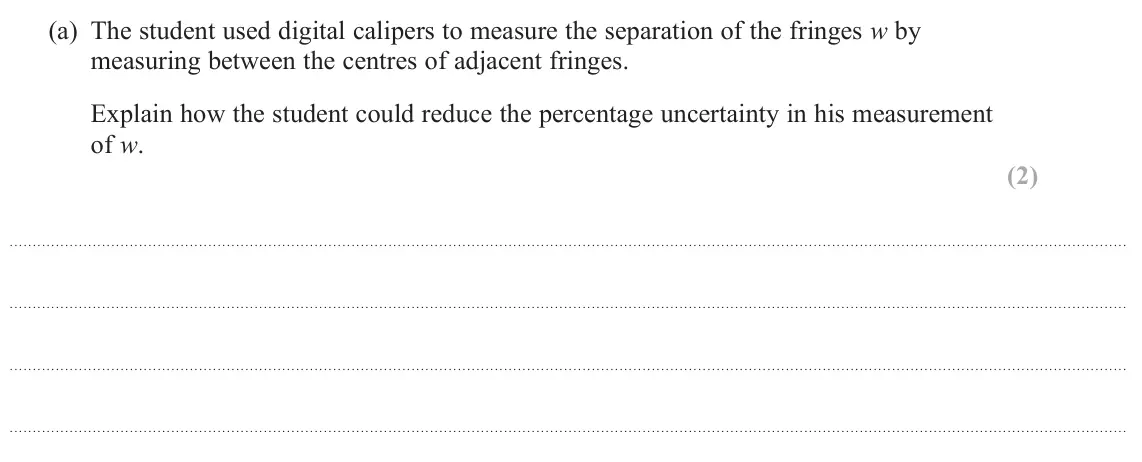
Q16(b)(i)
The whole paper ↗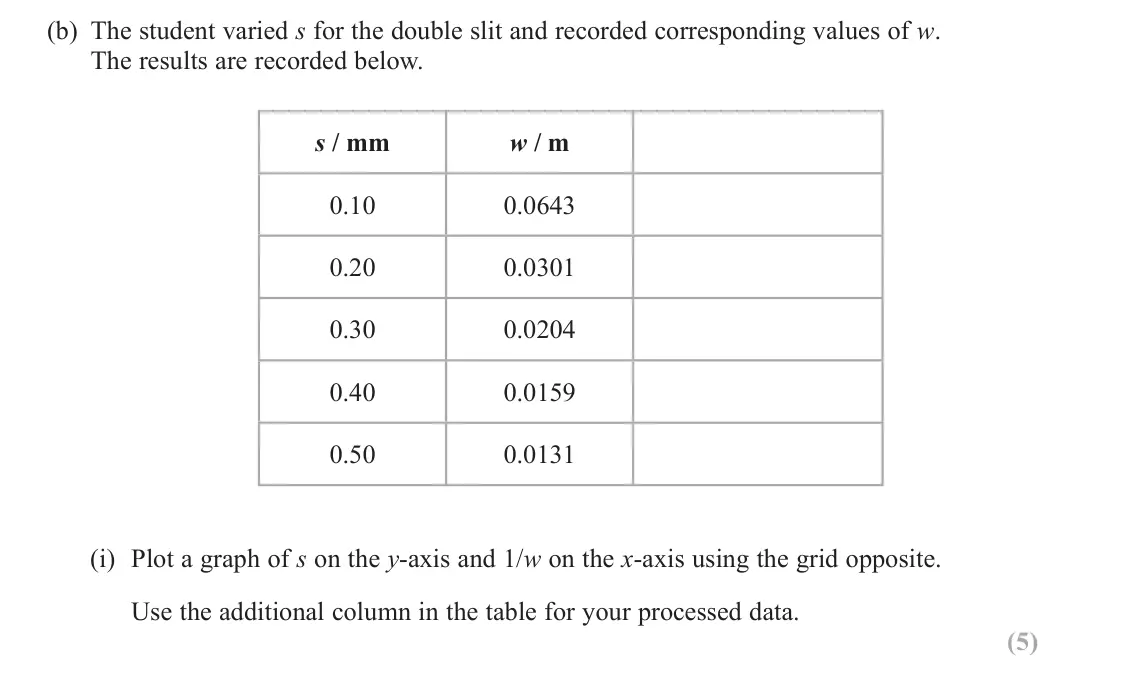
Q16(b)(ii)
The whole paper ↗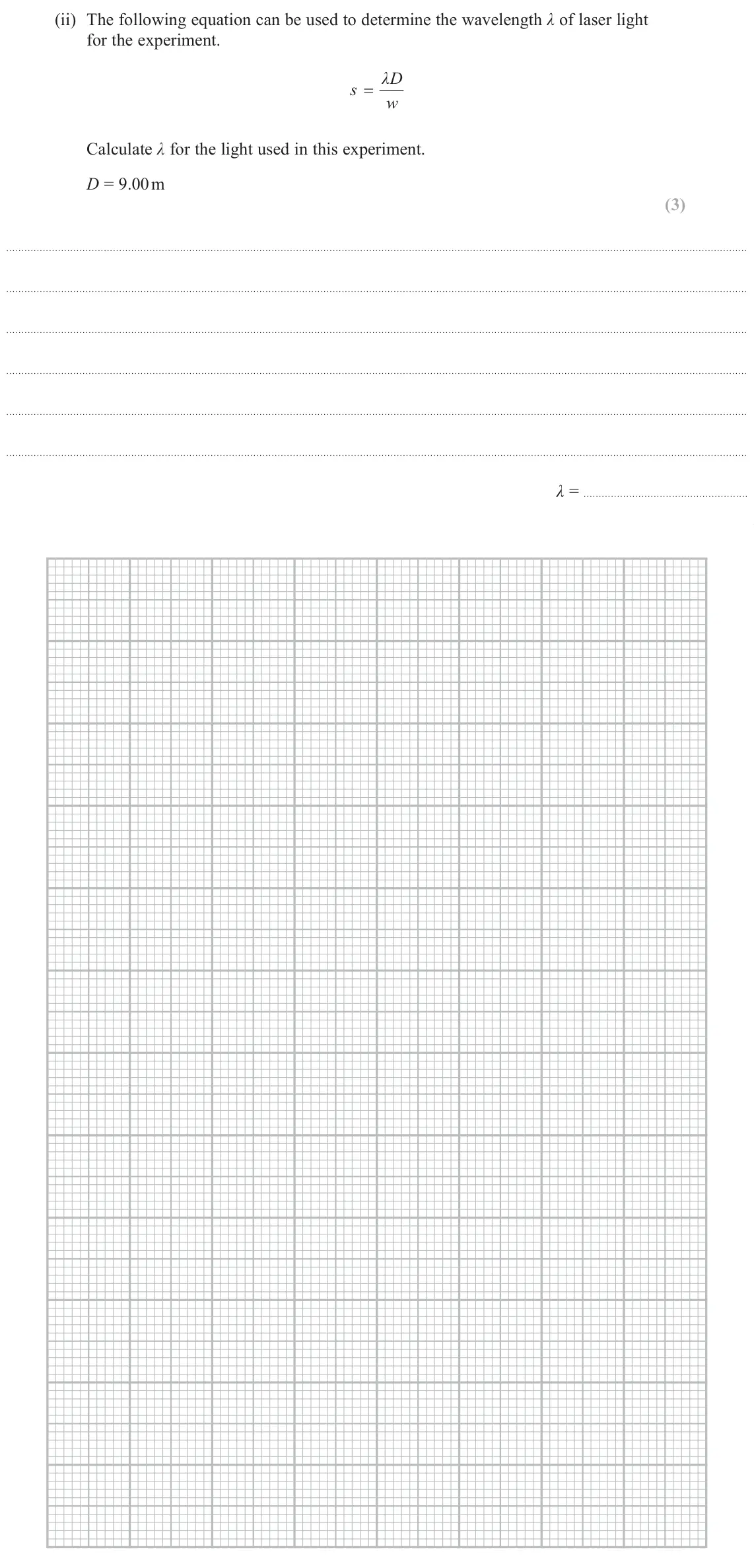
Q16(c)(i)
The whole paper ↗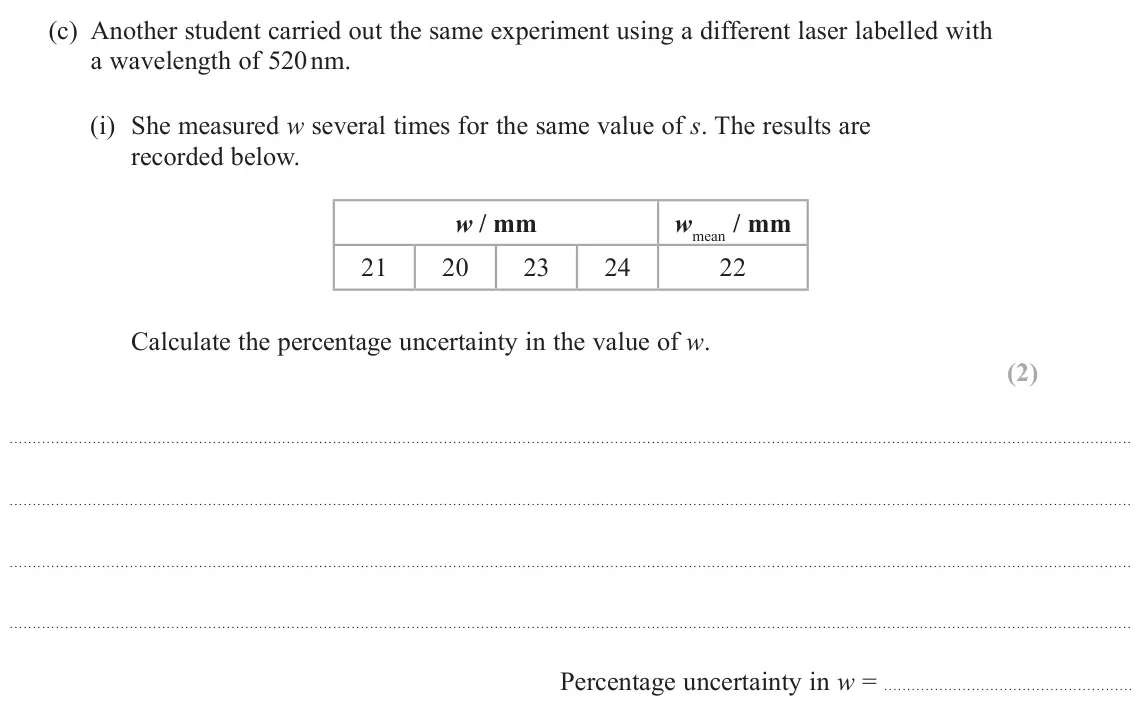
Q16(c)(ii)
The whole paper ↗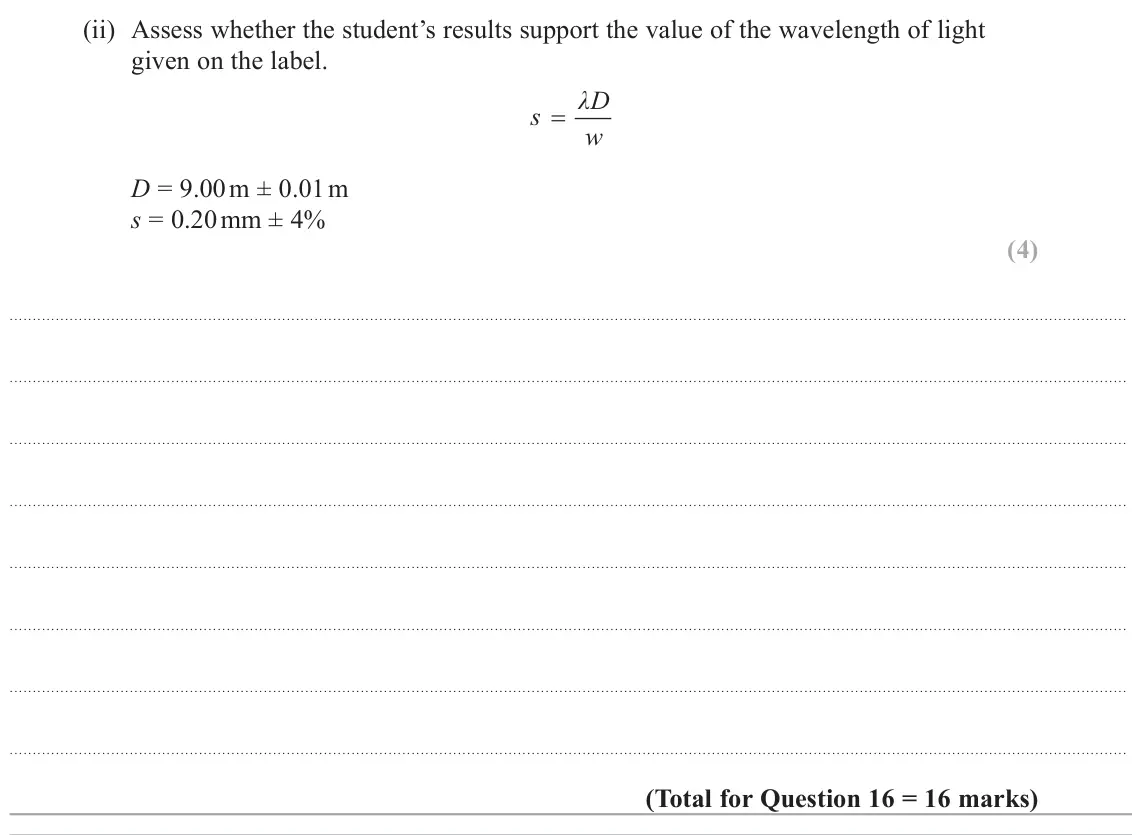
Q11(b)(i)
The whole paper ↗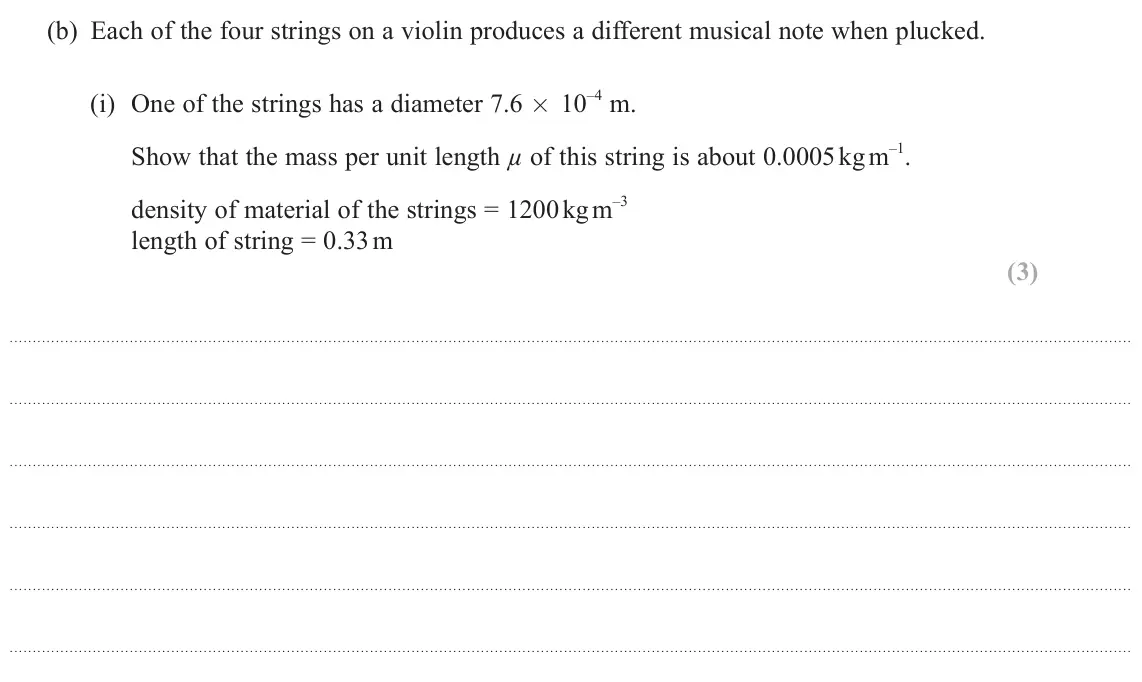
Q11(b)(ii)
The whole paper ↗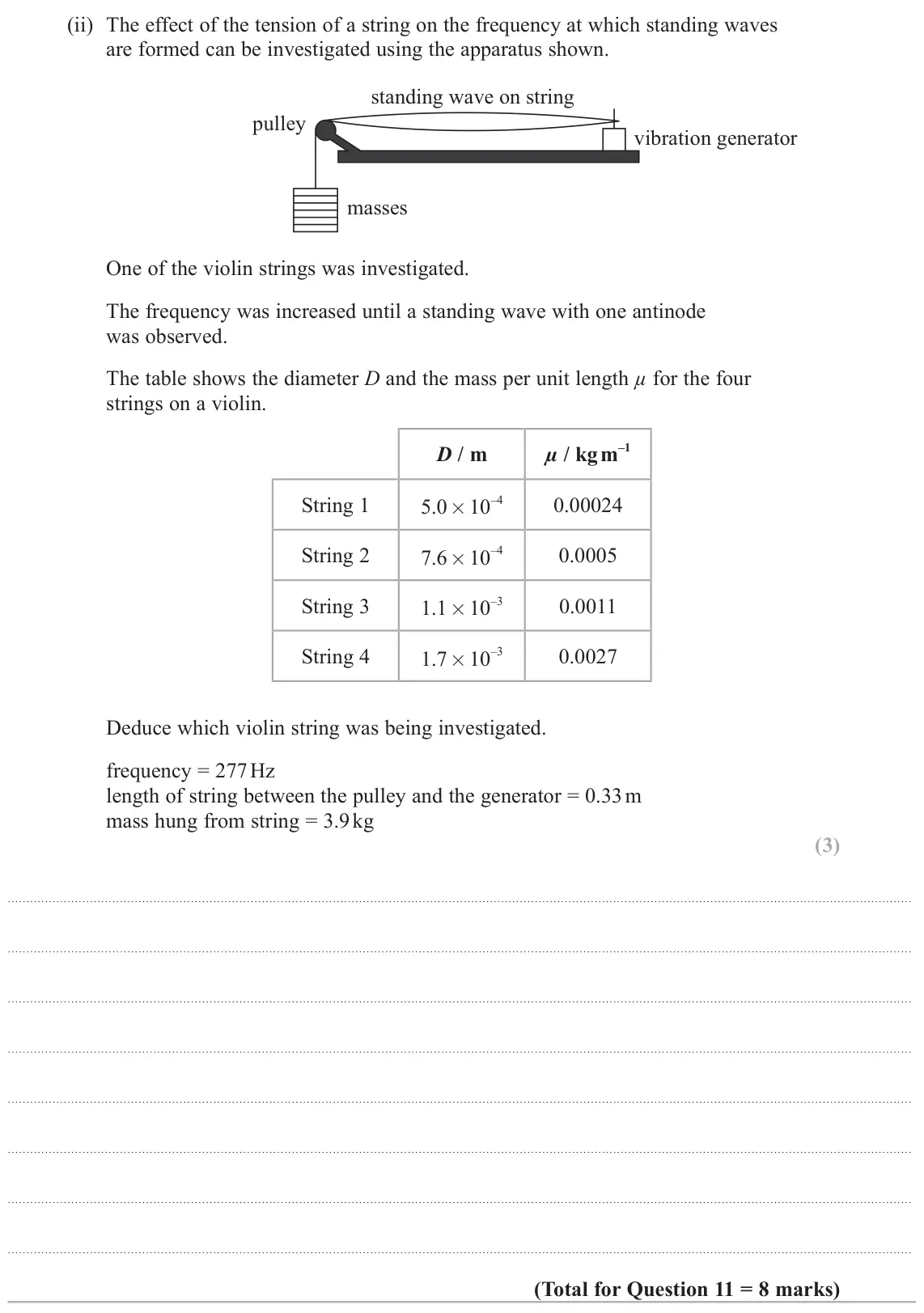
Q15(a)
The whole paper ↗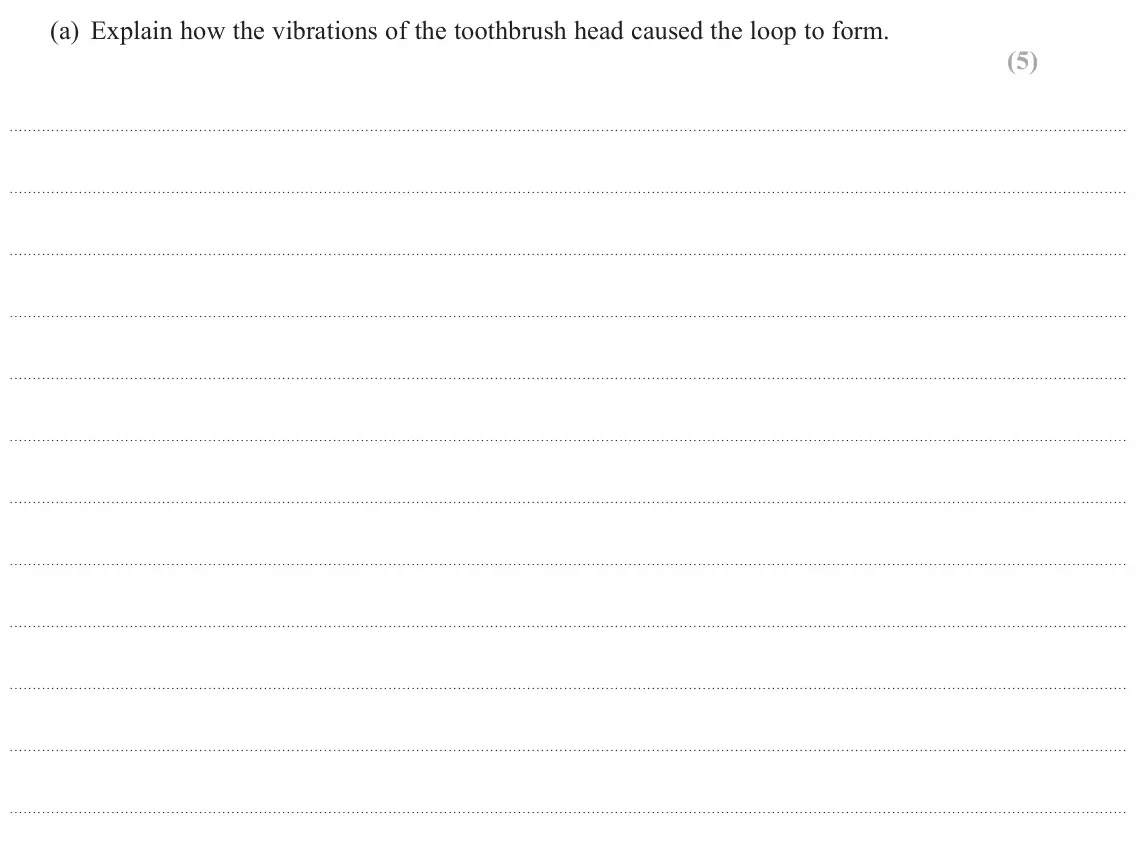
Q15(b)
The whole paper ↗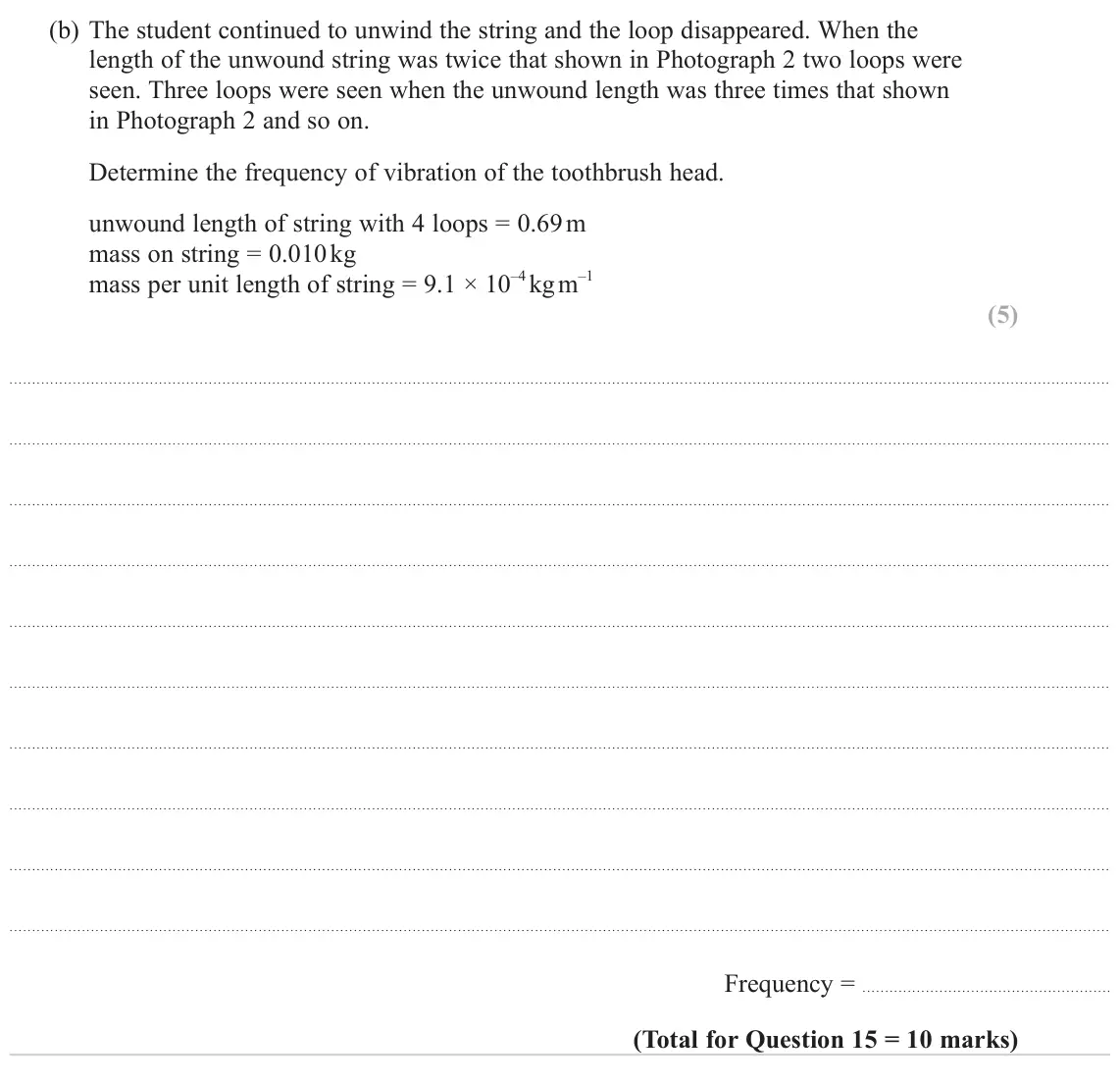
Q6(a)
The whole paper ↗
Q6(c)
The whole paper ↗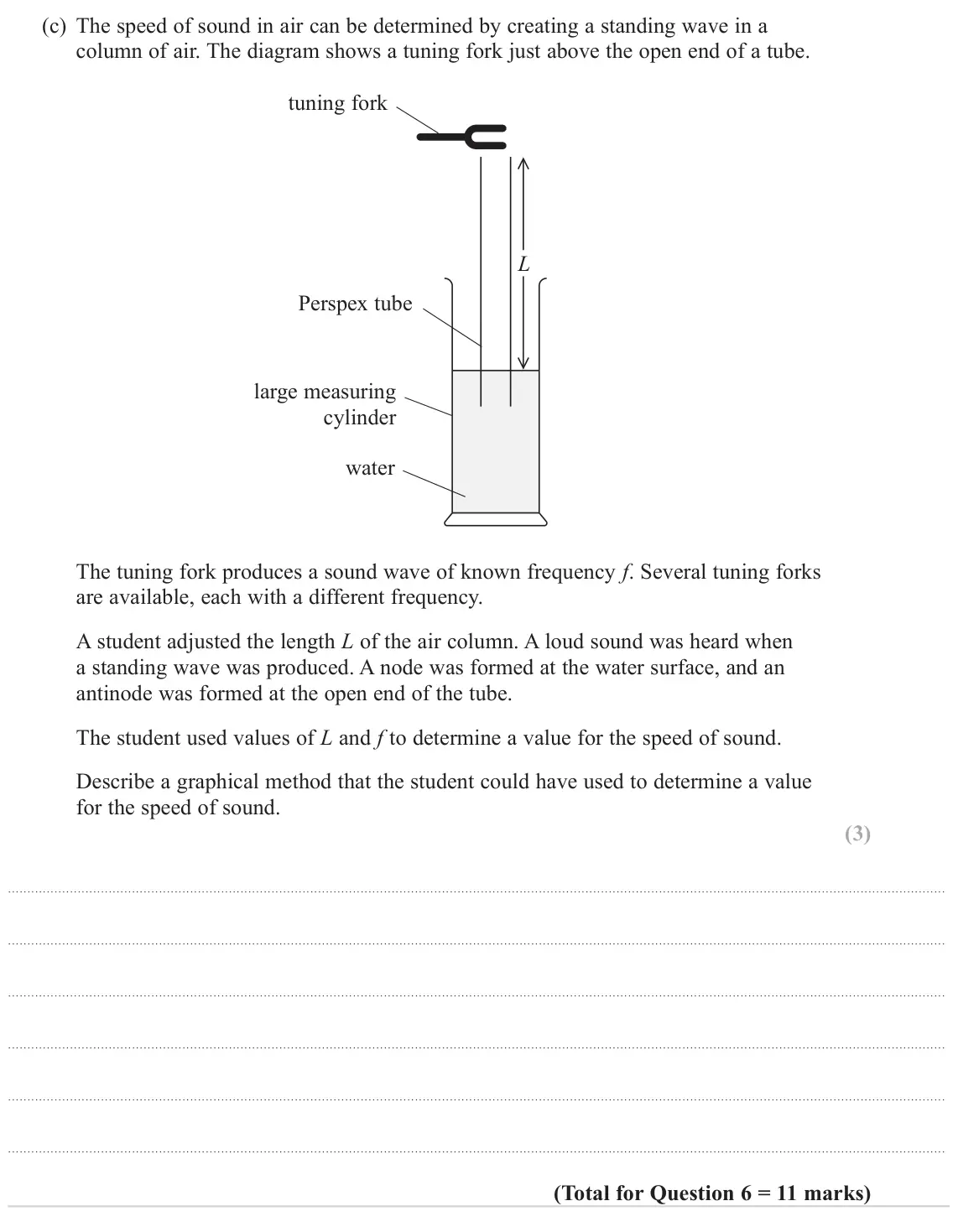
Q12(a)
The whole paper ↗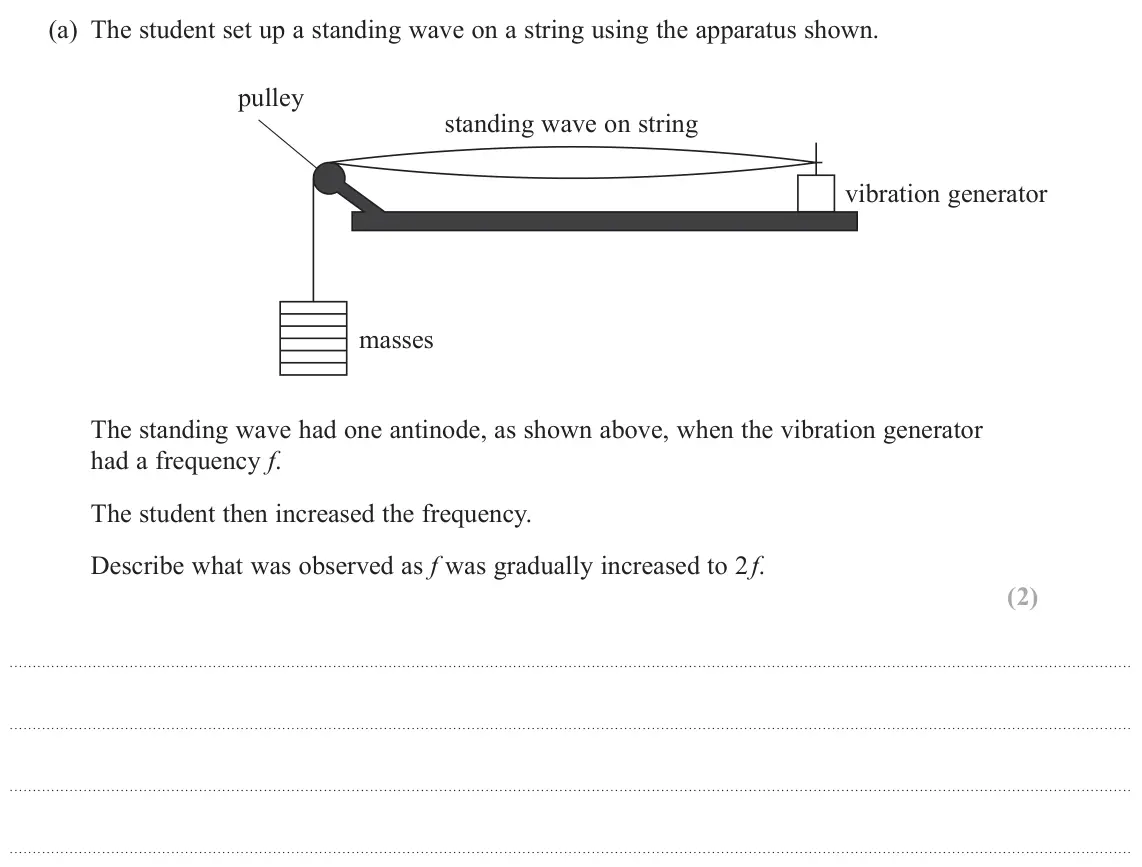
Q12(c)
The whole paper ↗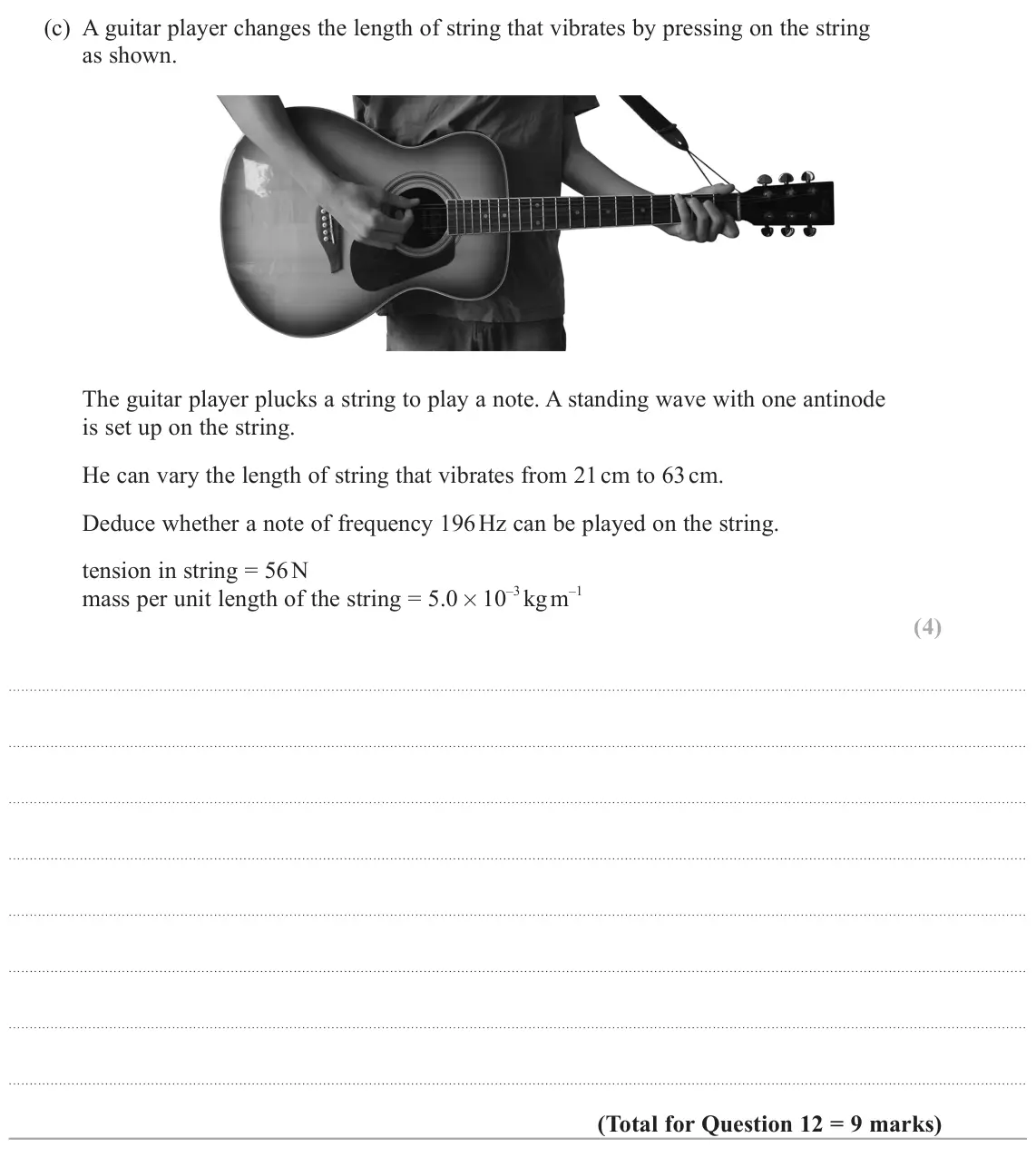
All 78 questions on Superposition and stationary waves, as a list
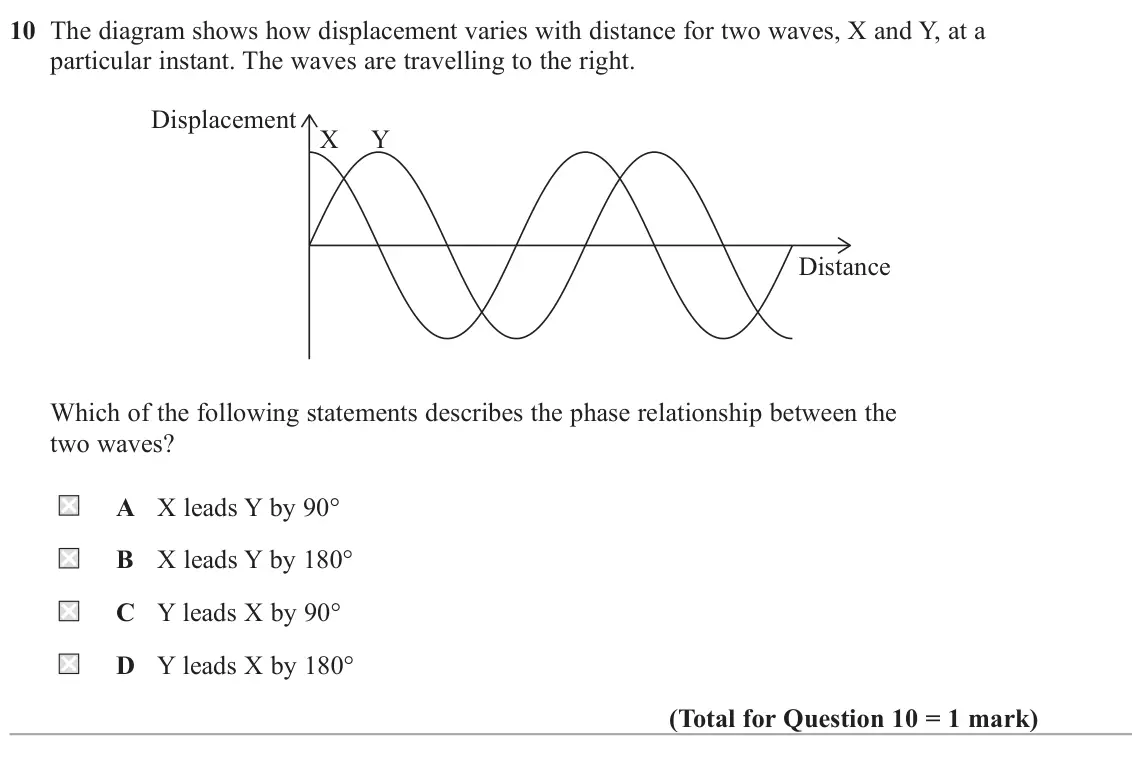
- June 2025, Paper 2, Q10 (1 mark): The diagram shows how displacement varies with distance for two waves, X and Y, at a particular instant. The waves are travelling to the right. Displacement X Y
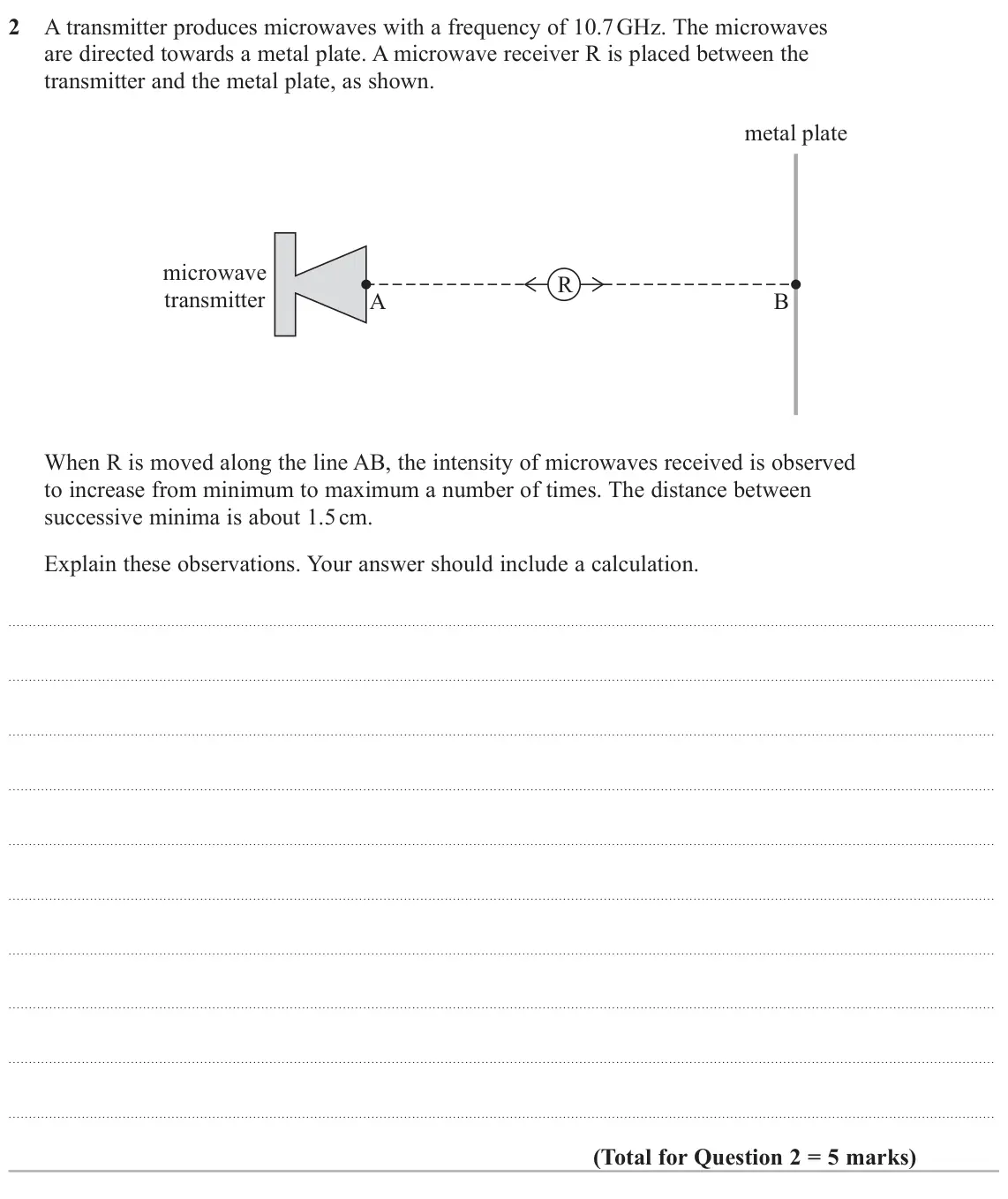
- June 2025, Paper 3, Q2 (5 marks): A transmitter produces microwaves with a frequency of 10.7 GHz. The microwaves are directed towards a metal plate. A microwave receiver R is placed between the
- June 2025, AS Paper 1, Q16(a) (2 marks): The student used digital calipers to measure the separation of the fringes w by measuring between the centres of adjacent fringes. Explain how the student could
- June 2025, AS Paper 1, Q16(b)(i) (5 marks): Plot a graph of s on the y‑axis and 1/w on the x‑axis using the grid opposite. Use the additional column in the table for your processed data. (5)
- June 2025, AS Paper 1, Q16(b)(ii) (3 marks): The following equation can be used to determine the wavelength λ of laser light for the experiment. λD s w Calculate λ for the light used in this experiment. D
- June 2025, AS Paper 1, Q16(c)(i) (2 marks): She measured w several times for the same value of s. The results are recorded below. w / mm wmean / mm 21 20 23 24 22 Calculate the percentage uncertainty in t
- June 2025, AS Paper 1, Q16(c)(ii) (4 marks): Assess whether the student’s results support the value of the wavelength of light given on the label. λD s w D = 9.00 m ± 0.01 m s = 0.20 mm ± 4% (4)
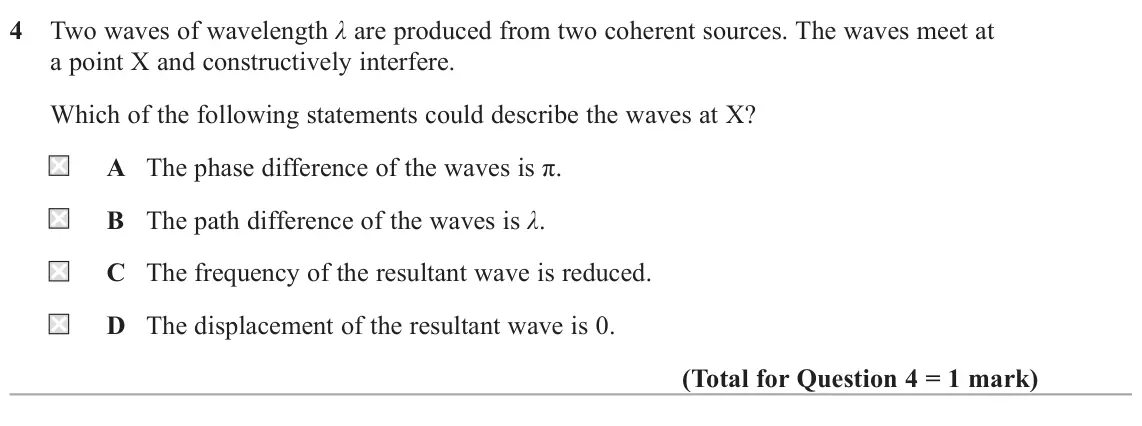
- June 2025, AS Paper 2, Q4 (1 mark): Two waves of wavelength λ are produced from two coherent sources. The waves meet at a point X and constructively interfere. Which of the following statements co
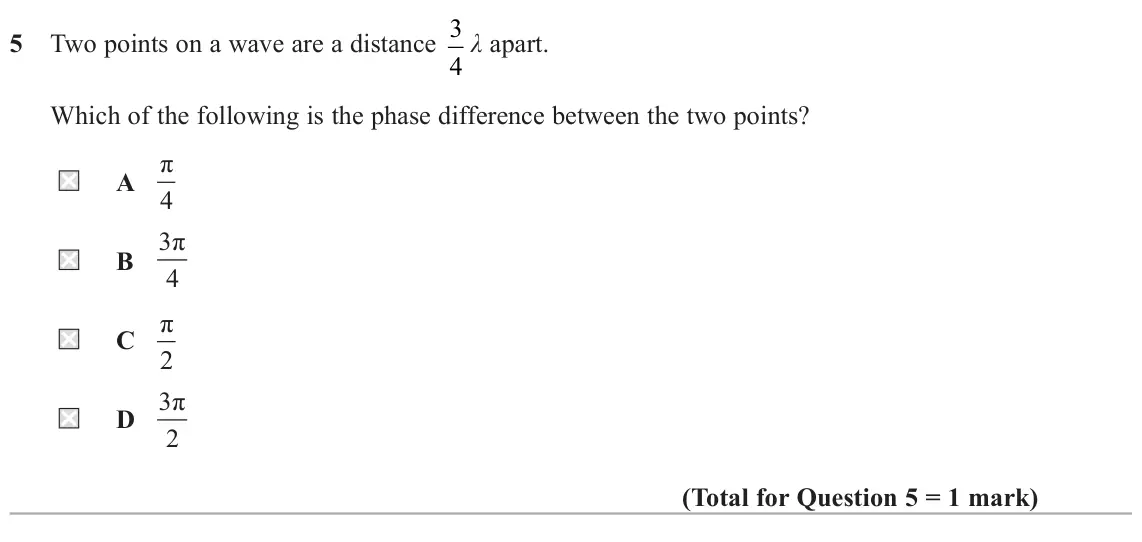
- June 2025, AS Paper 2, Q5 (1 mark): Two points on a wave are a distance 3 λ apart. 4 Which of the following is the phase difference between the two points? A π 4 B 3π 4 C π 2 D 3π 2
- June 2025, AS Paper 2, Q11(b)(i) (3 marks): One of the strings has a diameter 7.6 × 10 –4 m. Show that the mass per unit length µ of this string is about 0.0005 kg m –1. density of material of the strings
- June 2025, AS Paper 2, Q11(b)(ii) (3 marks): The effect of the tension of a string on the frequency at which standing waves are formed can be investigated using the apparatus shown. standing wave on string
- June 2024, Paper 2, Q15(a) (5 marks): Explain how the vibrations of the toothbrush head caused the loop to form. (5)
- June 2024, Paper 2, Q15(b) (5 marks): The student continued to unwind the string and the loop disappeared. When the length of the unwound string was twice that shown in Photograph 2 two loops were s
- June 2024, Paper 3, Q6(a) (3 marks): Explain why the sand moves to different positions when a standing wave is formed on the plate. (3)
- June 2024, Paper 3, Q6(c) (3 marks): The speed of sound in air can be determined by creating a standing wave in a column of air. The diagram shows a tuning fork just above the open end of a tube. t
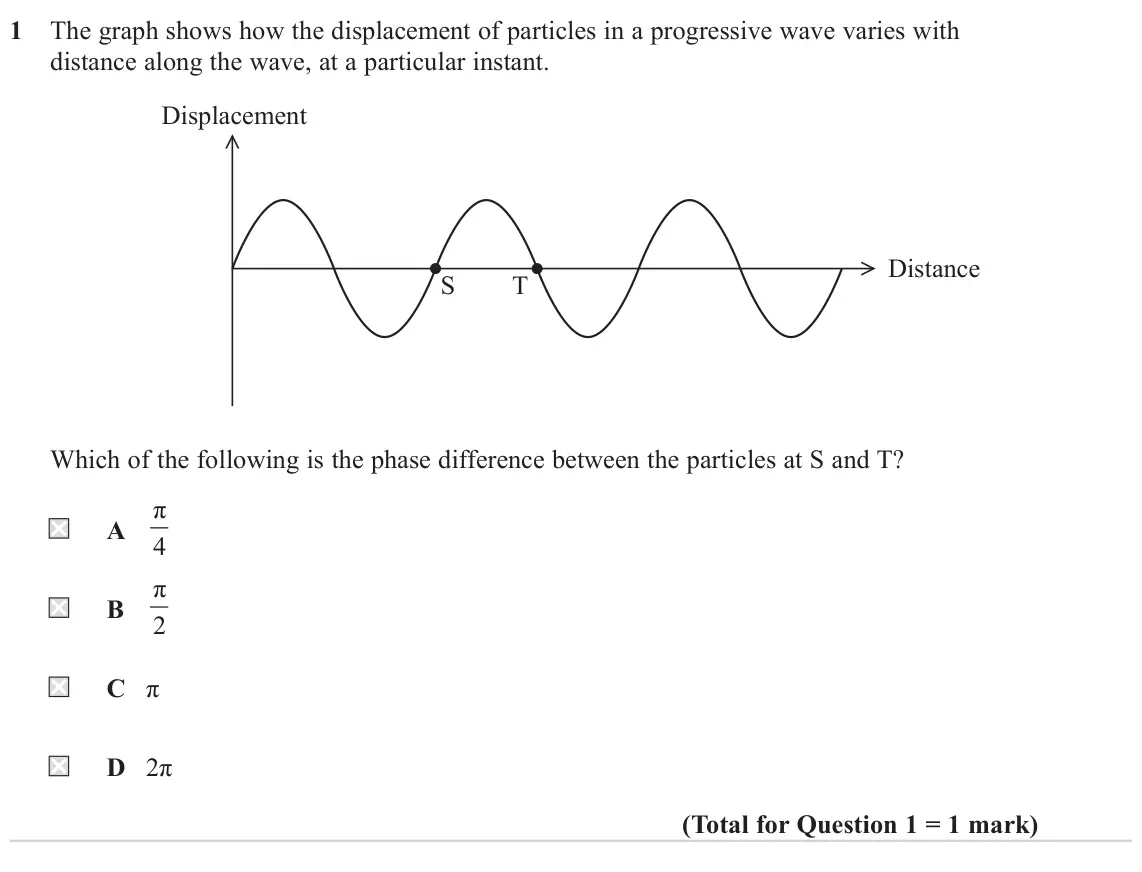
- June 2024, AS Paper 2, Q1 (1 mark): The graph shows how the displacement of particles in a progressive wave varies with distance along the wave, at a particular instant. Displacement Distance S T
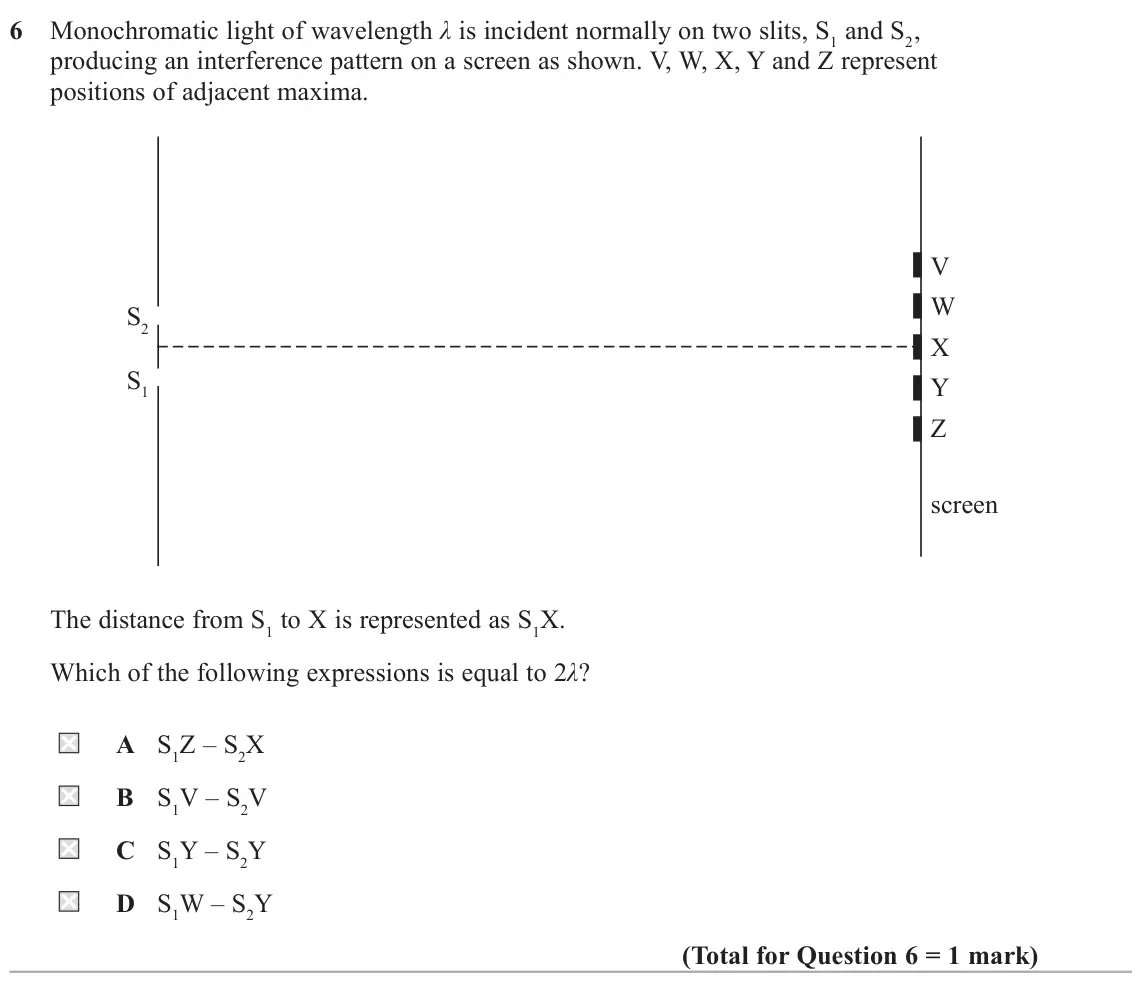
- June 2023, Paper 2, Q6 (1 mark): Monochromatic light of wavelength λ is incident normally on two slits, S1 and S2, producing an interference pattern on a screen as shown. V, W, X, Y and Z repre
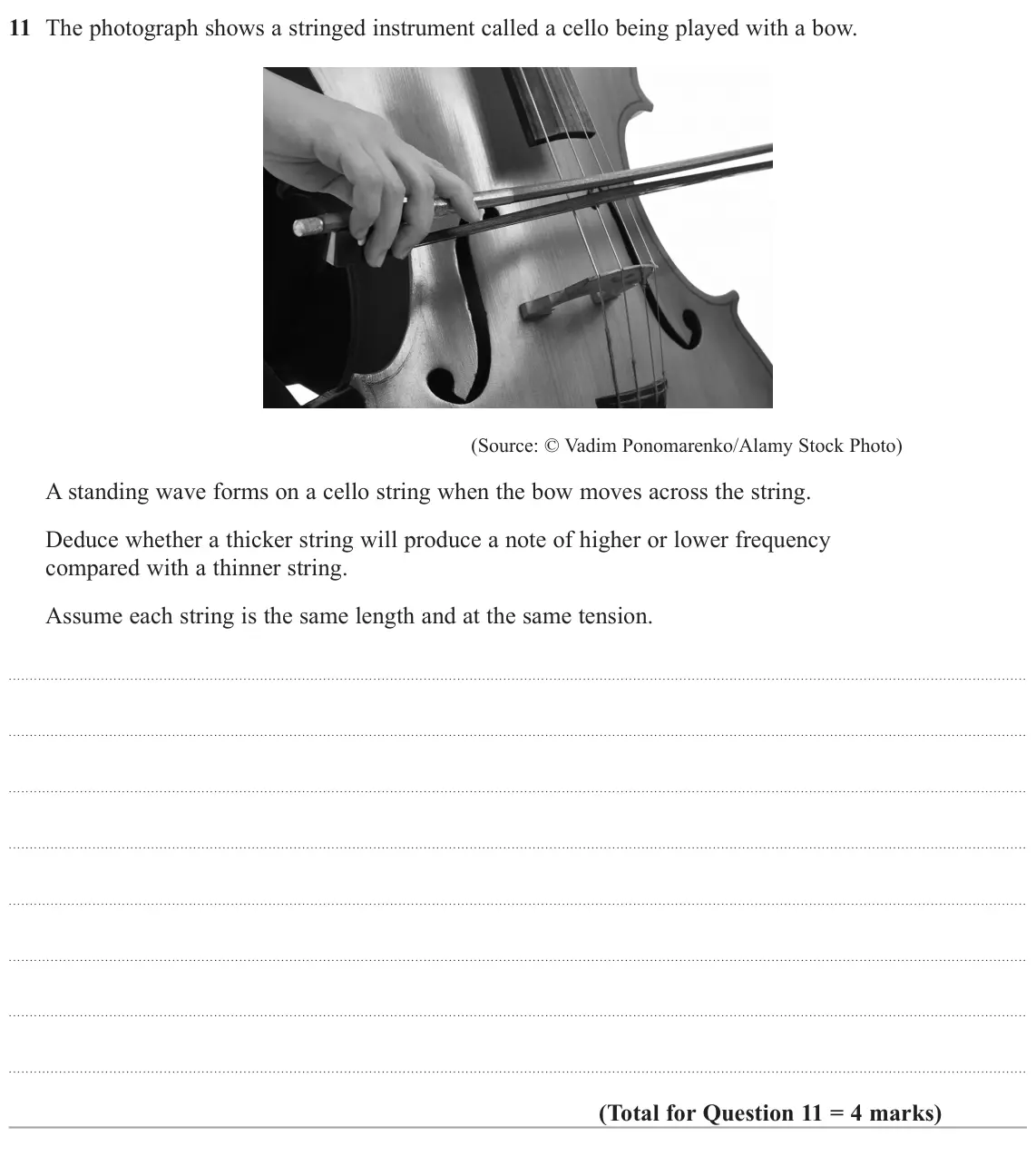
- June 2023, Paper 2, Q11 (4 marks): The photograph shows a stringed instrument called a cello being played with a bow. (Source: © Vadim Ponomarenko/Alamy Stock Photo) A standing wave forms on a ce
- June 2023, AS Paper 2, Q12(a) (2 marks): The student set up a standing wave on a string using the apparatus shown. pulley standing wave on string vibration generator masses The standing wave had one an
- June 2023, AS Paper 2, Q12(c) (4 marks): A guitar player changes the length of string that vibrates by pressing on the string as shown. The guitar player plucks a string to play a note. A standing wave
- June 2023, AS Paper 2, Q15(a) (5 marks): Describe how a standing wave can be created from the light emitted by the two lasers. (5)
- June 2022, Paper 2, Q17(b)(i) (4 marks): Calculate the minimum thickness d of the coating required for the reflection of green light to be eliminated. frequency of green light = 6.00 × 10¹⁴ Hz nc = 1.3
- June 2022, Paper 2, Q17(b)(ii) (1 mark): State why white light reflected from coated lenses is seen as purple. (1)
- June 2022, Paper 2, Q18(a)(i) (2 marks): Show that the mass per unit length μ of the string is about 1.1 × 10⁻³ kg m−1. (2)
- June 2022, Paper 2, Q18(a)(ii) (4 marks): When the middle of the string is plucked, a note of frequency 440 Hz is produced. Calculate the tension in the string. length of string = 41.0 cm (4) Tension in
- June 2022, Paper 2, Q18(b) (3 marks): The graph shows how the Young modulus E of the nylon varies with temperature. E 0 5 10 15 20 25 30 Temperature / °C When the harp is played, the temperature of
- June 2022, Paper 3, Q13(a) (3 marks): Explain how an antinode is produced at the mid-point of the wire between the bridges. (3)
- June 2022, Paper 3, Q13(b)(i) (1 mark): State one safety precaution that should be taken when carrying out the investigation. (1)
- June 2022, Paper 3, Q13(b)(ii) (3 marks): The student plotted a graph of L2 against 1/f 2. T Show that the gradient of this graph is equal to 4 μ (3)
- June 2022, Paper 3, Q13(b)(iii) (4 marks): The student’s graph is shown below. 0.05 0.04 0.03 L2 / m2 0.02 0.01 0.00 0.0 2.0 4.0 6.0 8.0 10.0 12.0 14.0 1 / f 2 / 10−6 s2 The value of μ for different stan
- June 2022, Paper 3, Q13(c)(i) (2 marks): He measured the diameter d of the wire using a micrometer. Explain one technique the student should use when measuring d. (2)
- June 2022, Paper 3, Q13(c)(ii) (6 marks): The student obtained the following data. d / mm 0.55 0.59 0.57 0.58 The stated value of μ for the brass wire used by the student was 2.14 × 10⁻³ kg m−1. Deduce
- June 2022, AS Paper 2, Q6 (1 mark): A two‑beam oscilloscope is used to display signals from two microphones as shown. Which of the following could be the phase difference in radians between the tr
- June 2022, AS Paper 2, Q14(b)(i) (3 marks): Calculate the speed of the sound wave. frequency of sound wave = 200 Hz (3) Speed of sound wave =
- November 2021, Paper 2, Q10 (1 mark): The diagram represents an arrangement used to generate standing waves on a string. string pulley vibration generator masses on mass hanger A standing wave patte
- November 2021, AS Paper 2, Q5 (1 mark): A fixed length L of string is connected to a vibration generator and held under tension T as shown. The frequency of the vibration generator is varied until, at
- November 2021, AS Paper 2, Q12(b) (4 marks): A silencer is a device fitted to a car to reduce the sound from the engine. Some sound passes through the silencer chamber and is reflected twice. Some sound pa
- November 2021, AS Paper 2, Q14(a) (3 marks): Early in 2020, a single-node seiche was observed on Lake Erie in the USA. A node formed at the centre of the lake. Antinodes formed at the two ends of the lake.
- October 2020, Paper 2, Q15(a) (3 marks): Explain how a standing wave is created on the string. (3)
- October 2020, Paper 2, Q15(b)(i) (1 mark): State the wavelength for this standing wave. (1) Wavelength =
- October 2020, Paper 2, Q15(b)(ii) (3 marks): Calculate the frequency of vibration for this standing wave. tension in guitar string = 88.6 N mass per unit length of guitar string = 4.47 × 10⁻³ kg m−1 (3) Fr
- October 2020, Paper 2, Q15(c)(ii) (2 marks): The vibrating length of string is unchanged by turning the tuning peg. Explain the effect that tightening the string has on the frequency of the sound produced.
- October 2020, Paper 3, Q9(b)(i) (4 marks): Explain why the sand collects in heaps. (4)
- October 2020, Paper 3, Q9(b)(ii) (3 marks): The student determined the distance d between the centres of adjacent heaps. Describe the procedure she should follow to determine an accurate value for d. (3)
- October 2020, Paper 3, Q9(b)(iii) (3 marks): Assess whether the experimental data is consistent with a value for the speed of sound of 340 m s−1. signal generator frequency = 3.25 kHz. d = 5.1 cm (3)
- October 2020, AS Paper 2, Q4 (1 mark): A string is held under tension. When it is plucked it vibrates with a frequency f. Which of the following would result in a lower value for f ? A decreasing the
- October 2020, AS Paper 2, Q14(a) (5 marks): Explain why the powder forms into small piles at regular intervals along the length of the tube. (5)
- October 2020, AS Paper 2, Q14(b) (3 marks): When the frequency of the source is 1.8 kHz the positions of six piles and the distance they cover is 0.50 m, as shown on the diagram. Calculate a value for the
- June 2019, Paper 2, Q15(b) (2 marks): State what is meant by superposition of waves. (2)
- June 2019, Paper 2, Q15(c): A student makes the following suggestion. "If the ultrasound reflects off a wall directly opposite the mouse repeller a standing wave is formed, so there will b
- June 2018, Paper 2, Q14 (6 marks): In 1965, Richard Feynman proposed a double slit experiment to investigate the wave properties of electrons. The experiment was later carried out using the arran
- June 2018, Paper 3, Q13(a) (8 marks): The relationship between N and D is of the form D = pN Determine p and q for this data using a graphical method. Use the additional columns for your processed d
- June 2018, Paper 3, Q13(b)(i) (2 marks): Use these readings to estimate the percentage uncertainty in the diameter due to the resolution of the instrument. (2) Percentage uncertainty =
- June 2018, Paper 3, Q13(b)(ii) (1 mark): State why the actual percentage uncertainty would have been greater than the value calculated in (b)(i). (1)
- June 2018, Paper 3, Q13(c) (4 marks): When considering the principles of this experiment, a student suggests that interference fringes would only be produced with monochromatic light. This is becaus
- June 2018, AS Paper 2, Q3 (1 mark): Which of the following is a correct statement about a stationary wave? A All points on the wave oscillate in phase. B A node is formed at a point of constructiv
- June 2018, AS Paper 2, Q6 (1 mark): The graphs show the position of two identical waves at a time t. displacement distance from source Which of the following is the phase difference between these
- June 2018, AS Paper 2, Q7 (1 mark): Which of the following gives the speed of the wave? A v = 4 I࣠O B v = 2 I࣠O C v = I࣠O D v = fl 2
- June 2018, AS Paper 2, Q8 (1 mark): Corresponding values of v2 against T are plotted. A straight line graph is obtained, as shown. Y࣠2 T Which of the following expressions for the mass per unit le
- June 2018, AS Paper 2, Q13(a) (1 mark): State what is meant by a wavefront. (1)
- June 2018, AS Paper 2, Q13(b)(i) (1 mark): State one safety precaution that should be taken with this procedure. (1)
- June 2018, AS Paper 2, Q13(b)(ii) (1 mark): Thomas Young first demonstrated the principle of this experiment in 1803 in support of the theory that light behaves as a wave. Give a reason why some scientist
- June 2018, AS Paper 2, Q13(c)(i) (3 marks): Point O is a point equidistant from the two slits. Explain why there is a bright line at this point. (3)
- June 2018, AS Paper 2, Q13(c)(ii) (1 mark): The next bright line is observed on the screen at point P. Lines AP and BP show the path of the light from each slit to the screen at P. State the difference in
- June 2017, Paper 2, Q20(b)(ii) (4 marks): In the LIGO detector, any change in the lengths of the arms is detected using a laser beam and photodetector. mirror Y arm 1 arm 2 B mirror laser X photodetecto
- June 2017, Paper 2, Q20(b)(iii) (2 marks): The system could be arranged so that when no gravitational waves are present, the beams have zero path difference at the photodetector. Explain whether using an
- June 2017, AS Paper 2, Q2 (1 mark): T 2 The velocity of a wave on a string is given by v = µ where T is the tension in the string and μ is a constant. Which of the following pairs of variables, if
- June 2017, AS Paper 2, Q4 (1 mark): Displacement-time graphs are shown for two waves, each of frequency f and period T. displacement time t The phase difference in radians between the two waves is
- June 2017, AS Paper 2, Q7 (1 mark): For two waves of light to be coherent the waves must A always have a phase difference equal to 0. B oscillate in the same plane. C have a similar amplitude. D o
- June 2017, AS Paper 2, Q10(b) (4 marks): A student uses the microwave transmitter and receiver to investigate interference using the set-up shown. transmitter receiver metal plates As the receiver is m
- June 2017, AS Paper 2, Q14(c)(i) (3 marks): Explain why the intensity at point B is less than the intensity at point A. (3)
- June 2017, AS Paper 2, Q14(c)(ii) (3 marks): Use the graph to determine a value for the speed of sound. frequency of sound wave = 2.0 kHz (3) Speed of sound =
- June 2016, AS Paper 2, Q6 (1 mark): The graph shows the variation of displacement with time for two waves. 0.25 0.20 0.15 0.10 0.05 0 0 10 20 30 40 50 Time / ms –0.05 –0.10 –0.15 –0.20 –0.25 What
- June 2016, AS Paper 2, Q11(b) (3 marks): Explain why a spot of light is produced at the centre of the shadow. (3)
- June 2016, AS Paper 2, Q12(a) (2 marks): Describe a method of varying and measuring the tension in the string. (2)
- June 2016, AS Paper 2, Q12(b) (3 marks): The student records the following data and plots a graph. Tension / N 20 25 30 35 40 Frequency / Hz 70 78 90 95 101 Frequency2 / Hz2 4900 6084 8100 10 201 Compl
- June 2016, AS Paper 2, Q12(c) (5 marks): The student reads that guitar strings have a mass per unit length of between 0.4 × 10⁻³ kg m–1 and 7 × 10⁻³ kg m–1. Determine whether the guitar string used in
- June 2016, AS Paper 2, Q13(b)(i) (2 marks): Show that the extra distance travelled by the electron beam reflecting off the second layer of atoms is given by 2dsinθ. θ is the angle between the beam and eac
Questions, mark schemes and examiner’s reports are © Pearson Edexcel, from their published past papers. Plumi isn’t affiliated with any exam board. Want whole papers? Every Edexcel A-Level Physics paper.
Rather write your answers by hand on iPad? Plumi marks them against the same mark schemes.