 plumi
Lenses: Edexcel A‑Level Physics questions
Every Edexcel A-Level Physics exam question on Lenses (specification points 75–81), 2016–2025, with its mark scheme and examiner’s report.
Find questions1,540
Calculations
Q16(a)
The whole paper ↗
Q16(b)
The whole paper ↗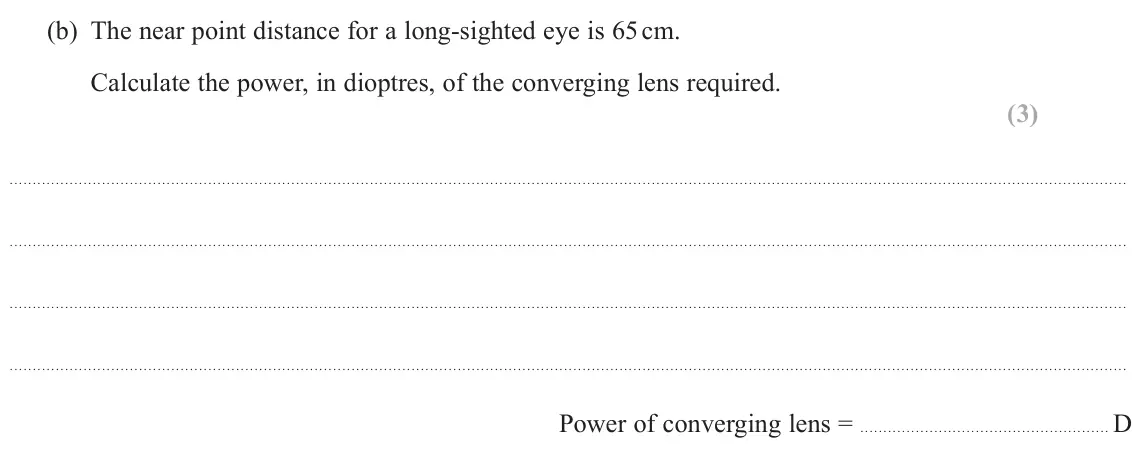
Q16(c)
The whole paper ↗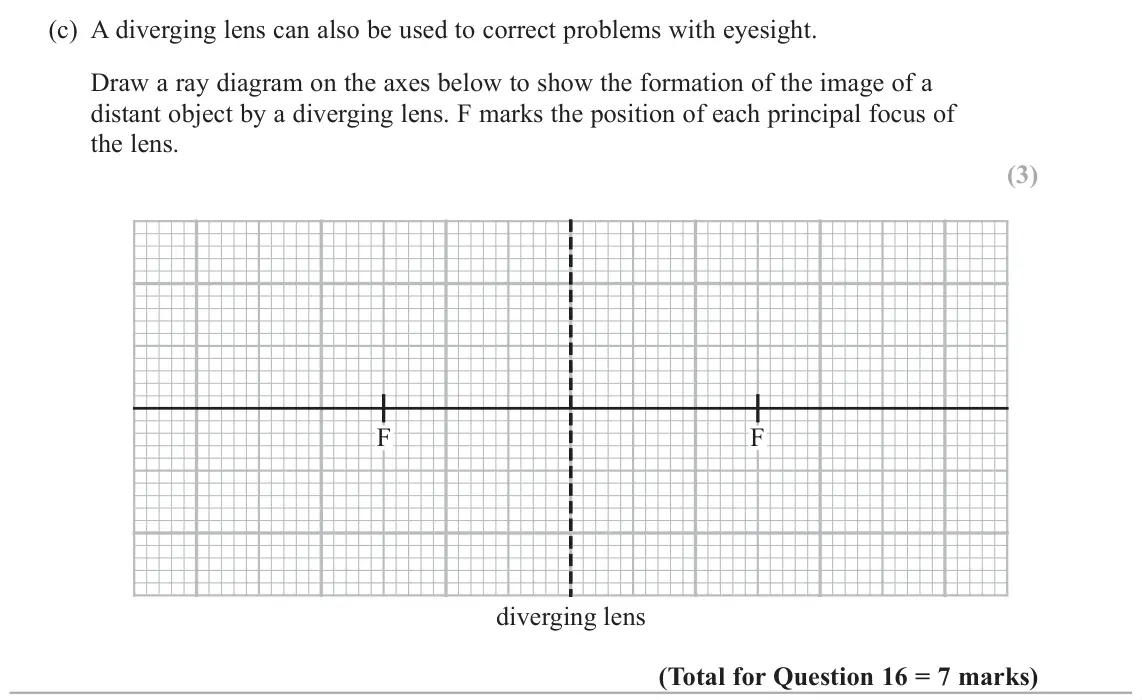
Q15(a)
The whole paper ↗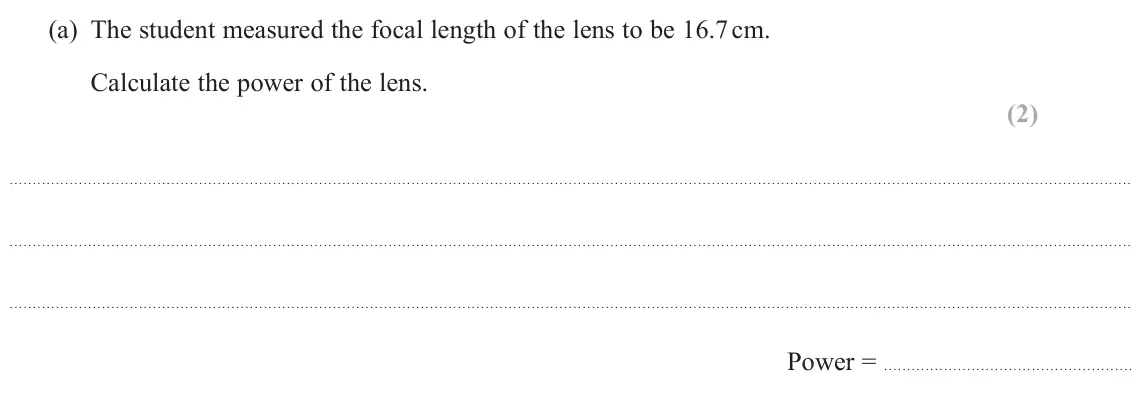
Q15(b)
The whole paper ↗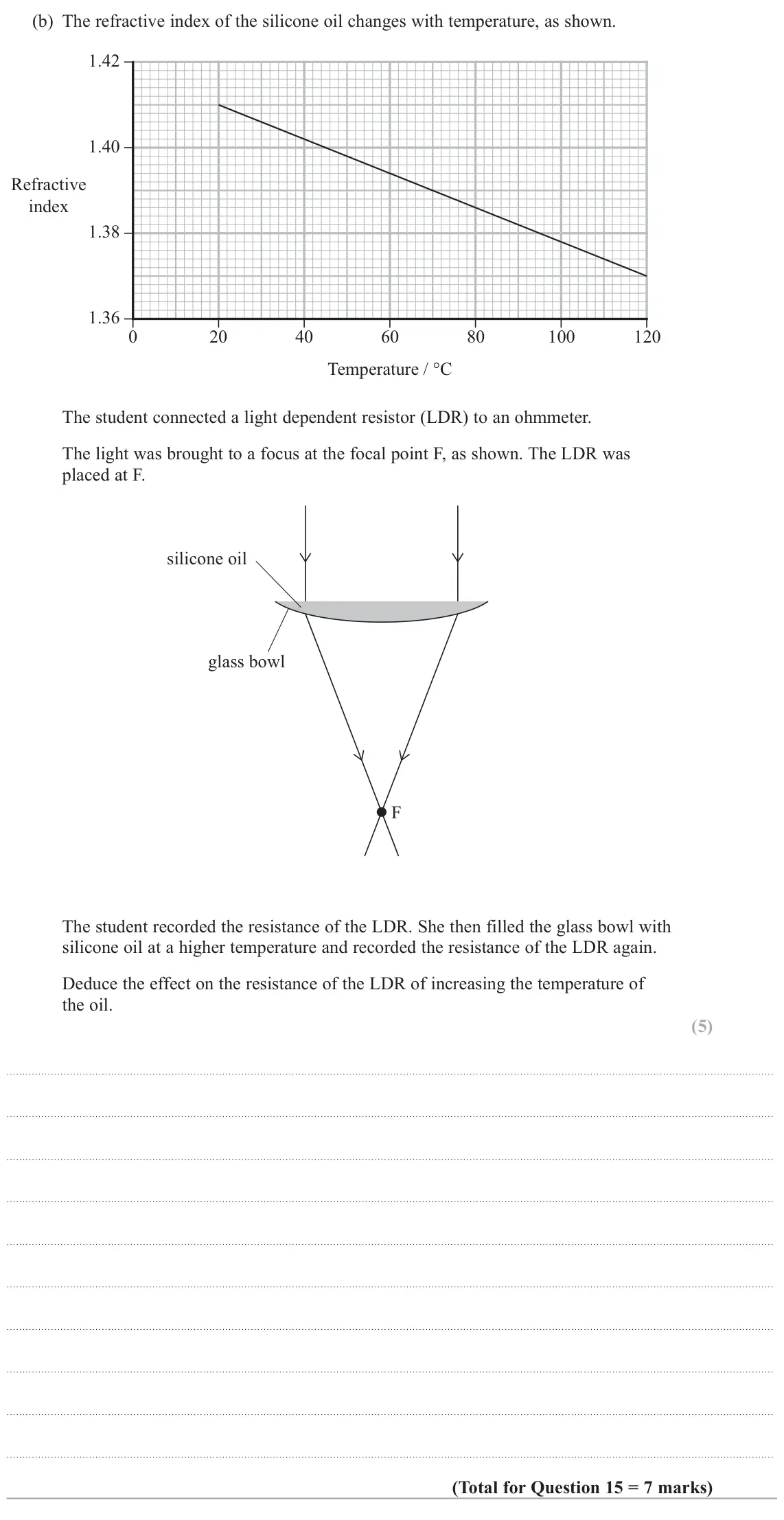
Q14(a)
The whole paper ↗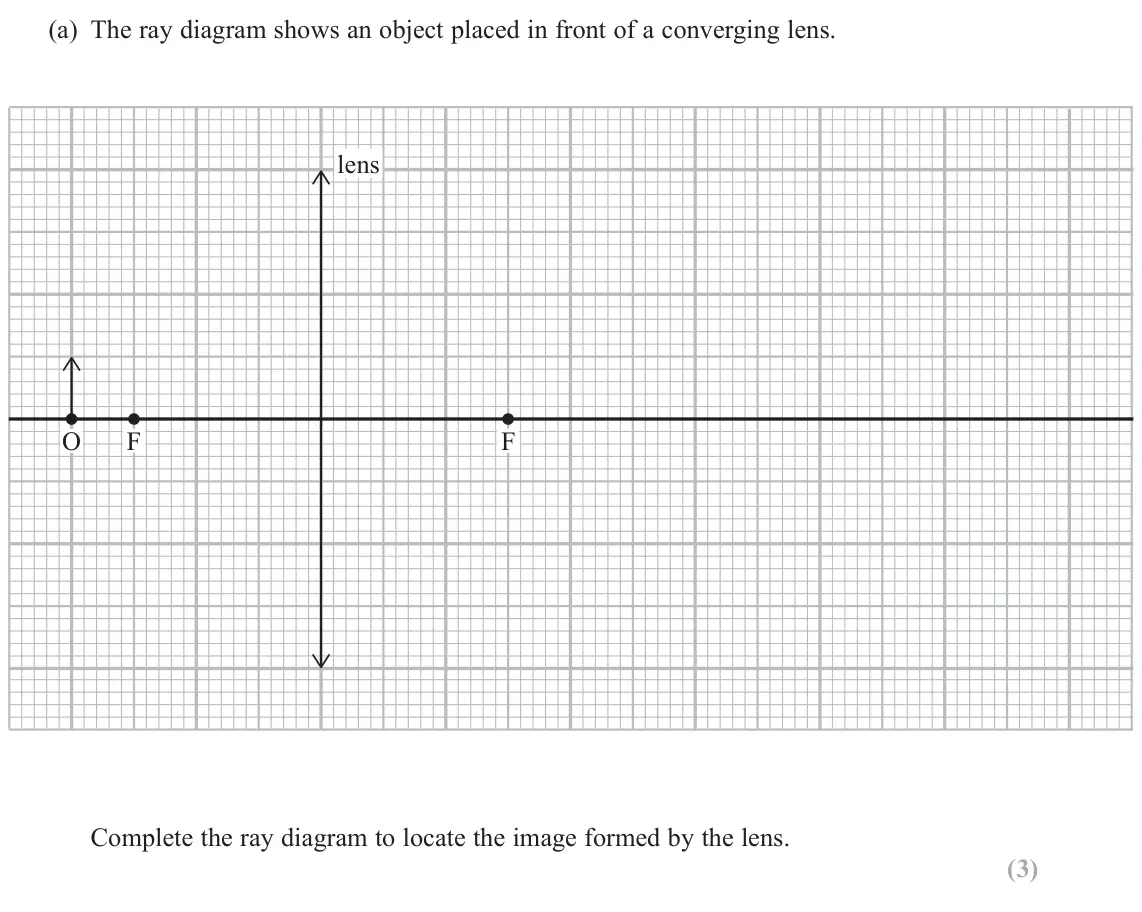
Q14(b)
The whole paper ↗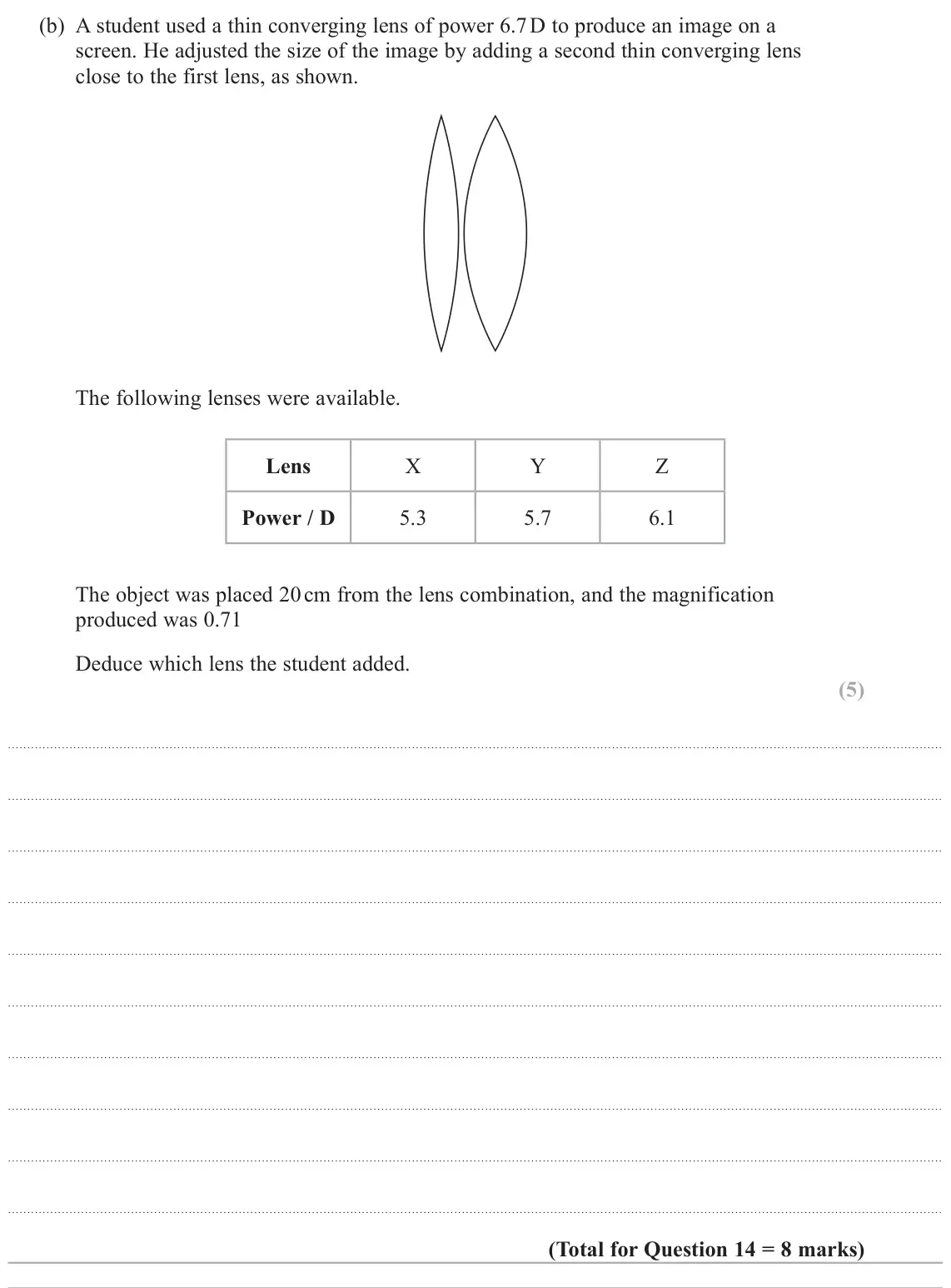
Q14(a)
The whole paper ↗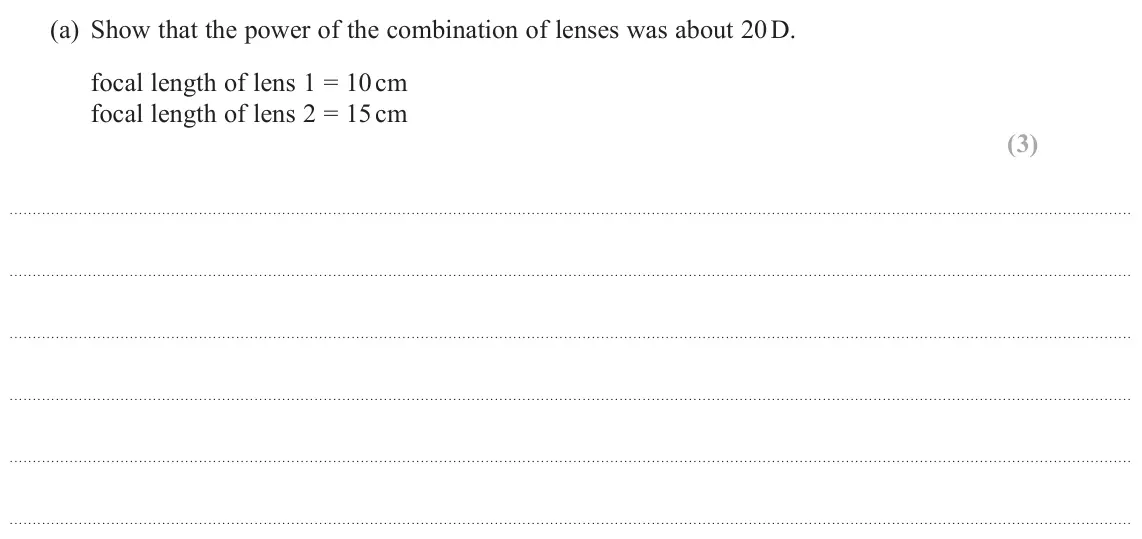
Q14(b)
The whole paper ↗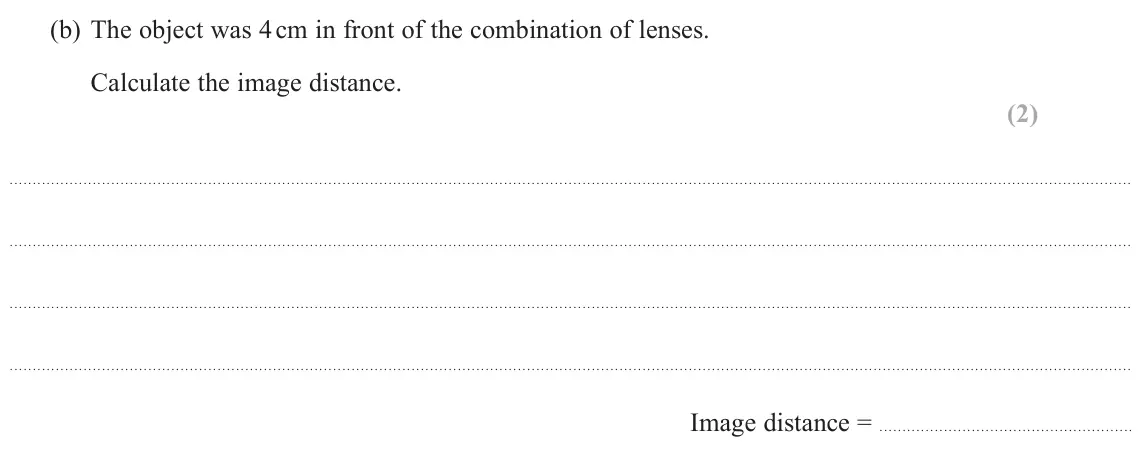
Q14(c)
The whole paper ↗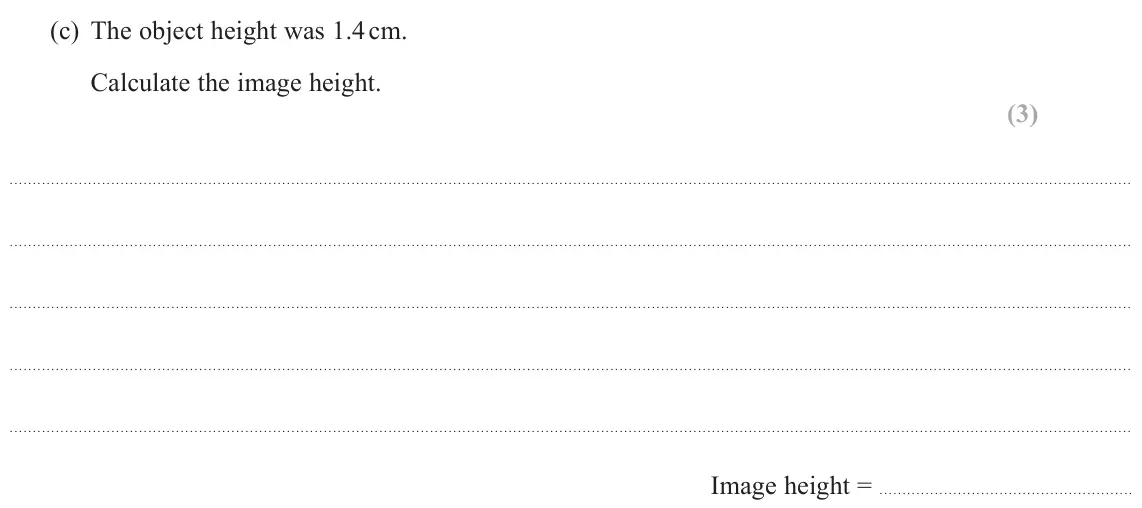
Q14(d)
The whole paper ↗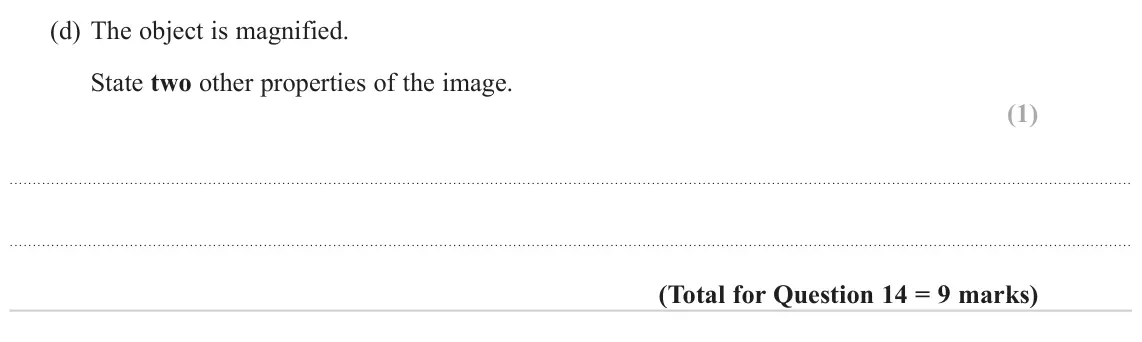
Q9(a)
The whole paper ↗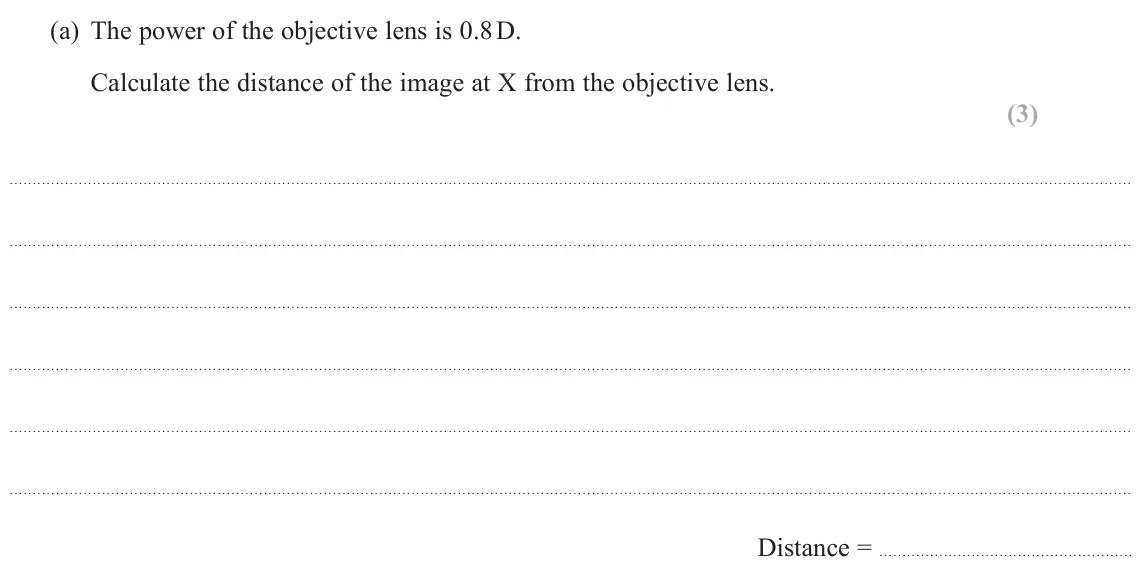
Q9(b)
The whole paper ↗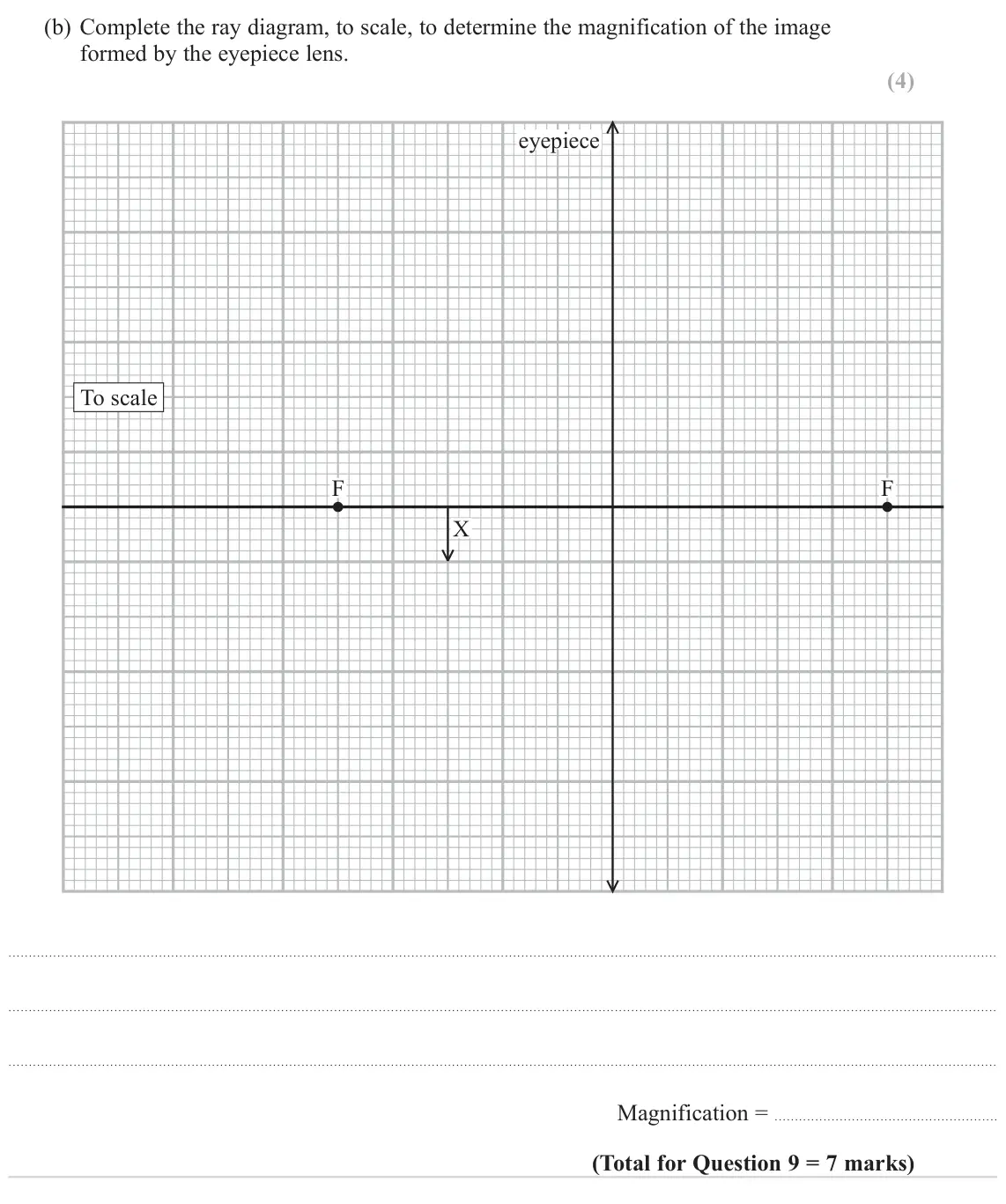
Q18(a)
The whole paper ↗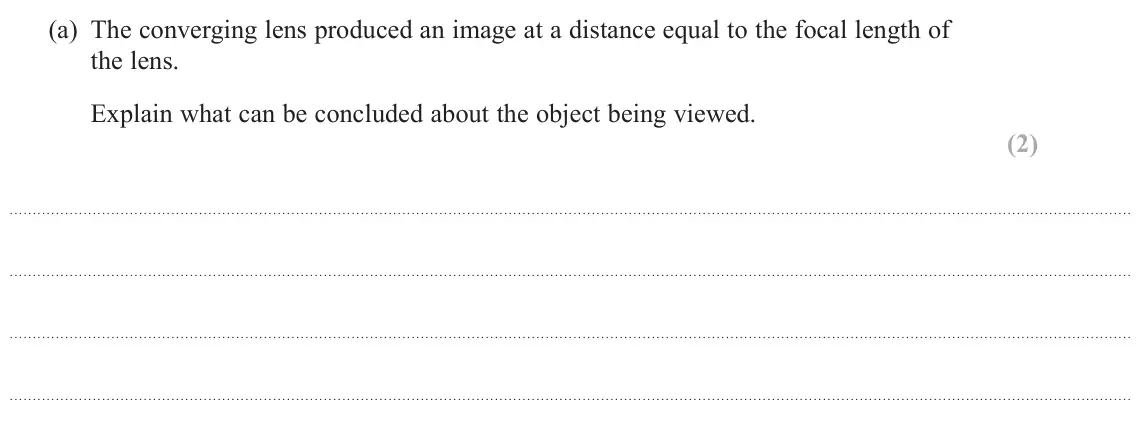
Q18(b)
The whole paper ↗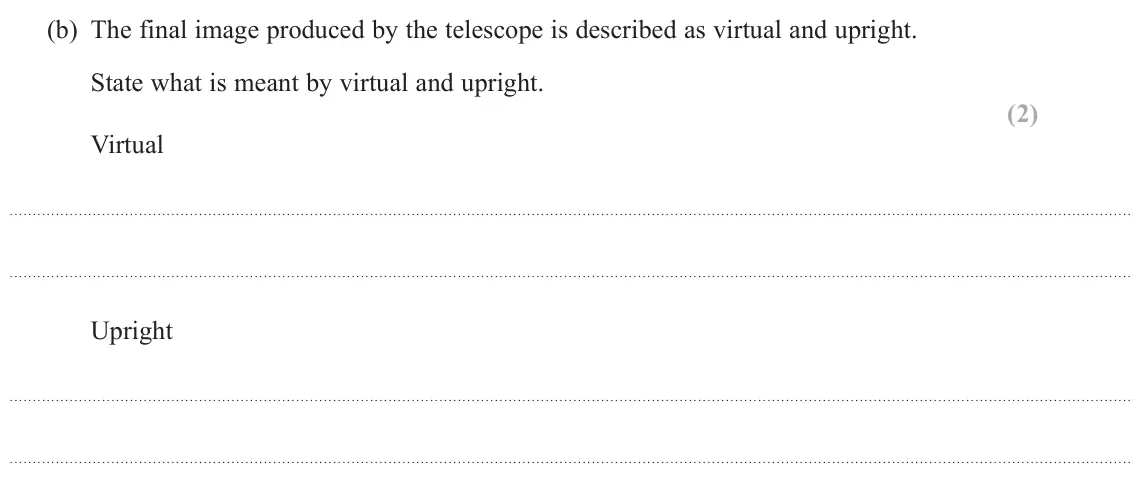
Q18(c)
The whole paper ↗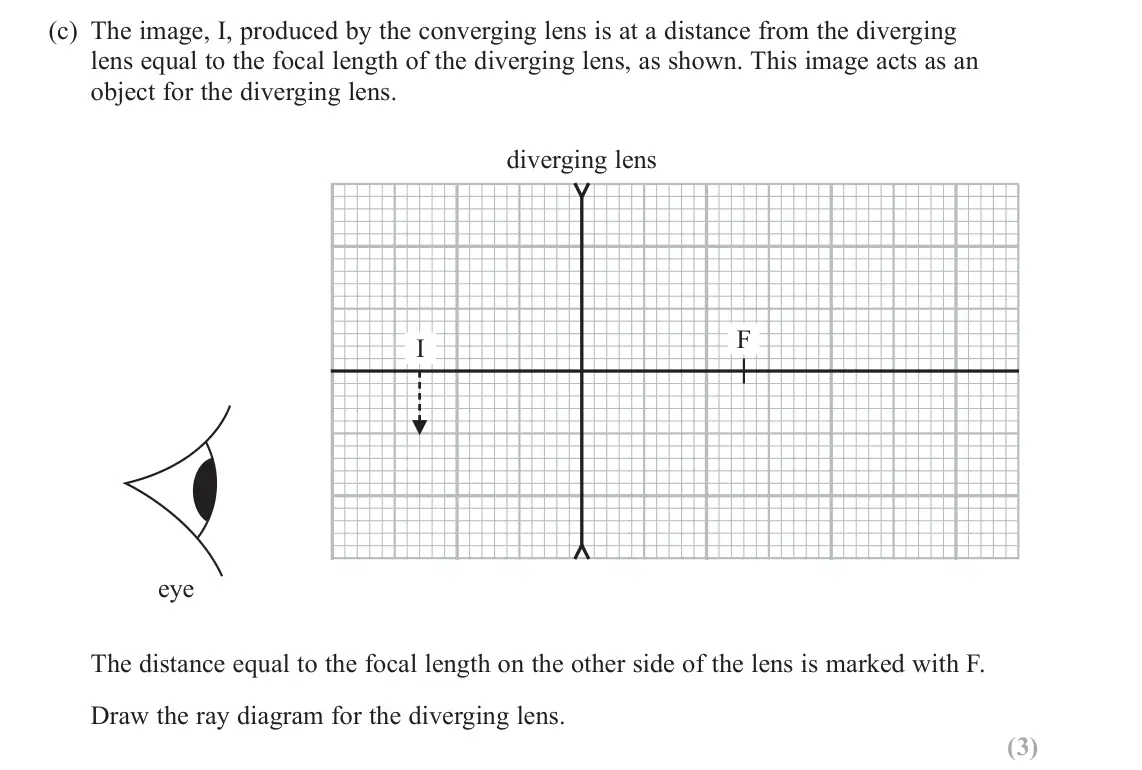
Q18(d)
The whole paper ↗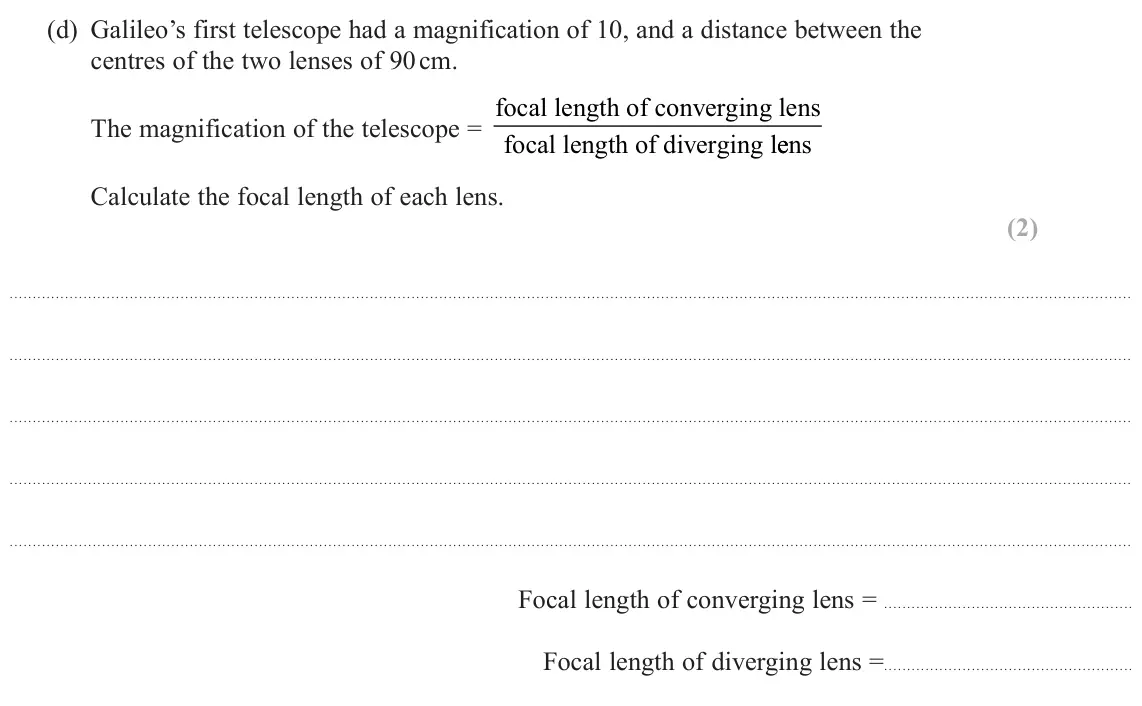
All 64 questions on Lenses, as a list
- June 2025, Paper 2, Q16(a) (1 mark): State the type of image formed by the converging lens when used to correct a long‑sighted eye. (1)
- June 2025, Paper 2, Q16(b) (3 marks): The near point distance for a long‑sighted eye is 65 cm. Calculate the power, in dioptres, of the converging lens required. (3) Power of converging lens = D
- June 2025, Paper 2, Q16(c) (3 marks): A diverging lens can also be used to correct problems with eyesight. Draw a ray diagram on the axes below to show the formation of the image of a distant object
- June 2025, AS Paper 1, Q15(a) (2 marks): The student measured the focal length of the lens to be 16.7 cm. Calculate the power of the lens. (2) Power =
- June 2025, AS Paper 1, Q15(b) (5 marks): The refractive index of the silicone oil changes with temperature, as shown. 1.42 1.40 Refractive index 1.38 1.36 0 20 40 60 80 100 120 Temperature / C The stud
- June 2025, AS Paper 2, Q14(a) (3 marks): The ray diagram shows an object placed in front of a converging lens. lens O F F Complete the ray diagram to locate the image formed by the lens. (3)
- June 2025, AS Paper 2, Q14(b) (5 marks): A student used a thin converging lens of power 6.7 D to produce an image on a screen. He adjusted the size of the image by adding a second thin converging lens
- June 2024, Paper 2, Q14(a) (3 marks): Show that the power of the combination of lenses was about 20 D. focal length of lens 1 = 10 cm focal length of lens 2 = 15 cm (3)
- June 2024, Paper 2, Q14(b) (2 marks): The object was 4 cm in front of the combination of lenses. Calculate the image distance. (2) Image distance =
- June 2024, Paper 2, Q14(c) (3 marks): The object height was 1.4 cm. Calculate the image height. (3) Image height =
- June 2024, Paper 2, Q14(d) (1 mark): The object is magnified. State two other properties of the image. (1)
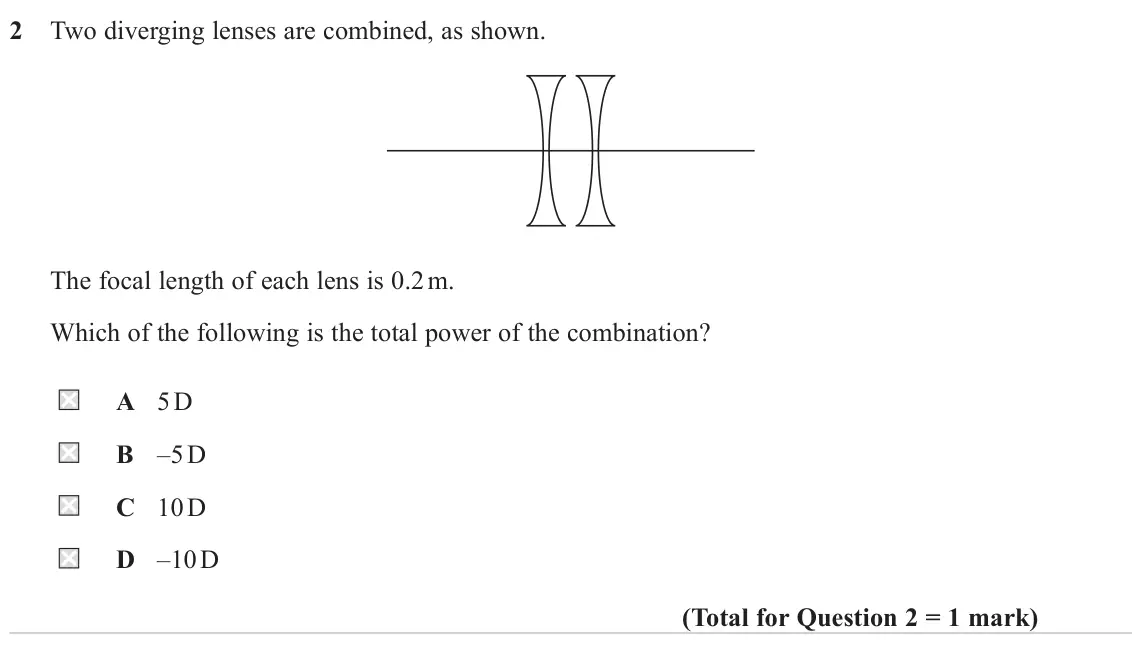
- June 2024, AS Paper 2, Q2 (1 mark): Two diverging lenses are combined, as shown. The focal length of each lens is 0.2 m. Which of the following is the total power of the combination? A 5 D B –5 D
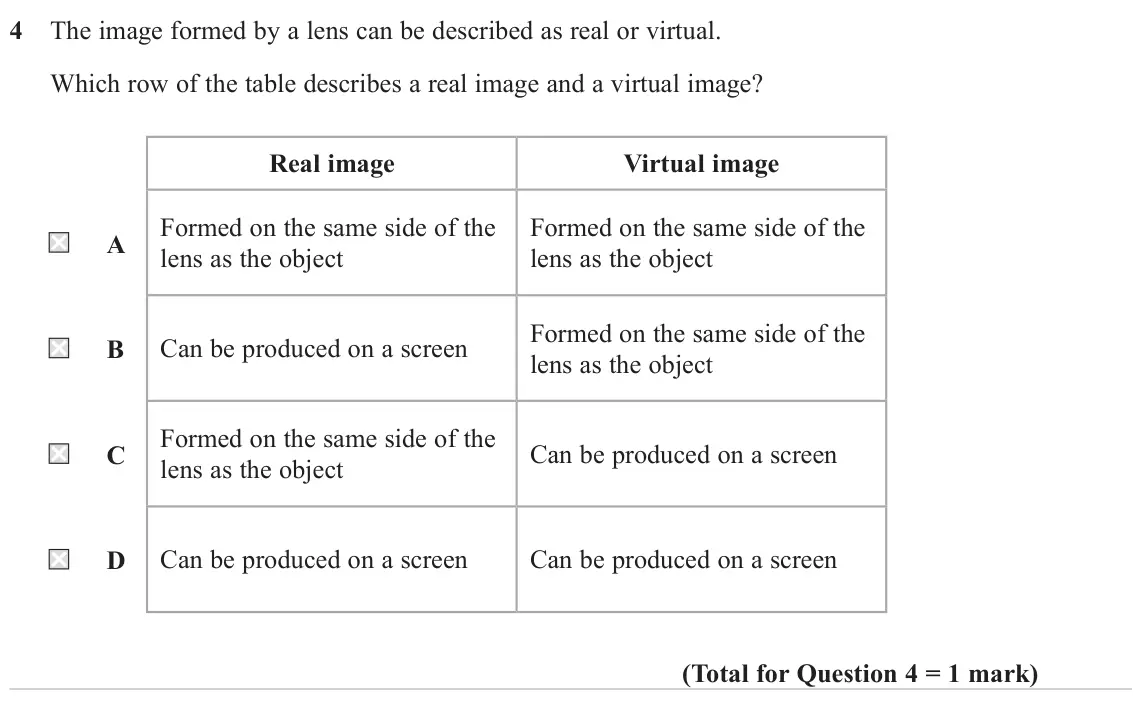
- June 2024, AS Paper 2, Q4 (1 mark): The image formed by a lens can be described as real or virtual. Which row of the table describes a real image and a virtual image? Real image Virtual image Form
- June 2024, AS Paper 2, Q9(a) (3 marks): The power of the objective lens is 0.8 D. Calculate the distance of the image at X from the objective lens. (3) Distance =
- June 2024, AS Paper 2, Q9(b) (4 marks): Complete the ray diagram, to scale, to determine the magnification of the image formed by the eyepiece lens. (4) eyepiece To scale F F X Magnification =
- June 2023, Paper 2, Q18(a) (2 marks): The converging lens produced an image at a distance equal to the focal length of the lens. Explain what can be concluded about the object being viewed. (2)
- June 2023, Paper 2, Q18(b) (2 marks): The final image produced by the telescope is described as virtual and upright. State what is meant by virtual and upright. (2) Virtual Upright
- June 2023, Paper 2, Q18(c) (3 marks): The image, I, produced by the converging lens is at a distance from the diverging lens equal to the focal length of the diverging lens, as shown. This image act
- June 2023, Paper 2, Q18(d) (2 marks): Galileo’s first telescope had a magnification of 10, and a distance between the centres of the two lenses of 90 cm. The magnification of the telescope = focal l
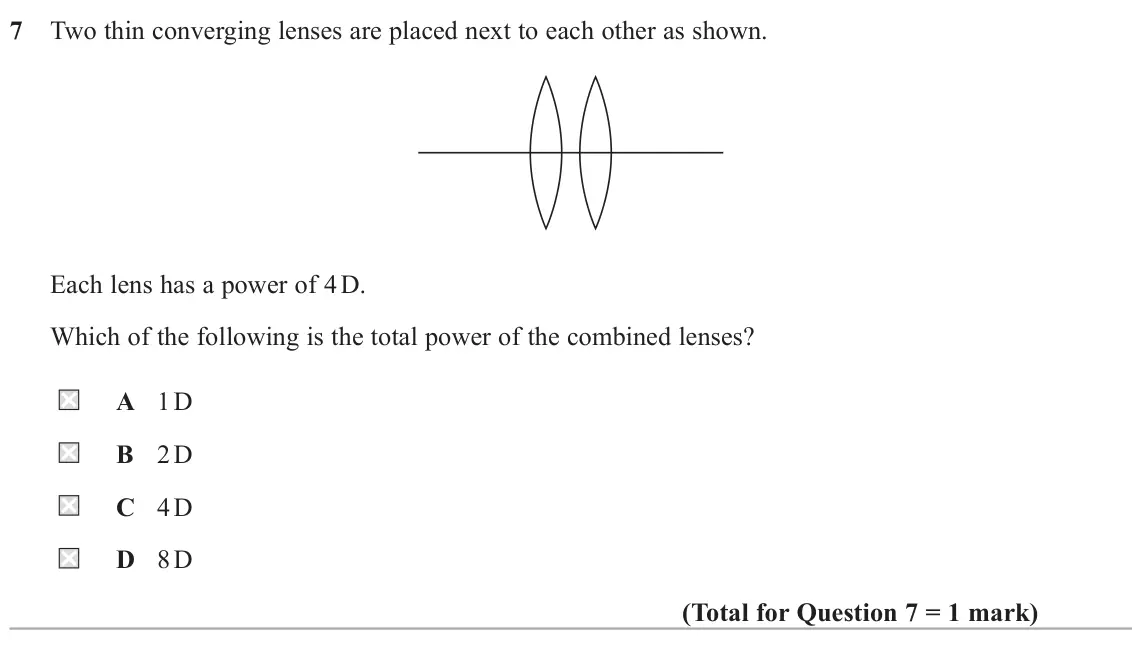
- June 2023, AS Paper 2, Q7 (1 mark): Two thin converging lenses are placed next to each other as shown. Each lens has a power of 4 D. Which of the following is the total power of the combined lense
- June 2023, AS Paper 2, Q13(a) (2 marks): Complete the ray diagram to show how a converging lens produces a magnified image of the object shown. (2) lens object F F
- June 2023, AS Paper 2, Q13(b) (5 marks): With the naked eye, the jeweller can detect a scratch that has a width of 0.1 mm or greater. The diamond has a scratch that is 10 µm wide. The jeweller holds th
- June 2022, Paper 2, Q9 (1 mark): The focal length and power of a converging glass lens are determined for the lens in air. The lens is then immersed in water. Which row in the table shows how t
- June 2022, Paper 2, Q11(a) (4 marks): The camera is initially focused on an object in the far distance. Calculate the displacement of the lens that would be required to focus on an object 25.0 cm fr
- June 2022, Paper 2, Q11(b) (1 mark): State why the lens and the light sensors in a mobile phone camera can be positioned a fixed distance apart. (1)
- June 2022, Paper 2, Q17(a)(i) (2 marks): In the arrangement shown, the final image is formed at infinity. Explain why the separation of the objective and eyepiece lenses is equal to the sum of their fo
- June 2022, Paper 2, Q17(a)(ii) (1 mark): State why the final image is inverted. (1)
- June 2022, AS Paper 2, Q4 (1 mark): A ray diagram, drawn to scale, is used to locate the size and position of an image formed by a lens as shown. 1 cm lens image object Which row in the table give
- June 2022, AS Paper 2, Q12(b) (4 marks): A teacher was modelling the human eye. He placed an object 60 cm from a converging lens system. A real image of the object was observed with a magnification of
- November 2021, Paper 2, Q2 (1 mark): An object is placed in front of a lens. Which row of the table shows a combination that will produce a real image of the object? Focal length of Object lens / c
- November 2021, Paper 2, Q19(a)(i) (2 marks): The power of an octopus lens is 118 D. Show that the focal length of the lens is about 8.5 mm. (2)
- November 2021, Paper 2, Q19(a)(ii) (2 marks): Calculate the shortest distance from the eye at which an object may be focused clearly on the retina. maximum distance from lens to retina = 2.0 cm (2) Shortest
- November 2021, Paper 2, Q19(a)(iii) (3 marks): The lens in the eye of an octopus is in contact with seawater. The refractive index of freshwater is less than the refractive index of seawater. Deduce what wou
- November 2021, AS Paper 1, Q16(a) (2 marks): Explain why a graph of m on the y-axis and v on the x-axis should be a straight line. (2)
- November 2021, AS Paper 1, Q16(b)(i) (6 marks): Complete the table and plot a graph of m against v on the grid opposite. (6)
- November 2021, AS Paper 1, Q16(b)(ii) (3 marks): Determine a value for f. (3) f =
- November 2021, AS Paper 1, Q16(c) (3 marks): If the distance from object to the lens is less than a certain value, no image is produced on the screen. Explain why. (3)
- November 2021, AS Paper 2, Q15(a) (4 marks): The diagram below shows an object in front of a converging lens. F is the principal focus. converging lens object F F Determine the position and magnification o
- November 2021, AS Paper 2, Q15(b) (4 marks): A short-sighted eye cannot focus on distant objects, because the power of the eye is too great. One student with short sight cannot focus on objects further tha
- October 2020, Paper 2, Q8 (1 mark): Which of the following lenses would produce a real image of an object placed 15 cm away from the lens? A converging, focal length = 10 cm B converging, focal le
- October 2020, AS Paper 2, Q15(a) (5 marks): Calculate the power of the lens in the magnifying glass. (5) Power of lens =
- June 2019, Paper 3, Q4 (5 marks): A student carried out an experiment to determine the focal length of a converging lens. He placed the lens a distance u from an illuminated object. He placed a
- June 2018, Paper 2, Q1 (1 mark): A system of lenses consists of a converging lens and a diverging lens in contact. The magnitude of the power of the converging lens is 9.4 D and the magnitude o
- June 2018, Paper 2, Q9 (1 mark): An object is placed 6.5 cm from a lens of focal length 3.9 cm. An image is formed 9.8 cm behind the lens. Which of the following expressions is equal to the mag
- June 2018, Paper 2, Q17(a) (4 marks): In the VR headset the lens is between the eye and the screen, as shown below. Not to scale Eye Screen Lens For a particular user of the headset, the image of th
- June 2018, Paper 2, Q17(b)(ii) (3 marks): Explain how the lens focuses a beam of light travelling parallel to the principal axis. (3)
- June 2018, Paper 3, Q8(a) (3 marks): A converging lens of focal length 15.0 cm is used to project an image of an illuminated object onto a screen. The object is a circle of diameter 4.0 mm and the
- June 2018, AS Paper 2, Q14(a)(i) (3 marks): Complete the ray diagram to determine the position of the image. (3)
- June 2018, AS Paper 2, Q14(a)(ii) (2 marks): Determine the magnification of this image. (2) Magnification =
- June 2018, AS Paper 2, Q14(a)(iii) (1 mark): State, with justification, whether the image is real or virtual. (1)
- June 2018, AS Paper 2, Q14(b)(i) (2 marks): Describe a method to determine an approximate value for the focal length of a converging lens. (2)
- June 2018, AS Paper 2, Q14(b)(ii) (2 marks): Explain why the lens with the shorter focal length is thicker at its centre. (2)
- June 2018, AS Paper 2, Q14(b)(iii) (5 marks): Both photographs show the same scene photographed from the same position. Photograph 1 Photograph 2 One photograph was taken using the lens of focal length 50 m
- June 2017, Paper 2, Q9 (1 mark): An object is placed 6.5 cm away from a lens of focal length 3.9 cm. An image is formed 9.8 cm from the lens. Which of the following is the magnification? A 0.60
- June 2017, Paper 2, Q18(a) (4 marks): It is suggested that the cornea provides 80% of the focusing power of the eye. Determine whether this is correct. focal length of cornea = 2.23 cm focal length
- June 2017, Paper 2, Q18(b)(i) (2 marks): Calculate the distance from the point object to this single lens when a focused image is formed on the retina. (2) Distance =
- June 2017, AS Paper 2, Q11(a) (2 marks): The diagram shows three parallel rays of light incident on a diverging lens and the path of the rays after passing through the lens. The diagram is drawn to act
- June 2017, AS Paper 2, Q11(b) (3 marks): The eye acts as a converging lens system. The diagram shows light rays from an object 25 cm in front of an eye converging to a point on the retina at the back o
- June 2017, AS Paper 2, Q11(c) (1 mark): A person who is long-sighted cannot clearly see objects that are close to the eye. Rays of light from an object 25 cm in front of the eye would converge to a po
- June 2017, AS Paper 2, Q12(a) (1 mark): State what is meant by a virtual image. (1)
- June 2016, AS Paper 2, Q14(a) (2 marks): Show that the focal length of the objective lens is about 1200 mm. (2)
- June 2016, AS Paper 2, Q14(b)(i) (2 marks): Explain why the image of the Moon produced at P by the objective lens will be at a distance of about 1200 mm from this lens. (2)
- June 2016, AS Paper 2, Q14(b)(ii) (2 marks): State the properties of the image at P. (2)
- June 2016, AS Paper 2, Q14(c) (3 marks): The eyepiece is at a distance of 100 mm from the image at P. To give a reasonable magnification, the final image at Q should be a virtual image at a distance of
Questions, mark schemes and examiner’s reports are © Pearson Edexcel, from their published past papers. Plumi isn’t affiliated with any exam board. Want whole papers? Every Edexcel A-Level Physics paper.
Rather write your answers by hand on iPad? Plumi marks them against the same mark schemes.