 plumi
Polarisation and diffraction: Edexcel A‑Level Physics questions
Every Edexcel A-Level Physics exam question on Polarisation and diffraction (specification points 82–87), 2016–2025, with its mark scheme and examiner’s report.
Find questions1,540
Calculations
Q9(a)
The whole paper ↗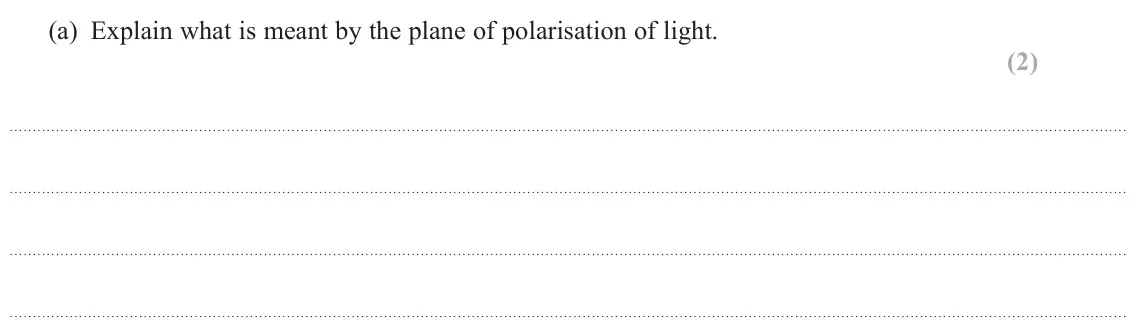
Q9(b)(i)
The whole paper ↗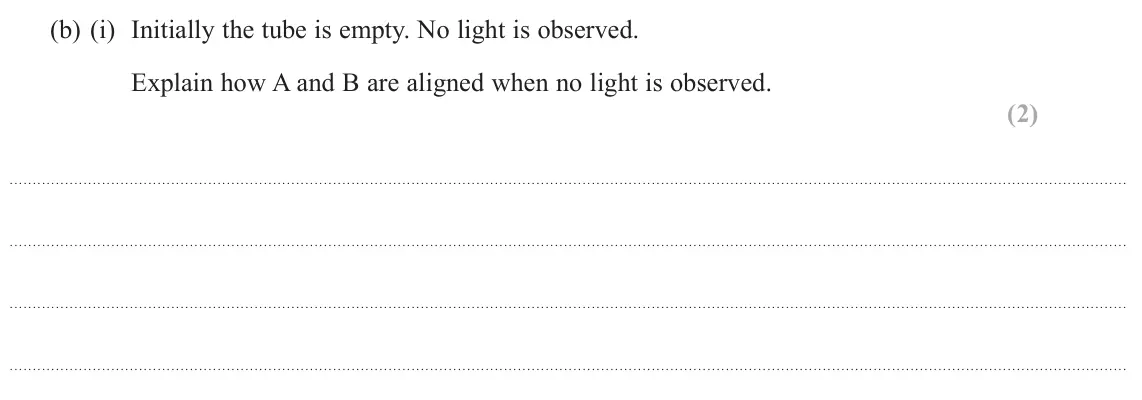
Q9(b)(ii)
The whole paper ↗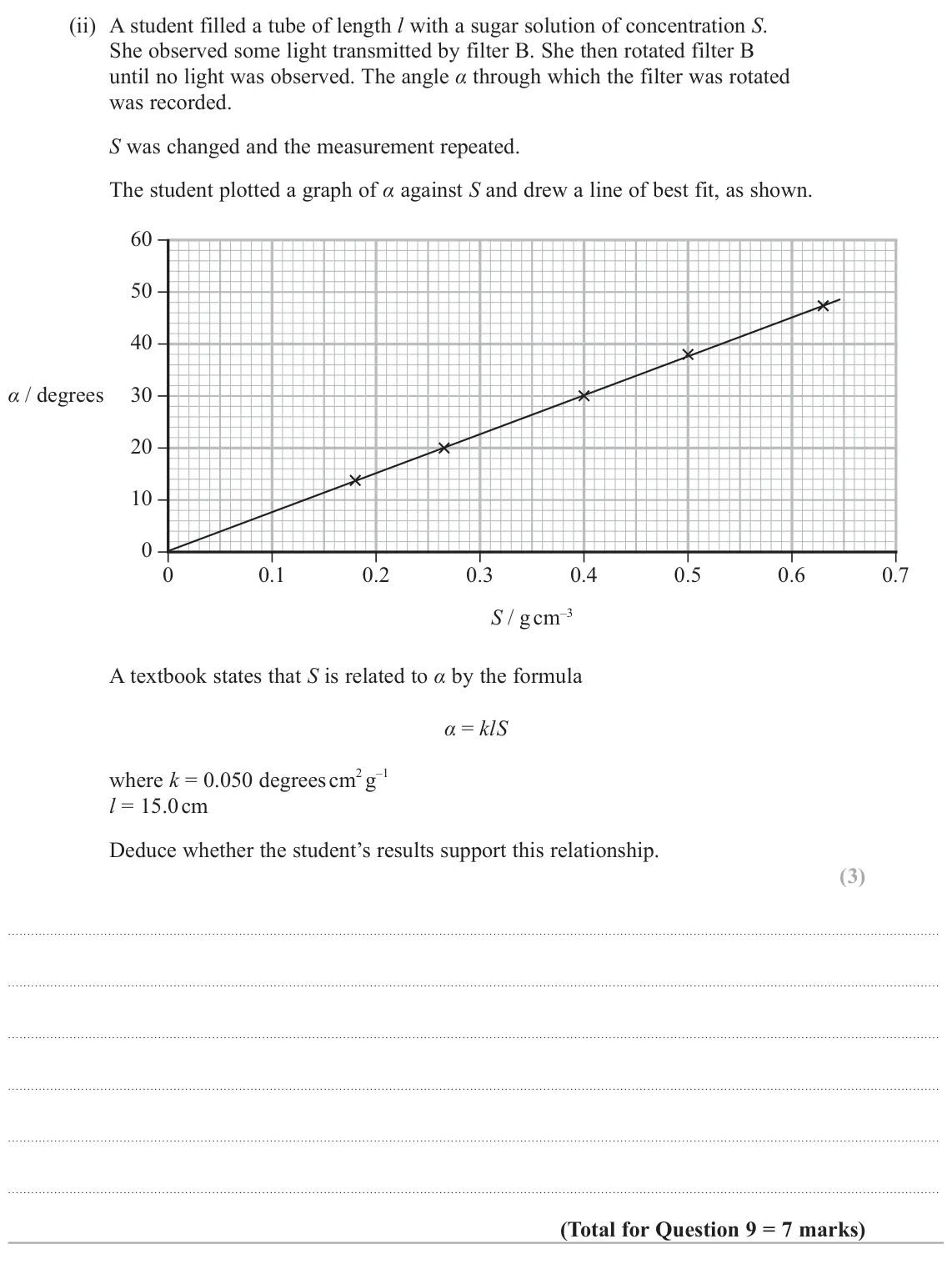
Q11(a)
The whole paper ↗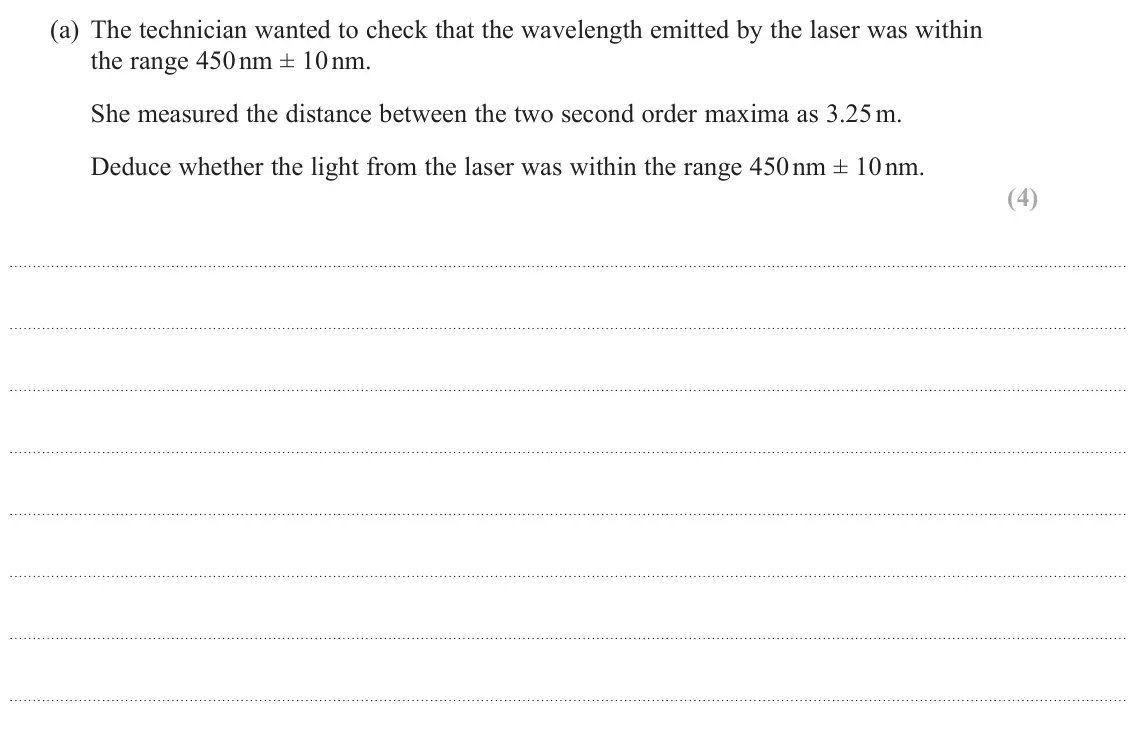
Q17(a)
The whole paper ↗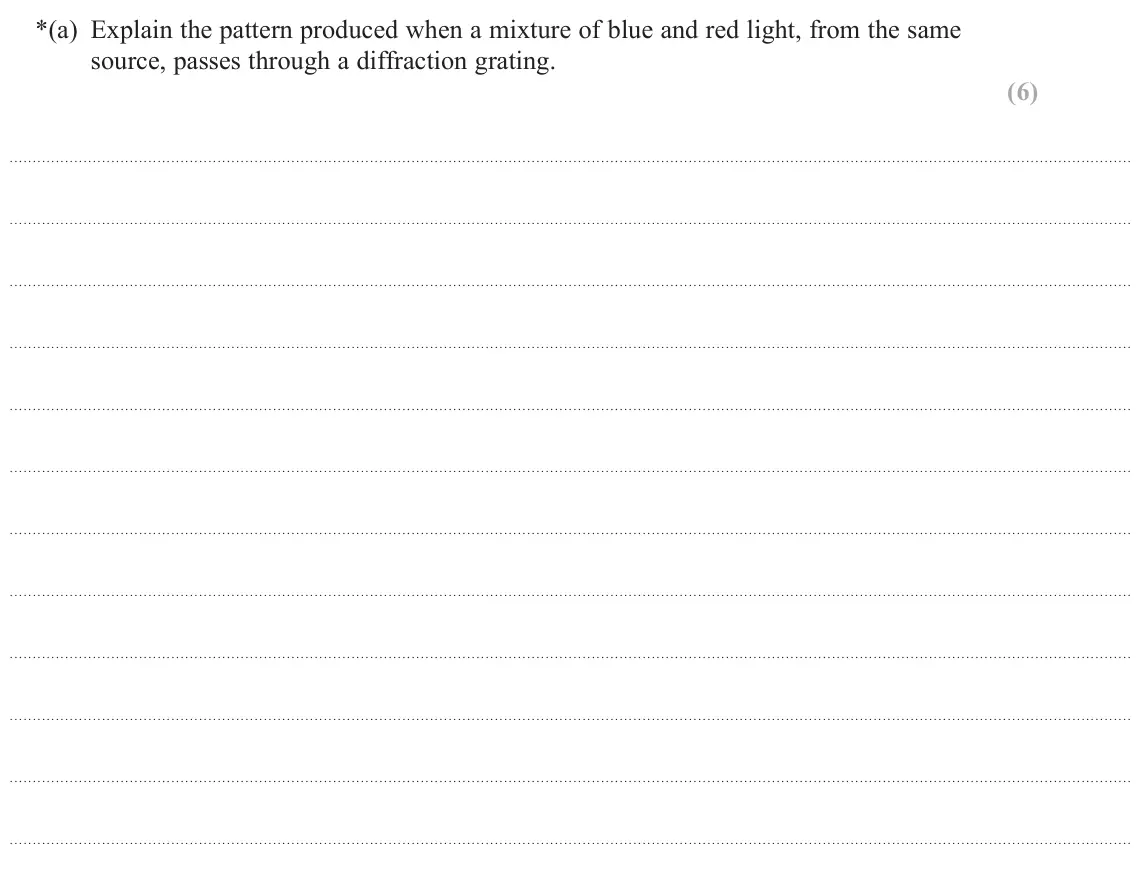
Q1(a)
The whole paper ↗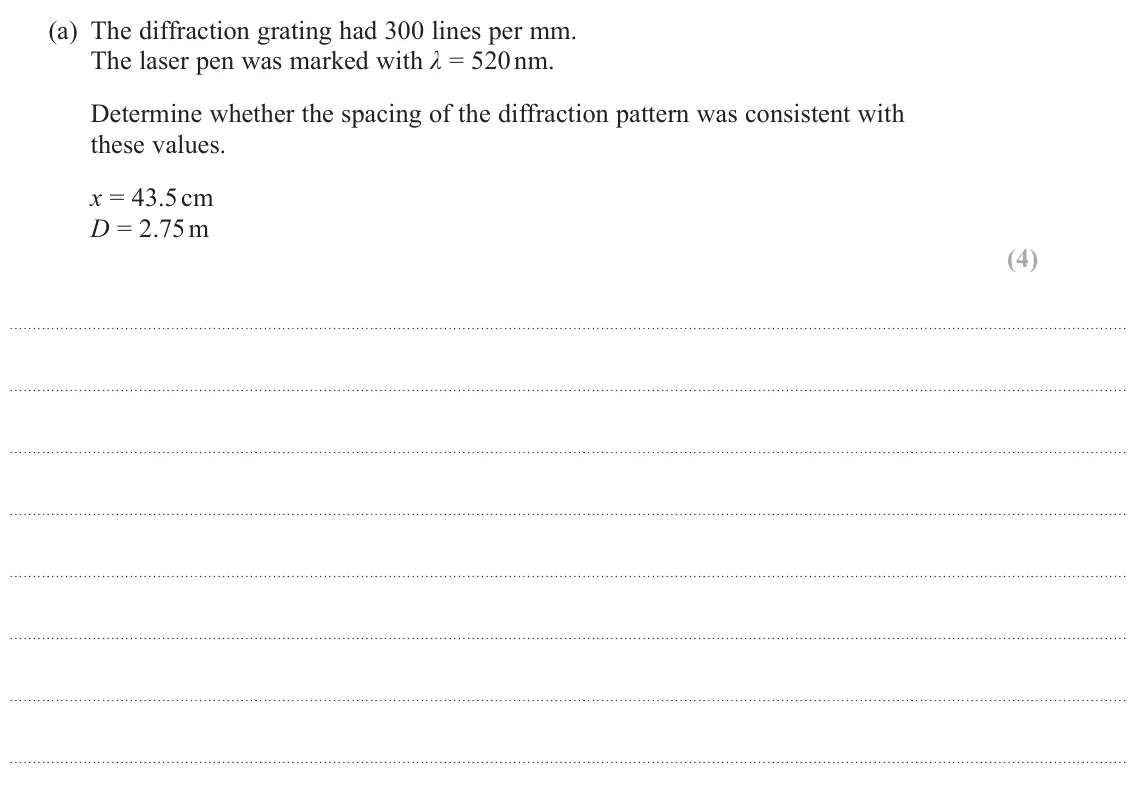
Q15(b)
The whole paper ↗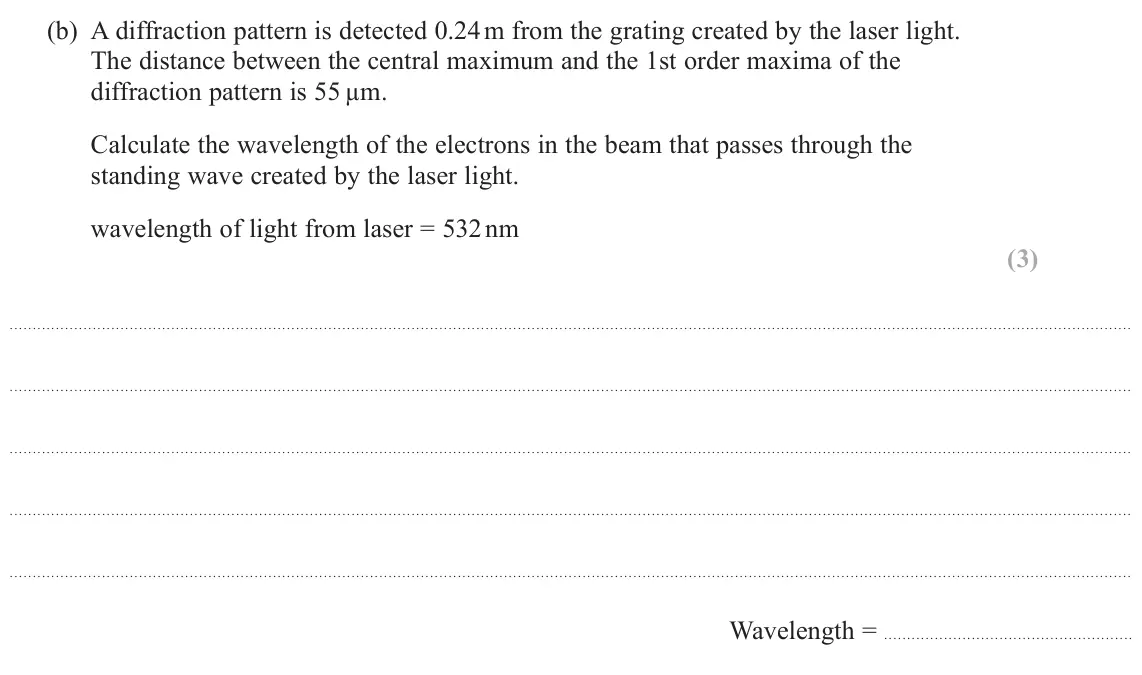
Q9(a)
The whole paper ↗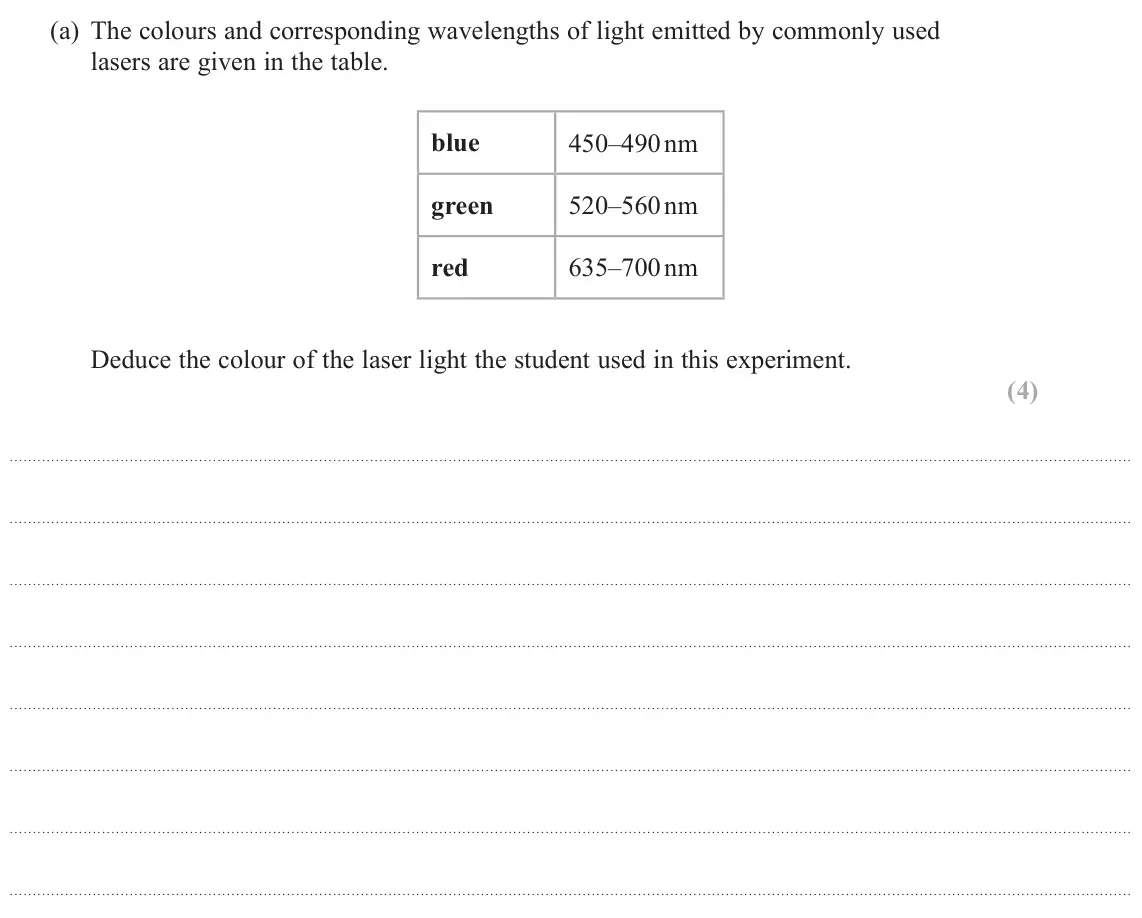
Q9(b)
The whole paper ↗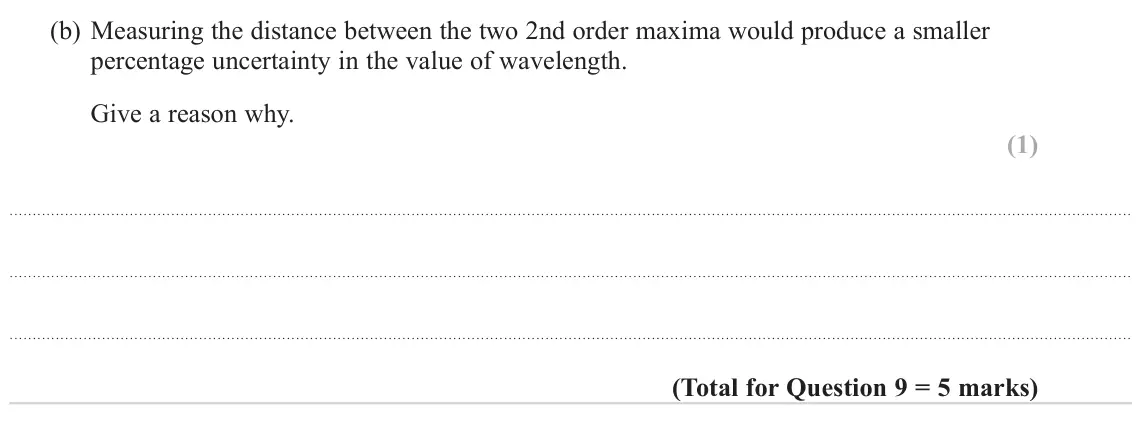
Q14(b)(ii)
The whole paper ↗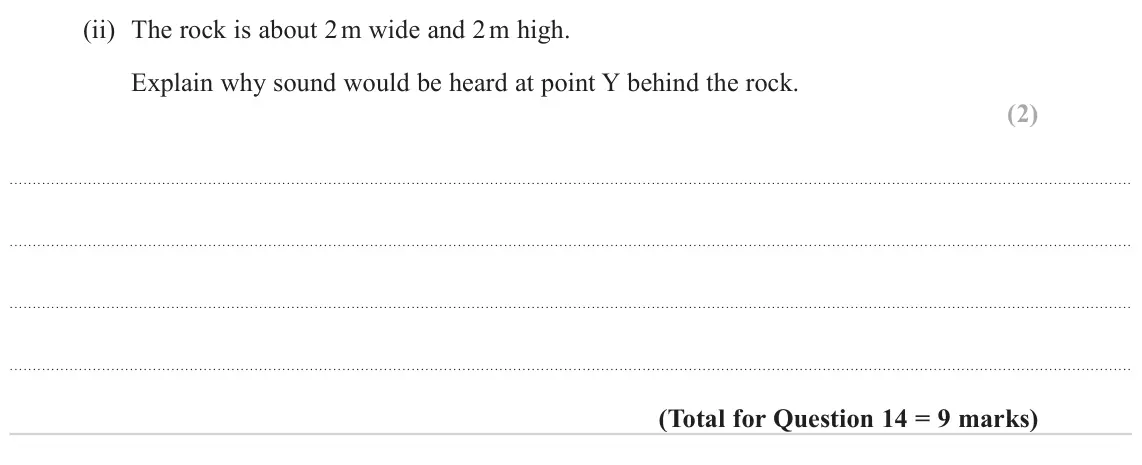
All 52 questions on Polarisation and diffraction, as a list
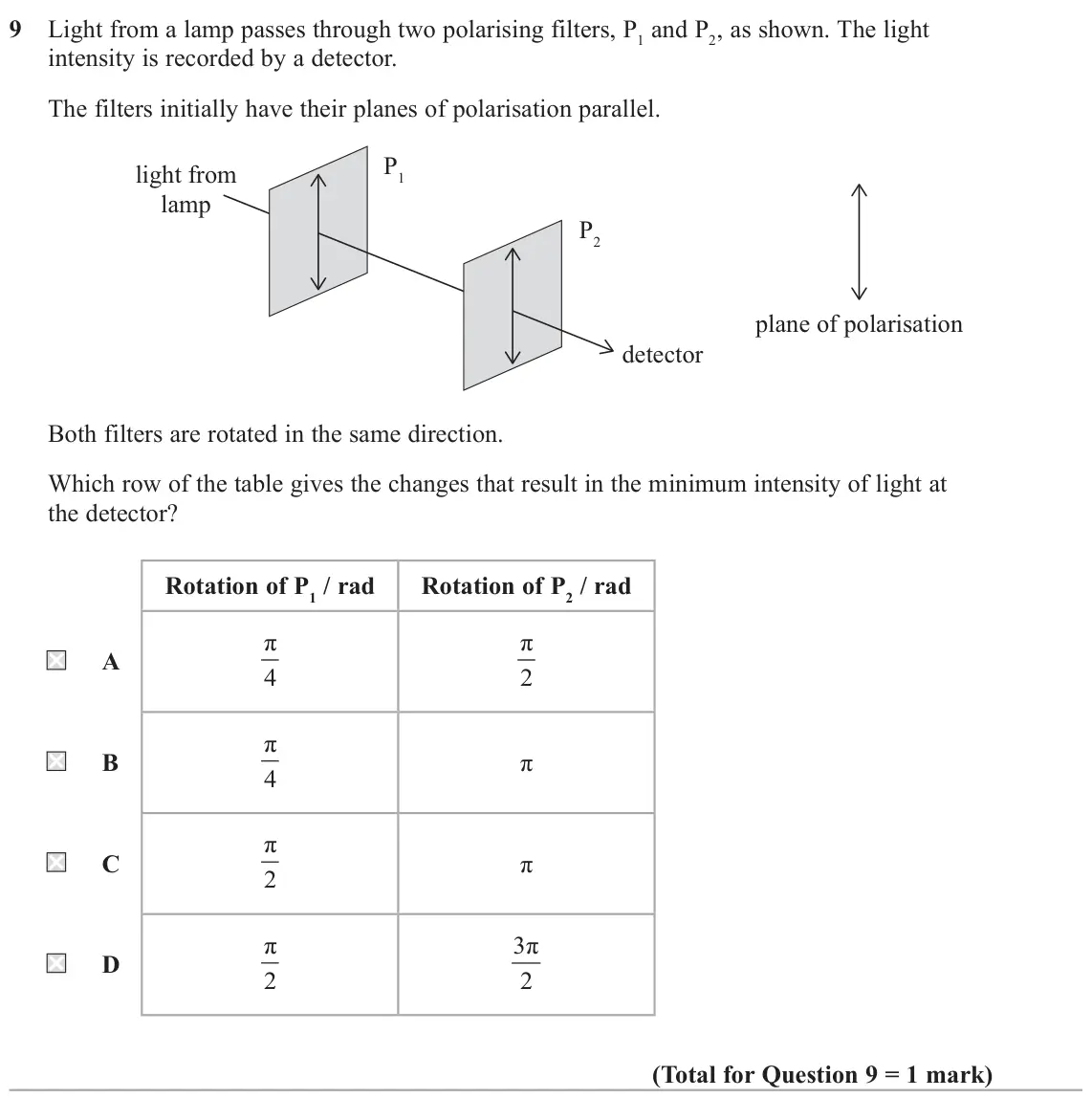
- June 2025, Paper 2, Q9 (1 mark): Light from a lamp passes through two polarising filters, P1 and P2, as shown. The light intensity is recorded by a detector. The filters initially have their pl
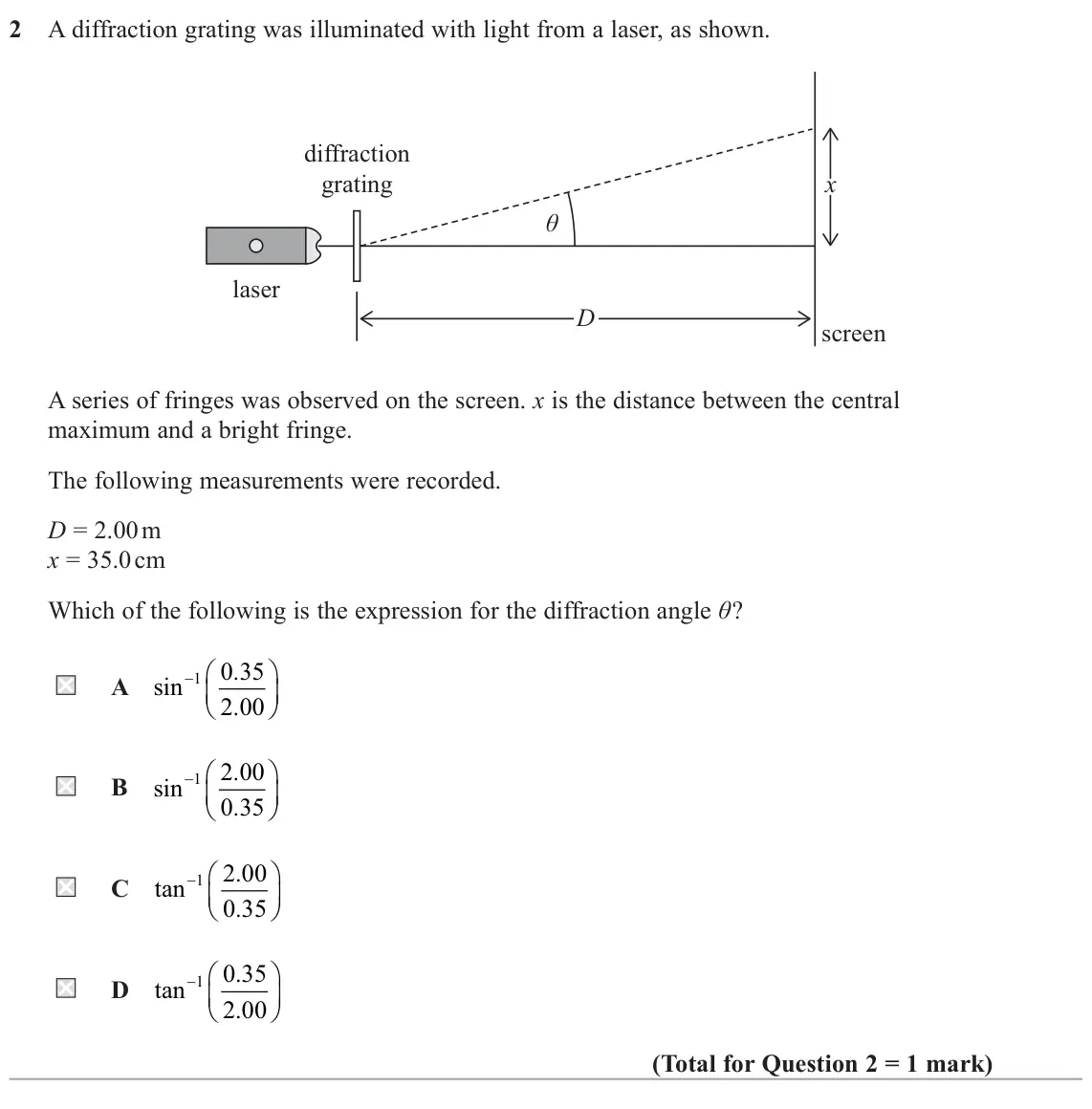
- June 2025, AS Paper 2, Q2 (1 mark): A diffraction grating was illuminated with light from a laser, as shown. diffraction grating x θ laser D screen A series of fringes was observed on the screen.
- June 2025, AS Paper 2, Q9(a) (2 marks): Explain what is meant by the plane of polarisation of light. (2)
- June 2025, AS Paper 2, Q9(b)(i) (2 marks): Initially the tube is empty. No light is observed. Explain how A and B are aligned when no light is observed. (2)
- June 2025, AS Paper 2, Q9(b)(ii) (3 marks): A student filled a tube of length l with a sugar solution of concentration S. She observed some light transmitted by filter B. She then rotated filter B until n
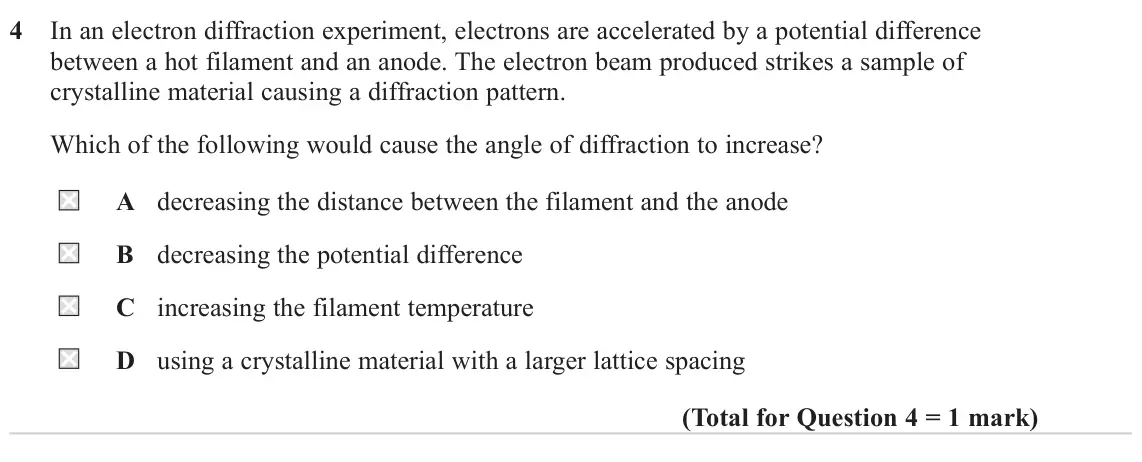
- June 2024, Paper 2, Q4 (1 mark): In an electron diffraction experiment, electrons are accelerated by a potential difference between a hot filament and an anode. The electron beam produced strik
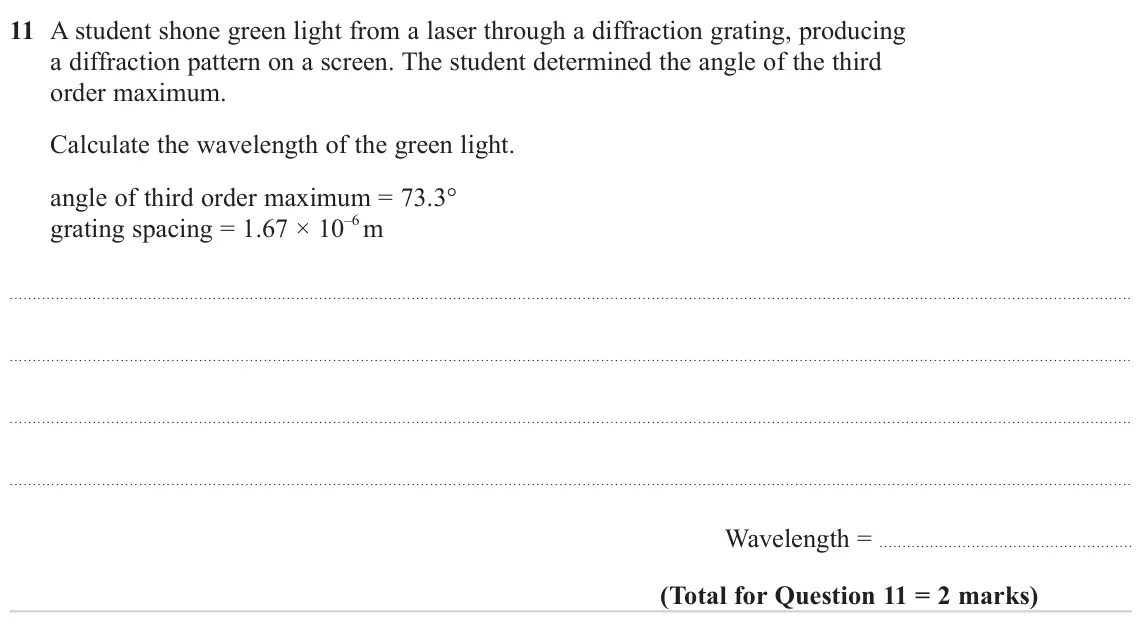
- June 2024, Paper 2, Q11 (2 marks): A student shone green light from a laser through a diffraction grating, producing a diffraction pattern on a screen. The student determined the angle of the thi
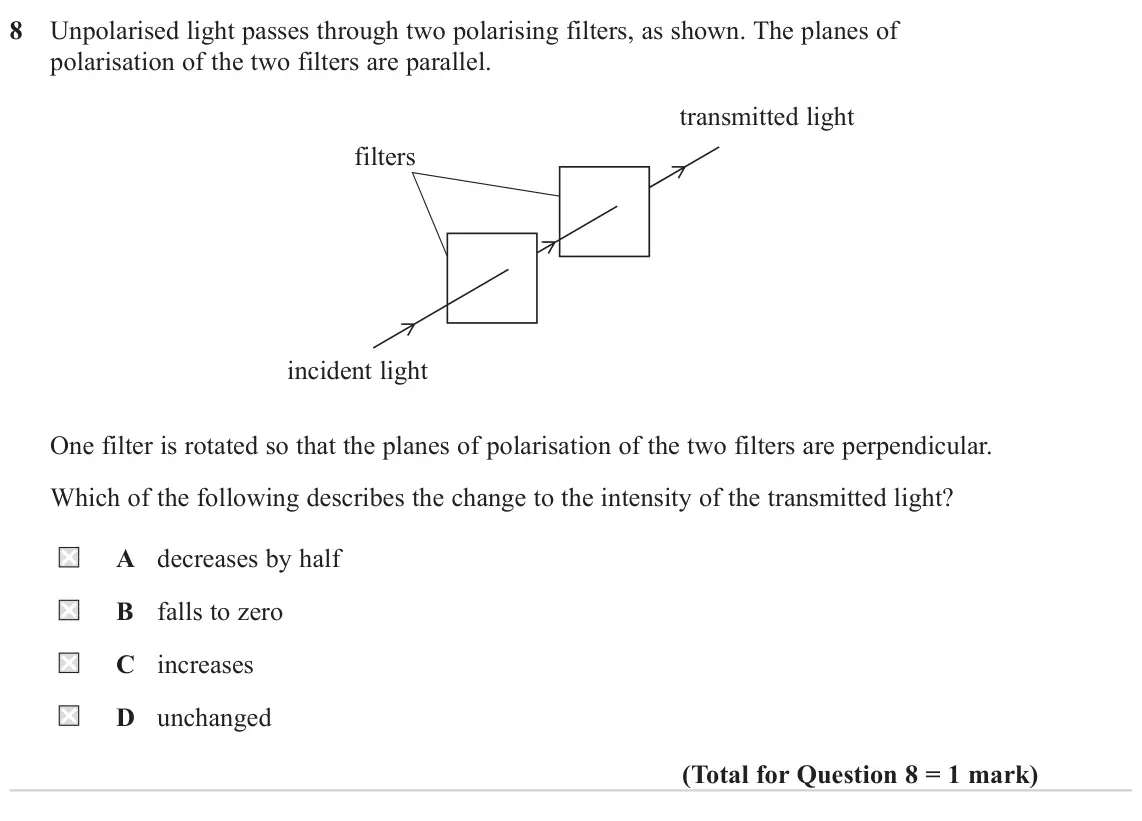
- June 2024, AS Paper 2, Q8 (1 mark): Unpolarised light passes through two polarising filters, as shown. The planes of polarisation of the two filters are parallel. transmitted light filters inciden
- June 2024, AS Paper 2, Q11(a) (4 marks): The technician wanted to check that the wavelength emitted by the laser was within the range 450 nm ± 10 nm. She measured the distance between the two second or
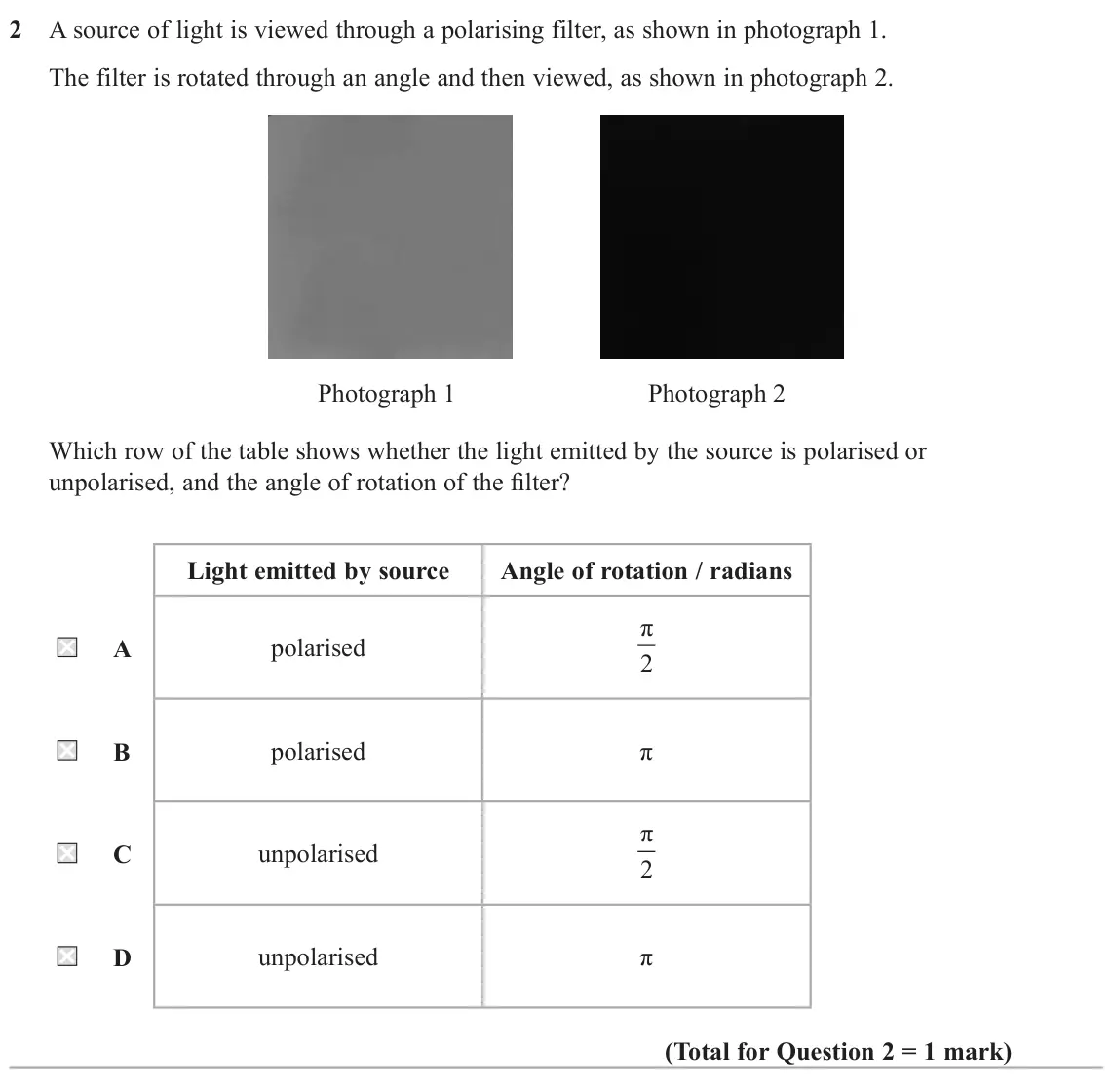
- June 2023, Paper 2, Q2 (1 mark): A source of light is viewed through a polarising filter, as shown in photograph 1. The filter is rotated through an angle and then viewed, as shown in photograp
- June 2023, Paper 2, Q17(a) (6 marks): Explain the pattern produced when a mixture of blue and red light, from the same source, passes through a diffraction grating. (6)
- June 2023, Paper 3, Q1(a) (4 marks): The diffraction grating had 300 lines per mm. The laser pen was marked with λ = 520 nm. Determine whether the spacing of the diffraction pattern was consistent
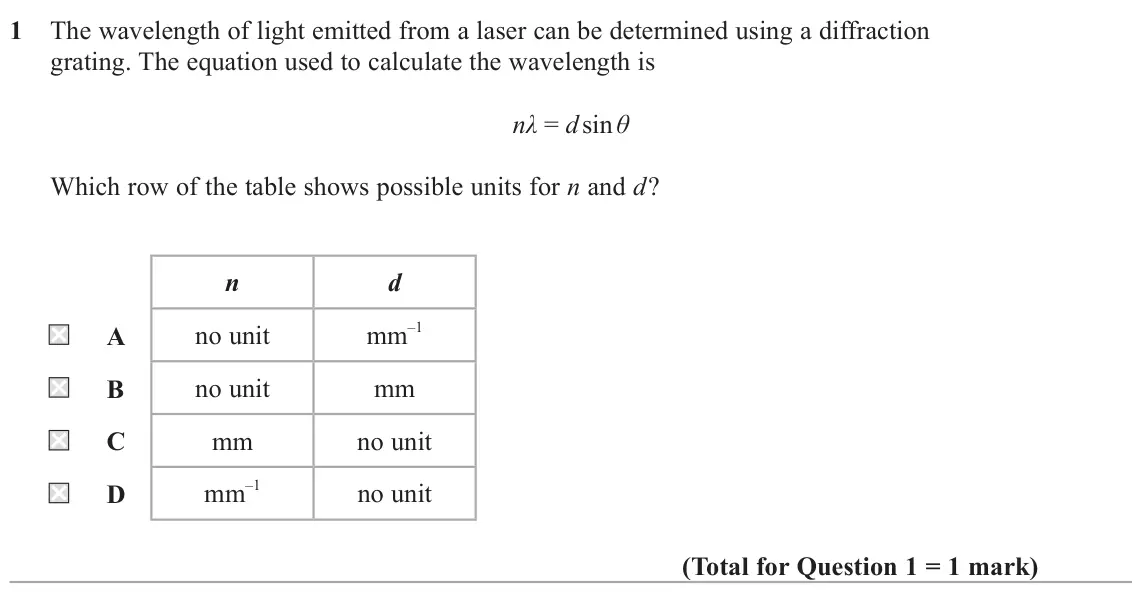
- June 2023, AS Paper 2, Q1 (1 mark): The wavelength of light emitted from a laser can be determined using a diffraction grating. The equation used to calculate the wavelength is nλ = d sin θ Which
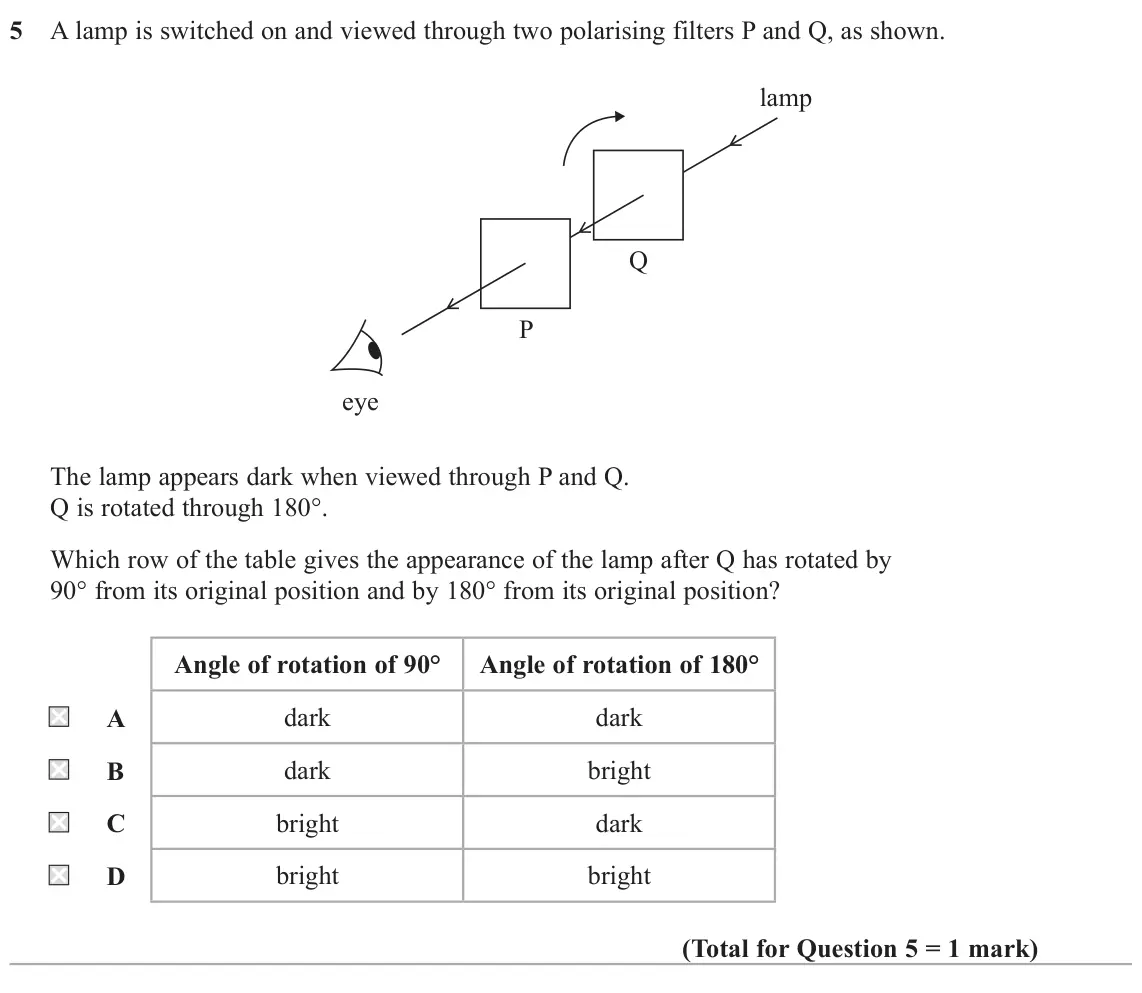
- June 2023, AS Paper 2, Q5 (1 mark): A lamp is switched on and viewed through two polarising filters P and Q, as shown. lamp Q P eye The lamp appears dark when viewed through P and Q. Q is rotated
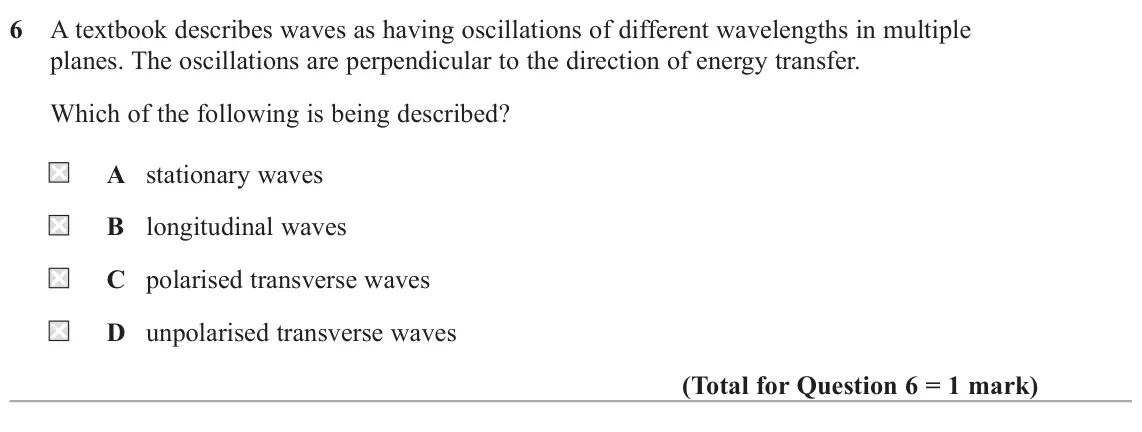
- June 2023, AS Paper 2, Q6 (1 mark): A textbook describes waves as having oscillations of different wavelengths in multiple planes. The oscillations are perpendicular to the direction of energy tra
- June 2023, AS Paper 2, Q15(b) (3 marks): A diffraction pattern is detected 0.24 m from the grating created by the laser light. The distance between the central maximum and the 1st order maxima of the d
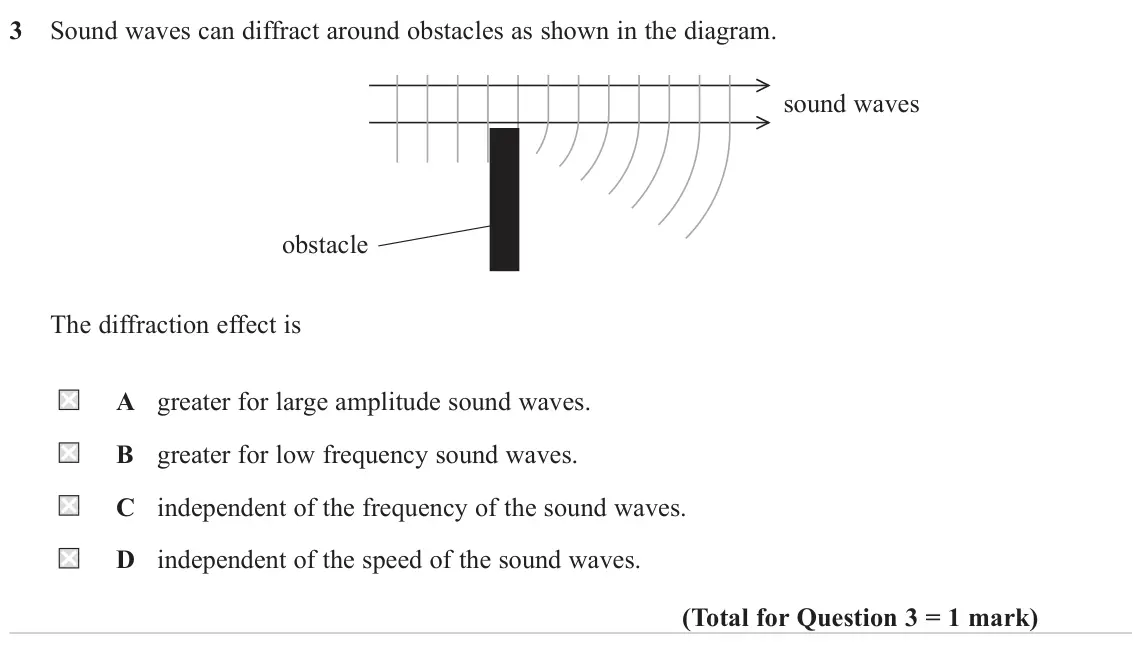
- June 2022, Paper 2, Q3 (1 mark): Sound waves can diffract around obstacles as shown in the diagram. sound waves obstacle The diffraction effect is A greater for large amplitude sound waves. B g
- June 2022, AS Paper 2, Q9(a) (4 marks): The colours and corresponding wavelengths of light emitted by commonly used lasers are given in the table. blue 450–490 nm green 520–560 nm red 635–700 nm Deduc
- June 2022, AS Paper 2, Q9(b) (1 mark): Measuring the distance between the two 2nd order maxima would produce a smaller percentage uncertainty in the value of wavelength. Give a reason why. (1)
- June 2022, AS Paper 2, Q14(b)(ii) (2 marks): The rock is about 2 m wide and 2 m high. Explain why sound would be heard at point Y behind the rock. (2)
- June 2022, AS Paper 2, Q17(c) (4 marks): The light incident on the camera lens is unpolarised. The photographer places a polarising filter in front of the camera lens. Explain how the polarising filter
- November 2021, Paper 2, Q19(b) (2 marks): An octopus can detect the orientation of polarised light. State what is meant by polarised light. (2)
- November 2021, Paper 3, Q11(a) (5 marks): Distance x was measured to be 0.500 m with a metre rule. The wavelength of light λ1 from the laser pointer was 650 nm. The laser pointer was replaced with one t
- November 2021, Paper 3, Q11(b) (2 marks): Explain one modification to this method that would decrease the uncertainty in the calculated value of λ2. (2)
- November 2021, Paper 3, Q11(c) (3 marks): In another experiment, the light from the laser pointer was not quite perpendicular to the screen. Explain how this would change the diffraction pattern produce
- November 2021, AS Paper 2, Q13 (6 marks): *13 A student views a laptop screen through a polarising filter. Initially the screen appears normal brightness. He rotates the filter to 90° and observes that
- November 2021, AS Paper 2, Q16(c) (3 marks): Diffraction and interference can be explained using the wave model of light. In an investigation to determine the wavelength of light from a laser, the light pa
- October 2020, Paper 2, Q17(d) (3 marks): Millikan used a device known as a monochromator to ensure that a single wavelength of light was used to illuminate the surface of the lithium. A monochromator s
- October 2020, AS Paper 1, Q15(a) (2 marks): Describe how the angle θ could be determined without using a protractor. (2)
- October 2020, AS Paper 1, Q15(b) (4 marks): Plot a graph of n against sinθon the grid below. (4)
- October 2020, AS Paper 1, Q15(c) (4 marks): The diffraction grating has 300 lines mm−1. Determine the wavelength of the laser light. (4) Wavelength =
- October 2020, AS Paper 2, Q9 (3 marks): The light emitted from a laptop screen is plane polarised. Explain how the plane of polarisation of the emitted light can be demonstrated using a polarising fil
- October 2020, AS Paper 2, Q11(b) (3 marks): Diffraction provides evidence for the wave nature of light. Use Huygens' construction to describe what happens to light waves after passing through a narrow gap
- October 2020, AS Paper 2, Q16(c) (3 marks): Superradiant lasers are highly monochromatic. Explain why a monochromatic light source is important in diffraction experiments. (3)
- June 2019, Paper 2, Q5 (1 mark): Three polarising filters X, Y and Z, are placed in front of a source of unpolarised light. The planes of polarisation of the filters are initially parallel. Fil
- June 2018, Paper 2, Q10 (1 mark): A monochromatic beam of light of wavelength Ȝ from a laser is directed at a diffraction grating of line spacing d. A student calculates the value of d/Ȝ in orde
- June 2018, Paper 2, Q14 (6 marks): In 1965, Richard Feynman proposed a double slit experiment to investigate the wave properties of electrons. The experiment was later carried out using the arran
- June 2018, Paper 3, Q12(b)(ii) (3 marks): It is observed that electrons, with energy of 5.5 keV, are diffracted as they pass through the thin gold foil. Explain a conclusion about the electrons that can
- June 2018, AS Paper 1, Q16(a)(i) (2 marks): Describe what is meant by plane polarised light. (2)
- June 2018, AS Paper 1, Q16(a)(ii) (2 marks): Explain the angle of polarisation of the upper polarising filter relative to the lower polarising filter. (2)
- June 2017, Paper 2, Q1 (1 mark): Which of the following wave properties is not exhibited by sound waves? A diffraction B interference C polarisation D refraction
- June 2017, Paper 2, Q10 (1 mark): A beam of light from a laser is directed at a diffraction grating. The diagram shows the positions of the central maximum and the first order maxima on a screen
- June 2017, Paper 2, Q15 (6 marks): * 15 The diagram shows apparatus used to investigate polarising filters. light detector source of light filter 1 filter 2 The arrows show the orientation of the
- June 2017, Paper 3, Q3 (3 marks): In the 19th century experiments with magnetic and electric field deflections were used to determine the charge to mass ratio of electrons. Later experiments sho
- June 2017, Paper 3, Q12(b)(i) (3 marks): A diffraction grating of known grating spacing is used in a school laboratory to analyse the light emitted by a laser. Describe how the diffraction grating is u
- June 2017, Paper 3, Q12(b)(ii) (4 marks): A diffraction grating with grating spacing of 2.2 × 10 −6 m is used to determine the difference in wavelength for the spectral line emitted by Barnard’s star. C
- June 2017, AS Paper 2, Q3 (1 mark): In an experiment to determine the wavelength of light, a diffraction grating is illuminated with light from a monochromatic source. A series of bright spots is
- June 2017, AS Paper 2, Q10(a) (2 marks): The receiver and transmitter are initially set up, as shown in the diagram, so that a maximum audible output is produced. direction of receiver rotation transmi
- June 2016, AS Paper 2, Q7 (1 mark): A source of unpolarised light is viewed through two crossed polarising filters X and Y. X unpolarised light Y Which row in the table correctly describes the lig
- June 2016, AS Paper 2, Q11(a) (2 marks): Use Huygens’ construction to explain the behaviour of light as it travels past the edge of the ball bearing. (2)
- June 2016, AS Paper 2, Q11(c) (3 marks): François Arago first demonstrated this experiment in 1818 for a group of eminent scientists, to show the behaviour of light. State the model for the behaviour o
- June 2016, AS Paper 2, Q13(b)(ii) (1 mark): Give one reason why there is more than one ring shown in both Figure 1 and Figure 2. (1)
Questions, mark schemes and examiner’s reports are © Pearson Edexcel, from their published past papers. Plumi isn’t affiliated with any exam board. Want whole papers? Every Edexcel A-Level Physics paper.
Rather write your answers by hand on iPad? Plumi marks them against the same mark schemes.