 plumi
Thermal properties and temperature: CAIE IGCSE Physics questions
Every CAIE IGCSE Physics exam question on 2.2 Thermal properties and temperature, June 2024 and the specimen papers, with its mark scheme and examiner’s report.
Find questions355
Calculations
Q3(b)(ii)
The whole paper ↗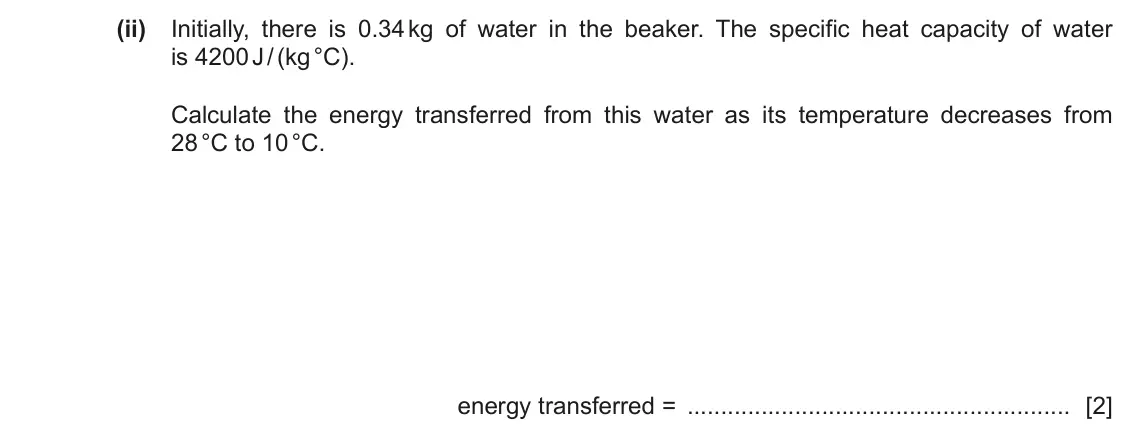
Q3(b)(iv)
The whole paper ↗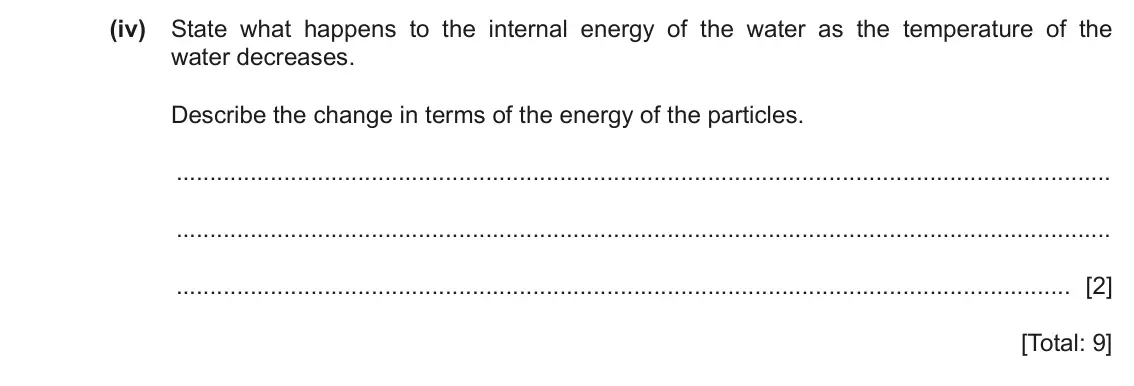
Q5(b)(ii)
The whole paper ↗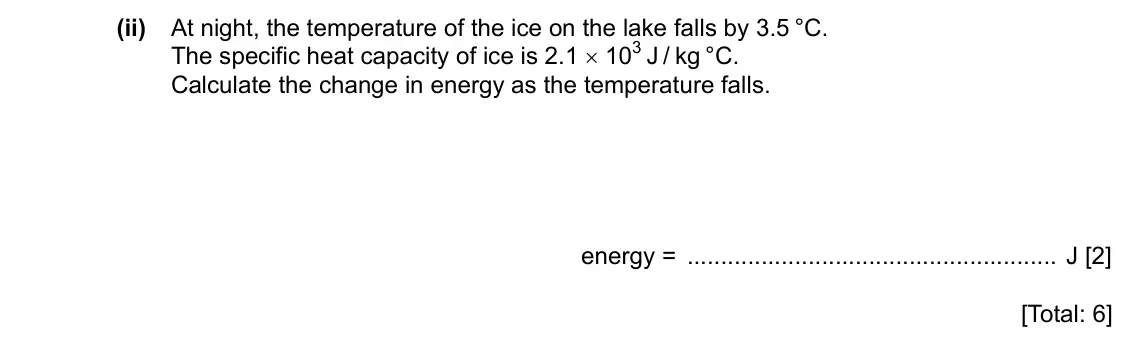
All 12 questions on Thermal properties and temperature, as a list
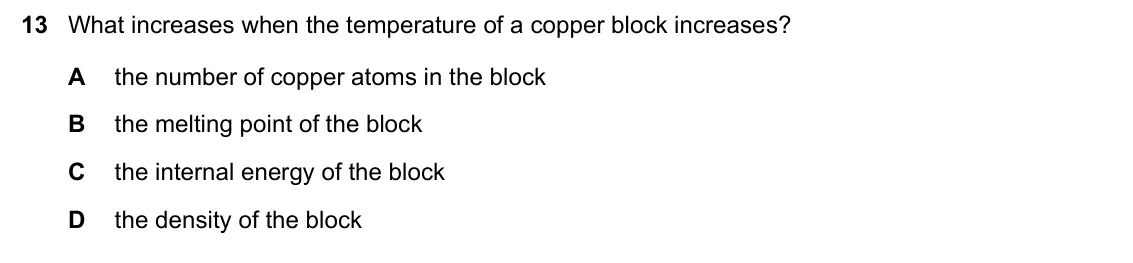
- June 2024, Paper 1, Q13 (1 mark): What increases when the temperature of a copper block increases? A the number of copper atoms in the block B the melting point of the block C the internal energ
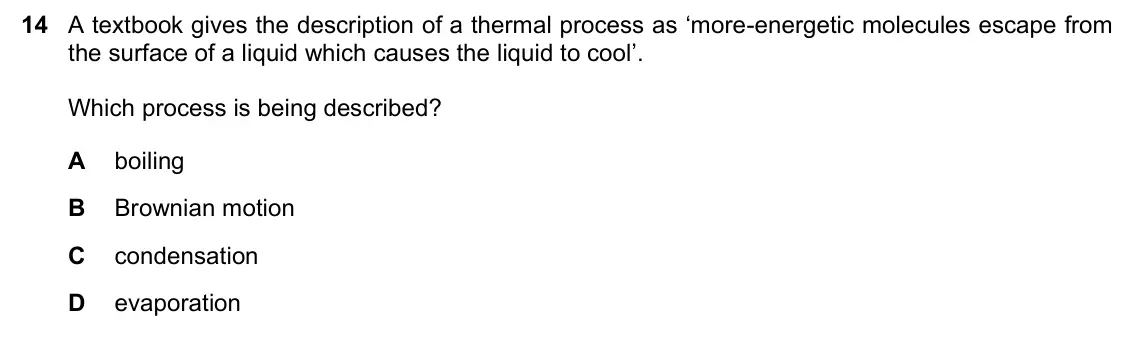
- June 2024, Paper 1, Q14 (1 mark): A textbook gives the description of a thermal process as ‘more-energetic molecules escape from the surface of a liquid which causes the liquid to cool’. Which p
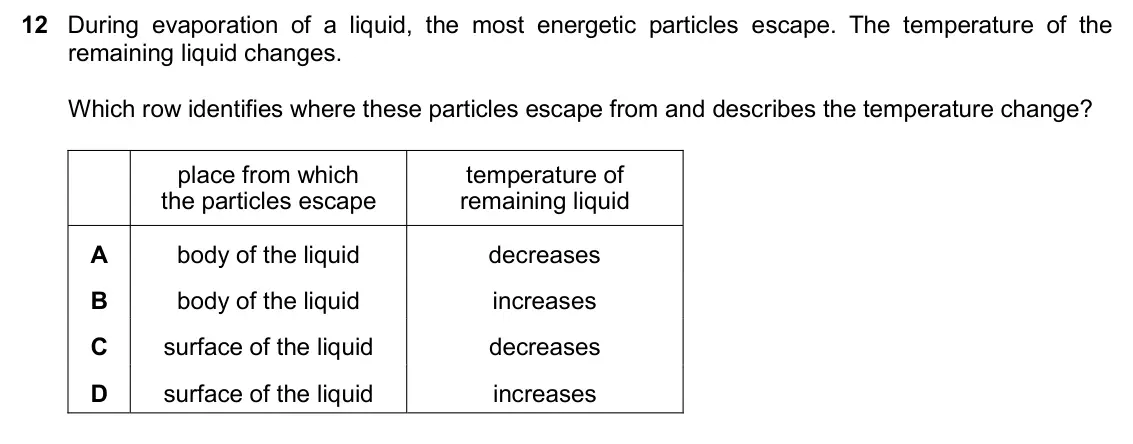
- June 2024, Paper 2, Q12 (1 mark): During evaporation of a liquid, the most energetic particles escape. The temperature of the remaining liquid changes. Which row identifies where these particles
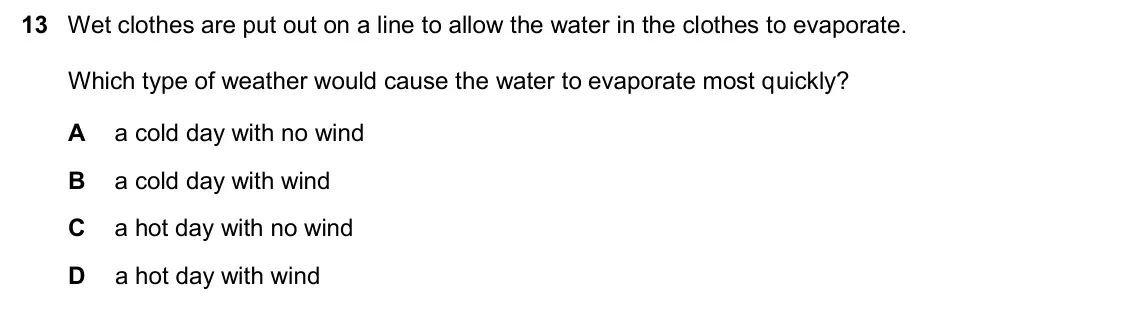
- June 2024, Paper 2, Q13 (1 mark): Wet clothes are put out on a line to allow the water in the clothes to evaporate. Which type of weather would cause the water to evaporate most quickly? A a col
- June 2024, Paper 4, Q3(b)(ii) (2 marks): Initially, there is 0.34 kg of water in the beaker. The specific heat capacity of water is 4200 J / (kg °C). Calculate the energy transferred from this water as
- June 2024, Paper 4, Q3(b)(iv) (2 marks): State what happens to the internal energy of the water as the temperature of the water decreases. Describe the change in terms of the energy of the particles. [
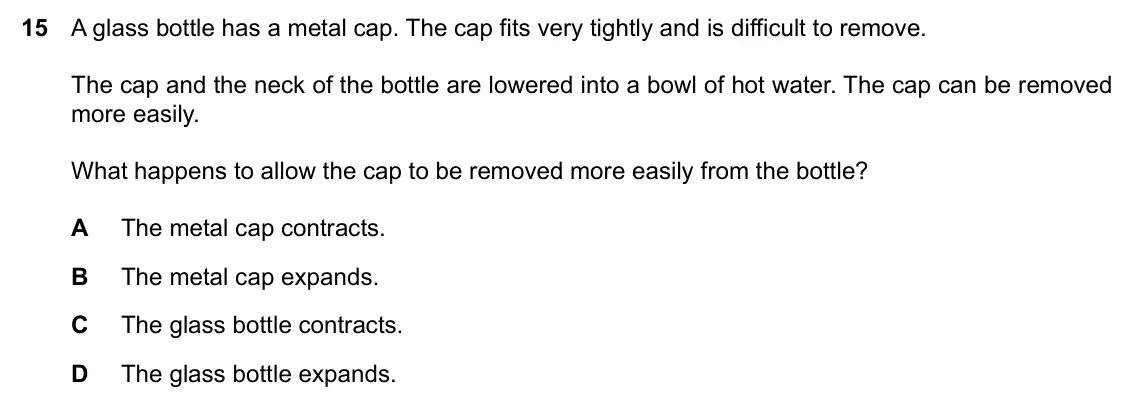
- Specimen, Paper 1, Q15 (1 mark): A glass bottle has a metal cap. The cap fits very tightly and is difficult to remove. The cap and the neck of the bottle are lowered into a bowl of hot water. T
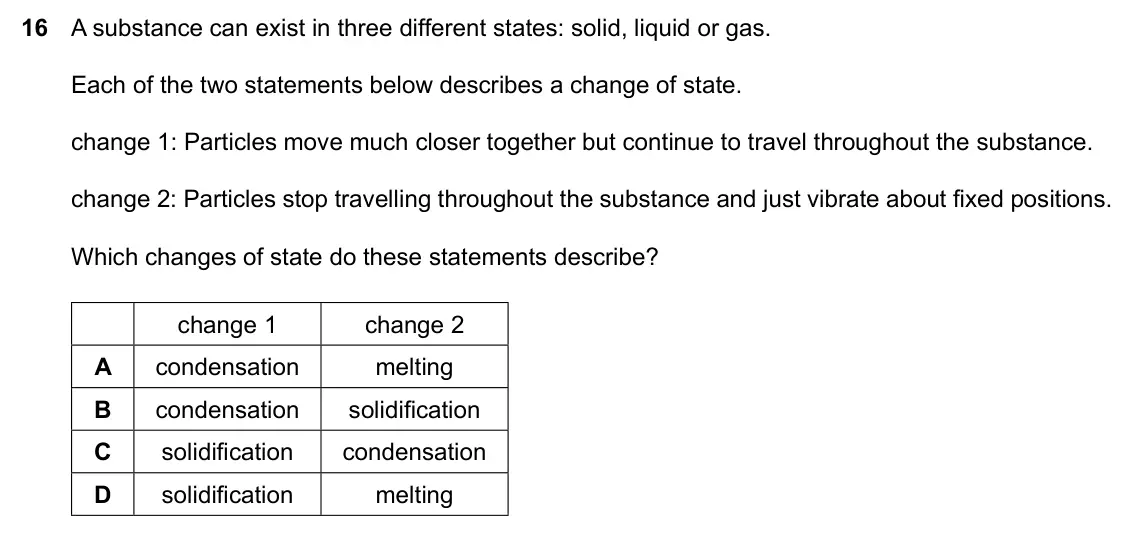
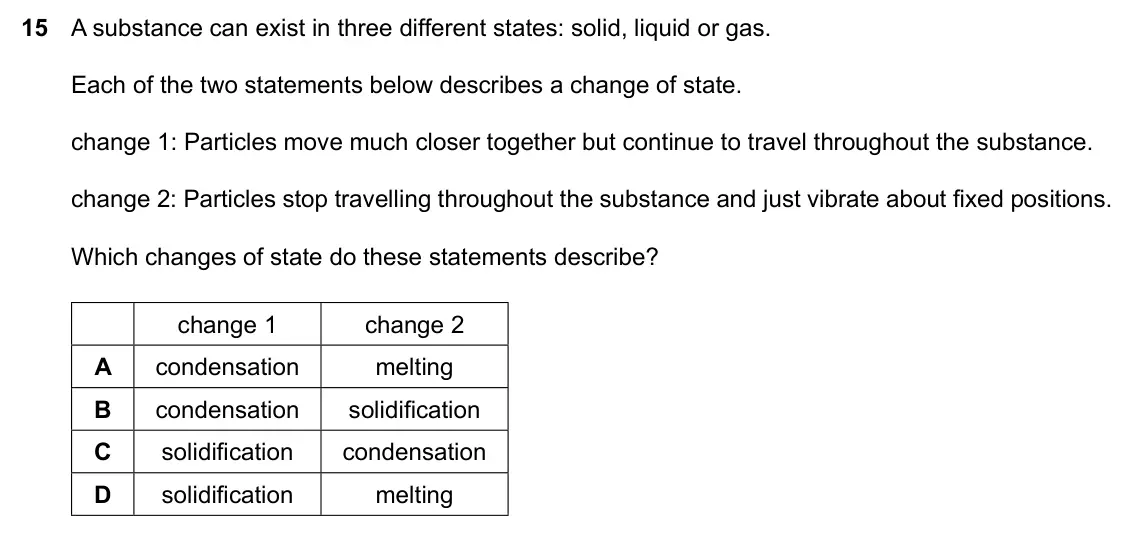
- Specimen, Paper 1, Q16 (1 mark): A substance can exist in three different states: solid, liquid or gas. Each of the two statements below describes a change of state. change 1: Particles move mu
- Specimen, Paper 2, Q15 (1 mark): A substance can exist in three different states: solid, liquid or gas. Each of the two statements below describes a change of state. change 1: Particles move mu
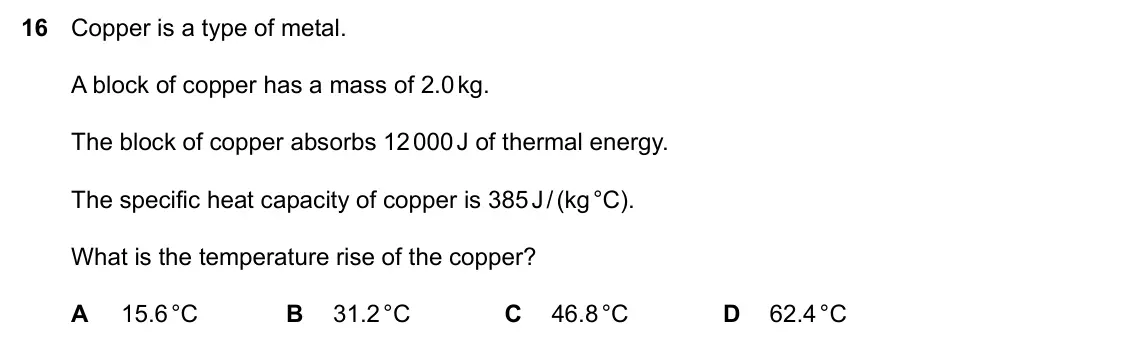
- Specimen, Paper 2, Q16 (1 mark): Copper is a type of metal. A block of copper has a mass of 2.0 kg. The block of copper absorbs 12 000 J of thermal energy. The specific heat capacity of copper
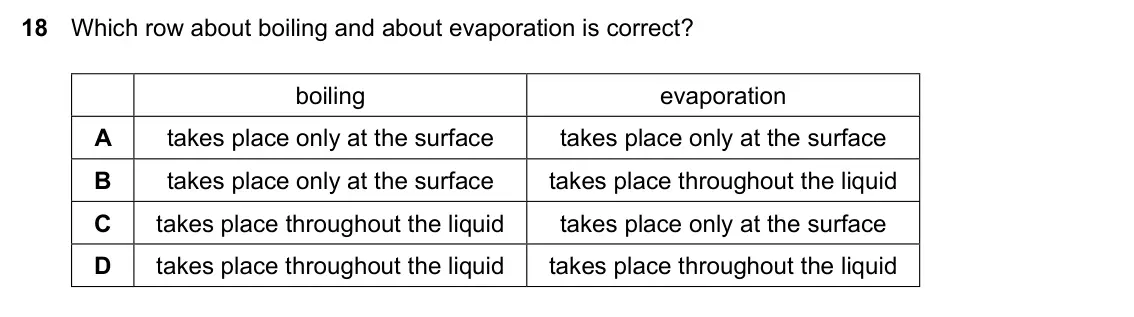
- Specimen, Paper 2, Q18 (1 mark): Which row about boiling and about evaporation is correct? boiling evaporation A takes place only at the surface takes place only at the surface B takes place on
- Specimen, Paper 4, Q5(b)(ii) (2 marks): At night, the temperature of the ice on the lake falls by 3.5 °C. The specific heat capacity of ice is 2.1 × 10³ J / kg °C. Calculate the change in energy as th
Questions, mark schemes and examiner’s reports are © Cambridge University Press & Assessment, from their published past papers. Plumi isn’t affiliated with any exam board. Want whole papers? Every CAIE IGCSE Physics paper.
Rather write your answers by hand on iPad? Plumi marks them against the same mark schemes.