 plumi
Forces: CAIE IGCSE Physics questions
Every CAIE IGCSE Physics exam question on 1.5 Forces, June 2024 and the specimen papers, with its mark scheme and examiner’s report.
Find questions355
Calculations
Q3(a)(i)
The whole paper ↗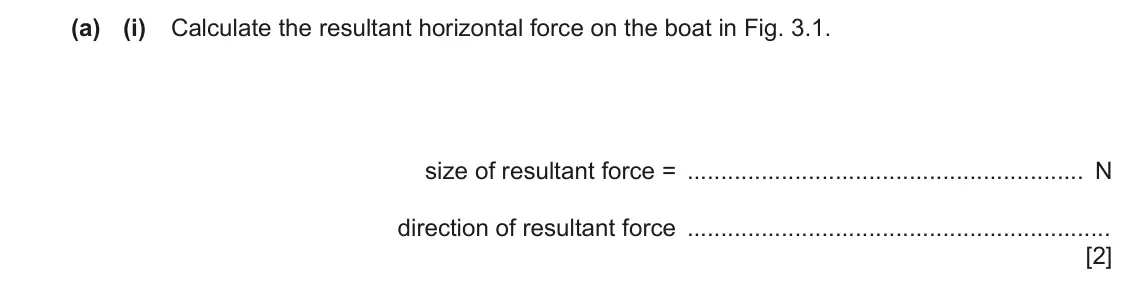
Q3(a)(ii)
The whole paper ↗
Q3(a)(iii)
The whole paper ↗
Q3(b)
The whole paper ↗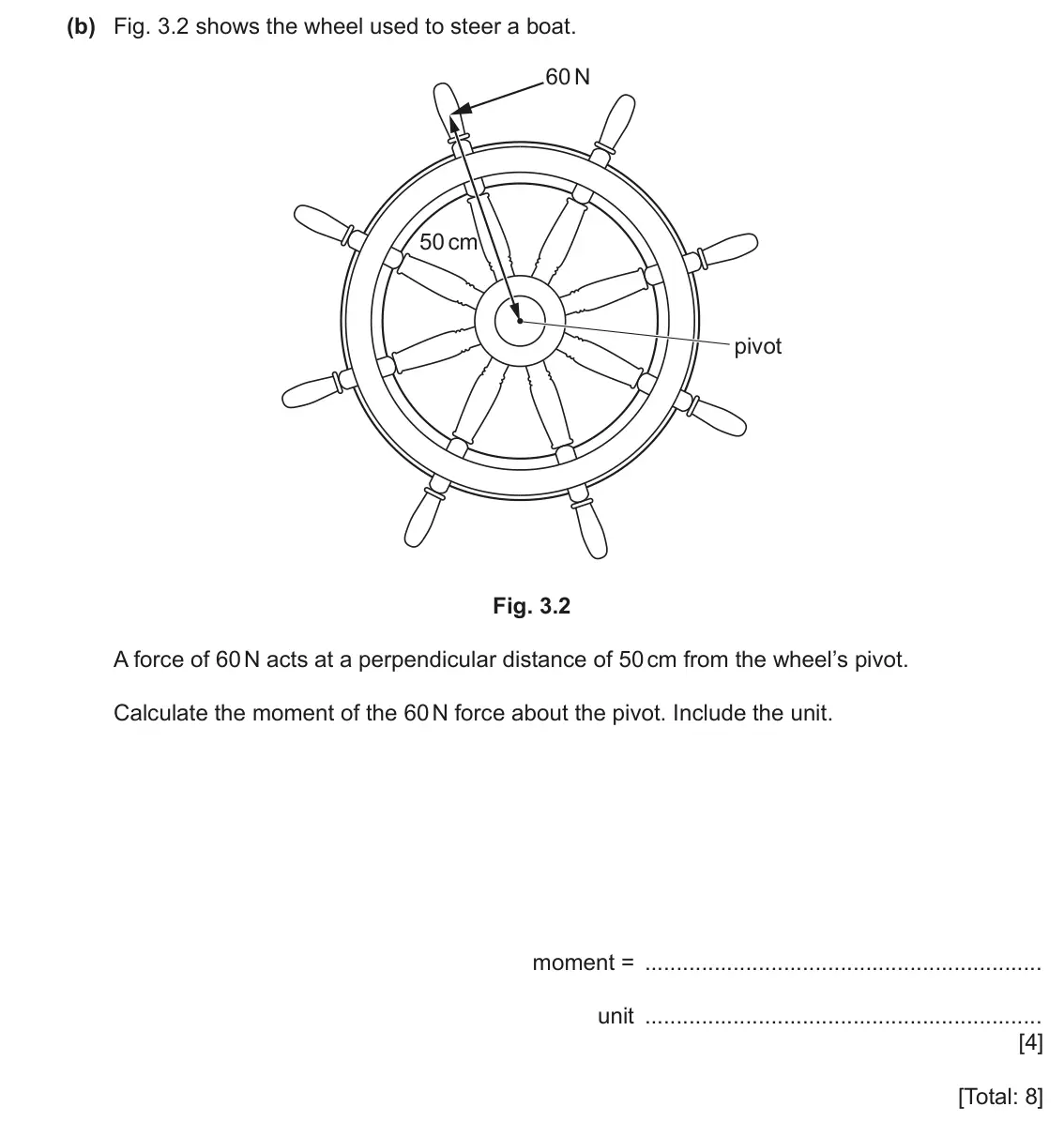
Q1(b)
The whole paper ↗
Q1(c)(i)
The whole paper ↗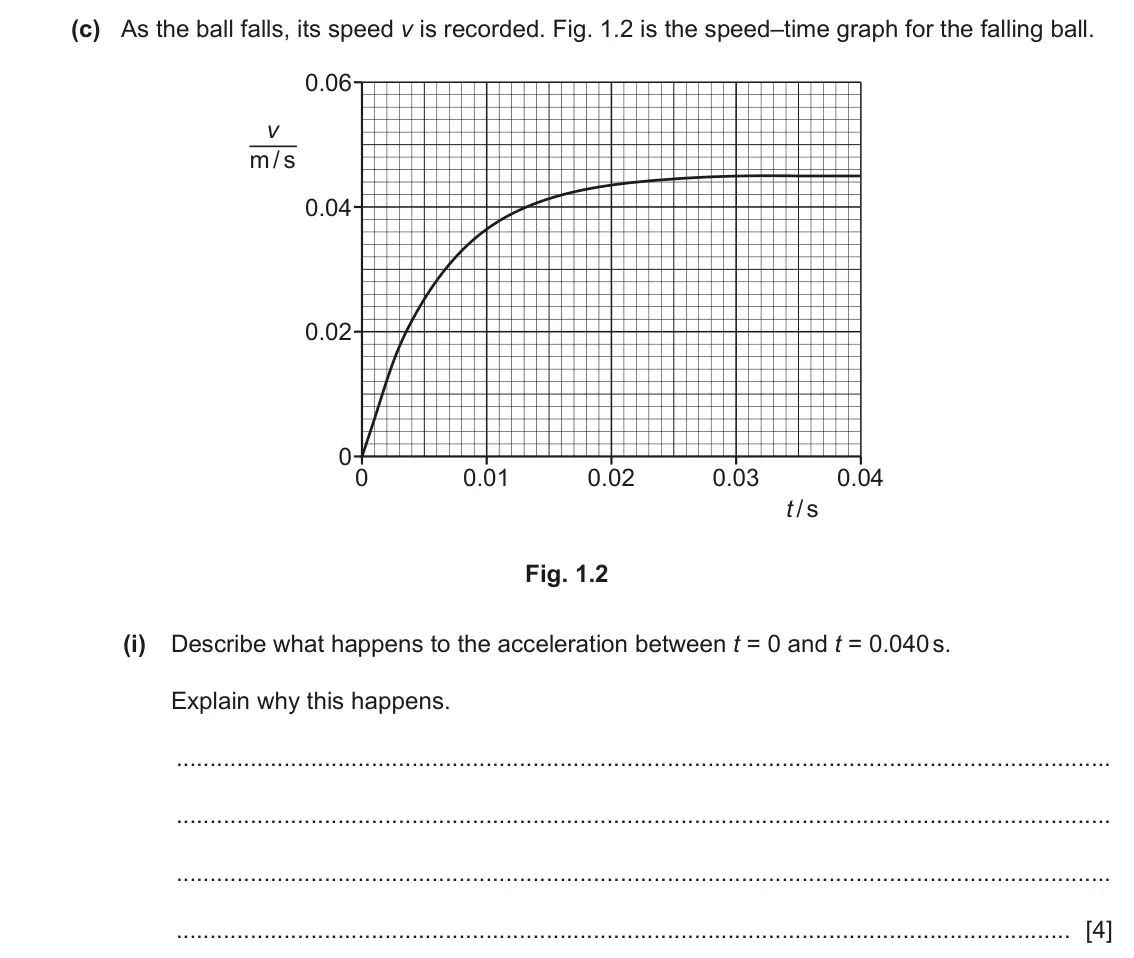
Q1(a)
The whole paper ↗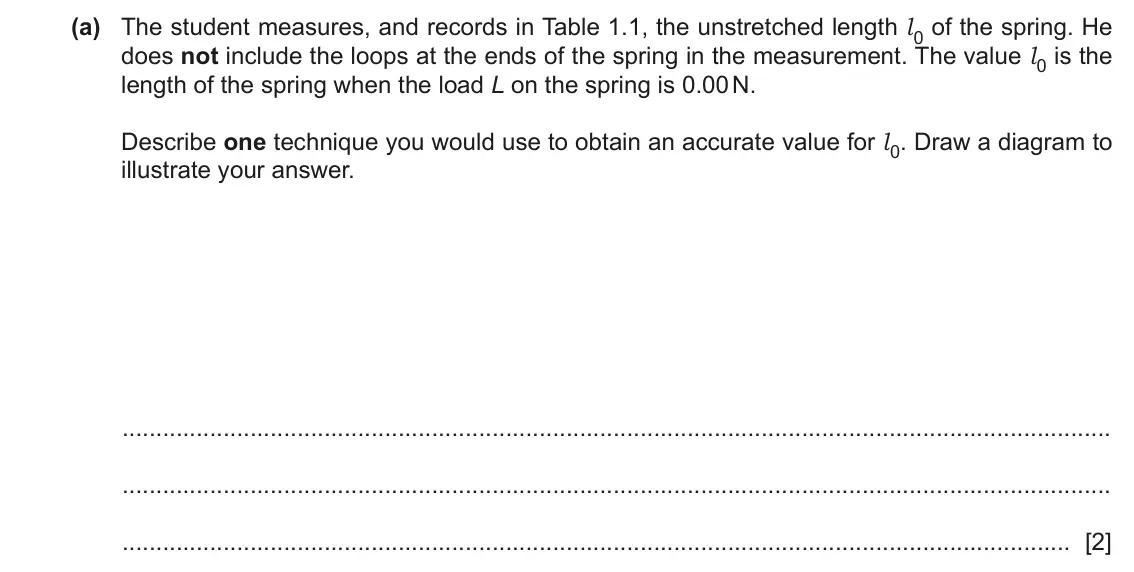
Q1(b)
The whole paper ↗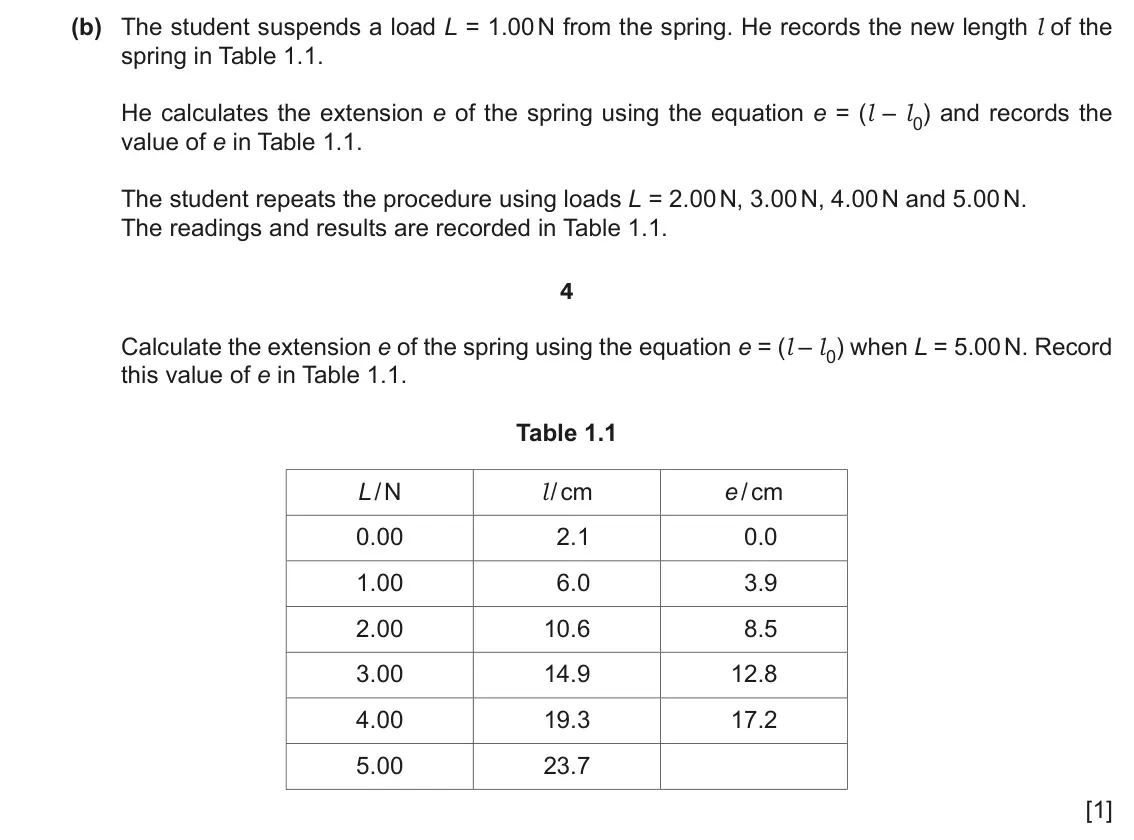
Q1(c)
The whole paper ↗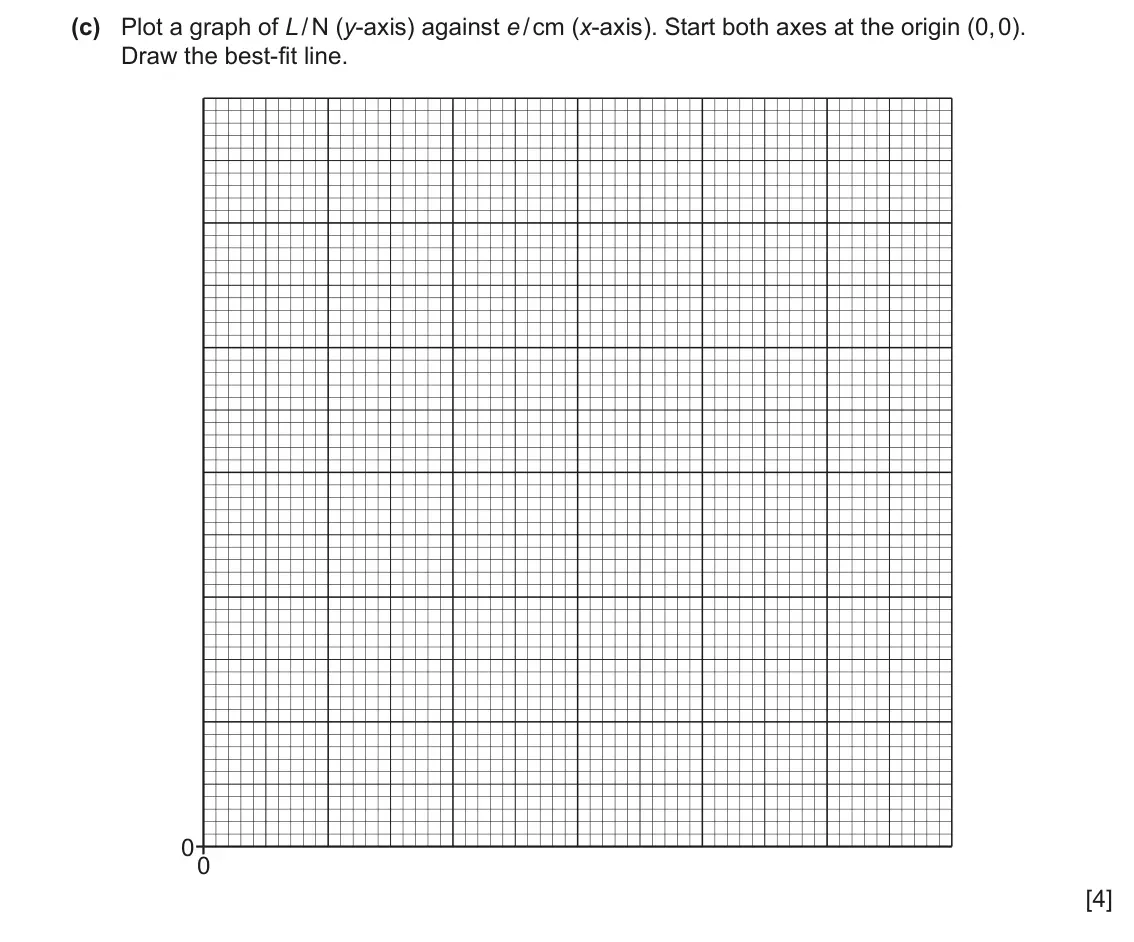
Q1(d)
The whole paper ↗
Q1(e)
The whole paper ↗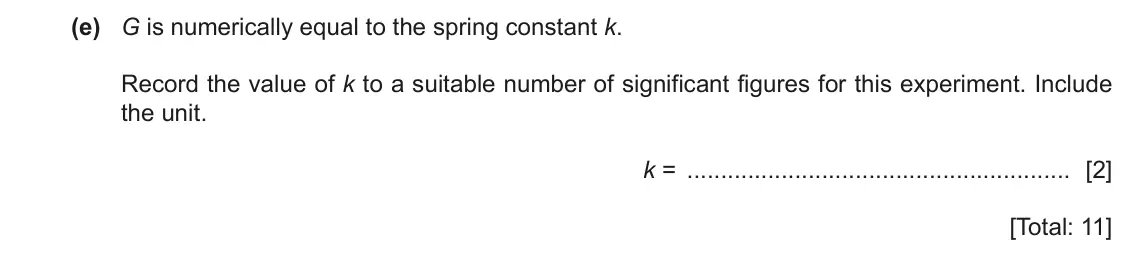
All 25 questions on Forces, as a list
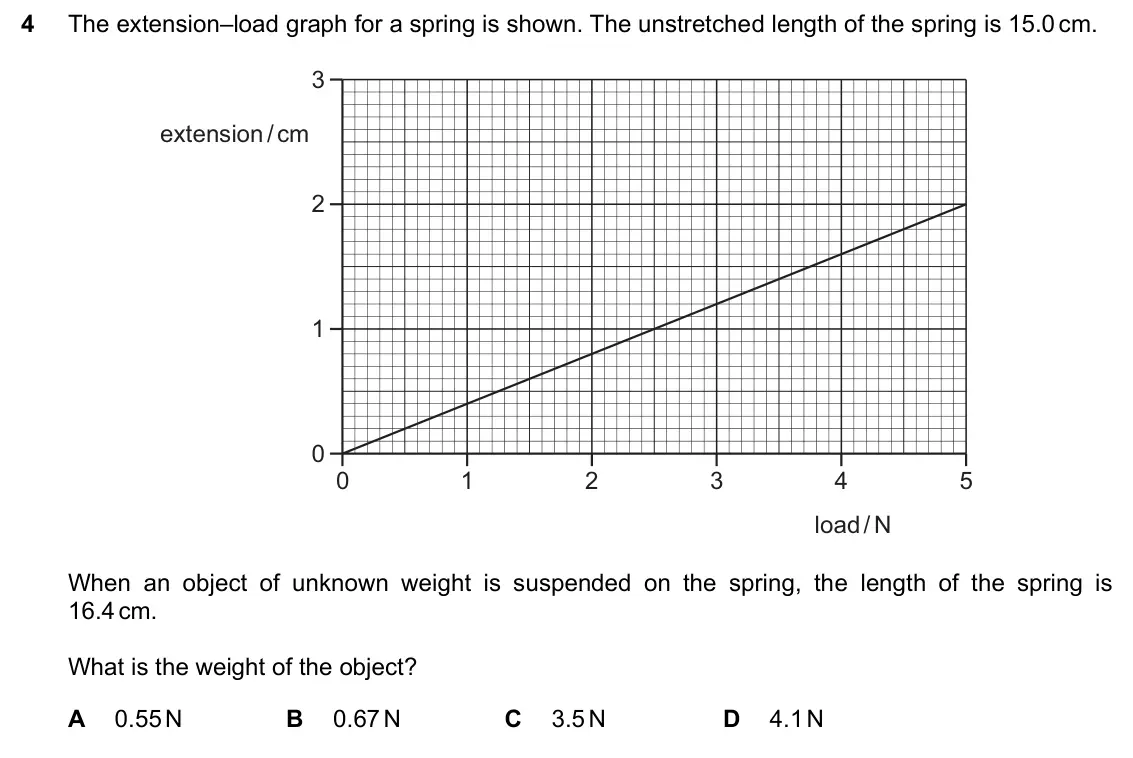
- June 2024, Paper 1, Q4 (1 mark): The extension–load graph for a spring is shown. The unstretched length of the spring is 15.0 cm. 3 extension / cm 2 1 0 0 1 2 3 4 5 load / N When an object of u
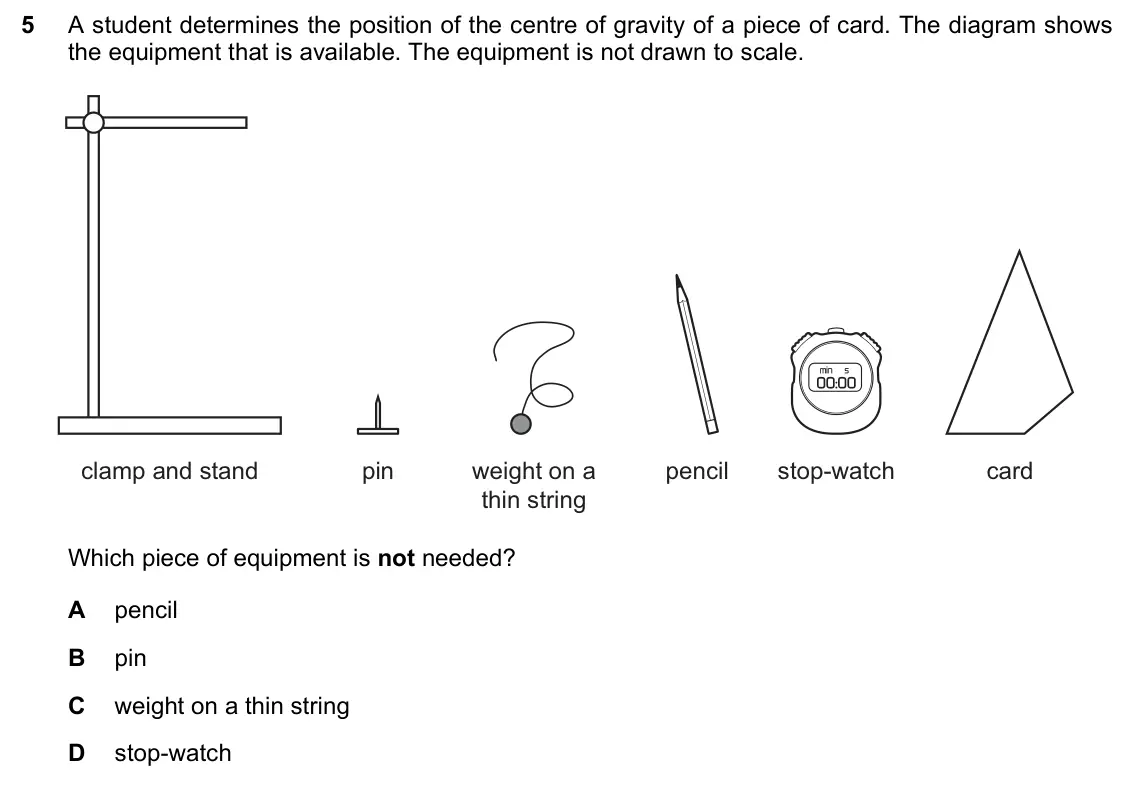
- June 2024, Paper 1, Q5 (1 mark): A student determines the position of the centre of gravity of a piece of card. The diagram shows the equipment that is available. The equipment is not drawn to
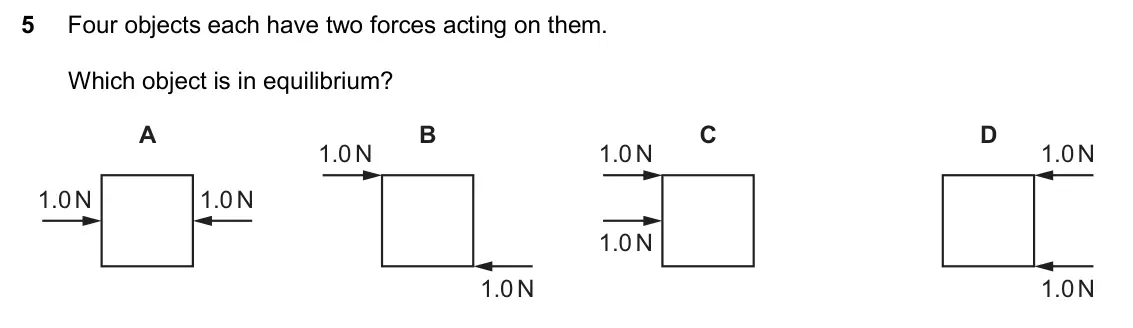
- June 2024, Paper 2, Q5 (1 mark): Four objects each have two forces acting on them. Which object is in equilibrium? A B C D 1.0 N 1.0 N 1.0 N 1.0 N 1.0 N 1.0 N 1.0 N 1.0 N
- June 2024, Paper 3, Q3(a)(i) (2 marks): Calculate the resultant horizontal force on the boat in Fig. 3.1. size of resultant force = N direction of resultant force [2]
- June 2024, Paper 3, Q3(a)(ii) (1 mark): Suggest what causes the 80 N force on the boat in Fig. 3.1. [1]
- June 2024, Paper 3, Q3(a)(iii) (1 mark): Another boat is travelling and the horizontal forces on this boat are balanced. Describe the horizontal motion of this boat. [1]
- June 2024, Paper 3, Q3(b) (4 marks): Fig. 3.2 shows the wheel used to steer a boat. 60 N 50 cm pivot Fig. 3.2 A force of 60 N acts at a perpendicular distance of 50 cm from the wheel’s pivot. Calcu
- June 2024, Paper 4, Q1(b) (2 marks): The mass of the ball is 0.0075 kg. Calculate the resultant force acting on the ball when it is accelerating downwards at 2.8 m / s2 . resultant force = [2]
- June 2024, Paper 4, Q1(c)(i) (4 marks): Describe what happens to the acceleration between t = 0 and t = 0.040 s. Explain why this happens. [4]
- June 2024, Paper 6, Q1(a) (2 marks): The student measures, and records in Table 1.1, the unstretched length l 0 of the spring. He does not include the loops at the ends of the spring in the measure
- June 2024, Paper 6, Q1(b) (1 mark): The student suspends a load L = 1.00 N from the spring. He records the new length l of the spring in Table 1.1. He calculates the extension e of the spring usin
- June 2024, Paper 6, Q1(c) (4 marks): Plot a graph of L / N (y-axis) against e / cm (x-axis). Start both axes at the origin (0, 0). Draw the best-fit line. 00 [4]
- June 2024, Paper 6, Q1(d) (2 marks): Determine the gradient G of the graph. Show all your working and indicate on the graph the values you use. G = [2]
- June 2024, Paper 6, Q1(e) (2 marks): G is numerically equal to the spring constant k. Record the value of k to a suitable number of significant figures for this experiment. Include the unit. k = [2
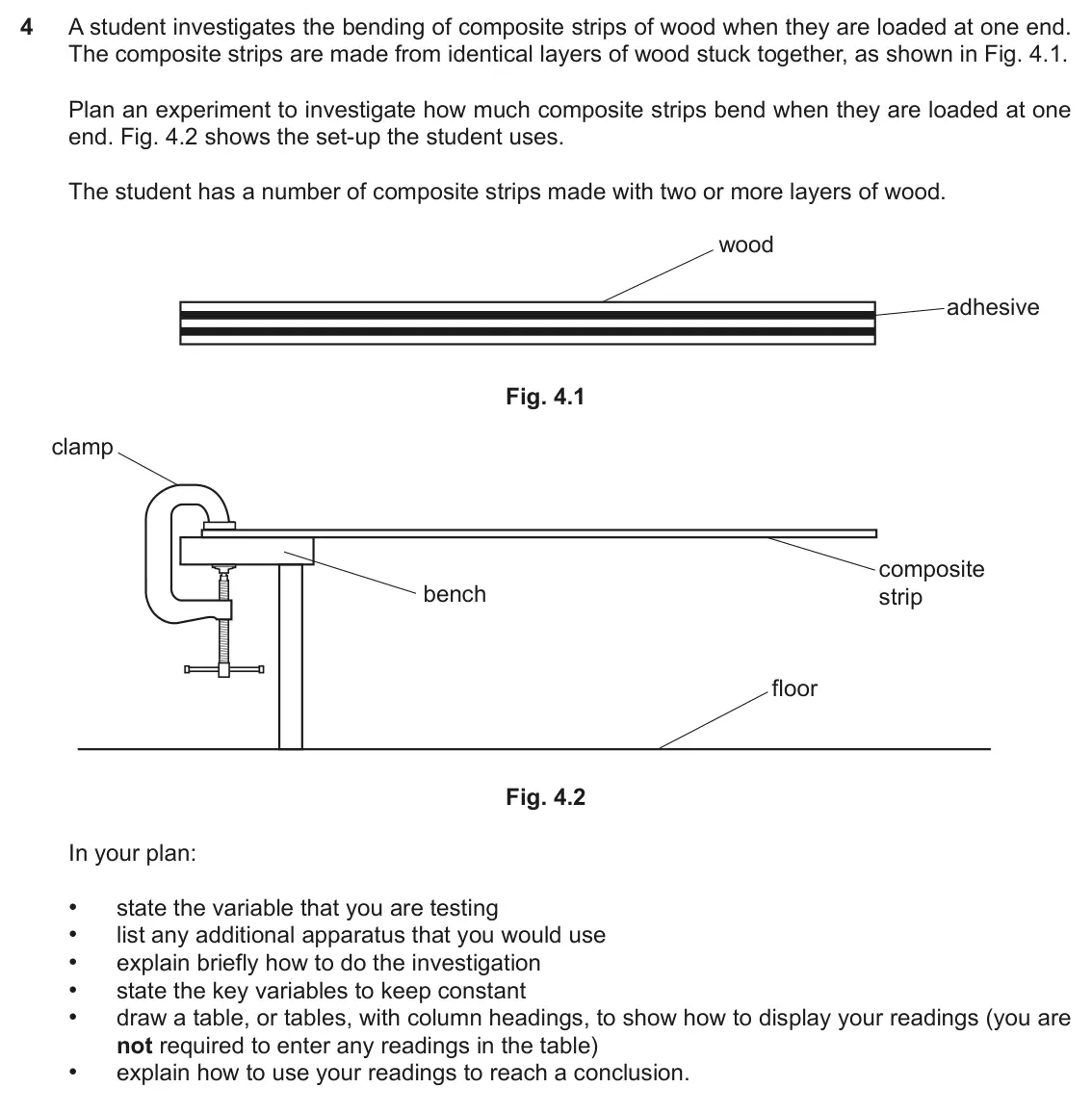
- June 2024, Paper 6, Q4 (7 marks): A student investigates the bending of composite strips of wood when they are loaded at one end. The composite strips are made from identical layers of wood stuc
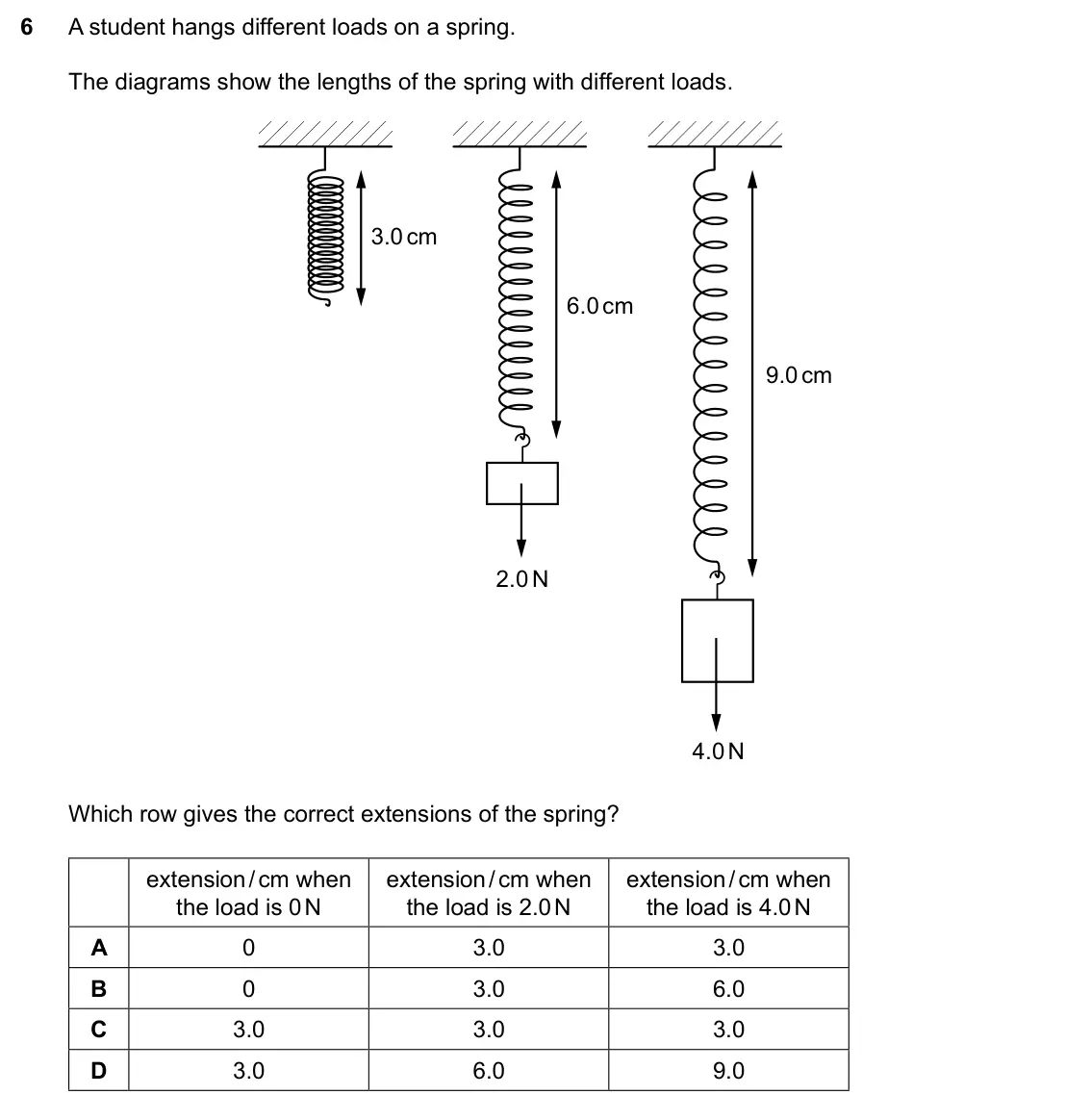
- Specimen, Paper 1, Q6 (1 mark): A student hangs different loads on a spring. The diagrams show the lengths of the spring with different loads. 3.0 cm 6.0 cm 9.0 cm 2.0 N 4.0 N Which row gives
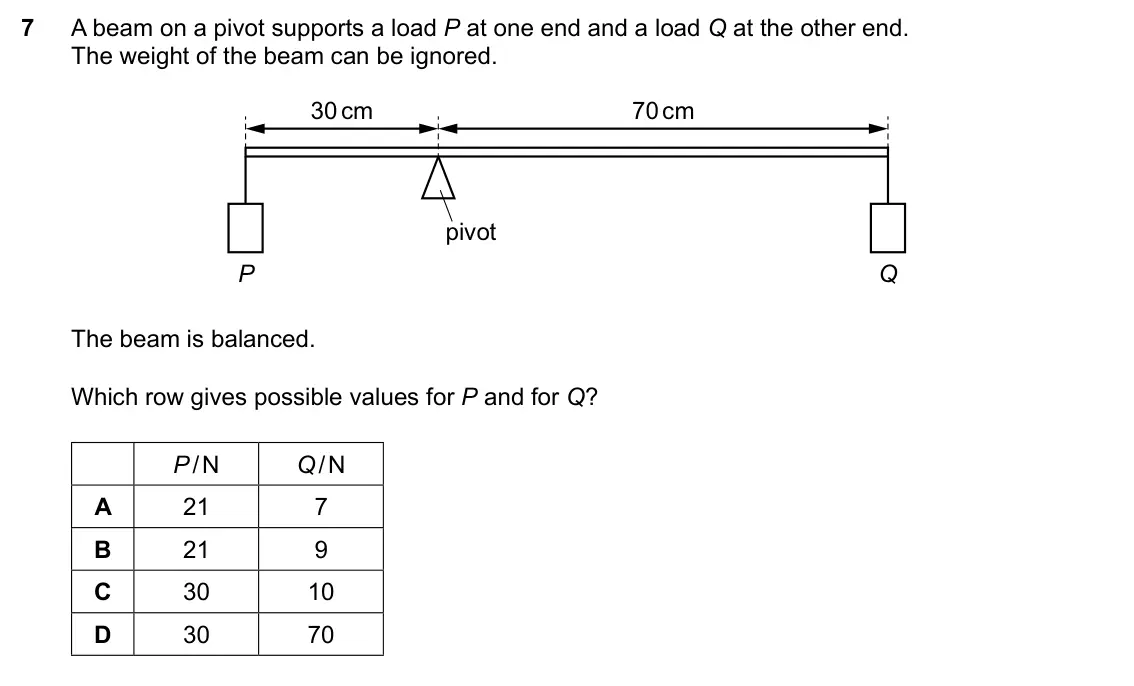
- Specimen, Paper 1, Q7 (1 mark): A beam on a pivot supports a load P at one end and a load Q at the other end. The weight of the beam can be ignored. 30 cm 70 cm pivot P Q The beam is balanced.
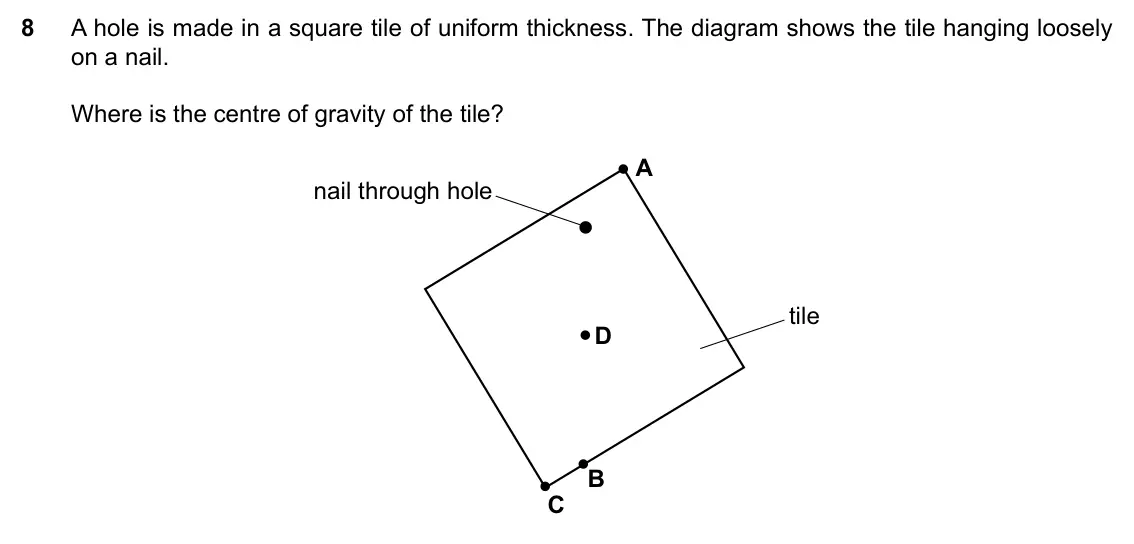
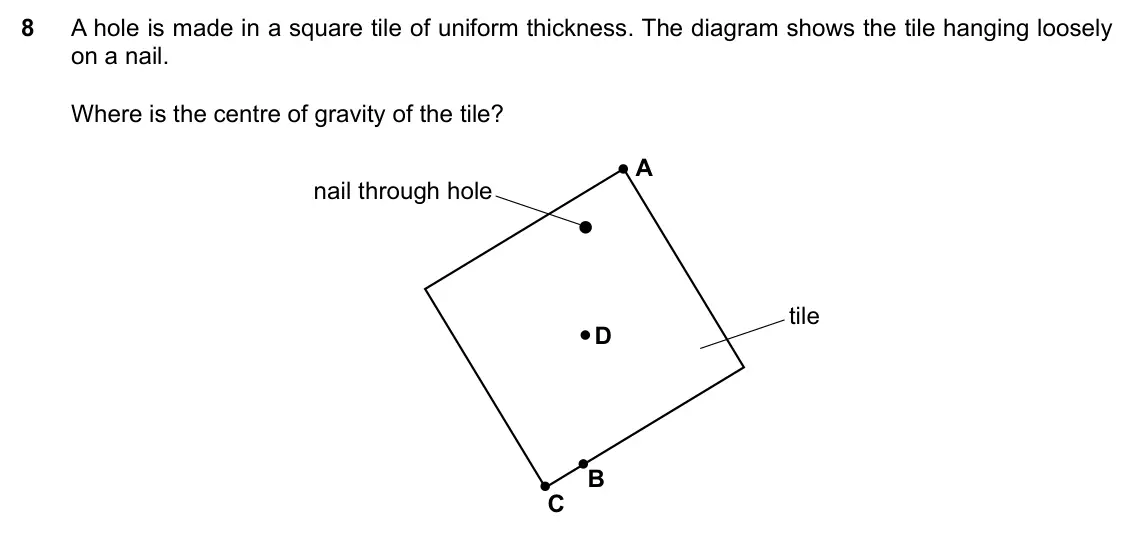
- Specimen, Paper 1, Q8 (1 mark): A hole is made in a square tile of uniform thickness. The diagram shows the tile hanging loosely on a nail. Where is the centre of gravity of the tile? A nail t
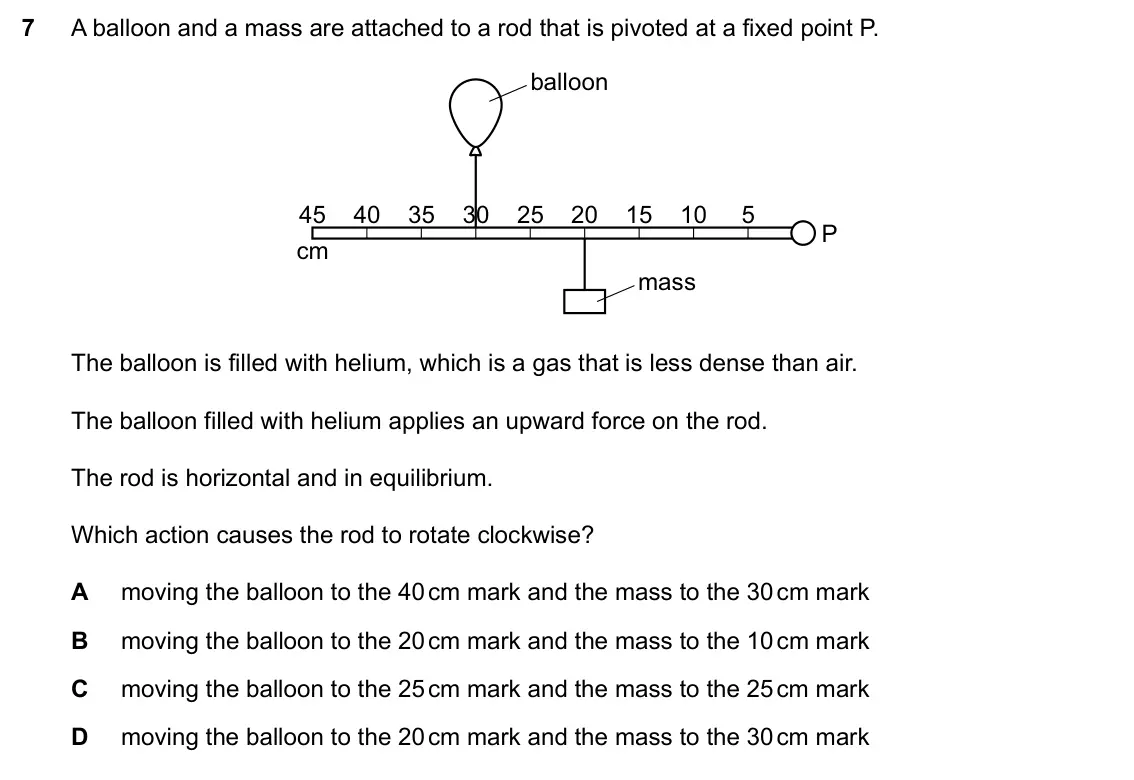
- Specimen, Paper 2, Q7 (1 mark): A balloon and a mass are attached to a rod that is pivoted at a fixed point P. balloon 45 40 35 30 25 20 15 10 5 P cm mass The balloon is filled with helium, wh
- Specimen, Paper 2, Q8 (1 mark): A hole is made in a square tile of uniform thickness. The diagram shows the tile hanging loosely on a nail. Where is the centre of gravity of the tile? A nail t
- Specimen, Paper 3, Q3(a)(i) (4 marks): The man applies a force of 150 N perpendicular to the bar and at a distance of 0.50 m from the pivot. Calculate the moment of this force about the pivot. Give t
- Specimen, Paper 3, Q3(a)(ii) (1 mark): The force applied by the man produces a turning effect (moment) about the pivot. Describe another example of using the turning effect of a force. [1]
- Specimen, Paper 3, Q3(b) (1 mark): The man tries to use the metal bar to remove another nail from the piece of wood. He applies the same force of 150 N at a distance of 0.50 m from the pivot. The
- Specimen, Paper 4, Q1(b) (2 marks): Without further calculation, state how the acceleration at time t = 100 s compares to the acceleration at time t = 10 s. Using ideas about forces, explain why a
- Specimen, Paper 4, Q2(a) (2 marks): Complete the definitions by giving the name of each quantity. mass × acceleration = force × time = [2]
Questions, mark schemes and examiner’s reports are © Cambridge University Press & Assessment, from their published past papers. Plumi isn’t affiliated with any exam board. Want whole papers? Every CAIE IGCSE Physics paper.
Rather write your answers by hand on iPad? Plumi marks them against the same mark schemes.