Skip to content
Try on iPad

Style

Get started
Whole past papers

Converting motion, friction and bearings: CAIE IGCSE Design and Technology questions

CAIE IGCSE Design and Technology past-paper questions on SC.5 Converting motion, friction and bearings, June 2024 and the 2020 and 2028 specimens, with mark schemes and examiner’s reports where available.

Getting your paper ready…

CAIE IGCSE Design and TechnologyConverting motion, friction and bearings268 questions

Paper
All papers
Exam
All years
Difficulty
More filters
Exam boards
Cambridge IGCSE

Loading the full question list…

268 questions

More options
  1. Q4June 2024 · Paper 42 marksCore

    SC.5 Converting motion, friction and bearings

    1
    Original question 4: Oil or grease can be used to reduce friction in a moving joint. Give two benefits of reducing friction in a mechanism. 1 2 [2]

    Loading the question…

    The whole paper ↗
  2. Q11(a)(i)June 2024 · Paper 41 markWarm-up

    SC.5 Converting motion, friction and bearings

    2
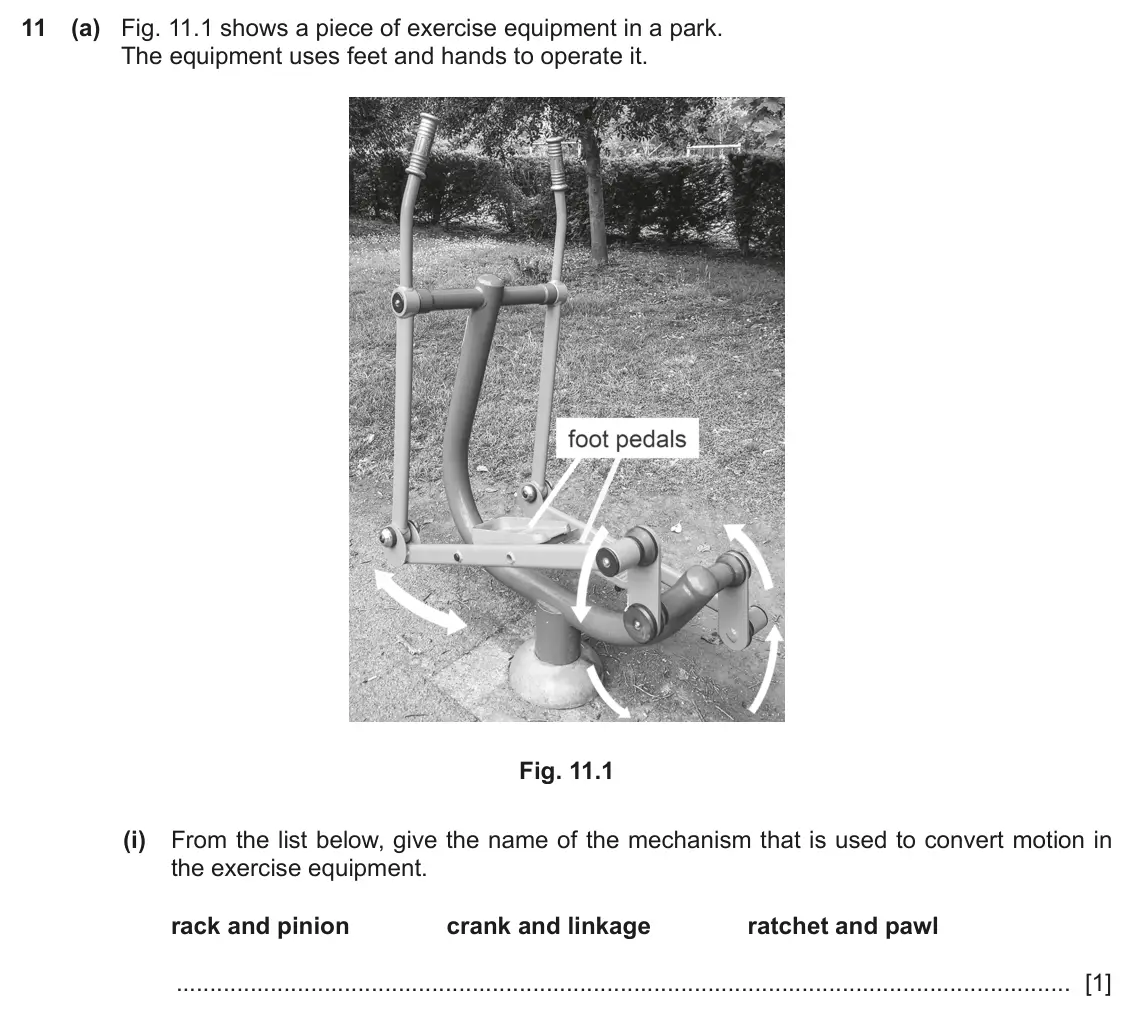
    Original question 11(a)(i): From the list below, give the name of the mechanism that is used to convert motion in the exercise equipment. rack and pinion crank and linkage ratchet and pawl

    Loading the question…

    The whole paper ↗
  3. Q11(a)(ii)June 2024 · Paper 42 marksCore

    SC.5 Converting motion, friction and bearings

    3
    Original question 11(a)(ii): State the conversion of motion that takes place when the equipment is used. to [2]

    Loading the question…

    The whole paper ↗
  4. Q11(a)(iii)June 2024 · Paper 42 marksCore

    SC.5 Converting motion, friction and bearings

    4
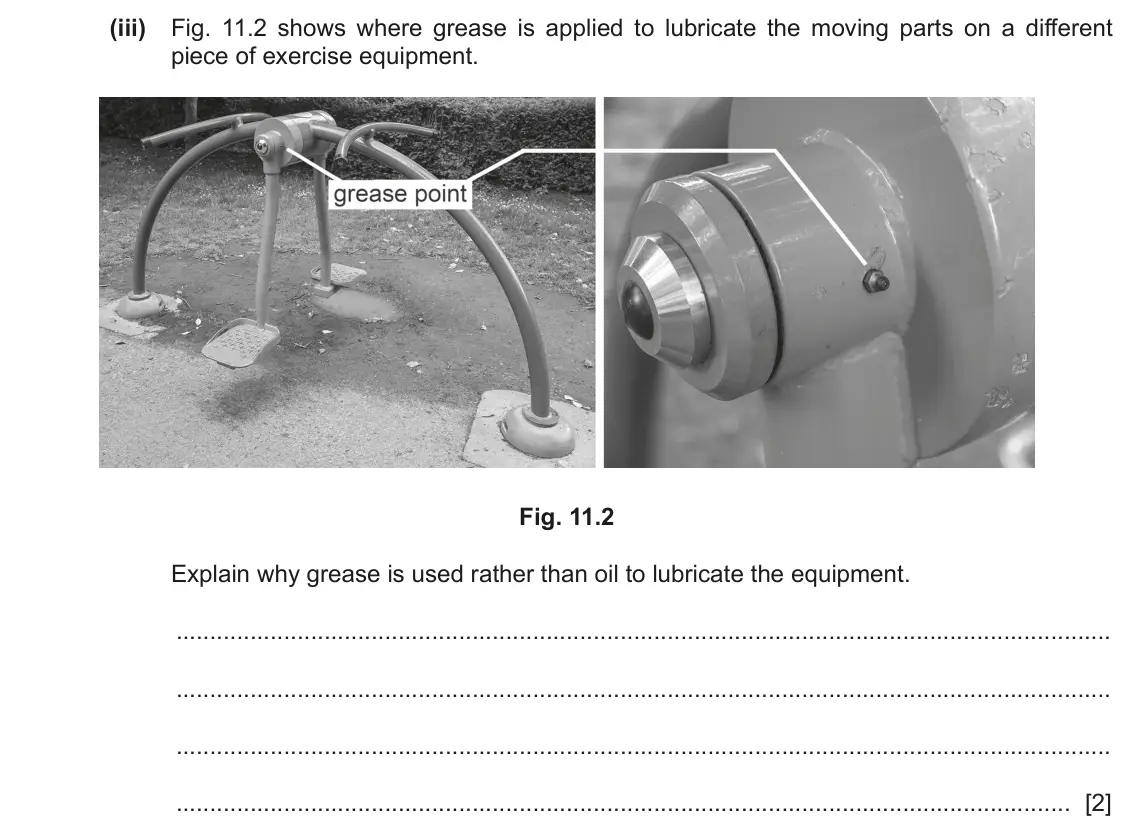
    Original question 11(a)(iii): Fig. 11.2 shows where grease is applied to lubricate the moving parts on a different piece of exercise equipment. Fig. 11.2 Explain why grease is used rather th

    Loading the question…

    The whole paper ↗
  5. Q11(b)(i)June 2024 · Paper 44 marksCore

    SC.5 Converting motion, friction and bearings

    5
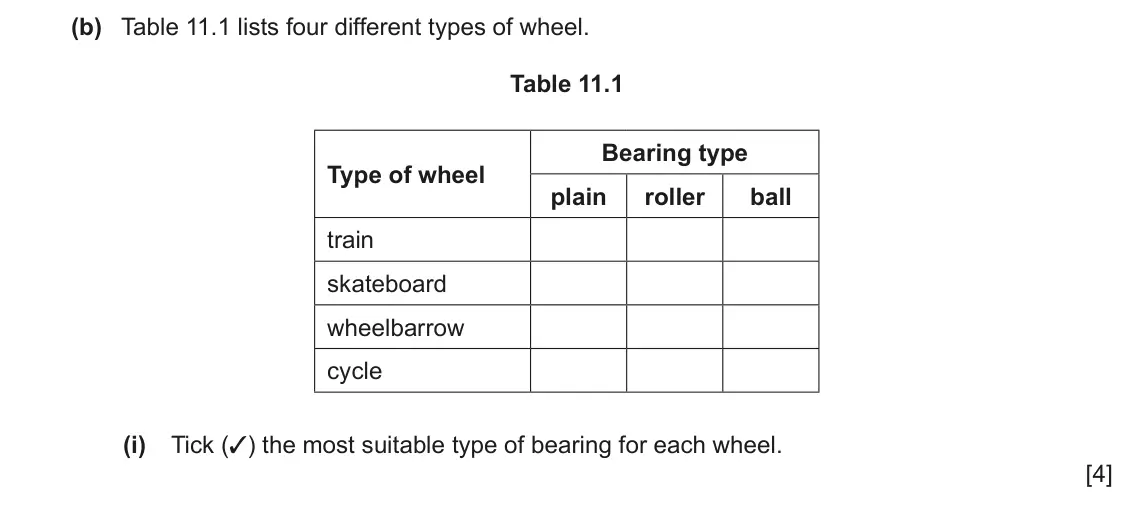
    Original question 11(b)(i): Tick (3) the most suitable type of bearing for each wheel. [4]

    Loading the question…

    The whole paper ↗
  6. Q11(b)(ii)June 2024 · Paper 43 marksStretch

    SC.5 Converting motion, friction and bearings

    6
    Original question 11(b)(ii): Describe the factors that must be considered when choosing bearings for a particular use. [3]

    Loading the question…

    The whole paper ↗
  7. Q11(c)(i)June 2024 · Paper 42 marksCore

    SC.5 Converting motion, friction and bearings

    7
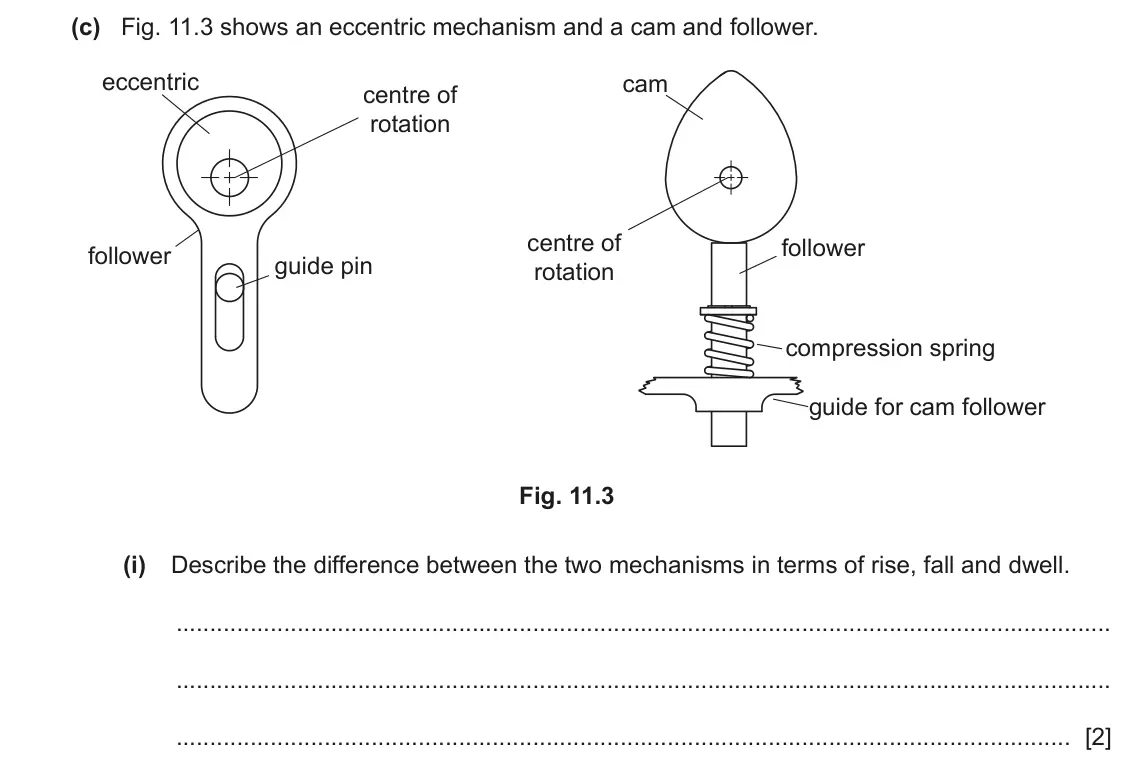
    Original question 11(c)(i): Describe the difference between the two mechanisms in terms of rise, fall and dwell. [2]

    Loading the question…

    The whole paper ↗
  8. Q11(c)(ii)June 2024 · Paper 41 markWarm-up

    SC.5 Converting motion, friction and bearings

    8
    Original question 11(c)(ii): Give one benefit of the eccentric mechanism shown in Fig. 11.3. [1]

    Loading the question…

    The whole paper ↗
  9. 9
    Original question 11(c)(iii): State two ways that efficiency can be lost in a mechanism. 1 2 [2]

    Loading the question…

    The whole paper ↗
  10. Q11(e)(ii)June 2024 · Paper 42 marksCore

    SC.5 Converting motion, friction and bearings

    10
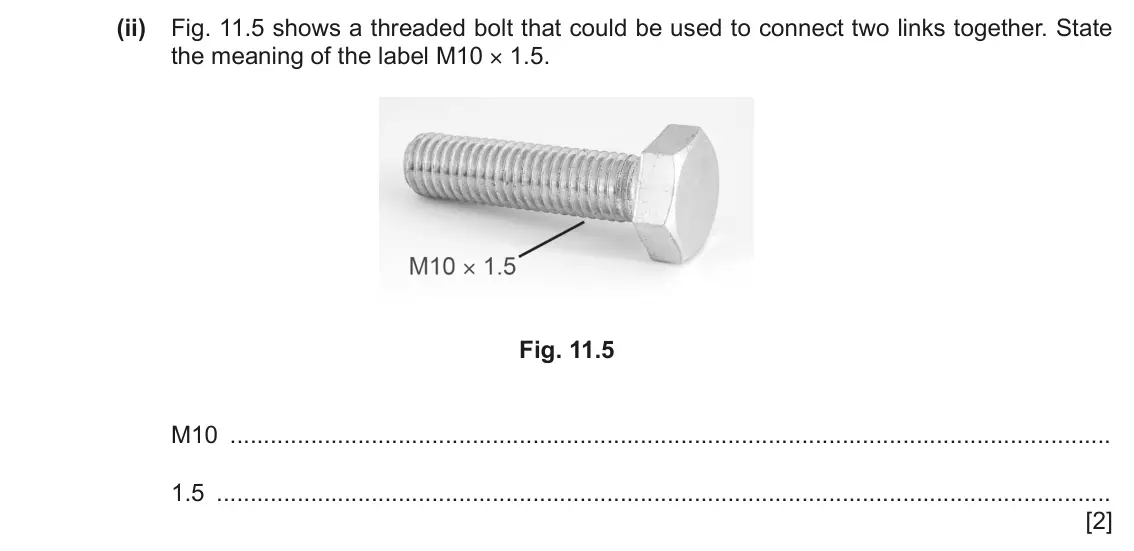
    Original question 11(e)(ii): Fig. 11.5 shows a threaded bolt that could be used to connect two links together. State the meaning of the label M10 × 1.5. Fig. 11.5 M10 1.5 [2]

    Loading the question…

    The whole paper ↗
  11. 11
    Original question 11(e)(iii): State the rotational force that is applied to the body of the bolt when a spanner is used to tighten it. [1]

    Loading the question…

    The whole paper ↗
  12. Q3(b)(ii)2028 specimen · Paper 1 (from 2028)2 marksCore

    SC.5 Converting motion, friction and bearings

    12
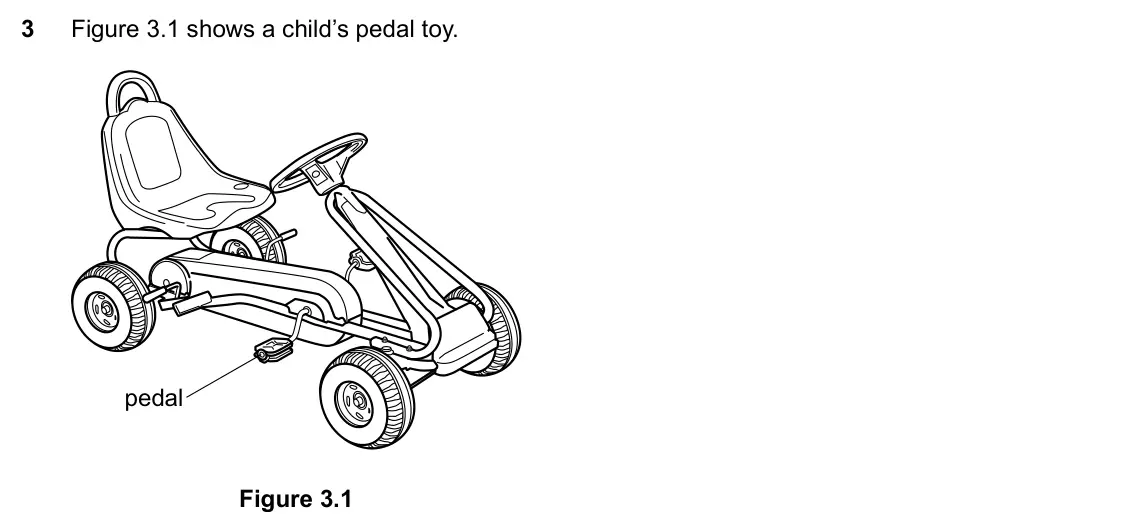
    Setup for original question 3(b)(ii)

    Loading the question setup…

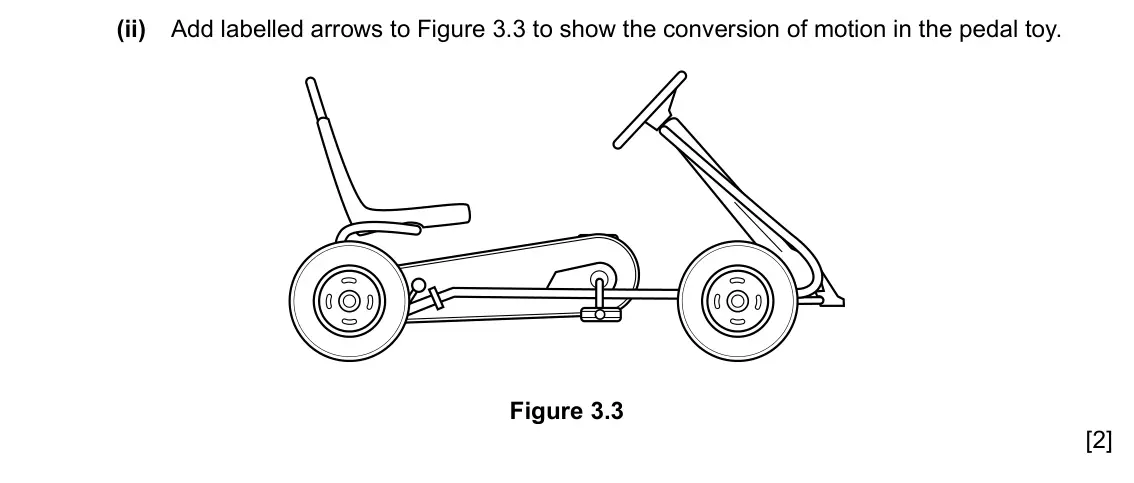
    Original question 3(b)(ii): Add labelled arrows to Figure 3.3 to show the conversion of motion in the pedal toy. Figure 3.3 [2]

    Loading the question…

    The whole paper ↗
  13. Q1(a)2020 specimen · Paper 42 marksCore

    SC.5 Converting motion, friction and bearings

    13
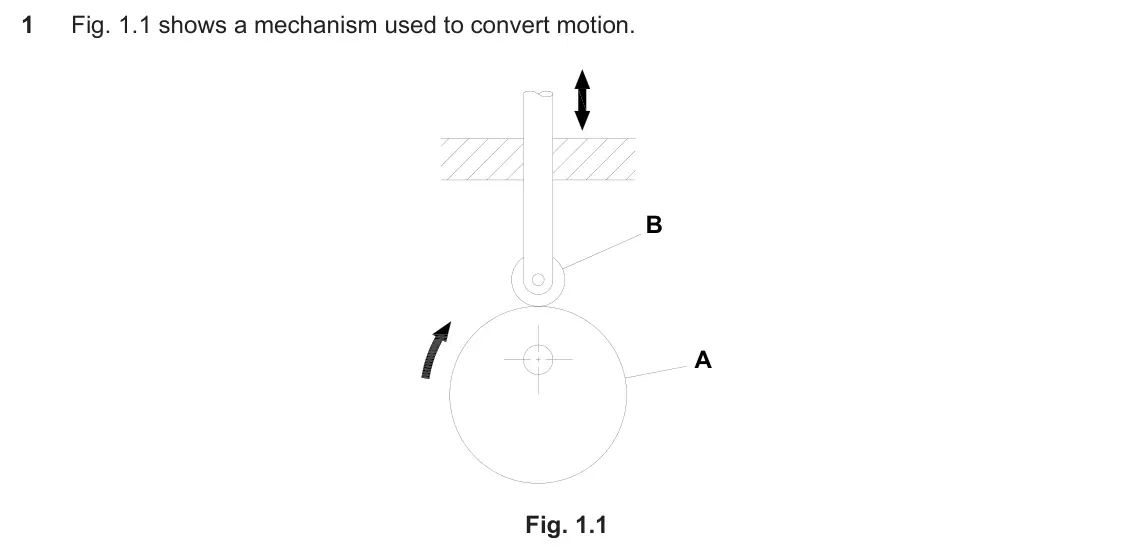
    Setup for original question 1(a)

    Loading the question setup…

    Original question 1(a): State the conversion of motion that takes place when part A rotates. to [2]

    Loading the question…

    The whole paper ↗
  14. Q1(b)2020 specimen · Paper 41 markWarm-up

    SC.5 Converting motion, friction and bearings

    14
    Original question 1(b): Give one reason for using roller B. [1]

    Loading the question…

    The whole paper ↗
  15. Q11(b)2020 specimen · Paper 42 marksCore

    SC.5 Converting motion, friction and bearings

    15
    Setup for original question 11(b)

    Loading the question setup…

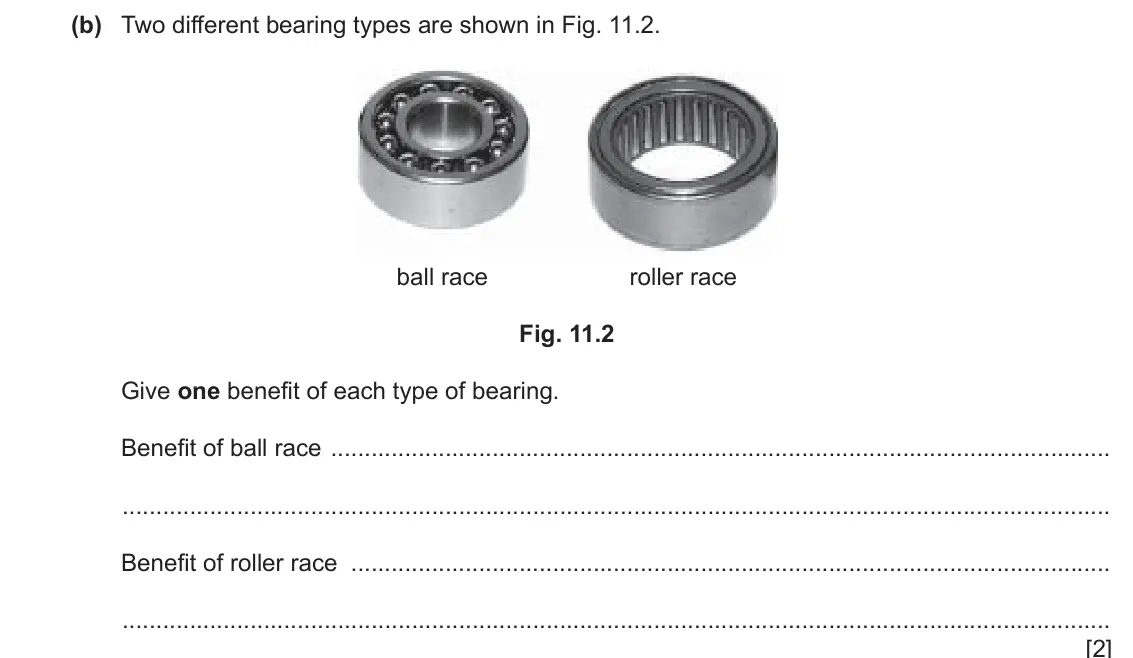
    Original question 11(b): Two different bearing types are shown in Fig. 11.2. ball race roller race Fig. 11.2 Give one benefit of each type of bearing. Benefi t of ball race Benefi t of ro

    Loading the question…

    The whole paper ↗
  16. 16
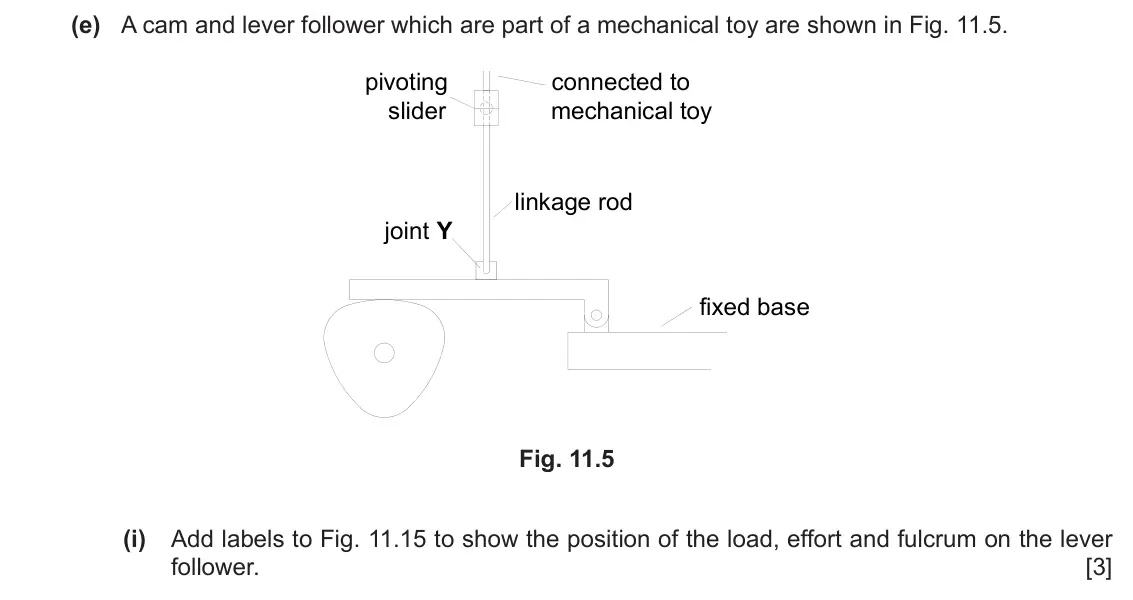
    Original question 11(e)(i): Add labels to Fig. 11.15 to show the position of the load, effort and fulcrum on the lever follower. [3]

    Loading the question…

    The whole paper ↗
  17. Q11(e)(iii)2020 specimen · Paper 42 marksCore

    SC.5 Converting motion, friction and bearings

    17
    Original question 11(e)(iii): Describe the action of the lever follower for one rotation of the camshaft. [2]

    Loading the question…

    The whole paper ↗
  18. 18
    Original question 11(e)(iv): Give the reason that joint Y is not a rigid joint. [1]

    Loading the question…

    The whole paper ↗
All 18 questions on Converting motion, friction and bearings, as a list
  1. June 2024, Paper 4, Q4 (2 marks): Oil or grease can be used to reduce friction in a moving joint. Give two benefits of reducing friction in a mechanism. 1 2 [2]
  2. June 2024, Paper 4, Q11(a)(i) (1 mark): From the list below, give the name of the mechanism that is used to convert motion in the exercise equipment. rack and pinion crank and linkage ratchet and pawl
  3. June 2024, Paper 4, Q11(a)(ii) (2 marks): State the conversion of motion that takes place when the equipment is used. to [2]
  4. June 2024, Paper 4, Q11(a)(iii) (2 marks): Fig. 11.2 shows where grease is applied to lubricate the moving parts on a different piece of exercise equipment. Fig. 11.2 Explain why grease is used rather th
  5. June 2024, Paper 4, Q11(b)(i) (4 marks): Tick (3) the most suitable type of bearing for each wheel. [4]
  6. June 2024, Paper 4, Q11(b)(ii) (3 marks): Describe the factors that must be considered when choosing bearings for a particular use. [3]
  7. June 2024, Paper 4, Q11(c)(i) (2 marks): Describe the difference between the two mechanisms in terms of rise, fall and dwell. [2]
  8. June 2024, Paper 4, Q11(c)(ii) (1 mark): Give one benefit of the eccentric mechanism shown in Fig. 11.3. [1]
  9. June 2024, Paper 4, Q11(c)(iii) (2 marks): State two ways that efficiency can be lost in a mechanism. 1 2 [2]
  10. June 2024, Paper 4, Q11(e)(ii) (2 marks): Fig. 11.5 shows a threaded bolt that could be used to connect two links together. State the meaning of the label M10 × 1.5. Fig. 11.5 M10 1.5 [2]
  11. June 2024, Paper 4, Q11(e)(iii) (1 mark): State the rotational force that is applied to the body of the bolt when a spanner is used to tighten it. [1]
  12. 2028 specimen, Paper 1 (from 2028), Q3(b)(ii) (2 marks): Add labelled arrows to Figure 3.3 to show the conversion of motion in the pedal toy. Figure 3.3 [2]
  13. 2020 specimen, Paper 4, Q1(a) (2 marks): State the conversion of motion that takes place when part A rotates. to [2]
  14. 2020 specimen, Paper 4, Q1(b) (1 mark): Give one reason for using roller B. [1]
  15. 2020 specimen, Paper 4, Q11(b) (2 marks): Two different bearing types are shown in Fig. 11.2. ball race roller race Fig. 11.2 Give one benefit of each type of bearing. Benefi t of ball race Benefi t of ro
  16. 2020 specimen, Paper 4, Q11(e)(i) (3 marks): Add labels to Fig. 11.15 to show the position of the load, effort and fulcrum on the lever follower. [3]
  17. 2020 specimen, Paper 4, Q11(e)(iii) (2 marks): Describe the action of the lever follower for one rotation of the camshaft. [2]
  18. 2020 specimen, Paper 4, Q11(e)(iv) (1 mark): Give the reason that joint Y is not a rigid joint. [1]

Questions, mark schemes and examiner’s reports are © Cambridge University Press & Assessment, from their published past papers. Plumi isn’t affiliated with any exam board. Want whole papers? CAIE IGCSE Design and Technology past papers.

The Plumi iPad app also offers exam-style questions with AI feedback on your handwritten working.