 plumi
Wave-particle duality: CAIE A‑Level Physics questions
CAIE A-Level Physics past-paper questions on 22.3 Wave-particle duality, 2017 to 2025 and the specimen papers, with mark schemes and examiner’s reports where available.
Past paper difficulty
Paper
All papers
Exam
All years
Calculations
Loading the full question list…
Q8(a)
The whole paper ↗1
Q8(b)
The whole paper ↗2
Q8(a)
The whole paper ↗3
Q8(b)
The whole paper ↗4
Q9(a)
The whole paper ↗5

Q9(b)
The whole paper ↗6
Q9(c)
The whole paper ↗7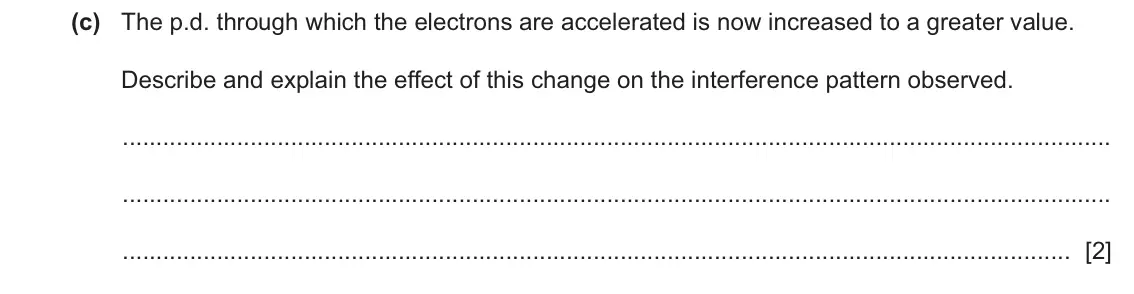
Q9(d)(i)
The whole paper ↗8
Q9(d)(ii)
The whole paper ↗9
Q7(a)
The whole paper ↗10
Q7(b)(i)
The whole paper ↗11
Q7(b)(ii)
The whole paper ↗12
Q7(c)(i)
The whole paper ↗13
Q7(c)(ii)
The whole paper ↗14
Q7(a)
The whole paper ↗15
Q7(b)(i)
The whole paper ↗16
Q7(b)(ii)
The whole paper ↗17
Q7(c)(i)
The whole paper ↗18
Q7(c)(ii)
The whole paper ↗19
Q8(a)(i)
The whole paper ↗20
All 50 questions on Wave-particle duality, as a list
- June 2025, Paper 4, Q8(a) (1 mark): State what is meant by the de Broglie wavelength. [1]
- June 2025, Paper 4, Q8(b) (2 marks): Calculate the de Broglie wavelength of an electron moving at a speed of 4.9 × 10⁷ m s–1. wavelength = m [2]
- June 2025 (variant 3), Paper 4, Q8(a) (1 mark): State what is meant by the de Broglie wavelength. [1]
- June 2025 (variant 3), Paper 4, Q8(b) (2 marks): Calculate the de Broglie wavelength of an electron moving at a speed of 4.9 × 10⁷ m s–1. wavelength = m [2]
- November 2024 (variant 2), Paper 4, Q9(a) (1 mark): Explain what this observation shows about the nature of electrons. [1]
- November 2024 (variant 2), Paper 4, Q9(b) (3 marks): Determine an expression, in terms of m, q and V, for the momentum p of an electron in the beam. p = [3]
- November 2024 (variant 2), Paper 4, Q9(c) (2 marks): The p.d. through which the electrons are accelerated is now increased to a greater value. Describe and explain the effect of this change on the interference pat
- November 2024 (variant 2), Paper 4, Q9(d)(i) (2 marks): On Fig. 9.1, sketch the variation of p with 1 λ. p 0 0 1 λ Fig. 9.1 [2]
- November 2024 (variant 2), Paper 4, Q9(d)(ii) (1 mark): State the name of the quantity represented by the gradient of the line in Fig. 9.1. [1] [Total: 9]
- June 2023, Paper 4, Q7(a) (1 mark): State what is meant by the de Broglie wavelength. [1]
- June 2023, Paper 4, Q7(b)(i) (1 mark): State the name of the phenomenon demonstrated by the pattern shown in Fig. 7.2. [1]
- June 2023, Paper 4, Q7(b)(ii) (2 marks): Explain what can be concluded from the pattern in Fig. 7.2 about the nature of electrons. [2]
- June 2023, Paper 4, Q7(c)(i) (2 marks): On Fig. 7.3, sketch the pattern that is now seen on the fluorescent screen in Fig. 7.1. Fig. 7.3 [2]
- June 2023, Paper 4, Q7(c)(ii) (3 marks): Explain, with reference to de Broglie wavelength, the change in the pattern on the fluorescent screen. [3] [Total: 9]
- June 2023 (variant 3), Paper 4, Q7(a) (1 mark): State what is meant by the de Broglie wavelength. [1]
- June 2023 (variant 3), Paper 4, Q7(b)(i) (1 mark): State the name of the phenomenon demonstrated by the pattern shown in Fig. 7.2. [1]
- June 2023 (variant 3), Paper 4, Q7(b)(ii) (2 marks): Explain what can be concluded from the pattern in Fig. 7.2 about the nature of electrons. [2]
- June 2023 (variant 3), Paper 4, Q7(c)(i) (2 marks): On Fig. 7.3, sketch the pattern that is now seen on the fluorescent screen in Fig. 7.1. Fig. 7.3 [2]
- June 2023 (variant 3), Paper 4, Q7(c)(ii) (3 marks): Explain, with reference to de Broglie wavelength, the change in the pattern on the fluorescent screen. [3] [Total: 9]
- June 2022 (variant 2), Paper 4, Q8(a)(i) (1 mark): the particulate nature of electromagnetic radiation [1]
- June 2022 (variant 2), Paper 4, Q8(a)(ii) (1 mark): the wave nature of matter. [1]
- June 2022 (variant 2), Paper 4, Q8(b)(i) (3 marks): Calculate the de Broglie wavelength λ of an alpha-particle moving at a speed of 6.2 × 10⁷ m s–1. λ = m [3]
- June 2022 (variant 2), Paper 4, Q8(b)(ii) (2 marks): The speed v of the alpha-particle in (b)(i) is gradually reduced to zero. On Fig. 8.1, sketch the variation with v of λ. λ 0 0 6.2 v / 107 m s–1 Fig. 8.1 [2]
- June 2022 (variant 2), Paper 4, Q8(c) (1 mark): Suggest an explanation for why people are not observed to diffract when they walk through a doorway. [1] [Total: 8]
- March 2022, Paper 4, Q8(a) (2 marks): State the formula for the de Broglie wavelength λ of a moving particle. State the meaning of any other symbol used. [2]
- March 2022, Paper 4, Q8(b)(i) (1 mark): State the name of the phenomenon shown by the electrons at the crystal. [1]
- March 2022, Paper 4, Q8(b)(ii) (1 mark): State what this phenomenon shows about the nature of electrons. [1]
- March 2022, Paper 4, Q8(b)(iii) (1 mark): Suggest why the thin crystal causes the phenomenon in (b)(i). [1]
- March 2022, Paper 4, Q8(b)(iv) (2 marks): The electron is accelerated through a different potential difference. The new pattern observed on the screen is shown in Fig. 8.2. edge of screen Fig. 8.2 not t
- November 2021, Paper 4, Q10(a)(i) (1 mark): the particulate nature of electromagnetic radiation [1]
- November 2021, Paper 4, Q10(a)(ii) (1 mark): the wave nature of matter. [1]
- November 2021, Paper 4, Q10(b)(i) (2 marks): State the equation that gives the effective wavelength λ of the particle. State the name of any other symbols used. [2]
- November 2021, Paper 4, Q10(b)(ii) (1 mark): State the name given to the wavelength of the moving particle. [1]
- November 2021, Paper 4, Q10(c)(i) (2 marks): Show that the final speed of the electrons is 4.1 × 10⁷ m s–1. [2]
- November 2021, Paper 4, Q10(c)(ii) (2 marks): Calculate the effective wavelength of a beam of electrons moving at the speed in (c)(i). wavelength = m [2] [Total: 9]
- November 2021 (variant 3), Paper 4, Q10(a)(ii) (1 mark): the wave nature of matter. [1]
- November 2021 (variant 3), Paper 4, Q10(b)(i) (2 marks): State the equation that gives the effective wavelength λ of the particle. State the name of any other symbols used. [2]
- November 2021 (variant 3), Paper 4, Q10(b)(ii) (1 mark): State the name given to the wavelength of the moving particle. [1]
- November 2021 (variant 3), Paper 4, Q10(c)(i) (2 marks): Show that the final speed of the electrons is 4.1 × 10⁷ m s–1. [2]
- November 2021 (variant 3), Paper 4, Q10(c)(ii) (2 marks): Calculate the effective wavelength of a beam of electrons moving at the speed in (c)(i). wavelength = m [2] [Total: 9]
- June 2021, Paper 4, Q6(b) (2 marks): The de Broglie wavelength of a particle is λ 0 when its momentum is p0. On Fig. 6.2, sketch the variation with momentum p of the de Broglie wavelength λ of the
- June 2021 (variant 3), Paper 4, Q6(b) (2 marks): The de Broglie wavelength of a particle is λ 0 when its momentum is p0. On Fig. 6.2, sketch the variation with momentum p of the de Broglie wavelength λ of the
- June 2020 (variant 2), Paper 4, Q11(b) (4 marks): The structure of a copper crystal is to be examined using electron diffraction. Electrons, having been accelerated from rest through a potential difference V, a
- June 2019, Paper 4, Q11(c) (3 marks): Photons of wavelength 380 nm are incident normally on a metal surface at a rate of 7.6 × 10¹⁴ s–1. All the photons are absorbed in the surface and no photoelect
- June 2019 (variant 3), Paper 4, Q11(c) (3 marks): Photons of wavelength 380 nm are incident normally on a metal surface at a rate of 7.6 × 10¹⁴ s–1. All the photons are absorbed in the surface and no photoelect
- November 2017 (variant 2), Paper 4, Q10(b) (2 marks): A neutron is moving in a straight line with momentum p. The de Broglie wavelength associated with this neutron is λ. On Fig. 10.2, sketch the variation with mom
- June 2017 (variant 2), Paper 4, Q11(a) (2 marks): Show that the momentum p of the accelerated electron is given by p = ( 2 mqV ) . [2]
- June 2017 (variant 2), Paper 4, Q11(b)(i) (2 marks): State what is meant by the de Broglie wavelength. [2]
- June 2017 (variant 2), Paper 4, Q11(b)(ii) (3 marks): Calculate the de Broglie wavelength of the electron. wavelength = m [3]
- June 2017 (variant 2), Paper 4, Q11(c) (2 marks): The separation of copper atoms in a copper crystal is approximately 2 × 10⁻¹⁰ m. By reference to your answer in (b)(ii), suggest whether electron diffraction co
Questions, mark schemes and examiner’s reports are © Cambridge University Press & Assessment, from their published past papers. Plumi isn’t affiliated with any exam board. Want whole papers? CAIE A-Level Physics past papers.
The Plumi iPad app also offers exam-style questions with AI feedback on your handwritten working.