 plumi
Energy levels in atoms and line spectra: CAIE A‑Level Physics questions
CAIE A-Level Physics past-paper questions on 22.4 Energy levels in atoms and line spectra, 2017 to 2025 and the specimen papers, with mark schemes and examiner’s reports where available.
Past paper difficulty
Paper
All papers
Exam
All years
Calculations
Loading the full question list…
Q8(a)
The whole paper ↗1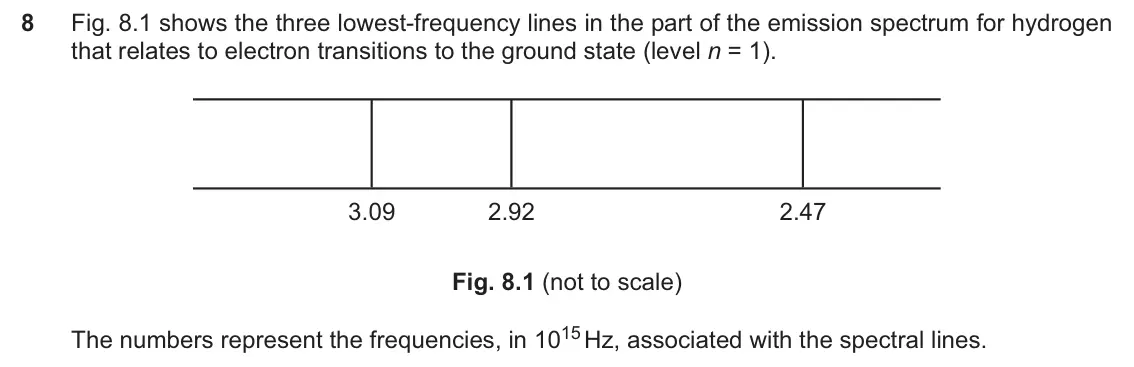
Q8(b)(i)
The whole paper ↗2
Q8(b)(ii)
The whole paper ↗3
Q8(b)(iii)
The whole paper ↗4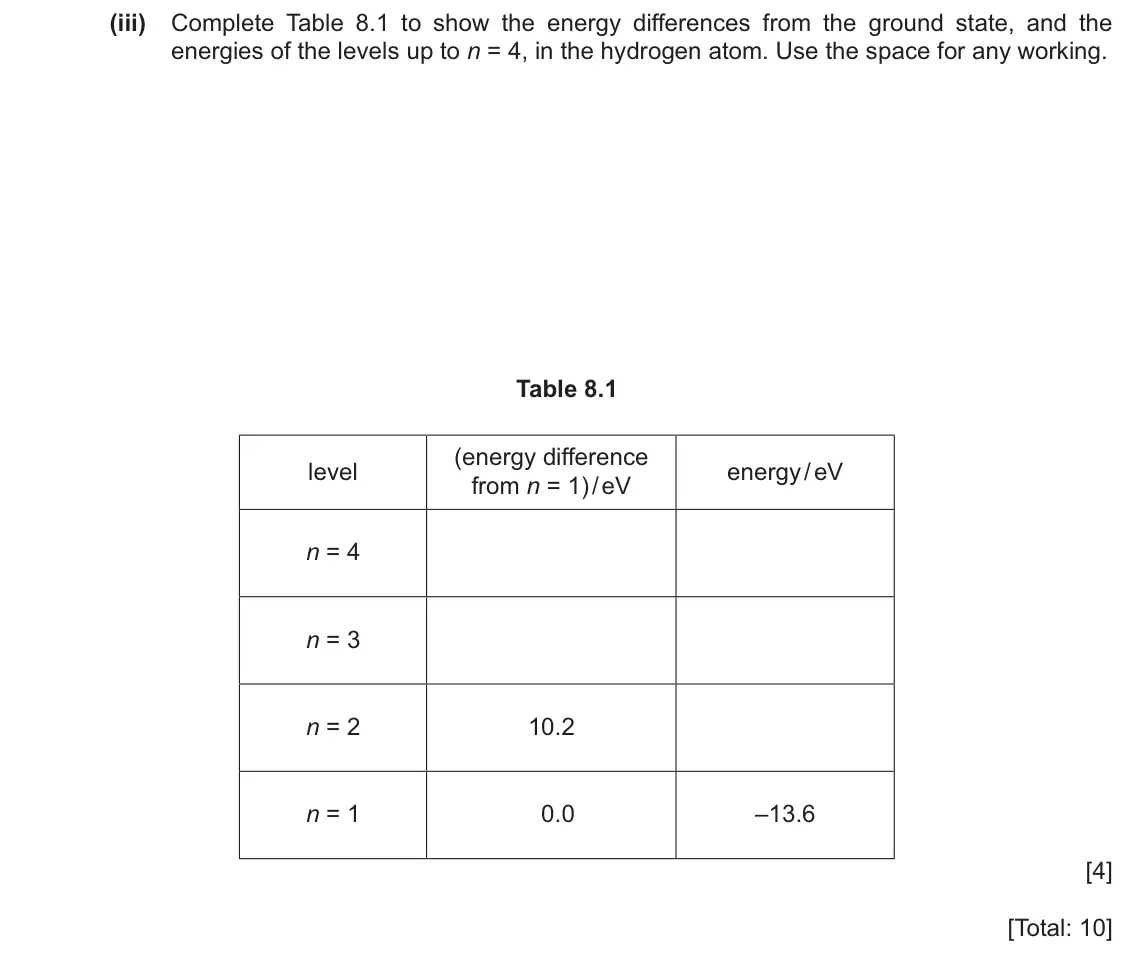
Q8(b)(ii)
The whole paper ↗5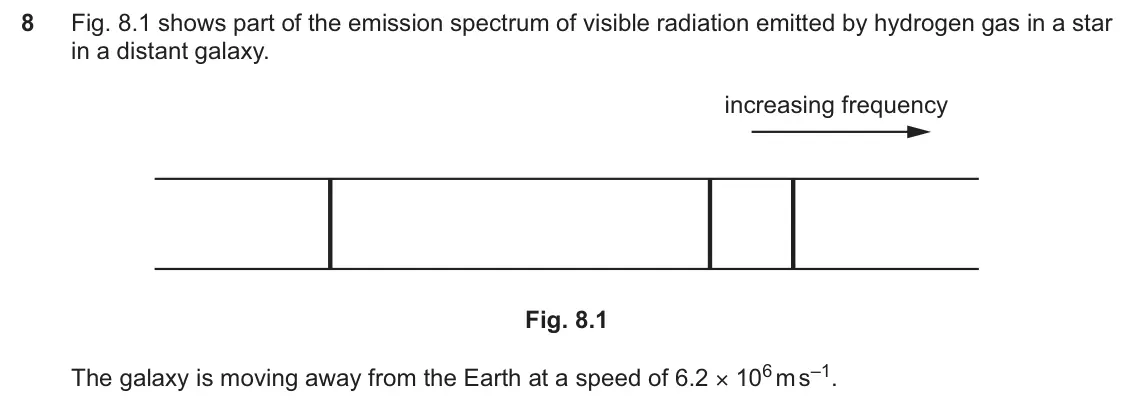

Q8(a)
The whole paper ↗6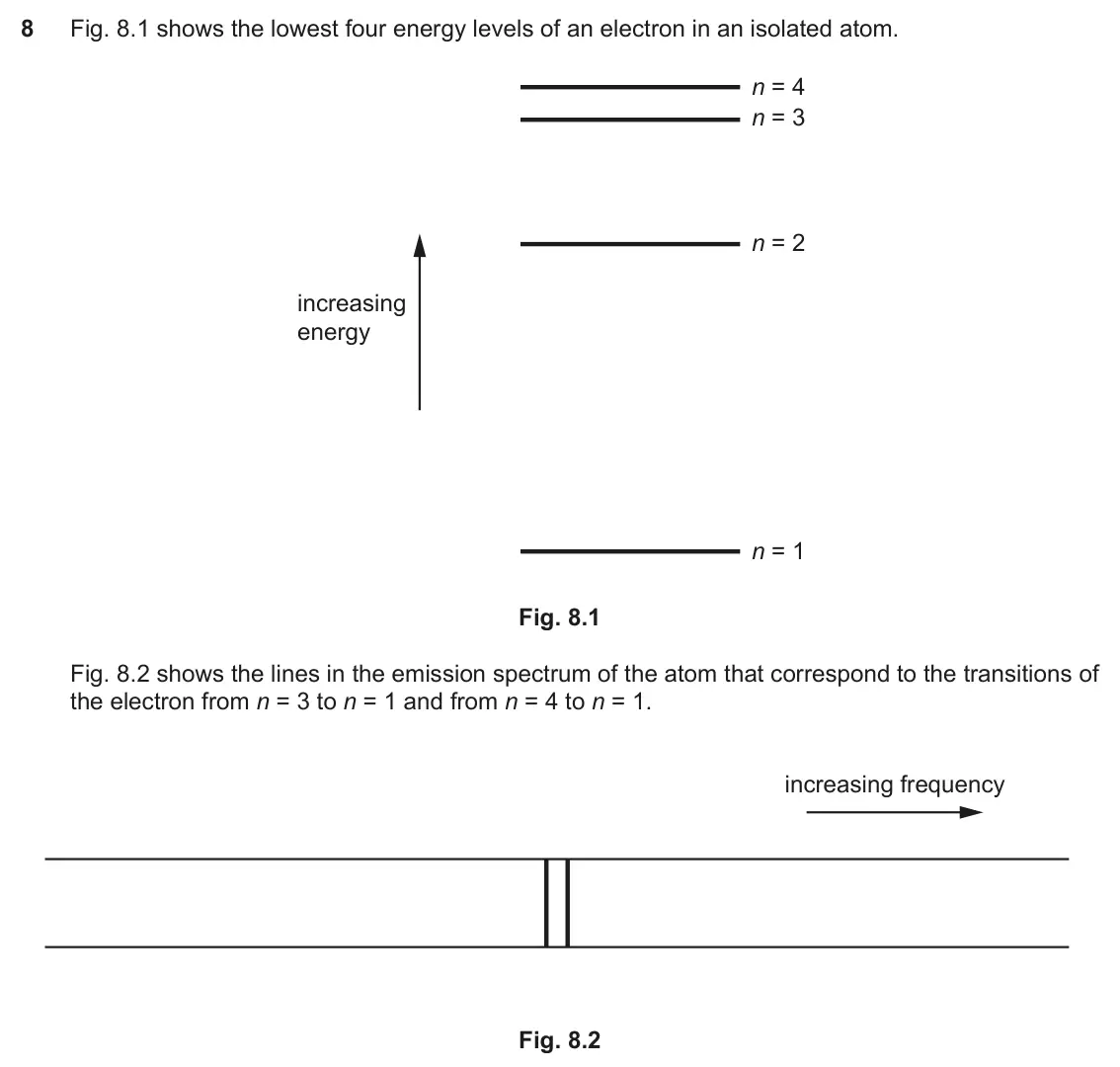

Q8(b)(i)
The whole paper ↗7
Q8(b)(ii)
The whole paper ↗8
Q8(c)
The whole paper ↗9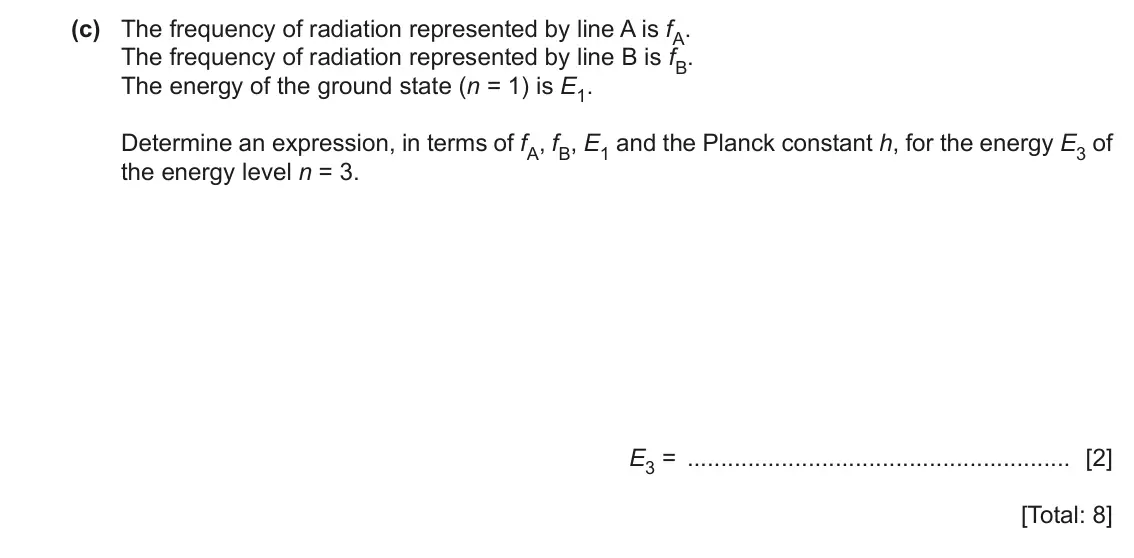
Q7(a)
The whole paper ↗10
Q7(b)
The whole paper ↗11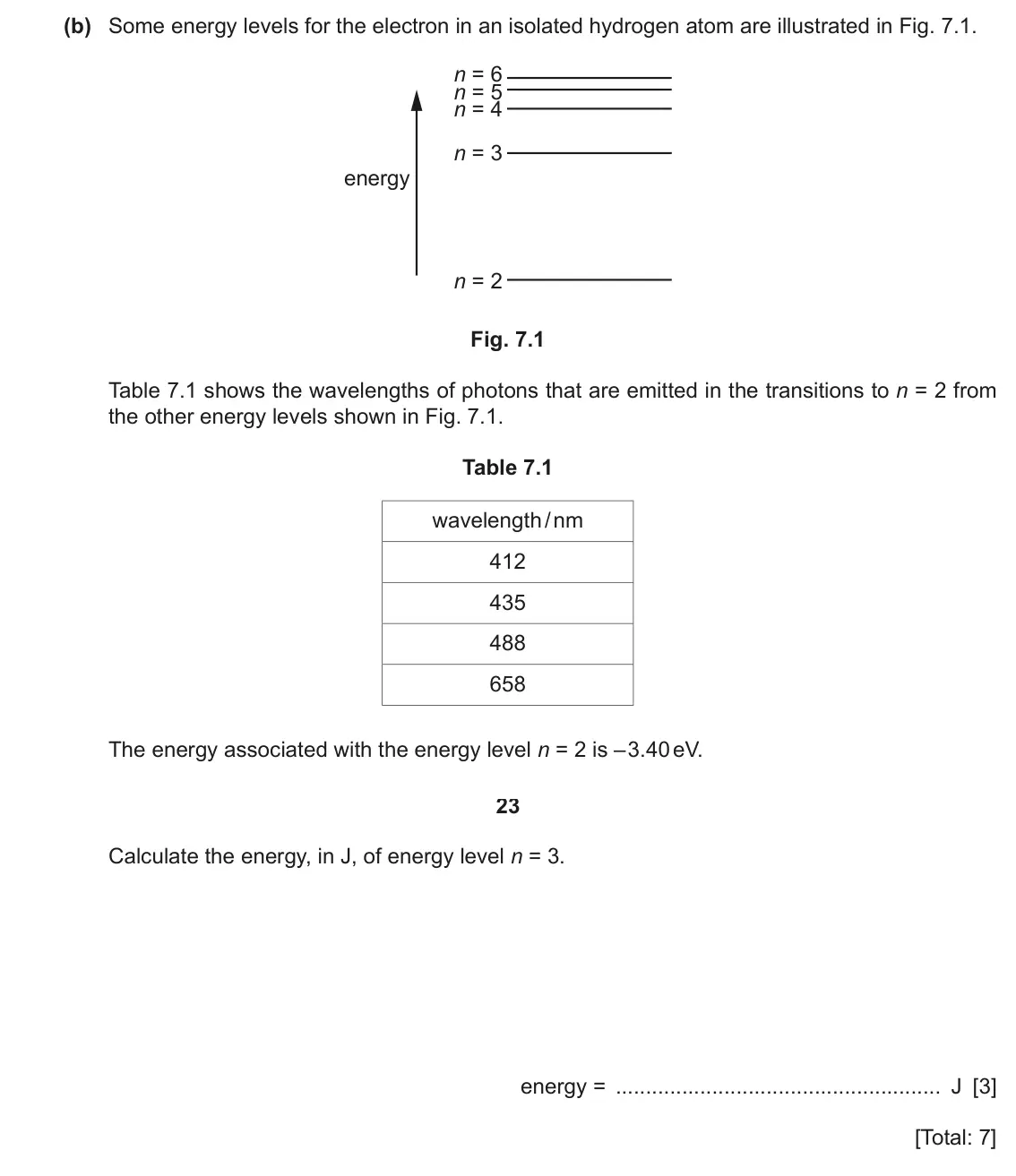
Q9(a)(i)
The whole paper ↗12
Q9(a)(ii)
The whole paper ↗13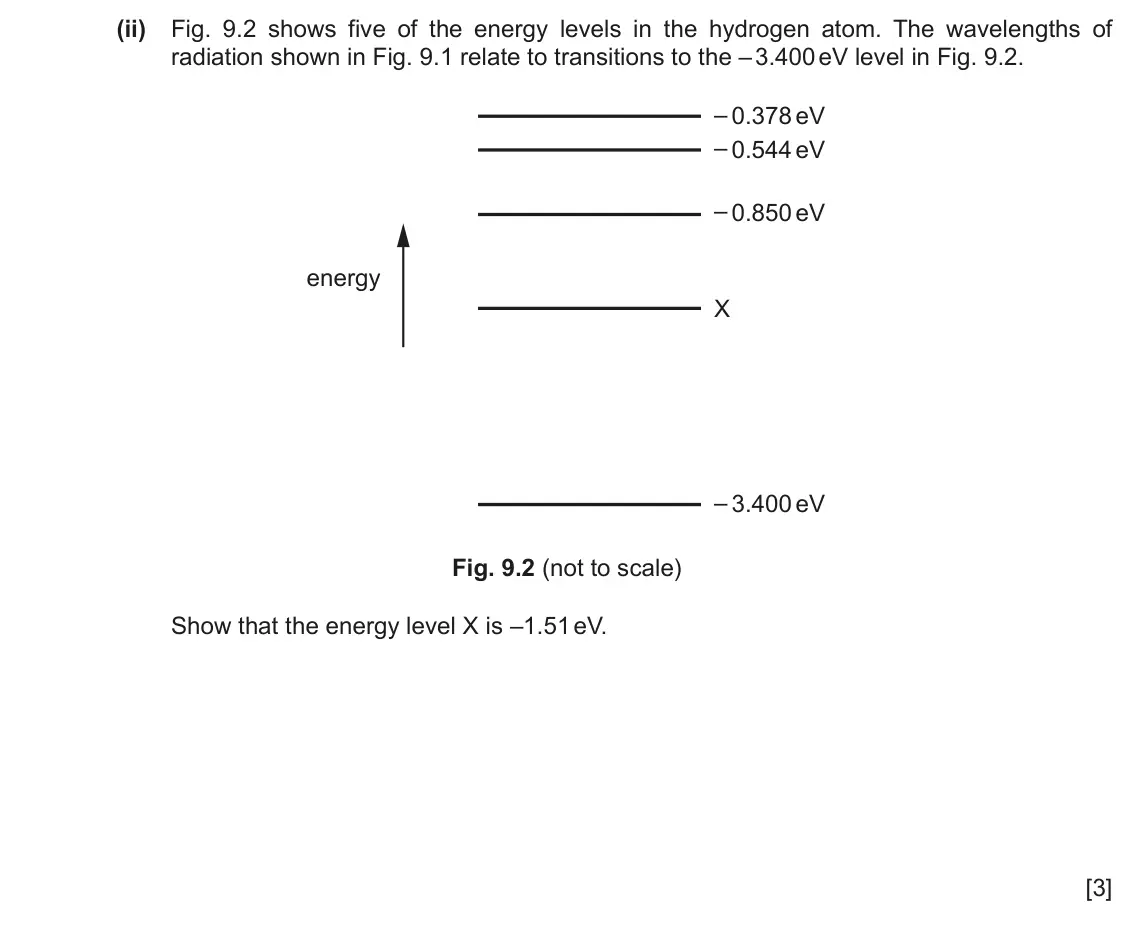
Q10(a)
The whole paper ↗14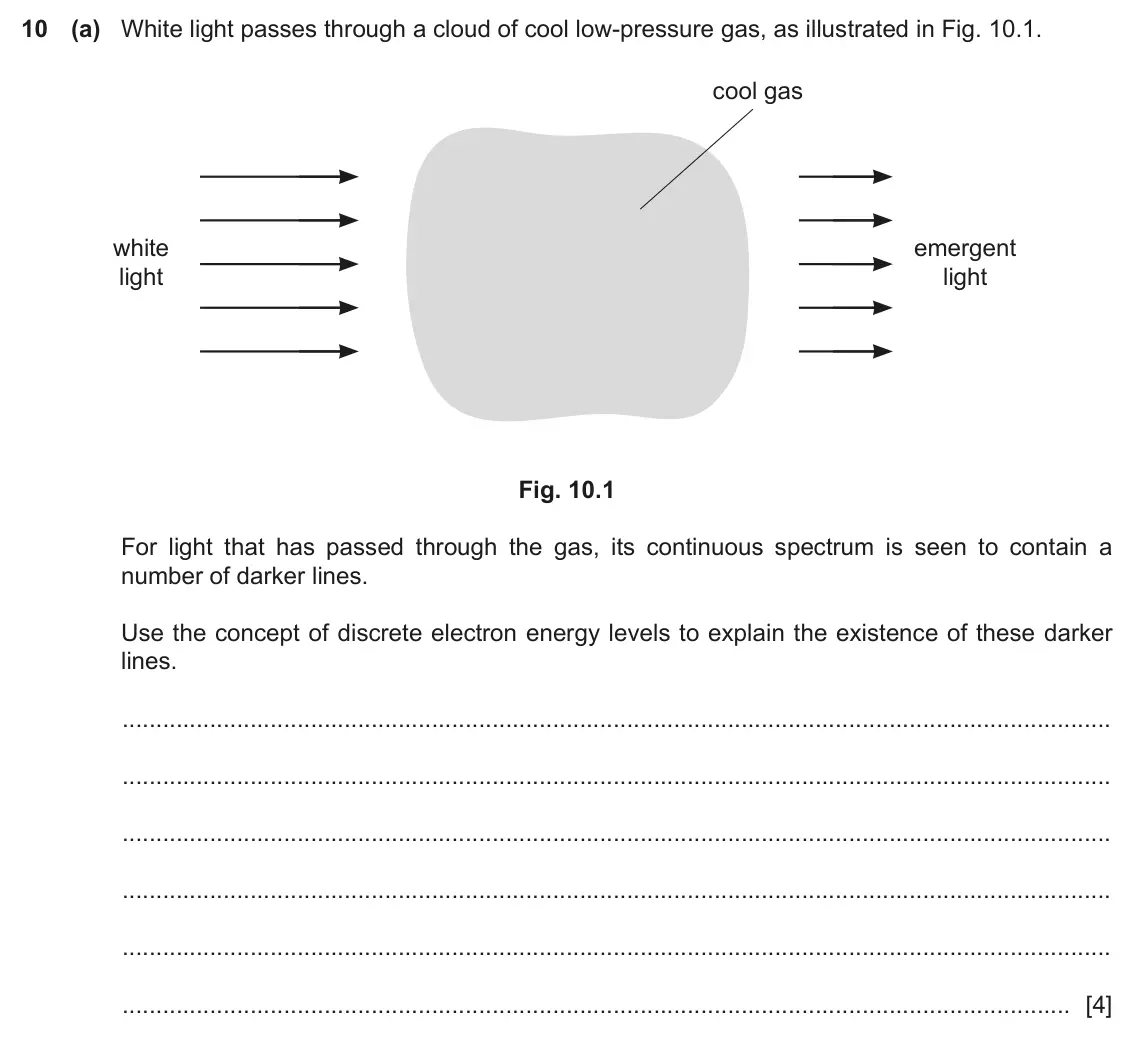
Q10(a)
The whole paper ↗15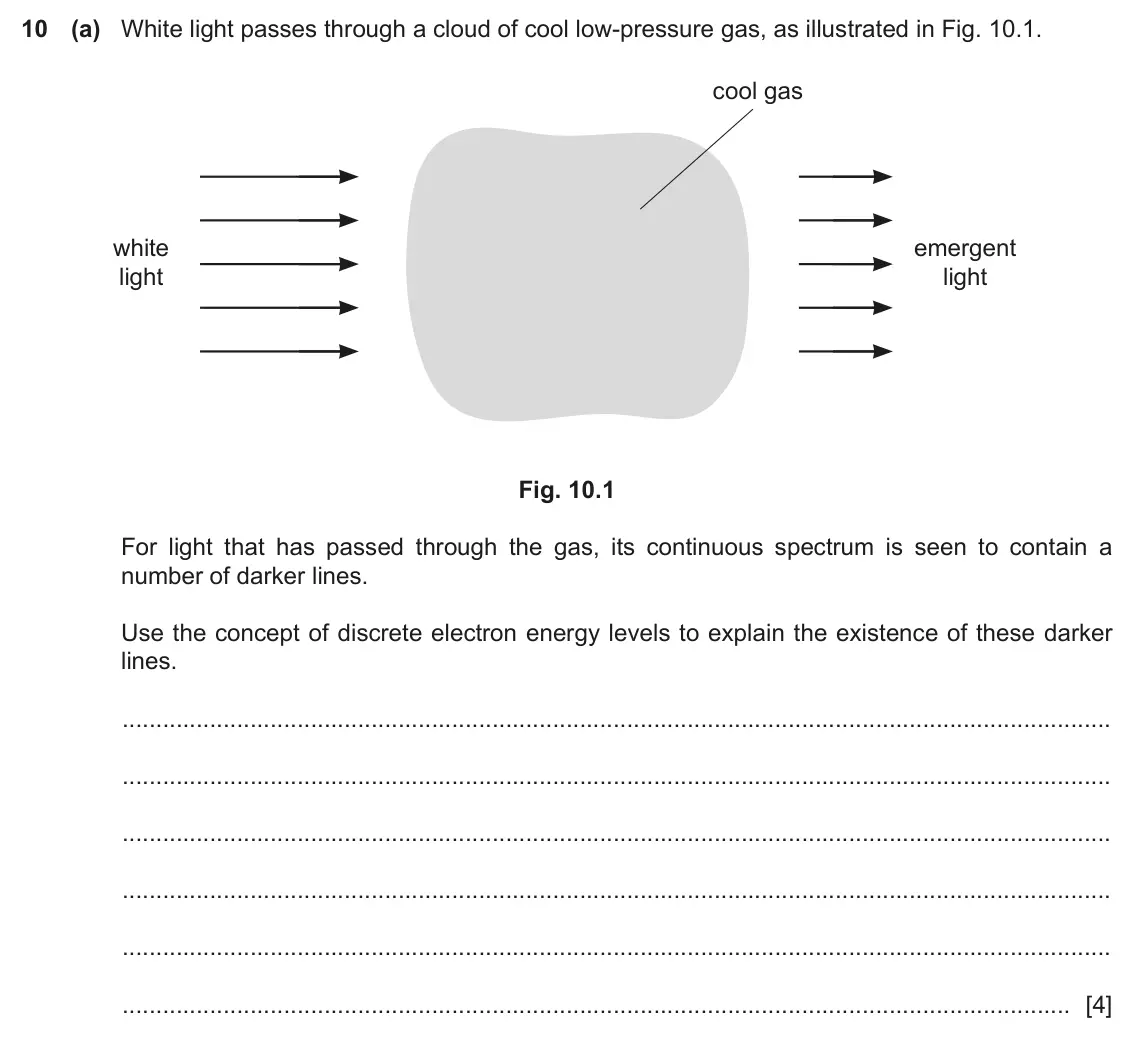
Q11(b)
The whole paper ↗16
Q11(c)(i)
The whole paper ↗17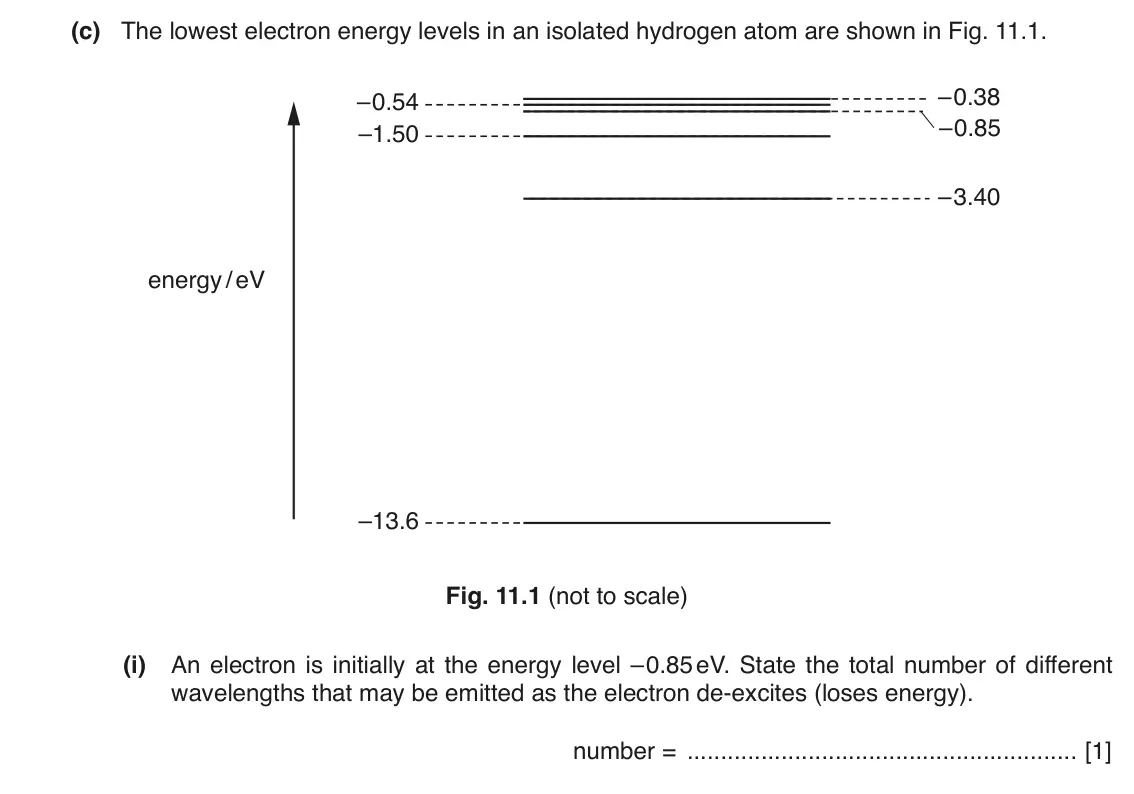
Q11(c)(ii)
The whole paper ↗18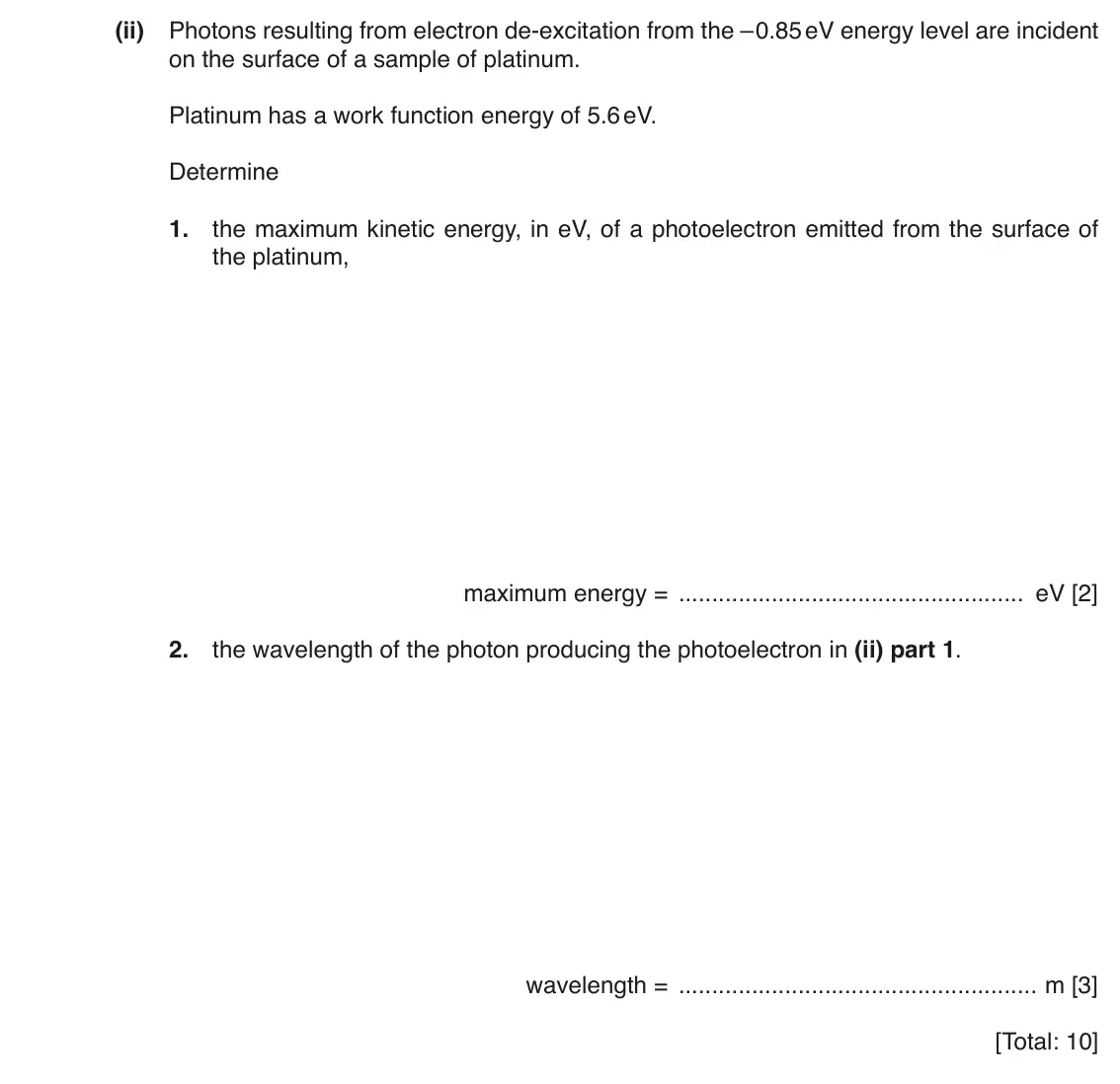
Q11(a)
The whole paper ↗19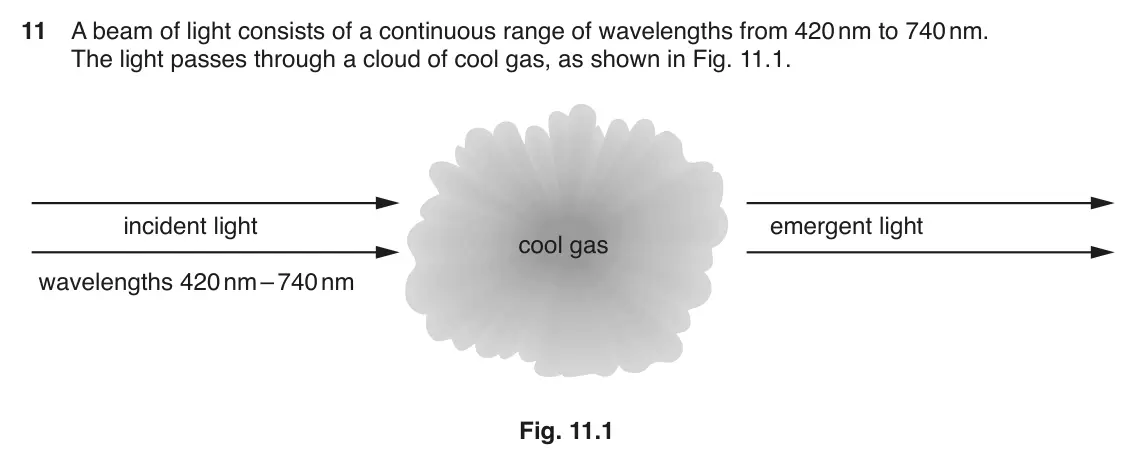
Q11(b)(i)
The whole paper ↗20
All 27 questions on Energy levels in atoms and line spectra, as a list
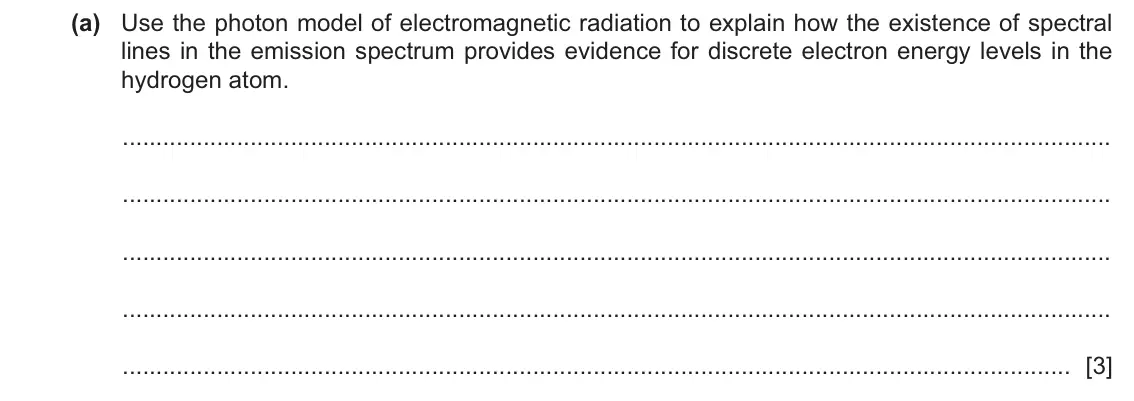
- November 2025 (variant 2), Paper 4, Q8(a) (3 marks): Use the photon model of electromagnetic radiation to explain how the existence of spectral lines in the emission spectrum provides evidence for discrete electro
- November 2025 (variant 2), Paper 4, Q8(b)(i) (1 mark): Calculate the energy, in J, of the ground state. energy = J [1]
- November 2025 (variant 2), Paper 4, Q8(b)(ii) (2 marks): Show that the energy difference between levels n = 1 and n = 2 is 10.2 eV. [2]
- November 2025 (variant 2), Paper 4, Q8(b)(iii) (4 marks): Complete Table 8.1 to show the energy differences from the ground state, and the energies of the levels up to n = 4, in the hydrogen atom. Use the space for any
- June 2024 (variant 2), Paper 4, Q8(b)(ii) (2 marks): Determine the energy, in eV, of the energy level from which the electron transition originates to cause the emission of this radiation. energy level = eV [2]
- June 2023 (variant 2), Paper 4, Q8(a) (2 marks): Explain, with reference to photons, why there is a single frequency of electromagnetic radiation that corresponds to each of these transitions. [2]
- June 2023 (variant 2), Paper 4, Q8(b)(i) (2 marks): On Fig. 8.2, draw a line that corresponds to the transition of the electron from n = 2 to n = 1. Label this line A. [2]
- June 2023 (variant 2), Paper 4, Q8(b)(ii) (2 marks): On Fig. 8.2, draw a line that corresponds to the transition of the electron from n = 3 to n = 2. Label this line B. [2]
- June 2023 (variant 2), Paper 4, Q8(c) (2 marks): The frequency of radiation represented by line A is fA. The frequency of radiation represented by line B is fB. The energy of the ground state (n = 1) is E1. De
- March 2023, Paper 4, Q7(a) (4 marks): A beam of white light passes through a cloud of cool gas. The spectrum of the transmitted light is viewed and contains a number of dark lines. Explain why these
- March 2023, Paper 4, Q7(b) (3 marks): Some energy levels for the electron in an isolated hydrogen atom are illustrated in Fig. 7.1. n = 6 n = 5 n = 4 n = 3 energy n = 2 Fig. 7.1 Table 7.1 shows the
- November 2022 (variant 2), Paper 4, Q9(a)(i) (3 marks): Explain how the emission spectrum provides evidence for the existence of discrete energy levels for the electron in a hydrogen atom. [3]
- November 2022 (variant 2), Paper 4, Q9(a)(ii) (3 marks): Fig. 9.2 shows five of the energy levels in the hydrogen atom. The wavelengths of radiation shown in Fig. 9.1 relate to transitions to the – 3.400 eV level in F
- June 2020, Paper 4, Q10(a) (4 marks): White light passes through a cloud of cool low-pressure gas, as illustrated in Fig. 10.1. cool gas white emergent light light Fig. 10.1 For light that has passe
- June 2020 (variant 3), Paper 4, Q10(a) (4 marks): White light passes through a cloud of cool low-pressure gas, as illustrated in Fig. 10.1. cool gas white emergent light light Fig. 10.1 For light that has passe
- November 2018 (variant 2), Paper 4, Q11(b) (2 marks): Describe the appearance of a visible line emission spectrum, as seen using a diffraction grating. [2]
- November 2018 (variant 2), Paper 4, Q11(c)(i) (1 mark): An electron is initially at the energy level –0.85 eV. State the total number of different wavelengths that may be emitted as the electron de-excites (loses ene
- November 2018 (variant 2), Paper 4, Q11(c)(ii) (5 marks): Photons resulting from electron de-excitation from the –0.85 eV energy level are incident on the surface of a sample of platinum. Platinum has a work function e
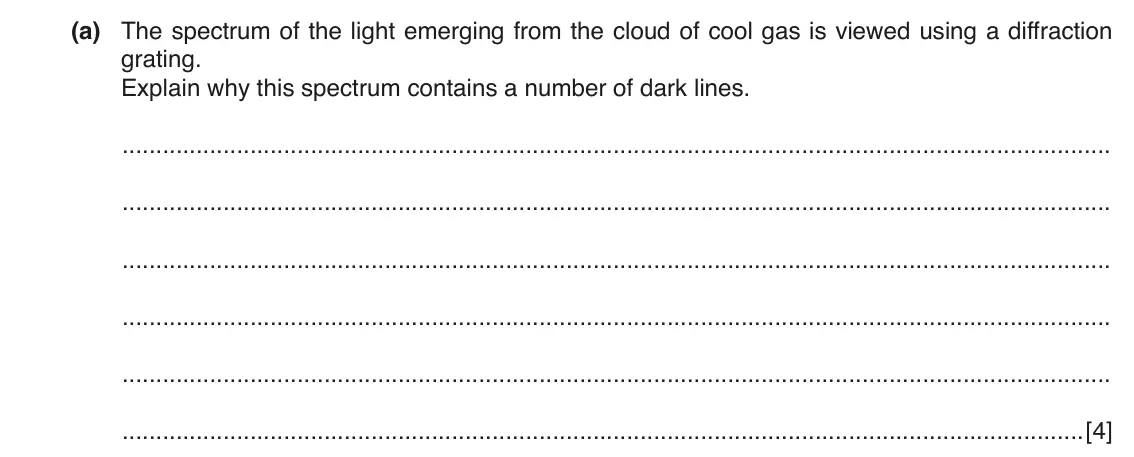
- June 2017, Paper 4, Q11(a) (4 marks): The spectrum of the light emerging from the cloud of cool gas is viewed using a diffraction grating. Explain why this spectrum contains a number of dark lines.
- June 2017, Paper 4, Q11(b)(i) (2 marks): Light of wavelength 420 nm has a photon energy of 2.96 eV. Calculate the photon energy, in eV, of light of wavelength 740 nm. photon energy = eV [2]
- June 2017, Paper 4, Q11(b)(ii) (2 marks): Use data from (i) and your answer in (i) to show, on Fig. 11.2, the changes in energy levels giving rise to the dark lines in (a). [2] [Total: 8]
- June 2017 (variant 3), Paper 4, Q11(a) (4 marks): The spectrum of the light emerging from the cloud of cool gas is viewed using a diffraction grating. Explain why this spectrum contains a number of dark lines.
- June 2017 (variant 3), Paper 4, Q11(b)(i) (2 marks): Light of wavelength 420 nm has a photon energy of 2.96 eV. Calculate the photon energy, in eV, of light of wavelength 740 nm. photon energy = eV [2]
- June 2017 (variant 3), Paper 4, Q11(b)(ii) (2 marks): Use data from (i) and your answer in (i) to show, on Fig. 11.2, the changes in energy levels giving rise to the dark lines in (a). [2] [Total: 8]
- March 2017, Paper 4, Q10(b)(i) (1 mark): All of the light absorbed by the hydrogen is re-emitted. Explain why dark lines are still observed in the absorption spectrum. [1]
- March 2017, Paper 4, Q10(b)(ii) (2 marks): Some of the energy levels of an electron in a hydrogen atom are illustrated in Fig. 10.1. –0.54 –0.85 –1.51 energy / eV –3.40 –13.60 Fig. 10.1 (not to scale) Th
- March 2017, Paper 4, Q10(b)(iii) (3 marks): Calculate the shortest wavelength of the light in the beam. wavelength = m [3] [Total: 8]
Questions, mark schemes and examiner’s reports are © Cambridge University Press & Assessment, from their published past papers. Plumi isn’t affiliated with any exam board. Want whole papers? CAIE A-Level Physics past papers.
The Plumi iPad app also offers exam-style questions with AI feedback on your handwritten working.