 plumi
Centripetal acceleration: CAIE A‑Level Physics questions
CAIE A-Level Physics past-paper questions on 12.2 Centripetal acceleration, 2017 to 2025 and the specimen papers, with mark schemes and examiner’s reports where available.
Past paper difficulty
Paper
All papers
Exam
All years
Calculations
Loading the full question list…
Q1(b)(ii)
The whole paper ↗1
Q1(b)(i)
The whole paper ↗2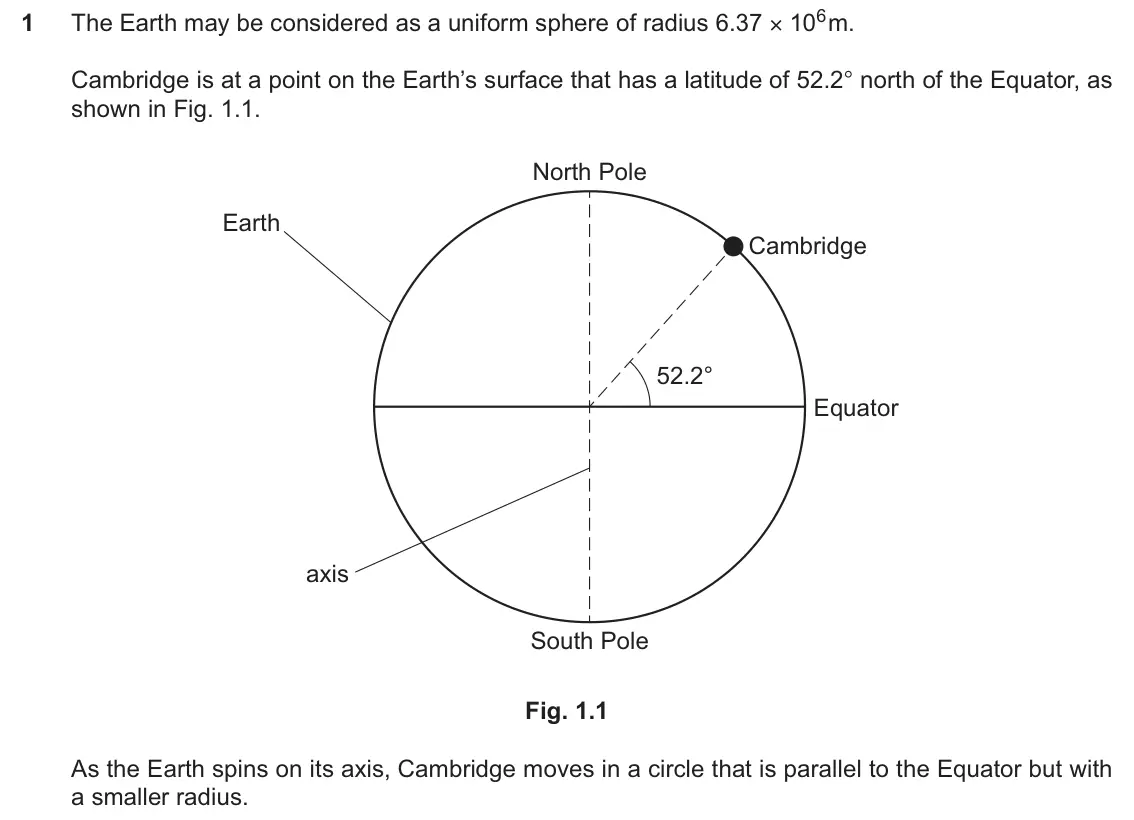

Q1(b)(ii)
The whole paper ↗3
Q1(b)(iii)
The whole paper ↗4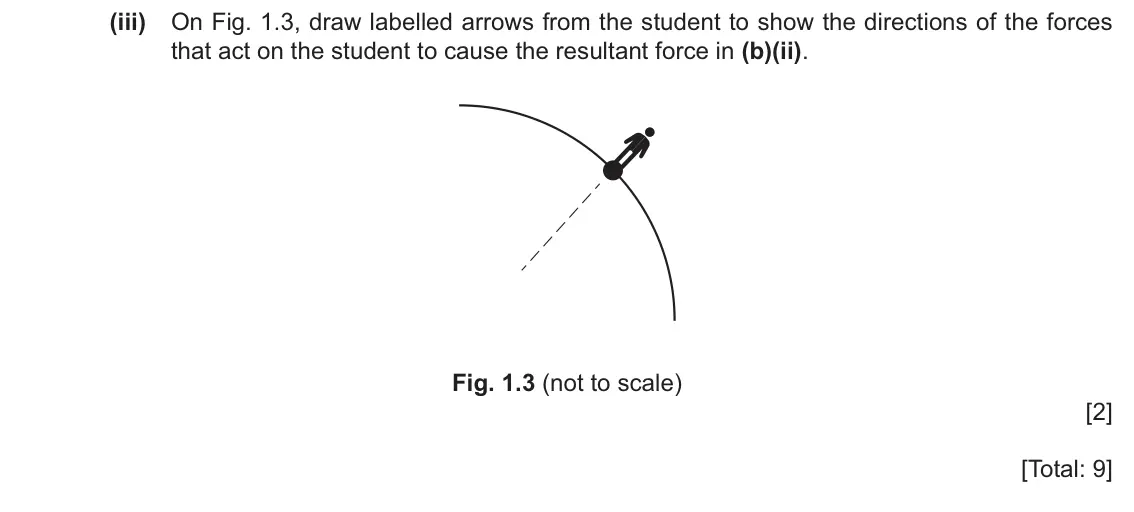
Q1(b)(ii)
The whole paper ↗5
Q2(c)(i)
The whole paper ↗6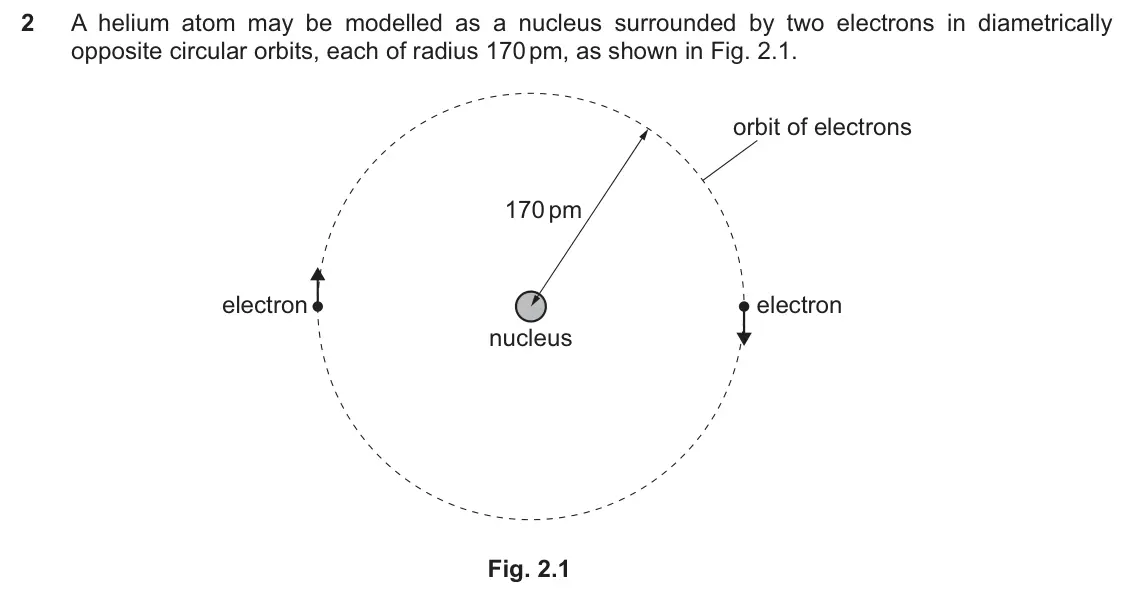

Q2(c)(i)
The whole paper ↗7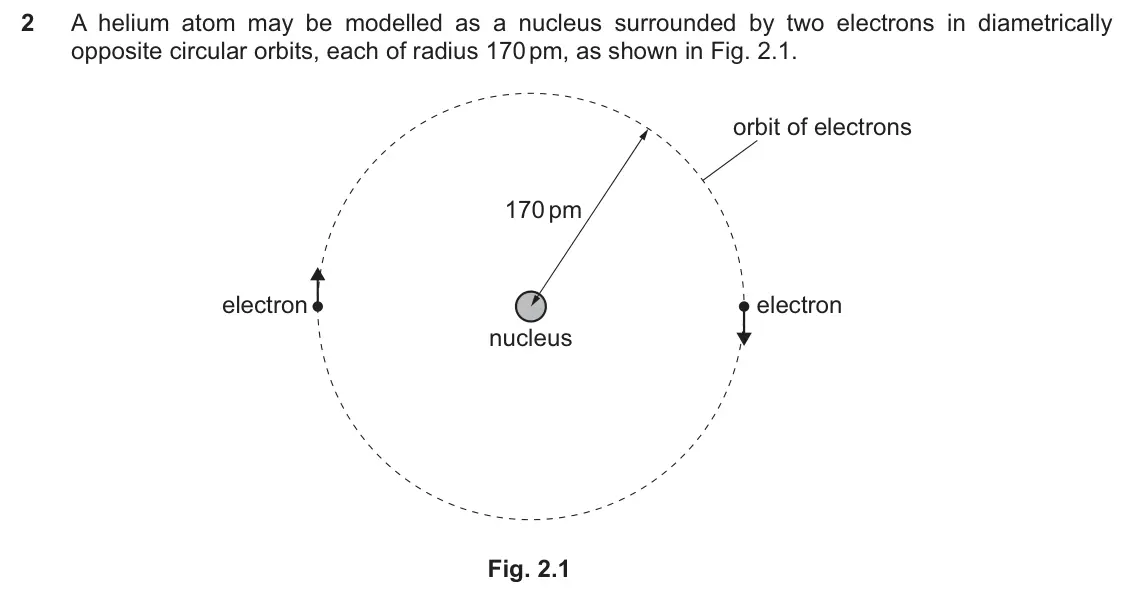

Q1(a)
The whole paper ↗8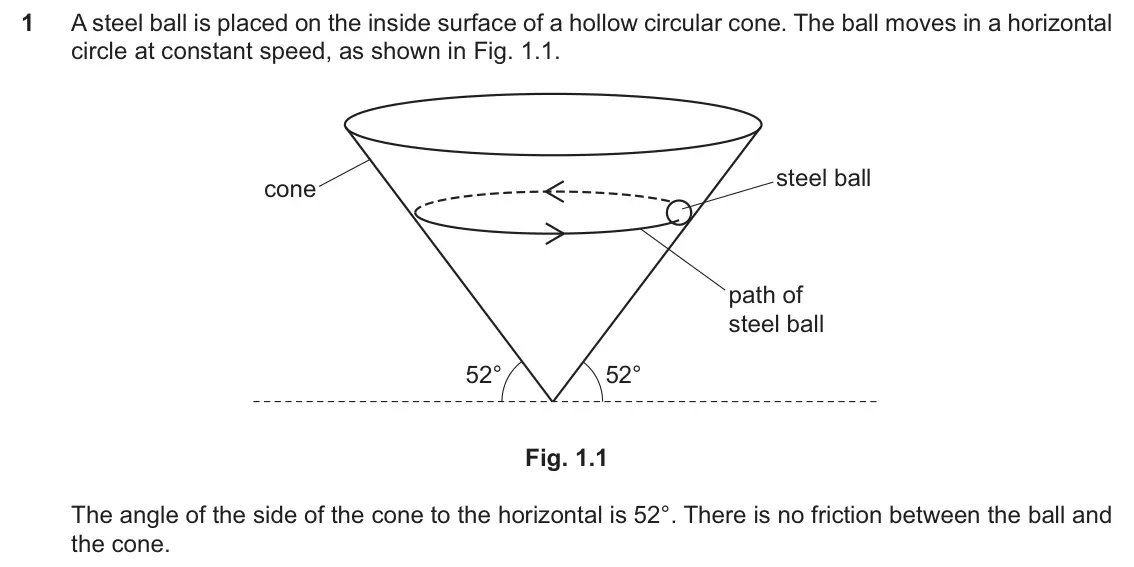

Q1(b)
The whole paper ↗9
Q1(c)
The whole paper ↗10
Q1(e)
The whole paper ↗11
Q1(a)(ii)
The whole paper ↗12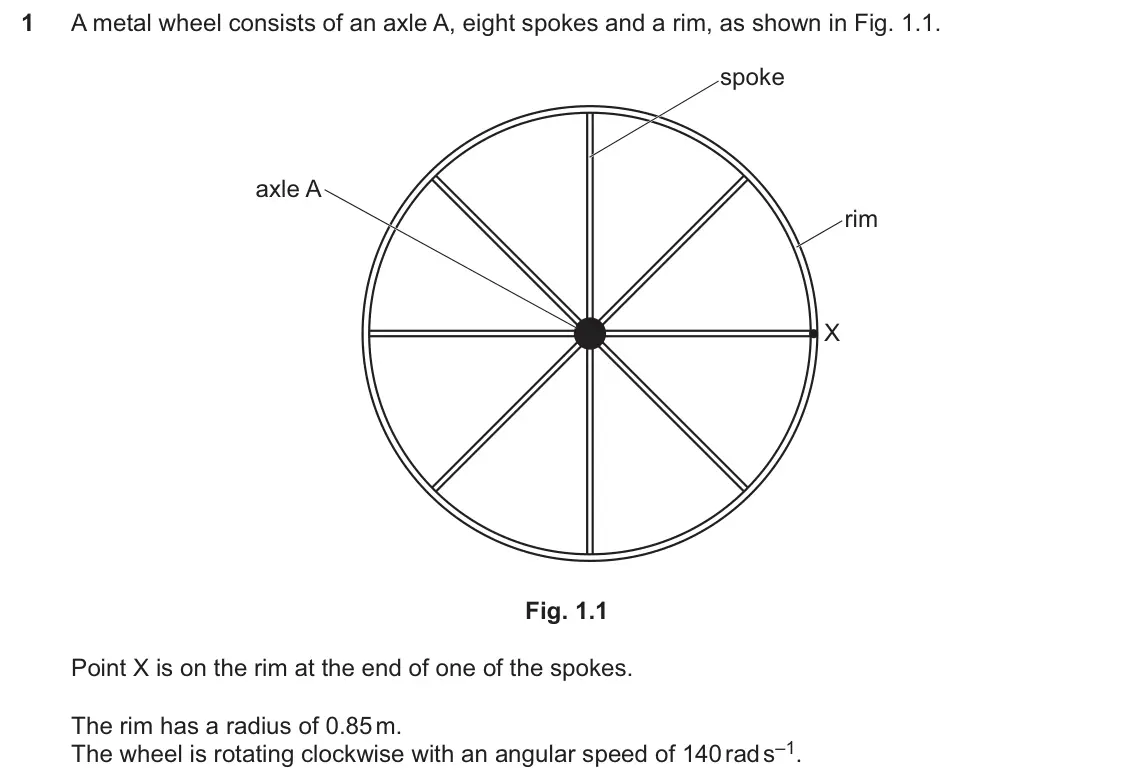

Q1(c)(iii)
The whole paper ↗13
Q1(d)
The whole paper ↗14
Q2(a)
The whole paper ↗15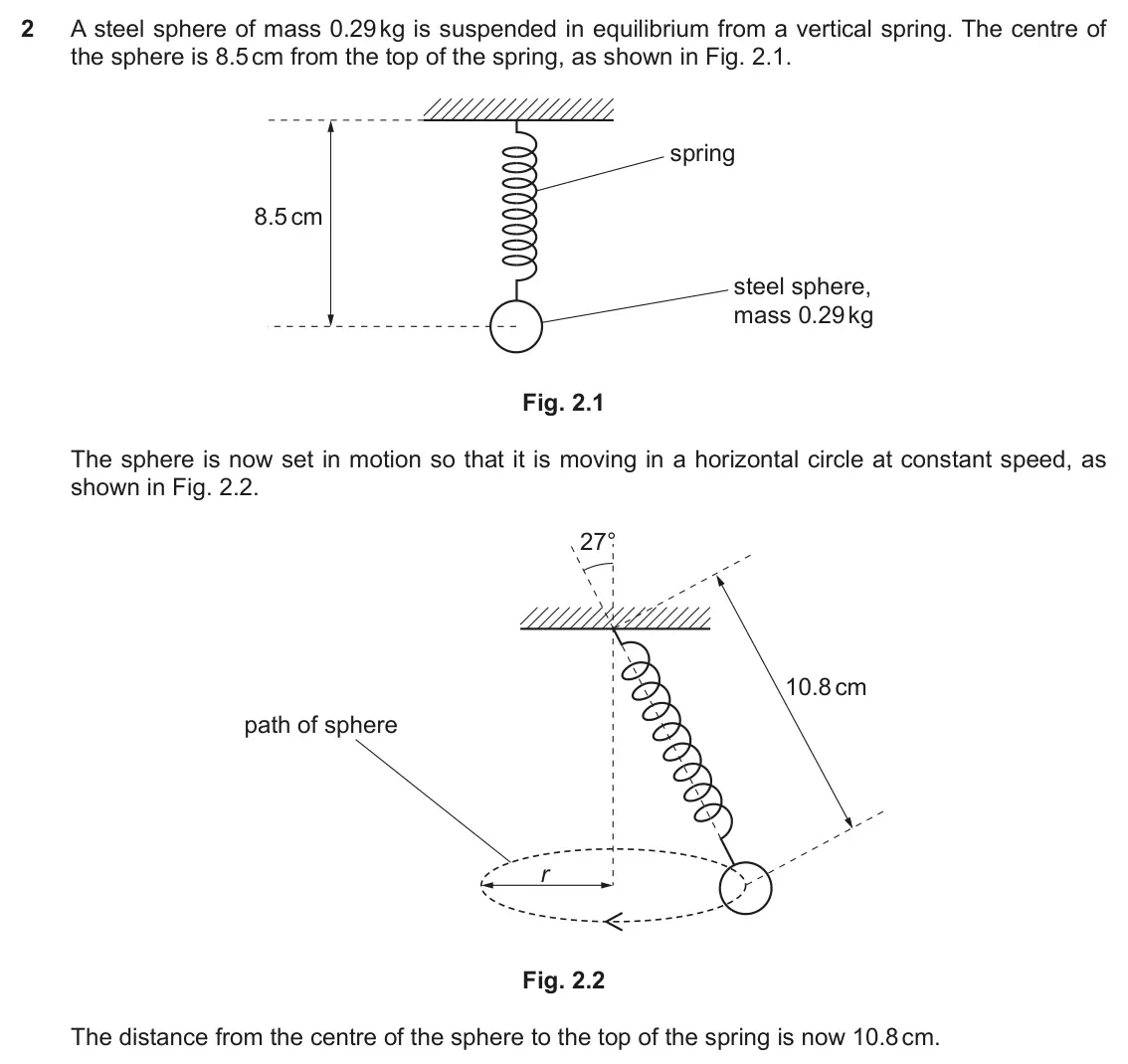

Q2(c)(i)
The whole paper ↗16
Q2(a)
The whole paper ↗17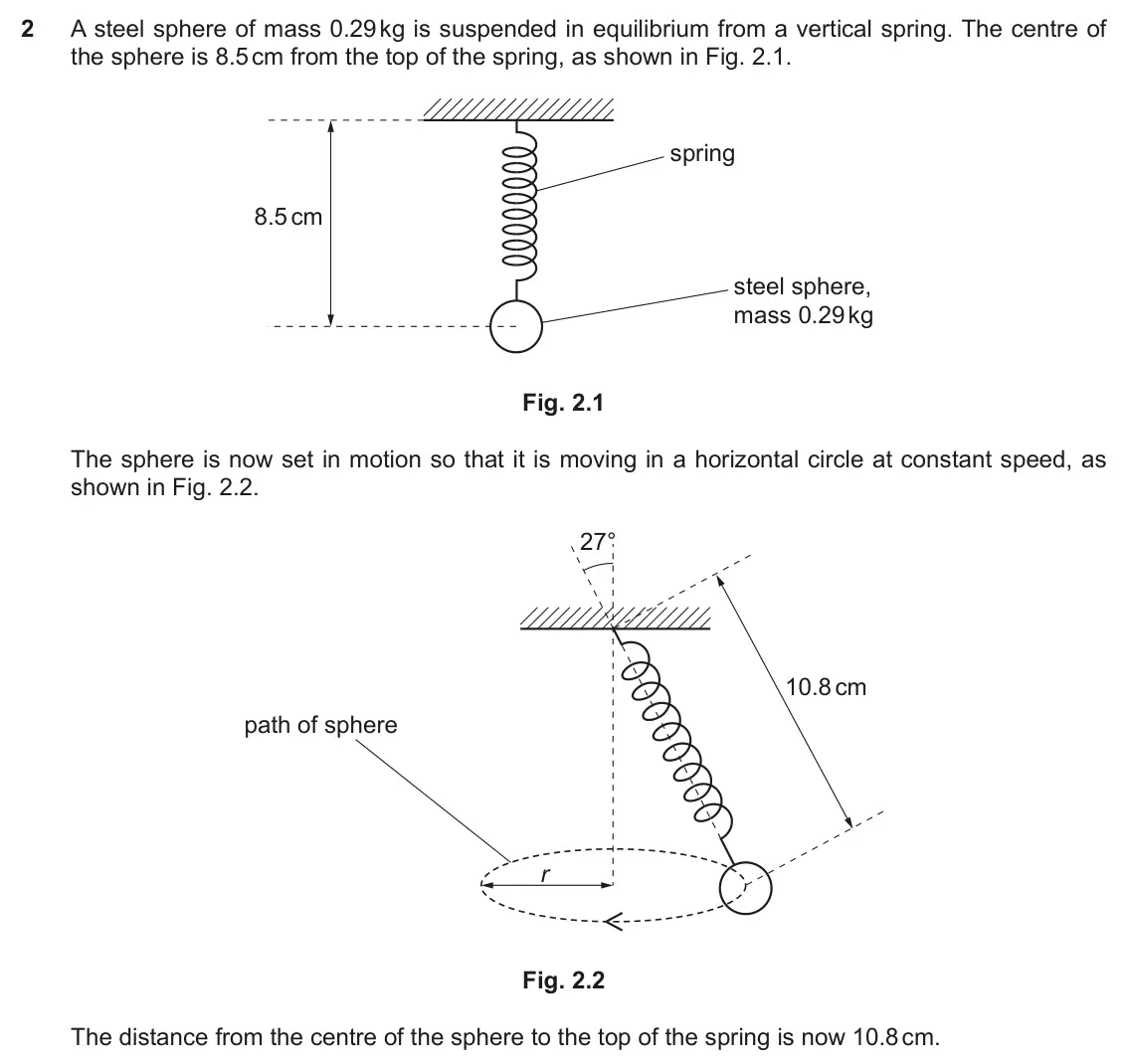

Q2(b)(i)
The whole paper ↗18
Q2(b)(ii)
The whole paper ↗19
Q2(c)(i)
The whole paper ↗20
All 37 questions on Centripetal acceleration, as a list
- November 2025, Paper 4, Q1(b)(ii) (2 marks): Determine an expression, in terms of v and ω, for the centripetal acceleration of the ball. centripetal acceleration = [2]
- November 2025 (variant 2), Paper 4, Q1(b)(i) (2 marks): Determine the magnitude of the resultant force that acts to cause the circular motion of the student. resultant force = N [2]
- November 2025 (variant 2), Paper 4, Q1(b)(ii) (1 mark): On Fig. 1.2, draw an arrow to show the direction of the resultant force that acts on the student. student Cambridge Earth’s surface Fig. 1.2 (not to scale) [1]
- November 2025 (variant 2), Paper 4, Q1(b)(iii) (2 marks): On Fig. 1.3, draw labelled arrows from the student to show the directions of the forces that act on the student to cause the resultant force in (b)(ii). Fig. 1.
- November 2025 (variant 3), Paper 4, Q1(b)(ii) (2 marks): Determine an expression, in terms of v and ω, for the centripetal acceleration of the ball. centripetal acceleration = [2]
- June 2025, Paper 4, Q2(c)(i) (2 marks): Calculate the speed of the orbiting electrons. speed = m s–1 [2]
- June 2025 (variant 3), Paper 4, Q2(c)(i) (2 marks): Calculate the speed of the orbiting electrons. speed = m s–1 [2]
- March 2025, Paper 4, Q1(a) (1 mark): Fig. 1.2 shows a cross‑section through the cone and the steel ball. Fig. 1.2 On Fig. 1.2, draw labelled arrows to show the two forces acting on the ball. [1]
- March 2025, Paper 4, Q1(b) (2 marks): Describe how the forces acting on the ball cause its acceleration to be centripetal. [2]
- March 2025, Paper 4, Q1(c) (3 marks): The ball moves in a circle of radius 0.15 m. Show that the speed of the ball is 1.4 m s–1. [3]
- March 2025, Paper 4, Q1(e) (1 mark): The speed of the ball is increased. Explain why the radius of the circular path of the ball increases. [1] [Total: 9]
- November 2024 (variant 2), Paper 4, Q1(a)(ii) (2 marks): the centripetal acceleration. acceleration = m s–2 [2]
- November 2023 (variant 2), Paper 4, Q1(c)(iii) (2 marks): Calculate the magnitude of the centripetal acceleration of the piece of modelling clay. centripetal acceleration = m s–2 [2]
- November 2023 (variant 2), Paper 4, Q1(d) (2 marks): Use your answer in (c)(iii) to explain why the variation with time of the magnitude of the force exerted by the minute hand on the piece of modelling clay is ne
- June 2023, Paper 4, Q2(a) (3 marks): Explain, with reference to the forces acting on the sphere, why the length of the spring in Fig. 2.2 is greater than in Fig. 2.1. [3]
- June 2023, Paper 4, Q2(c)(i) (2 marks): Use the information in (b) to determine the centripetal acceleration of the sphere. centripetal acceleration = m s–2 [2]
- June 2023 (variant 3), Paper 4, Q2(a) (3 marks): Explain, with reference to the forces acting on the sphere, why the length of the spring in Fig. 2.2 is greater than in Fig. 2.1. [3]
- June 2023 (variant 3), Paper 4, Q2(b)(i) (1 mark): Show that the radius r of the circle is 4.9 cm. [1]
- June 2023 (variant 3), Paper 4, Q2(b)(ii) (2 marks): Show that the tension in the spring is 3.2 N. [2]
- June 2023 (variant 3), Paper 4, Q2(c)(i) (2 marks): Use the information in (b) to determine the centripetal acceleration of the sphere. centripetal acceleration = m s–2 [2]
- November 2022 (variant 2), Paper 4, Q1(c)(i) (3 marks): Determine the centripetal acceleration of the object. centripetal acceleration = m s–2 [3]
- November 2022 (variant 2), Paper 4, Q1(c)(ii) (2 marks): Describe how the two forces acting on the object give rise to this centripetal acceleration. You may draw a diagram if you wish. [2] [Total: 10]
- June 2022 (variant 2), Paper 4, Q2(b)(iii) (3 marks): Use the information in (b)(ii) to determine the period of the circular orbit of the two particles. period = s [3]
- November 2021, Paper 4, Q1(a) (2 marks): With reference to velocity and acceleration, describe uniform circular motion. [2]
- November 2021, Paper 4, Q1(b)(i) (2 marks): The maximum speed at which the car on path X can move around the track without sliding is 94 m s–1. Calculate F. F = N [2]
- November 2021, Paper 4, Q1(b)(ii) (3 marks): Both cars move around the track. Each car has the maximum speed at which it can move without sliding. Complete Table 1.1, by placing one tick in each row, to in
- November 2021 (variant 2), Paper 4, Q1(a) (1 mark): State what is meant by centripetal acceleration. [1]
- November 2021 (variant 2), Paper 4, Q1(b)(i) (1 mark): State what happens to the magnitude of the centripetal acceleration of the car as it moves around the loop from X to Y. [1]
- November 2021 (variant 2), Paper 4, Q1(b)(ii) (2 marks): Explain, if the car remains in contact with the track, why the centripetal acceleration of the car at point Y must be greater than 9.8 m s–2. [2]
- November 2021 (variant 2), Paper 4, Q1(c) (3 marks): The initial speed at which the car in (b) moves along the track is 3.8 m s–1. Determine whether the car is in contact with the track at point Y. Show your worki
- November 2021 (variant 2), Paper 4, Q1(d) (1 mark): Suggest, with a reason but without calculation, whether your conclusion in (c) would be different for a car of mass 460 g moving with the same initial speed. [1
- November 2021 (variant 3), Paper 4, Q1(b)(i) (2 marks): The maximum speed at which the car on path X can move around the track without sliding is 94 m s–1. Calculate F. F = N [2]
- November 2021 (variant 3), Paper 4, Q1(b)(ii) (3 marks): Both cars move around the track. Each car has the maximum speed at which it can move without sliding. Complete Table 1.1, by placing one tick in each row, to in
- June 2018, Paper 4, Q1(b)(i) (1 mark): Each planet orbits at constant speed. Explain whether the planets are in equilibrium. [1]
- June 2018, Paper 4, Q1(b)(ii) (6 marks): The radius of the orbit of a planet is R and the orbital period is T. Data for some of the planets are given in Fig. 1.1. planet R / m T 2 / s2 c 9.6 × 10¹⁰ 2.5
- June 2018 (variant 3), Paper 4, Q1(b)(i) (1 mark): Each planet orbits at constant speed. Explain whether the planets are in equilibrium. [1]
- June 2017 (variant 2), Paper 5, Q1 (15 marks): A student is investigating the motion of a small cube on a turntable connected to an electric motor as shown in Fig. 1.1. turntable cube r Fig. 1.1 The cube is
Questions, mark schemes and examiner’s reports are © Cambridge University Press & Assessment, from their published past papers. Plumi isn’t affiliated with any exam board. Want whole papers? CAIE A-Level Physics past papers.
The Plumi iPad app also offers exam-style questions with AI feedback on your handwritten working.