 plumi
Forces and motion: AQA GCSE Physics questions
Every AQA GCSE Physics exam question on 4.5.6 Forces and motion, 2018–2025, with its mark scheme and examiner’s report.
Find questions1,653
Calculations
Q01.2
The whole paper ↗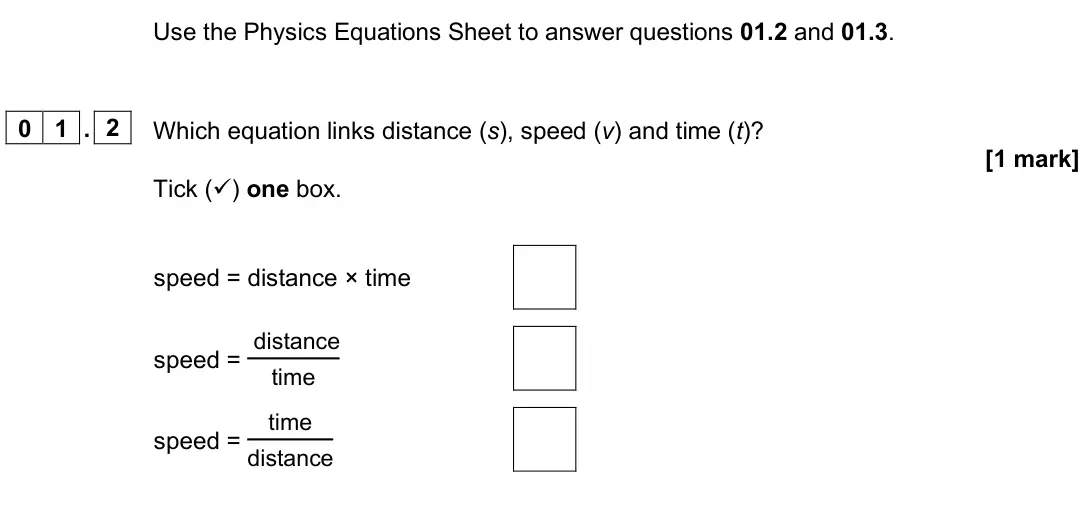
Q01.3
The whole paper ↗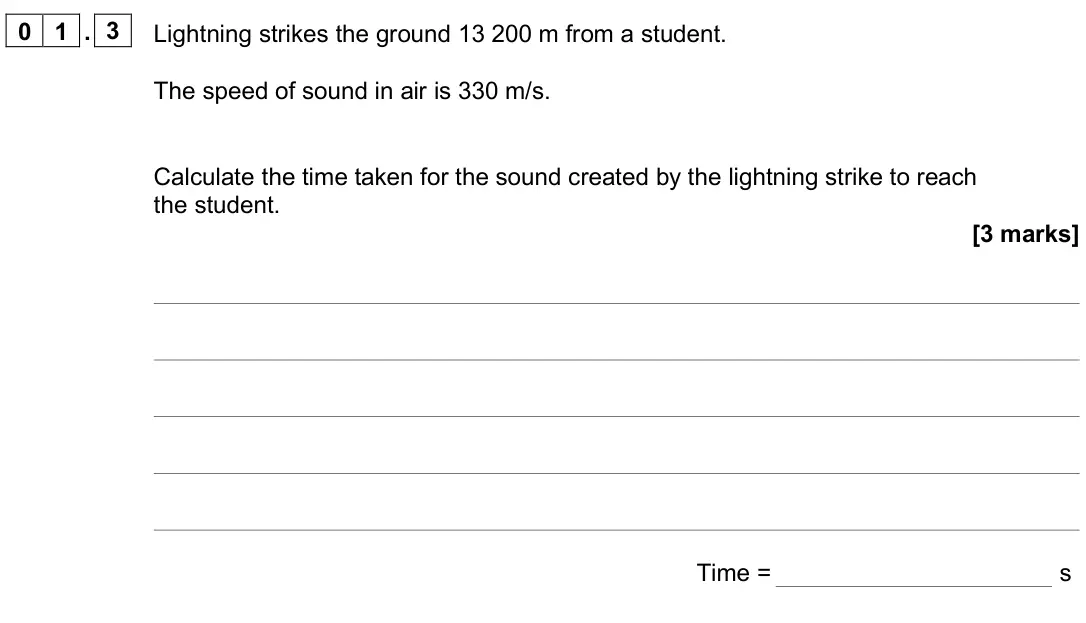
Q03.1
The whole paper ↗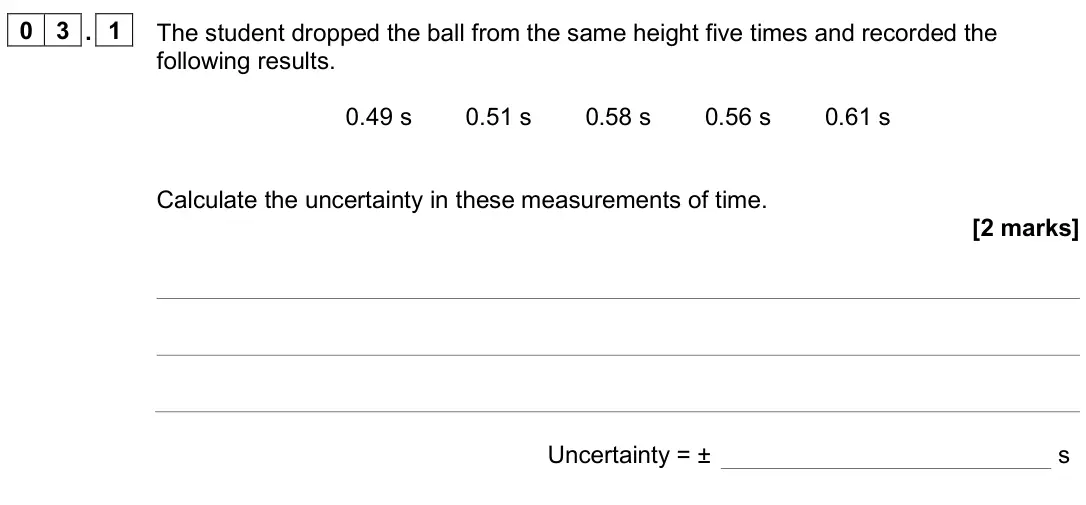
Q03.2
The whole paper ↗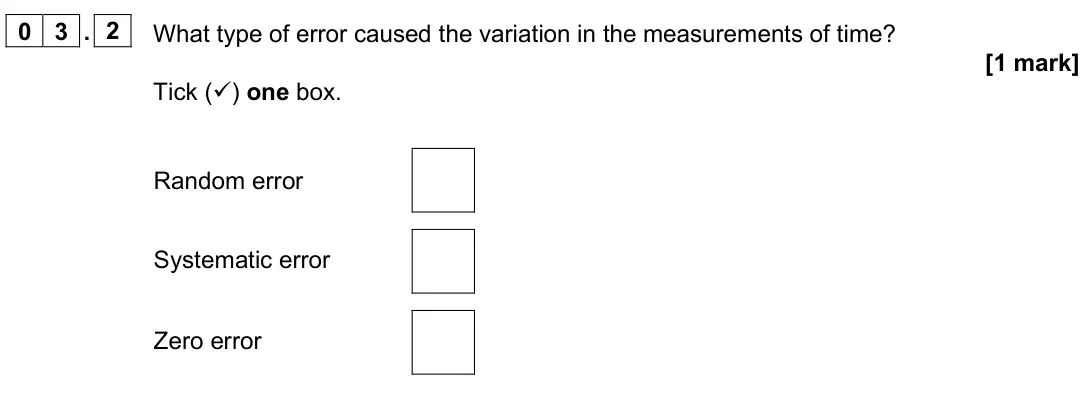
Q03.3
The whole paper ↗
Q03.4
The whole paper ↗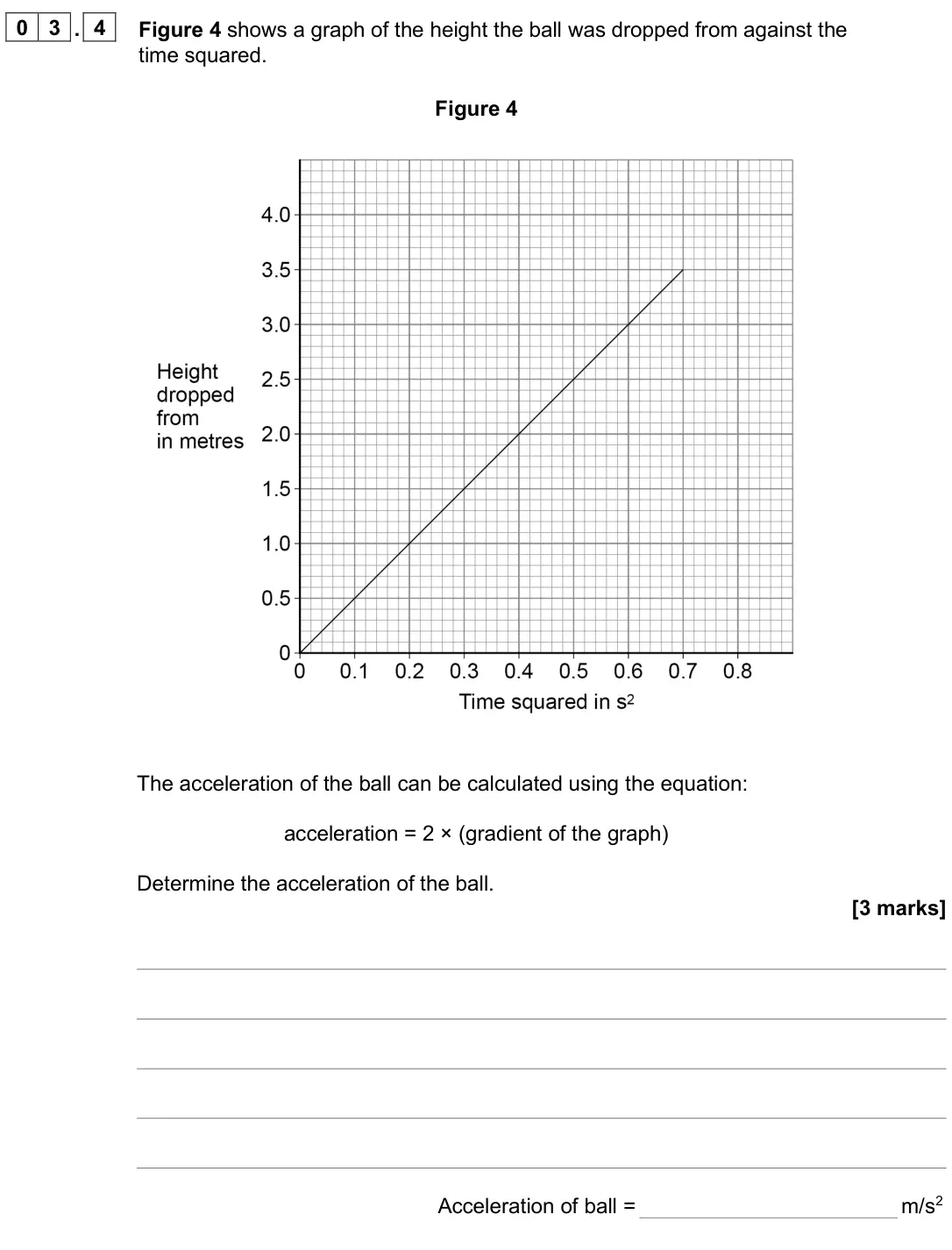
Q05.1
The whole paper ↗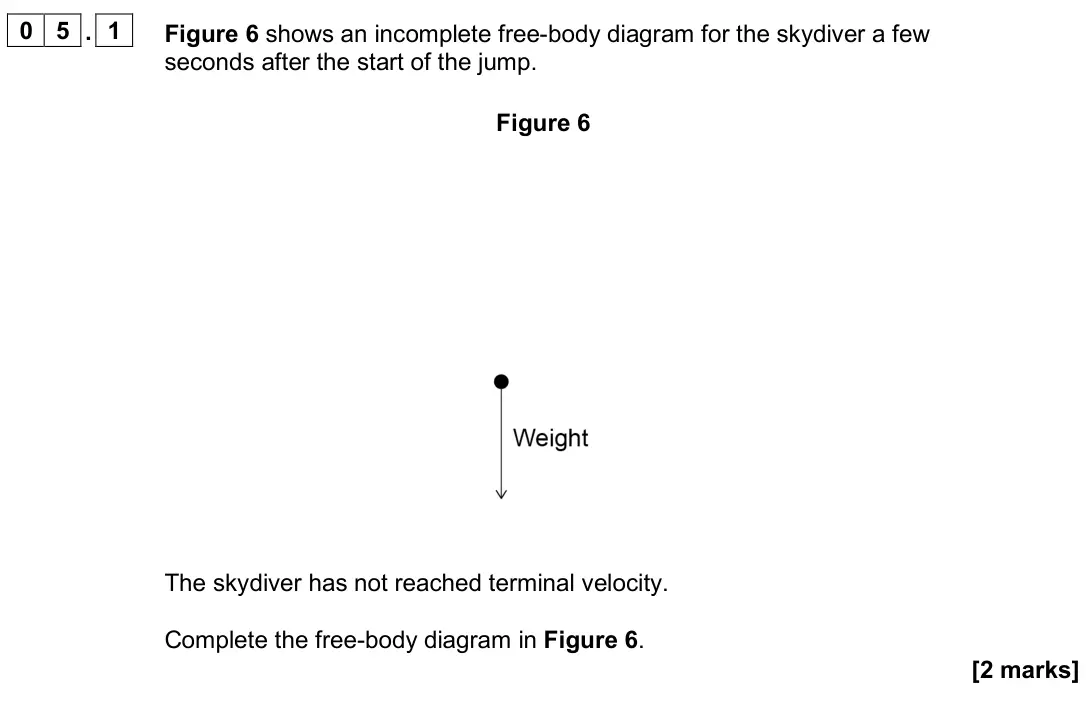
Q05.2
The whole paper ↗
Q05.3
The whole paper ↗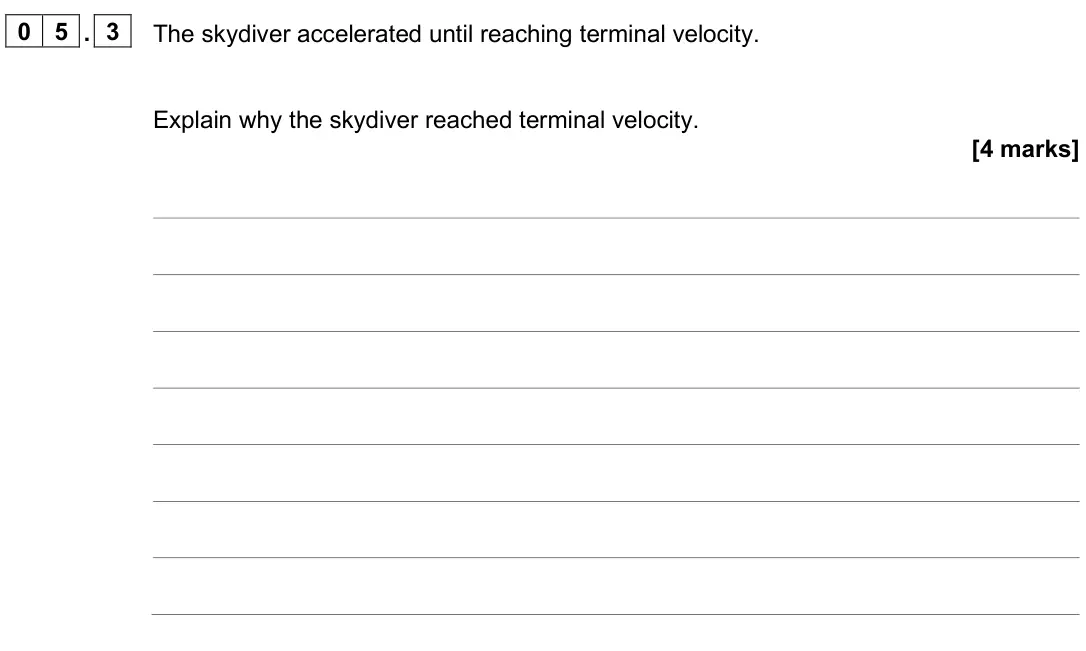
Q06.1
The whole paper ↗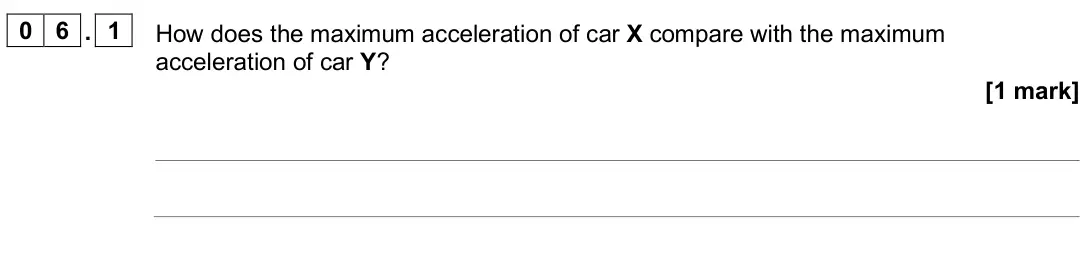
Q06.2
The whole paper ↗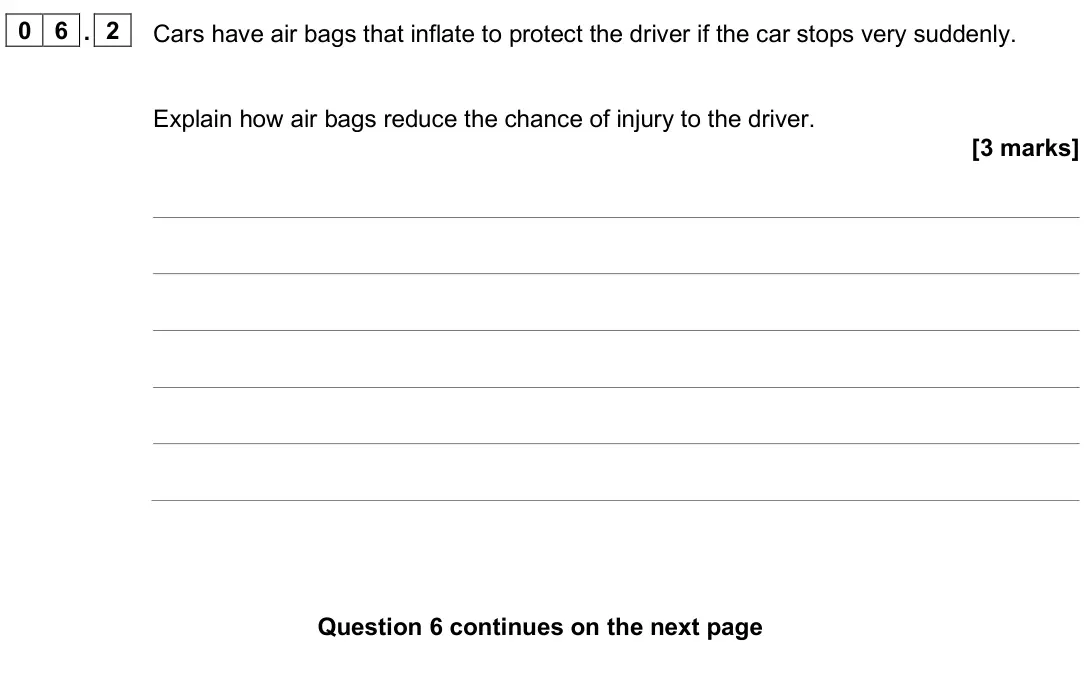
Q06.4
The whole paper ↗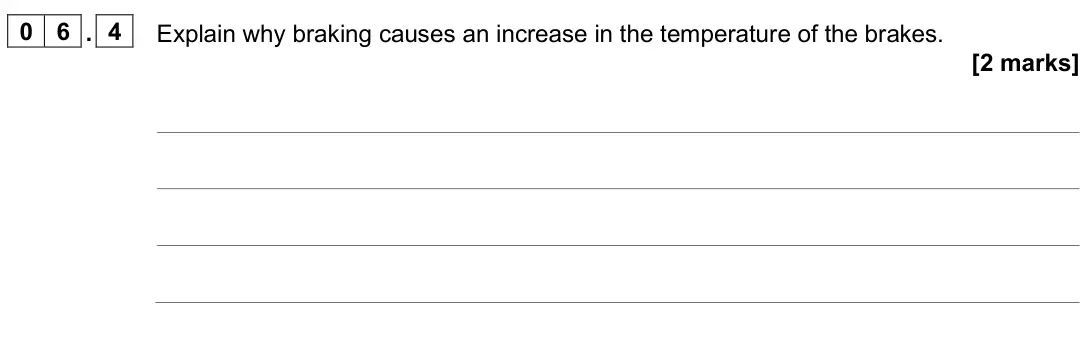
Q06.5
The whole paper ↗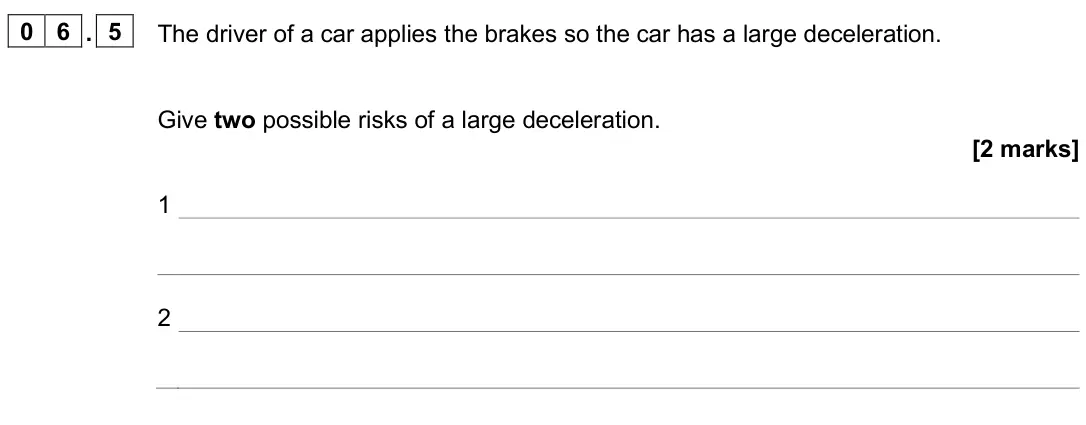
Q02.5
The whole paper ↗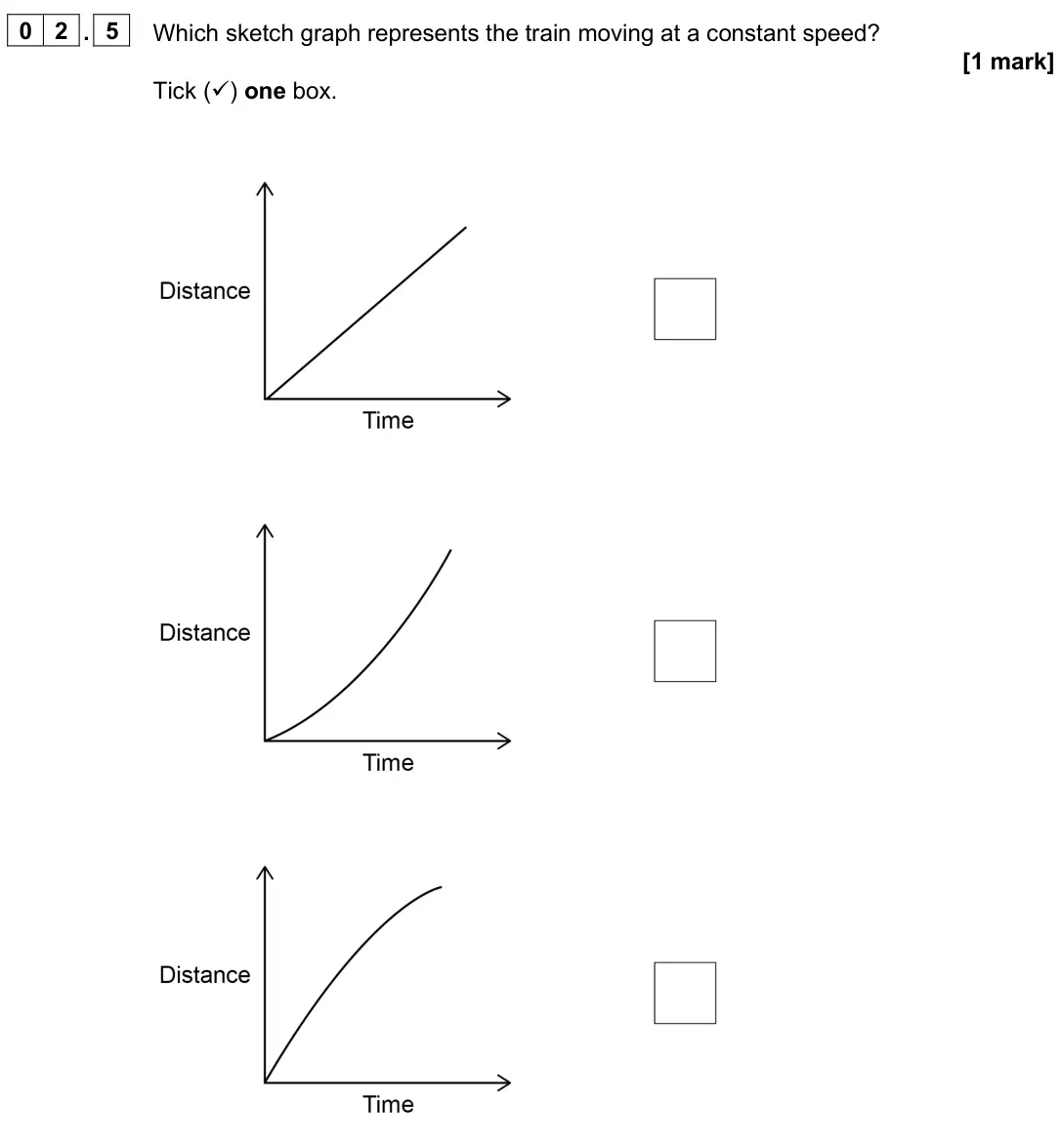
Q02.6
The whole paper ↗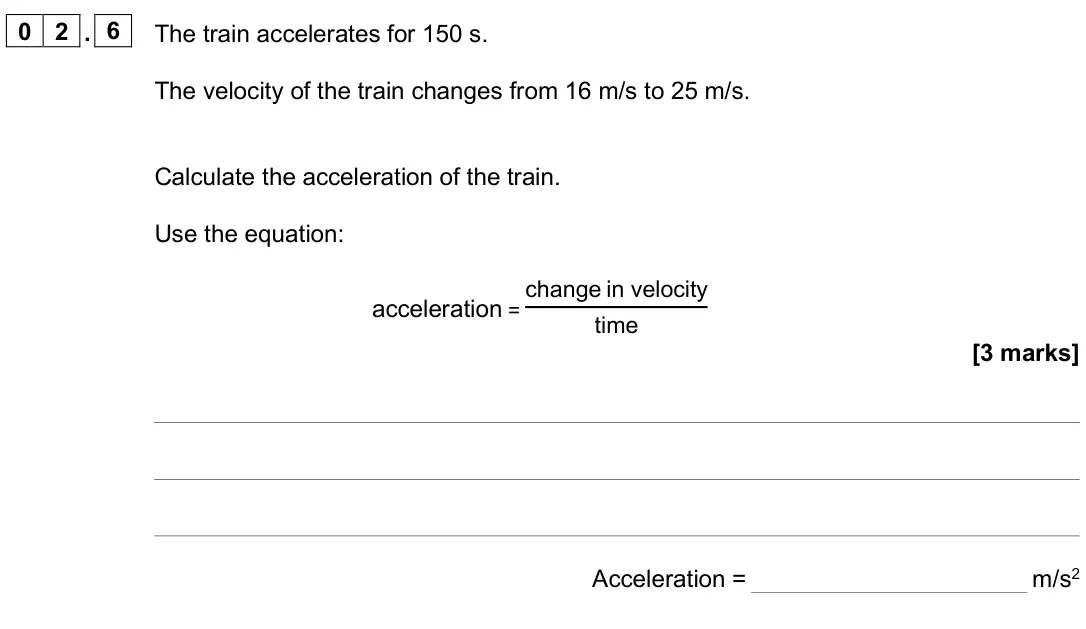
Q04.1
The whole paper ↗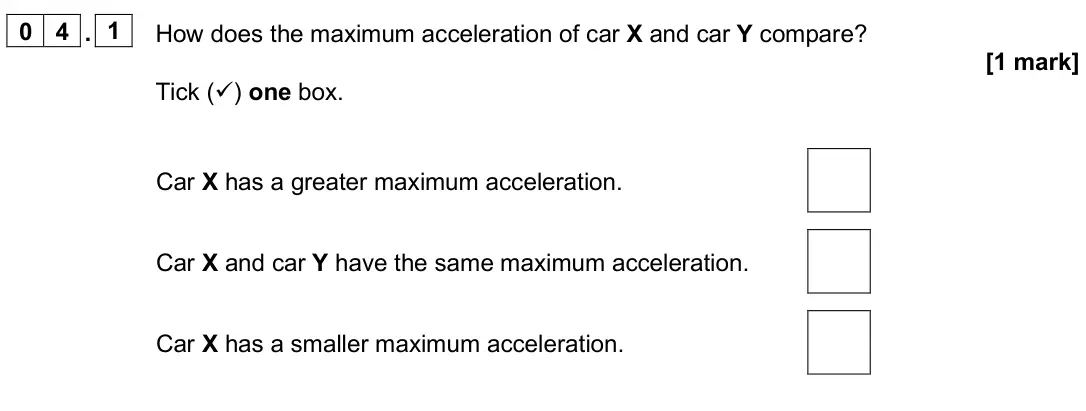
Q04.2
The whole paper ↗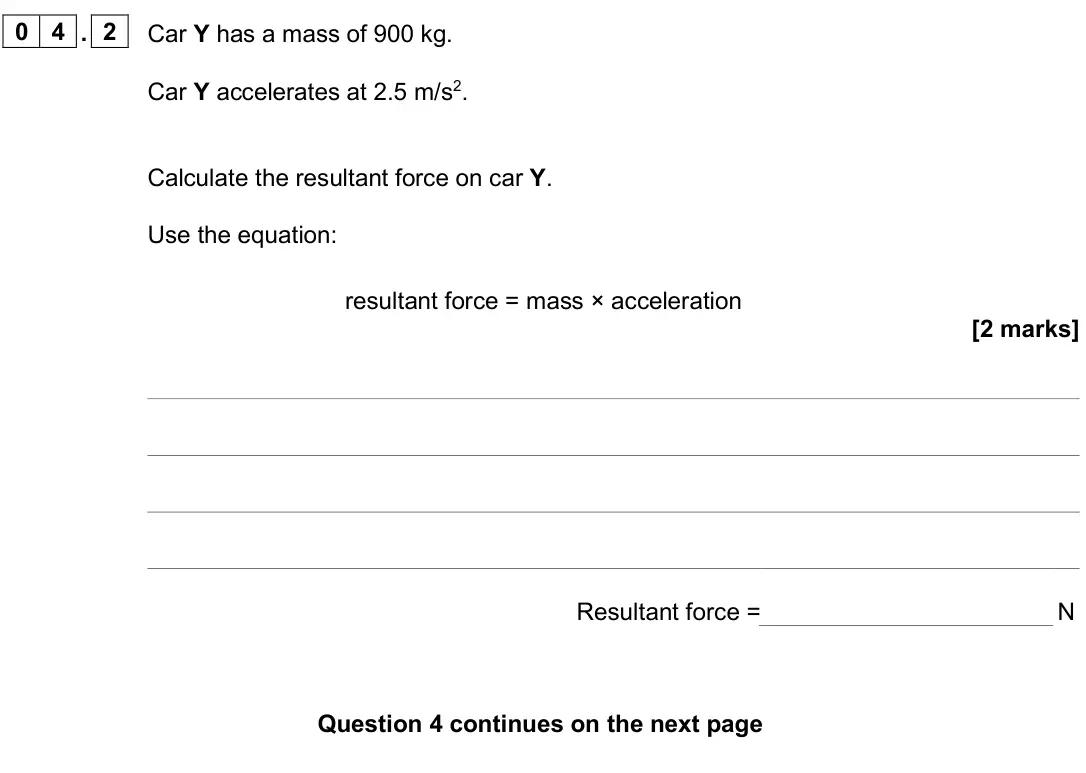
Q04.3
The whole paper ↗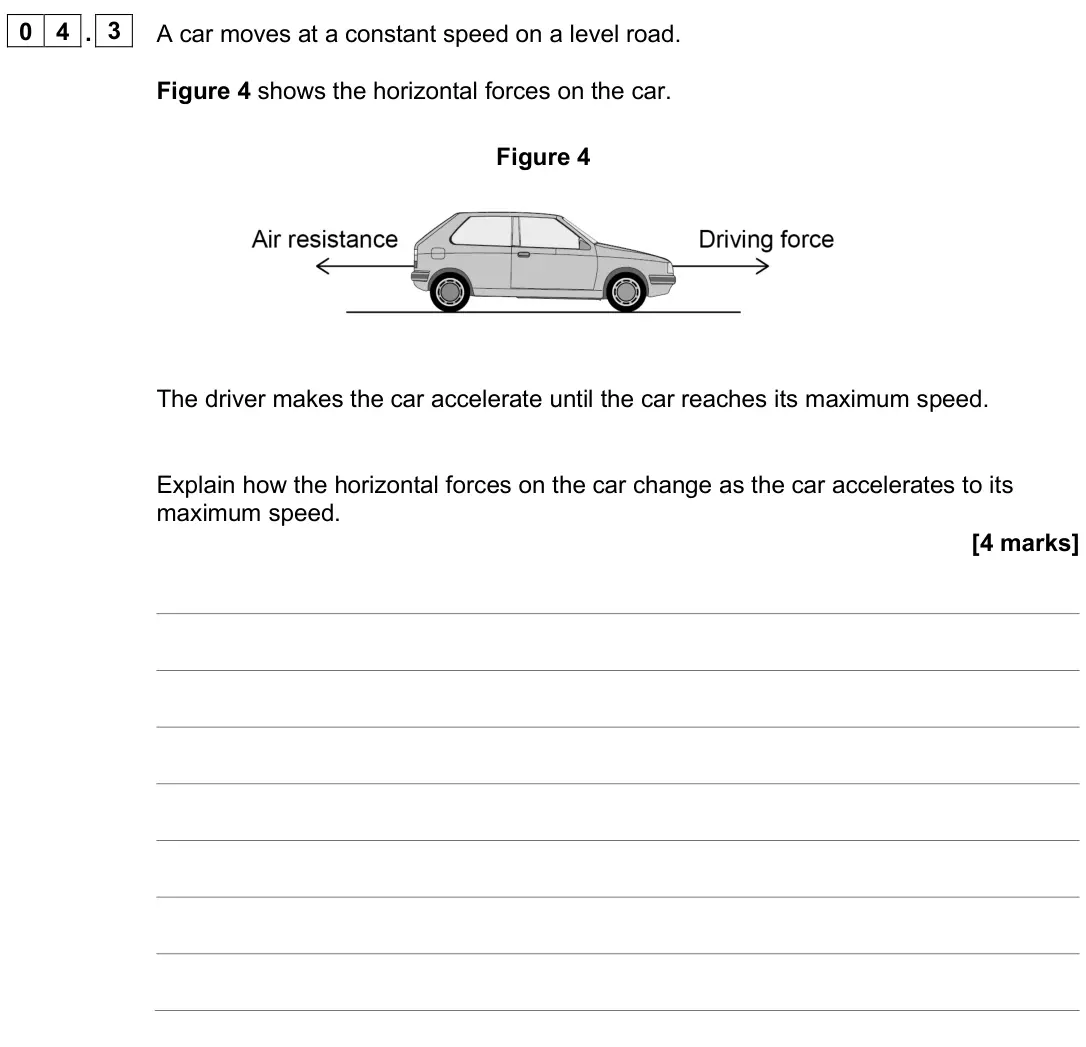
Q04.4
The whole paper ↗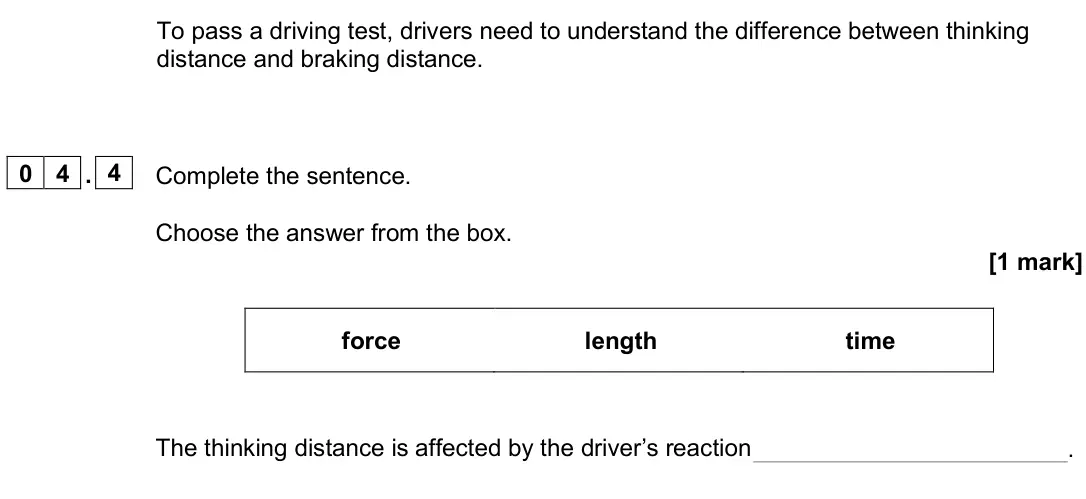
Q04.5
The whole paper ↗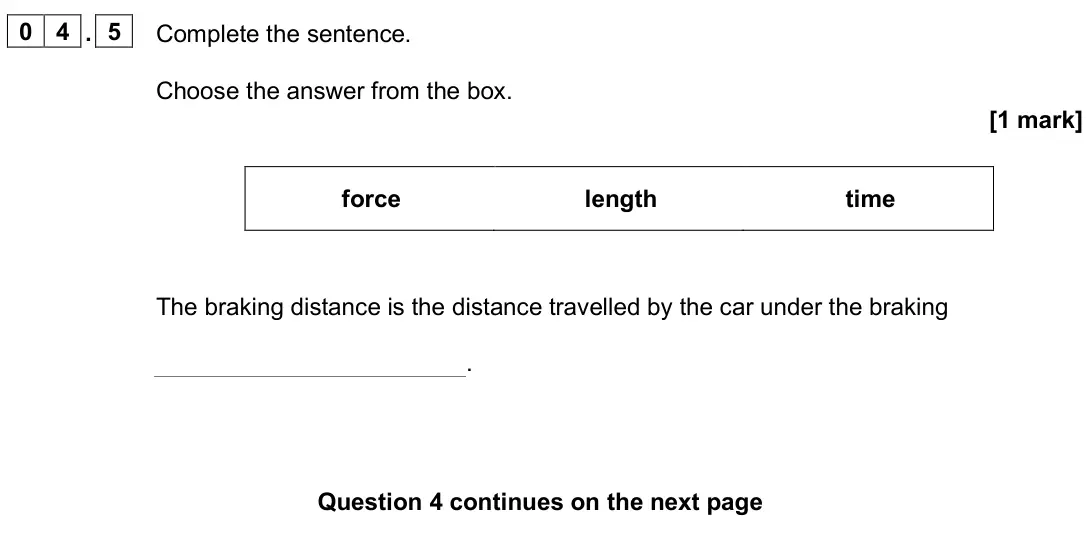
All 206 questions on Forces and motion, as a list
- June 2025, Paper 2 Higher, Q01.2 (1 mark): and 01.3. 0 1 . 2 Which equation links distance (s), speed (v) and time (t)? [1 mark] Tick () one box. speed = distance × time speed = distance time speed = ti
- June 2025, Paper 2 Higher, Q01.3 (3 marks): Lightning strikes the ground 13 200 m from a student. The speed of sound in air is 330 m/s. Calculate the time taken for the sound created by the lightning stri
- June 2025, Paper 2 Higher, Q03.1 (2 marks): The student dropped the ball from the same height five times and recorded the following results. 0.49 s 0.51 s 0.58 s 0.56 s 0.61 s Calculate the uncertainty in
- June 2025, Paper 2 Higher, Q03.2 (1 mark): What type of error caused the variation in the measurements of time? [1 mark] Tick () one box. Random error Systematic error Zero error
- June 2025, Paper 2 Higher, Q03.3 (1 mark): Suggest one reason for the error that caused the variation in the measurements of time. [1 mark]
- June 2025, Paper 2 Higher, Q03.4 (3 marks): Figure 4 shows a graph of the height the ball was dropped from against the time squared. Figure 4 The acceleration of the ball can be calculated using the equat
- June 2025, Paper 2 Higher, Q05.1 (2 marks): Figure 6 shows an incomplete free-body diagram for the skydiver a few seconds after the start of the jump. Figure 6 The skydiver has not reached terminal veloci
- June 2025, Paper 2 Higher, Q05.2 (4 marks): During the first 2.5 minutes the mean acceleration of the skydiver was 0.64 m/s2. The initial velocity of the skydiver was 0 m/s. Calculate the velocity of the
- June 2025, Paper 2 Higher, Q05.3 (4 marks): The skydiver accelerated until reaching terminal velocity. Explain why the skydiver reached terminal velocity. [4 marks]
- June 2025, Paper 2 Higher, Q06.1 (1 mark): How does the maximum acceleration of car X compare with the maximum acceleration of car Y? [1 mark]
- June 2025, Paper 2 Higher, Q06.2 (3 marks): Cars have air bags that inflate to protect the driver if the car stops very suddenly. Explain how air bags reduce the chance of injury to the driver. [3 marks]
- June 2025, Paper 2 Higher, Q06.4 (2 marks): Explain why braking causes an increase in the temperature of the brakes. [2 marks]
- June 2025, Paper 2 Higher, Q06.5 (2 marks): The driver of a car applies the brakes so the car has a large deceleration. Give two possible risks of a large deceleration. [2 marks] 1 2
- June 2025, Paper 2 Foundation, Q02.5 (1 mark): Which sketch graph represents the train moving at a constant speed? [1 mark] Tick () one box.
- June 2025, Paper 2 Foundation, Q02.6 (3 marks): The train accelerates for 150 s. The velocity of the train changes from 16 m/s to 25 m/s. Calculate the acceleration of the train. Use the equation: acceleratio
- June 2025, Paper 2 Foundation, Q04.1 (1 mark): How does the maximum acceleration of car X and car Y compare? [1 mark] Tick () one box. Car X has a greater maximum acceleration. Car X and car Y have the same
- June 2025, Paper 2 Foundation, Q04.2 (2 marks): Car Y has a mass of 900 kg. Car Y accelerates at 2.5 m/s2. Calculate the resultant force on car Y. Use the equation: resultant force = mass × acceleration [2 ma
- June 2025, Paper 2 Foundation, Q04.3 (4 marks): A car moves at a constant speed on a level road. Figure 4 shows the horizontal forces on the car. Figure 4 The driver makes the car accelerate until the car rea
- June 2025, Paper 2 Foundation, Q04.4 (1 mark): Complete the sentence. Choose the answer from the box. [1 mark] force length time The thinking distance is affected by the driver’s reaction .
- June 2025, Paper 2 Foundation, Q04.5 (1 mark): Complete the sentence. Choose the answer from the box. [1 mark] force length time The braking distance is the distance travelled by the car under the braking .
- June 2025, Paper 2 Foundation, Q04.6 (3 marks): Figure 5 shows how speed affects the thinking distance and braking distance of a car. Figure 5 The car is moving at a speed of 100 km/h. Calculate the stopping
- June 2025, Paper 2 Foundation, Q04.7 (2 marks): Which two of the following would increase the stopping distance of a car? [2 marks] Tick () two boxes. Fitting new brakes to the car Fitting new tyres to the c
- June 2025, Paper 2 Foundation, Q08.2 (1 mark): and 08.3. 0 8 . 2 Which equation links distance (s), speed (v) and time (t)? [1 mark] Tick () one box. speed = distance × time speed = distance time speed = ti
- June 2025, Paper 2 Foundation, Q08.3 (3 marks): Lightning strikes the ground 13 200 m from a student. The speed of sound in air is 330 m/s. Calculate the time taken for the sound created by the lightning stri
- June 2025, Paper 2 Foundation, Q10.1 (2 marks): The student dropped the ball from the same height five times and recorded the following results. 0.49 s 0.51 s 0.58 s 0.56 s 0.61 s Calculate the uncertainty in
- June 2025, Paper 2 Foundation, Q10.2 (1 mark): What type of error caused the variation in the measurements of time? [1 mark] Tick () one box. Random error Systematic error Zero error
- June 2025, Paper 2 Foundation, Q10.3 (1 mark): Suggest one reason for the error that caused the variation in the measurements of time. [1 mark]
- June 2025, Paper 2 Foundation, Q10.4 (3 marks): Figure 16 shows a graph of the height the ball was dropped from against the time squared. Figure 16 The acceleration of the ball can be calculated using the equ
- June 2024, Paper 2 Higher, Q02.1 (2 marks): The child is standing still. What is the resultant vertical force on the child? Give a reason for your answer. [2 marks] Resultant vertical force = N Reason
- June 2024, Paper 2 Higher, Q02.4 (2 marks): The child pushed the baby walker from a carpet onto a hard floor. The child applied the same horizontal force to the baby walker. Explain why the speed of the b
- June 2024, Paper 2 Higher, Q03.5 (4 marks): The distance between Arcturus and the Earth is 3.6 × 10¹⁴ km. speed of light = 3.0 × 10⁸ m/s Calculate the time taken for light from Arcturus to reach the Earth
- June 2024, Paper 2 Higher, Q04.6 (2 marks): A seismometer is a device that detects earthquakes. P-waves travel at a known speed between an earthquake and a seismometer. S-waves travel at a slower speed th
- June 2024, Paper 2 Higher, Q05.2 (1 mark): Give one variable that should have been a control variable in this investigation. [1 mark]
- June 2024, Paper 2 Higher, Q05.3 (3 marks): The student held the trolley stationary and then released it. The trolley moved along the runway with a constant acceleration. The student recorded the time tak
- June 2024, Paper 2 Higher, Q05.4 (2 marks): The student released the trolley three times and determined the following values for acceleration: 1.36 m/s2 1.39 m/s2 1.33 m/s2 Calculate the uncertainty in th
- June 2024, Paper 2 Higher, Q05.5 (2 marks): The runway was then raised at one end. The force acting through the string remained the same. Figure 11 shows this. Figure 11 Explain how the acceleration was a
- June 2024, Paper 2 Higher, Q07.1 (3 marks): Determine the distance travelled by the train in the first 600 s of the journey. [3 marks] Distance = m
- June 2024, Paper 2 Higher, Q07.2 (3 marks): Explain what happens to the braking force as the train decelerates. Use information from Figure 12. [3 marks]
- June 2024, Paper 2 Higher, Q07.3 (3 marks): Determine the maximum deceleration of the train. [3 marks] Deceleration = m/s2
- June 2024, Paper 2 Higher, Q07.4 (6 marks): Another train travels at a speed of 60 m/s. A constant braking force of 270 000 N causes the train to decelerate and stop. mass of train = 240 000 kg Calculate
- June 2024, Paper 2 Higher, Q07.5 (3 marks): It is illegal for train drivers to drink alcohol before driving a train. Explain how drinking alcohol would affect the stopping distance of a train. [3 marks]
- June 2024, Paper 2 Foundation, Q03.1 (1 mark): The trolley in Figure 5 is not moving. Which force prevents the trolley from moving? [1 mark] Tick () one box. Friction Tension Weight
- June 2024, Paper 2 Foundation, Q03.2 (2 marks): Draw one line from each variable to the correct quantity. [2 marks]
- June 2024, Paper 2 Foundation, Q03.3 (2 marks): For one of the masses put on the trolley, the student recorded three values of acceleration. 1.58 m/s2 1.53 m/s2 1.54 m/s2 Calculate the mean acceleration of th
- June 2024, Paper 2 Foundation, Q03.4 (1 mark): Describe the relationship shown in Figure 6. [1 mark]
- June 2024, Paper 2 Foundation, Q03.5 (2 marks): When the total mass of the trolley was 1.5 kg, the acceleration of the trolley was 0.62 m/s2. Calculate the resultant force acting on the trolley. Use the equat
- June 2024, Paper 2 Foundation, Q05.1 (2 marks): Some quantities are scalar quantities and others are vector quantities. Which of the following are scalar quantities? [2 marks] Tick () two boxes. Displacement
- June 2024, Paper 2 Foundation, Q05.2 (1 mark): What was the total distance walked by the person in 2000 seconds? [1 mark] Total distance = m
- June 2024, Paper 2 Foundation, Q05.3 (2 marks): Calculate the average speed of the person during the 2000 seconds. Use your answer to Question 05.2 Use the equation: average speed = total distance total time
- June 2024, Paper 2 Foundation, Q05.4 (2 marks): Which section of Figure 9 shows the person walking the slowest? Give a reason for your answer. [2 marks] Tick () one box. A B C Reason
- June 2024, Paper 2 Foundation, Q05.6 (1 mark): On another day, the person ran the same route. What is a typical speed for a person running? [1 mark] Tick () one box. 0.3 m/s 3.0 m/s 30 m/s
- June 2024, Paper 2 Foundation, Q07.4 (2 marks): A child is swimming in the pool. The velocity of the child is 0.70 m/s. The child then accelerates for 5.0 s, reaching a final velocity of 1.3 m/s. Calculate th
- June 2024, Paper 2 Foundation, Q07.8 (4 marks): The child steps off the diving board and falls into the swimming pool. The initial velocity of the child is 0 m/s. acceleration due to gravity = 9.8 m/s2 Calcul
- June 2024, Paper 2 Foundation, Q09.1 (2 marks): The child is standing still. What is the resultant vertical force on the child? Give a reason for your answer. [2 marks] Resultant vertical force = N Reason
- June 2024, Paper 2 Foundation, Q09.4 (2 marks): The child pushed the baby walker from a carpet onto a hard floor. The child applied the same horizontal force to the baby walker. Explain why the speed of the b
- June 2023, Paper 2 Higher, Q02.1 (2 marks): Determine the magnitude of the aeroplane’s displacement from the start point to the finish point on Figure 3. [2 marks] Displacement = m
- June 2023, Paper 2 Higher, Q02.3 (1 mark): Describe the motion of the aeroplane as it moves towards the runway. [1 mark]
- June 2023, Paper 2 Higher, Q02.5 (2 marks): The aeroplane stops for a short time and then accelerates along the runway. Figure 5 shows a distance–time sketch-graph for this stage of the journey. Figure 5
- June 2023, Paper 2 Higher, Q03.3 (3 marks): Determine the distance travelled by the car during the first 5 seconds of the journey. Use Figure 9. [3 marks] Distance travelled by the car = m
- June 2023, Paper 2 Higher, Q03.4 (3 marks): In an emergency the driver needs to apply the brakes suddenly to stop the car quickly. The driver of the car is distracted. Explain why the distraction will inc
- June 2023, Paper 2 Higher, Q03.5 (2 marks): Explain why the temperature of the brakes increases as they are used. [2 marks]
- June 2023, Paper 2 Higher, Q05.2 (1 mark): How does Newton’s Third Law of motion apply to the collision between the bumper car and the barrier? [1 mark]
- June 2023, Paper 2 Higher, Q05.5 (3 marks): A bumper car moved with an initial constant velocity and then accelerated at 2.0 m/s2. While accelerating, the bumper car travelled a distance of 1.5 m. The fin
- June 2023, Paper 2 Higher, Q06.3 (3 marks): Explain the effect of the Earth’s gravitational force on the motion of the Hubble Space Telescope. [3 marks]
- June 2023, Paper 2 Foundation, Q02.1 (2 marks): Complete the sentences. Choose answers from the box. [2 marks] chemical electrostatic kinetic nuclear thermal A driver applies the brakes to a moving car. As th
- June 2023, Paper 2 Foundation, Q02.2 (1 mark): Figure 3 shows how the speed of the car affects the minimum braking distance of the car. Figure 3 Describe the relationship between the speed of the car and the
- June 2023, Paper 2 Foundation, Q02.3 (1 mark): Complete the sentence. Choose the answer from the box. [1 mark] decreases stays the same increases When the road becomes icy, the braking distance .
- June 2023, Paper 2 Foundation, Q02.4 (3 marks): Calculate the time taken for the velocity of the car to decrease from 12.5 m/s to 5.0 m/s. Use the equation: time taken = change in velocity deceleration [3 mar
- June 2023, Paper 2 Foundation, Q02.5 (2 marks): Calculate the resultant force causing the car to decelerate. Use the equation: resultant force = mass × deceleration [2 marks] Resultant force = N
- June 2023, Paper 2 Foundation, Q02.6 (1 mark): The student wanted to test the reaction time of the people in her class. Which of the following could have been a control variable in this investigation? [1 mar
- June 2023, Paper 2 Foundation, Q02.7 (1 mark): The student tested three people in her class. The mean distance that the ruler fell before being caught was 18.2 cm. If all of the people in her class were test
- June 2023, Paper 2 Foundation, Q02.8 (2 marks): Describe how this investigation could be changed to find out how listening to music affects reaction time. [2 marks]
- June 2023, Paper 2 Foundation, Q05.4 (2 marks): Microwaves from a mobile phone take 0.000 009 s to reach a mobile phone mast. speed of microwaves = 300 000 000 m/s Calculate the distance between the mobile ph
- June 2023, Paper 2 Foundation, Q07.3 (3 marks): Figure 18 shows how the distance travelled by the Hubble Space Telescope during its orbit changes with time. Figure 18 The gradient of the line in Figure 18 giv
- June 2023, Paper 2 Foundation, Q10.1 (2 marks): Determine the magnitude of the aeroplane’s displacement from the start point to the finish point on Figure 25. [2 marks] Displacement = m
- June 2023, Paper 2 Foundation, Q10.3 (1 mark): Describe the motion of the aeroplane as it moves towards the runway. [1 mark]
- June 2023, Paper 2 Foundation, Q10.5 (2 marks): The aeroplane stops for a short time and then accelerates along the runway. Figure 27 shows a distance–time sketch-graph for this stage of the journey. Figure 2
- June 2022, Paper 2 Higher, Q01.2 (1 mark): and 01.3. 0 1 . 2 Write down the equation which links acceleration (a), change in velocity (Δv) and time taken (t). [1 mark]
- June 2022, Paper 2 Higher, Q01.3 (3 marks): The maximum acceleration of the car is 20 m/s2. Calculate the time taken for the speed of the car to change from 0 m/s to 28 m/s at its maximum acceleration. [3
- June 2022, Paper 2 Higher, Q01.4 (3 marks): In a trial run, the car accelerates at 10 m/s2 until it reaches its final velocity. distance travelled by the car = 605 m initial velocity of the car = 0 m/s Ca
- June 2022, Paper 2 Higher, Q03.1 (2 marks): The braking distance of a car increases as the speed of the car increases. Give two other factors that increase the braking distance of a car. [2 marks] 1 2
- June 2022, Paper 2 Higher, Q03.2 (2 marks): Explain why the driver’s reaction time affects the thinking distance of a car. [2 marks]
- June 2022, Paper 2 Higher, Q03.3 (2 marks): Scientists have investigated how drinking alcohol affects a person’s reaction time. Figure 5 shows the results of the investigation. Figure 5 Which of the follo
- June 2022, Paper 2 Higher, Q03.4 (4 marks): The speed limit on the road in Figure 6 is 20 m/s. The cameras in Figure 6 are 1.5 km apart. Calculate the minimum time it takes to travel 1.5 km without breaki
- June 2022, Paper 2 Higher, Q03.5 (3 marks): The average speed of a car between the cameras and the average velocity of the car between the cameras are different. Explain why. [3 marks]
- June 2022, Paper 2 Higher, Q04.1 (1 mark): Why does the hailstone accelerate? [1 mark]
- June 2022, Paper 2 Higher, Q04.2 (3 marks): The hailstone stops accelerating and reaches terminal velocity. Explain why the hailstone reaches terminal velocity. [3 marks]
- June 2022, Paper 2 Higher, Q04.3 (1 mark): Why does terminal velocity increase with mass? [1 mark] Tick () one box. As mass increases the cross-sectional surface area of a hailstone increases. As mass i
- June 2022, Paper 2 Foundation, Q02.1 (1 mark): Which force causes the hailstones to fall to the ground? [1 mark] Tick () one box. Air resistance Gravitational force Magnetic force Tension
- June 2022, Paper 2 Foundation, Q02.2 (1 mark): As the hailstones begin to fall they accelerate. Which force increases as the hailstones accelerate? [1 mark] Tick () one box. Air resistance Gravitational for
- June 2022, Paper 2 Foundation, Q02.3 (1 mark): After a short time hailstones fall at terminal velocity. Which of the following statements is true at terminal velocity? [1 mark] Tick () one box. The hailston
- June 2022, Paper 2 Foundation, Q02.4 (2 marks): Estimate the terminal velocity for a hailstone with a diameter of 80 mm. Show how you obtain your answer. [2 marks] Terminal velocity = m/s
- June 2022, Paper 2 Foundation, Q02.5 (1 mark): Give one reason why a hailstone with a large diameter has a greater terminal velocity than a hailstone with a smaller diameter. [1 mark] Tick () one box. It ha
- June 2022, Paper 2 Foundation, Q07.5 (3 marks): Calculate the wavelength of a sound wave with a frequency of 6600 Hz. speed of sound = 330 m/s Use the equation: wavelength = speed frequency Choose the unit fr
- June 2022, Paper 2 Foundation, Q07.6 (1 mark): and 07.7. 0 7 . 6 Write down the equation which links distance (s), speed (v) and time (t). [1 mark]
- June 2022, Paper 2 Foundation, Q07.7 (3 marks): Distance A on Figure 14 is 13.2 m. speed of sound = 330 m/s Calculate the time taken for the sound to travel from loudspeaker A to the technician. [3 marks] Tim
- June 2022, Paper 2 Foundation, Q08.2 (1 mark): and 08.3. 0 8 . 2 Write down the equation which links acceleration (a), change in velocity (Δv) and time taken (t). [1 mark]
- June 2022, Paper 2 Foundation, Q08.3 (3 marks): The maximum acceleration of the car is 20 m/s2. Calculate the time taken for the speed of the car to change from 0 m/s to 28 m/s at its maximum acceleration. [3
- June 2022, Paper 2 Foundation, Q08.4 (3 marks): In a trial run, the car accelerates at 10 m/s2 until it reaches its final velocity. distance travelled by the car = 605 m initial velocity of the car = 0 m/s Ca
- November 2021, Paper 2 Higher, Q01.1 (4 marks): Explain the effect of two other factors on the braking distance of a car. Do not refer to speed in your answer. [4 marks]
- November 2021, Paper 2 Higher, Q01.2 (1 mark): Which equation links acceleration (a), mass (m) and resultant force (F). [1 mark] Tick () one box. resultant force = mass × acceleration resultant force = mass
- November 2021, Paper 2 Higher, Q01.3 (3 marks): The mean braking force on a car is 7200 N. The car has a mass of 1600 kg. Calculate the deceleration of the car. [3 marks] Deceleration = m/s2
- November 2021, Paper 2 Higher, Q01.4 (2 marks): Figure 1 shows how the thinking distance and braking distance for a car vary with the speed of the car. Figure 1 Determine the stopping distance when the car is
- November 2021, Paper 2 Higher, Q07.2 (3 marks): Determine the distance travelled by the cyclist between Y and Z. [3 marks] Distance travelled by the cyclist between Y and Z = m
- November 2021, Paper 2 Higher, Q07.4 (3 marks): The speed of the cyclist and trailer increased uniformly from 0 m/s to 2.4 m/s. The cyclist travelled 0.018 km while accelerating. Calculate the initial acceler
- November 2021, Paper 2 Higher, Q09.3 (6 marks): The teacher closed the switch and the copper rod accelerated uniformly from rest for 0.15 s. The current in the copper rod was 1.7 A. mass of copper rod = 4.0 g
- November 2021, Paper 2 Foundation, Q02.3 (1 mark): What is the relationship between force A and force B when the cyclist travels at a constant velocity? [1 mark] Tick () one box. A = B A > B A < B
- November 2021, Paper 2 Foundation, Q02.6 (1 mark): What is the change in velocity of the cyclist in the first 20 seconds of the journey? [1 mark] Tick () one box. 5.2 m/s 5.4 m/s 5.6 m/s 5.8 m/s
- November 2021, Paper 2 Foundation, Q02.7 (2 marks): Determine the acceleration of the cyclist during the first 20 seconds of the journey. Use your answer from Question 02.6 Use the equation: acceleration = change
- November 2021, Paper 2 Foundation, Q02.8 (1 mark): Complete the sentence. Choose the answer from the box. [1 mark] deceleration speed velocity Between 30 and 40 seconds the cyclist moves with a constant .
- November 2021, Paper 2 Foundation, Q02.9 (1 mark): The cyclist travels from home to school. Figure 7 shows the route the cyclist followed. Figure 7 Draw an arrow on Figure 7 to show the displacement of the cycli
- November 2021, Paper 2 Foundation, Q07.6 (1 mark): Write down the equation which links distance travelled (s), speed (v) and time (t). [1 mark]
- November 2021, Paper 2 Foundation, Q07.7 (4 marks): The conveyor belt moves a can at a speed of 1.7 m/s. Calculate the time taken to move the can 3.3 m at this speed. Give your answer to 2 significant figures. [4
- November 2021, Paper 2 Foundation, Q08.1 (4 marks): Explain the effect of two other factors on the braking distance of a car. Do not refer to speed in your answer. [4 marks]
- November 2021, Paper 2 Foundation, Q08.2 (1 mark): Which equation links acceleration (a), mass (m) and resultant force (F). [1 mark] Tick () one box. resultant force = mass × acceleration resultant force = mass
- November 2021, Paper 2 Foundation, Q08.3 (3 marks): The mean braking force on a car is 7200 N. The car has a mass of 1600 kg. Calculate the deceleration of the car. [3 marks] Deceleration = m/s2
- November 2021, Paper 2 Foundation, Q08.4 (2 marks): Figure 18 shows how the thinking distance and braking distance for a car vary with the speed of the car. Figure 18 Determine the stopping distance when the car
- November 2020, Paper 2 Higher, Q01.1 (1 mark): Before attaching the mass holder the student placed the trolley at the top of the runway. The trolley rolled down the runway without being pushed. What change t
- November 2020, Paper 2 Higher, Q01.2 (1 mark): The student attached the mass holder to the string. The string rubbed along the edge of the bench as the mass holder fell to the floor. Suggest what the student
- November 2020, Paper 2 Higher, Q01.3 (4 marks): Complete Figure 2. • Choose a suitable scale for the x-axis. • Plot the results. • Draw a line of best fit. [4 marks]
- November 2020, Paper 2 Higher, Q01.4 (1 mark): Describe the relationship between the resultant force on the trolley and the acceleration of the trolley. [1 mark]
- November 2020, Paper 2 Higher, Q01.5 (2 marks): Describe how the investigation could be improved to reduce the effect of random errors. [2 marks]
- November 2020, Paper 2 Higher, Q01.6 (1 mark): Write down the equation that links acceleration (a), mass (m) and resultant force (F). [1 mark]
- November 2020, Paper 2 Higher, Q01.7 (4 marks): The resultant force on the trolley was 0.375 N. The mass of the trolley was 0.60 kg. Calculate the acceleration of the trolley. Give your answer to 2 significan
- November 2020, Paper 2 Higher, Q02.2 (1 mark): Write down the equation that links distance travelled (s), speed (v) and time (t). [1 mark]
- November 2020, Paper 2 Higher, Q02.3 (3 marks): The mean distance between the Sun and the Earth is 1.5 × 10¹¹ m. Light travels at a speed of 3.0 × 10⁸ m/s. Calculate the time taken for light from the Sun to r
- November 2020, Paper 2 Higher, Q06.4 (1 mark): Describe the motion of the car during the first 30 seconds. [1 mark]
- November 2020, Paper 2 Higher, Q06.5 (4 marks): Determine the speed of the car 20 seconds after it started to move. [4 marks] Speed = m/s
- November 2020, Paper 2 Higher, Q06.6 (6 marks): A different car accelerated from 0.12 m/s to 0.52 m/s. The acceleration of the car was 0.040 m/s2. The work done to accelerate the car was 0.48 J. Calculate the
- November 2020, Paper 2 Higher, Q06.7 (4 marks): Explain why the car has a maximum speed. [4 marks]
- November 2020, Paper 2 Foundation, Q01.1 (1 mark): What was the distance fallen by the modelling clay? [1 mark] Tick () one box. from A to C from A to D from B to C from B to D
- November 2020, Paper 2 Foundation, Q01.2 (1 mark): What measuring instrument should be used to measure the distance fallen? [1 mark]
- November 2020, Paper 2 Foundation, Q01.3 (1 mark): The student removed each piece of modelling clay from the oil before dropping the next piece. Suggest one reason why. [1 mark]
- November 2020, Paper 2 Foundation, Q01.4 (2 marks): Calculate value X in Table 1. [2 marks] X = s
- November 2020, Paper 2 Foundation, Q01.5 (2 marks): Each piece of modelling clay had the same mass. Which shape in Table 1 had the smallest resistive force acting against it as it fell? Tick () one box. Give one
- November 2020, Paper 2 Foundation, Q01.6 (1 mark): How would the time taken to fall change if the modelling clay was dropped through air instead of through oil? [1 mark] Tick () one box. Time through air would
- November 2020, Paper 2 Foundation, Q07.1 (1 mark): An aircraft travels at a constant velocity. How is the velocity of the aircraft different to the speed of the aircraft? [1 mark]
- November 2020, Paper 2 Foundation, Q07.2 (2 marks): Figure 11 shows one of the engines on the aircraft. Figure 11 Air is taken into the front of the engine and pushed out of the back of the engine. Explain the ef
- November 2020, Paper 2 Foundation, Q07.3 (3 marks): Figure 12 shows a distance-time graph for the aircraft. Figure 12 Determine the speed of the aircraft. [3 marks] Speed = m/s
- November 2020, Paper 2 Foundation, Q07.4 (1 mark): Write down the equation that links acceleration (a), change in velocity (Δv) and time taken (t). [1 mark]
- November 2020, Paper 2 Foundation, Q07.5 (4 marks): At a different stage of the flight, the aircraft was travelling at a velocity of 250 m/s. The aircraft then decelerated at 0.14 m/s2. Calculate the time taken f
- November 2020, Paper 2 Foundation, Q08.1 (1 mark): Before attaching the mass holder the student placed the trolley at the top of the runway. The trolley rolled down the runway without being pushed. What change t
- November 2020, Paper 2 Foundation, Q08.2 (1 mark): The student attached the mass holder to the string. The string rubbed along the edge of the bench as the mass holder fell to the floor. Suggest what the student
- November 2020, Paper 2 Foundation, Q08.3 (4 marks): Complete Figure 14. • Choose a suitable scale for the x-axis. • Plot the results. • Draw a line of best fit. [4 marks]
- November 2020, Paper 2 Foundation, Q08.4 (1 mark): Describe the relationship between the resultant force on the trolley and the acceleration of the trolley. [1 mark]
- November 2020, Paper 2 Foundation, Q08.5 (2 marks): Describe how the investigation could be improved to reduce the effect of random errors. [2 marks]
- November 2020, Paper 2 Foundation, Q08.6 (1 mark): Write down the equation that links acceleration (a), mass (m) and resultant force (F). [1 mark]
- November 2020, Paper 2 Foundation, Q08.7 (4 marks): The resultant force on the trolley was 0.375 N. The mass of the trolley was 0.60 kg. Calculate the acceleration of the trolley. Give your answer to 2 significan
- November 2020, Paper 2 Foundation, Q09.2 (1 mark): Write down the equation that links distance travelled (s), speed (v) and time (t). [1 mark]
- November 2020, Paper 2 Foundation, Q09.3 (3 marks): The mean distance between the Sun and the Earth is 1.5 × 10¹¹ m. Light travels at a speed of 3.0 × 10⁸ m/s. Calculate the time taken for light from the Sun to r
- June 2019, Paper 2 Higher, Q03.1 (6 marks): The driver of a vehicle sees a hazard on the road. The driver uses the brakes to stop the vehicle. Explain the factors that affect the distance needed to stop a
- June 2019, Paper 2 Higher, Q03.4 (2 marks): The greater the braking force, the greater the deceleration of a vehicle. Explain the possible dangers caused by a vehicle having a large deceleration when it i
- June 2019, Paper 2 Higher, Q06.1 (1 mark): An adult of mass 80 kg has more inertia than a child of mass 40 kg What is inertia? [1 mark]
- June 2019, Paper 2 Higher, Q08.1 (2 marks): Figure 16 shows part of the free body diagram for the skydiver three seconds after jumping. Complete the free body diagram for the skydiver. [2 marks] Figure 16
- June 2019, Paper 2 Higher, Q08.2 (4 marks): Explain the changing motion of the skydiver in terms of the forces acting on the skydiver. [4 marks]
- June 2019, Paper 2 Higher, Q08.3 (3 marks): Use Figure 15 to determine the speed of the skydiver between 7 seconds and 12 seconds. [3 marks] Speed = m/s
- June 2019, Paper 2 Higher, Q08.4 (3 marks): In 2012 a skydiver jumped from a helium balloon 39 000 metres above the Earth’s surface. The skydiver reached a maximum speed of 377 m/s Jumping from 39 000 met
- June 2019, Paper 2 Higher, Q09.2 (1 mark): Which of the following is the same as 2 microseconds? [1 mark] Tick () one box. 2 x 10³ s 2 x 10⁻³ s 2 x 10⁻⁶ s 2 x 10⁻⁹ s
- June 2019, Paper 2 Foundation, Q01.1 (1 mark): Complete the sentence. Choose the answer from the box. [1 mark] equal to greater than less than The force from the athlete pushing backwards on the starting blo
- June 2019, Paper 2 Foundation, Q01.2 (2 marks): Three parts of the distance-time graph are labelled J, K and L. Draw one line from each of the labels to the correct description of the athlete’s motion for tha
- June 2019, Paper 2 Foundation, Q01.3 (1 mark): What distance does the athlete travel after the end of the race before stopping? [1 mark] Distance = m
- June 2019, Paper 2 Foundation, Q01.4 (2 marks): Calculate the average speed of the athlete between the start and finish of the 100 metre race. Use the equation: average speed = distance travelled time taken [
- June 2019, Paper 2 Foundation, Q01.5 (1 mark): The athlete runs faster than a typical person. What is the average running speed of a typical person in metres per second? [1 mark] Tick () one box. 1.5 3.0 4.
- June 2019, Paper 2 Foundation, Q06.1 (1 mark): During which part of the journey is the resultant force on the train zero? [1 mark] Tick () one box. A B C
- June 2019, Paper 2 Foundation, Q06.2 (3 marks): Figure 16 shows part of the velocity-time graph for the train journey. Complete Figure 16 showing part B and part C of the train journey. [3 marks] Figure 16
- June 2019, Paper 2 Foundation, Q06.3 (1 mark): Write down the equation which links acceleration, change in velocity and time taken. [1 mark]
- June 2019, Paper 2 Foundation, Q06.4 (3 marks): Another train accelerated at 1.15 m/s2 for 22.0 s Calculate the increase in velocity of the train. [3 marks] Increase in velocity = m/s
- June 2019, Paper 2 Foundation, Q10.1 (6 marks): The driver of a vehicle sees a hazard on the road. The driver uses the brakes to stop the vehicle. Explain the factors that affect the distance needed to stop a
- June 2019, Paper 2 Foundation, Q10.4 (2 marks): The greater the braking force, the greater the deceleration of a vehicle. Explain the possible dangers caused by a vehicle having a large deceleration when it i
- June 2018, Paper 2 Higher, Q01.1 (2 marks): Describe the motion of the ball between points A and B on Figure 1. [2 marks]
- June 2018, Paper 2 Higher, Q01.2 (1 mark): What direction is the ball moving between points C and D on Figure 1? [1 mark]
- June 2018, Paper 2 Higher, Q01.4 (4 marks): When the ball hits the ground, energy is transferred from the ball to the Earth. Explain how the data in Figure 1 shows this energy transfer. [4 marks]
- June 2018, Paper 2 Higher, Q06.3 (1 mark): When the boat propeller pushes water backwards, the boat moves forwards. The force on the water causes an equal and opposite force to act on the boat. Which law
- June 2018, Paper 2 Foundation, Q01.2 (2 marks): Light takes 500 seconds to travel from the Sun to the Earth. Light travels at 300 000 kilometres per second. Calculate the distance between the Sun and the Eart
- June 2018, Paper 2 Foundation, Q06.4 (1 mark): Write down the equation which links acceleration, mass and resultant force. [1 mark]
- June 2018, Paper 2 Foundation, Q06.5 (3 marks): A rope is used to pull the lifebuoy to the side of the swimming pool. A resultant force of 4.0 N acts on the lifebuoy. The mass of the lifebuoy is 2.5 kg. Calcu
- June 2018, Paper 2 Foundation, Q10.1 (2 marks): Describe the motion of the ball between points A and B on Figure 14. [2 marks]
- June 2018, Paper 2 Foundation, Q10.2 (1 mark): What direction is the ball moving between points C and D on Figure 14? [1 mark]
- June 2018, Paper 2 Foundation, Q10.4 (4 marks): When the ball hits the ground, energy is transferred from the ball to the Earth. Explain how the data in Figure 14 shows this energy transfer. [4 marks]
- Specimen, Paper 2 Higher, Q07.1: In 2011, some of the scientists working at the CERN particle laboratory published the results of experiments they had conducted over the previous three years. T
- Specimen, Paper 2 Higher, Q07.2 (2 marks): In 2011, some of the scientists working at the CERN particle laboratory published the results of experiments they had conducted over the previous three years. T
- Specimen, Paper 2 Higher, Q07.3 (3 marks): In 2011, some of the scientists working at the CERN particle laboratory published the results of experiments they had conducted over the previous three years. T
- Specimen, Paper 2 Higher, Q07.4 (1 mark): In 2011, some of the scientists working at the CERN particle laboratory published the results of experiments they had conducted over the previous three years. T
- Specimen, Paper 2 Higher, Q07.5 (1 mark): In 2011, some of the scientists working at the CERN particle laboratory published the results of experiments they had conducted over the previous three years. T
- Specimen, Paper 2 Higher, Q07.6 (1 mark): In 2011, some of the scientists working at the CERN particle laboratory published the results of experiments they had conducted over the previous three years. T
- Specimen, Paper 2 Higher, Q08.1 (1 mark): A train travels from town A to town B. Figure 14 shows the route taken by the train. Figure 14 has been drawn to scale. Figure 14 0 8 The distance the train tra
- Specimen, Paper 2 Higher, Q08.2 (2 marks): A train travels from town A to town B. Figure 14 shows the route taken by the train. Figure 14 has been drawn to scale. Figure 14 0 8 Use Figure 14 to determine
- Specimen, Paper 2 Higher, Q08.3 (2 marks): A train travels from town A to town B. Figure 14 shows the route taken by the train. Figure 14 has been drawn to scale. Figure 14 0 8 There are places on the jo
- Specimen, Paper 2 Higher, Q08.4 (3 marks): Estimate the distance travelled by the train along the section of the journey shown in Figure 15. To gain full marks you must show how you worked out your answe
- Specimen, Paper 2 Higher, Q09.1: The stopping distance of a car is the sum of the thinking distance and the braking distance. Table 4 shows how the thinking distance and braking distance vary w
- Specimen, Paper 2 Higher, Q09.2 (2 marks): The stopping distance of a car is the sum of the thinking distance and the braking distance. Table 4 shows how the thinking distance and braking distance vary w
- Specimen, Paper 2 Higher, Q09.3 (2 marks): The stopping distance of a car is the sum of the thinking distance and the braking distance. Table 4 shows how the thinking distance and braking distance vary w
- Specimen, Paper 2 Higher, Q09.4 (1 mark): The stopping distance of a car is the sum of the thinking distance and the braking distance. Table 4 shows how the thinking distance and braking distance vary w
- Specimen, Paper 2 Higher, Q09.6 (3 marks): The stopping distance of a car is the sum of the thinking distance and the braking distance. Table 4 shows how the thinking distance and braking distance vary w
- Specimen, Paper 2 Foundation, Q03.1 (4 marks): Figure 4 shows two students investigating reaction time. Figure 4 Student A lets the ruler go. Student B closes her hand the moment she sees the ruler fall. Thi
- Specimen, Paper 2 Foundation, Q03.2 (1 mark): A second group of students used a stop clock and computer simulation test to measure their reaction times. Table 2 shows their results. Table 2 Student Reaction
- Specimen, Paper 2 Foundation, Q03.3 (2 marks): Test 3 for student Z gave an anomalous result. Suggest two possible reasons why this anomalous result occurred. [2 marks] 1 2 0 3 . 3
- Specimen, Paper 2 Foundation, Q07.4 (2 marks): Figure 11 shows a skier using a drag lift. The drag lift pulls the skier from the bottom to the top of a ski slope. The arrows, A, B, C and D represent the forc
- Specimen, Paper 2 Foundation, Q09.1: Figure 15 shows the forces acting on a child who is balancing on a pogo stick. The child and pogo stick are not moving. Figure 15 0 9 The downward force of the
- Specimen, Paper 2 Foundation, Q10.1: Figure 16 shows the horizontal forces acting on a car. Figure 16 1 0 Which one of the statements describes the motion of the car? [1 mar Tick one box. It will b
- Specimen, Paper 2 Foundation, Q10.2 (1 mark): Figure 16 shows the horizontal forces acting on a car. Figure 16 1 0 During part of the journey the car is driven at a constant speed for five minutes. Which on
- Specimen, Paper 2 Foundation, Q10.3 (2 marks): Figure 16 shows the horizontal forces acting on a car. Figure 16 1 0 During a different part of the journey the car accelerates from 9m/s to 18m/s in 6 s. Use t
- Specimen, Paper 2 Foundation, Q10.4 (1 mark): Figure 16 shows the horizontal forces acting on a car. Figure 16 1 0 Which equation links acceleration, mass and resultant force? [1 mark] Tick one box. resulta
- Specimen, Paper 2 Foundation, Q10.5 (2 marks): Figure 16 shows the horizontal forces acting on a car. Figure 16 1 0 The mass of the car is 1120 kg. The mass of the driver is 80 kg. Calculate the resultant fo
- Specimen, Paper 2 Foundation, Q10.6 (3 marks): Figure 16 shows the horizontal forces acting on a car. Figure 16 1 0 Calculate the distance travelled while the car is accelerating. Use the correct equation fr
- Specimen, Paper 2 Foundation, Q10.7 (4 marks): Figure 16 shows the horizontal forces acting on a car. Figure 16 1 0 A car driver sees a fallen tree lying across the road ahead and makes an emergency stop. Th
Questions, mark schemes and examiner’s reports are © AQA, from their published past papers. Plumi isn’t affiliated with any exam board. Want whole papers? Every AQA GCSE Physics paper.
Rather write your answers by hand on iPad? Plumi marks them against the same mark schemes.