 plumi
Energy changes in a system, and the ways energy is stored before and after such changes: AQA GCSE Physics questions
Every AQA GCSE Physics exam question on 4.1.1 Energy changes in a system, and the ways energy is stored before and after such changes, 2018–2025, with its mark scheme and examiner’s report.
Find questions1,653
Calculations
Q02.1
The whole paper ↗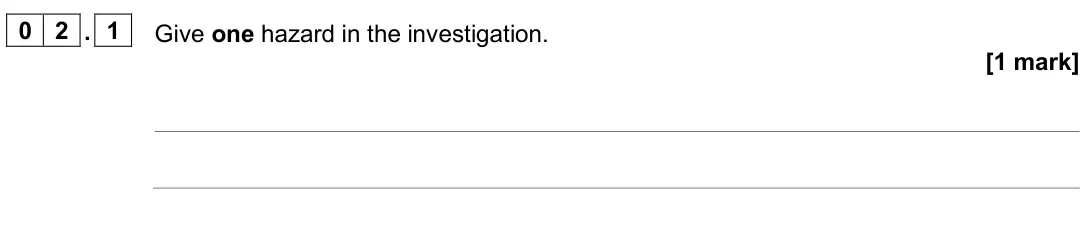
Q02.2
The whole paper ↗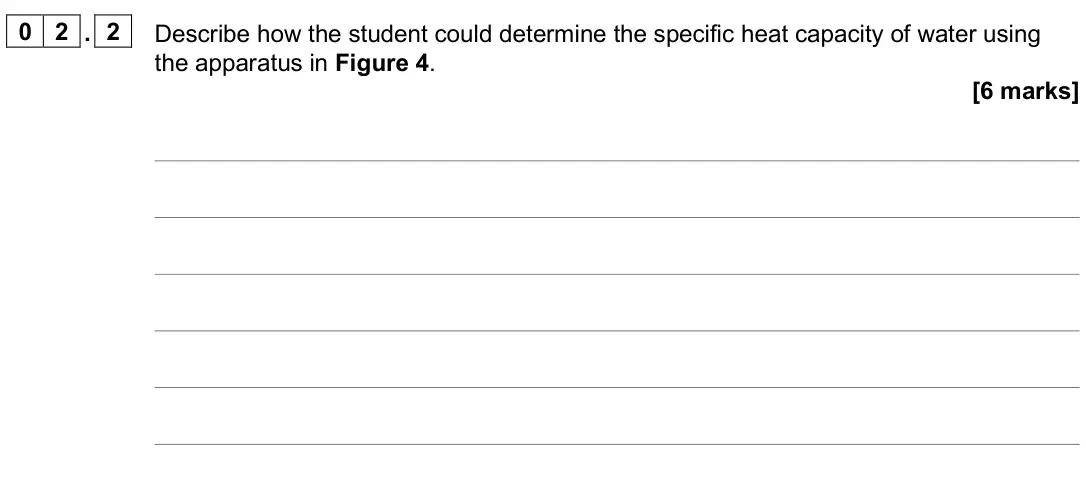
Q02.3
The whole paper ↗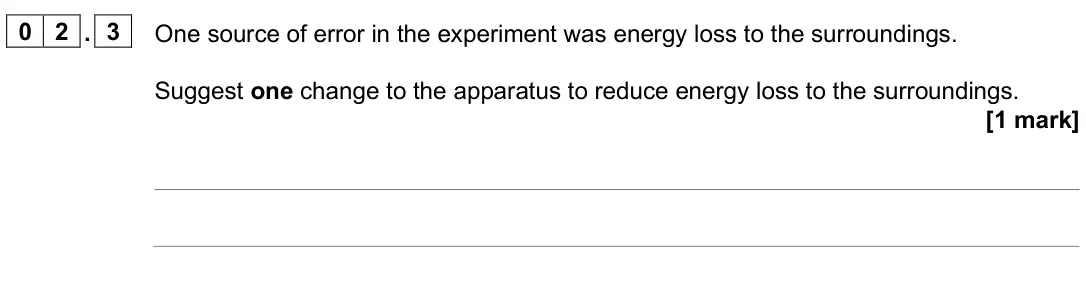
Q02.4
The whole paper ↗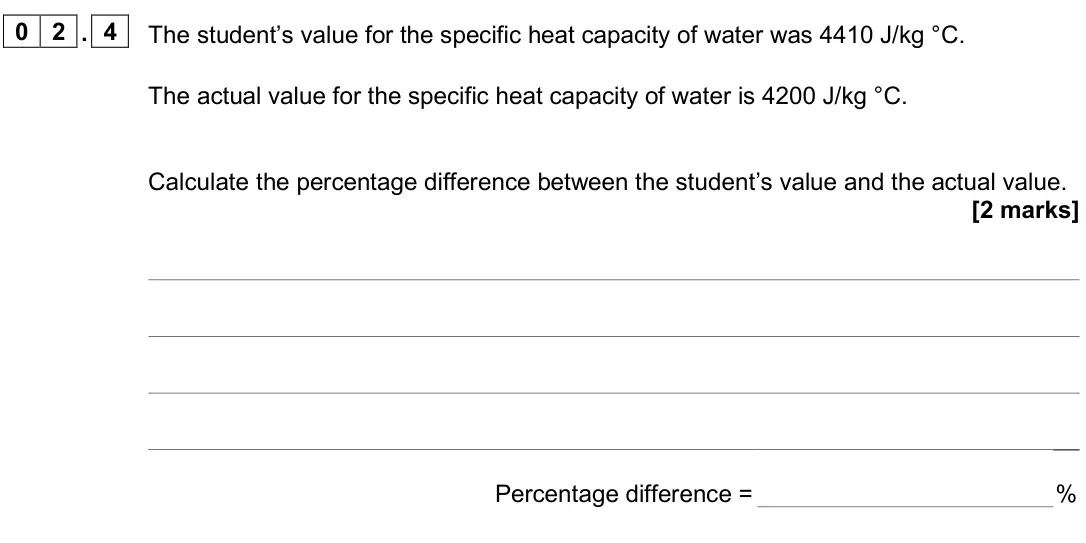
Q05.3
The whole paper ↗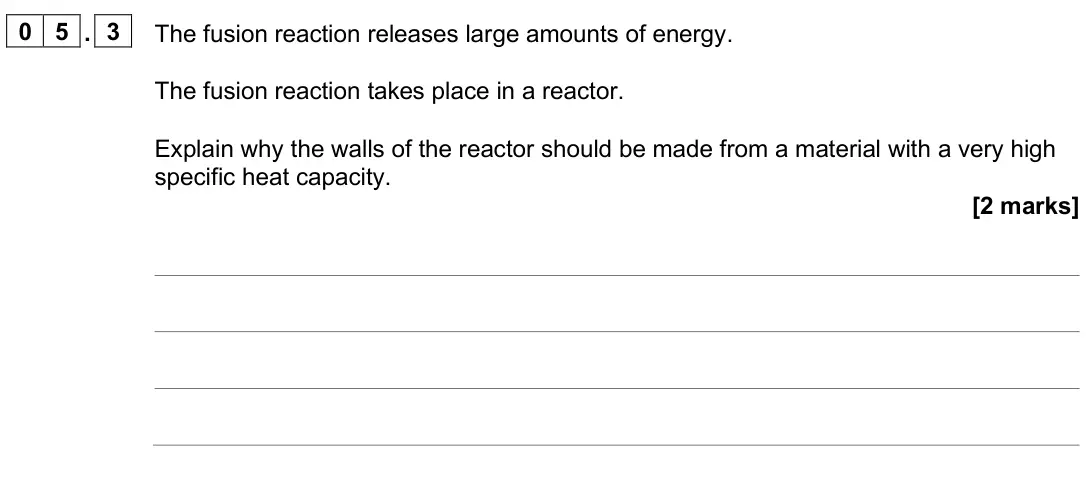
Q06.1
The whole paper ↗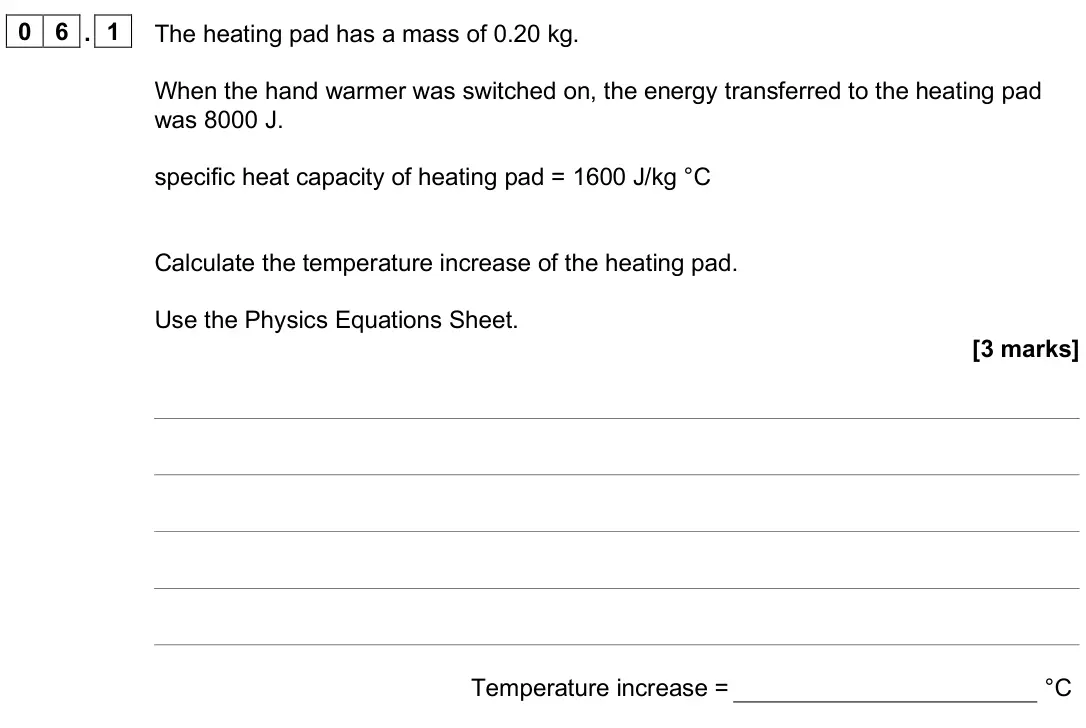
Q09.1
The whole paper ↗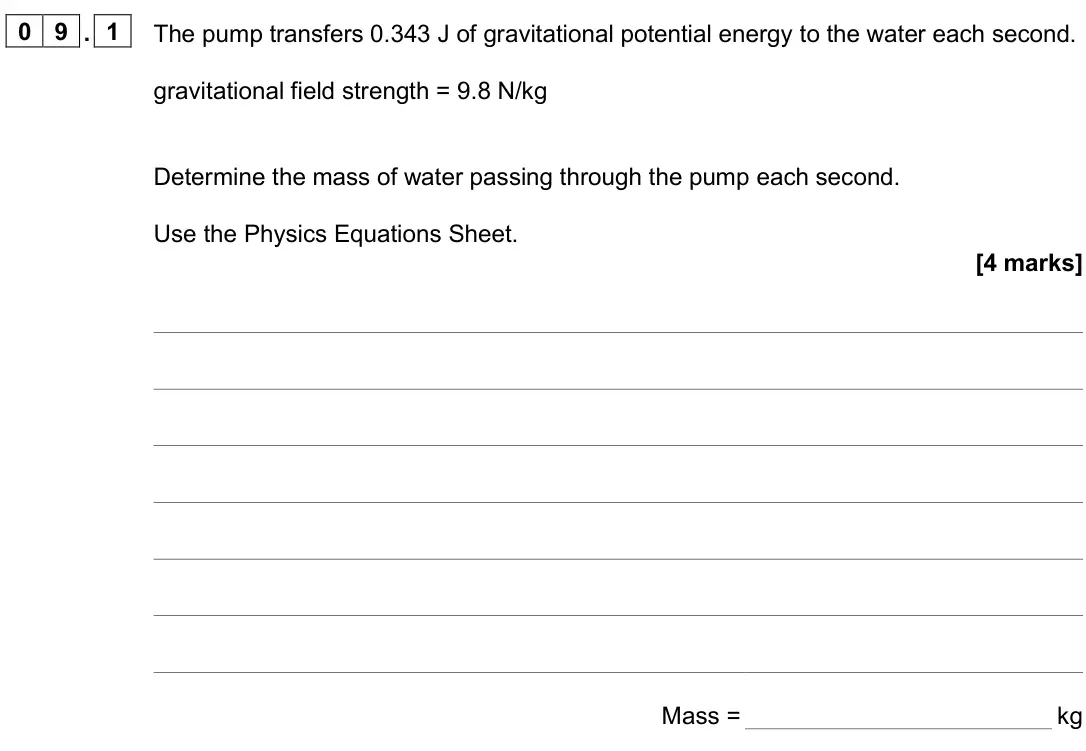
Q10.1
The whole paper ↗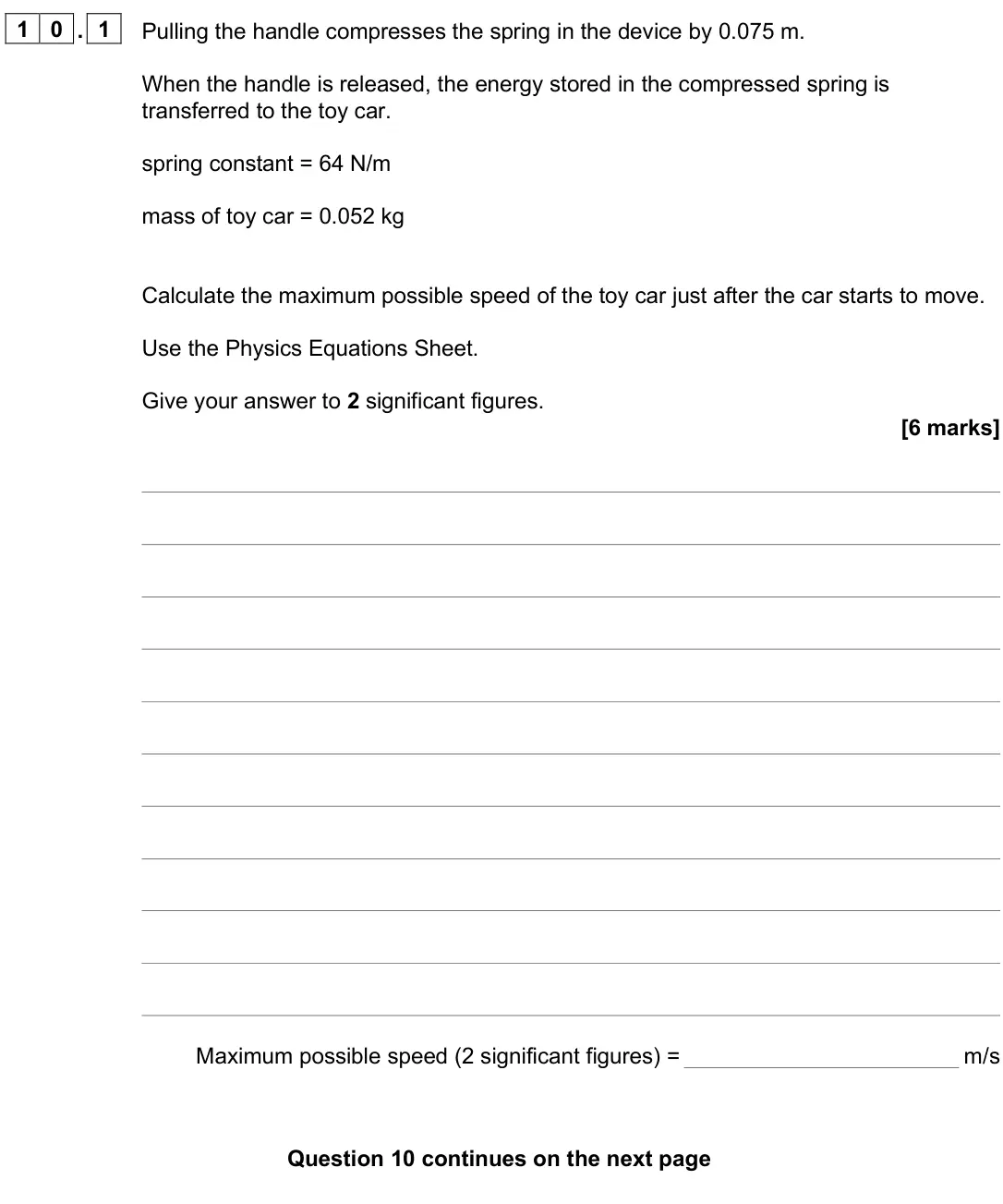
Q10.2
The whole paper ↗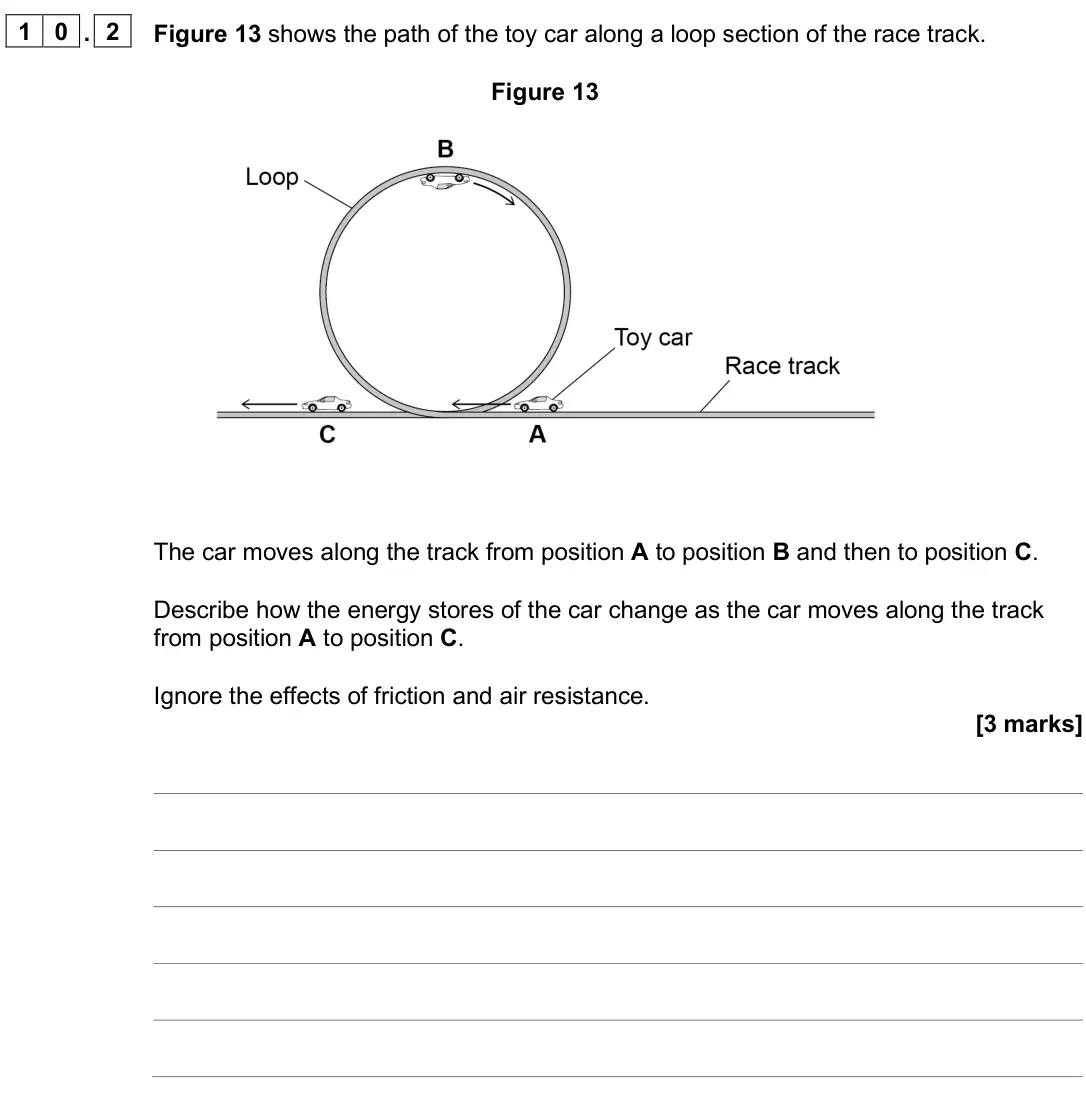
Q10.3
The whole paper ↗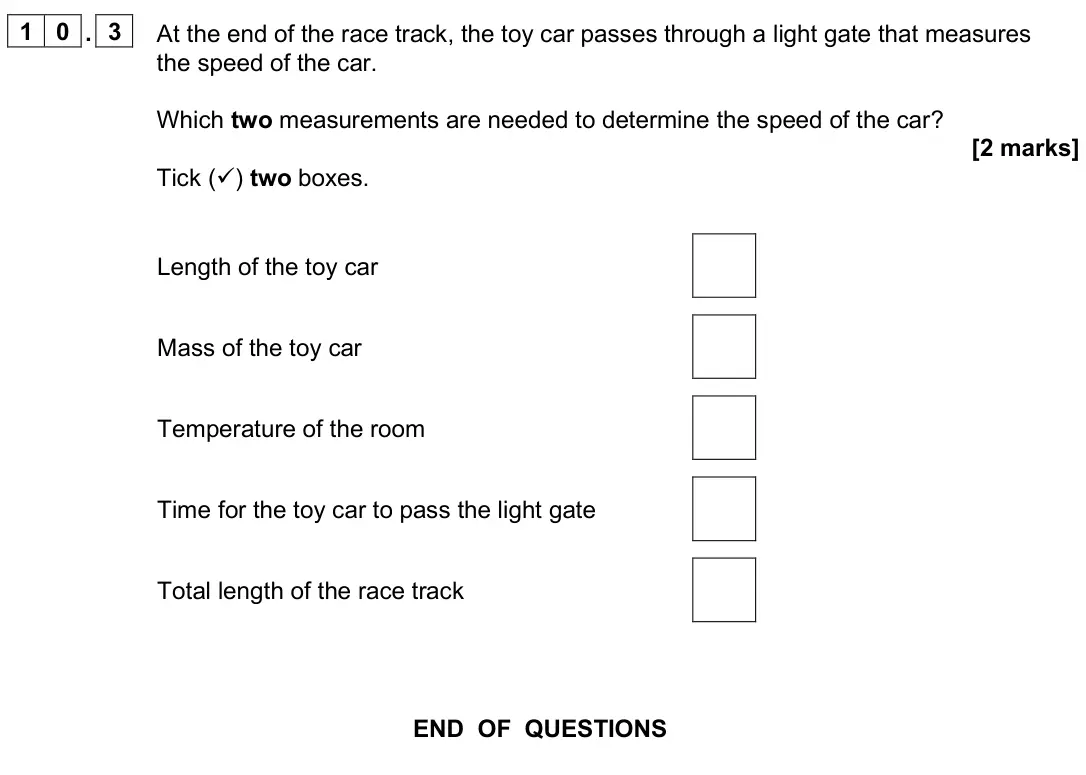
Q02.3
The whole paper ↗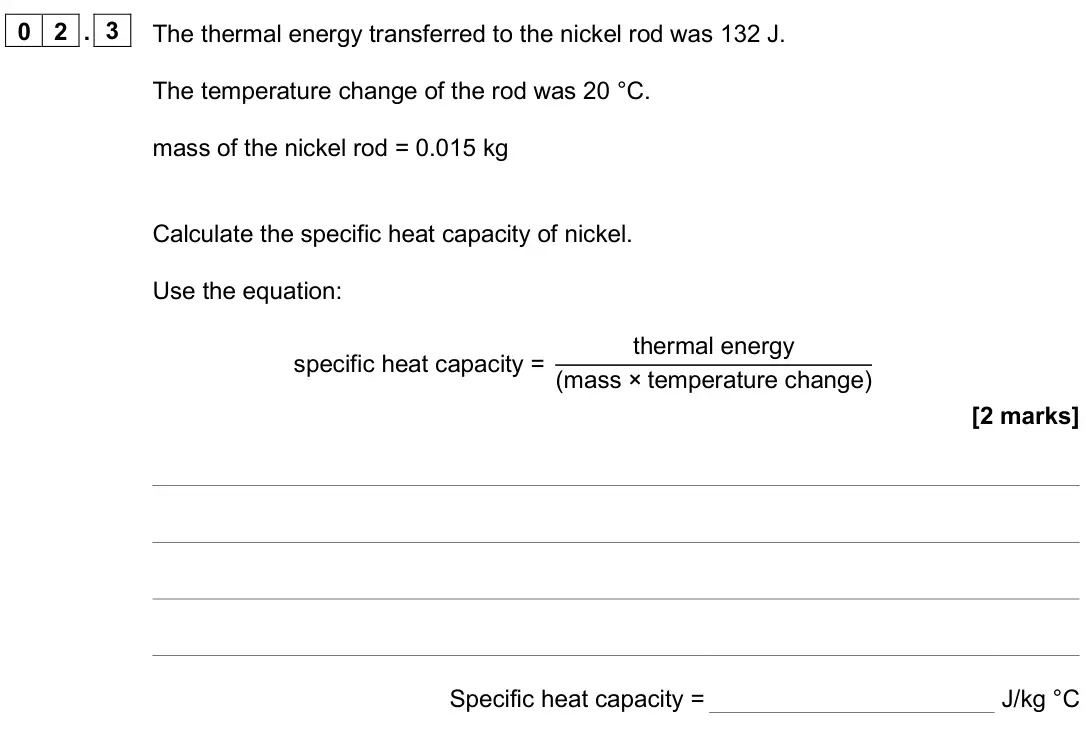
Q02.4
The whole paper ↗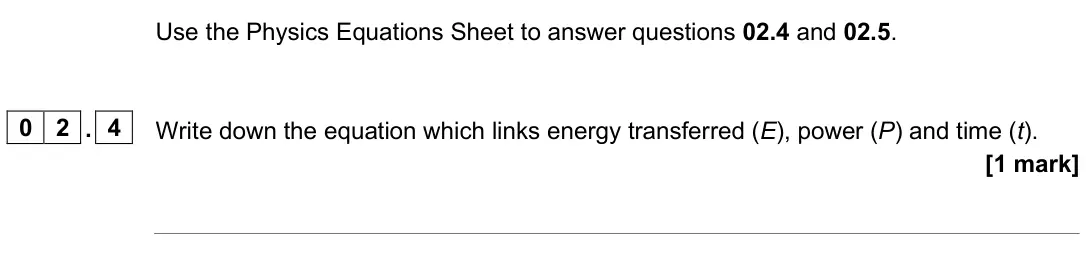
Q02.5
The whole paper ↗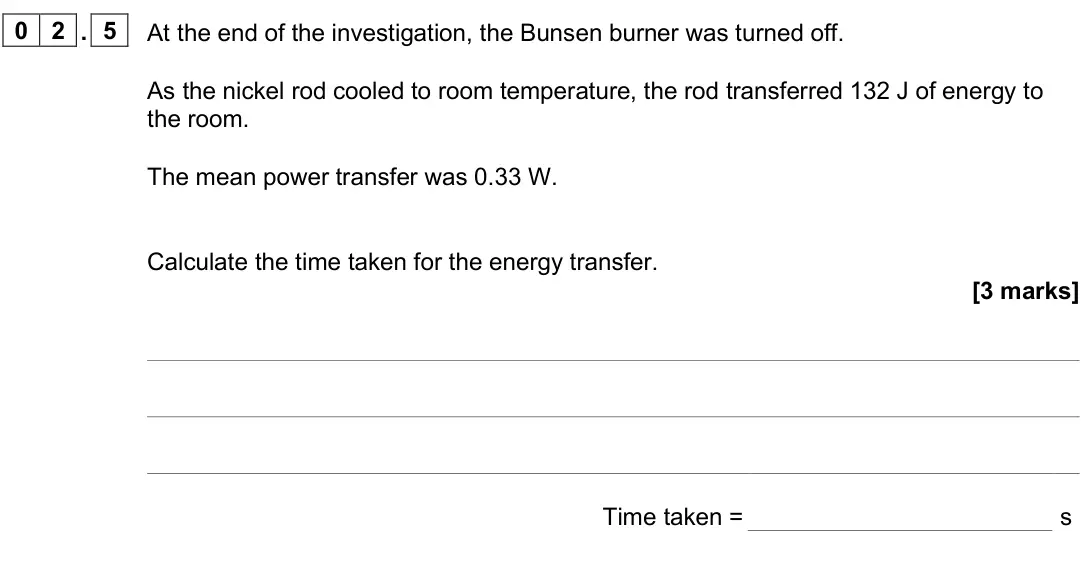
Q05.5
The whole paper ↗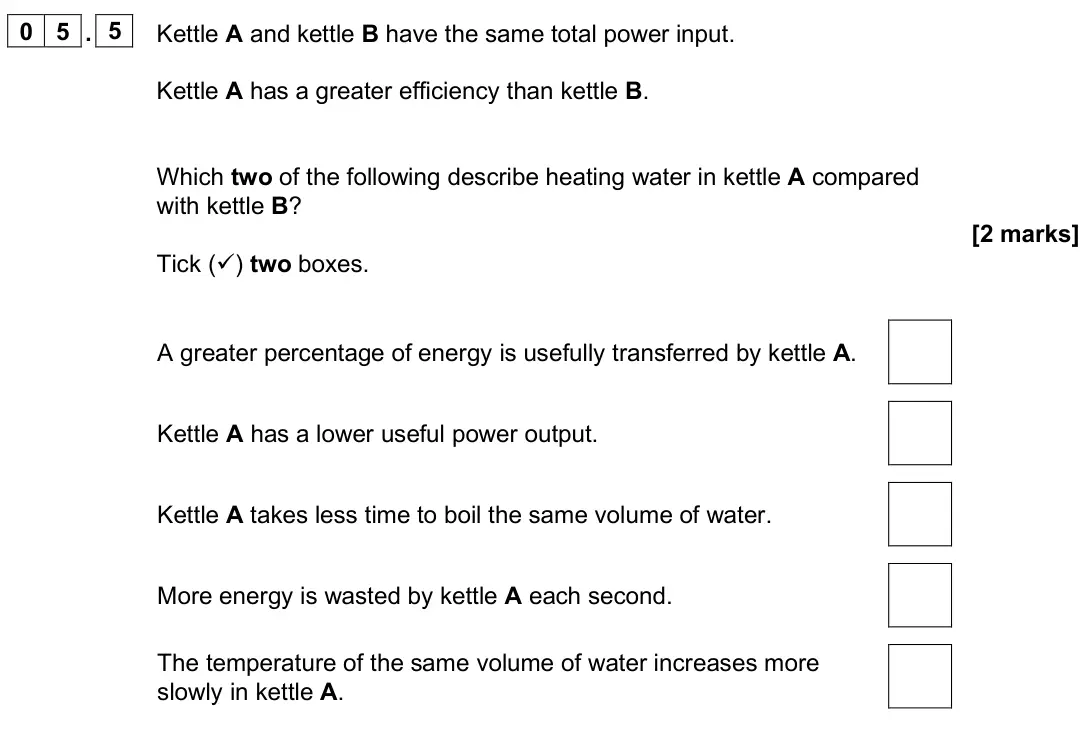
Q06.1
The whole paper ↗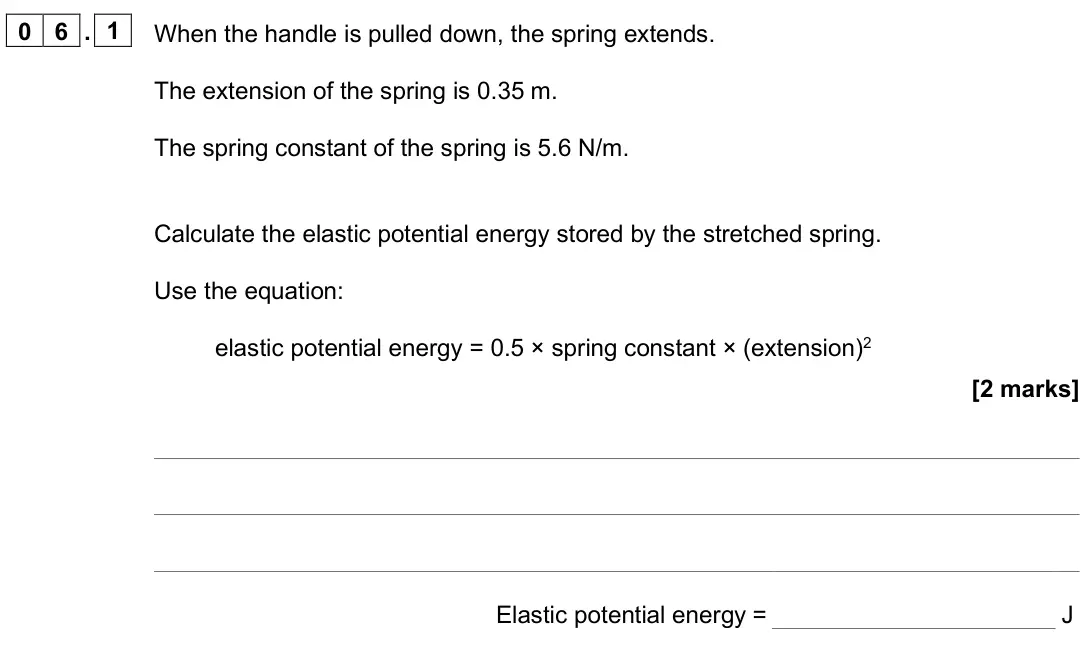
Q06.2
The whole paper ↗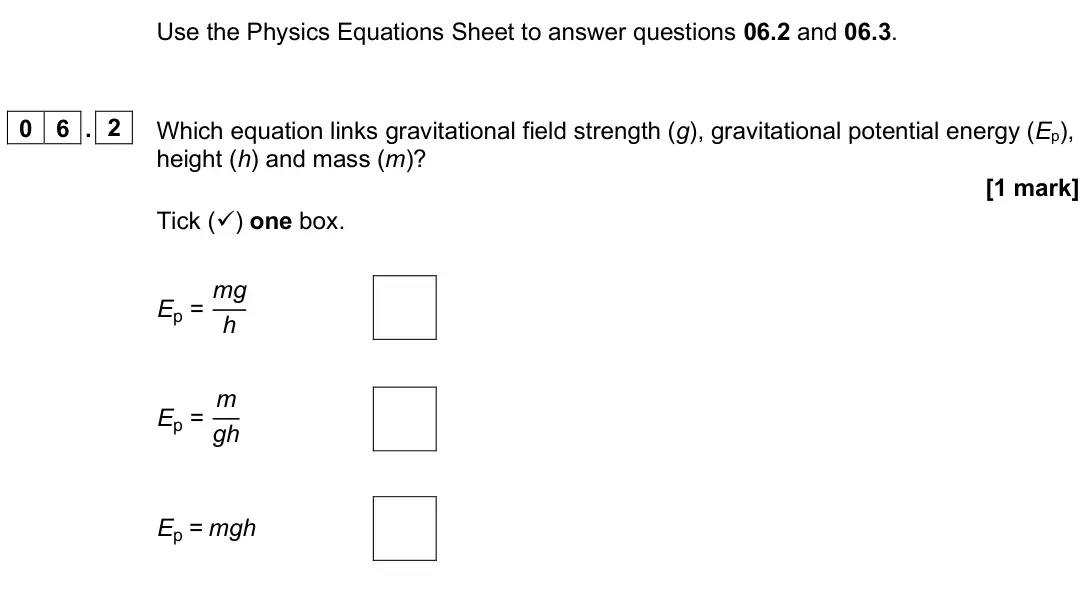
Q06.3
The whole paper ↗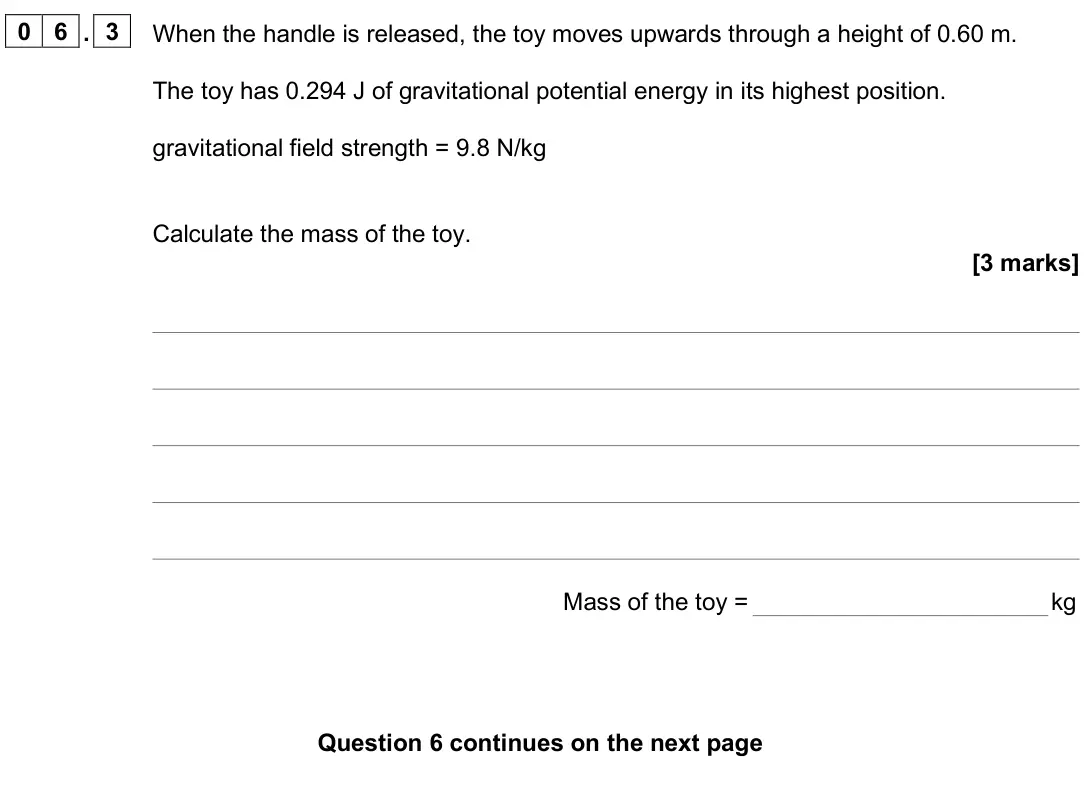
Q06.4
The whole paper ↗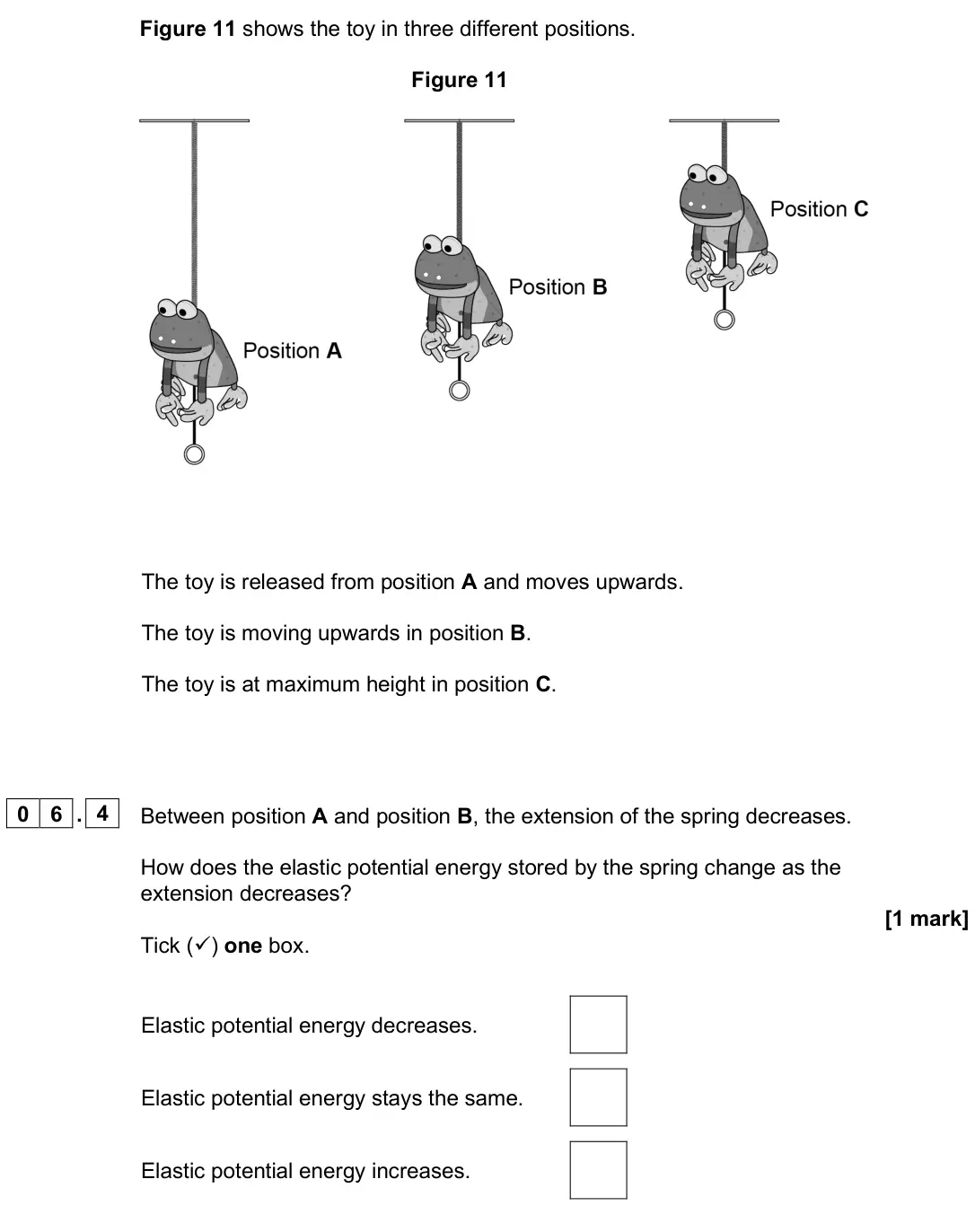
Q06.5
The whole paper ↗
Q06.6
The whole paper ↗
All 151 questions on Energy changes in a system, and the ways energy is stored before and after such changes, as a list
- June 2025, Paper 1 Higher, Q02.1 (1 mark): Give one hazard in the investigation. [1 mark]
- June 2025, Paper 1 Higher, Q02.2 (6 marks): Describe how the student could determine the specific heat capacity of water using the apparatus in Figure 4. [6 marks]
- June 2025, Paper 1 Higher, Q02.3 (1 mark): One source of error in the experiment was energy loss to the surroundings. Suggest one change to the apparatus to reduce energy loss to the surroundings. [1 mar
- June 2025, Paper 1 Higher, Q02.4 (2 marks): The student’s value for the specific heat capacity of water was 4410 J/kg °C. The actual value for the specific heat capacity of water is 4200 J/kg °C. Calculat
- June 2025, Paper 1 Higher, Q05.3 (2 marks): The fusion reaction releases large amounts of energy. The fusion reaction takes place in a reactor. Explain why the walls of the reactor should be made from a m
- June 2025, Paper 1 Higher, Q06.1 (3 marks): The heating pad has a mass of 0.20 kg. When the hand warmer was switched on, the energy transferred to the heating pad was 8000 J. specific heat capacity of hea
- June 2025, Paper 1 Higher, Q09.1 (4 marks): The pump transfers 0.343 J of gravitational potential energy to the water each second. gravitational field strength = 9.8 N/kg Determine the mass of water passi
- June 2025, Paper 1 Higher, Q10.1 (6 marks): Pulling the handle compresses the spring in the device by 0.075 m. When the handle is released, the energy stored in the compressed spring is transferred to the
- June 2025, Paper 1 Higher, Q10.2 (3 marks): Figure 13 shows the path of the toy car along a loop section of the race track. Figure 13 The car moves along the track from position A to position B and then t
- June 2025, Paper 1 Higher, Q10.3 (2 marks): At the end of the race track, the toy car passes through a light gate that measures the speed of the car. Which two measurements are needed to determine the spe
- June 2025, Paper 1 Foundation, Q02.3 (2 marks): The thermal energy transferred to the nickel rod was 132 J. The temperature change of the rod was 20 °C. mass of the nickel rod = 0.015 kg Calculate the specifi
- June 2025, Paper 1 Foundation, Q02.4 (1 mark): and 02.5. 0 2 . 4 Write down the equation which links energy transferred (E), power (P) and time (t). [1 mark]
- June 2025, Paper 1 Foundation, Q02.5 (3 marks): At the end of the investigation, the Bunsen burner was turned off. As the nickel rod cooled to room temperature, the rod transferred 132 J of energy to the room
- June 2025, Paper 1 Foundation, Q05.5 (2 marks): Kettle A and kettle B have the same total power input. Kettle A has a greater efficiency than kettle B. Which two of the following describe heating water in ket
- June 2025, Paper 1 Foundation, Q06.1 (2 marks): When the handle is pulled down, the spring extends. The extension of the spring is 0.35 m. The spring constant of the spring is 5.6 N/m. Calculate the elastic p
- June 2025, Paper 1 Foundation, Q06.2 (1 mark): and 06.3. 0 6 . 2 Which equation links gravitational field strength (g), gravitational potential energy (Ep), height (h) and mass (m)? [1 mark] Tick () one box
- June 2025, Paper 1 Foundation, Q06.3 (3 marks): When the handle is released, the toy moves upwards through a height of 0.60 m. The toy has 0.294 J of gravitational potential energy in its highest position. gr
- June 2025, Paper 1 Foundation, Q06.4 (1 mark): Between position A and position B, the extension of the spring decreases. How does the elastic potential energy stored by the spring change as the extension dec
- June 2025, Paper 1 Foundation, Q06.5 (1 mark): Between position B and position C, the toy slows down. How does the kinetic energy of the toy change as the toy slows down? [1 mark] Tick () one box. Kinetic e
- June 2025, Paper 1 Foundation, Q06.6 (1 mark): How does the gravitational potential energy of the toy change as the toy moves from position B to position C? [1 mark] Tick () one box. Gravitational potential
- June 2025, Paper 1 Foundation, Q06.7 (2 marks): The toy moves up and down many times before eventually stopping. Which two of the following are reasons why the toy eventually stops? [2 marks] Tick () two box
- June 2025, Paper 1 Foundation, Q09.1 (1 mark): Give one hazard in the investigation. [1 mark]
- June 2025, Paper 1 Foundation, Q09.2 (6 marks): Describe how the student could determine the specific heat capacity of water using the apparatus in Figure 17. [6 marks]
- June 2025, Paper 1 Foundation, Q09.3 (1 mark): One source of error in the experiment was energy loss to the surroundings. Suggest one change to the apparatus to reduce energy loss to the surroundings. [1 mar
- June 2025, Paper 1 Foundation, Q09.4 (2 marks): The student’s value for the specific heat capacity of water was 4410 J/kg °C. The actual value for the specific heat capacity of water is 4200 J/kg °C. Calculat
- June 2025, Paper 2 Higher, Q06.3 (5 marks): Car X has a mass of 1400 kg and is travelling at 18 m/s. The driver applies the brakes. The car has a constant deceleration and comes to a stop in a distance of
- June 2024, Paper 1 Higher, Q01.1 (1 mark): Which energy store increases when water is heated? [1 mark]
- June 2024, Paper 1 Higher, Q01.2 (1 mark): Which energy store increases when water is pumped uphill into a reservoir? [1 mark]
- June 2024, Paper 1 Higher, Q01.3 (4 marks): Table 1 shows information about the two methods of storing energy. Table 1 Method Energy stored per 100 kg of water in kJ Percentage of stored energy wasted Ins
- June 2024, Paper 1 Higher, Q02.2 (1 mark): and 02.3. 0 2 . 2 Write down the equation which links energy (E), power (P) and time (t). [1 mark]
- June 2024, Paper 1 Higher, Q02.3 (3 marks): A nuclear power station has a power output of 500 MW. Calculate the energy output in 3600 s. Give your answer in J. [3 marks] Energy output = J
- June 2024, Paper 1 Higher, Q06.1 (1 mark): Which energy store increases as the bungee cords are stretched? [1 mark]
- June 2024, Paper 1 Higher, Q06.2 (6 marks): When the pod is released, the pod accelerates upwards. Before the pod is released the extension of each of the two bungee cords is 8.0 m. The spring constant of
- June 2024, Paper 1 Higher, Q08.3 (4 marks): When the air is hot enough, a small piece of cotton wool in the piston catches fire. The energy transferred to the air in the piston is 0.0130 J. The mass of ai
- June 2024, Paper 1 Foundation, Q03.1 (1 mark): How is the extension of each bungee cord calculated? [1 mark] Tick () one box. stretched length + original length stretched length – original length stretched
- June 2024, Paper 1 Foundation, Q03.2 (2 marks): Before the pod is released, the extension of each bungee cord is 7.5 m. spring constant of the bungee cord = 800 N/m Calculate the elastic potential energy stor
- June 2024, Paper 1 Foundation, Q03.3 (2 marks): The maximum speed of the pod is 15 m/s. The mass of the pod is 240 kg. Calculate the maximum kinetic energy of the pod. Use the equation: kinetic energy = 0.5 ×
- June 2024, Paper 1 Foundation, Q03.4 (1 mark): and 03.5. 0 3 . 4 Which equation links gravitational field strength (g), gravitational potential energy (Ep), height (h) and mass (m)? [1 mark] Tick () one box
- June 2024, Paper 1 Foundation, Q03.5 (3 marks): The pod has 24 000 J of gravitational potential energy when at its maximum height. The mass of the pod is 240 kg. gravitational field strength = 9.8 N/kg Calcul
- June 2024, Paper 1 Foundation, Q05.6 (3 marks): When the air is hot enough, a small piece of cotton wool in the piston catches fire. The energy transferred to the air in the piston is 0.0130 J. The mass of ai
- June 2024, Paper 1 Foundation, Q09.1 (1 mark): Which energy store increases when water is heated? [1 mark]
- June 2024, Paper 1 Foundation, Q09.2 (1 mark): Which energy store increases when water is pumped uphill into a reservoir? [1 mark]
- June 2024, Paper 1 Foundation, Q09.3 (4 marks): Table 4 shows information about the two methods of storing energy. Table 4 Method Energy stored per 100 kg of water in kJ Percentage of stored energy wasted Ins
- June 2024, Paper 1 Foundation, Q10.2 (1 mark): and 10.3. 1 0 . 2 Write down the equation which links energy (E), power (P) and time (t). [1 mark]
- June 2024, Paper 1 Foundation, Q10.3 (3 marks): A nuclear power station has a power output of 500 MW. Calculate the energy output in 3600 s. Give your answer in J. [3 marks] Energy output = J
- June 2023, Paper 1 Higher, Q02.1 (1 mark): Before the power supply was switched on, the thermometer was used to measure the temperature of the iron block. The student left the thermometer in the iron blo
- June 2023, Paper 1 Higher, Q02.2 (4 marks): Figure 3 shows how the temperature changed after the power supply was switched on. Figure 3 The energy transferred to the iron block between 5 and 10 minutes wa
- June 2023, Paper 1 Higher, Q02.3 (2 marks): The student repeated the investigation but wrapped insulation around the iron block. What effect will adding insulation have had on the investigation? [2 marks]
- June 2023, Paper 1 Higher, Q04.1 (4 marks): In one day, 2 500 000 kg of water passes through the hydroelectric generator. The change in gravitational potential energy of the water is 367.5 MJ. gravitation
- June 2023, Paper 1 Higher, Q04.2 (5 marks): The generator transfers 3.0 kW of electrical power. Calculate the time taken for the generator to transfer 2.16 × 10⁷ J of energy. Use the Physics Equations She
- June 2023, Paper 1 Higher, Q06.3 (5 marks): The current in the lamp is 0.21 A when the potential difference across the lamp is 6.0 V. Calculate the energy transferred by the filament lamp in 30 minutes. U
- June 2023, Paper 1 Higher, Q07.1 (1 mark): The baby bouncer should not be used with babies that have a mass greater than 12 kg. Suggest one reason why. [1 mark]
- June 2023, Paper 1 Higher, Q07.2 (3 marks): In positions A and B the baby is stationary. Describe the energy transfers as the baby moves from position A to position B. [3 marks]
- June 2023, Paper 1 Higher, Q07.3 (4 marks): In one position the extension of the spring is 8.0 cm. The elastic potential energy stored by the spring is 4.0 J. Calculate the spring constant of the spring.
- June 2023, Paper 1 Foundation, Q04.2 (2 marks): The mass of water that passes through the hydroelectric generator each day is 2 500 000 kg. The change in vertical height of the water is 15.0 m. gravitational
- June 2023, Paper 1 Foundation, Q04.3 (1 mark): and 04.4. 0 4 . 3 Write down the equation which links energy (E), power (P) and time (t). [1 mark]
- June 2023, Paper 1 Foundation, Q04.4 (3 marks): The hydroelectric generator transfers electrical power of 3000 W to the village. Calculate the energy transferred to the village in 60 minutes. [3 marks] Energy
- June 2023, Paper 1 Foundation, Q06.1 (3 marks): In position B, the student is moving towards the river and the bungee cord is stretching. How do the energy stores in position B compare with the energy stores
- June 2023, Paper 1 Foundation, Q06.2 (2 marks): The bungee cord behaves like a spring with a spring constant of 78.4 N/m. At one point in the bungee jump, the extension of the bungee cord is 25 m. Calculate t
- June 2023, Paper 1 Foundation, Q06.3 (1 mark): Bungee cord C will have a smaller extension than A or B for any bungee jumper. Give the reason why. [1 mark]
- June 2023, Paper 1 Foundation, Q06.4 (2 marks): Which bungee cord would be safest to use for a person with a large weight? Give a reason for your answer. [2 marks] Bungee cord Reason
- June 2023, Paper 1 Foundation, Q09.1 (1 mark): Before the power supply was switched on, the thermometer was used to measure the temperature of the iron block. The student left the thermometer in the iron blo
- June 2023, Paper 1 Foundation, Q09.2 (4 marks): Figure 13 shows how the temperature changed after the power supply was switched on. Figure 13 The energy transferred to the iron block between 5 and 10 minutes
- June 2023, Paper 1 Foundation, Q09.3 (2 marks): The student repeated the investigation but wrapped insulation around the iron block. What effect will adding insulation have had on the investigation? [2 marks]
- June 2022, Paper 1 Higher, Q04.4 (3 marks): For one type of insulating material, the temperature of the water decreased from 85.0 °C to 65.0 °C. The energy transferred from the water was 10.5 kJ. specific
- June 2022, Paper 1 Higher, Q09.1 (5 marks): The mass of the girl was 60.0 kg. The height of the stairs was 175 cm. The girl ran to the top of the stairs in 1.40 s. gravitational field strength = 9.8 N/kg
- June 2022, Paper 1 Higher, Q09.2 (2 marks): The total power output of the girl was greater than the answer to question 09.1. Suggest two reasons why. [2 marks] 1 2
- June 2022, Paper 1 Higher, Q09.3 (1 mark): A boy took more than 1.40 s to run up the same stairs. The power output of the boy was the same as the power output of the girl. What conclusion can be made abo
- June 2022, Paper 1 Higher, Q10.1 (6 marks): Just before the toy aeroplane is released, the spring has an extension of 0.12 m. mass of aeroplane = 0.020 kg spring constant of the spring = 50 N/m Calculate
- June 2022, Paper 1 Higher, Q10.2 (1 mark): Complete the sentence. [1 mark] As the aeroplane moves upwards through the air there is a decrease in the energy of the aeroplane.
- June 2022, Paper 1 Higher, Q10.3 (1 mark): Give one factor which would increase the distance the toy aeroplane travels horizontally before hitting the ground. [1 mark]
- June 2022, Paper 1 Foundation, Q01.1 (2 marks): The boy falls from the position in Figure 1 towards the trampoline. Complete the sentences. Choose answers from the box. [2 marks] chemical elastic potential gr
- June 2022, Paper 1 Foundation, Q01.2 (2 marks): As the boy lands on the trampoline, each spring stretches 0.015 m. spring constant of each spring = 120 000 N/m Calculate the energy stored by each spring. Use
- June 2022, Paper 1 Foundation, Q01.3 (1 mark): There are 40 springs on the trampoline. Calculate the total energy stored by the 40 springs when each spring is stretched by 0.015 m. Use your answer from Quest
- June 2022, Paper 1 Foundation, Q01.5 (1 mark): Why is the kinetic energy of the boy after he bounces less than his kinetic energy as he lands? [1 mark] Tick () one box. Energy is not conserved. Energy is tr
- June 2022, Paper 1 Foundation, Q02.1 (1 mark): The girl measured the height of the stairs. What measuring instrument should she have used? [1 mark]
- June 2022, Paper 1 Foundation, Q02.2 (2 marks): The height of the stairs was 1.7 m. The mass of the girl was 50 kg. gravitational field strength = 9.8 N/kg Calculate the change in gravitational potential ener
- June 2022, Paper 1 Foundation, Q02.3 (2 marks): A boy ran up the same stairs and did 1800 J of work. The time it took the boy to run up the stairs was 1.44 s. Calculate the power of the boy. Use the equation:
- June 2022, Paper 1 Foundation, Q02.4 (1 mark): Which stop-clock was used to measure the time the boy took to run up the stairs? [1 mark] Tick () one box. Stop-clock A Stop-clock B Stop-clock C
- June 2022, Paper 1 Foundation, Q05.4 (4 marks): The mass of water that turned into steam was 0.0090 kg. The heater transferred 25 200 J of energy to the water to turn it into steam. Calculate the specific lat
- June 2022, Paper 1 Foundation, Q08.3 (4 marks): The mass of water used was 0.12 kg. specific heat capacity of water = 4200 J/kg °C Determine the total change in thermal energy of the water when Material X was
- June 2022, Paper 2 Higher, Q04.4 (3 marks): Explain the difference in the maximum kinetic energy of a hailstone with a mass of 10 g and a hailstone with a mass of 20 g. [3 marks]
- November 2021, Paper 1 Higher, Q01.2 (1 mark): Which equation links energy transferred (E), power (P) and time (t)? [1 mark] Tick () one box. energy transferred = power time energy transferred = time power
- November 2021, Paper 1 Higher, Q01.3 (3 marks): The battery in the electric car can store 162 000 000 J of energy. The charging station has a power output of 7200 W. Calculate the time taken to fully recharge
- November 2021, Paper 1 Higher, Q02.2 (3 marks): Nuclear fusion of deuterium is difficult to achieve on Earth because of the high temperature needed. Electricity is used to increase the temperature of 4.0 g of
- November 2021, Paper 1 Higher, Q05.1 (2 marks): During one year, 1.25 × 10¹⁸ J of energy was transferred from the National Grid. number of seconds in 1 year = 3.16 × 10⁷ Calculate the mean energy transferred
- November 2021, Paper 1 Higher, Q08.2 (5 marks): The car is released from rest at position A and accelerates due to gravity down the track to position B. mass of toy car = 0.040 kg vertical height between posi
- November 2021, Paper 1 Higher, Q08.3 (2 marks): At position C the car’s gravitational potential energy is 0.20 J greater than at position B. How much kinetic energy does the car need at position B to complete
- November 2021, Paper 1 Foundation, Q02.6 (2 marks): The average energy transferred from the National Grid every second for each person in the UK is 600 J. There are 32 000 000 seconds in one year. Calculate the a
- November 2021, Paper 1 Foundation, Q07.1 (2 marks): Complete the sentences. Choose answers from the box. [2 marks] As the diver falls towards the water there is a decrease in her energy. As the diver falls toward
- November 2021, Paper 1 Foundation, Q07.2 (1 mark): Write down the equation which links kinetic energy (Ek), mass (m) and speed (v). [1 mark]
- November 2021, Paper 1 Foundation, Q07.3 (3 marks): At the instant the diver hits the water, the kinetic energy of the diver is 5040 J. The speed of the diver is 12 m/s. Calculate the mass of the diver. [3 marks]
- November 2021, Paper 1 Foundation, Q07.4 (1 mark): Most of the kinetic energy of the diver is transferred to the water. How does this affect the thermal energy of the water? [1 mark] Tick () one box. The therma
- November 2021, Paper 1 Foundation, Q09.2 (1 mark): Which equation links energy transferred (E), power (P) and time (t)? [1 mark] Tick () one box. energy transferred = power time energy transferred = time power
- November 2021, Paper 1 Foundation, Q09.3 (3 marks): The battery in the electric car can store 162 000 000 J of energy. The charging station has a power output of 7200 W. Calculate the time taken to fully recharge
- November 2021, Paper 1 Foundation, Q10.2 (3 marks): Nuclear fusion of deuterium is difficult to achieve on Earth because of the high temperature needed. Electricity is used to increase the temperature of 4.0 g of
- November 2021, Paper 2 Higher, Q01.1 (4 marks): Explain the effect of two other factors on the braking distance of a car. Do not refer to speed in your answer. [4 marks]
- November 2021, Paper 2 Foundation, Q08.1 (4 marks): Explain the effect of two other factors on the braking distance of a car. Do not refer to speed in your answer. [4 marks]
- November 2020, Paper 1 Higher, Q06.1 (2 marks): A light gate and data logger can be used to determine the speed of each rider and sled. What two measurements are needed to determine the speed of a rider and s
- November 2020, Paper 1 Higher, Q06.2 (4 marks): The decrease in gravitational potential energy of one rider on the slide was 8.33 kJ. The rider moved through a vertical height of 17.0 m. gravitational field s
- November 2020, Paper 1 Higher, Q06.3 (4 marks): At the bottom of the slide, all riders and their sleds have approximately the same speed. Explain why. [4 marks]
- November 2020, Paper 1 Higher, Q07.1 (1 mark): When the kettle was switched on the temperature of the water did not immediately start to increase. Suggest one reason why. [1 mark]
- November 2020, Paper 1 Higher, Q07.2 (5 marks): The energy transferred to the water in 100 seconds was 155 000 J. specific heat capacity of water = 4200 J/kg °C Determine the mass of water in the kettle. Use
- November 2020, Paper 1 Higher, Q07.3 (3 marks): The straight section of the line in Figure 10 can be used to calculate the useful power output of the kettle. Explain how. [3 marks]
- November 2020, Paper 1 Foundation, Q02.2 (2 marks): The mass of one rider is 62.5 kg. The height of the slide is 16.0 m. gravitational field strength = 9.8 N/kg Calculate the gravitational potential energy of the
- November 2020, Paper 1 Foundation, Q02.3 (2 marks): At the bottom of the slide the speed of the rider is 12 m/s. The mass of the rider is 62.5 kg. Calculate the kinetic energy of the rider at the bottom of the sl
- November 2020, Paper 1 Foundation, Q02.4 (2 marks): When a rider reaches the bottom of the slide, the sled decelerates and stops. Give two factors that will affect how far the sled will move before it stops. [2 m
- November 2020, Paper 1 Foundation, Q07.1 (2 marks): Water has a high specific heat capacity. Complete the sentence. Choose answers from the box. [2 marks] °C J kg s W The specific heat capacity of a substance is
- November 2020, Paper 1 Foundation, Q07.4 (1 mark): The temperature of the water did not start to increase until 10 seconds after the kettle was switched on. What is the reason for this? [1 mark] Tick () one box
- November 2020, Paper 1 Foundation, Q07.5 (6 marks): Describe a method the student could have used to obtain the results shown in Figure 10. [6 marks]
- November 2020, Paper 1 Foundation, Q07.6 (3 marks): The mass of water in the kettle was 0.50 kg. The temperature of the water increased from 20 °C to 100 °C. specific heat capacity of water = 4200 J/kg °C Calcula
- June 2019, Paper 1 Foundation, Q03.1 (2 marks): Describe how the vertical height of the tower could be measured accurately. [2 marks]
- June 2019, Paper 1 Foundation, Q03.2 (2 marks): When using the zip wire, the person moved through a vertical height of 2.0 m The person has a mass of 45 kg gravitational field strength = 9.8 N/kg Calculate th
- June 2019, Paper 1 Foundation, Q03.3 (3 marks): Give three factors that affected the kinetic energy of the person as she reached the bottom of the zip wire. [3 marks] 1 2 3
- June 2019, Paper 1 Foundation, Q06.4 (1 mark): Write down the equation which links energy transferred, power and time. [1 mark]
- June 2019, Paper 1 Foundation, Q06.5 (3 marks): The charger has a power output of 7000 W Calculate the time taken to transfer 420 000 J of energy to the car battery. [3 marks] Time = s
- June 2019, Paper 1 Foundation, Q08.1 (1 mark): Why did the student insulate the beaker of water? [1 mark] Tick () one box. To increase energy transfer to the surroundings. To reduce energy transfer to the s
- June 2019, Paper 1 Foundation, Q08.2 (1 mark): One hazard in this experiment is the hot water. Give one risk to the student caused by this hazard. [1 mark]
- June 2019, Paper 1 Foundation, Q08.3 (1 mark): Figure 13 shows the thermometer that the student used. Figure 13 What is the resolution of the thermometer? [1 mark] Tick () one box. 1 °C 3 °C 19 °C
- June 2019, Paper 1 Foundation, Q08.4 (1 mark): Figure 14 shows the beaker of water on a balance. Figure 14 The mass of the water was 0.20 kg What was the mass of the beaker? [1 mark] Tick () one box. 0.06 k
- June 2019, Paper 1 Foundation, Q08.5 (4 marks): The energy transferred to the water was 26 400 J The mass of water was 0.20 kg The temperature increase of the water was 30 °C Calculate the specific heat capac
- June 2019, Paper 1 Foundation, Q09.1 (1 mark): What does power input mean? [1 mark] Tick () one box. The charge transferred each second by the bulb. The current through the bulb. The energy transferred each
- June 2019, Paper 1 Foundation, Q09.6 (2 marks): In addition to power input, light bulbs should also be labelled with the rate at which they emit visible light. Suggest why. [2 marks]
- June 2019, Paper 1 Foundation, Q11.1 (3 marks): The muscle power in watts per kg is calculated using the following equation: muscle power = 9.8 × jump height time One volunteer has a muscle power of 41 W/kg H
- June 2019, Paper 1 Foundation, Q11.2 (1 mark): Write down the equation which links kinetic energy, mass and speed. [1 mark]
- June 2019, Paper 1 Foundation, Q11.3 (3 marks): One volunteer had a kinetic energy of 270 J and a speed of 3.0 m/s at the moment he left the ground. Calculate his mass. [3 marks] Mass = kg
- June 2019, Paper 1 Foundation, Q11.4 (4 marks): Compare the muscle power of males with the muscle power of females. Use data from Figure 19 in your answer. [4 marks]
- June 2019, Paper 1 Foundation, Q11.5 (1 mark): The muscle power of each volunteer was measured five times. The highest muscle power reading was recorded instead of calculating an average. Suggest one reason
- June 2018, Paper 2 Higher, Q01.3 (1 mark): The ball and the Earth form a system. What is meant by ‘a system’? Tick one box. [1 mark] A group of objects that interact. Objects with big differences in mass
- June 2018, Paper 2 Higher, Q01.4 (4 marks): When the ball hits the ground, energy is transferred from the ball to the Earth. Explain how the data in Figure 1 shows this energy transfer. [4 marks]
- June 2018, Paper 2 Foundation, Q10.3 (1 mark): The ball and the Earth form a system. What is meant by ‘a system’? Tick one box. [1 mark] A group of objects that interact. Objects with big differences in mass
- June 2018, Paper 2 Foundation, Q10.4 (4 marks): When the ball hits the ground, energy is transferred from the ball to the Earth. Explain how the data in Figure 14 shows this energy transfer. [4 marks]
- Specimen, Paper 1 Higher, Q04.1: Choose the most appropriate resolution for the thermometer used by the student. [1 mar Tick one box. 0.1 ⁰C 0.5 ⁰C 1.0 ⁰C
- Specimen, Paper 1 Higher, Q04.2 (1 mark): Write down the equation which links energy transferred, power and time. [1 mark]
- Specimen, Paper 1 Higher, Q04.3 (2 marks): Calculate the mean power supplied by the Sun to the water in the pan. [2 marks] Average power = W
- Specimen, Paper 1 Higher, Q04.4 (3 marks): Calculate the mass of water the student used in her investigation. Use the correct equation from the Physics Equation Sheet. [3 marks] Mass = kg
- Specimen, Paper 1 Higher, Q04.5 (1 mark): The student’s results can only be used as an estimate of the mean power at her location. Give one reason why. [1 mark]
- Specimen, Paper 1 Higher, Q11.1: Write down the equation which links gravitational field strength, gravitational potent energy, height and mass. [1 mar
- Specimen, Paper 1 Higher, Q11.2 (2 marks): Calculate the change in gravitational potential energy from the position where the student jumps to the point 20.0 m below. [2 mark Change in gravitational pote
- Specimen, Paper 1 Higher, Q11.3 (1 mark): 80% of this change in gravitational potential energy has been transferred to the student’s kinetic energy store. How much has the student’s kinetic energy store
- Specimen, Paper 1 Higher, Q11.4 (4 marks): Calculate the speed of the student after falling 20.0 m. Give your answer to two significant figures. [4 marks] Speed = m/s
- Specimen, Paper 1 Higher, Q11.5 (3 marks): At the lowest point in the jump, the energy stored by the stretched bungee cord is 24.5 kJ. The bungee cord behaves like a spring. Calculate the spring constant
- Specimen, Paper 1 Foundation, Q02.1 (2 marks): For safety reasons, it is important that the bungee cord used is appropriate for the student’s weight. Give two reasons why. [2 marks] 1 2
- Specimen, Paper 1 Foundation, Q02.2 (3 marks): The student jumps off the bridge. Complete the sentences to describe the energy transfers. Use answers from the box. [3 mark elastic potential gravitational pot
- Specimen, Paper 1 Foundation, Q02.3 (2 marks): At the lowest point in the jump when the student is stationary, the extension of the bungee cord is 35 metres. The bungee cord behaves like a spring with a spri
- Specimen, Paper 1 Foundation, Q12.1: Choose the most appropriate resolution for the thermometer used by the student. [1 mar Tick one box. 0.1 ⁰C 0.5 ⁰C 1.0 ⁰C
- Specimen, Paper 1 Foundation, Q12.2 (1 mark): Write down the equation which links energy transferred, power and time. [1 mark]
- Specimen, Paper 1 Foundation, Q12.3 (2 marks): Calculate the mean power supplied by the Sun to the water in the pan. [2 marks] Average power = W
- Specimen, Paper 1 Foundation, Q12.4 (3 marks): Calculate the mass of water the student used in her investigation. Use the correct equation from the Physics Equation Sheet. [3 marks] Mass = kg
- Specimen, Paper 1 Foundation, Q12.5 (1 mark): The student’s results can only be used as an estimate of the mean power at her location. Give one reason why. [1 mark]
- Specimen, Paper 2 Foundation, Q10.7 (4 marks): Figure 16 shows the horizontal forces acting on a car. Figure 16 1 0 A car driver sees a fallen tree lying across the road ahead and makes an emergency stop. Th
Questions, mark schemes and examiner’s reports are © AQA, from their published past papers. Plumi isn’t affiliated with any exam board. Want whole papers? Every AQA GCSE Physics paper.
Rather write your answers by hand on iPad? Plumi marks them against the same mark schemes.