 plumi
Thermal energy transfer: AQA A‑Level Physics questions
AQA A-Level Physics past-paper questions on 3.6.2.1 Thermal energy transfer, 2008–2025, with mark schemes and examiner’s reports where available.
Paper
All papers
Exam
All years
Calculations
Q02.5
The whole paper ↗
Q03.3
The whole paper ↗
Q01.4
The whole paper ↗
Q01.1
The whole paper ↗- Your answer
Q01.1
The whole paper ↗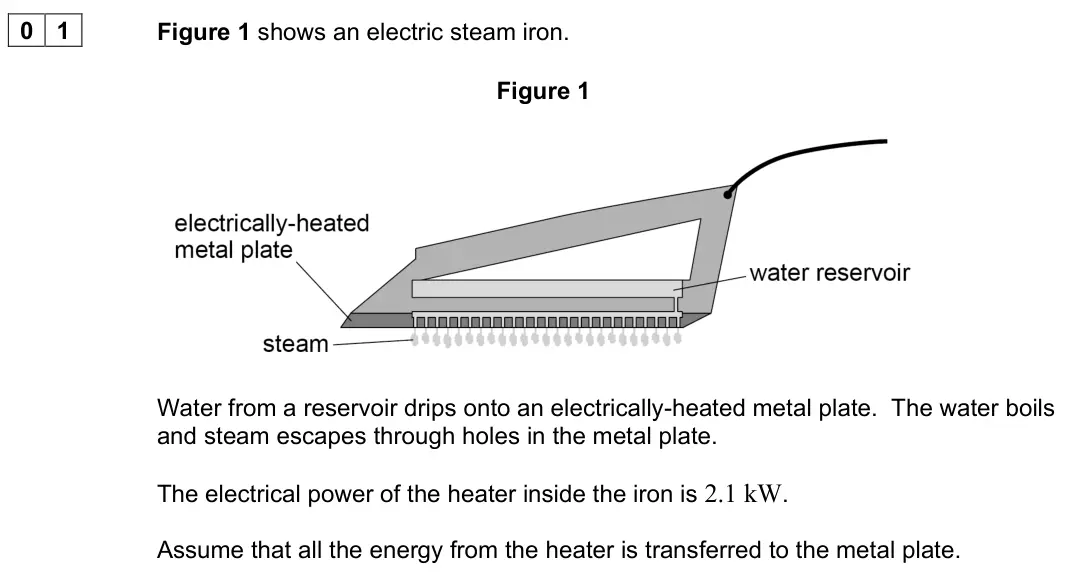
Q01.2
The whole paper ↗- Your answer
Q01.1
The whole paper ↗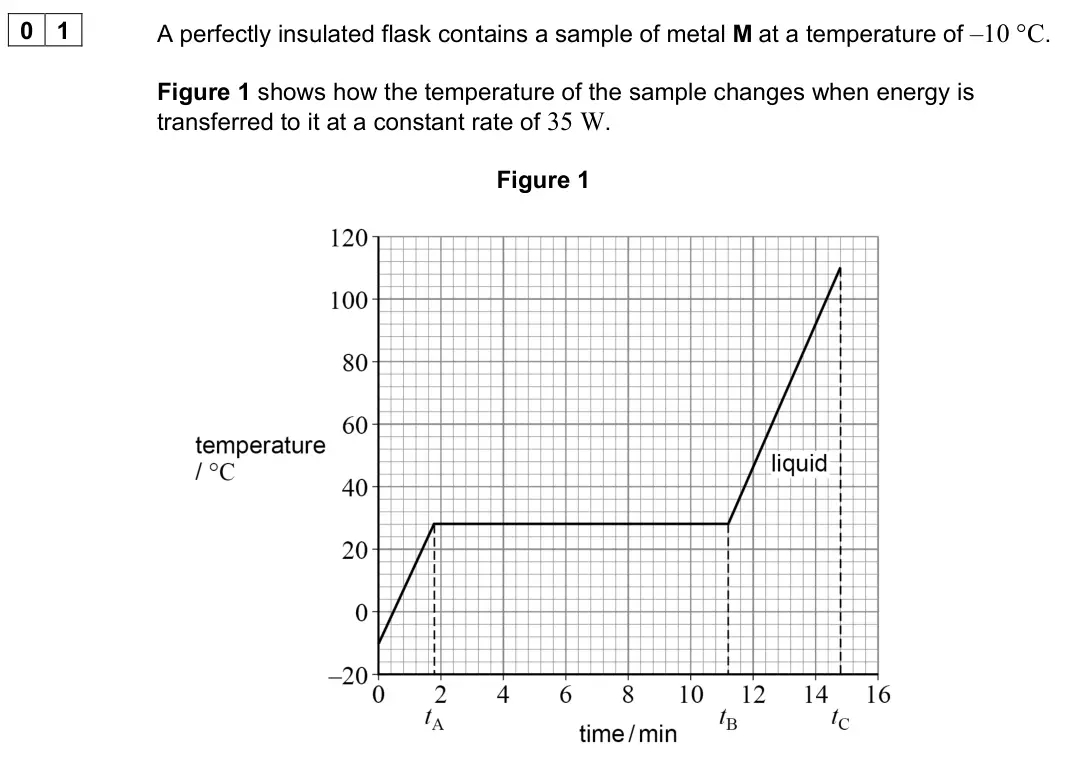
Q01.2
The whole paper ↗Q01.3
The whole paper ↗Q01.4
The whole paper ↗Q01.5
The whole paper ↗Q01.6
The whole paper ↗Q01.1
The whole paper ↗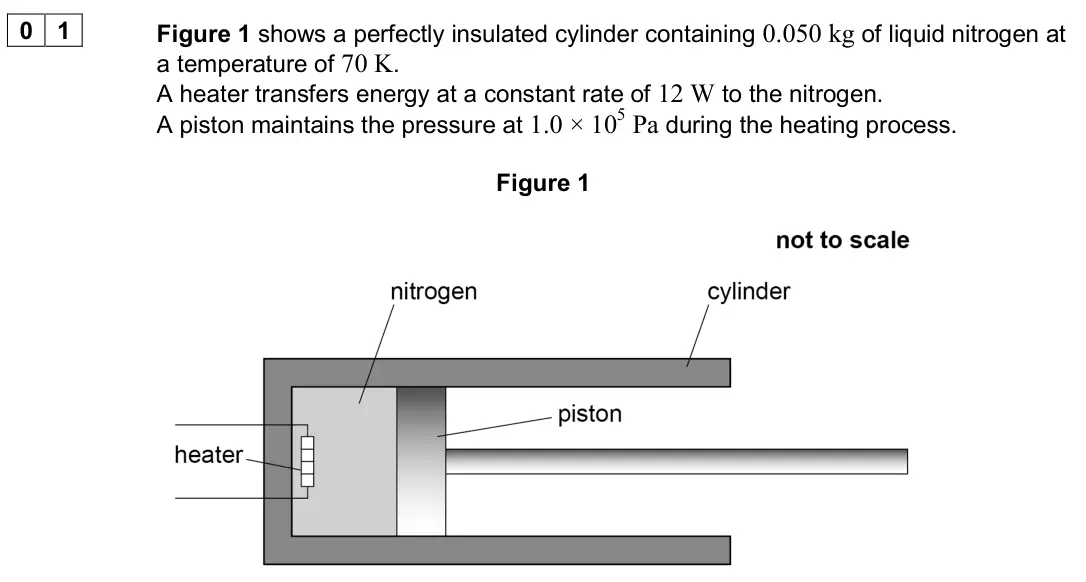
Q01.2
The whole paper ↗Q02.1
The whole paper ↗Q01.1
The whole paper ↗Q01.2
The whole paper ↗Q01.3
The whole paper ↗
All 46 questions on Thermal energy transfer, as a list
- June 2025, Paper 2, Q02.5 (3 marks): When an ideal gas is heated at constant volume, all of the energy supplied by heating is used to increase the average kinetic energy of the particles. When wate
- June 2025, Paper 2, Q03.3 (4 marks): The vehicle has a battery-powered laser that is used to vaporise small samples of ice. On Mars, ice changes directly from solid to vapour at a temperature of 0
- June 2024, Paper 2, Q01.4 (3 marks): A room contains moist air at a temperature of 20 °C. A dehumidifier cools and then condenses water vapour from the moist air. The final temperature of the liqui
- June 2023, Paper 2, Q01.1 (1 mark): State what is meant by the internal energy of an ideal gas. [1 mark]
- June 2023, Paper 2, Q08 (1 mark): [multiple choice] A 1000 W heater is 75% efficient. The heater is used to increase the temperature of some water from 10 °C to 85 °C in 7 hours. What mass of wa
- June 2022, Paper 2, Q01.1 (2 marks): The metal plate has a mass of 1.2 kg and is initially at a temperature of 20 °C. The heater is switched on. After a time t the metal plate reaches its working t
- June 2022, Paper 2, Q01.2 (3 marks): The metal plate is maintained at its working temperature. Water at 20 °C drips continuously onto the metal plate. Steam at 100 °C emerges continuously from the
- November 2021, Paper 2, Q07 (1 mark): [multiple choice] A solar panel transfers energy at a rate of 1.2 kW to liquid passing through it. The liquid has a specific heat capacity of 4.0 kJ kg−1 K−1. W
- November 2020, Paper 2, Q01.1 (1 mark): State the melting temperature of M. [1 mark] temperature = °C
- November 2020, Paper 2, Q01.2 (1 mark): Explain how the energy transferred to the sample changes the arrangement of the atoms during the time interval tA to tB. [1 mark]
- November 2020, Paper 2, Q01.3 (2 marks): State what happens to the potential energy of the atoms and to the kinetic energy of the atoms during the time interval tA to tB. [2 marks]
- November 2020, Paper 2, Q01.4 (1 mark): Describe how the motion of the atoms changes during the time interval tB to tC. [1 mark]
- November 2020, Paper 2, Q01.5 (3 marks): The sample has a mass of 0.25 kg. Determine the specific heat capacity of M when in the liquid state. State an appropriate SI unit for your answer. [3 marks] sp
- November 2020, Paper 2, Q01.6 (2 marks): Table 1 shows the specific latent heats of fusion l for elements that are liquid at similar temperatures to M. Table 1 Element Caesium Gallium Mercury Rubidium
- June 2019, Paper 2, Q01.1 (5 marks): The nitrogen is heated from 70 K and is completely turned into a gas after 890 s. Calculate the specific heat capacity of liquid nitrogen. Give an appropriate u
- June 2019, Paper 2, Q01.2 (4 marks): The work done by the nitrogen in the cylinder when expanding due to a change of state is X. The energy required to change the state of the nitrogen from a liqui
- June 2019, Paper 2, Q02.1 (2 marks): State what is meant by the internal energy of a gas. [2 marks]
- June 2018, Paper 2, Q01.1 (2 marks): Explain what is meant by specific latent heat of fusion. [2 marks]
- June 2018, Paper 2, Q01.2 (3 marks): Figure 1 shows how the temperature of the water is maintained in a hot tub. Figure 1 The hot tub system has a volume of 4.5 m3 and is filled with water at a tem
- June 2018, Paper 2, Q01.3 (2 marks): The pump can circulate the water at different speeds. When working at higher speeds the rise in temperature is greater. Explain why. Again assume that no heat i
- June 2017, Paper 2, Q08 (1 mark): [multiple choice] A continuous stream of water falls through a vertical distance of 100 m. Assume no thermal energy is transferred to the surroundings. The spec
- June 2017, Paper 2, Q09 (1 mark): A student measures the power of a microwave oven. He places 200 g of water at 23 °C into the microwave and heats it on full power for 1 minute. When he removes
- Specimen, Paper 2, Q23 (1 mark): A liquid flows continuously through a chamber that contains an electric heater. When the steady state is reached, the liquid leaving the chamber is at a higher
- Specimen, Paper 2, Q24 (1 mark): The temperature of a hot liquid in a container falls at a rate of 2 K per minute just before it begins to solidify. The temperature then remains steady for 20 m
- June 2016, PHYA5 Section A (old spec), Q5(a) (1 mark): Which statement explains why energy is needed to melt ice at 0 ºC to water at 0 ºC? Place a tick () in the right-hand column to show the correct answer. [1 mar
- June 2016, PHYA5 Section A (old spec), Q5(b)(i) (1 mark): Calculate the energy required to melt the ice at a temperature of 0 ºC. The specific latent heat of fusion of water is 3.3 × 10⁵ J kg–1. [1 mark] energy = _____
- June 2016, PHYA5 Section A (old spec), Q5(b)(ii) (1 mark): The water loses 1.8 × 10⁴ J of energy to the ice during the experiment. Calculate the energy given to the ice to raise its temperature to 0 ºC. Assume that no e
- June 2016, PHYA5 Section A (old spec), Q5(b)(iii) (2 marks): Calculate the specific heat capacity of the ice. State an appropriate unit for your answer. [2 marks] specific heat capacity = unit =
- June 2015, PHYA5 Section A (old spec), Q4(a) (1 mark): Lead has a specific heat capacity of 130 J kg–1 K–1. Explain what is meant by this statement. [1 mark]
- June 2015, PHYA5 Section A (old spec), Q4(b) (3 marks): Lead of mass 0.75 kg is heated from 21 ºC to its melting point and continues to be heated until it has all melted. Calculate how much energy is supplied to the
- June 2014, PHYA5 Section A (old spec), Q4(a) (2 marks): Define the specific latent heat of vaporisation of water. [2 marks]
- June 2014, PHYA5 Section A (old spec), Q4(b)(i) (2 marks): Calculate how much thermal energy is transferred from the copper block as it cools to 100 ºC. Give your answer to an appropriate number of significant figures.
- June 2014, PHYA5 Section A (old spec), Q4(b)(ii) (2 marks): Calculate how much of this thermal energy is available to make steam. Assume no heat is lost to the surroundings. [2 marks] available thermal energy J
- June 2014, PHYA5 Section A (old spec), Q4(b)(iii) (1 mark): Calculate the maximum mass of steam that may be produced. [1 mark] mass kg
- June 2013, PHYA5 Section A (old spec), Q3(i) (2 marks): Show that the final temperature, Tf, of the cola drink is about 8ºC when it reaches thermal equilibrium with the beaker. Assume no heat is gained from or lost t
- June 2013, PHYA5 Section A (old spec), Q3(ii) (3 marks): The cola drink and beaker are cooled from Tf to a temperature of 3.0ºC by adding ice at a temperature of 0ºC. Calculate the mass of ice added. Assume no heat is
- June 2012, PHYA5 Section A (old spec), Q1(a) (2 marks): Assuming all the energy is transferred to the water, calculate the rise in temperature of the water as it flows through the heater. specific heat capacity of wa
- June 2012, PHYA5 Section A (old spec), Q1(b) (2 marks): The water suddenly stops flowing at the instant when its average temperature is 26 oC. The mass of water trapped in the heater is 0.41kg. Calculate the time tak
- June 2011, PHYA5 Section A (old spec), Q4(a) (2 marks): After an interval of 30s, all the ice has reached a temperature of 0 oC. Calculate the specific heat capacity of ice. answer = Jkg–1K–1 (2 marks)
- June 2011, PHYA5 Section A (old spec), Q4(b) (3 marks): Show that the final temperature of the water formed when the heater is left on for a further 500s is about 40 oC. specific heat capacity of water = 4200 Jkg–1K–
- June 2011, PHYA5 Section A (old spec), Q4(c) (2 marks): The whole procedure is repeated in an uninsulated container in a room at a temperature of 25 oC. State and explain whether the final temperature of the water fo
- January 2009, PA02 (2008 spec), Q3(a) (2 marks): 3 (a) State what is meant by the specific heat capacity of a substance. (2 marks)
- January 2009, PA02 (2008 spec), Q3(b) (5 marks): 3 (b) In an experiment to measure the specific heat capacity of the metal in a metal beaker, hot water is poured into the beaker. The temperature of the water f
- June 2008, PA02 (2008 spec), Q4(a) (4 marks): 4 (a) Calculate 4 (a) (i) the time taken to raise the temperature of the water from 20° C to 100° C, 4 (a) (ii) the additional time taken for the kettle to conv
- June 2008, PA02 (2008 spec), Q4(b) (2 marks): 4 (b) State two reasons why in practice, the actual time taken in part 4(a)(i) will be longer. (2 marks)
- January 2008, PA02 (2008 spec), Q6(b) (5 marks): (b) Approximately 70% of the kinetic energy of the car is converted into thermal energy in the brakes of the car when coming to rest. The total mass of the brak
Questions, mark schemes and examiner’s reports are © AQA, from their published past papers. Plumi isn’t affiliated with any exam board. Want whole papers? AQA A-Level Physics past papers.
The Plumi iPad app also offers exam-style questions with AI feedback on your handwritten working.