 plumi
Ideal gases: AQA A‑Level Physics questions
AQA A-Level Physics past-paper questions on 3.6.2.2 Ideal gases, 2008–2025, with mark schemes and examiner’s reports where available.
Paper
All papers
Exam
All years
Calculations
- Your answer
- Your answer
Q01.1
The whole paper ↗
- Your answer
Q02.1
The whole paper ↗
Q02.2
The whole paper ↗- Your answer
Q02.3
The whole paper ↗Q02.4
The whole paper ↗Q04.1
The whole paper ↗
Q04.2
The whole paper ↗Q04.3
The whole paper ↗Q04.5
The whole paper ↗Q04.6
The whole paper ↗Q04.7
The whole paper ↗Q03.5
The whole paper ↗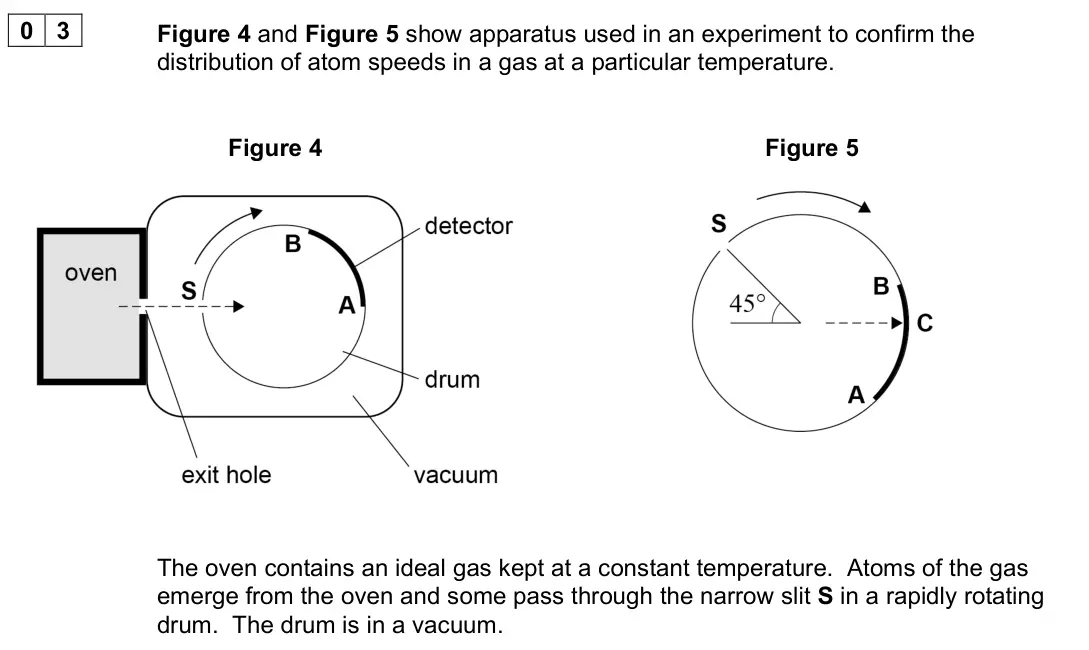
All 56 questions on Ideal gases, as a list
- June 2025, Paper 2, Q08 (1 mark): In an investigation of Boyle’s law, a sealed syringe of cross-sectional area 1.0 × 10⁻⁴ m2 contains 12 cm3 of gas. The gas is initially at atmospheric pressure.
- June 2025, Paper 2, Q09 (1 mark): The graph shows the variation of pressure with volume for a constant mass of a gas. The temperature of the gas: [1 mark] A decreases as the pressure increases.
- June 2025, Paper 2, Q10 (1 mark): The graph shows how the pressure of a fixed mass of gas varies with temperature. The gas has a constant volume. Which expression gives a value for absolute zero
- June 2024, Paper 2, Q01.1 (1 mark): Show that the amount of air in each cubic metre is about 40 mol. [1 mark]
- June 2024, Paper 2, Q08 (1 mark): [multiple choice] In which process is work done by an ideal gas? [1 mark] A doubling the pressure at constant volume B doubling the volume at constant pressure
- June 2024, Paper 2, Q10 (1 mark): An ideal gas is enclosed in an insulated container with a small electric heater. The initial temperature of the gas is 300 K. The product of pressure and volume
- June 2023, Paper 2, Q02.1 (5 marks): The mass of the wheel is measured when the gas in the tyre is at a pressure of 1.01 × 10⁵ Pa. More of the same gas is added to the tyre and the mass of the whee
- June 2023, Paper 2, Q02.2 (2 marks): Motorsport regulations specify a minimum amount of gas in the tyre. The amount of gas in the tyre is checked by measuring the pressure before the wheel is put o
- June 2023, Paper 2, Q09 (1 mark): Which can lead to a value for the absolute zero of temperature? [1 mark] A Boyle’s law B Brownian motion C Charles’s law D Rutherford scattering
- June 2022, Paper 2, Q02.3 (3 marks): A sealed flask of volume 0.35 m3 contains an ideal gas at a pressure of 220 kPa. The mean kinetic energy of the gas molecules is 6.7 × 10⁻²¹ J. Calculate the am
- June 2022, Paper 2, Q02.4 (2 marks): Figure 2 shows the variation of pressure with volume for a fixed mass of an ideal gas at constant absolute temperature T. Draw, on Figure 2, the graph for the s
- June 2022, Paper 2, Q07 (1 mark): [multiple choice] An ideal gas, initially at 300 K, is compressed to half its original volume. It is then cooled at constant volume until the pressure is restor
- June 2022, Paper 2, Q08 (1 mark): A fixed volume of an ideal gas is heated. Which row gives quantities that double when the kelvin temperature of the gas doubles? [1 mark] A rms speed of the mol
- June 2022, Paper 3A, Q04.1 (2 marks): Show that y is not inversely proportional to M. Use data points from Figure 10. [2 marks] Figure 10
- June 2022, Paper 3A, Q04.2 (3 marks): The masses are removed and the cylinder is inverted. P moves downwards without friction before coming to rest, as shown in Figure 11. Figure 11 Explain why P do
- June 2022, Paper 3A, Q04.3 (4 marks): The mass of P is 0.350 kg. Deduce y when the cylinder is in the inverted position shown in Figure 11. Draw a line of best fit on Figure 10 to arrive at your ans
- June 2022, Paper 3A, Q04.5 (3 marks): Figure 13 shows data obtained using the apparatus in Figure 12. Figure 13 Explain why the gradient of the graph in Figure 13 confirms that the air obeys Boyle’s
- June 2022, Paper 3A, Q04.6 (3 marks): The largest pressure that can be read from the pressure gauge is 3.4 × 10⁵ Pa. Determine, using Figure 13, the volume V corresponding to this pressure. [3 marks
- June 2022, Paper 3A, Q04.7 (2 marks): State one property of the air that must not change during the experiment. Go on to suggest how this can be achieved. [2 marks]
- November 2021, Paper 2, Q03.5 (1 mark): The pressure of gas in the oven is initially 5.0 × 10⁴ Pa. The volume of the oven is 2.7 × 10⁻² m3. During the experiment the pressure in the oven decreases to
- November 2021, Paper 2, Q09 (1 mark): A fixed mass of gas is heated at constant volume. The graph is drawn for this process. What do x and y represent? [1 mark] x y A pressure in Pa temperature in º
- November 2020, Paper 2, Q07 (1 mark): [multiple choice] When an ideal gas at a temperature of 27 °C is suddenly compressed to one quarter of its volume, the pressure increases by a factor of 7 What
- November 2020, Paper 2, Q08 (1 mark): The diagram shows two flasks X and Y connected by a thin tube of negligible volume. The flasks contain an ideal gas. The volume of X is twice the volume of Y. W
- June 2019, Paper 2, Q01.2 (4 marks): The work done by the nitrogen in the cylinder when expanding due to a change of state is X. The energy required to change the state of the nitrogen from a liqui
- June 2019, Paper 2, Q02.2 (2 marks): Absolute zero of temperature can be interpreted in terms of the ideal gas laws or the kinetic energy of particles in an ideal gas. Describe these two interpreta
- June 2018, Paper 2, Q08 (1 mark): [multiple choice] The graph shows the variation of pressure p with temperature for a fixed mass of an ideal gas at constant volume. What is the gradient of the
- June 2018, Paper 2, Q09 (1 mark): Two flasks X and Y are filled with an ideal gas and are connected by a tube of negligible volume compared to that of the flasks. The volume of X is twice the vo
- June 2018, Paper 3A, Q03.1 (2 marks): Explain why the volume of the air in the flask in Figure 9c is less than the volume of the air in the flask in Figure 9d. [2 marks]
- June 2018, Paper 3A, Q03.2 (2 marks): Explain why Charles’s Law can be applied to compare the air in the flask in Figure 9a with the air in the flask in Figure 9d. [2 marks]
- June 2018, Paper 3A, Q03.3 (3 marks): The flask is removed from water bath C and the valve and stopper are removed. The volume of the water in the flask is V1 The flask is then completely refilled w
- June 2018, Paper 3A, Q03.4 (3 marks): Plot on Figure 11 points to show the volume V and the temperature θ of the air in the flask when • the flask is as shown in Figure 9a • the flask is as shown in
- June 2018, Paper 3A, Q03.5 (1 mark): Add a best fit line to your graph in Figure 11 to show how V should vary with θ according to Charles’s Law. [1 mark]
- June 2018, Paper 3A, Q03.6 (3 marks): Determine the value of absolute zero in °C using your graph in Figure 11. [3 marks] value of absolute zero = °C
- June 2017, Paper 2, Q01.2 (2 marks): Calculate the number of gas molecules trapped in the cylinder using information from the initial situation at A. [2 marks] number of molecules =
- June 2017, Paper 2, Q01.3 (2 marks): Calculate, in K, the change in temperature of the gas during the compression that occurs between A and B. [2 marks] change in temperature = K
- June 2017, Paper 2, Q01.4 (2 marks): Deduce whether the temperature of the gas changes during the compression from B to C. [2 marks]
- June 2017, Paper 2, Q01.5 (3 marks): Compare the work done on the gas during the change from A to B with that from B to C on Figure 1. [3 marks]
- June 2017, Paper 2, Q10 (1 mark): The composition of a carbon dioxide (CO2) molecule is one atom of C 6 12 and two atoms of O 8 16 . What is the number of molecules of CO2 in 2.2 kg of the gas?
- Specimen, Paper 2, Q03.3 (6 marks): The ‘laws of football’ require the ball to have a circumference between 680 mm and 700 mm. The pressure of the air in the ball is required to be between 0.60 ×
- Specimen, Paper 2, Q25 (1 mark): A fixed mass of gas occupies a volume V. The temperature of the gas increases so that the root mean square velocity of the gas molecules is doubled. What will t
- Specimen, Paper 2, Q26 (1 mark): X and Y are two gas bottles that are connected by a tube that has negligible volume compared with the volume of each bottle. Initially the valve W is closed. X
- June 2016, PHYA5 Section A (old spec), Q4(a) (2 marks): ‘The pressure of an ideal gas is inversely proportional to its volume’, is an incomplete statement of Boyle’s law. State two conditions necessary to complete th
- June 2016, PHYA5 Section A (old spec), Q4(b)(i) (2 marks): Calculate the final volume of the air trapped in the cylinder. [2 marks] volume of air = __________________________ m3
- June 2016, PHYA5 Section A (old spec), Q4(b)(ii) (1 mark): Calculate the number of moles of air in the cylinder. [1 mark] number of moles = _____________________________
- June 2016, PHYA5 Section A (old spec), Q4(b)(iii) (2 marks): Calculate the initial density of air trapped in the cylinder. [2 marks] density = _______________________ kg m–3
- June 2015, PHYA5 Section A (old spec), Q5(a) (6 marks): The concept of an absolute zero of temperature may be explained by reference to the behaviour of a gas. Discuss one experiment that can be performed using a gas
- June 2014, PHYA5 Section A (old spec), Q3(a) (1 mark): Define the Avogadro constant. [1 mark]
- June 2013, PHYA5 Section A (old spec), Q4(b)(i) (2 marks): Calculate the number of moles of gas contained in the cylinder. number of moles mol (2 marks)
- June 2013, PHYA5 Section A (old spec), Q4(b)(ii) (3 marks): The gas has a molar mass of 4.3 × 10⁻² kgmol–1. Calculate the density of the gas in the cylinder. State an appropriate unit for your answer. density unit (3 mar
- June 2013, PHYA5 Section A (old spec), Q4(b)(iii) (3 marks): The cylinder is taken to high altitude where the temperature is –50ºC and the pressure is 3.6 × 10⁴ Pa. A valve on the cylinder is opened to allow gas to escape
- June 2012, PHYA5 Section A (old spec), Q4(a)(i) (1 mark): Calculate the number of moles of air in the tyre. answer = mol (1 mark)
- June 2012, PHYA5 Section A (old spec), Q4(a)(ii) (3 marks): After the bicycle has been ridden the temperature of the air in the tyre is 295K. Calculate the new pressure in the tyre assuming the volume is unchanged. Give
- June 2011, PHYA5 Section A (old spec), Q5(a) (2 marks): Draw a graph on the axes below to show how the volume of the gas varies with temperature in oC. (2 marks) –300 –250 –200 –150 temperature /°C –100 –50 0 50 volu
- June 2011, PHYA5 Section A (old spec), Q5(b) (2 marks): Calculate the number of moles of gas present in the container. answer = moles (2 marks)
- January 2009, PA02 (2008 spec), Q6 (5 marks): 6 (i) On the axes below sketch a graph to show how the pressure, p, of a fixed mass of ideal gas varies with absolute temperature, T, if the gas is kept at a co
- June 2008, PA02 (2008 spec), Q5(a) (5 marks): 5 (a) 6.7 mol of an ideal gas in a rigid container exerts a pressure of 110 kPa at a temperature of 25°C. 5 (a) (i) Calculate the volume of the container. 5 (a)
Questions, mark schemes and examiner’s reports are © AQA, from their published past papers. Plumi isn’t affiliated with any exam board. Want whole papers? AQA A-Level Physics past papers.
The Plumi iPad app also offers exam-style questions with AI feedback on your handwritten working.