 plumi
Molecular kinetic theory model: AQA A‑Level Physics questions
AQA A-Level Physics past-paper questions on 3.6.2.3 Molecular kinetic theory model, 2008–2025, with mark schemes and examiner’s reports where available.
Paper
All papers
Exam
All years
Calculations
Q02.1
The whole paper ↗
Q02.2
The whole paper ↗Q02.3
The whole paper ↗Q02.4
The whole paper ↗Q02.5
The whole paper ↗Q01.2
The whole paper ↗
Q01.3
The whole paper ↗- Your answer
Q01.1
The whole paper ↗Q01.2
The whole paper ↗Q01.3
The whole paper ↗Q01.4
The whole paper ↗Q07.4
The whole paper ↗Q02.1
The whole paper ↗Q02.2
The whole paper ↗Q02.3
The whole paper ↗Q03.1
The whole paper ↗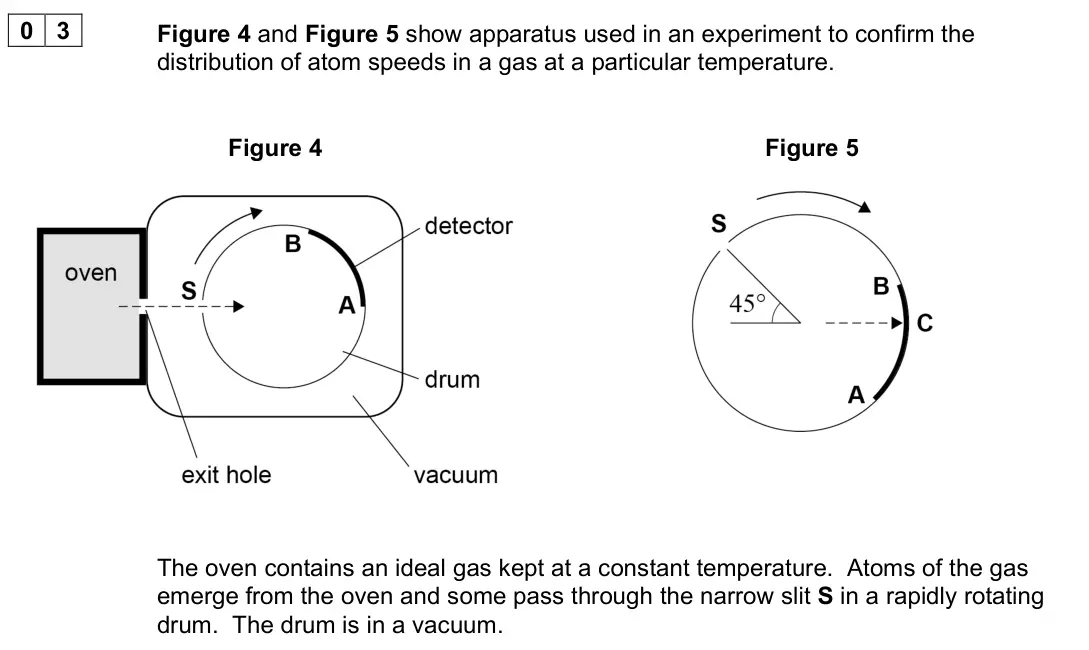
Q03.3
The whole paper ↗Q03.4
The whole paper ↗
All 59 questions on Molecular kinetic theory model, as a list
- June 2025, Paper 2, Q02.1 (2 marks): One of these assumptions is that particle motion is random. State what is meant by random particle motion. [2 marks]
- June 2025, Paper 2, Q02.2 (2 marks): State two other assumptions required for this derivation. [2 marks] 1 2
- June 2025, Paper 2, Q02.3 (3 marks): When the temperature of a fixed mass of an ideal gas increases at constant pressure, the gas must expand. Explain this expansion using the kinetic theory model.
- June 2025, Paper 2, Q02.4 (1 mark): Helium behaves as an ideal gas. The temperature of a sample of helium gas is increased from 27 °C to 77 °C. Calculate the change in the average kinetic energy o
- June 2025, Paper 2, Q02.5 (3 marks): When an ideal gas is heated at constant volume, all of the energy supplied by heating is used to increase the average kinetic energy of the particles. When wate
- June 2024, Paper 2, Q01.2 (3 marks): The density of the dry air is 1.25 kg m−3. Calculate crms for the air molecules. Give your answer to an appropriate number of significant figures. [3 marks] crm
- June 2024, Paper 2, Q01.3 (2 marks): Calculate, in K, the change of temperature that will double crms for the air molecules. [2 marks] change of temperature = K
- June 2024, Paper 2, Q09 (1 mark): Three molecules have speeds 2.00v, 4.00v and 5.00v. What is the crms speed of these molecules? [1 mark] A 3.50v B 3.67v C 3.87v D 26.0v
- June 2023, Paper 2, Q01.1 (1 mark): State what is meant by the internal energy of an ideal gas. [1 mark]
- June 2023, Paper 2, Q01.2 (1 mark): Explain why P has a change in momentum of −2mc during one collision with W. [1 mark]
- June 2023, Paper 2, Q01.3 (1 mark): P collides repeatedly with W. Show that the frequency f of collisions is 2 c l . [1 mark]
- June 2023, Paper 2, Q01.4 (2 marks): Deduce an expression, in terms of m, c and V, for the contribution of P to the pressure exerted on W. Refer to appropriate Newton’s laws of motion. [2 marks]
- June 2023, Paper 2, Q07.4 (3 marks): In a reactor, the speed of a fast-moving neutron is reduced by a series of y random collisions with carbon-12 nuclei. The final kinetic energy Ef of the neutron
- June 2022, Paper 2, Q02.1 (2 marks): In the kinetic theory model, it is assumed that there are many identical particles moving at random. State two other assumptions made in deriving the equation p
- June 2022, Paper 2, Q02.2 (3 marks): Explain why molecules of a gas exert a force on the walls of a container. Refer to Newton’s laws of motion in your answer. [3 marks]
- June 2022, Paper 2, Q02.3 (3 marks): A sealed flask of volume 0.35 m3 contains an ideal gas at a pressure of 220 kPa. The mean kinetic energy of the gas molecules is 6.7 × 10⁻²¹ J. Calculate the am
- June 2022, Paper 2, Q08 (1 mark): A fixed volume of an ideal gas is heated. Which row gives quantities that double when the kelvin temperature of the gas doubles? [1 mark] A rms speed of the mol
- November 2021, Paper 2, Q03.1 (1 mark): Explain why the drum must be in a vacuum. [1 mark]
- November 2021, Paper 2, Q03.3 (3 marks): The speed of the atom in Question 03.2 is equal to crms, the root mean square speed of the atoms of the gas in the oven. The molar mass of the gas is 0.209 kg m
- November 2021, Paper 2, Q03.4 (2 marks): The oven temperature is kept constant during the experiment but the pressure in the oven decreases as atoms leave through the exit hole. Explain, using the kine
- November 2021, Paper 2, Q03.6 (2 marks): Atoms enter the drum every time S passes the exit hole. The detector darkens at the point where an atom strikes it. After a time, the detector is removed from t
- November 2021, Paper 2, Q08 (1 mark): A gas occupies a volume V. Its particles have a root mean square speed (crms) of u. The gas is compressed at constant temperature to a volume 0.5V. What is the
- November 2021, Paper 2, Q10 (1 mark): Three particles are travelling in the same plane with velocities as shown in the vector diagram. What is the root mean square speed of the particles? [1 mark] A
- November 2020, Paper 2, Q09 (1 mark): A sample P of an ideal gas contains 1 mol at an absolute temperature T. A second sample Q of an ideal gas contains 2 3 mol at an absolute temperature 2T. The to
- November 2020, Paper 2, Q10 (1 mark): An ideal gas is contained in a cubical box of side length a. The gas has N molecules each of mass m. What is the pressure exerted by the gas on the walls of the
- November 2020, Paper 2, Q11 (1 mark): Which statement is true about an experiment where Brownian motion is demonstrated using smoke particles in air? [1 mark] A The experiment makes it possible to s
- June 2019, Paper 2, Q02.3 (3 marks): A mixture of argon atoms and helium atoms is in a cylinder enclosed with a piston. The mixture is at a temperature of 310 K. Calculate the root mean square spee
- June 2019, Paper 2, Q02.4 (1 mark): Compare the mean kinetic energy of the argon atoms and the helium atoms in the mixture. [1 mark]
- June 2019, Paper 2, Q02.5 (3 marks): Explain, in terms of the kinetic theory model, why a pressure is exerted by the gas on the piston. [3 marks]
- June 2019, Paper 2, Q02.6 (3 marks): The mixture of gases in the cylinder stays the same. Explain, using the kinetic theory model, two changes that can be made independently to reduce the pressure
- June 2019, Paper 2, Q07 (1 mark): [multiple choice] Brownian motion [1 mark] A makes it possible to see the motion of air molecules. B is caused by the collisions of smoke particles. C is caused
- June 2019, Paper 2, Q25 (1 mark): Which is not an assumption about gas particles in the kinetic theory model for a gas? [1 mark] A They collide elastically with the container walls. B They have
- June 2018, Paper 2, Q10 (1 mark): The average mass of an air molecule is 4.8 × 10⁻²⁶ kg What is the mean square speed of an air molecule at 750 K? [1 mark] A 3.3 × 10⁵ m2 s–2 B 4.3 × 10⁵ m2 s–2
- June 2018, Paper 2, Q11 (1 mark): A transparent illuminated box contains small smoke particles and air. The smoke particles are observed to move randomly when viewed through a microscope. What i
- June 2018, Paper 2, Q12 (1 mark): The diagram shows a gas particle about to collide elastically with a wall. Which diagram shows the correct change in momentum ∆mv that occurs during the collisi
- June 2017, Paper 2, Q01.1 (1 mark): A number of assumptions are made when explaining the behaviour of a gas using the molecular kinetic theory model. State one assumption about the size of molecul
- June 2017, Paper 2, Q11 (1 mark): What is the total internal energy of 2.4 mol of an ideal gas which has a temperature of 15 °C? [1 mark] A 6.0 × 10⁻²¹ J B 1.4 × 10⁻²⁰ J C 4.5 × 10² J D 8.6 × 10
- Specimen, Paper 2, Q03.1 (2 marks): State two assumptions made about the motion of the molecules in a gas in the derivation of the kinetic theory of gases equation. [2 marks] 0 3 . 1
- Specimen, Paper 2, Q03.2 (3 marks): Use the kinetic theory of gases to explain why the pressure inside a football increases when the temperature of the air inside it rises. Assume that the volume
- Specimen, Paper 2, Q25 (1 mark): A fixed mass of gas occupies a volume V. The temperature of the gas increases so that the root mean square velocity of the gas molecules is doubled. What will t
- June 2016, PHYA5 Section A (old spec), Q4(c) (2 marks): State and explain what happens to the speed of molecules in a gas as the temperature increases. [2 marks] ______________________________________________________
- June 2015, PHYA5 Section A (old spec), Q5(b)(i) (2 marks): State two assumptions about the movement of molecules that are used when deriving the equation of state, pV = – N m (crms)2 for an ideal gas. [2 marks] 1 2 1 3
- June 2015, PHYA5 Section A (old spec), Q5(b)(ii) (1 mark): Three molecules move at the speeds shown in Table 2. Table 2 Calculate their mean square speed. [1 mark] mean square speed m2 s–2 molecule speed / m s–1 1 2000
- June 2015, PHYA5 Section A (old spec), Q5(c) (2 marks): The average molecular kinetic energy of an ideal gas is 6.6 × 10⁻²¹ J. Calculate the temperature of the gas. [2 marks] temperature K END OF SECTION A
- June 2014, PHYA5 Section A (old spec), Q3(b)(i) (1 mark): Calculate the mean kinetic energy of krypton atoms in a sample of gas at a temperature of 22 ºC. [1 mark] mean kinetic energy J
- June 2014, PHYA5 Section A (old spec), Q3(b)(ii) (3 marks): Calculate the mean-square speed, (crms)2, of krypton atoms in a sample of gas at a temperature of 22 ºC. State an appropriate unit for your answer. mass of 1 mo
- June 2014, PHYA5 Section A (old spec), Q3(c) (2 marks): A sample of gas consists of a mixture of krypton and argon atoms. The mass of a krypton atom is greater than that of an argon atom. State and explain how the me
- June 2013, PHYA5 Section A (old spec), Q4(a) (2 marks): Outline what is meant by an ideal gas. (2 marks)
- June 2012, PHYA5 Section A (old spec), Q4(b) (2 marks): Describe one way in which the motion of the molecules of air inside the bicycle tyre is similar and one way in which it is different at the two temperatures. si
- June 2011, PHYA5 Section A (old spec), Q5(c) (3 marks): Calculate the average kinetic energy of a molecule when this gas is at a temperature of 50.0 oC. Give your answer to an appropriate number of significant figure
- June 2011, PHYA5 Section A (old spec), Q5(d) (1 mark): Calculate the total internal energy of the gas at a temperature of 50.0 oC. answer = J (1 mark)
- June 2011, PHYA5 Section A (old spec), Q5(e) (6 marks): By considering the motion of the molecules explain how a gas exerts a pressure and why the volume of the container must change if the pressure is to remain cons
- June 2008, PA02 (2008 spec), Q5(a) (5 marks): 5 (a) 6.7 mol of an ideal gas in a rigid container exerts a pressure of 110 kPa at a temperature of 25°C. 5 (a) (i) Calculate the volume of the container. 5 (a)
- June 2008, PA02 (2008 spec), Q5(b) (3 marks): 5 (b) Two of the assumptions about the behaviour of the molecules of an ideal gas are that they move with random motion and make elastic collisions with the wal
- June 2008, PA10 (2008 spec), Q5(a) (5 marks): 5 (a) (i) Estimate the mean kinetic energy of an atom of the vapour at a temperature of 3000 K. 5 (a) (ii) Explain why the vapour emits light when its temperatu
- January 2008, PA02 (2008 spec), Q1(a) (2 marks): 1 (a) One of the assumptions of the kinetic theory of gases is that gas molecules move with random motion. State two other assumptions of the kinetic theory of
- January 2008, PA02 (2008 spec), Q1(b) (2 marks): (b) Explain why the average velocity of the gas molecules in a container is zero. (2 marks)
- January 2008, PA02 (2008 spec), Q1(c) (2 marks): (c) The pressure a gas exerts on the walls of a container depends on the mean square speed of the molecules. Explain what is meant by mean square speed. (2 mark
- January 2008, PA02 (2008 spec), Q1(d) (2 marks): (d) Explain why the mean square speeds of the gas molecules of two different gases at the same temperature are not the same. (2 marks)
Questions, mark schemes and examiner’s reports are © AQA, from their published past papers. Plumi isn’t affiliated with any exam board. Want whole papers? AQA A-Level Physics past papers.
The Plumi iPad app also offers exam-style questions with AI feedback on your handwritten working.