 plumi
Telescopes: AQA A‑Level Physics questions
Every AQA A-Level Physics exam question on 3.9.1 Telescopes, 2016–2025, with its mark scheme and examiner’s report.
Find questions2,714
Calculations
Q02.1
The whole paper ↗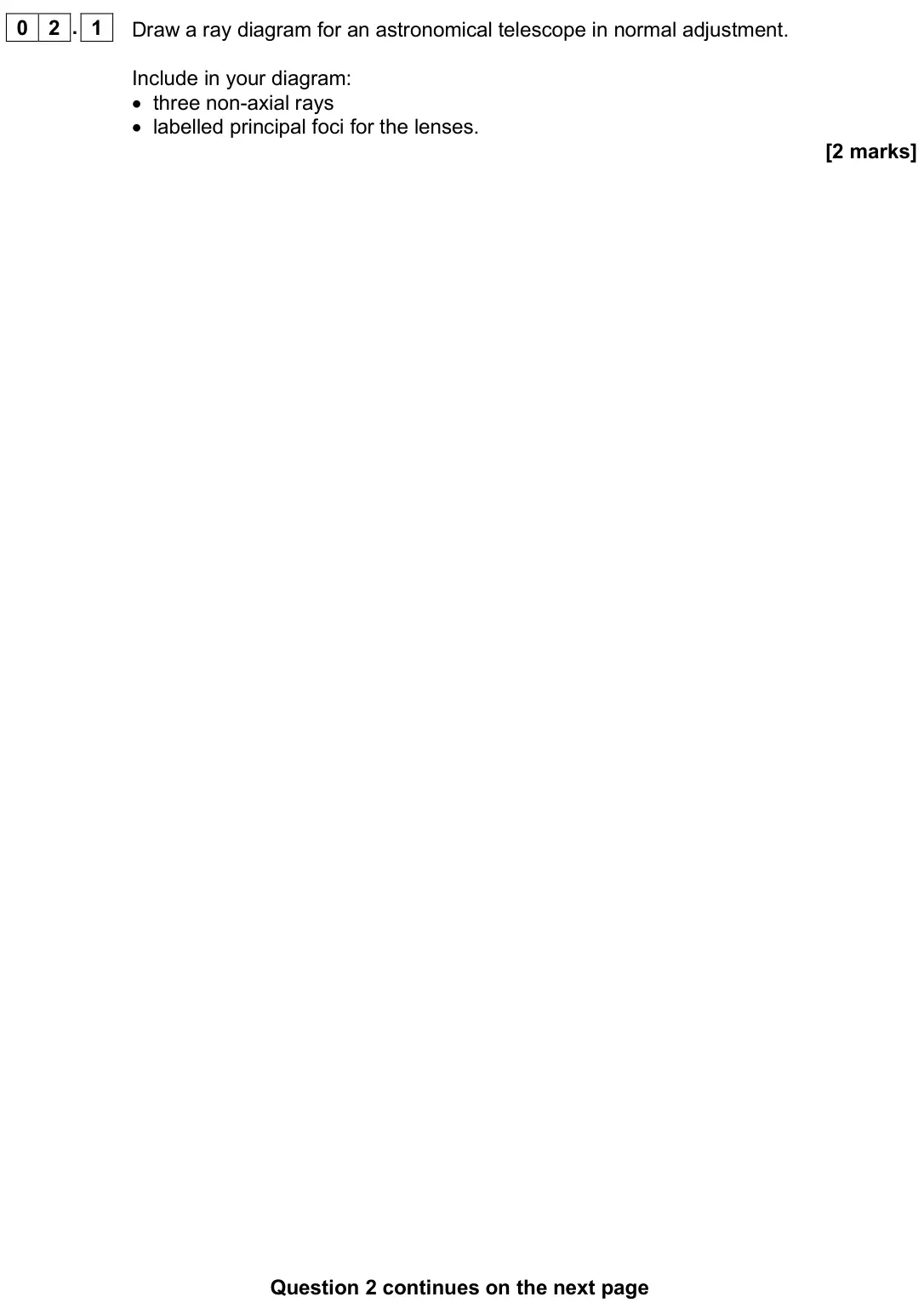
Q02.2
The whole paper ↗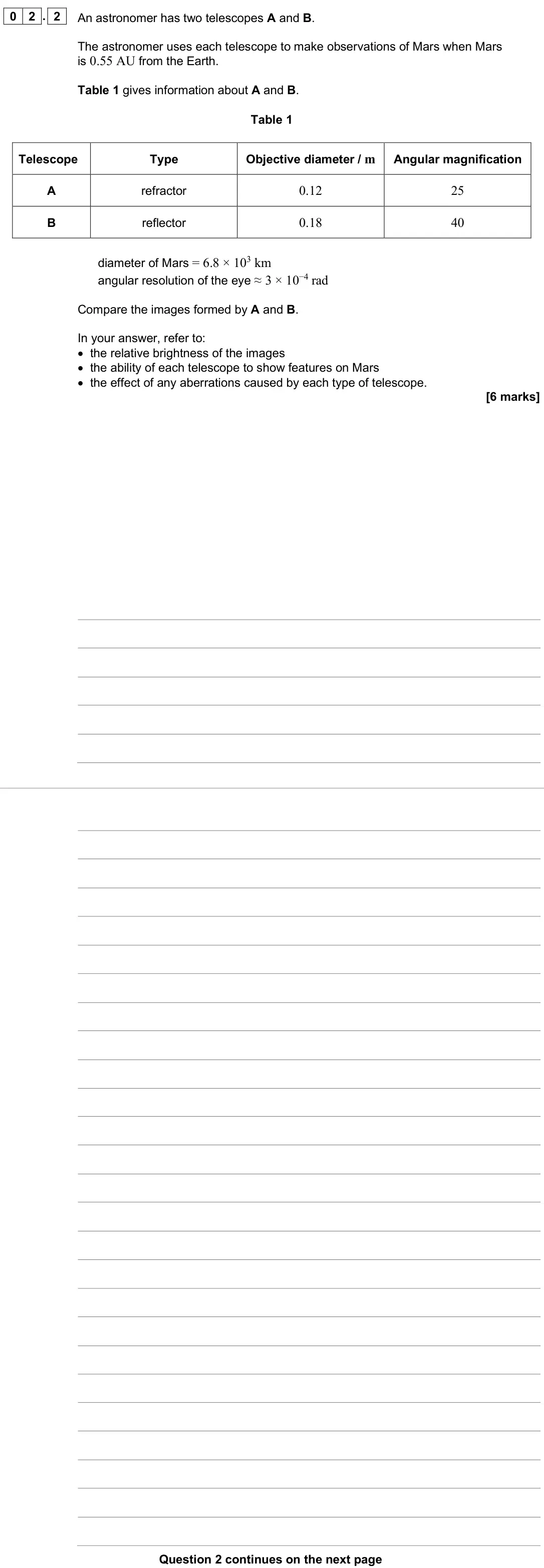
Q02.3
The whole paper ↗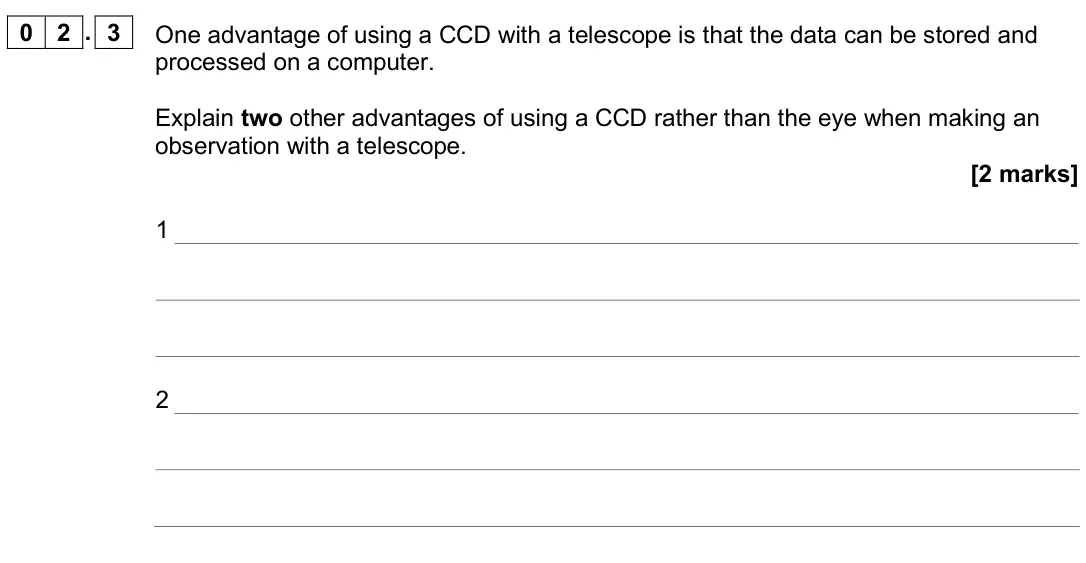
Q01.1
The whole paper ↗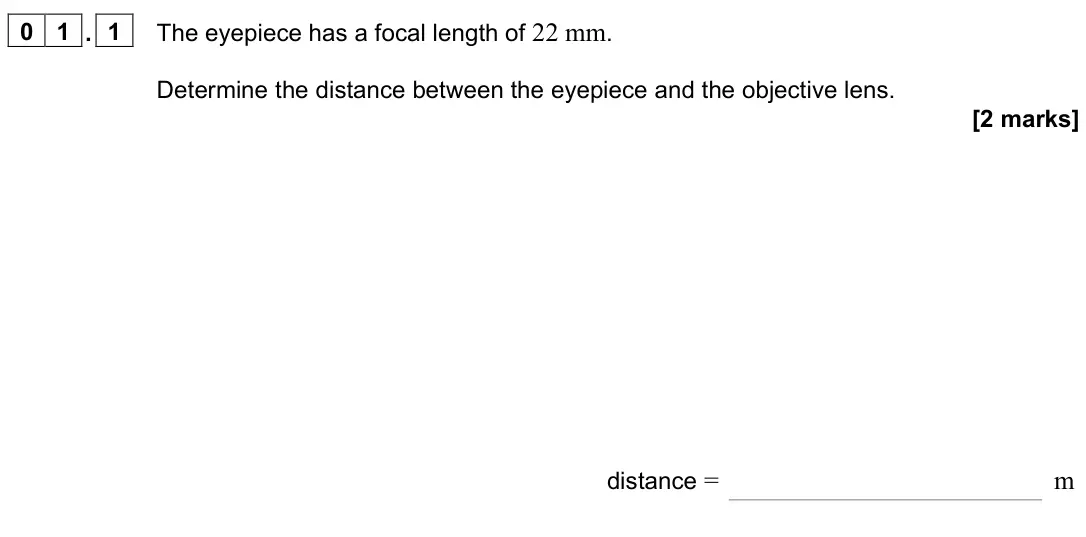
Q01.2
The whole paper ↗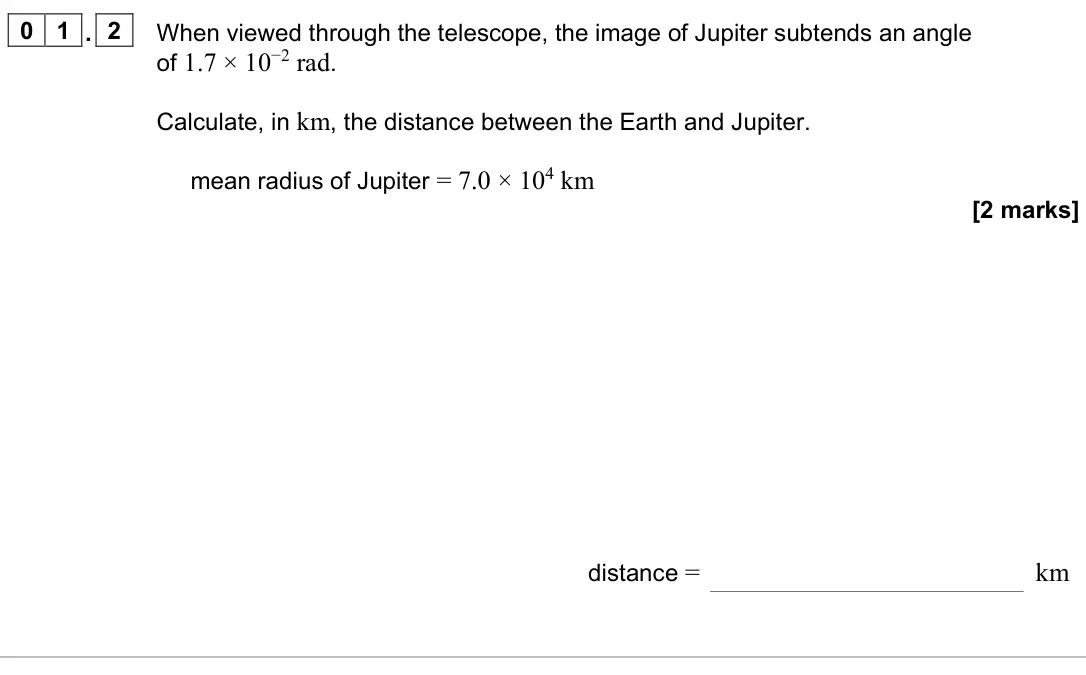
Q01.3
The whole paper ↗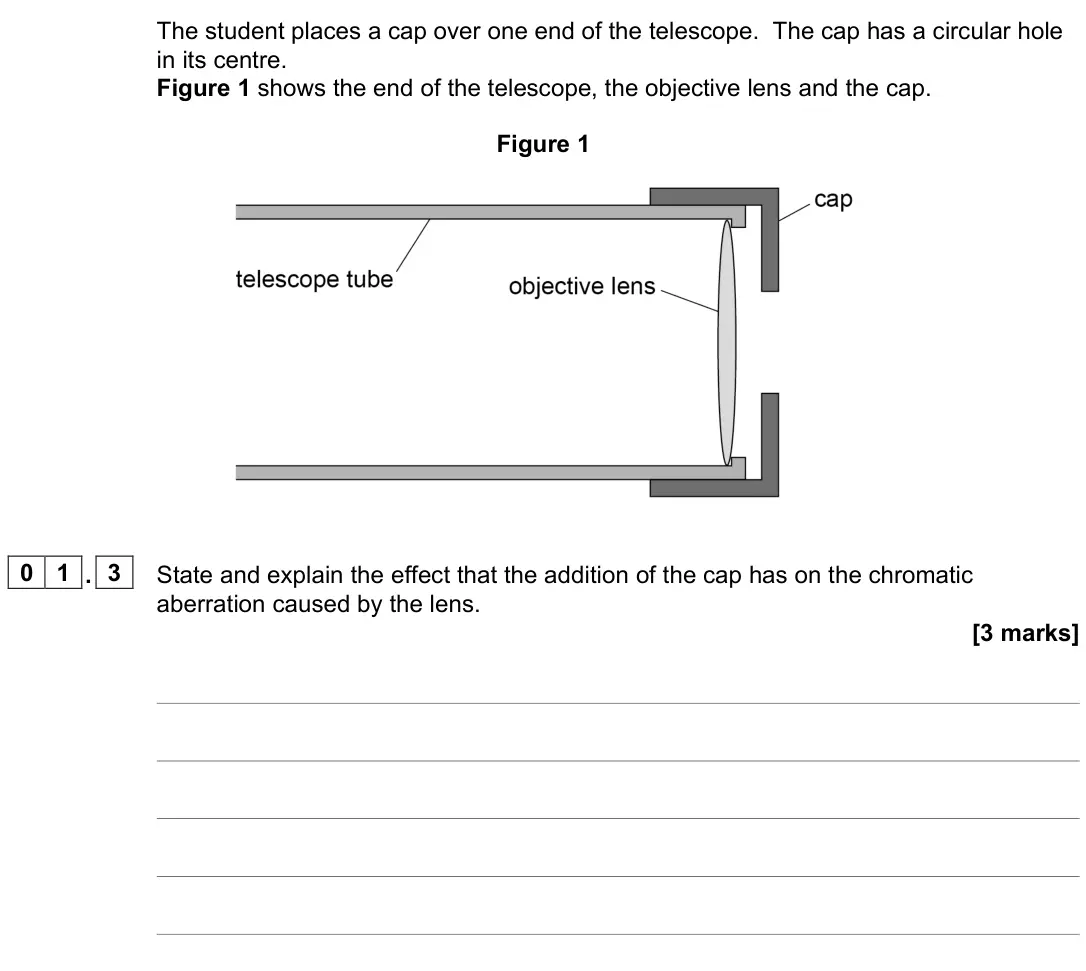
Q01.4
The whole paper ↗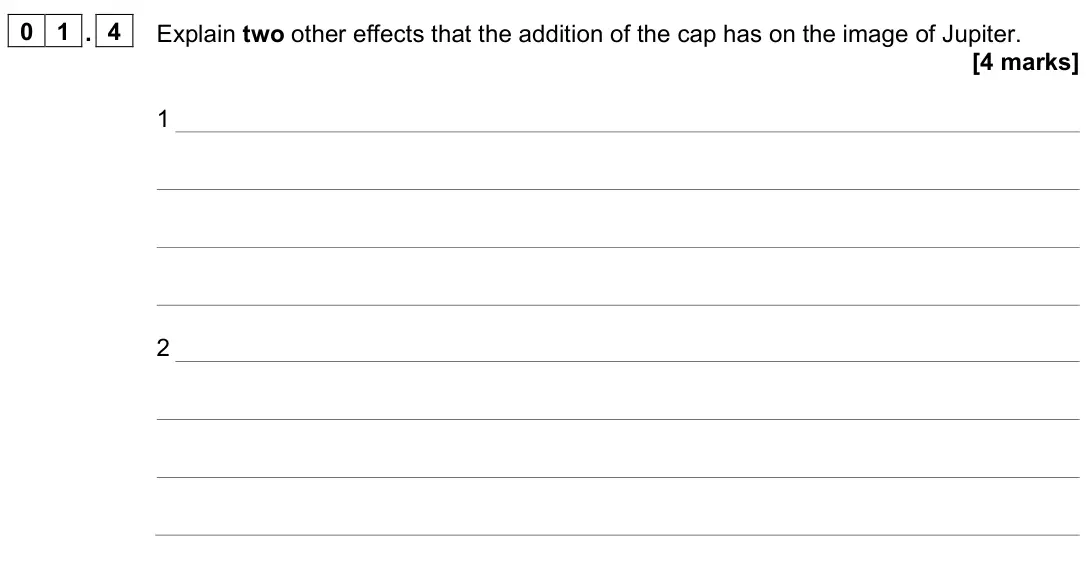
Q02.1
The whole paper ↗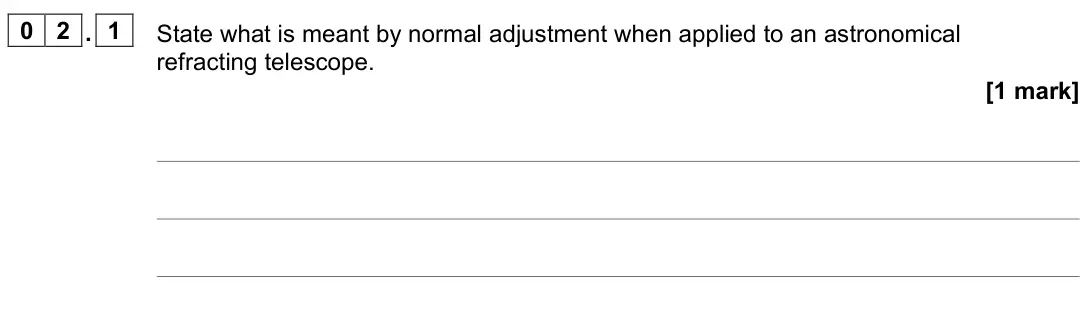
Q02.4
The whole paper ↗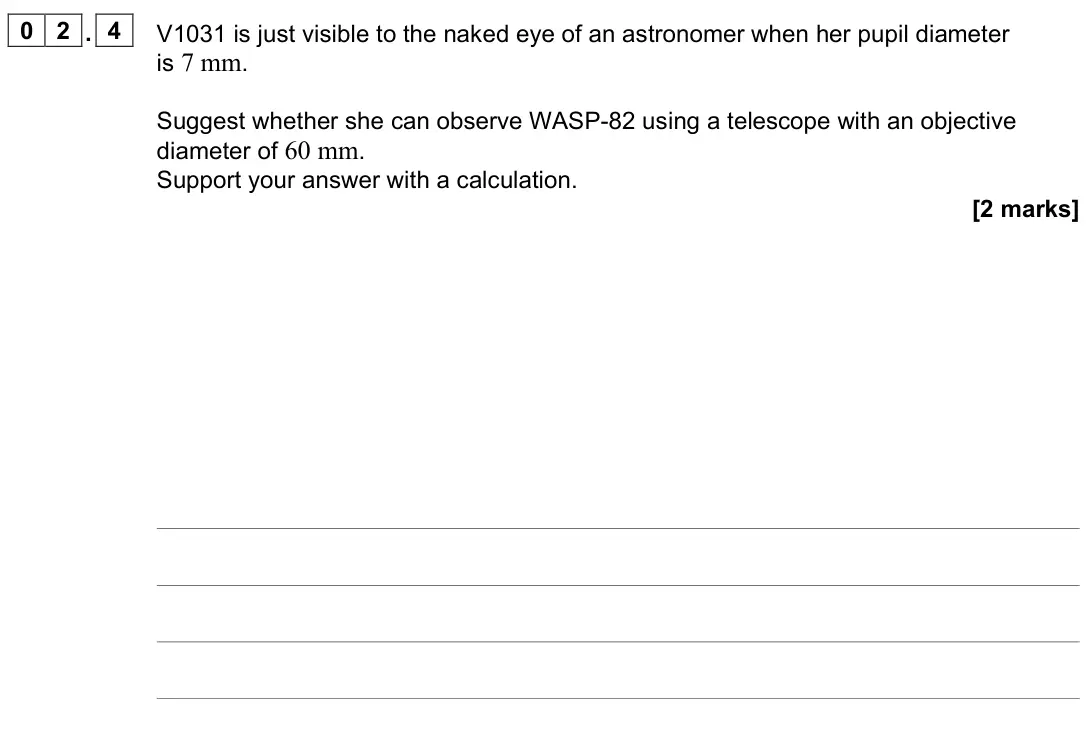
Q02.5
The whole paper ↗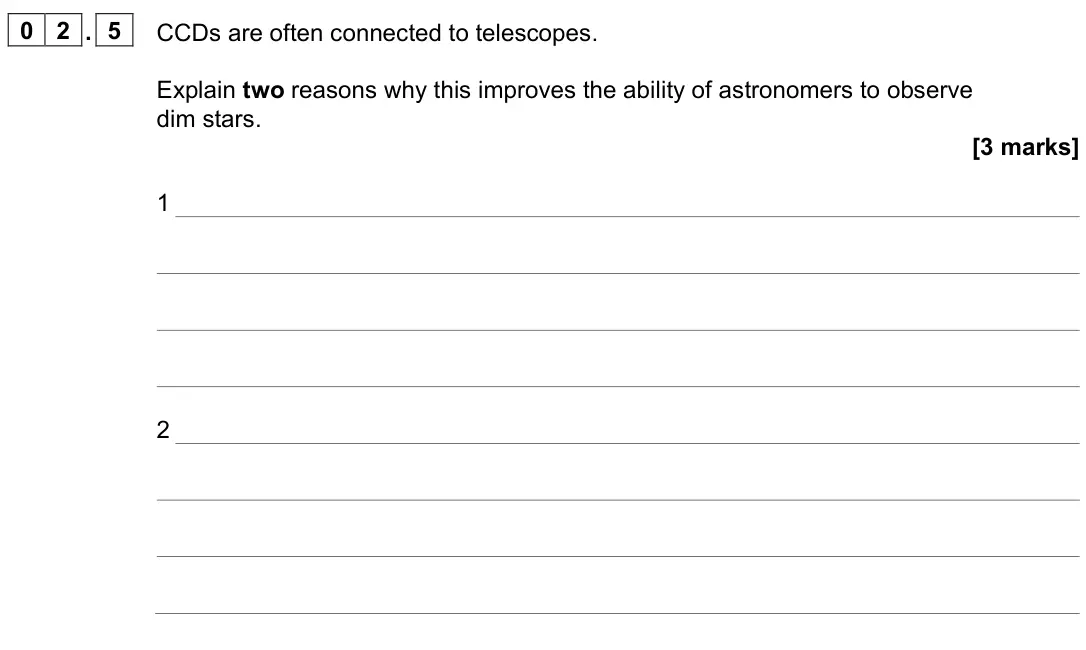
Q03.2
The whole paper ↗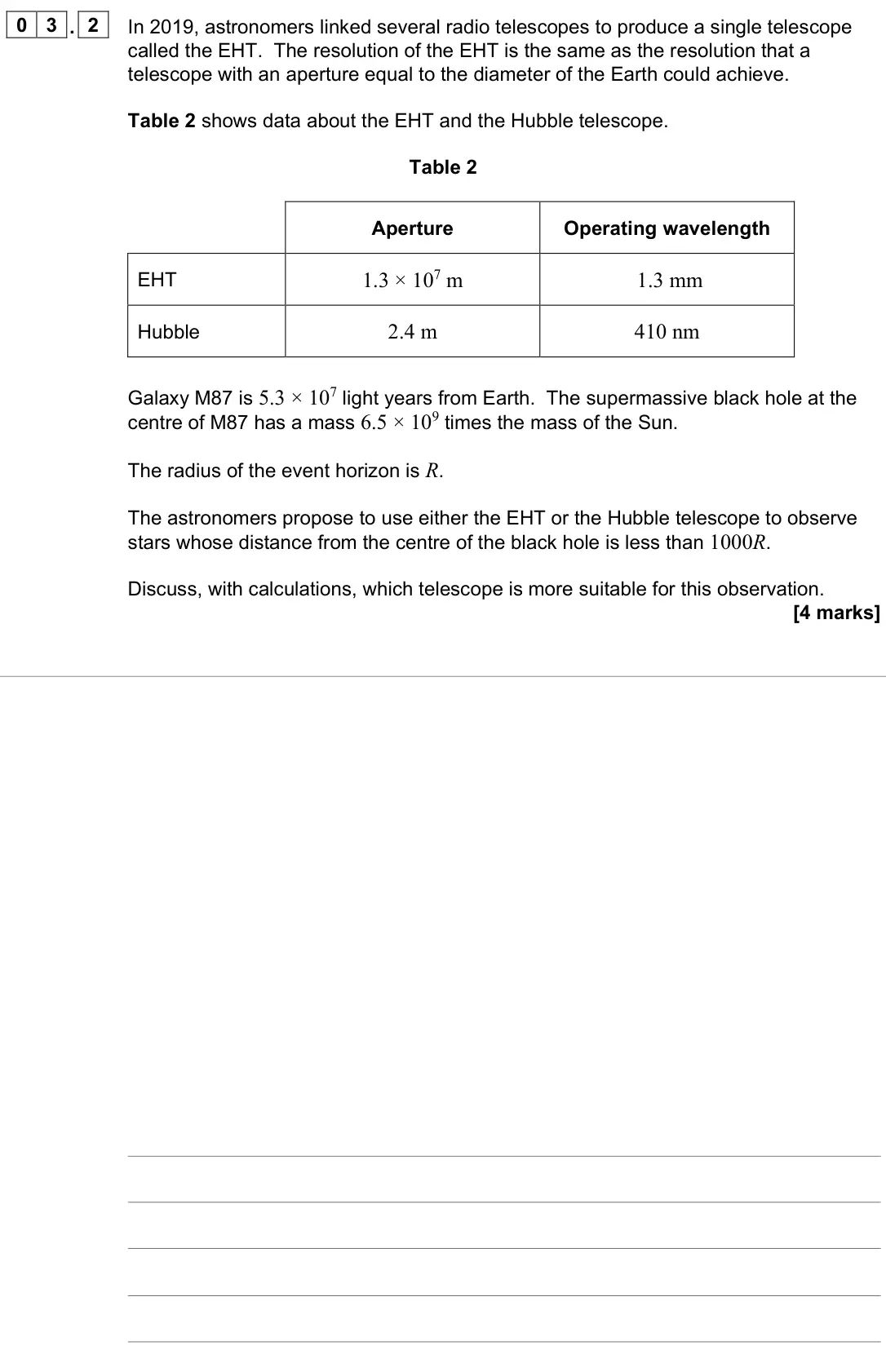
Q01.1
The whole paper ↗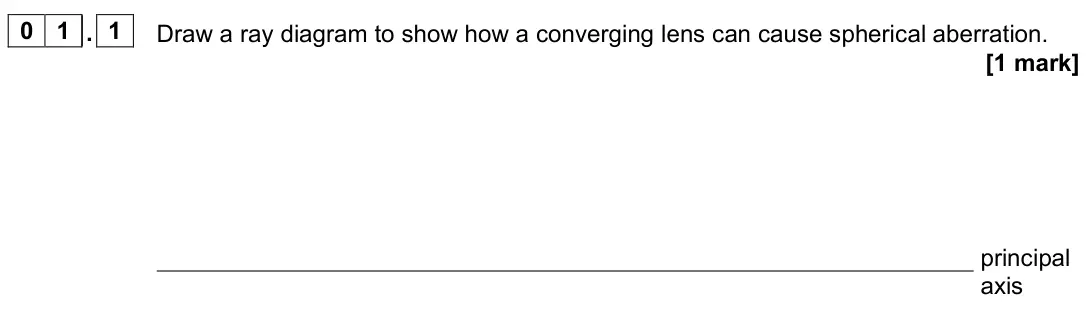
Q01.2
The whole paper ↗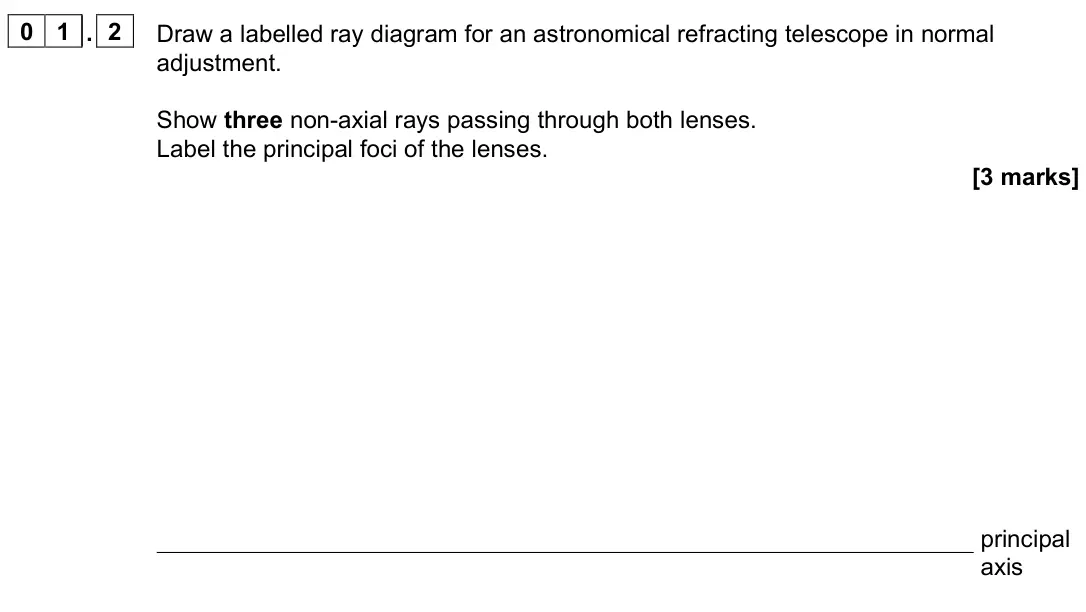
Q01.3
The whole paper ↗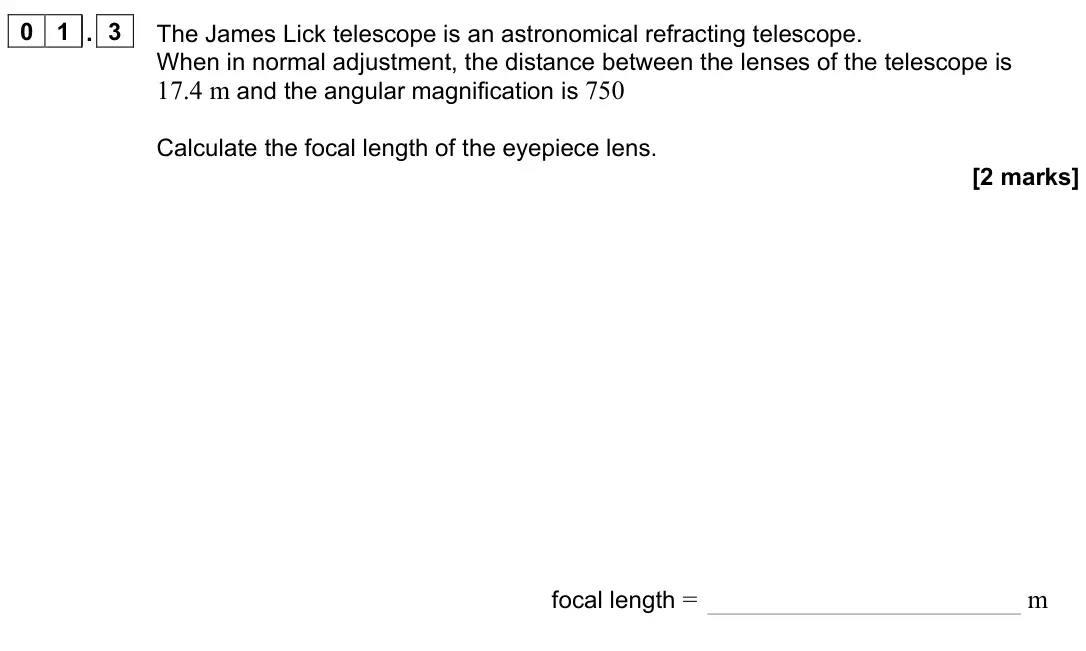
Q01.4
The whole paper ↗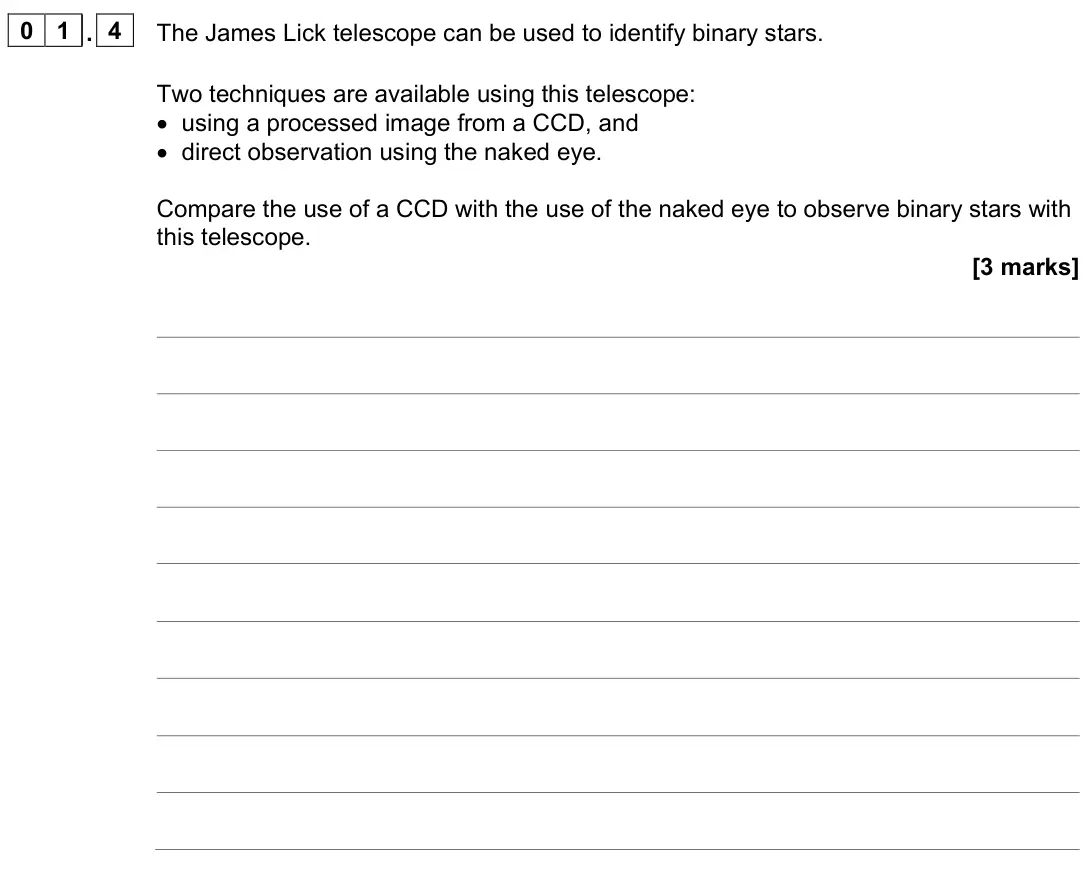
Q05.1
The whole paper ↗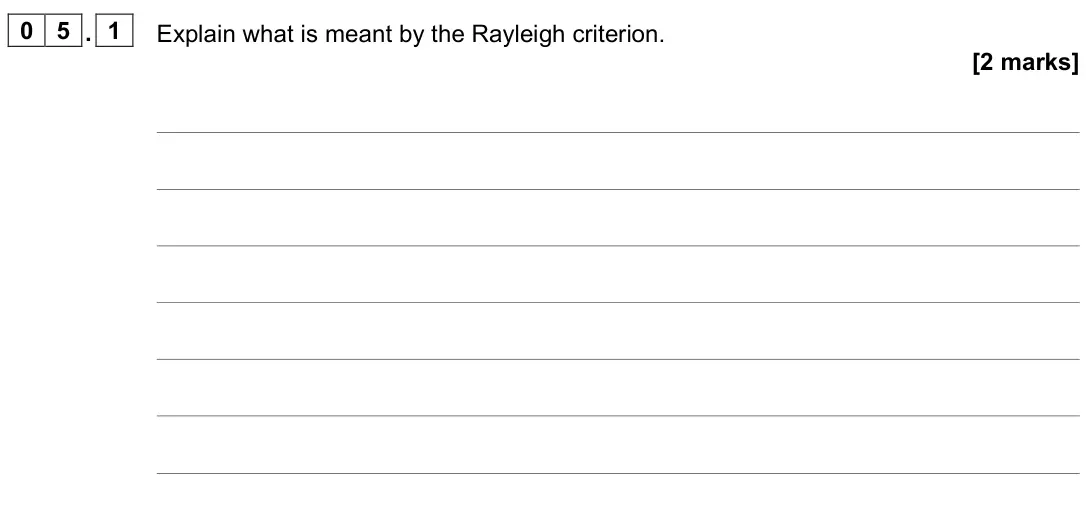
Q05.2
The whole paper ↗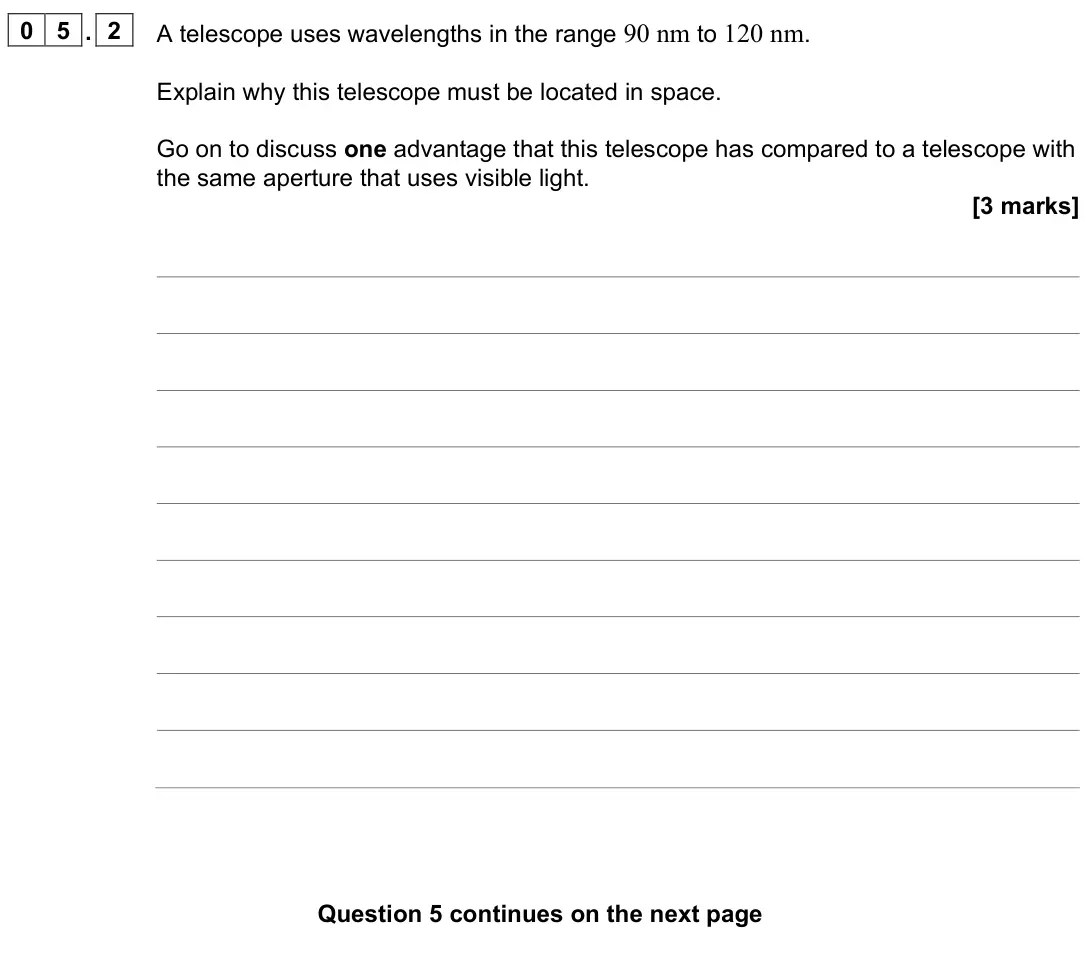
Q05.3
The whole paper ↗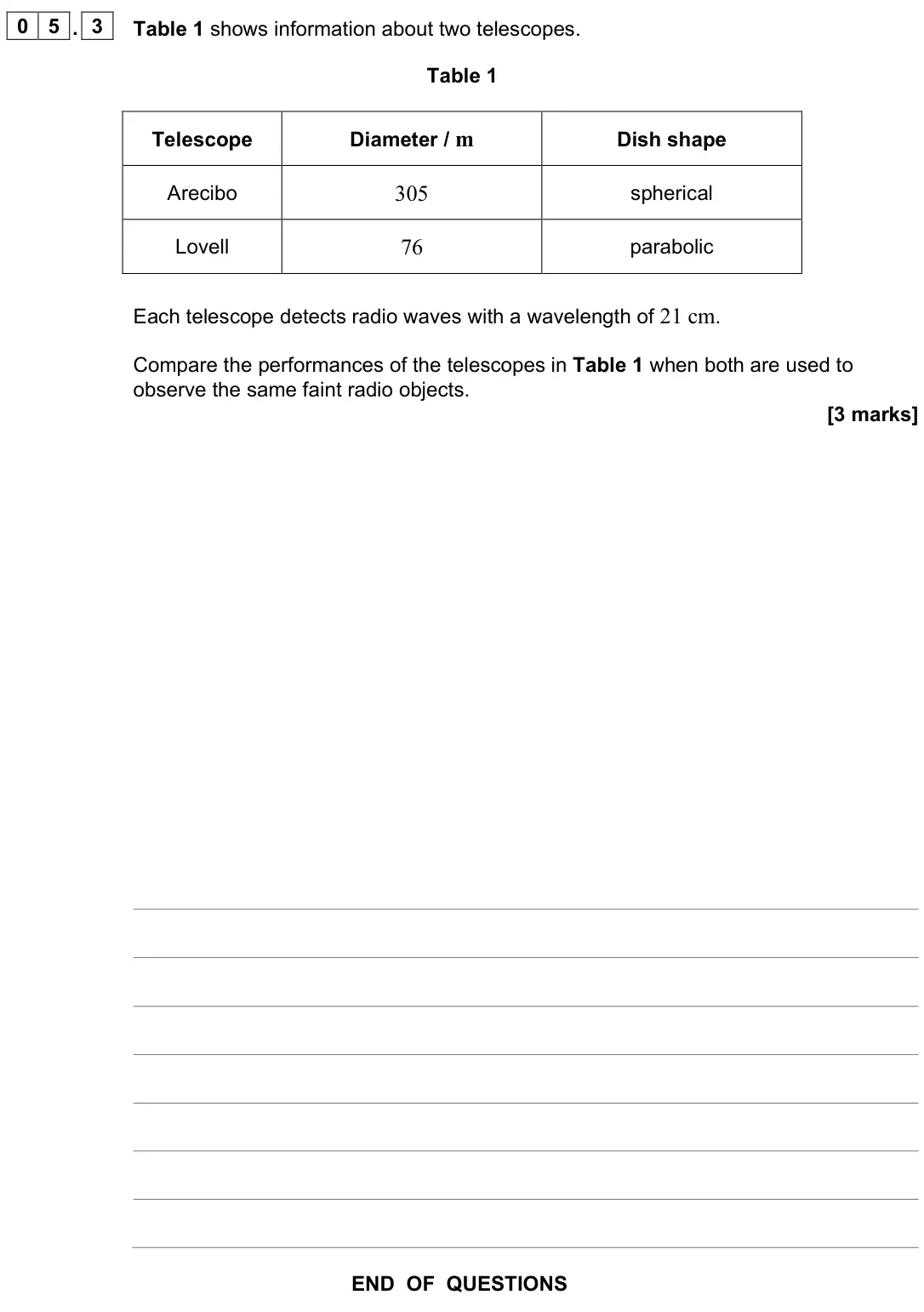
Q01.1
The whole paper ↗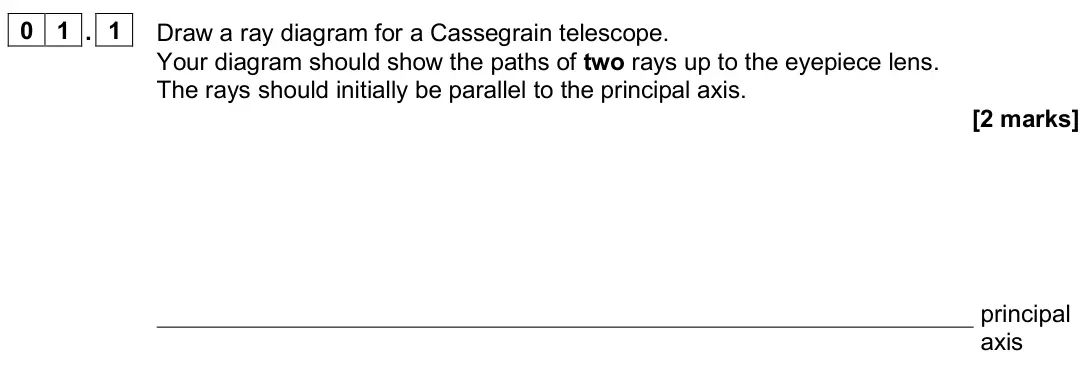
All 36 questions on Telescopes, as a list
- June 2025, Paper 3 Astrophysics, Q02.1 (2 marks): Draw a ray diagram for an astronomical telescope in normal adjustment. Include in your diagram: • three non-axial rays • labelled principal foci for the lenses.
- June 2025, Paper 3 Astrophysics, Q02.2 (6 marks): An astronomer has two telescopes A and B. The astronomer uses each telescope to make observations of Mars when Mars is 0.55 AU from the Earth. Table 1 gives inf
- June 2025, Paper 3 Astrophysics, Q02.3 (2 marks): One advantage of using a CCD with a telescope is that the data can be stored and processed on a computer. Explain two other advantages of using a CCD rather tha
- June 2024, Paper 3 Astrophysics, Q01.1 (2 marks): The eyepiece has a focal length of 22 mm. Determine the distance between the eyepiece and the objective lens. [2 marks] distance = m
- June 2024, Paper 3 Astrophysics, Q01.2 (2 marks): When viewed through the telescope, the image of Jupiter subtends an angle of 1.7 × 10⁻² rad. Calculate, in km, the distance between the Earth and Jupiter. mean
- June 2024, Paper 3 Astrophysics, Q01.3 (3 marks): State and explain the effect that the addition of the cap has on the chromatic aberration caused by the lens. [3 marks]
- June 2024, Paper 3 Astrophysics, Q01.4 (4 marks): Explain two other effects that the addition of the cap has on the image of Jupiter. [4 marks] 1 2
- June 2023, Paper 3 Astrophysics, Q02.1 (1 mark): State what is meant by normal adjustment when applied to an astronomical refracting telescope. [1 mark]
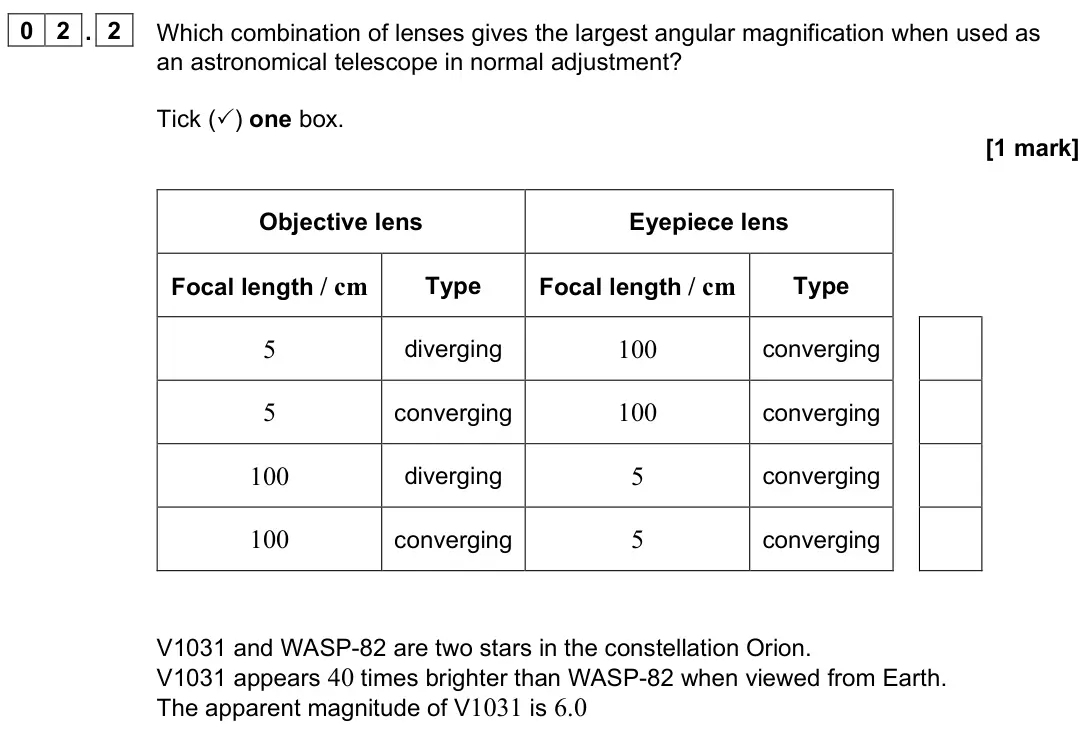
- June 2023, Paper 3 Astrophysics, Q02.2 (1 mark): Which combination of lenses gives the largest angular magnification when used as an astronomical telescope in normal adjustment? Tick () one box. [1 mark] Obje
- June 2023, Paper 3 Astrophysics, Q02.4 (2 marks): V1031 is just visible to the naked eye of an astronomer when her pupil diameter is 7 mm. Suggest whether she can observe WASP-82 using a telescope with an objec
- June 2023, Paper 3 Astrophysics, Q02.5 (3 marks): CCDs are often connected to telescopes. Explain two reasons why this improves the ability of astronomers to observe dim stars. [3 marks] 1 2
- June 2023, Paper 3 Astrophysics, Q03.2 (4 marks): In 2019, astronomers linked several radio telescopes to produce a single telescope called the EHT. The resolution of the EHT is the same as the resolution that
- June 2022, Paper 3 Astrophysics, Q01.1 (1 mark): Draw a ray diagram to show how a converging lens can cause spherical aberration. [1 mark] principal axis
- June 2022, Paper 3 Astrophysics, Q01.2 (3 marks): Draw a labelled ray diagram for an astronomical refracting telescope in normal adjustment. Show three non-axial rays passing through both lenses. Label the prin
- June 2022, Paper 3 Astrophysics, Q01.3 (2 marks): The James Lick telescope is an astronomical refracting telescope. When in normal adjustment, the distance between the lenses of the telescope is 17.4 m and the
- June 2022, Paper 3 Astrophysics, Q01.4 (3 marks): The James Lick telescope can be used to identify binary stars. Two techniques are available using this telescope: • using a processed image from a CCD, and • di
- November 2021, Paper 3 Astrophysics, Q05.1 (2 marks): Explain what is meant by the Rayleigh criterion. [2 marks]
- November 2021, Paper 3 Astrophysics, Q05.2 (3 marks): A telescope uses wavelengths in the range 90 nm to 120 nm. Explain why this telescope must be located in space. Go on to discuss one advantage that this telesco
- November 2021, Paper 3 Astrophysics, Q05.3 (3 marks): Table 1 shows information about two telescopes. Table 1 Telescope Diameter / m Dish shape Arecibo 305 spherical Lovell 76 parabolic Each telescope detects radio
- November 2020, Paper 3 Astrophysics, Q01.1 (2 marks): Draw a ray diagram for a Cassegrain telescope. Your diagram should show the paths of two rays up to the eyepiece lens. The rays should initially be parallel to
- November 2020, Paper 3 Astrophysics, Q01.2 (3 marks): A spacecraft passes Pluto at a distance of 12 500 km. The telescope on board has an aperture of diameter 0.21 m and operates at a wavelength of 450 nm. Discuss
- November 2020, Paper 3 Astrophysics, Q01.3 (2 marks): The Hubble telescope has an aperture of diameter 2.4 m. Compare the collecting power of the Hubble telescope with the telescope on the spacecraft in Question 01
- November 2020, Paper 3 Astrophysics, Q01.4 (3 marks): An astrophysicist had to decide whether to use a reflecting telescope or a refracting telescope on the spacecraft in Question 01.2. Discuss which type of telesc
- June 2019, Paper 3 Astrophysics, Q01.1 (1 mark): The lenses used in refracting telescopes can cause chromatic aberration. Complete Figure 1 to show how a lens produces chromatic aberration. [1 mark] Figure 1
- June 2019, Paper 3 Astrophysics, Q01.2 (1 mark): A Cassegrain telescope uses mirrors. What are the shapes of the primary and secondary mirrors in a Cassegrain telescope? Tick () one box. [1 mark] Primary mirr
- June 2019, Paper 3 Astrophysics, Q01.3 (6 marks): Table 1 contains information about two telescopes, A and B. Each telescope is planned to be the biggest of its type in the world. Table 1 Telescope A B Type Opt
- June 2018, Paper 3 Astrophysics, Q01.1 (2 marks): Calculate the wavelength of light for which the Griffith telescope has a minimum angular resolution of 1.8 × 10⁻⁶ rad [2 marks] wavelength = m
- June 2018, Paper 3 Astrophysics, Q01.2 (3 marks): The Griffith telescope is used to observe two point objects which subtend an angle of 1.8 × 10⁻⁶ rad at the unaided eye. The typical human eye has a minimum ang
- June 2018, Paper 3 Astrophysics, Q01.3 (3 marks): The asteroid Apophis has a diameter of 325 m It has been calculated that, in 2029, its distance of closest approach to the Earth’s surface will be 3.0 × 10⁴ km
- June 2017, Paper 3 Astrophysics, Q01 (2 marks): Draw the ray diagram for a Cassegrain telescope. Your diagram should show the paths of two rays, initially parallel to the principal axis, as far as the eyepiec
- June 2017, Paper 3 Astrophysics, Q02.1 (3 marks): The telescopes are used to view the same object. Suggest which telescope in Table 1 produces the brighter image. Support your answer with a suitable calculation
- June 2017, Paper 3 Astrophysics, Q02.2 (2 marks): The minimum angular resolution of a telescope can be determined using the Rayleigh criterion. Explain what is meant by the Rayleigh criterion. [2 marks
- June 2017, Paper 3 Astrophysics, Q02.3 (2 marks): Discuss which of the two telescopes in Table 1 would be better at resolving the images of two objects that are close together. [2 marks
- Specimen, Paper 3 Astrophysics, Q01.1 (2 marks): The concave mirrors used in some reflecting telescopes can suffer from spherical aberration. 0 1 Draw a diagram to show what is meant by spherical aberration wh
- Specimen, Paper 3 Astrophysics, Q01.2 (6 marks): The concave mirrors used in some reflecting telescopes can suffer from spherical aberration. 0 1 The International Ultraviolet Explorer (IUE) and the Gran Teles
- Specimen, Paper 3 Astrophysics, Q01.3 (2 marks): The concave mirrors used in some reflecting telescopes can suffer from spherical aberration. 0 1 The Charge Coupled Device (CCD) is an important part of the det
Questions, mark schemes and examiner’s reports are © AQA, from their published past papers. Plumi isn’t affiliated with any exam board. Want whole papers? Every AQA A-Level Physics paper.
Rather write your answers by hand on iPad? Plumi marks them against the same mark schemes.