 plumi
Classification of stars: AQA A‑Level Physics questions
Every AQA A-Level Physics exam question on 3.9.2 Classification of stars, 2016–2025, with its mark scheme and examiner’s report.
Find questions2,714
Calculations
Q01.1
The whole paper ↗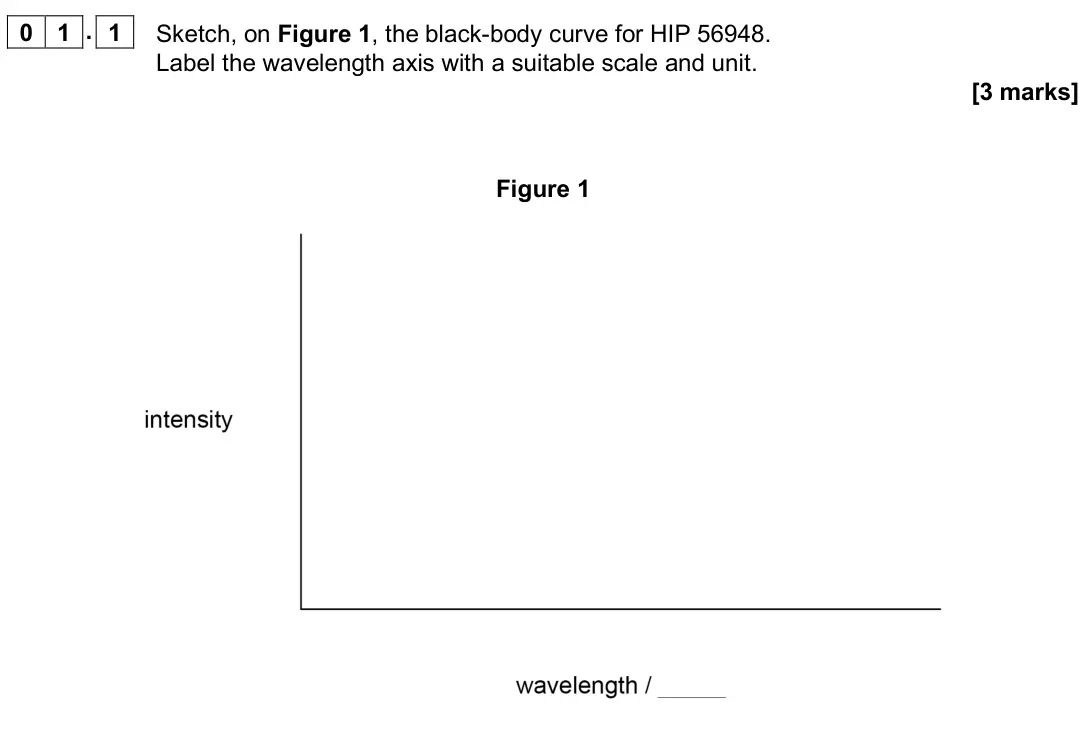
Q01.3
The whole paper ↗
Q04.1
The whole paper ↗
Q04.2
The whole paper ↗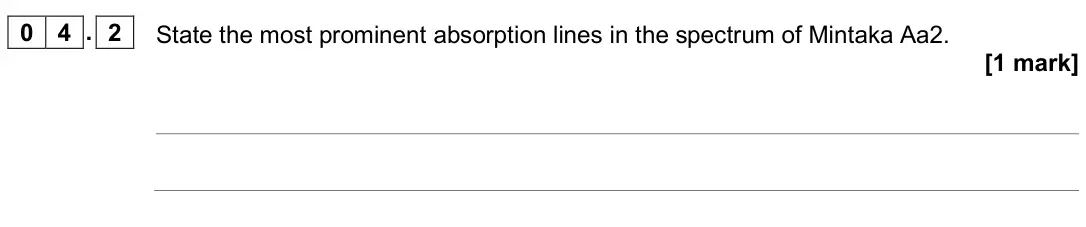
Q04.3
The whole paper ↗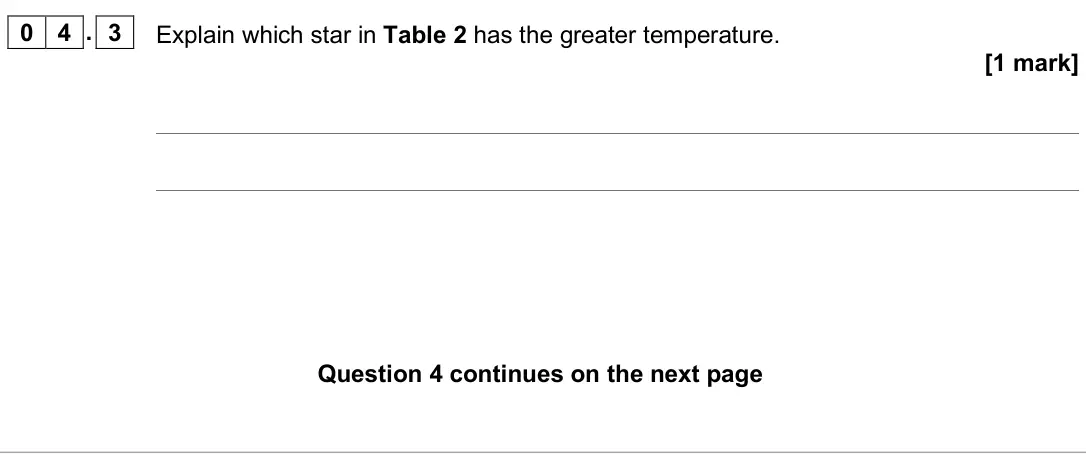
Q04.4
The whole paper ↗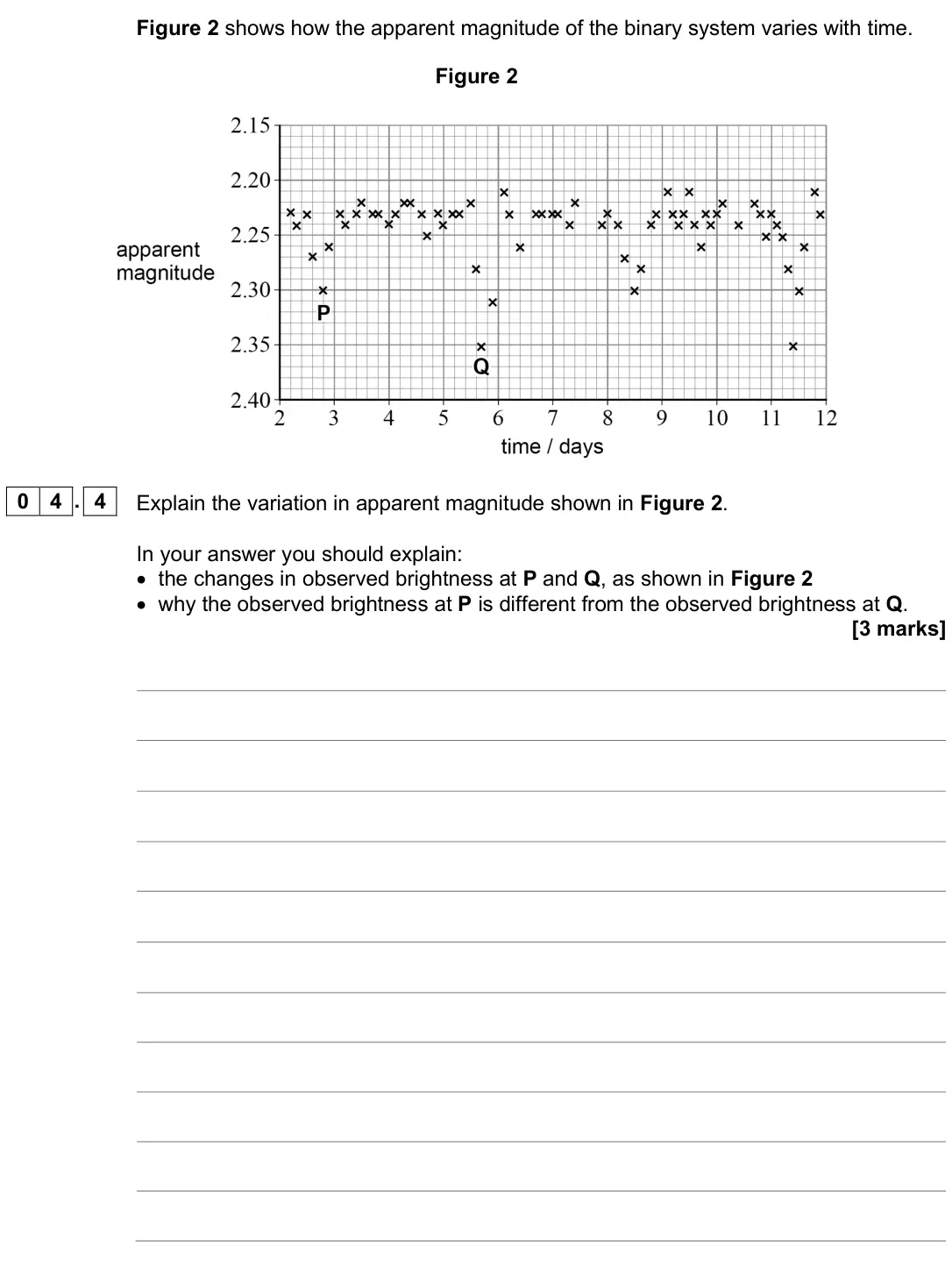
Q04.5
The whole paper ↗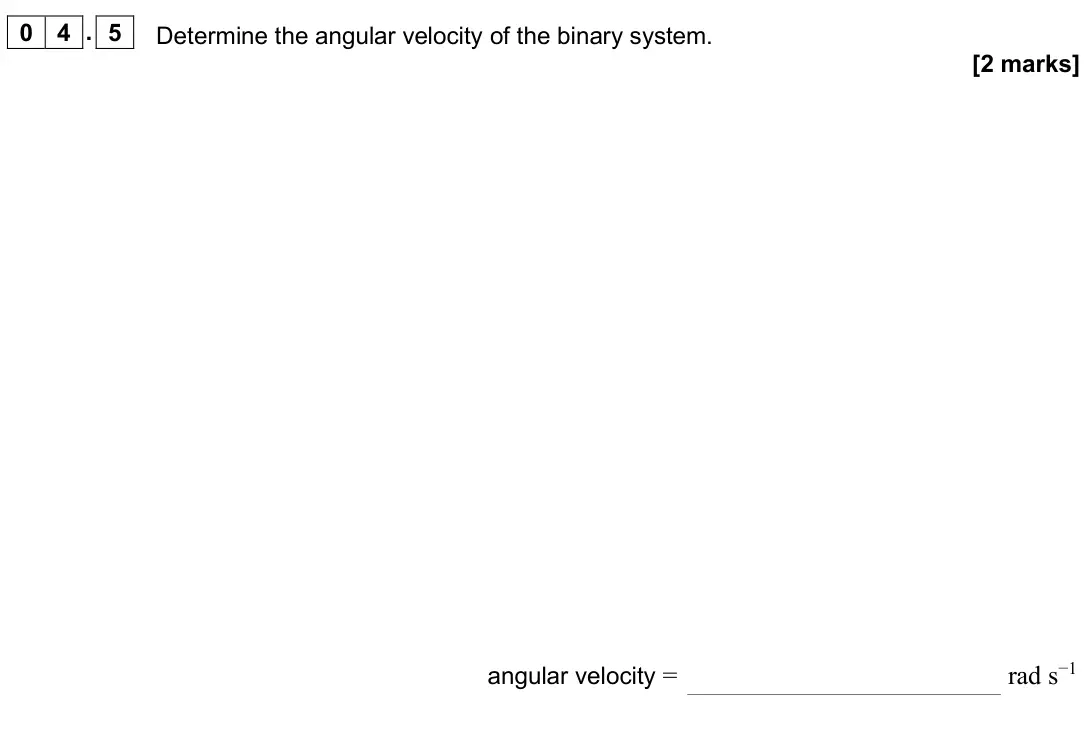
Q02.1
The whole paper ↗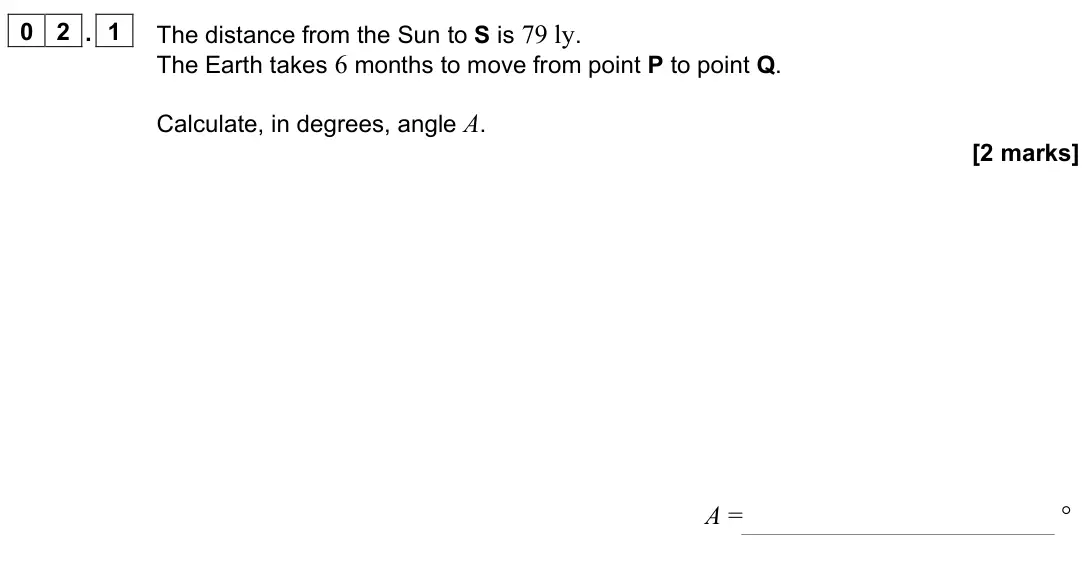
Q02.2
The whole paper ↗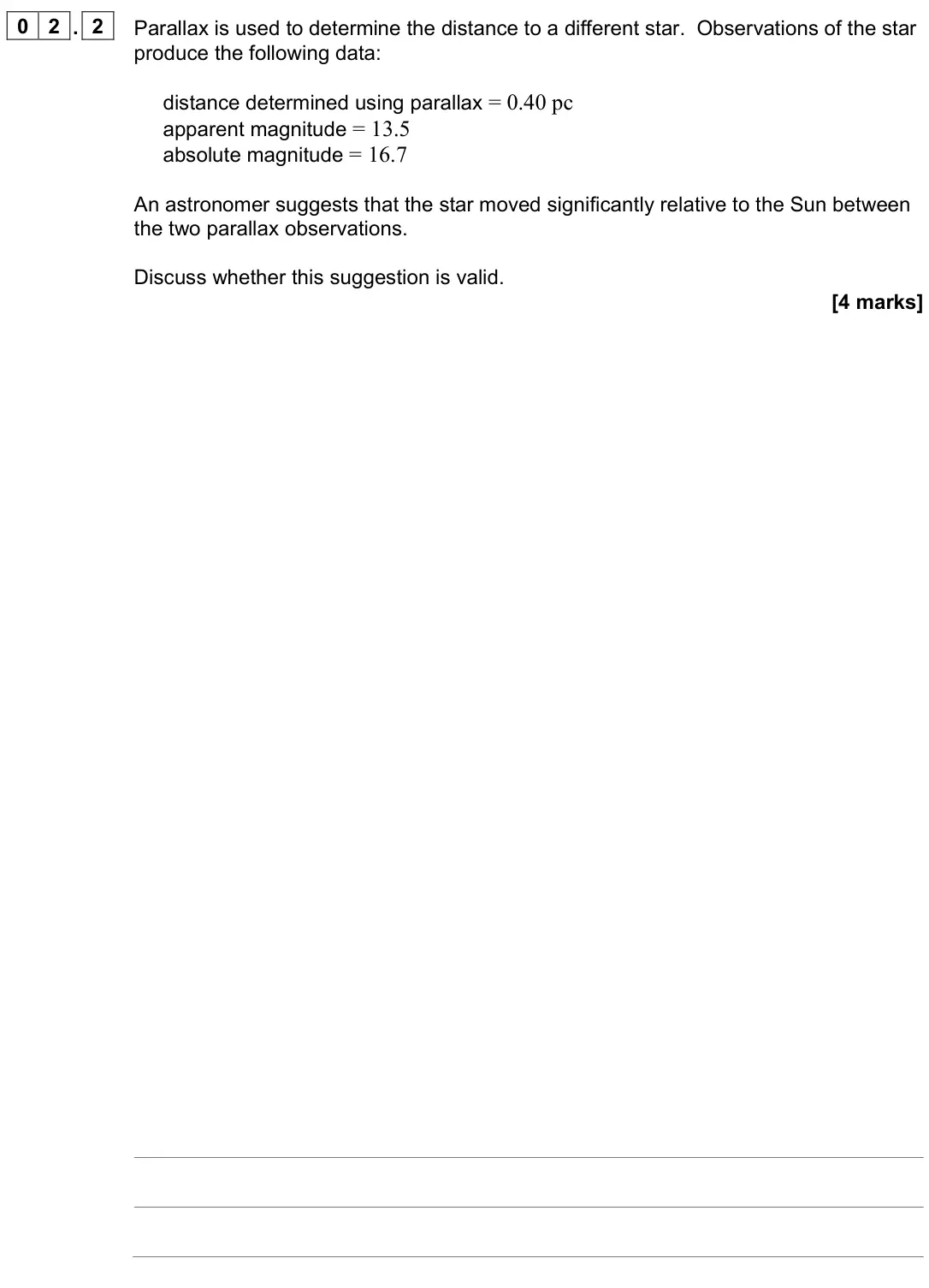
Q03.1
The whole paper ↗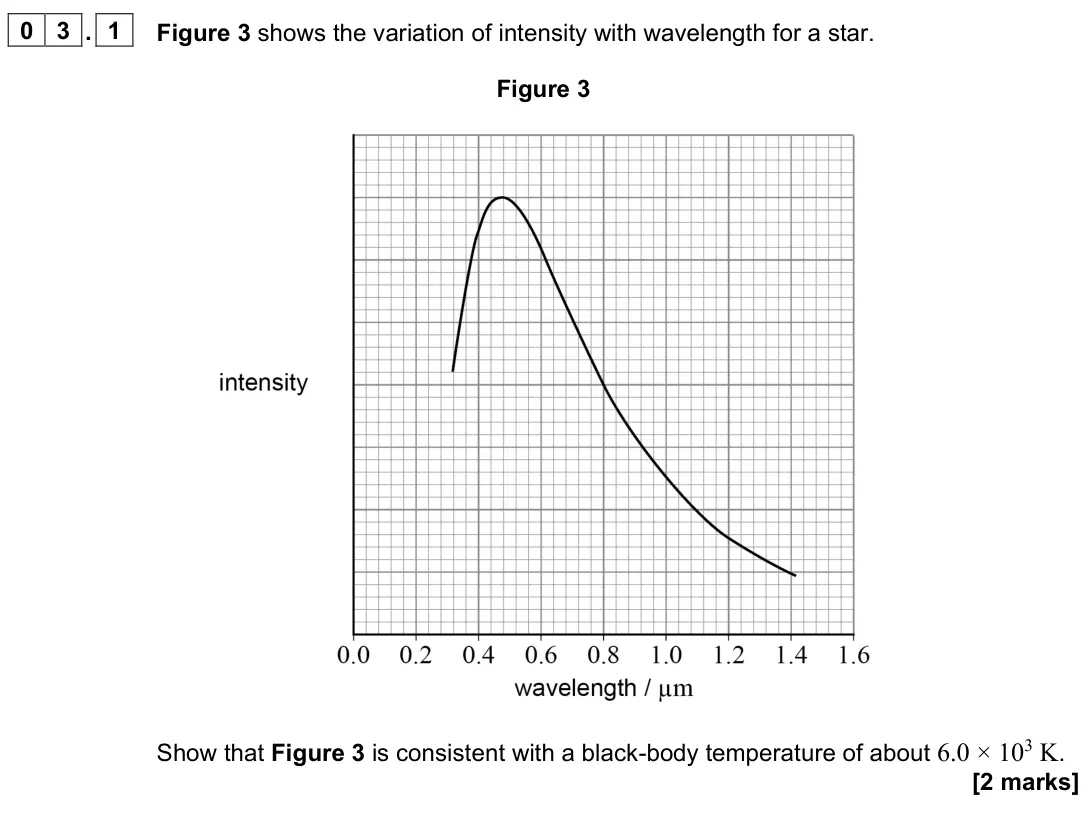
Q03.2
The whole paper ↗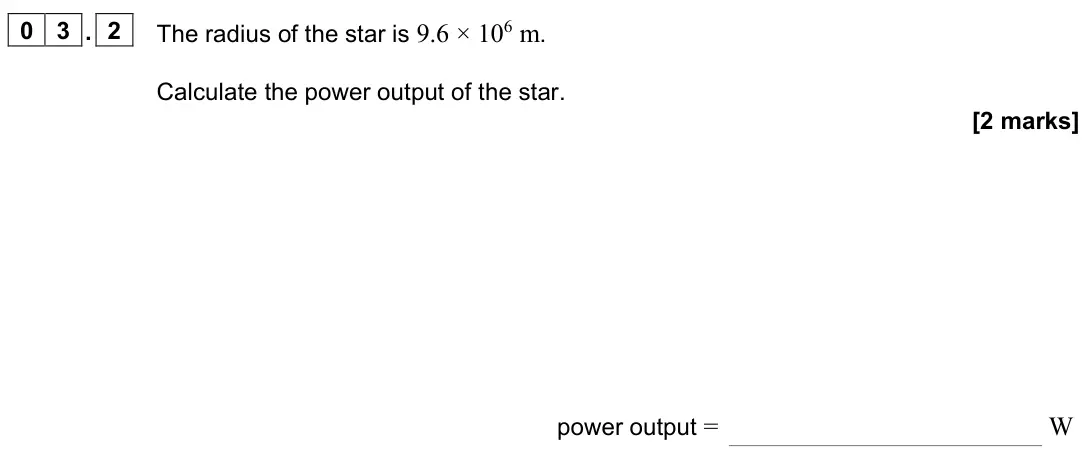
Q03.3
The whole paper ↗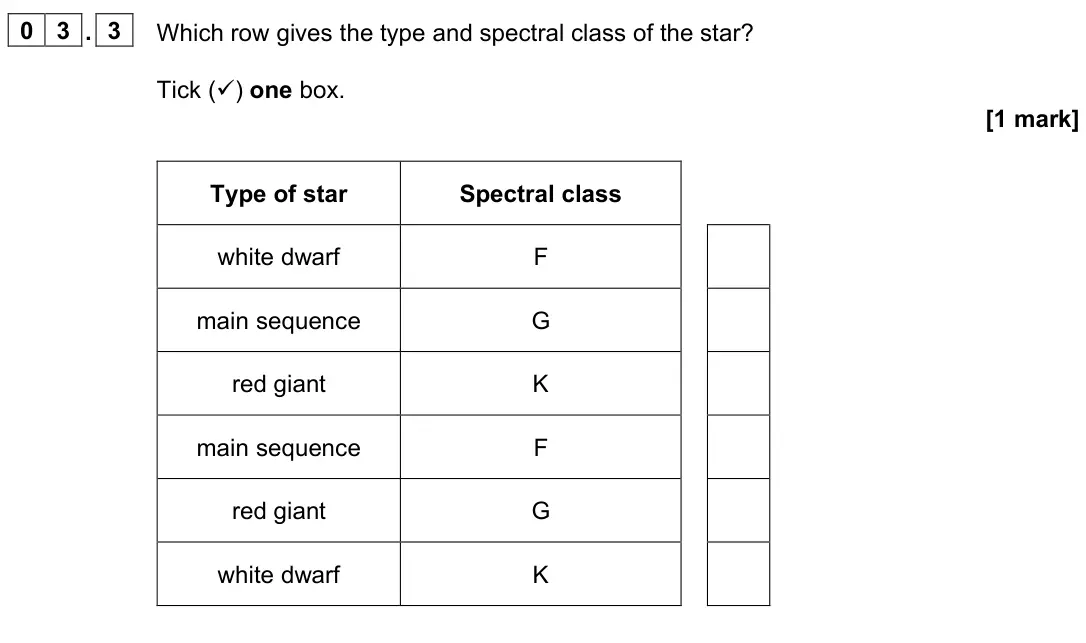
Q03.4
The whole paper ↗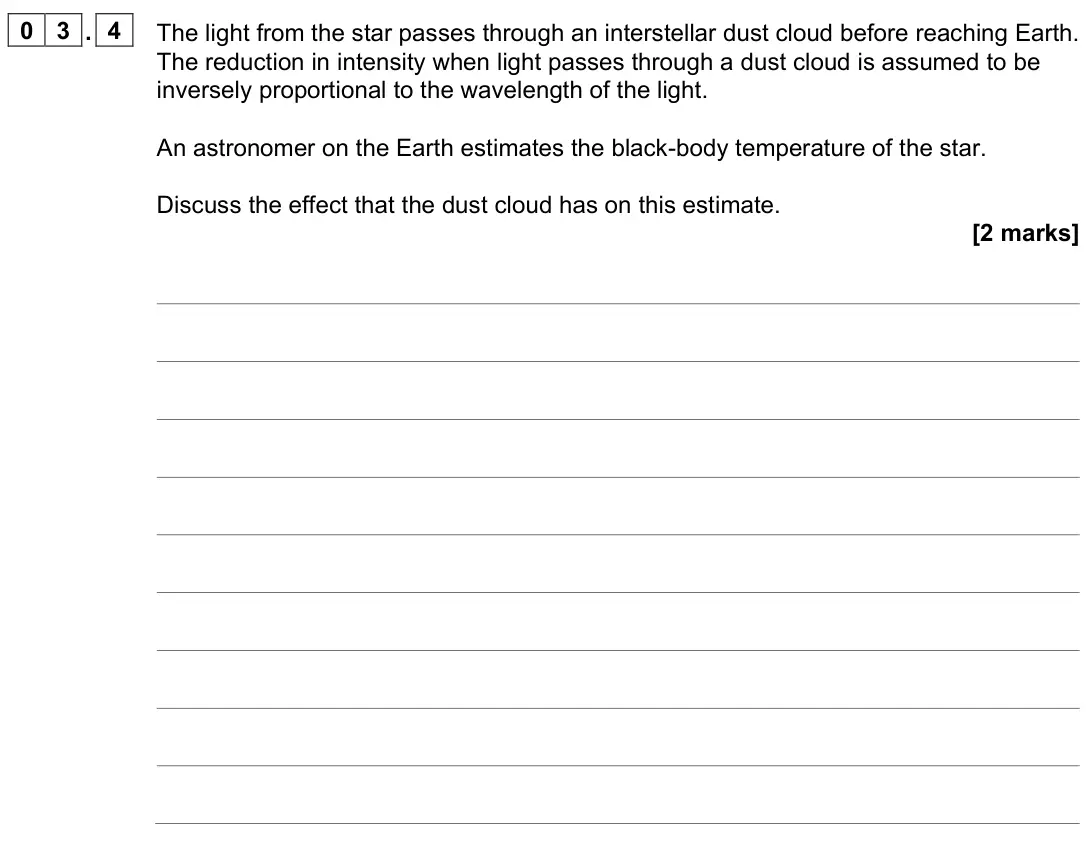
Q04.2
The whole paper ↗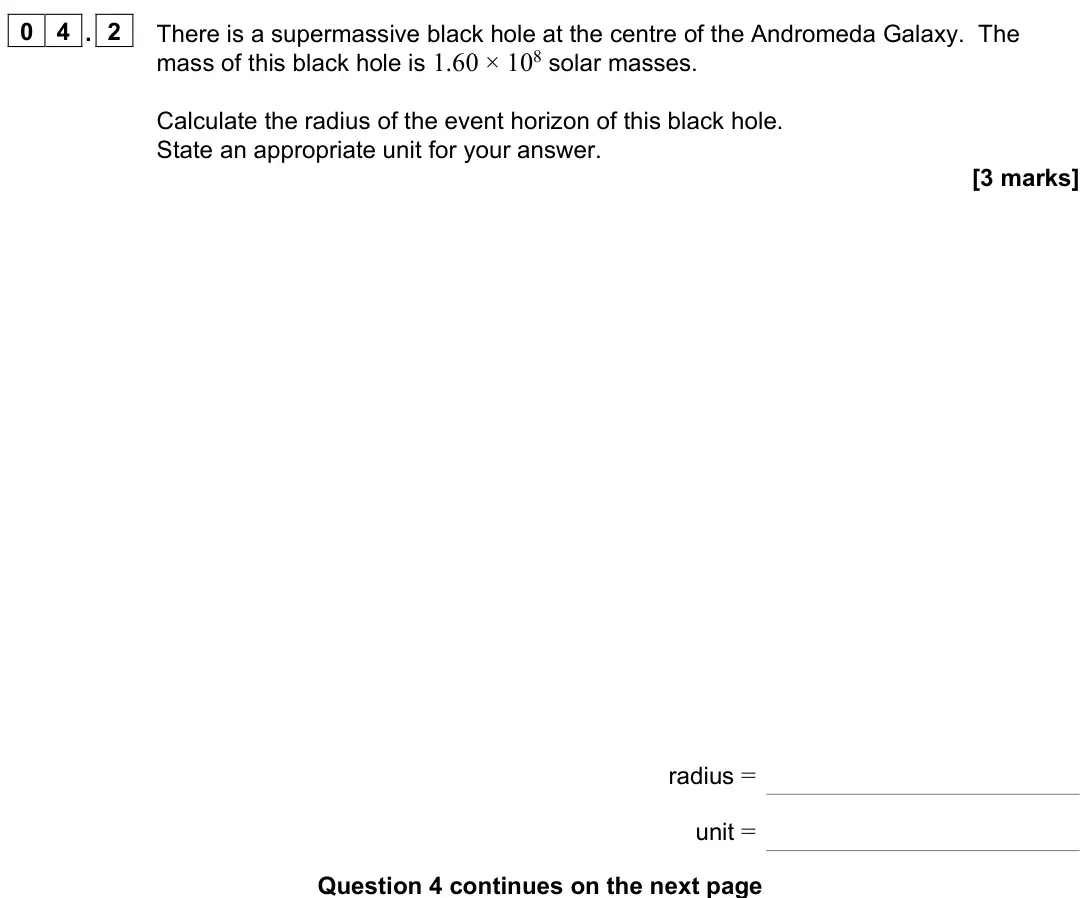
Q01.1
The whole paper ↗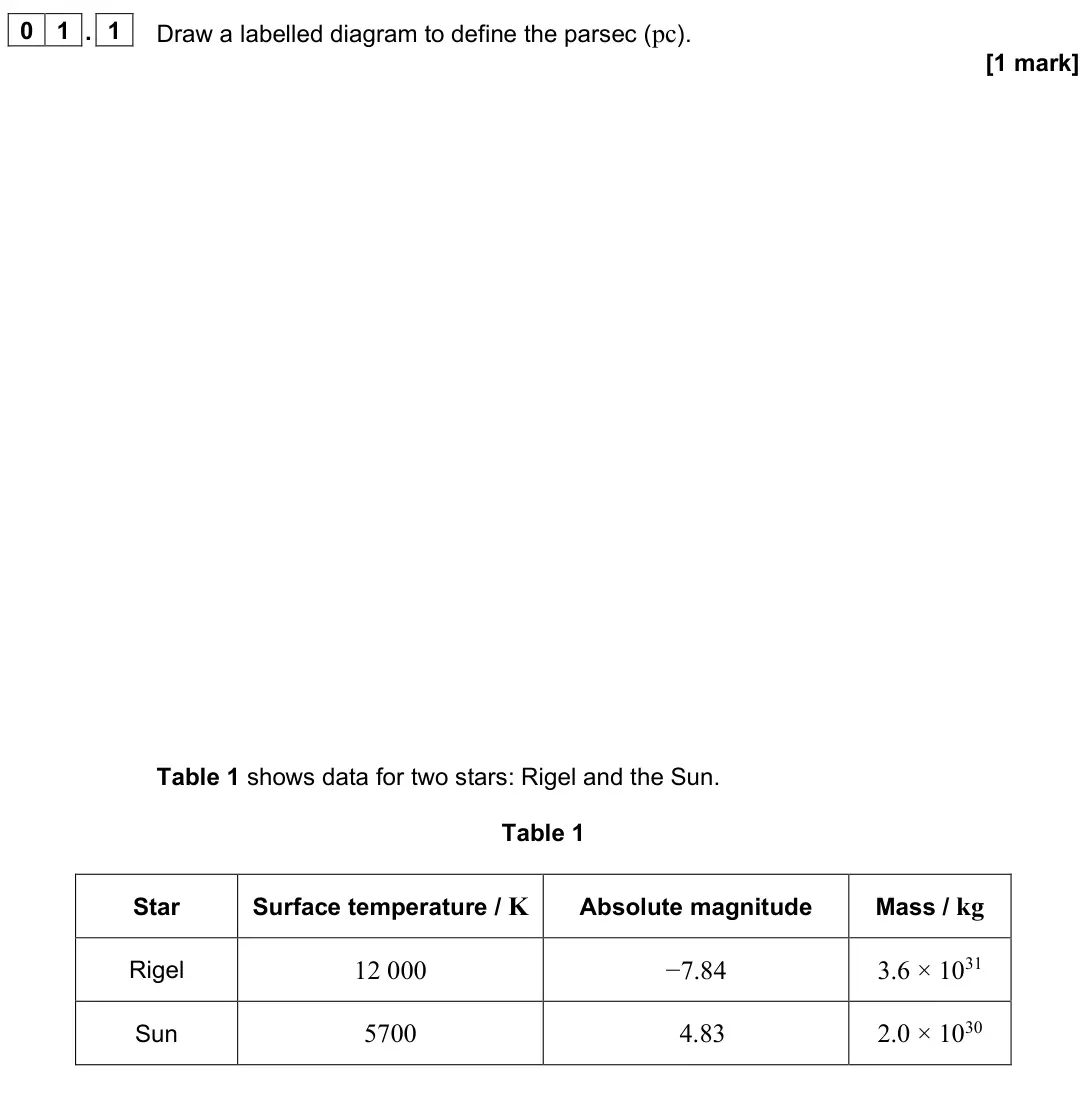
Q01.2
The whole paper ↗
Q01.3
The whole paper ↗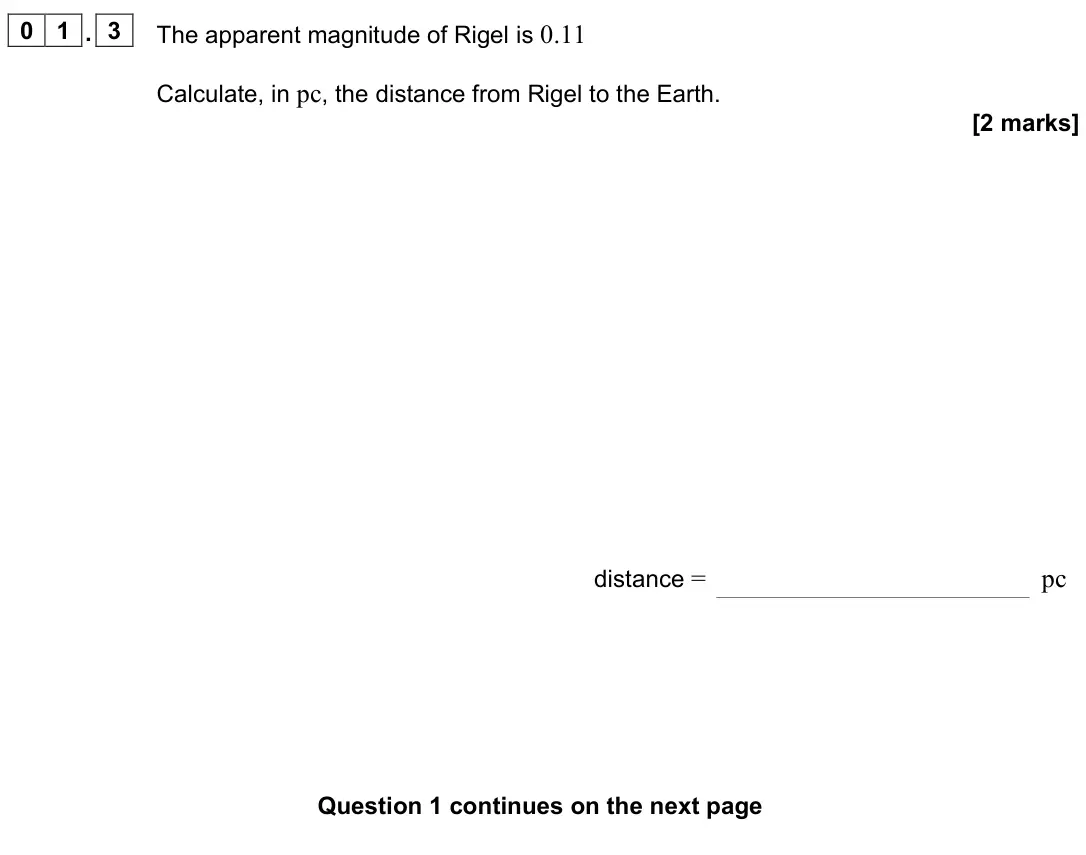
Q01.4
The whole paper ↗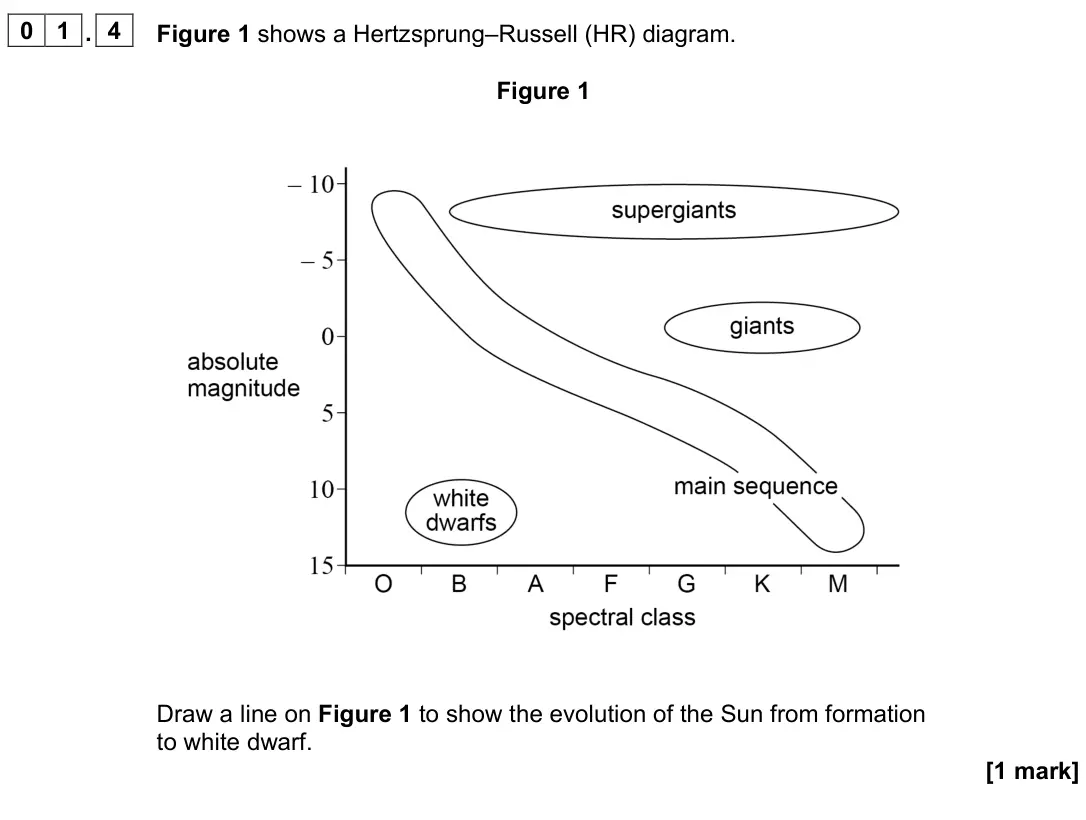
All 76 questions on Classification of stars, as a list
- June 2025, Paper 3 Astrophysics, Q01.1 (3 marks): Sketch, on Figure 1, the black-body curve for HIP 56948. Label the wavelength axis with a suitable scale and unit. [3 marks] Figure 1
- June 2025, Paper 3 Astrophysics, Q01.2 (1 mark): The diameter of HIP 56948 is the same as the diameter of the Sun. Suggest a value for the absolute magnitude of HIP 56948. [1 mark] absolute magnitude =
- June 2025, Paper 3 Astrophysics, Q01.3 (1 mark): Astronomers study HIP 56948 in their search for Earth-like exoplanets because HIP 56948 is similar to the Sun. Suggest one difficulty in detecting an Earth-like
- June 2025, Paper 3 Astrophysics, Q04.1 (3 marks): Show that the data in Table 2 are consistent with the two stars being in a binary system. [3 marks]
- June 2025, Paper 3 Astrophysics, Q04.2 (1 mark): State the most prominent absorption lines in the spectrum of Mintaka Aa2. [1 mark]
- June 2025, Paper 3 Astrophysics, Q04.3 (1 mark): Explain which star in Table 2 has the greater temperature. [1 mark]
- June 2025, Paper 3 Astrophysics, Q04.4 (3 marks): Explain the variation in apparent magnitude shown in Figure 2. In your answer you should explain: • the changes in observed brightness at P and Q, as shown in F
- June 2025, Paper 3 Astrophysics, Q04.5 (2 marks): Determine the angular velocity of the binary system. [2 marks] angular velocity = rad s−1
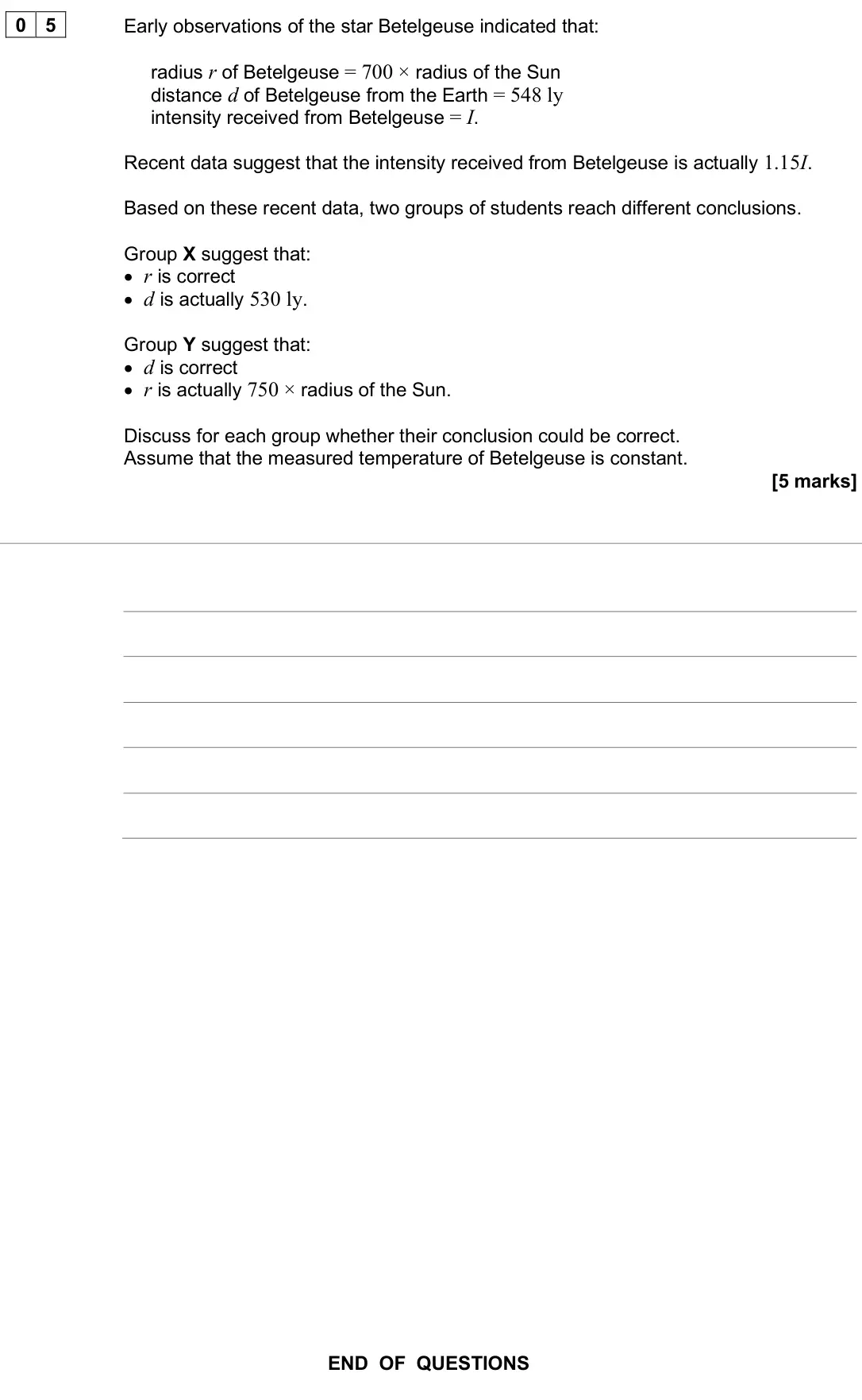
- June 2025, Paper 3 Astrophysics, Q05 (5 marks): Early observations of the star Betelgeuse indicated that: radius r of Betelgeuse = 700 × radius of the Sun distance d of Betelgeuse from the Earth = 548 ly inte
- June 2024, Paper 3 Astrophysics, Q02.1 (2 marks): The distance from the Sun to S is 79 ly. The Earth takes 6 months to move from point P to point Q. Calculate, in degrees, angle A. [2 marks] A = °
- June 2024, Paper 3 Astrophysics, Q02.2 (4 marks): Parallax is used to determine the distance to a different star. Observations of the star produce the following data: distance determined using parallax = 0.40 p
- June 2024, Paper 3 Astrophysics, Q03.1 (2 marks): Figure 3 shows the variation of intensity with wavelength for a star. Figure 3 Show that Figure 3 is consistent with a black-body temperature of about 6.0 × 10³
- June 2024, Paper 3 Astrophysics, Q03.2 (2 marks): The radius of the star is 9.6 × 10⁶ m. Calculate the power output of the star. [2 marks] power output = W
- June 2024, Paper 3 Astrophysics, Q03.3 (1 mark): Which row gives the type and spectral class of the star? Tick () one box. [1 mark] Type of star Spectral class white dwarf F main sequence G red giant K main s
- June 2024, Paper 3 Astrophysics, Q03.4 (2 marks): The light from the star passes through an interstellar dust cloud before reaching Earth. The reduction in intensity when light passes through a dust cloud is as
- June 2024, Paper 3 Astrophysics, Q04.2 (3 marks): There is a supermassive black hole at the centre of the Andromeda Galaxy. The mass of this black hole is 1.60 × 10⁸ solar masses. Calculate the radius of the ev
- June 2023, Paper 3 Astrophysics, Q01.1 (1 mark): Draw a labelled diagram to define the parsec (pc). [1 mark] Table 1 shows data for two stars: Rigel and the Sun. Table 1 Star Surface temperature / K Absolute m
- June 2023, Paper 3 Astrophysics, Q01.2 (1 mark): State the spectral class of Rigel. [1 mark]
- June 2023, Paper 3 Astrophysics, Q01.3 (2 marks): The apparent magnitude of Rigel is 0.11 Calculate, in pc, the distance from Rigel to the Earth. [2 marks] distance = pc
- June 2023, Paper 3 Astrophysics, Q01.4 (1 mark): Figure 1 shows a Hertzsprung–Russell (HR) diagram. Figure 1 Draw a line on Figure 1 to show the evolution of the Sun from formation to white dwarf. [1 mark]
- June 2023, Paper 3 Astrophysics, Q01.5 (2 marks): One stage in the evolution of Rigel includes the emission of a gamma ray burst. Outline the circumstances during which a gamma ray burst will be emitted by Rige
- June 2023, Paper 3 Astrophysics, Q02.3 (2 marks): Calculate the apparent magnitude of WASP-82. [2 marks] apparent magnitude =
- June 2023, Paper 3 Astrophysics, Q03.1 (1 mark): State the defining property of a black hole. [1 mark]
- June 2023, Paper 3 Astrophysics, Q03.2 (4 marks): In 2019, astronomers linked several radio telescopes to produce a single telescope called the EHT. The resolution of the EHT is the same as the resolution that
- June 2023, Paper 3 Astrophysics, Q04 (6 marks): M40 A and M40 B are two stars that appear very close to each other when viewed from Earth. There are two possible reasons for this: • they are an orbiting binar
- June 2022, Paper 3 Astrophysics, Q02.1 (2 marks): Explain the shape of the graph in Figure 1. [2 marks]
- June 2022, Paper 3 Astrophysics, Q02.4 (2 marks): Calculate the orbital radius of the primary star. [2 marks] orbital radius = m
- June 2022, Paper 3 Astrophysics, Q02.5 (1 mark): Which absorption lines would be most prominent in the spectrum of the primary star? Tick () one box. [1 mark] hydrogen hydrogen and helium ionised metals neutr
- June 2022, Paper 3 Astrophysics, Q02.6 (2 marks): A different eclipsing binary star system is thought to consist of a white dwarf star and a neutron star. Discuss how astronomers could confirm this. [2 marks]
- June 2022, Paper 3 Astrophysics, Q03.2 (2 marks): Show that the absolute magnitude X of quasar 3C 273 is about −27 [2 marks]
- June 2022, Paper 3 Astrophysics, Q03.3 (3 marks): Assume that the quasar and the galaxy are both viewed from the same distance. Explain which would be the brighter object. Go on to calculate the ratio brightnes
- June 2022, Paper 3 Astrophysics, Q03.4 (3 marks): The black hole at the centre of IC 1101 has a mass of 7.1 × 10¹¹ MS where MS is the mass of the Sun. Calculate the average density within the event horizon of t
- November 2021, Paper 3 Astrophysics, Q01.1 (3 marks): State the evolutionary stage of the star at each of the points W, X, Y and Z. [3 marks] W X Y Z
- November 2021, Paper 3 Astrophysics, Q01.2 (1 mark): Annotate Figure 1 with a T to show the position of Theta Carinae. [1 mark]
- November 2021, Paper 3 Astrophysics, Q01.3 (2 marks): Explain one difficulty with using the transit method to detect this planet. [2 marks]
- November 2021, Paper 3 Astrophysics, Q01.4 (5 marks): The astronomer suggests that the Earth-sized planet receives a similar amount of power from Theta Carinae as the Earth does from the Sun. The average power outp
- November 2021, Paper 3 Astrophysics, Q03 (6 marks): Miaplacidus and Avior are two stars in the constellation Carina. Miaplacidus is a class A star. Avior is a class K star. Figure 2 shows how the intensity of rad
- November 2020, Paper 3 Astrophysics, Q02.1 (1 mark): Which star has the highest surface temperature? Tick () one box. [1 mark] Caph Ruchbah Schedar Tsih
- November 2020, Paper 3 Astrophysics, Q02.2 (4 marks): Figure 1 shows the intensity received at Earth from two of the stars, plotted against wavelength. The effect of absorption by the Earth’s atmosphere is not show
- November 2020, Paper 3 Astrophysics, Q02.3 (1 mark): State which star in Table 1 is dimmest on the absolute magnitude scale. [1 mark]
- November 2020, Paper 3 Astrophysics, Q02.4 (3 marks): Calculate the absolute magnitude of Schedar. [3 marks] absolute magnitude =
- November 2020, Paper 3 Astrophysics, Q02.5 (2 marks): Tsih has a mass over 15 times the mass of the Sun. Tsih may eventually collapse to form a black hole. Calculate the radius of the event horizon for a black hole
- November 2020, Paper 3 Astrophysics, Q04.1 (2 marks): Calculate 34 power output of Melnick power output of the Sun . [2 marks] answer =
- November 2020, Paper 3 Astrophysics, Q04.2 (2 marks): Discuss why the evolution of a supergiant star in the local part of our galaxy could be dangerous for life on Earth. [2 marks]
- June 2019, Paper 3 Astrophysics, Q02.1 (3 marks): Discuss, with reference to the Hipparcos scale, why many star maps show only two stars in the constellation Canis Minor. [3 marks]
- June 2019, Paper 3 Astrophysics, Q02.2 (2 marks): State and explain which star in Table 2 has the most prominent Hydrogen Balmer absorption lines. [2 marks]
- June 2019, Paper 3 Astrophysics, Q02.3 (3 marks): Deduce which star, Gamma A or HD 66141, has the larger diameter. [3 marks]
- June 2019, Paper 3 Astrophysics, Q02.5 (3 marks): Calculate the distance from the Earth to Procyon. Give an appropriate unit for your answer. [3 marks] distance = unit
- June 2019, Paper 3 Astrophysics, Q03.1 (1 mark): Label the absolute magnitude axis with a suitable scale. [1 mark]
- June 2019, Paper 3 Astrophysics, Q03.2 (2 marks): Label with an S the position of the Sun on the HR diagram. [2 marks]
- June 2019, Paper 3 Astrophysics, Q03.3 (2 marks): Draw a line on the HR diagram to show the evolution of a star similar to the Sun from formation to white dwarf. [2 marks]
- June 2019, Paper 3 Astrophysics, Q03.4 (1 mark): Label with a P the position on the HR diagram of a star much redder, and with a greater power output, than the Sun. [1 mark]
- June 2019, Paper 3 Astrophysics, Q03.5 (3 marks): A star much more massive than the Sun may become a supernova and then a black hole. Discuss whether supernovae and black holes can be placed on the HR diagram i
- June 2018, Paper 3 Astrophysics, Q02.1 (2 marks): Sketch, on the axes in Figure 1, the black-body radiation curve for a typical star. [2 marks] Figure 1
- June 2018, Paper 3 Astrophysics, Q02.2 (3 marks): Explain, with reference to the SI units involved, how the curve you have drawn can be used to determine the black-body temperature of the star. [3 marks]
- June 2018, Paper 3 Astrophysics, Q02.3 (6 marks): Two stars, 61 Cygnus A and 61 Cygnus B, can be seen very close together in the constellation Cygnus. Early astronomers were unsure whether the two stars form a
- June 2018, Paper 3 Astrophysics, Q02.4 (1 mark): What is the spectral class of 61 Cygnus A? Tick () the correct box. [1 mark] A F G K
- June 2017, Paper 3 Astrophysics, Q03.1 (2 marks): Define the parsec. You may use a diagram as part of your answer. [2 marks
- June 2017, Paper 3 Astrophysics, Q03.2 (3 marks): Deduce which star is larger, Kornephoros or Rutilicus. [3 marks
- June 2017, Paper 3 Astrophysics, Q03.3 (2 marks): One of the four stars has the peak in its black-body radiation curve at a wavelength of 1.0 µm. Calculate the corresponding temperature for this curve. [2 marks
- June 2017, Paper 3 Astrophysics, Q03.4 (2 marks): Explain which star produced the black-body radiation curve described in question 03.3. [2 marks
- June 2017, Paper 3 Astrophysics, Q03.5 (1 mark): Which star has the brightest absolute magnitude? Tick () the correct box. [1 mark Kornephoros Rasalgethi Rutilicus Sarin
- June 2017, Paper 3 Astrophysics, Q03.6 (3 marks): Determine the absolute magnitude of Sarin. [3 marks absolute magnitude =
- June 2017, Paper 3 Astrophysics, Q05 (6 marks): According to NASA nearly 2000 exoplanets had been discovered by 2016, and the search continues. One aim of this search is to find an Earth-like planet orbiting
- Specimen, Paper 3 Astrophysics, Q02.1 (2 marks): The Summer Triangle consists of three stars, Altair, Deneb and Vega. Some of the properties of the three stars are summarised in Table 2. Table 2 Altair Deneb V
- Specimen, Paper 3 Astrophysics, Q02.2 (2 marks): The Summer Triangle consists of three stars, Altair, Deneb and Vega. Some of the properties of the three stars are summarised in Table 2. Table 2 Altair Deneb V
- Specimen, Paper 3 Astrophysics, Q02.3 (3 marks): The Summer Triangle consists of three stars, Altair, Deneb and Vega. Some of the properties of the three stars are summarised in Table 2. Table 2 Altair Deneb V
- Specimen, Paper 3 Astrophysics, Q02.4 (3 marks): The Summer Triangle consists of three stars, Altair, Deneb and Vega. Some of the properties of the three stars are summarised in Table 2. Table 2 Altair Deneb V
- Specimen, Paper 3 Astrophysics, Q02.5 (2 marks): The Summer Triangle consists of three stars, Altair, Deneb and Vega. Some of the properties of the three stars are summarised in Table 2. Table 2 Altair Deneb V
- Specimen, Paper 3 Astrophysics, Q03.1: Antares is a red supergiant star in the constellation of Scorpio. It has a mass about 18 times that of the Sun. Eventually the star will become a supernova, lea
- Specimen, Paper 3 Astrophysics, Q03.2 (2 marks): Antares is a red supergiant star in the constellation of Scorpio. It has a mass about 18 times that of the Sun. Eventually the star will become a supernova, lea
- Specimen, Paper 3 Astrophysics, Q03.3 (2 marks): Antares is a red supergiant star in the constellation of Scorpio. It has a mass about 18 times that of the Sun. Eventually the star will become a supernova, lea
- Specimen, Paper 3 Astrophysics, Q03.4 (2 marks): Antares is a red supergiant star in the constellation of Scorpio. It has a mass about 18 times that of the Sun. Eventually the star will become a supernova, lea
- Specimen, Paper 3 Astrophysics, Q04.1 (1 mark): In 1999 a planet was discovered orbiting a star in the constellation of Pegasus. 0 4 State one reason why it is difficult to make a direct observation of this p
- Specimen, Paper 3 Astrophysics, Q04.2 (2 marks): In 1999 a planet was discovered orbiting a star in the constellation of Pegasus. 0 4 The initial discovery of the planet was made using the radial velocity meth
- Specimen, Paper 3 Astrophysics, Q04.3 (3 marks): In 1999 a planet was discovered orbiting a star in the constellation of Pegasus. 0 4 The discovery was confirmed by measuring the variation in the apparent magn
Questions, mark schemes and examiner’s reports are © AQA, from their published past papers. Plumi isn’t affiliated with any exam board. Want whole papers? Every AQA A-Level Physics paper.
Rather write your answers by hand on iPad? Plumi marks them against the same mark schemes.