 plumi
Cosmology: AQA A‑Level Physics questions
Every AQA A-Level Physics exam question on 3.9.3 Cosmology, 2016–2025, with its mark scheme and examiner’s report.
Find questions2,714
Calculations
Q03.1
The whole paper ↗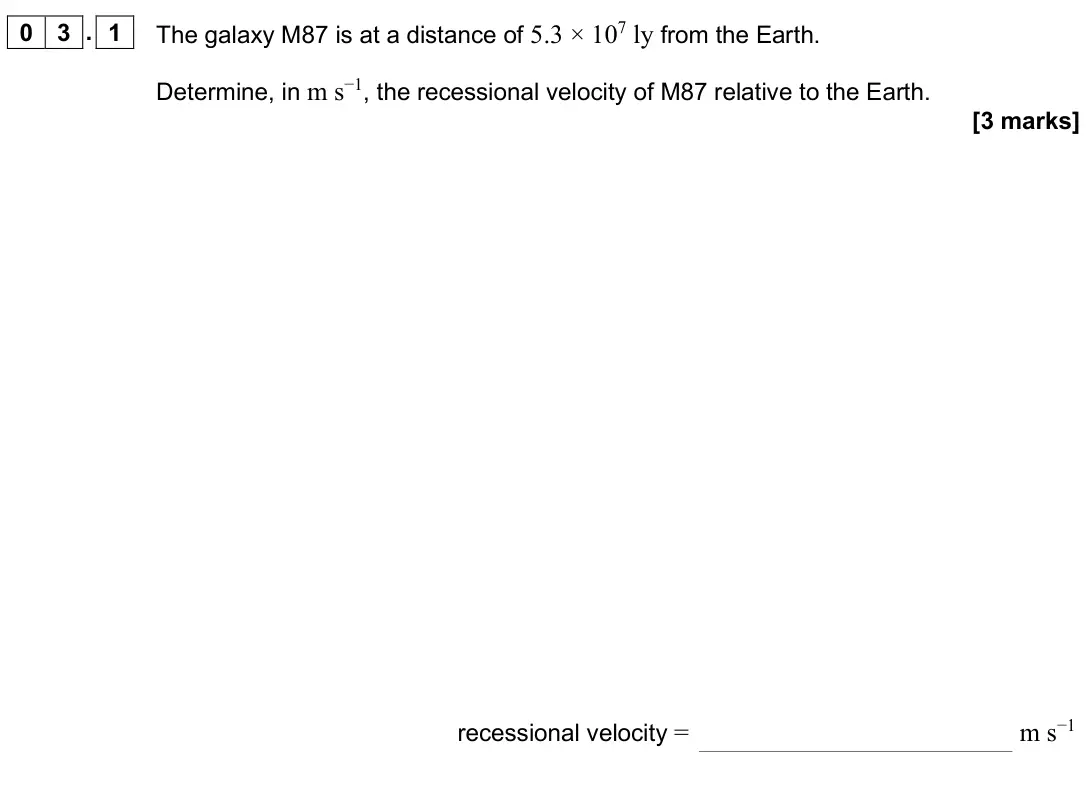
Q03.2
The whole paper ↗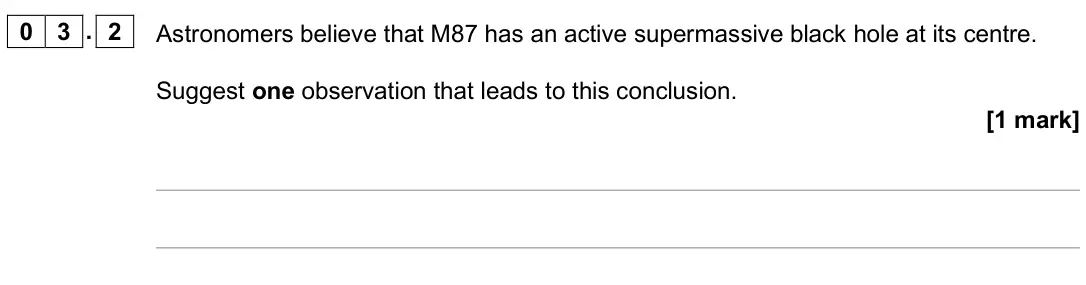
Q03.3
The whole paper ↗
Q04.1
The whole paper ↗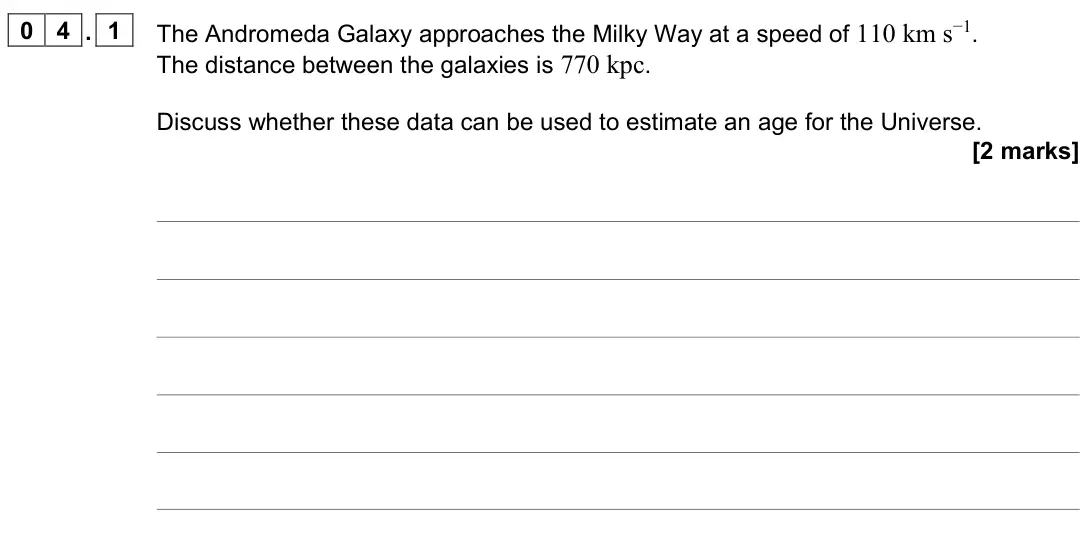
Q04.3
The whole paper ↗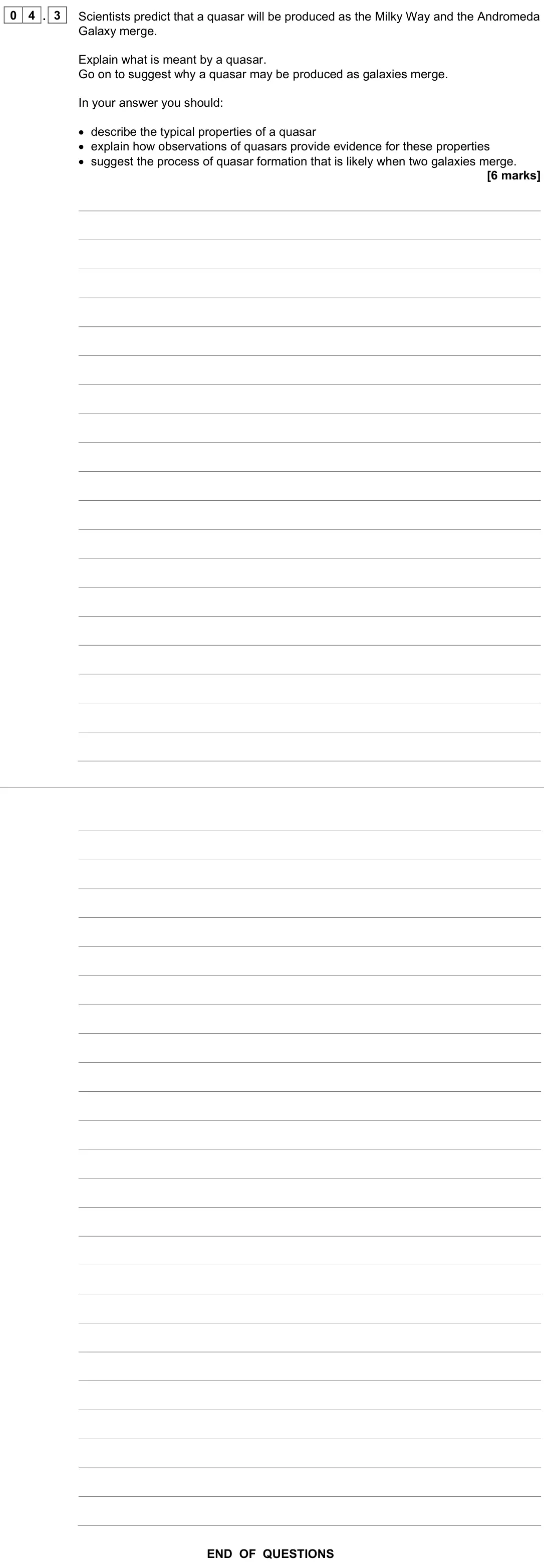
Q03.3
The whole paper ↗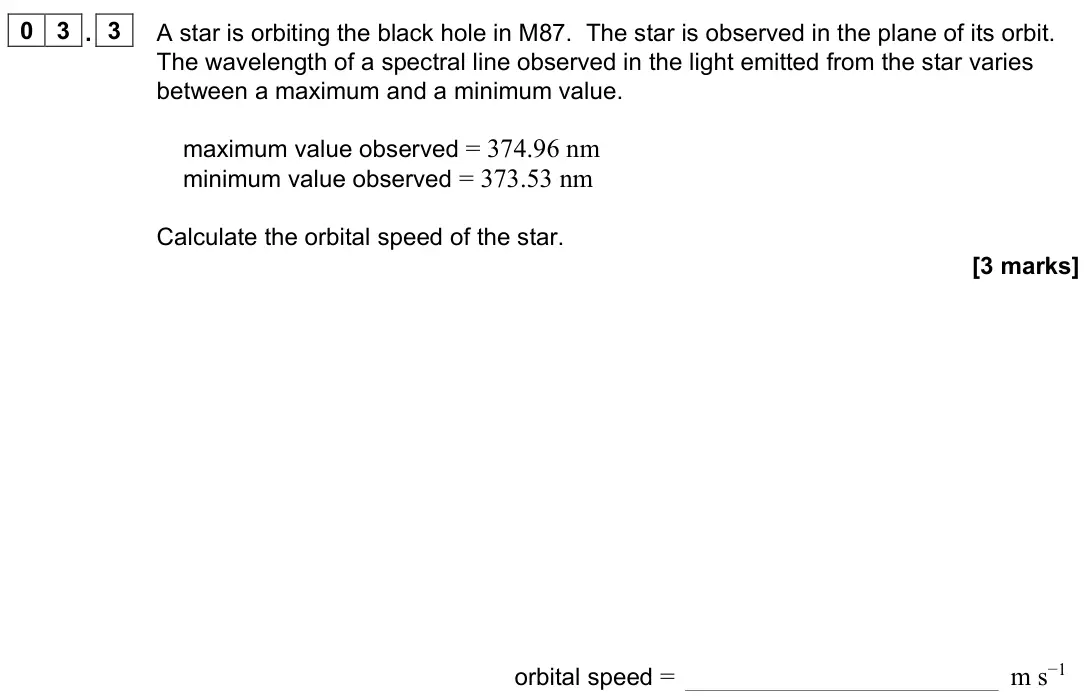
Q05.1
The whole paper ↗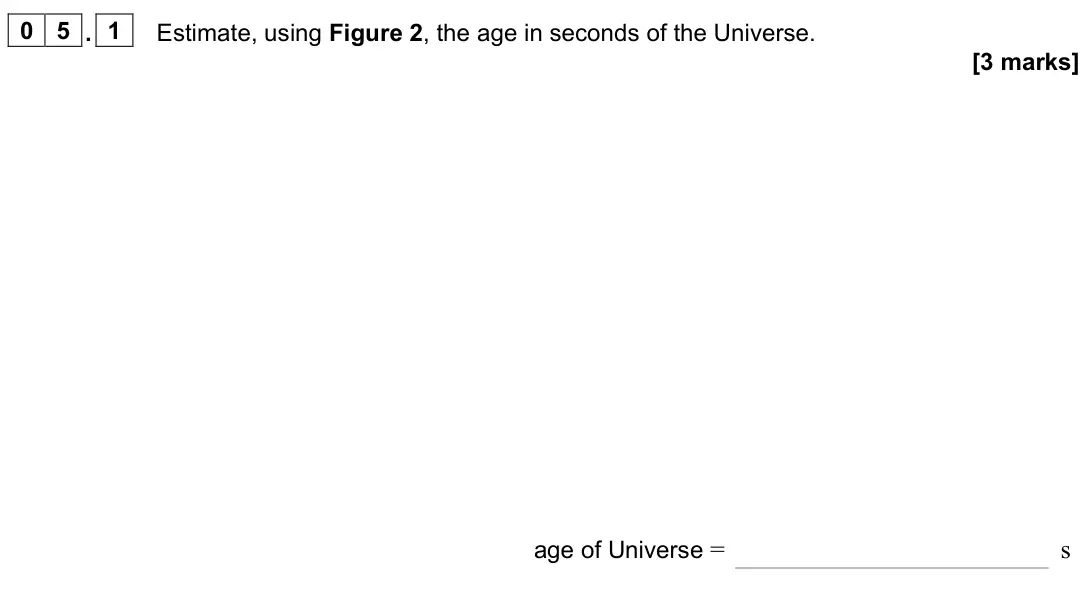
Q05.2
The whole paper ↗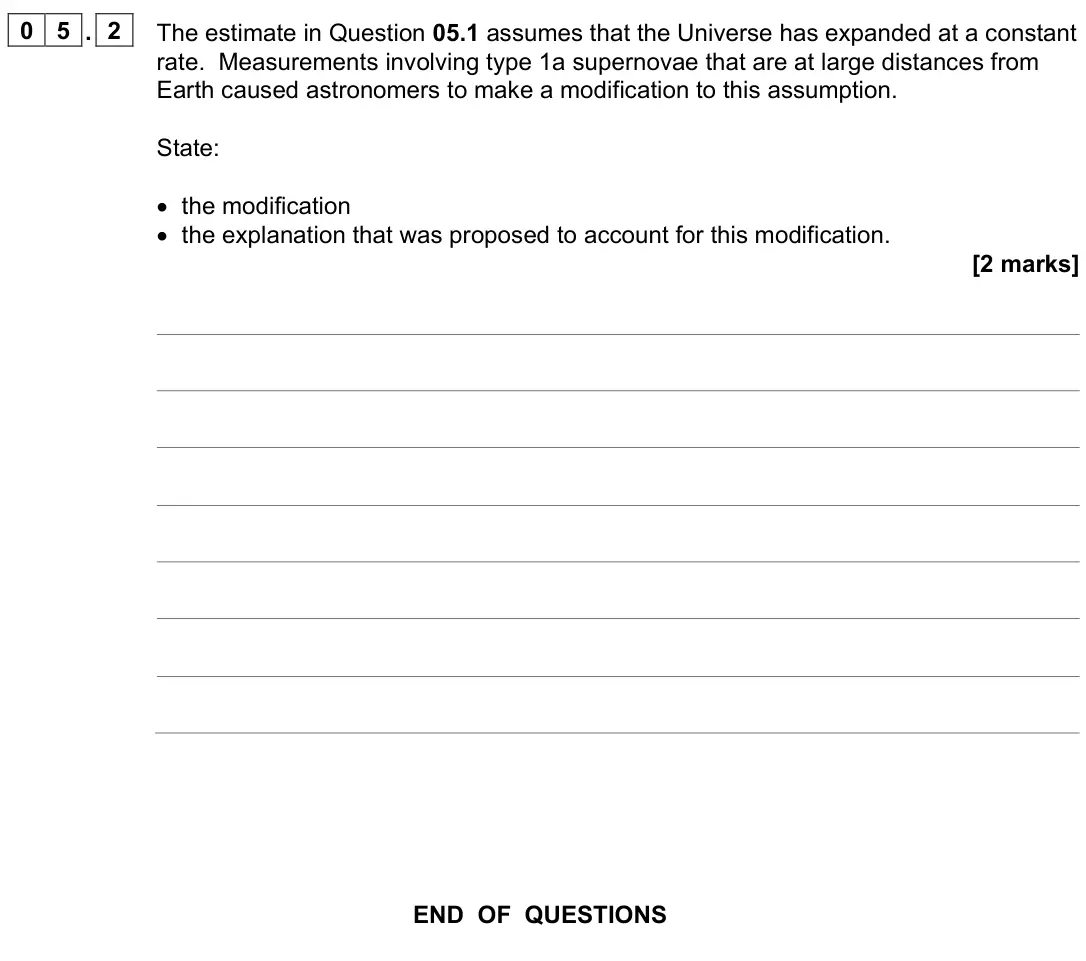
Q02.2
The whole paper ↗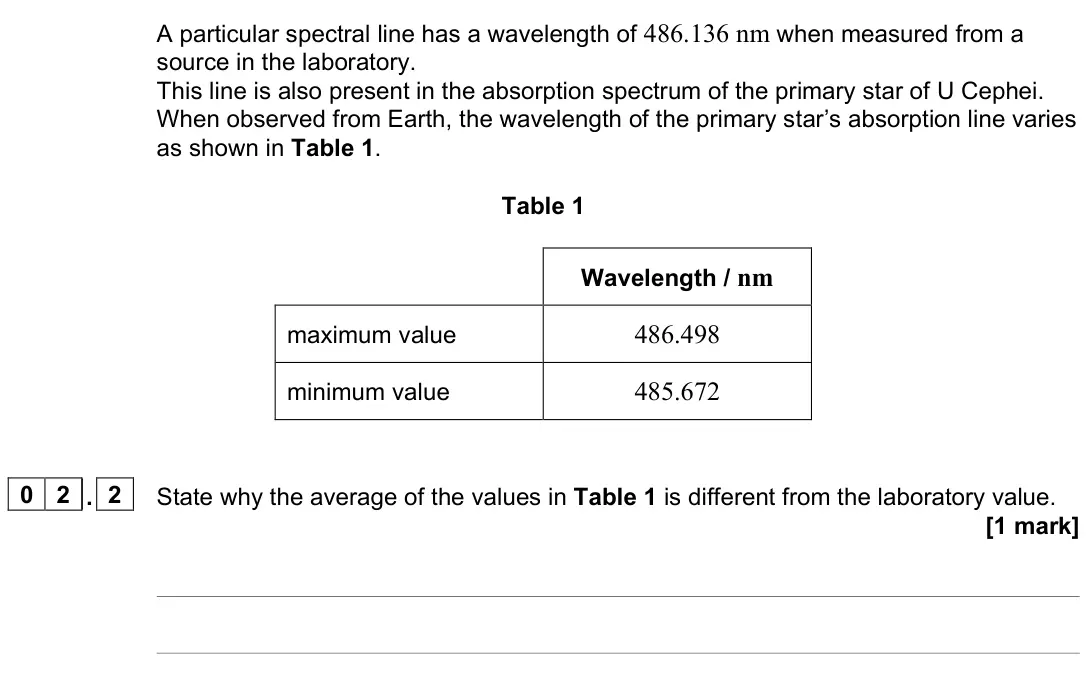
Q02.3
The whole paper ↗
Q03.1
The whole paper ↗
Q02.1
The whole paper ↗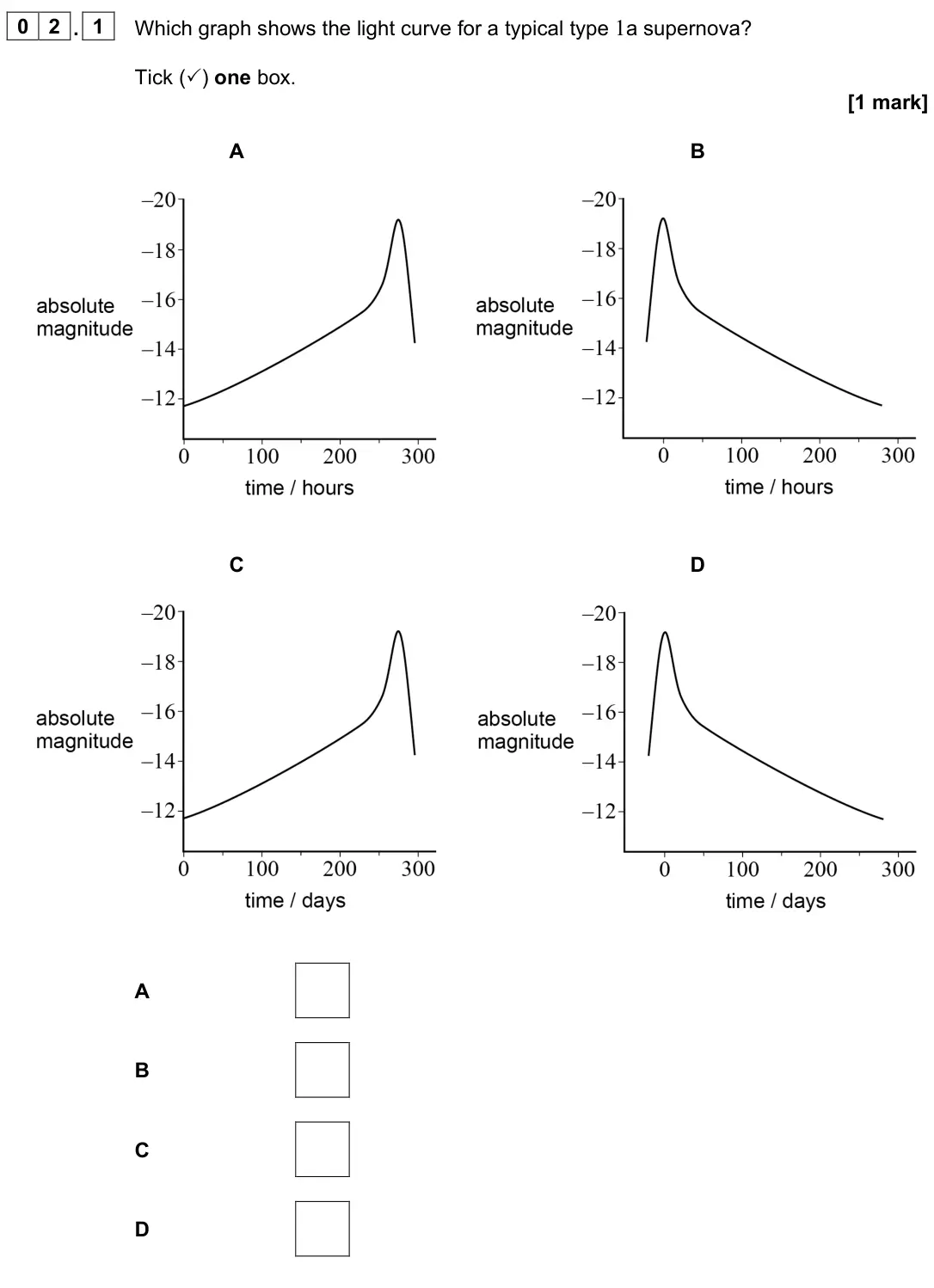
Q02.2
The whole paper ↗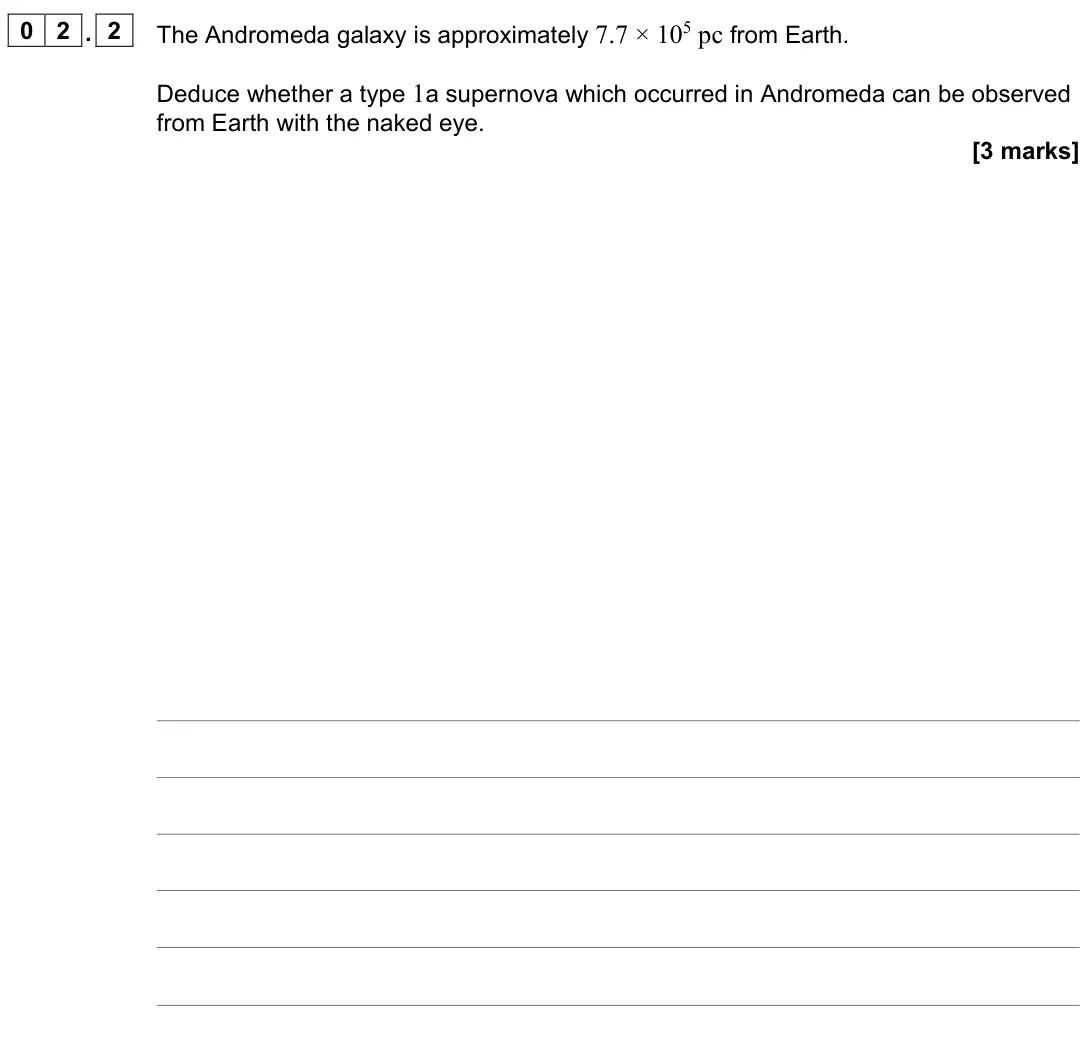
Q04.1
The whole paper ↗
Q04.2
The whole paper ↗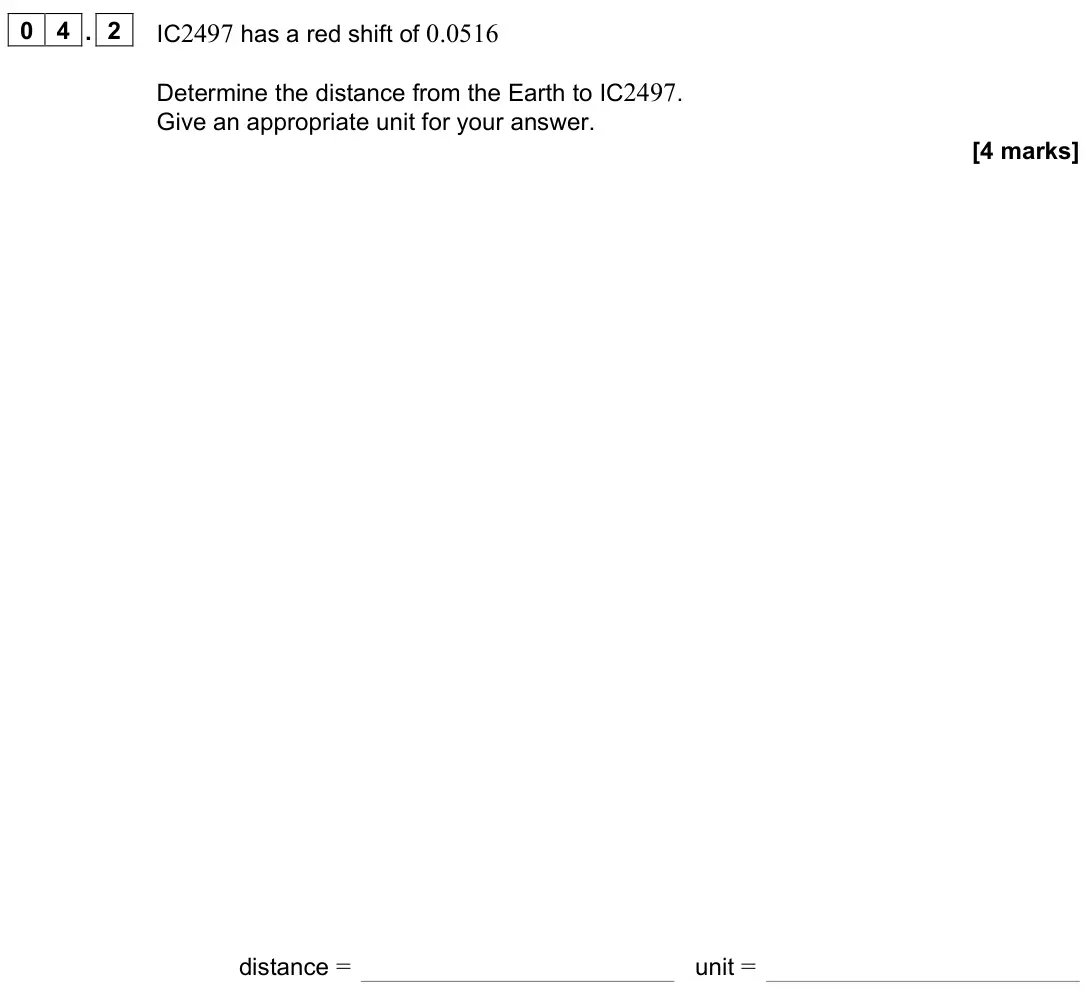
Q03.1
The whole paper ↗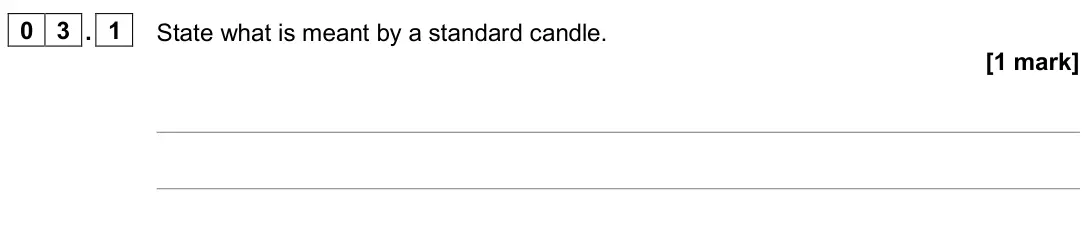
Q03.2
The whole paper ↗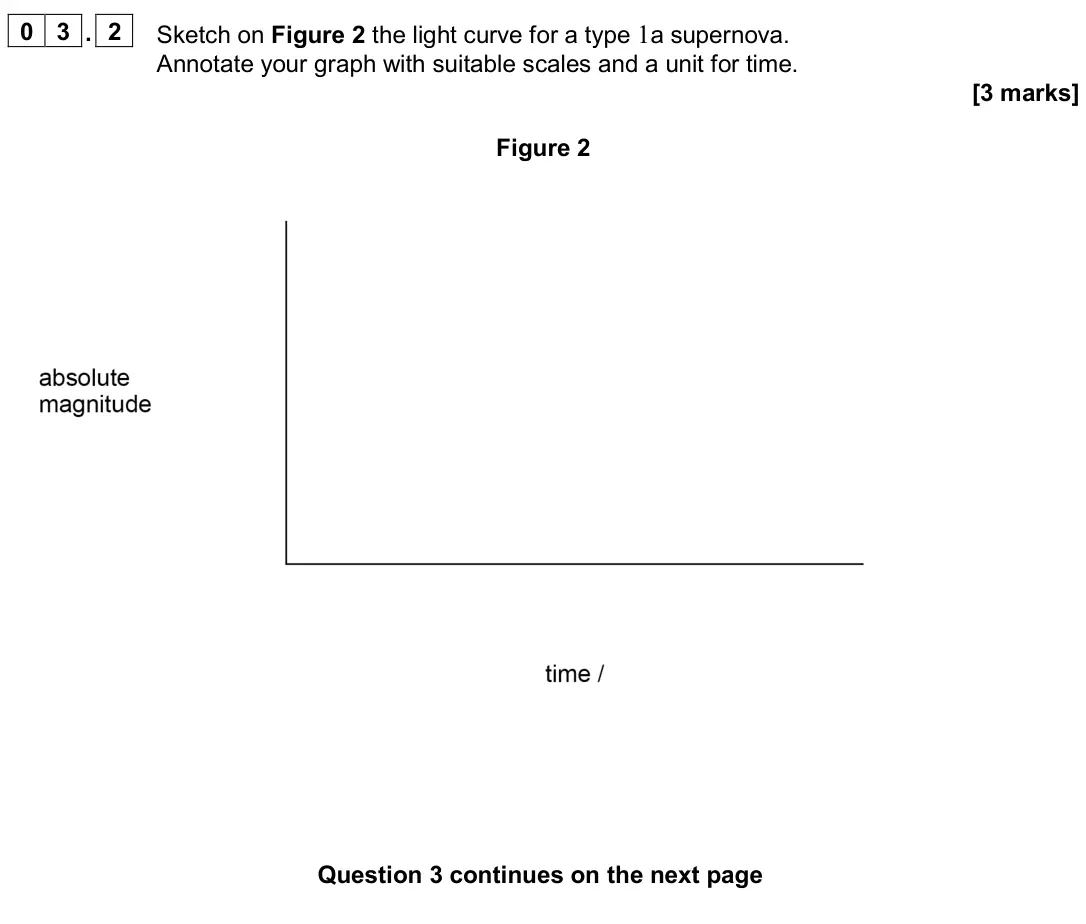
Q03.3
The whole paper ↗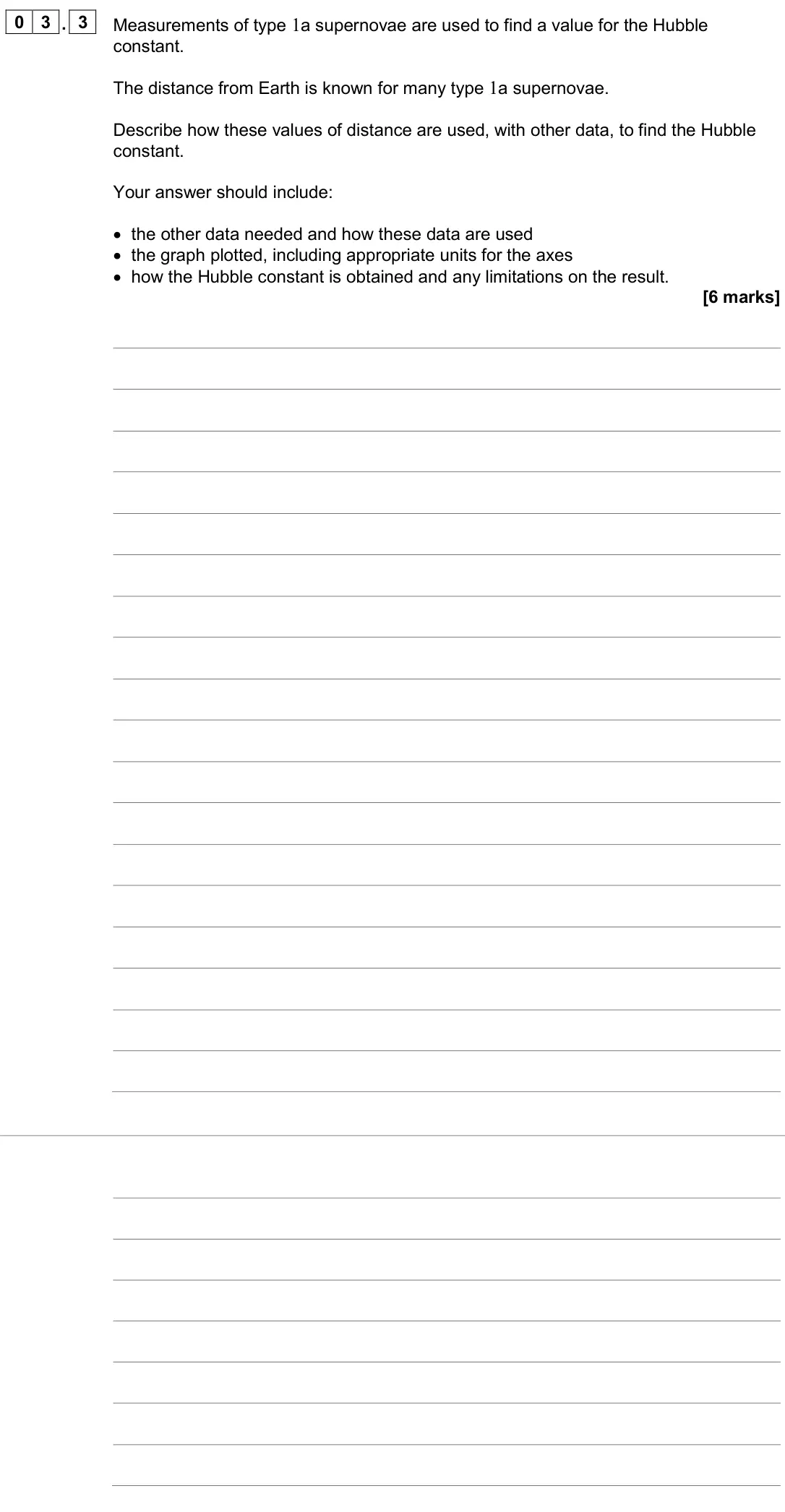
Q02.4
The whole paper ↗
All 30 questions on Cosmology, as a list
- June 2025, Paper 3 Astrophysics, Q03.1 (3 marks): The galaxy M87 is at a distance of 5.3 × 10⁷ ly from the Earth. Determine, in m s−1, the recessional velocity of M87 relative to the Earth. [3 marks] recessiona
- June 2025, Paper 3 Astrophysics, Q03.2 (1 mark): Astronomers believe that M87 has an active supermassive black hole at its centre. Suggest one observation that leads to this conclusion. [1 mark]
- June 2025, Paper 3 Astrophysics, Q03.3 (1 mark): Which provides evidence for the existence of dark energy? Tick () one box. [1 mark]
- June 2024, Paper 3 Astrophysics, Q04.1 (2 marks): The Andromeda Galaxy approaches the Milky Way at a speed of 110 km s−1. The distance between the galaxies is 770 kpc. Discuss whether these data can be used to
- June 2024, Paper 3 Astrophysics, Q04.3 (6 marks): Scientists predict that a quasar will be produced as the Milky Way and the Andromeda Galaxy merge. Explain what is meant by a quasar. Go on to suggest why a qua
- June 2023, Paper 3 Astrophysics, Q03.3 (3 marks): A star is orbiting the black hole in M87. The star is observed in the plane of its orbit. The wavelength of a spectral line observed in the light emitted from t
- June 2023, Paper 3 Astrophysics, Q05.1 (3 marks): Estimate, using Figure 2, the age in seconds of the Universe. [3 marks] age of Universe = s
- June 2023, Paper 3 Astrophysics, Q05.2 (2 marks): The estimate in Question 05.1 assumes that the Universe has expanded at a constant rate. Measurements involving type 1a supernovae that are at large distances f
- June 2022, Paper 3 Astrophysics, Q02.2 (1 mark): State why the average of the values in Table 1 is different from the laboratory value. [1 mark]
- June 2022, Paper 3 Astrophysics, Q02.3 (3 marks): Show that the orbital speed of the primary star is about 250 km s−1. [3 marks]
- June 2022, Paper 3 Astrophysics, Q03.1 (1 mark): State the property of the quasar that led to its discovery. [1 mark]
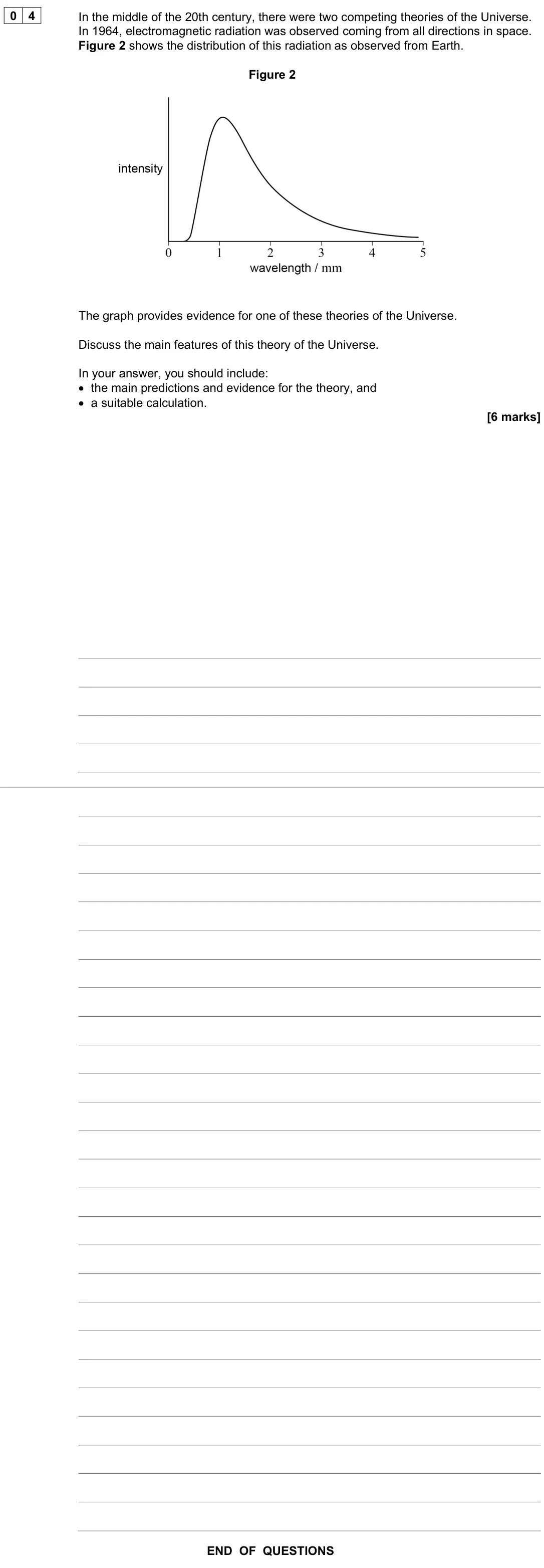
- June 2022, Paper 3 Astrophysics, Q04 (6 marks): In the middle of the 20th century, there were two competing theories of the Universe. In 1964, electromagnetic radiation was observed coming from all directions
- November 2021, Paper 3 Astrophysics, Q02.1 (1 mark): Which graph shows the light curve for a typical type 1a supernova? Tick () one box. [1 mark] A B C D A B C D
- November 2021, Paper 3 Astrophysics, Q02.2 (3 marks): The Andromeda galaxy is approximately 7.7 × 10⁵ pc from Earth. Deduce whether a type 1a supernova which occurred in Andromeda can be observed from Earth with th
- November 2021, Paper 3 Astrophysics, Q04.1 (2 marks): Suggest why the quasar stopped emitting radiation. [2 marks]
- November 2021, Paper 3 Astrophysics, Q04.2 (4 marks): IC2497 has a red shift of 0.0516 Determine the distance from the Earth to IC2497. Give an appropriate unit for your answer. [4 marks] distance = unit =
- November 2020, Paper 3 Astrophysics, Q03.1 (1 mark): State what is meant by a standard candle. [1 mark]
- November 2020, Paper 3 Astrophysics, Q03.2 (3 marks): Sketch on Figure 2 the light curve for a type 1a supernova. Annotate your graph with suitable scales and a unit for time. [3 marks] Figure 2
- November 2020, Paper 3 Astrophysics, Q03.3 (6 marks): Measurements of type 1a supernovae are used to find a value for the Hubble constant. The distance from Earth is known for many type 1a supernovae. Describe how
- June 2019, Paper 3 Astrophysics, Q02.4 (2 marks): Astronomers recently used the radial velocity method to discover an exoplanet orbiting HD 66141. Describe the main features of the radial velocity method in the
- June 2019, Paper 3 Astrophysics, Q04.1 (3 marks): Table 3 contains information about two galaxies. Table 3 Galaxy Red shift, z Distance from Earth / ly NGC 936 4.8 × 10⁻³ 6.8 × 10⁷ NGC 3379 3.0 × 10⁻³ 3.2 × 10⁷
- June 2019, Paper 3 Astrophysics, Q04.2 (2 marks): Quasars are the most distant measurable objects. Discuss one problem associated with the determination of the distance from the Earth to a quasar. [2 marks]
- June 2018, Paper 3 Astrophysics, Q03.1 (2 marks): Describe the links between galaxies, black holes and quasars. [2 marks]
- June 2018, Paper 3 Astrophysics, Q03.2 (4 marks): At a distance of 5.81 × 10⁸ light year, Markarian-231 is the closest known quasar to the Earth. The red shift z of Markarian-231 is 0.0415 Use these data to est
- June 2018, Paper 3 Astrophysics, Q03.3 (3 marks): A typical quasar is believed to be approximately the size of the solar system, with a power output similar to that of a thousand galaxies. Estimate, with refere
- June 2018, Paper 3 Astrophysics, Q04.1 (3 marks): Explain what is meant by cosmological microwave background radiation and how its existence supports the Big Bang theory. [3 marks]
- June 2018, Paper 3 Astrophysics, Q04.2 (3 marks): Explain how the relative abundance of hydrogen and helium supports the Big Bang theory. [3 marks]
- June 2017, Paper 3 Astrophysics, Q04.1 (3 marks): Sketch, on the axes in Figure 1, the light curve for a typical type 1a supernova. Label the axes with suitable scales. [3 marks
- June 2017, Paper 3 Astrophysics, Q04.2 (1 mark): Type 1a supernovae can be used as standard candles. Explain what is meant by a standard candle. [1 mark
- June 2017, Paper 3 Astrophysics, Q04.3 (3 marks): Measurements of type 1a supernovae in 1999 led to a controversy concerning the behaviour of the Universe. Describe this controversy and how the measurements led
Questions, mark schemes and examiner’s reports are © AQA, from their published past papers. Plumi isn’t affiliated with any exam board. Want whole papers? Every AQA A-Level Physics paper.
Rather write your answers by hand on iPad? Plumi marks them against the same mark schemes.