 plumi
Electric field strength: AQA A‑Level Physics questions
AQA A-Level Physics past-paper questions on 3.7.3.2 Electric field strength, 2008–2025, with mark schemes and examiner’s reports where available.
Paper
All papers
Exam
All years
Calculations
Q06.4
The whole paper ↗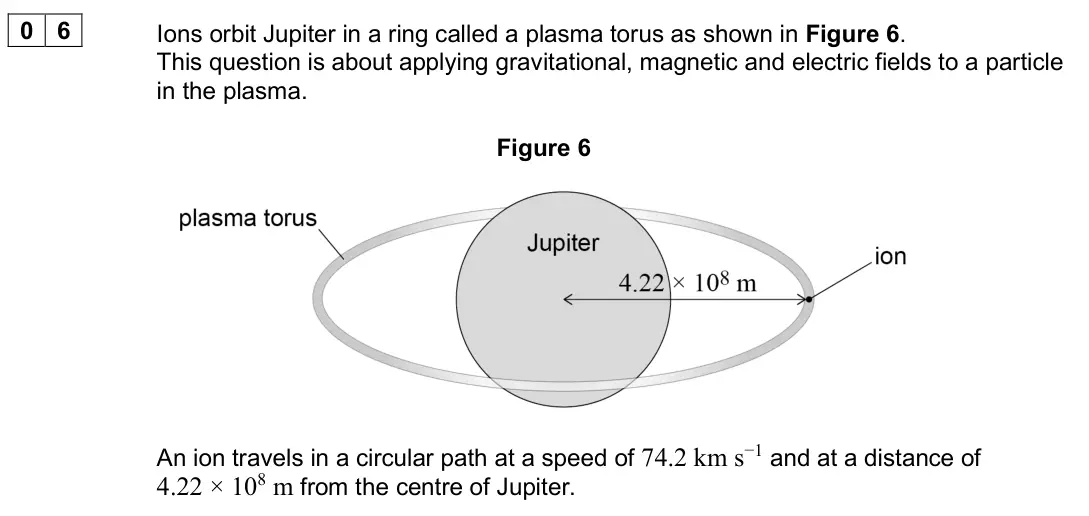
Q06.5
The whole paper ↗Q06.2
The whole paper ↗Q04.1
The whole paper ↗
Q03.1
The whole paper ↗
Q03.1
The whole paper ↗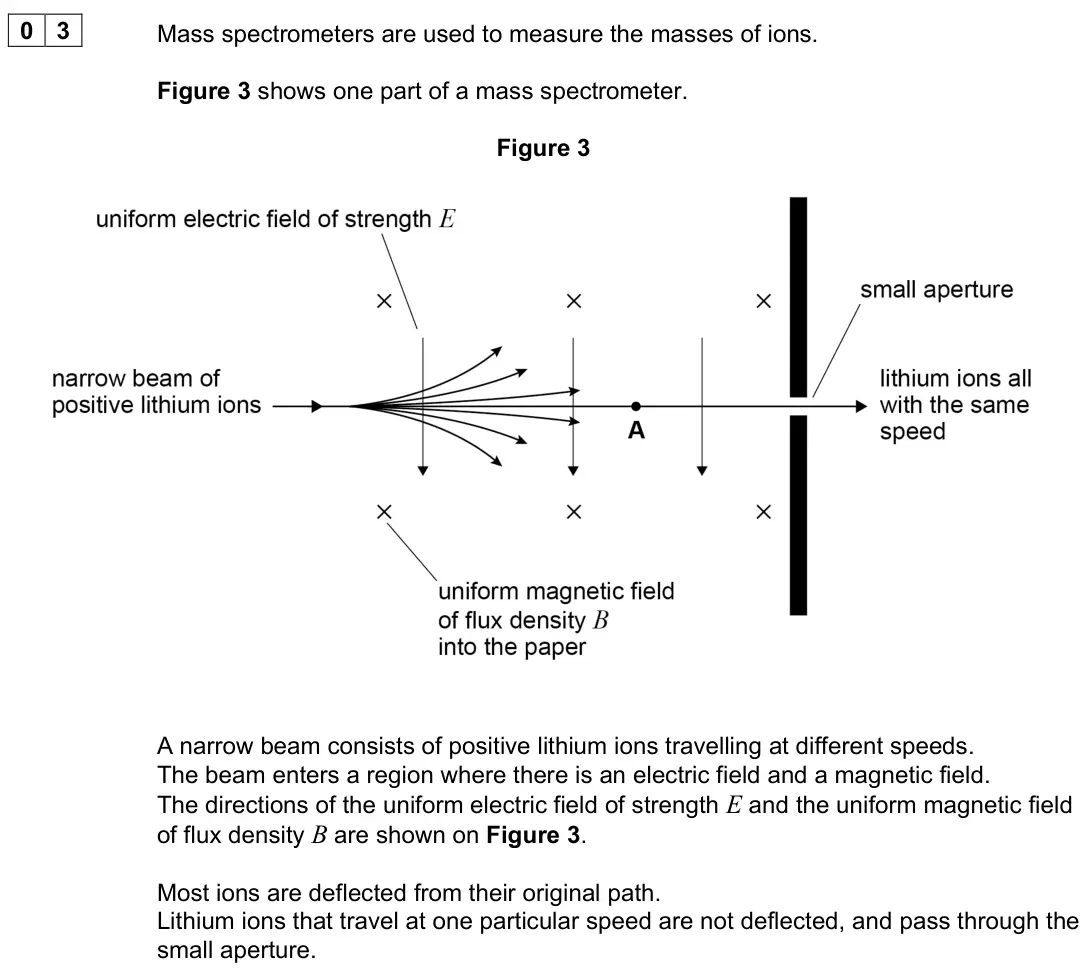
Q03.2
The whole paper ↗- Your answer
- Your answer
- Your answer
Q02.1
The whole paper ↗
All 82 questions on Electric field strength, as a list
- June 2025, Paper 2, Q06.4 (3 marks): An electric field of strength 371 μV m−1 can also accelerate the ion. Calculate the acceleration of the ion due to this electric field. [3 marks] acceleration =
- June 2025, Paper 2, Q06.5 (3 marks): The plasma torus contains two ions X and Y as shown in Figure 8. X has a charge of +2e. Y has a charge of +1e. Assume that each ion acts as a point charge. Figu
- June 2025, Paper 2, Q11 (1 mark): Two charged metal spheres have charges +Q and −q. The magnitude of +Q is greater than the magnitude of −q. In which diagram are the electric field lines correct
- June 2025, Paper 2, Q15 (1 mark): The diagram shows point charges Q and q. Q and q have charges of opposite sign. The magnitude of the charge of Q is greater than the magnitude of the charge of
- June 2025, Paper 2, Q16 (1 mark): The diagram shows two parallel conducting plates at potentials of −20 V and −10 V. The displacement x is measured from the bottom (−20 V) plate. Which graph sho
- June 2024, Paper 2, Q06.2 (4 marks): Determine, using the graph in Figure 9, the maximum magnitude of the electric field. State an appropriate unit for your answer. [4 marks] maximum magnitude = un
- June 2024, Paper 2, Q26 (1 mark): Which diagram shows a distribution of charge where the electric potential at P and the electric field at P are both zero? [1 mark] A B C D A B C D
- June 2024, Paper 2, Q27 (1 mark): An ion has a specific charge of −7.1 × 10⁷ C kg−1. It is held stationary in a vertical electric field on the surface of the Earth. What are the magnitude and di
- June 2023, Paper 2, Q04.1 (2 marks): Figure 5 shows a dashed line between the mesh and the wire. Sketch on Figure 6 a graph to show how the magnitude E of the electric field strength varies with th
- June 2023, Paper 2, Q14 (1 mark): Six metal spheres, each carrying a charge of magnitude Q, are equally spaced around a circle of diameter d. What is the magnitude of the field strength at the c
- June 2023, Paper 2, Q16 (1 mark): The diagram shows the path of an electron in a uniform electric field. The electron moves in a vertical plane. The direction of the electric field is [1 mark] A
- June 2022, Paper 2, Q03.1 (2 marks): State and explain the location of the excess electrons. [2 marks]
- November 2021, Paper 2, Q16 (1 mark): Two parallel metal plates separated by a distance d have a potential difference V across them. A particle with charge Q is placed midway between the plates. Wha
- November 2021, Paper 2, Q18 (1 mark): An isolated spherical conductor is charged. The conductor has a radius R and an electric potential V. The electric field strength at its surface is E. Point T i
- November 2020, Paper 2, Q03.1 (1 mark): The positive lithium ion A in Figure 3 moves at a speed v. Draw two labelled arrows on Figure 3 to show the directions of the electric force FE and the magnetic
- November 2020, Paper 2, Q03.2 (2 marks): Lithium ions travelling at 1.5 × 10⁵ m s−1 pass through the small aperture. Calculate E. B = 0.12 T [2 marks] E = V m−1
- November 2020, Paper 2, Q15 (1 mark): At a distance L from a fixed point charge, the electric field strength is E and the electric potential is V. What are the electric field strength and the electr
- June 2019, Paper 2, Q14 (1 mark): A small object of mass m has a charge Q. The object remains stationary in an evacuated space between two horizontal plates. The plates are separated by a distan
- June 2019, Paper 2, Q16 (1 mark): An electric field acts into the plane of the paper. An electron enters the field at 90° to the field lines. The force on the electron is [1 mark] A zero. B alon
- June 2018, Paper 2, Q02.1 (2 marks): Define the electric field strength at a point in an electric field. [2 marks]
- June 2018, Paper 2, Q02.2 (3 marks): Figure 2 shows a point charge of +46 µC placed 120 mm from a point charge Q. Figure 2 Position P is on the line joining the charges at a distance 66 mm from cha
- June 2018, Paper 2, Q02.4 (2 marks): A small rubber ball coated with a conducting paint carries a positive charge. The ball is suspended in equilibrium from a vertical wall by an uncharged non-cond
- June 2018, Paper 2, Q20 (1 mark): A conducting sphere holding a charge of +10 µC is placed centrally inside a second uncharged conducting sphere. Which diagram shows the electric field lines for
- June 2017, Paper 2, Q06.5 (1 mark): State which object L or M has a charge with the greater magnitude. object State which object L or M has a positive charge. object [1 mark]
- June 2017, Paper 2, Q15 (1 mark): Two parallel metal plates of separation a carry equal and opposite charges. Which graph best represents how the electric field strength E varies with the distan
- June 2017, Paper 2, Q16 (1 mark): A particle of mass m and charge q is accelerated through a potential difference V over a distance d. What is the average acceleration of the particle? [1 mark]
- June 2017, Paper 2, Q17 (1 mark): An electron moves through a distance of 0.10 m parallel to the field lines of a uniform electric field of strength 2.0 kN C−1. What is the work done on the elec
- Specimen, Paper 2, Q01.2 (3 marks): Figure 1 shows a system that separates two minerals from the ore containing them using an electric field. Figure 1 The crushed particles of the two different mi
- Specimen, Paper 2, Q01.3 (1 mark): Figure 1 shows a system that separates two minerals from the ore containing them using an electric field. Figure 1 The crushed particles of the two different mi
- Specimen, Paper 2, Q01.5 (4 marks): Figure 1 shows a system that separates two minerals from the ore containing them using an electric field. Figure 1 The crushed particles of the two different mi
- Specimen, Paper 2, Q11 (1 mark): Q
- Specimen, Paper 2, Q12 (1 mark): Two parallel metal plates are separated by a distance d and have a potential difference V across them. Which expression gives the magnitude of the electrostatic
- June 2016, PHYA4 Section A (old spec), Q13 (1 mark): The diagram shows a charge –Q being moved from point X to point Y between two charged parallel plates separated by a distance d. Which one of the following grap
- June 2016, PHYA4 Section A (old spec), Q14 (1 mark): The diagram shows four point charges, each +Q, at the corners of a square of side 2a. What is the electric field strength at P, the centre of the square? A zero
- June 2015, PHYA4 Section A (old spec), Q15 (1 mark): A positive ion has a charge-to-mass ratio of 2.40 × 10⁷ C kg–1. It is held stationary in a vertical electric field. Which line, A to D, in the table shows corre
- June 2015, PHYA4 Section B (old spec), Q2(c)(iii) (2 marks): Calculate the electric field strength at the point where r = 0.40 m. [2 marks] electric field strength V m–1
- June 2014, PHYA4 Section A (old spec), Q14 (1 mark): Which one of the following statements is correct? When a negative ion is projected into an electric field A the field can change the magnitude of the velocity b
- June 2014, PHYA4 Section B (old spec), Q2(a)(i) (2 marks): State and explain the direction of the electrostatic force on the ion. [2 marks]
- June 2014, PHYA4 Section B (old spec), Q2(a)(ii) (2 marks): Calculate the magnitude of the electrostatic force acting on the ion. [2 marks] magnitude of electrostatic force N
- June 2014, PHYA4 Section B (old spec), Q2(a)(iii) (1 mark): Calculate the electric field strength. [1 mark] electric field strength NC–1
- June 2013, PHYA4 Section A (old spec), Q16 (1 mark): Two horizontal parallel plate conductors are separated by a distance of 5.0mm in air. The lower plate is earthed and the potential of the upper plate is +50V. W
- June 2013, PHYA4 Section A (old spec), Q18 (1 mark): Which path, A to D, shows how an electron moves in the uniform electric field represented in the diagram? boundary of electric field electric field initial dire
- June 2013, PHYA4 Section A (old spec), Q19 (1 mark): The diagram shows a negative ion at a point in an electric field, which is represented by the arrowed field lines. Which one of the following statements correct
- June 2013, PHYA4 Section B (old spec), Q2(a)(i) (1 mark): The air gap is 12mm wide. Calculate the minimum pd required across the discs for a spark to occur. Assume that the electric field in the air gap is uniform. pd
- January 2013, PHYA4 Section A (old spec), Q14 (1 mark): A small sphere, of mass m and carrying a charge Q, is suspended from a thread and placed in a uniform horizontal electric field of strength E. When the sphere c
- January 2013, PHYA4 Section A (old spec), Q16 (1 mark): A beam of electrons, moving with a constant velocity v in a vacuum, enters a uniform electric field between two metal plates. Which line, A to D, in the table d
- January 2013, PHYA4 Section A (old spec), Q21 (1 mark): Which line, A to D, in the table correctly describes the trajectory of charged particles which enter separately, at right angles, a uniform electric field, and
- January 2013, PHYA4 Section B (old spec), Q4(b)(i) (3 marks): Sketch on Figure 3 the pattern of the electric field surrounding the charges. (3 marks)
- January 2013, PHYA4 Section B (old spec), Q4(c)(i) (4 marks): Calculate the magnitude of the resultant electric field strength at the mid-point of the line joining the two charges in Figure 3. State an appropriate unit for
- January 2013, PHYA4 Section B (old spec), Q4(c)(ii) (1 mark): State the direction of the resultant electric field at the mid-point of the line joining the charges. (1 mark)
- June 2012, PHYA4 Section B (old spec), Q2(a)(i) (1 mark): Draw an arrow on Figure 2 to show the direction of the electrostatic force that acts on the stationary electron. (1 mark)
- June 2012, PHYA4 Section B (old spec), Q2(a)(ii) (2 marks): State and explain what, if anything, will happen to the magnitude of the electrostatic force acting on the electron as it starts to move in this field. (2 marks
- June 2012, PHYA4 Section B (old spec), Q2(b)(i) (2 marks): State and explain how the electrostatic force on the proton in Figure 3b compares with that on the electron in Figure 3a. (2 marks)
- June 2012, PHYA4 Section B (old spec), Q2(b)(ii) (2 marks): Each of the particles starts to move from the positions shown in Figure 3a and Figure 3b. State and explain how the magnitude of the initial acceleration of the
- June 2012, PHYA4 Section B (old spec), Q2(b)(iii) (2 marks): Describe and explain what will happen to the acceleration of each of these particles as they continue to move in the electric field.
- June 2012, PHYA4 Section B (old spec), Q2(c)(ii) (3 marks): An illuminated shop sign includes a neon discharge tube, as shown in Figure 4. A pd of 4500V is applied across the electrodes, which are 180mm apart. Figure 4 A
- June 2012, PHYA5 Turning points (old spec), Q1(a) (3 marks): Explain why the beam curves downwards at an increasing angle to its initial direction.
- January 2012, PHYA4 Section A (old spec), Q15 (1 mark): The distance between two point charges of + 8.0nC and + 2.0nC is 60mm. At a point between the charges, on the line joining them, the resultant electric field st
- January 2012, PHYA4 Section A (old spec), Q16 (1 mark): Which one of the following cannot be used as a unit for electric field strength? A Jm–1C–1 B JA–1s–1m–1 C NA–1s–1 D JCm–1
- January 2012, PHYA4 Section B (old spec), Q1(b)(iii) (1 mark): Show that the electric field strength at point M, which is mid-way between L and N, is 2.5Vm–1. (1 mark)
- January 2012, PHYA4 Section B (old spec), Q1(c)(i) (2 marks): On Figure 2, sketch the electric field between R and S, showing its direction. (2 marks)
- January 2012, PHYA4 Section B (old spec), Q1(c)(ii) (1 mark): Point T is mid-way between R and S. Calculate the electric field strength at T. answer = Vm–1 (1 mark)
- January 2012, PHYA4 Section B (old spec), Q1(c)(iii) (1 mark): Parts (b)(iii) and (c)(ii) both involve the electric field strength at a point mid-way between potentials of + 1.0V and + 3.0V. Explain why the magnitudes of th
- June 2011, PHYA4 Section A (old spec), Q15 (1 mark): An ion carrying a charge of +4.8 × 10⁻¹⁹C travels horizontally at a speed of 8.0 × 10⁵ms–1. It enters a uniform vertical electric field of strength 4200 V m–1,
- June 2011, PHYA4 Section B (old spec), Q4(b)(ii) (2 marks): Explain why the ions have no overall deflection when a magnetic field of the required strength has been applied. (2 marks)
- June 2011, PHYA4 Section B (old spec), Q4(b)(iii) (4 marks): A stream of ions passes between the plates at a velocity of 1.7x10⁵ms–1. The separation d of the plates is 65mm and the pd across them is 48V. Calculate the val
- June 2011, PHYA4 Section B (old spec), Q4(c) (2 marks): Explain what would happen to ions with a velocity higher than 1.7x10⁵ms–1 when they pass between the plates at a time when the conditions in part (b)(iii) have
- January 2011, PHYA4 Section A (old spec), Q14 (1 mark): What is the acceleration of an electron at a point in an electric field where the field strength is 1.5×10⁵ Vm–1? A 1.2×10⁶ ms–2 B 1.4×10¹³ ms–2 C 2.7×10¹⁵ ms–2
- January 2011, PHYA4 Section A (old spec), Q15 (1 mark): At a distance R from a fixed charge, the electric field strength is E and the electric potential is V. Which line, A to D, in the table gives the electric field
- January 2011, PHYA4 Section B (old spec), Q4(a)(i) (2 marks): A pd of 600V is applied between P1 and P2 when the switch is closed. Calculate the magnitude of the electric field strength between the plates, assuming it is u
- January 2011, PHYA4 Section B (old spec), Q4(a)(ii) (1 mark): Show that the magnitude of the electrostatic force that acts on the ball under these conditions is 1.3mN. (1 mark)
- January 2011, PHYA4 Section B (old spec), Q4(b)(i) (2 marks): On Figure 4, mark and label the forces that act on the ball when in this position. (2 marks)
- January 2011, PHYA4 Section B (old spec), Q4(b)(ii) (3 marks): The mass of the ball is 4.8 × 10⁻⁴kg. By considering the equilibrium of the ball, determine the value of θ. answer = degrees (3 marks)
- June 2010, PHYA4 Section B (old spec), Q2(a)(i) (1 mark): State the direction of the electric field between the plates. (1 mark)
- June 2010, PHYA4 Section B (old spec), Q2(a)(iii) (3 marks): The pd applied across the plates is 5.0kV. If the charge on the sphere is –4.1 × 10⁻⁸C, determine the separation of the plates. answer = m (3 marks)
- June 2010, PHYA4 Section B (old spec), Q2(b)(i) (2 marks): State and explain the effect of this on the electric field between the plates. (2 marks)
- January 2010, PHYA4 Section A (old spec), Q15 (1 mark): Two parallel metal plates separated by a distance d have a potential difference V across them. What is the magnitude of the electrostatic force acting on a char
- January 2010, PHYA4 Section A (old spec), Q16 (1 mark): Which one of the following statements about electric field strength and electric potential is incorrect? A Electric potential is a scalar quantity. B Electric f
- June 2008, PA04A (2008 spec), Q10 (2 marks): 10 A charged particle of mass 4.80 × 10 –13 kg and charge 8.00 × 10 –19 C is stationary in a vertical electric Þ eld. What is the value of the electric Þ eld? (
- June 2008, PA04A (2008 spec), Q11 (2 marks): 11 The diagram shows four point charges, each +Q, at the corners of a square of side 2a. What is the electric Þ eld strength at P, the centre of the square? A z
- January 2008, PA04B (2008 spec), Q3(a) (5 marks): 3 (a) Electrons experience forces in electric fields. In each of the following cases, state the direction of the force that acts on a moving electron, and descr
- January 2008, PA04B (2008 spec), Q3(b) (4 marks): (b) Figure 2 shows two parallel metal plates, 44 mm apart, which have a pd of 110 V applied across them, with an electron between them. Figure 2 Calculate 44 mm
Questions, mark schemes and examiner’s reports are © AQA, from their published past papers. Plumi isn’t affiliated with any exam board. Want whole papers? AQA A-Level Physics past papers.
The Plumi iPad app also offers exam-style questions with AI feedback on your handwritten working.