Skip to content
Try on iPad

Style

Get started
Whole past papers

Methods of conserving biodiversity: AQA A‑Level Environmental Science questions

AQA A-Level Environmental Science past-paper questions on 3.1.2.3 Methods of conserving biodiversity, 2020–2025, with mark schemes and examiner’s reports where available.

Getting your paper ready…

AQA A-Level Environmental ScienceMethods of conserving biodiversity551 questions

Paper
All papers
Exam
All years
Calculations

Loading the full question list…
551 questions

More options
  1. Q02.4June 2025 · Paper 21 mark

    3.1.2.3 Methods of conserving biodiversity

    1
    Setup for original question 02.4

    Loading the question setup…

    Original question 02.4: State the name of one piece of UK legislation that bans the release of non-indigenous species into the wild. [1 mark]

    Loading the question…

    The whole paper ↗
  2. Q04.1June 2025 · Paper 23 marks

    3.1.2.3 Methods of conserving biodiversity

    2
    Setup for original question 04.1

    Loading the question setup…

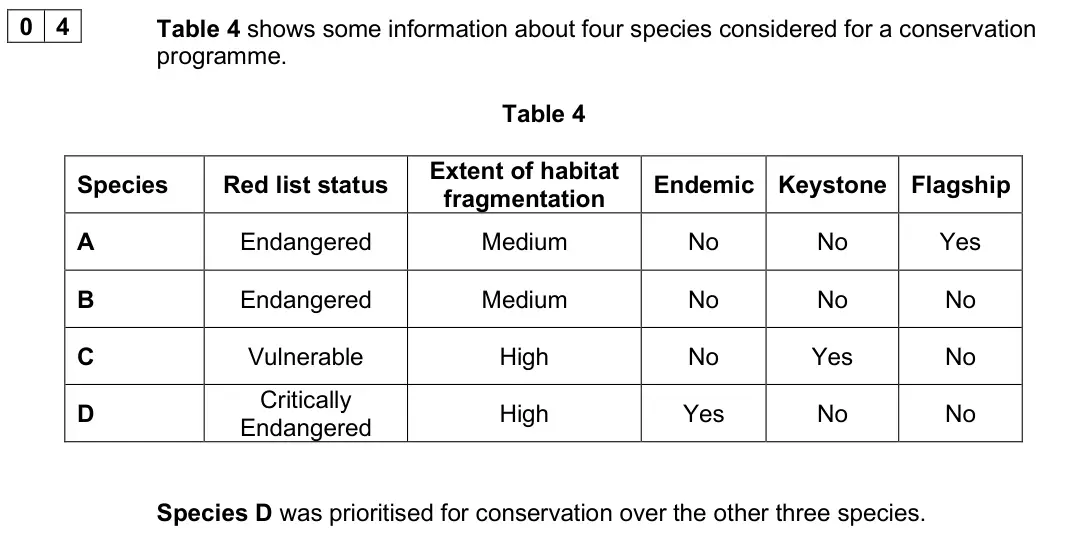
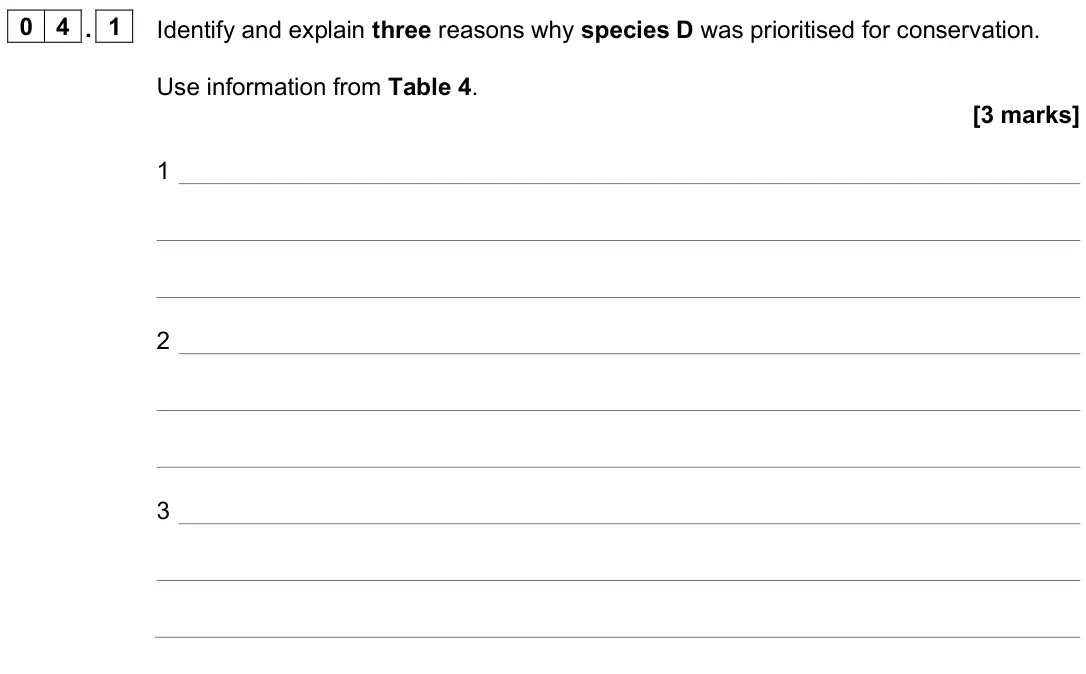
    Original question 04.1: Identify and explain three reasons why species D was prioritised for conservation. Use information from Table 4. [3 marks] 1 2 3

    Loading the question…

    The whole paper ↗
  3. Q04.2June 2025 · Paper 21 mark

    3.1.2.3 Methods of conserving biodiversity

    3
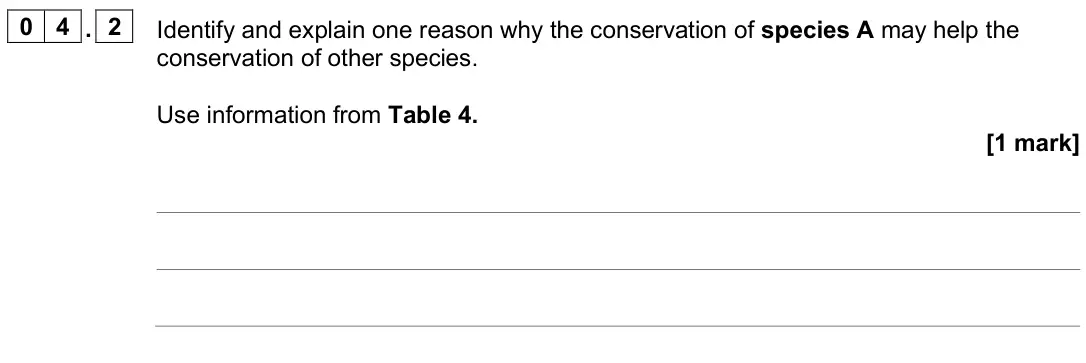
    Original question 04.2: Identify and explain one reason why the conservation of species A may help the conservation of other species. Use information from Table 4. [1 mark]

    Loading the question…

    The whole paper ↗
  4. Q04.3June 2025 · Paper 21 mark

    3.1.2.3 Methods of conserving biodiversity

    4
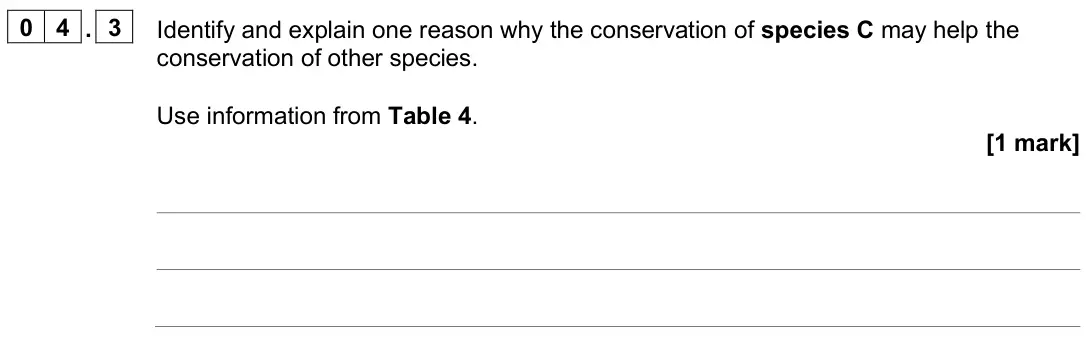
    Original question 04.3: Identify and explain one reason why the conservation of species C may help the conservation of other species. Use information from Table 4. [1 mark]

    Loading the question…

    The whole paper ↗
  5. Q07.3June 2025 · Paper 22 marks

    3.1.2.3 Methods of conserving biodiversity

    5
    Setup for original question 07.3

    Loading the question setup…

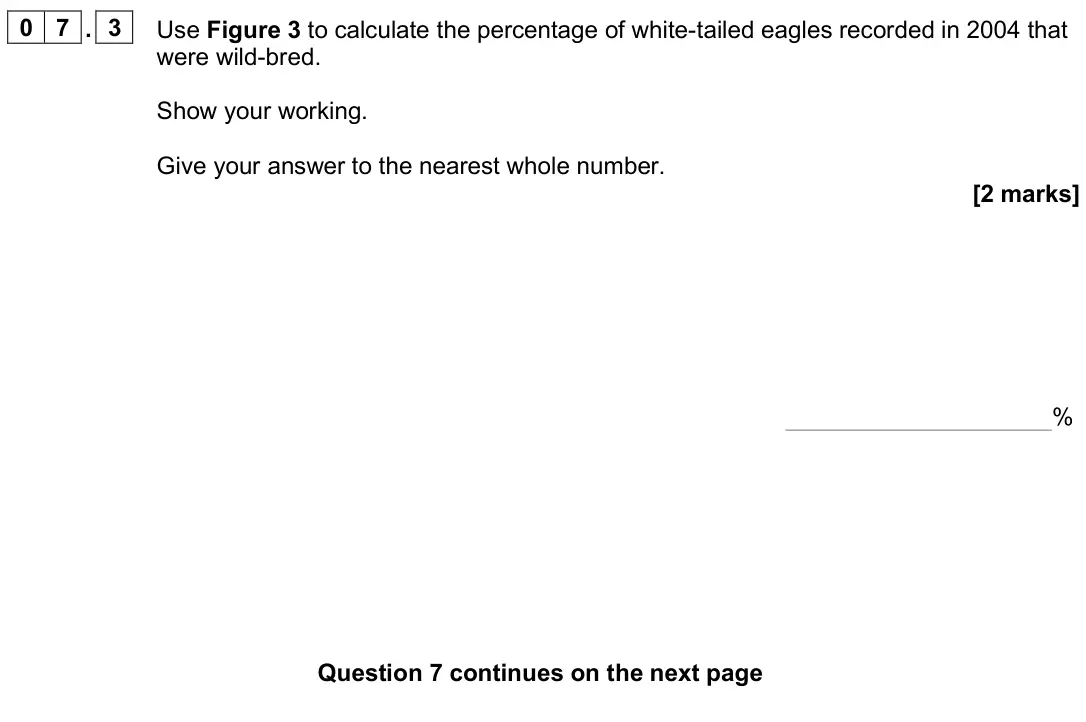
    Original question 07.3: Use Figure 3 to calculate the percentage of white-tailed eagles recorded in 2004 that were wild-bred. Show your working. Give your answer to the nearest whole n

    Loading the question…

    The whole paper ↗
  6. 6
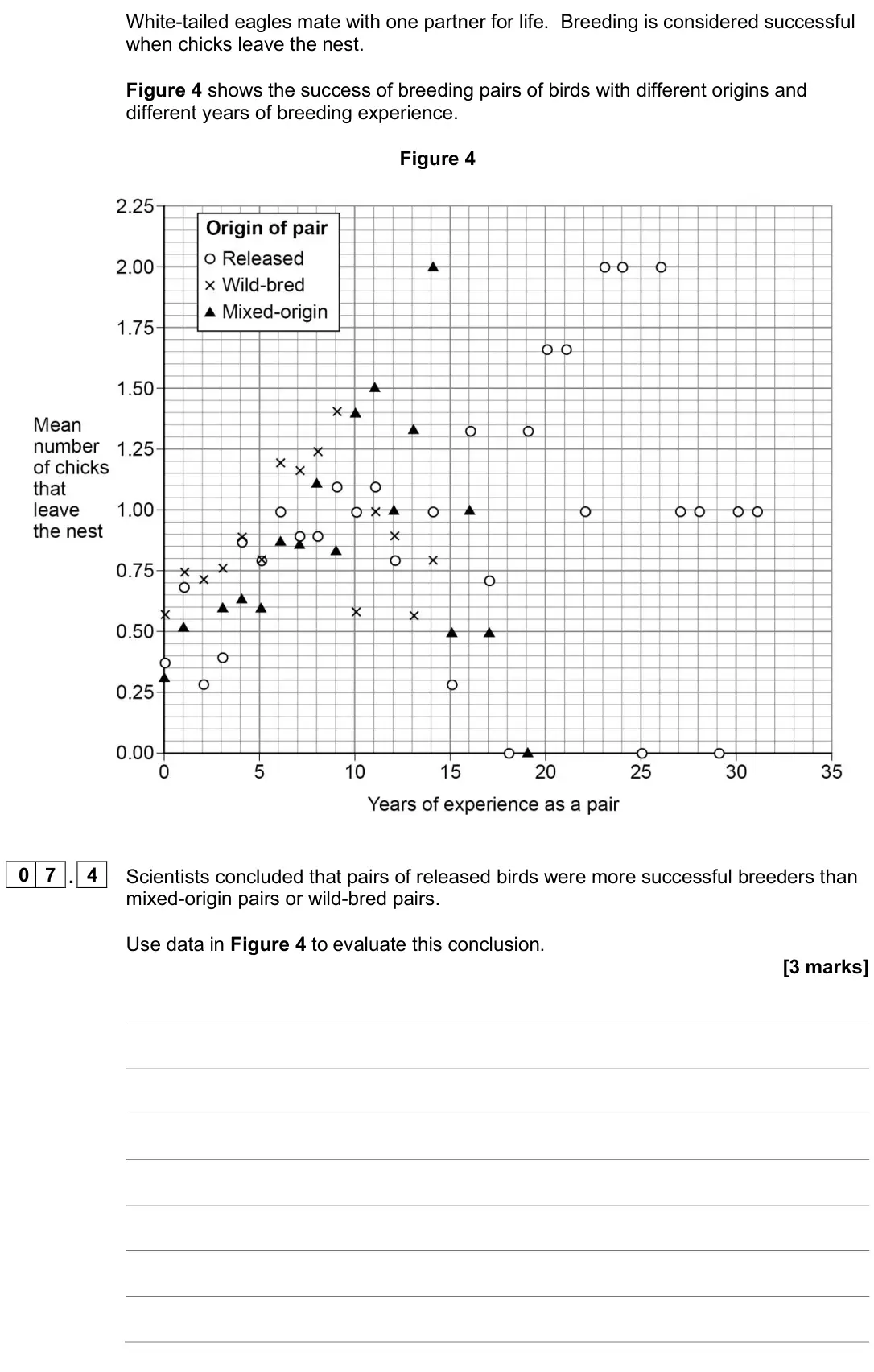
    Original question 07.4: Scientists concluded that pairs of released birds were more successful breeders than mixed-origin pairs or wild-bred pairs. Use data in Figure 4 to evaluate thi

    Loading the question…

    The whole paper ↗
  7. Q07.5June 2025 · Paper 23 marks

    3.1.2.3 Methods of conserving biodiversity

    7
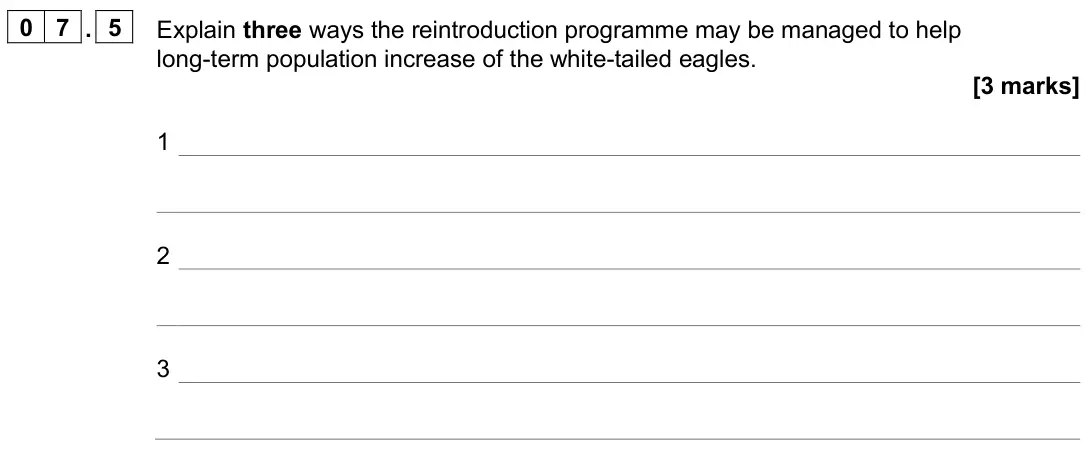
    Original question 07.5: Explain three ways the reintroduction programme may be managed to help long-term population increase of the white-tailed eagles. [3 marks] 1 2 3

    Loading the question…

    The whole paper ↗
  8. Q01.1June 2024 · Paper 21 mark

    3.1.2.3 Methods of conserving biodiversity

    8
    Setup for original question 01.1

    Loading the question setup…

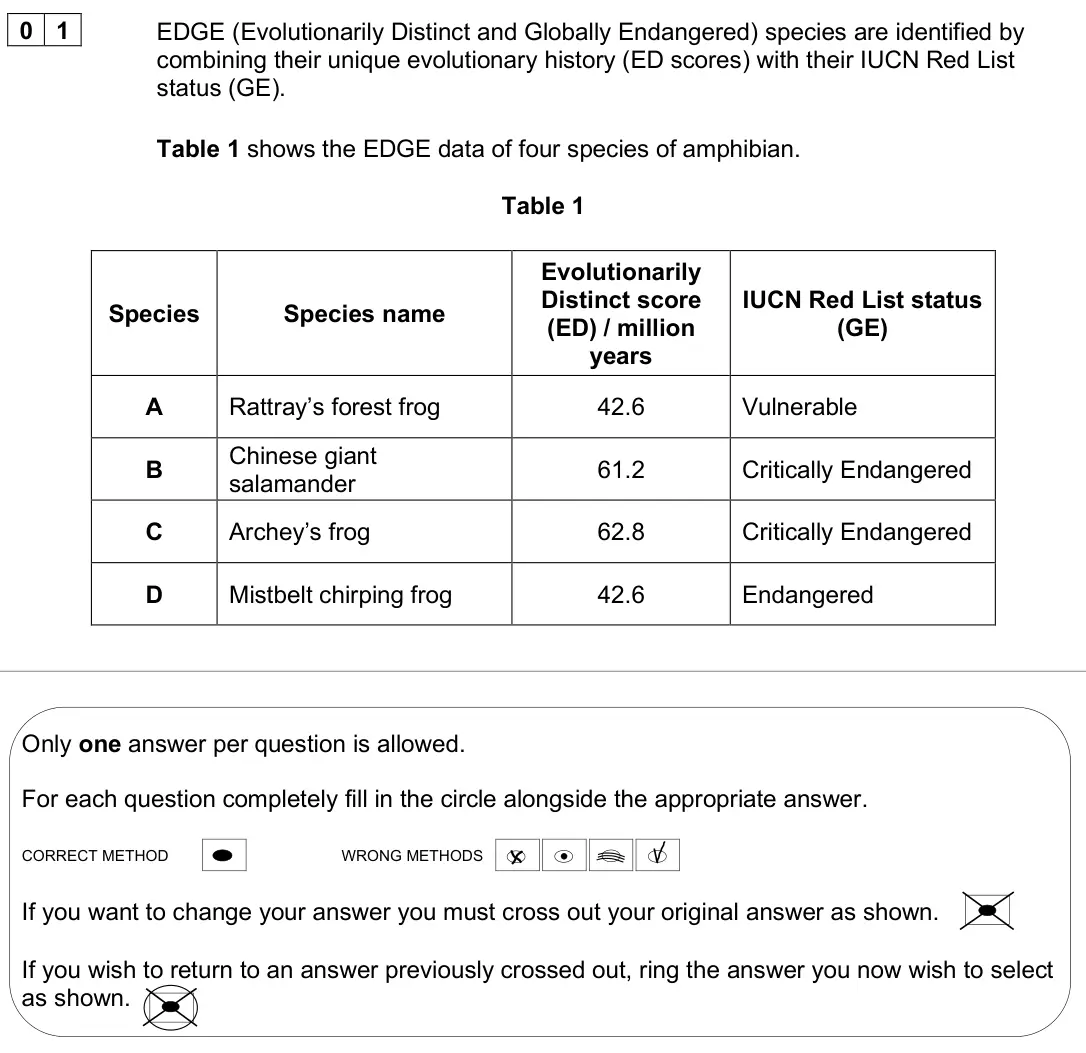
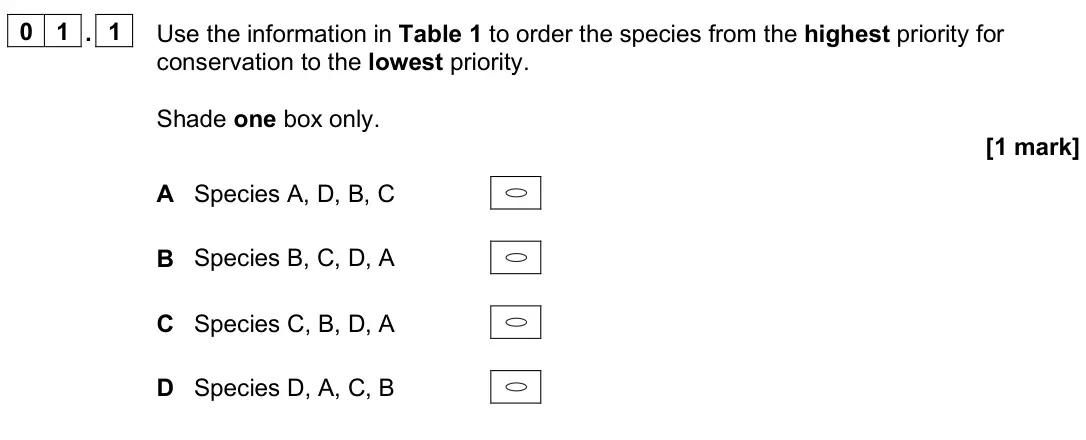
    Original question 01.1: Use the information in Table 1 to order the species from the highest priority for conservation to the lowest priority. Shade one box only. [1 mark] A Species A,

    Loading the question…

    The whole paper ↗
  9. Q01.3June 2024 · Paper 22 marks

    3.1.2.3 Methods of conserving biodiversity

    9
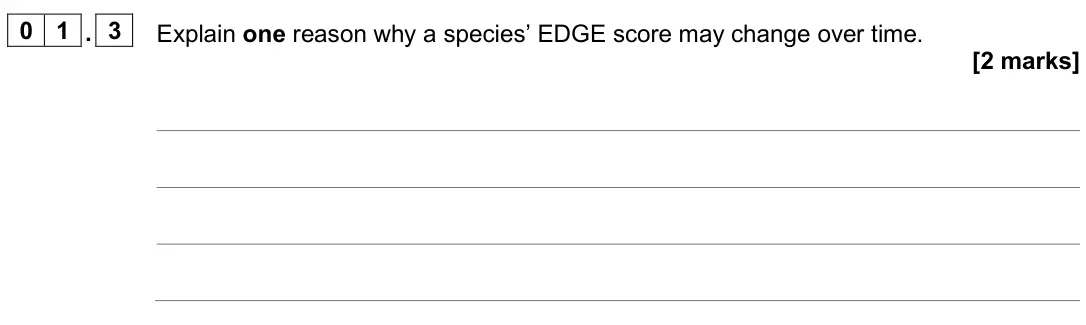
    Original question 01.3: Explain one reason why a species’ EDGE score may change over time. [2 marks]

    Loading the question…

    The whole paper ↗
  10. Q02.2June 2024 · Paper 22 marks

    3.1.2.3 Methods of conserving biodiversity

    10
    Setup for original question 02.2

    Loading the question setup…

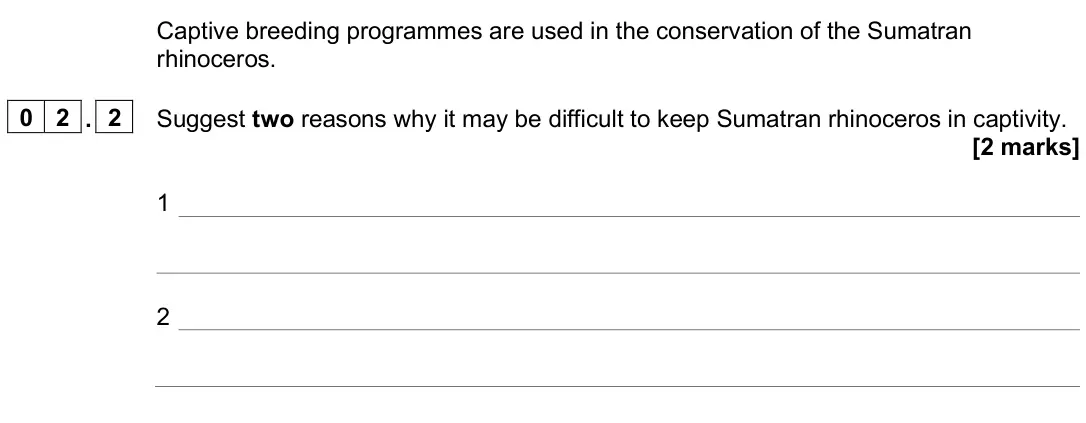
    Original question 02.2: Suggest two reasons why it may be difficult to keep Sumatran rhinoceros in captivity. [2 marks] 1 2

    Loading the question…

    The whole paper ↗
  11. Q02.3June 2024 · Paper 23 marks

    3.1.2.3 Methods of conserving biodiversity

    11
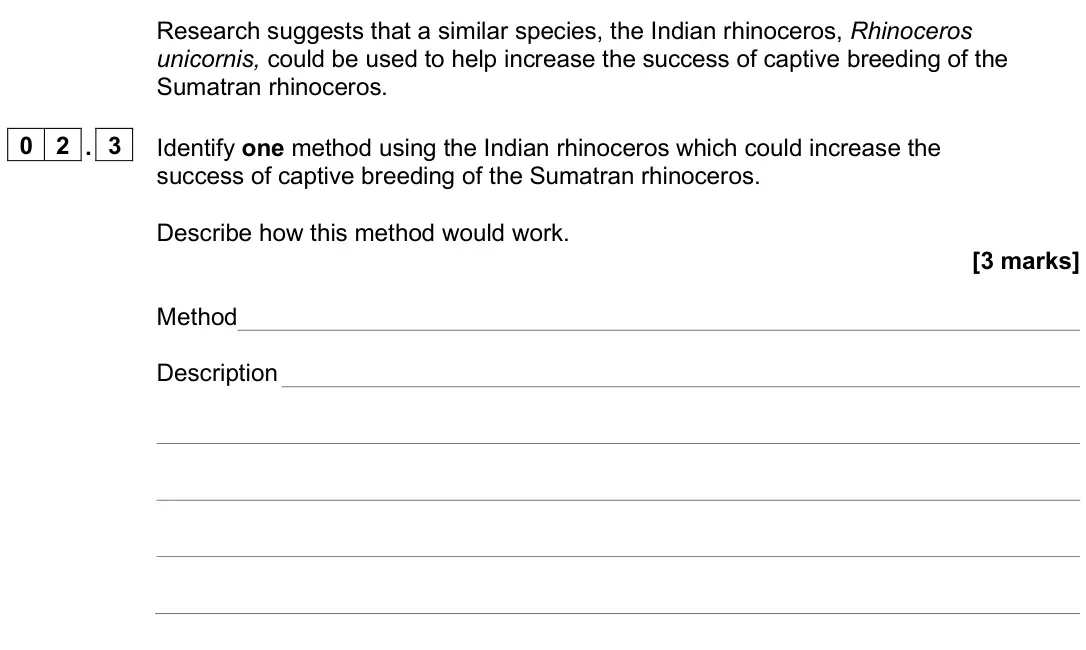
    Original question 02.3: Identify one method using the Indian rhinoceros which could increase the success of captive breeding of the Sumatran rhinoceros. Describe how this method would

    Loading the question…

    The whole paper ↗
  12. 12
    Original question 02.4: In the wild, Sumatran rhinoceros are monitored using radio collars. Suggest one way that data from the radio collars can be used to help with the conservation o

    Loading the question…

    The whole paper ↗
  13. Q03.4June 2024 · Paper 21 mark

    3.1.2.3 Methods of conserving biodiversity

    13
    Original question 03.4: Identify one international agreement that protects Antarctica. [1 mark]

    Loading the question…

    The whole paper ↗
  14. Q04.1June 2024 · Paper 23 marks

    3.1.2.3 Methods of conserving biodiversity

    14
    Setup for original question 04.1

    Loading the question setup…

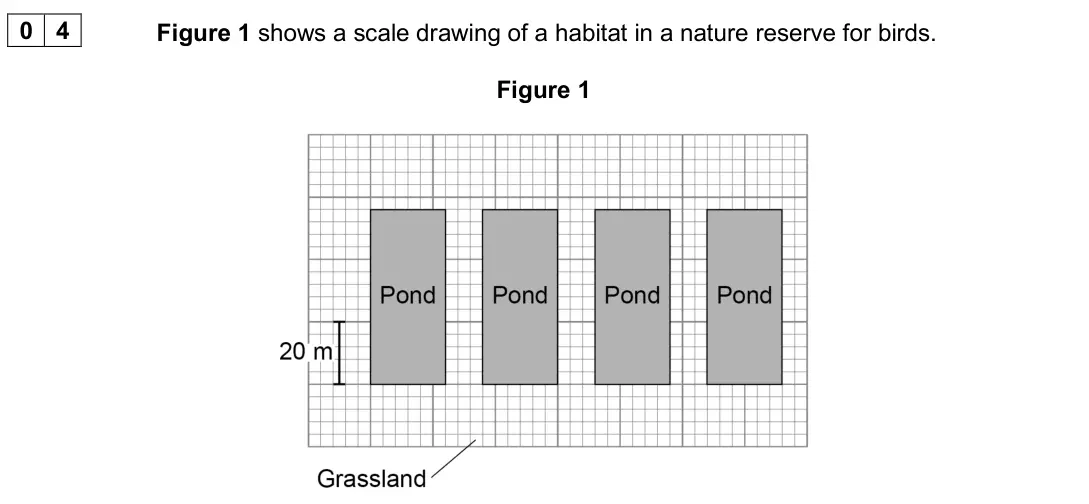
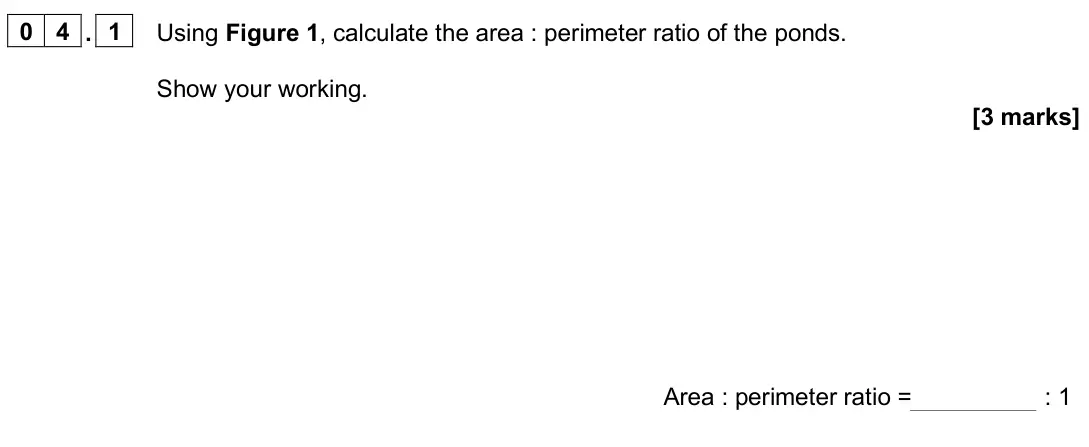
    Original question 04.1: Using Figure 1, calculate the area : perimeter ratio of the ponds. Show your working. [3 marks] Area : perimeter ratio = : 1

    Loading the question…

    The whole paper ↗
  15. 15
    Original question 04.2: State two reasons why a smaller area : perimeter ratio may result in a greater biodiversity of birds. [2 marks] 1 2

    Loading the question…

    The whole paper ↗
  16. Q11.1June 2024 · Paper 225 marks

    3.1.2.3 Methods of conserving biodiversity

    16
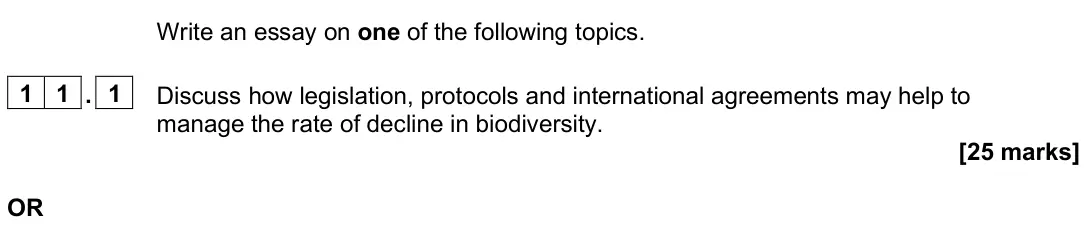
    Original question 11.1: Discuss how legislation, protocols and international agreements may help to manage the rate of decline in biodiversity. [25 marks] OR

    Loading the question…

    The whole paper ↗
  17. Q03.4June 2023 · Paper 23 marks

    3.1.2.3 Methods of conserving biodiversity

    17
    Setup for original question 03.4

    Loading the question setup…

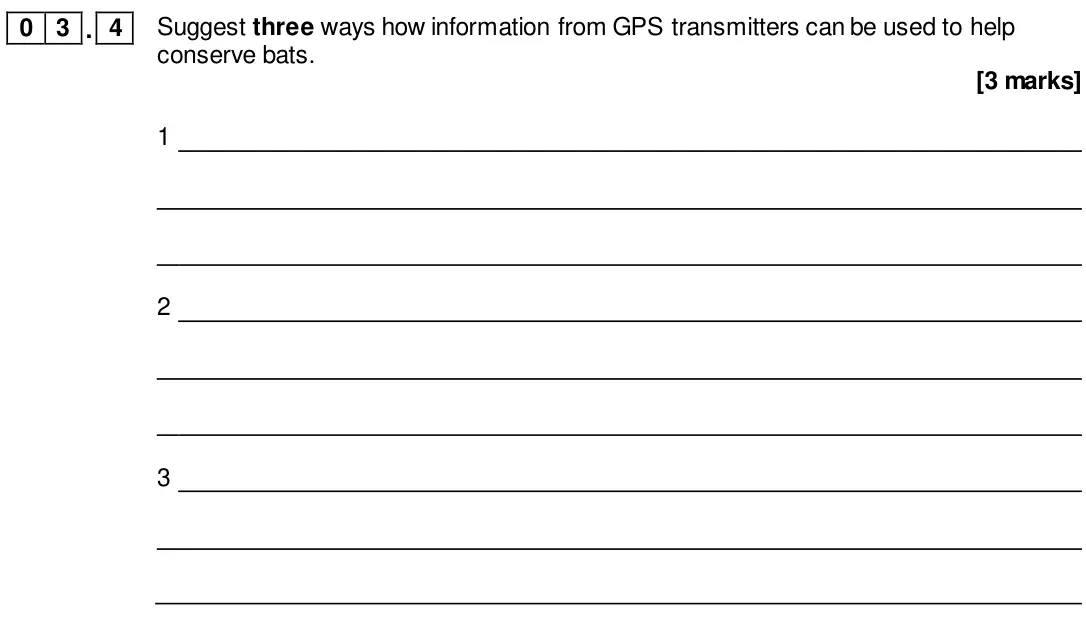
    Original question 03.4: Suggest three ways how information from GPS transmitters can be used to help conserve bats. [3 marks] 1 2 3

    Loading the question…

    The whole paper ↗
  18. Q05.2June 2023 · Paper 21 mark

    3.1.2.3 Methods of conserving biodiversity

    18
    Original question 05.2: Give the name of a designation that may be used to protect a deep-water reef in the UK. [1 mark]

    Loading the question…

    The whole paper ↗
  19. 19
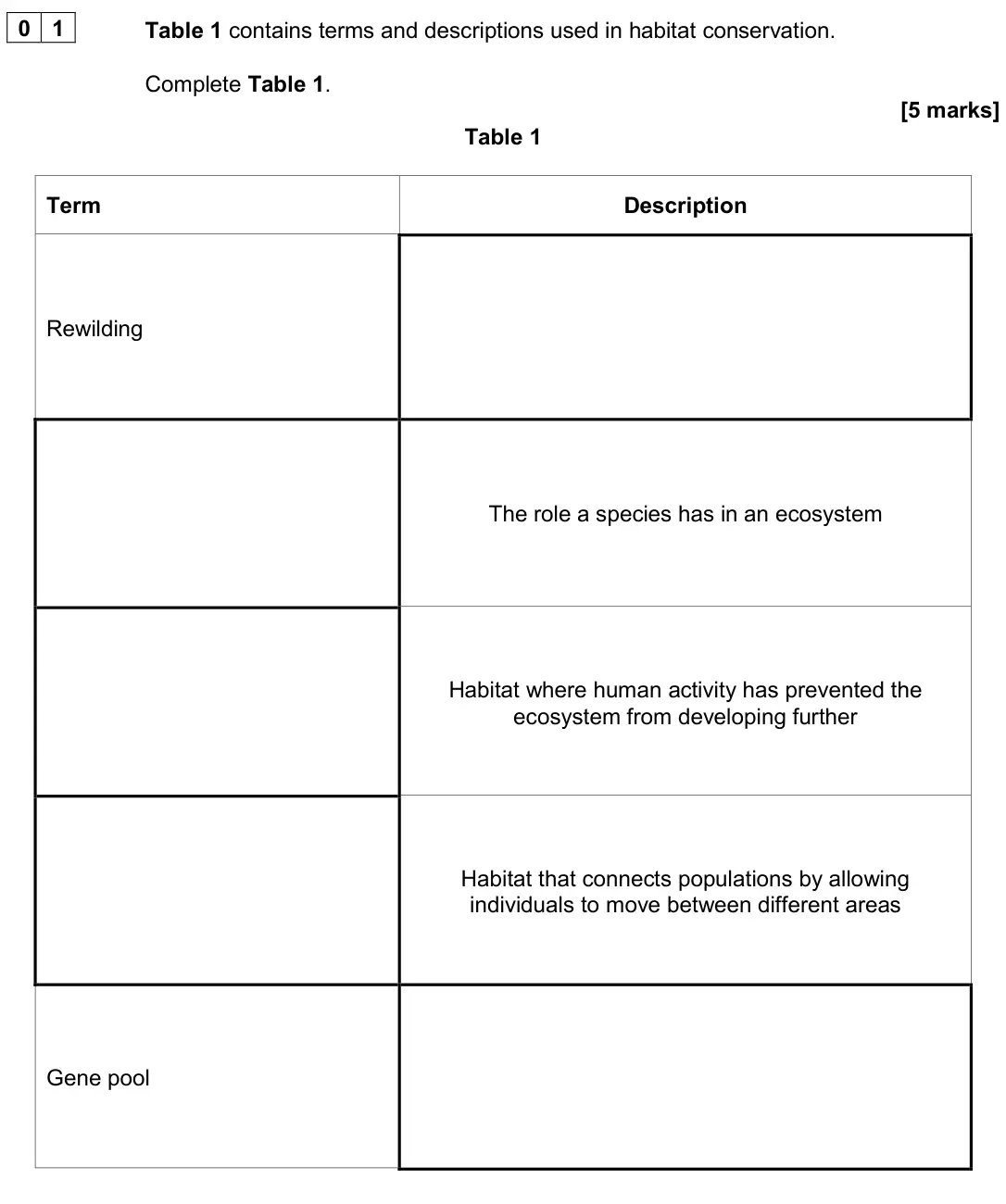
    Original question 01: Table 1 contains terms and descriptions used in habitat conservation. Complete Table 1. [5 marks] Table 1 Term Description Rewilding The role a species has in a

    Loading the question…

    The whole paper ↗
  20. Q05.4June 2022 · Paper 25 marks

    3.1.2.3 Methods of conserving biodiversity

    20
    Setup for original question 05.4

    Loading the question setup…

    Original question 05.4: Describe how named methods of conservation protect Antarctica. [5 marks]

    Loading the question…

    The whole paper ↗
All 33 questions on Methods of conserving biodiversity, as a list
  1. June 2025, Paper 2, Q02.4 (1 mark): State the name of one piece of UK legislation that bans the release of non-indigenous species into the wild. [1 mark]
  2. June 2025, Paper 2, Q04.1 (3 marks): Identify and explain three reasons why species D was prioritised for conservation. Use information from Table 4. [3 marks] 1 2 3
  3. June 2025, Paper 2, Q04.2 (1 mark): Identify and explain one reason why the conservation of species A may help the conservation of other species. Use information from Table 4. [1 mark]
  4. June 2025, Paper 2, Q04.3 (1 mark): Identify and explain one reason why the conservation of species C may help the conservation of other species. Use information from Table 4. [1 mark]
  5. June 2025, Paper 2, Q07.3 (2 marks): Use Figure 3 to calculate the percentage of white-tailed eagles recorded in 2004 that were wild-bred. Show your working. Give your answer to the nearest whole n
  6. June 2025, Paper 2, Q07.4 (3 marks): Scientists concluded that pairs of released birds were more successful breeders than mixed-origin pairs or wild-bred pairs. Use data in Figure 4 to evaluate thi
  7. June 2025, Paper 2, Q07.5 (3 marks): Explain three ways the reintroduction programme may be managed to help long-term population increase of the white-tailed eagles. [3 marks] 1 2 3
  8. June 2024, Paper 2, Q01.1 (1 mark): Use the information in Table 1 to order the species from the highest priority for conservation to the lowest priority. Shade one box only. [1 mark] A Species A,
  9. June 2024, Paper 2, Q01.3 (2 marks): Explain one reason why a species’ EDGE score may change over time. [2 marks]
  10. June 2024, Paper 2, Q02.2 (2 marks): Suggest two reasons why it may be difficult to keep Sumatran rhinoceros in captivity. [2 marks] 1 2
  11. June 2024, Paper 2, Q02.3 (3 marks): Identify one method using the Indian rhinoceros which could increase the success of captive breeding of the Sumatran rhinoceros. Describe how this method would
  12. June 2024, Paper 2, Q02.4 (2 marks): In the wild, Sumatran rhinoceros are monitored using radio collars. Suggest one way that data from the radio collars can be used to help with the conservation o
  13. June 2024, Paper 2, Q03.4 (1 mark): Identify one international agreement that protects Antarctica. [1 mark]
  14. June 2024, Paper 2, Q04.1 (3 marks): Using Figure 1, calculate the area : perimeter ratio of the ponds. Show your working. [3 marks] Area : perimeter ratio = : 1
  15. June 2024, Paper 2, Q04.2 (2 marks): State two reasons why a smaller area : perimeter ratio may result in a greater biodiversity of birds. [2 marks] 1 2
  16. June 2024, Paper 2, Q11.1 (25 marks): Discuss how legislation, protocols and international agreements may help to manage the rate of decline in biodiversity. [25 marks] OR
  17. June 2023, Paper 2, Q03.4 (3 marks): Suggest three ways how information from GPS transmitters can be used to help conserve bats. [3 marks] 1 2 3
  18. June 2023, Paper 2, Q05.2 (1 mark): Give the name of a designation that may be used to protect a deep-water reef in the UK. [1 mark]
  19. June 2022, Paper 2, Q01 (5 marks): Table 1 contains terms and descriptions used in habitat conservation. Complete Table 1. [5 marks] Table 1 Term Description Rewilding The role a species has in a
  20. June 2022, Paper 2, Q05.4 (5 marks): Describe how named methods of conservation protect Antarctica. [5 marks]
  21. June 2022, Paper 2, Q11.1 (25 marks): Discuss how an understanding of ecological processes can help make conservation activities more effective. [25 marks] OR
  22. November 2021, Paper 2, Q01 (5 marks): Table 1 gives some information about the criteria used by the International Union for Conservation of Nature (IUCN) to prioritise the conservation of wildlife.
  23. November 2021, Paper 2, Q02.3 (4 marks): Suggest how the information collected by motion-sensitive cameras may be used in the conservation of Owston’s civets. [4 marks]
  24. November 2021, Paper 2, Q03.2 (3 marks): Describe how CITES protects endangered species. [3 marks]
  25. November 2021, Paper 2, Q03.3 (4 marks): Describe how legislation aims to conserve biodiversity in the UK. [4 marks]
  26. November 2021, Paper 2, Q03.4 (1 mark): Describe how ‘Debt for Nature Swaps’ help to conserve biodiversity. [1 mark]
  27. November 2021, Paper 2, Q04.3 (1 mark): Select the designation suitable for the protection of mangroves. Shade one box only. [1 mark] A Local Nature Reserve (LNR) B National Nature Reserve (NNR) C Ram
  28. November 2021, Paper 2, Q11.1 (25 marks): Discuss how captive breeding and release programmes may be managed to increase their success. [25 marks] OR
  29. November 2020, Paper 2, Q03.2 (4 marks): Explain why Site A would be the better habitat design to increase the population of the Northern Pool Frog. [4 marks]
  30. November 2020, Paper 2, Q04.1 (1 mark): Use data in Figure 2 to calculate the percentage (%) of known reptile and amphibian species living in the Neotropical region that have been included on the LPI.
  31. November 2020, Paper 2, Q04.2 (9 marks): Explain how the use of electronic monitoring technology may provide information that is useful for the conservation of wildlife. [9 marks]
  32. Specimen, Paper 2, Q04.4 (1 mark): Figure 3 shows the Great Crested Newt, Triturus cristatus. The Great Crested Newt (GCN) is indigenous to the UK but it is not endemic. Figure 3 Define the term
  33. Specimen, Paper 2, Q08.1 (5 marks): Use the information above and your own knowledge to explain why the African Forest Elephant is considered to be a keystone species. [5 marks]

Questions, mark schemes and examiner’s reports are © AQA, from their published past papers. Plumi isn’t affiliated with any exam board. Want whole papers? AQA A-Level Environmental Science past papers.

The Plumi iPad app also offers exam-style questions with AI feedback on your handwritten working.