Skip to content

Inflation and deflation: AQA A‑Level Economics questions

Every AQA A-Level Economics exam question on 4.2.3.3 Inflation and deflation, 2020–2025, with its mark scheme and examiner’s report.

Find questions686
Calculations

686 questions

  1. Q03

    June 2025 · Paper 2

    The whole paper ↗
    June 2025 Paper 2, question 03: Extract B (lines 6–7) states: ‘Some analysts hope that, before long, the currency will start to appreciate which could help Norway reduce inflation.’ With the h
  2. Q12

    June 2025 · Paper 2

    The whole paper ↗
    June 2025 Paper 2, question 12: Evaluate the view that a low rate of inflation is always beneficial for a country’s macroeconomic performance. [25 marks] Essay 2 In 2023, the UK government all
  3. Q29

    June 2025 · Paper 3

    The whole paper ↗
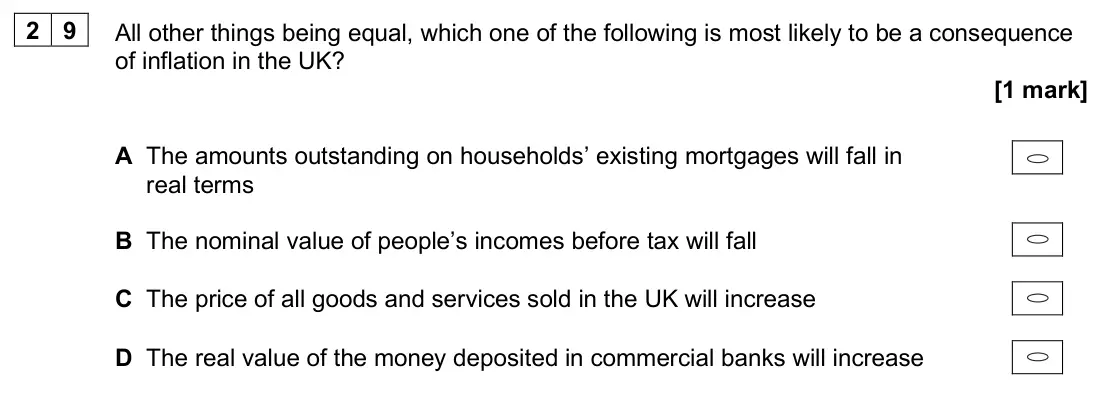
    June 2025 Paper 3, question 29: All other things being equal, which one of the following is most likely to be a consequence of inflation in the UK? [1 mark] A The amounts outstanding on househ
  4. June 2025 AS Paper 2, question 25: Extract B (lines 6–7) states: ‘A shortage of labour is one of the factors that has contributed to rising inflation, threatening macroeconomic stability.’ Explai
  5. Q03

    June 2024 · Paper 2

    The whole paper ↗
    June 2024 Paper 2, question 03: Extract C (lines 4–5) states ‘Energy and food bills had risen dramatically due to shocks to the economy, such as labour shortages, a depreciation of the pound…’
  6. June 2024 Paper 2, question 10: Assess whether an increase in the money supply is always damaging for an economy. [25 marks] Essay 1 In November 2022, the Bank of England warned there was a ri
  7. Q28

    June 2024 · Paper 3

    The whole paper ↗
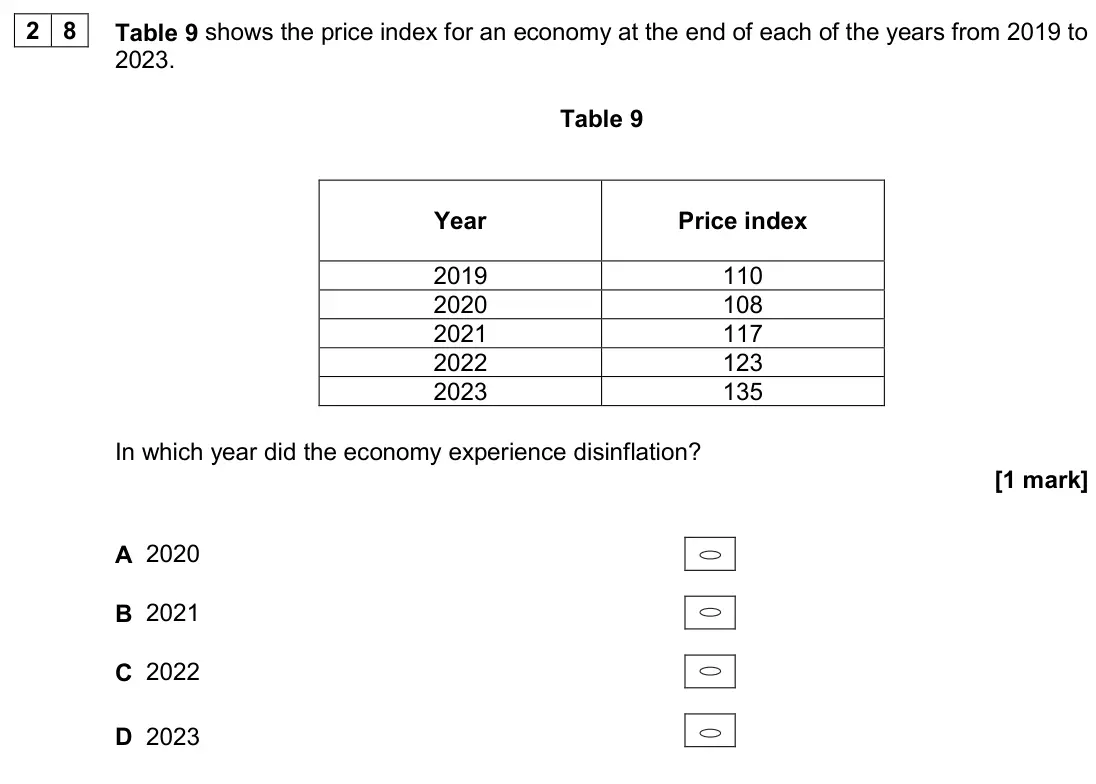
    June 2024 Paper 3, question 28: Table 9 shows the price index for an economy at the end of each of the years from 2019 to 2023. Table 9 Year Price index 2019 110 2020 108 2021 117 2022 123 202
  8. Q06

    June 2024 · AS Paper 2

    The whole paper ↗
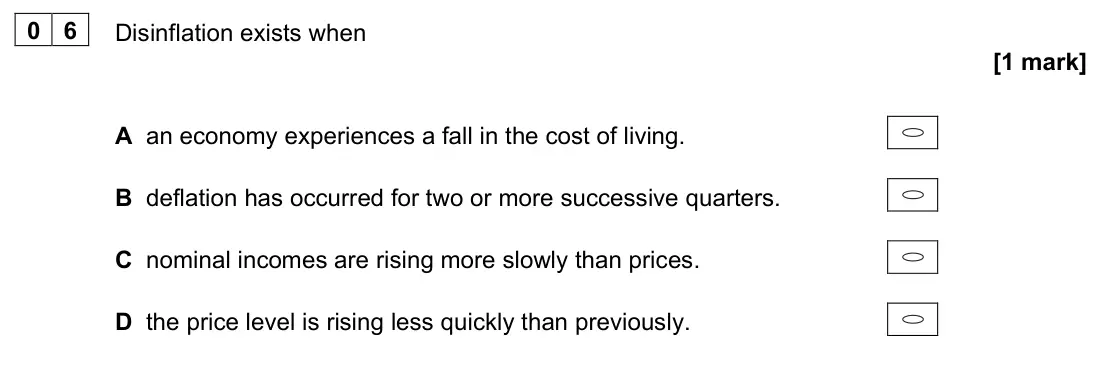
    June 2024 AS Paper 2, question 06: Disinflation exists when [1 mark] A an economy experiences a fall in the cost of living. B deflation has occurred for two or more successive quarters. C nominal
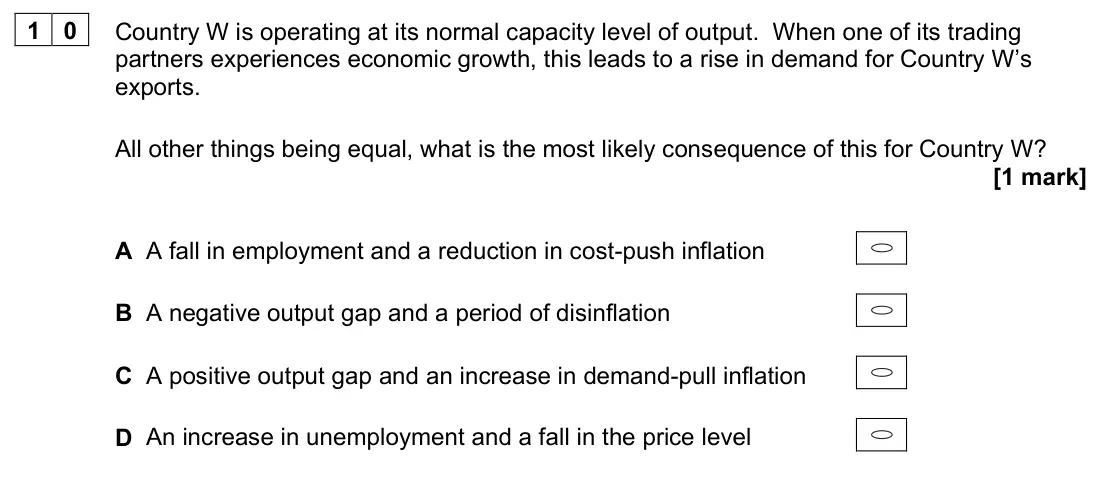
  9. June 2024 AS Paper 2, question 10: Country W is operating at its normal capacity level of output. When one of its trading partners experiences economic growth, this leads to a rise in demand for
  10. Q23

    June 2024 · AS Paper 2

    The whole paper ↗
    June 2024 AS Paper 2, question 23: Use Extract A to identify two significant points of comparison between inflation and the growth in average weekly real earnings over the period shown. [4 marks]
  11. Q12

    June 2023 · Paper 3

    The whole paper ↗
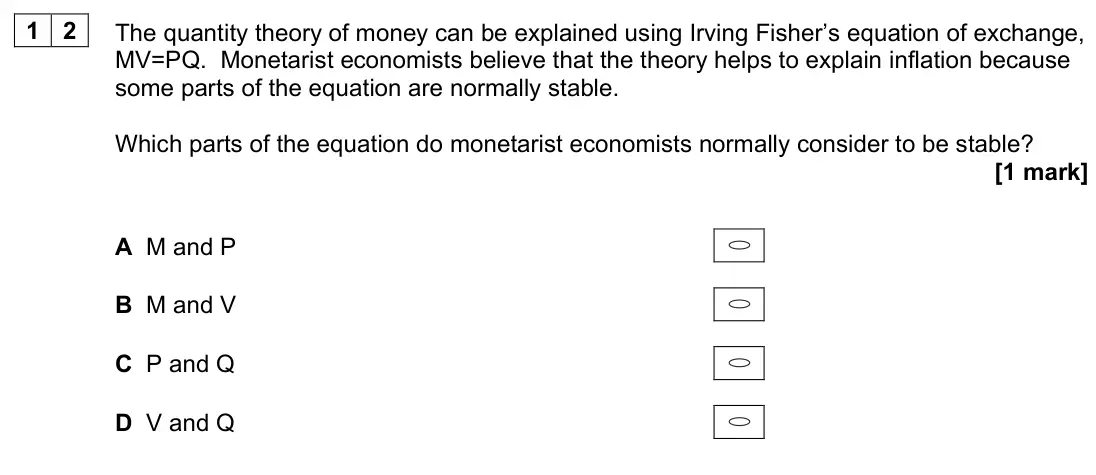
    June 2023 Paper 3, question 12: The quantity theory of money can be explained using Irving Fisher’s equation of exchange, MV=PQ. Monetarist economists believe that the theory helps to explain
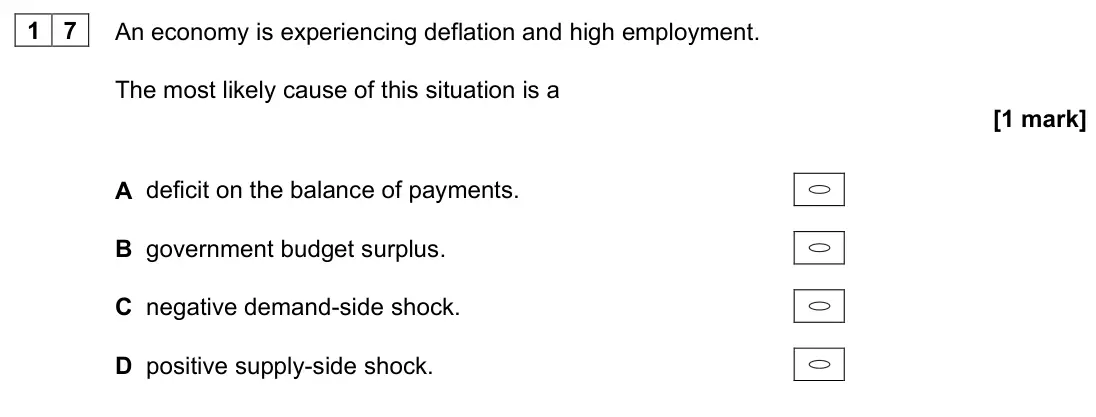
  12. June 2023 AS Paper 2, question 17: An economy is experiencing deflation and high employment. The most likely cause of this situation is a [1 mark] A deficit on the balance of payments. B governme
  13. Q21

    June 2023 · AS Paper 2

    The whole paper ↗
    June 2023 AS Paper 2, question 21: Define ‘deflation’ Extract C (line 2). [3 marks] Context 1 Total for this context: 50 marks INFLATION Extract A: UK inflation rate (%), measured by CPI, January
  14. Q07

    June 2022 · Paper 2

    The whole paper ↗
    June 2022 Paper 2, question 07: Extract E (lines 7–9) states: ‘It was hoped that policy measures, including a reduction in tariffs... would help to reduce inflation’. With the help of a diagra
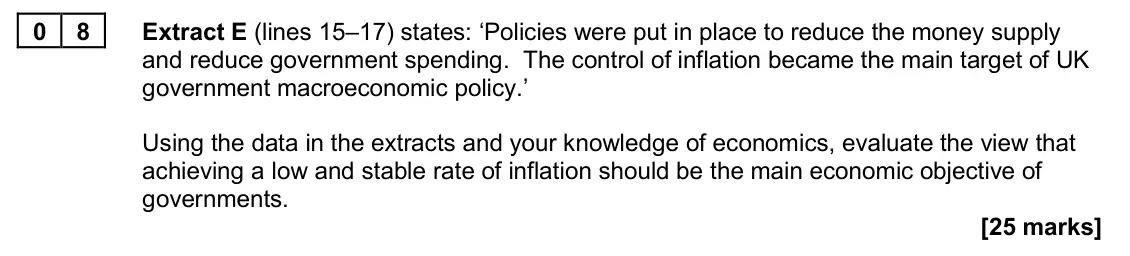
  15. June 2022 Paper 2, question 08: Extract E (lines 15–17) states: ‘Policies were put in place to reduce the money supply and reduce government spending. The control of inflation became the main
  16. Q10

    June 2022 · Paper 3

    The whole paper ↗
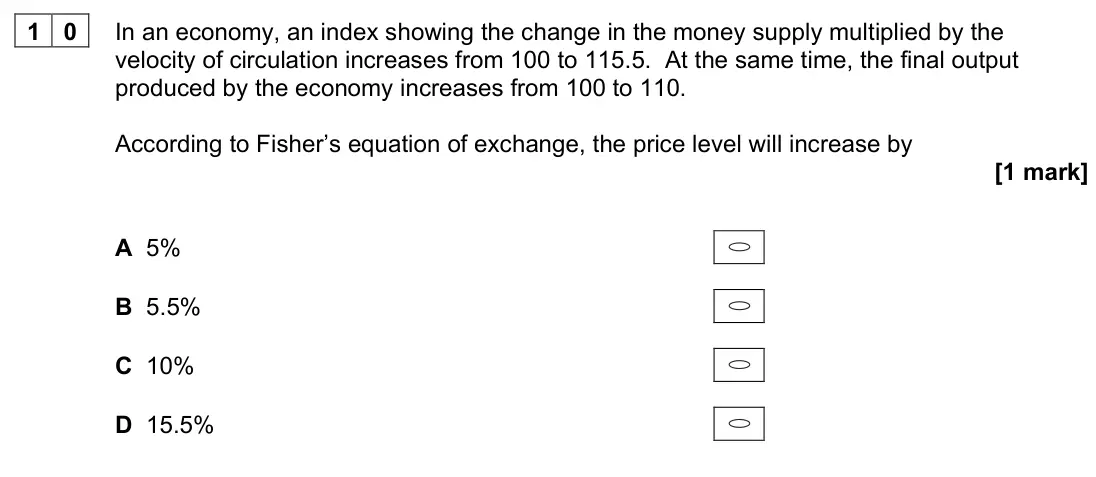
    June 2022 Paper 3, question 10: In an economy, an index showing the change in the money supply multiplied by the velocity of circulation increases from 100 to 115.5. At the same time, the fina
  17. Q06

    June 2022 · AS Paper 2

    The whole paper ↗
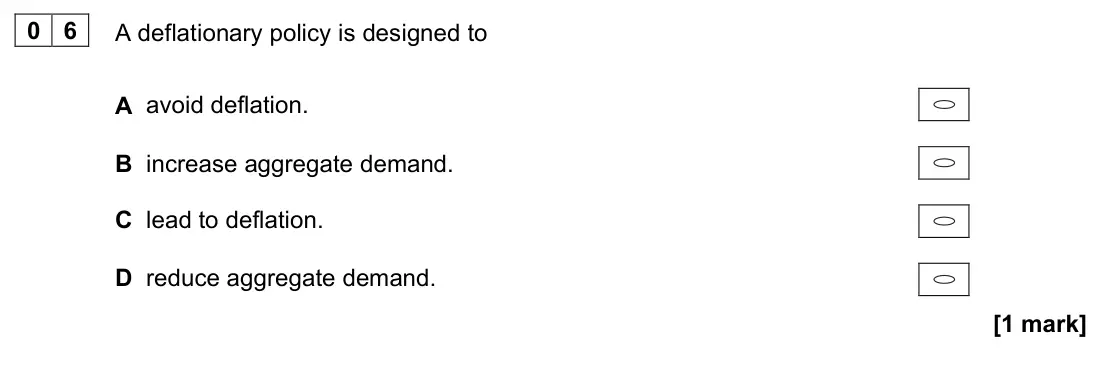
    June 2022 AS Paper 2, question 06: A deflationary policy is designed to A avoid deflation. B increase aggregate demand. C lead to deflation. D reduce aggregate demand. [1 mark]
  18. Q13

    November 2020 · Paper 3

    The whole paper ↗
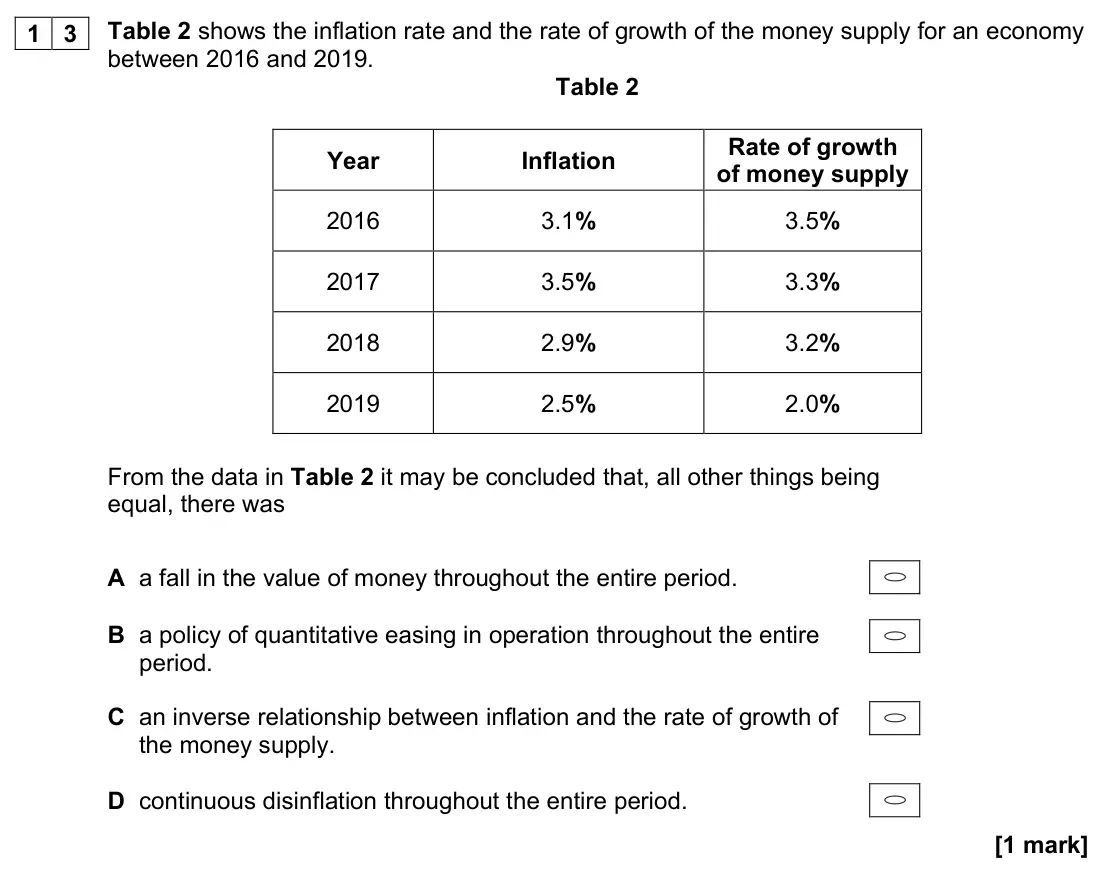
    November 2020 Paper 3, question 13: Table 2 shows the inflation rate and the rate of growth of the money supply for an economy between 2016 and 2019. Table 2 Year Inflation Rate of growth of money
  19. Q12

    November 2020 · AS Paper 2

    The whole paper ↗
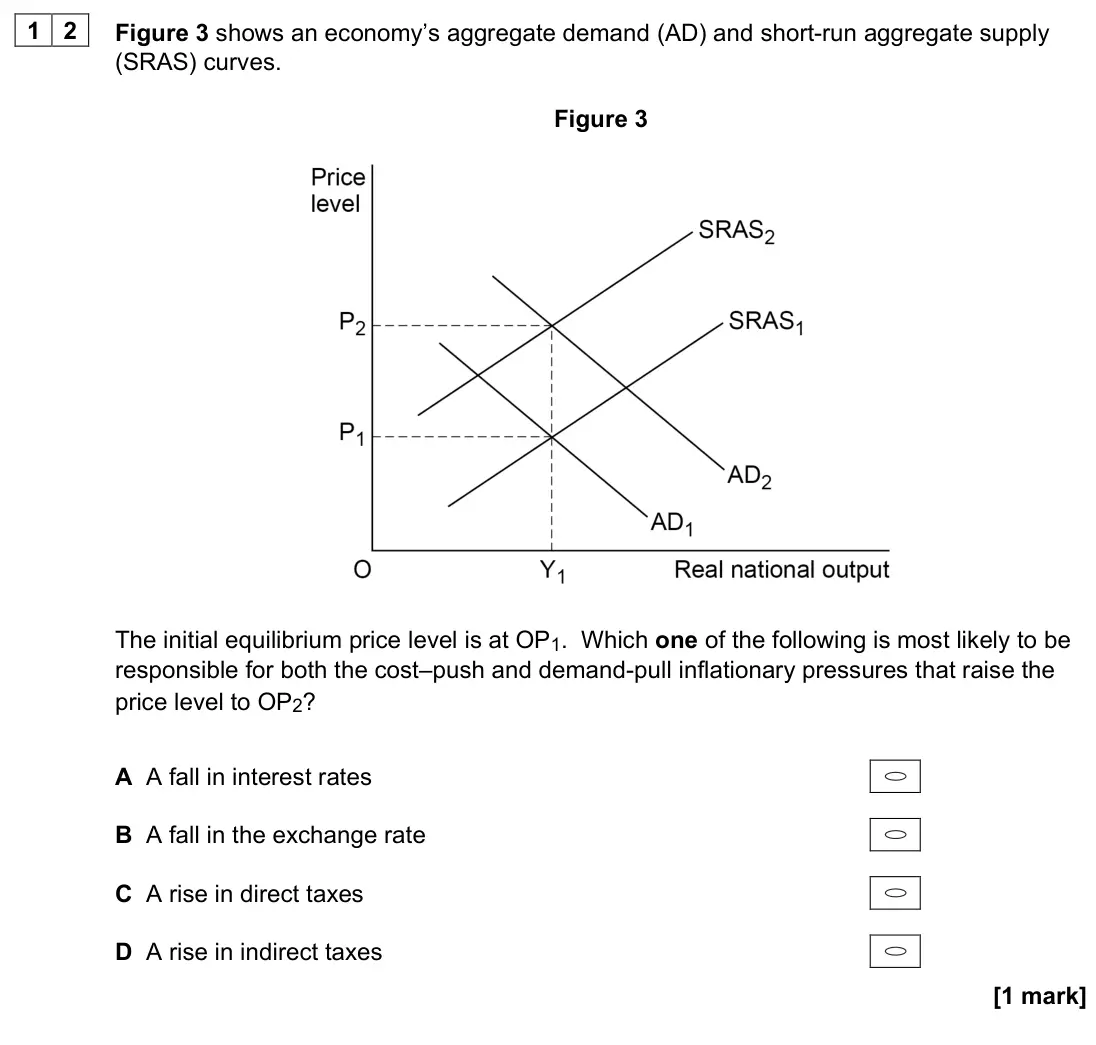
    November 2020 AS Paper 2, question 12: Figure 3 shows an economy’s aggregate demand (AD) and short-run aggregate supply (SRAS) curves. Figure 3 The initial equilibrium price level is at OP1. Which on
All 19 questions on Inflation and deflation, as a list
  1. June 2025, Paper 2, Q03 (9 marks): Extract B (lines 6–7) states: ‘Some analysts hope that, before long, the currency will start to appreciate which could help Norway reduce inflation.’ With the h
  2. June 2025, Paper 2, Q12 (25 marks): Evaluate the view that a low rate of inflation is always beneficial for a country’s macroeconomic performance. [25 marks] Essay 2 In 2023, the UK government all
  3. June 2025, Paper 3, Q29 (1 mark): All other things being equal, which one of the following is most likely to be a consequence of inflation in the UK? [1 mark] A The amounts outstanding on househ
  4. June 2025, AS Paper 2, Q25 (10 marks): Extract B (lines 6–7) states: ‘A shortage of labour is one of the factors that has contributed to rising inflation, threatening macroeconomic stability.’ Explai
  5. June 2024, Paper 2, Q03 (9 marks): Extract C (lines 4–5) states ‘Energy and food bills had risen dramatically due to shocks to the economy, such as labour shortages, a depreciation of the pound…’
  6. June 2024, Paper 2, Q10 (25 marks): Assess whether an increase in the money supply is always damaging for an economy. [25 marks] Essay 1 In November 2022, the Bank of England warned there was a ri
  7. June 2024, Paper 3, Q28 (1 mark): Table 9 shows the price index for an economy at the end of each of the years from 2019 to 2023. Table 9 Year Price index 2019 110 2020 108 2021 117 2022 123 202
  8. June 2024, AS Paper 2, Q06 (1 mark): Disinflation exists when [1 mark] A an economy experiences a fall in the cost of living. B deflation has occurred for two or more successive quarters. C nominal
  9. June 2024, AS Paper 2, Q10 (1 mark): Country W is operating at its normal capacity level of output. When one of its trading partners experiences economic growth, this leads to a rise in demand for
  10. June 2024, AS Paper 2, Q23 (4 marks): Use Extract A to identify two significant points of comparison between inflation and the growth in average weekly real earnings over the period shown. [4 marks]
  11. June 2023, Paper 3, Q12 (1 mark): The quantity theory of money can be explained using Irving Fisher’s equation of exchange, MV=PQ. Monetarist economists believe that the theory helps to explain
  12. June 2023, AS Paper 2, Q17 (1 mark): An economy is experiencing deflation and high employment. The most likely cause of this situation is a [1 mark] A deficit on the balance of payments. B governme
  13. June 2023, AS Paper 2, Q21 (3 marks): Define ‘deflation’ Extract C (line 2). [3 marks] Context 1 Total for this context: 50 marks INFLATION Extract A: UK inflation rate (%), measured by CPI, January
  14. June 2022, Paper 2, Q07 (9 marks): Extract E (lines 7–9) states: ‘It was hoped that policy measures, including a reduction in tariffs... would help to reduce inflation’. With the help of a diagra
  15. June 2022, Paper 2, Q08 (25 marks): Extract E (lines 15–17) states: ‘Policies were put in place to reduce the money supply and reduce government spending. The control of inflation became the main
  16. June 2022, Paper 3, Q10 (1 mark): In an economy, an index showing the change in the money supply multiplied by the velocity of circulation increases from 100 to 115.5. At the same time, the fina
  17. June 2022, AS Paper 2, Q06 (1 mark): A deflationary policy is designed to A avoid deflation. B increase aggregate demand. C lead to deflation. D reduce aggregate demand. [1 mark]
  18. November 2020, Paper 3, Q13 (1 mark): Table 2 shows the inflation rate and the rate of growth of the money supply for an economy between 2016 and 2019. Table 2 Year Inflation Rate of growth of money
  19. November 2020, AS Paper 2, Q12 (1 mark): Figure 3 shows an economy’s aggregate demand (AD) and short-run aggregate supply (SRAS) curves. Figure 3 The initial equilibrium price level is at OP1. Which on

Questions, mark schemes and examiner’s reports are © AQA, from their published past papers. Plumi isn’t affiliated with any exam board. Want whole papers? Full past papers.

Rather write your answers by hand on iPad? Plumi marks them against the same mark schemes.