Skip to content

Exchange rate systems: AQA A‑Level Economics questions

Every AQA A-Level Economics exam question on 4.2.6.4 Exchange rate systems, 2020–2025, with its mark scheme and examiner’s report.

Find questions686
Calculations

686 questions

  1. Q01

    June 2025 · Paper 2

    The whole paper ↗
    June 2025 Paper 2, question 01: Using the data in Extract A (Figure 1), calculate how the value of the Norwegian krone has changed compared to the Singapore dollar between 26 October 2021 and
  2. Q02

    June 2025 · Paper 2

    The whole paper ↗
    June 2025 Paper 2, question 02: Explain how the data in Extract A (Figure 2) show that Singapore may have benefitted from managing its exchange rate compared to Germany and Norway. [4 marks] C
  3. Q03

    June 2025 · Paper 2

    The whole paper ↗
    June 2025 Paper 2, question 03: Extract B (lines 6–7) states: ‘Some analysts hope that, before long, the currency will start to appreciate which could help Norway reduce inflation.’ With the h
  4. Q04

    June 2025 · Paper 2

    The whole paper ↗
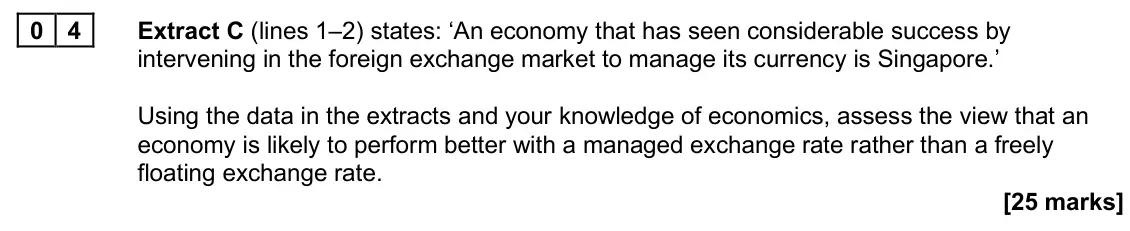
    June 2025 Paper 2, question 04: Extract C (lines 1–2) states: ‘An economy that has seen considerable success by intervening in the foreign exchange market to manage its currency is Singapore.’
  5. Q03

    June 2024 · Paper 2

    The whole paper ↗
    June 2024 Paper 2, question 03: Extract C (lines 4–5) states ‘Energy and food bills had risen dramatically due to shocks to the economy, such as labour shortages, a depreciation of the pound…’
  6. Q26

    June 2024 · Paper 3

    The whole paper ↗
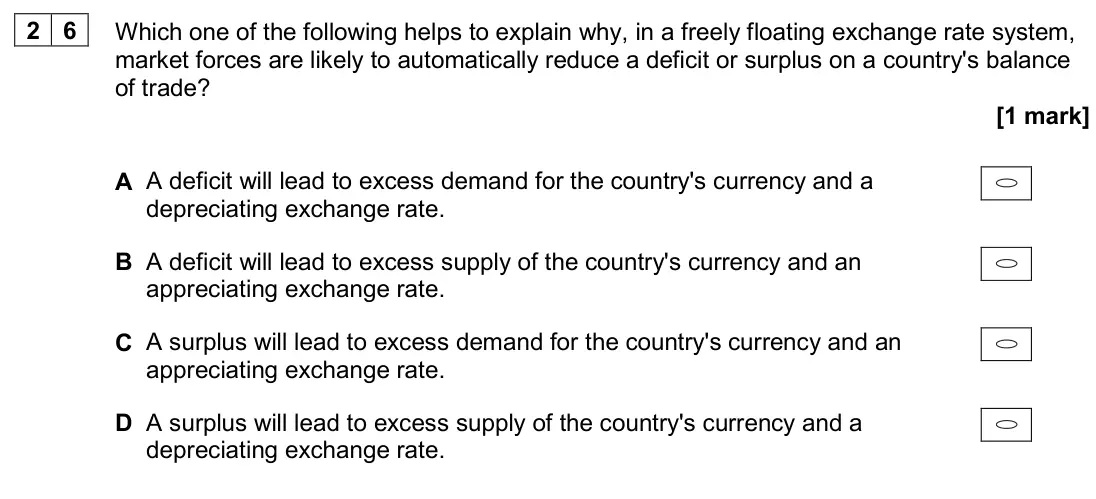
    June 2024 Paper 3, question 26: Which one of the following helps to explain why, in a freely floating exchange rate system, market forces are likely to automatically reduce a deficit or surplu
  7. Q23

    June 2023 · Paper 3

    The whole paper ↗
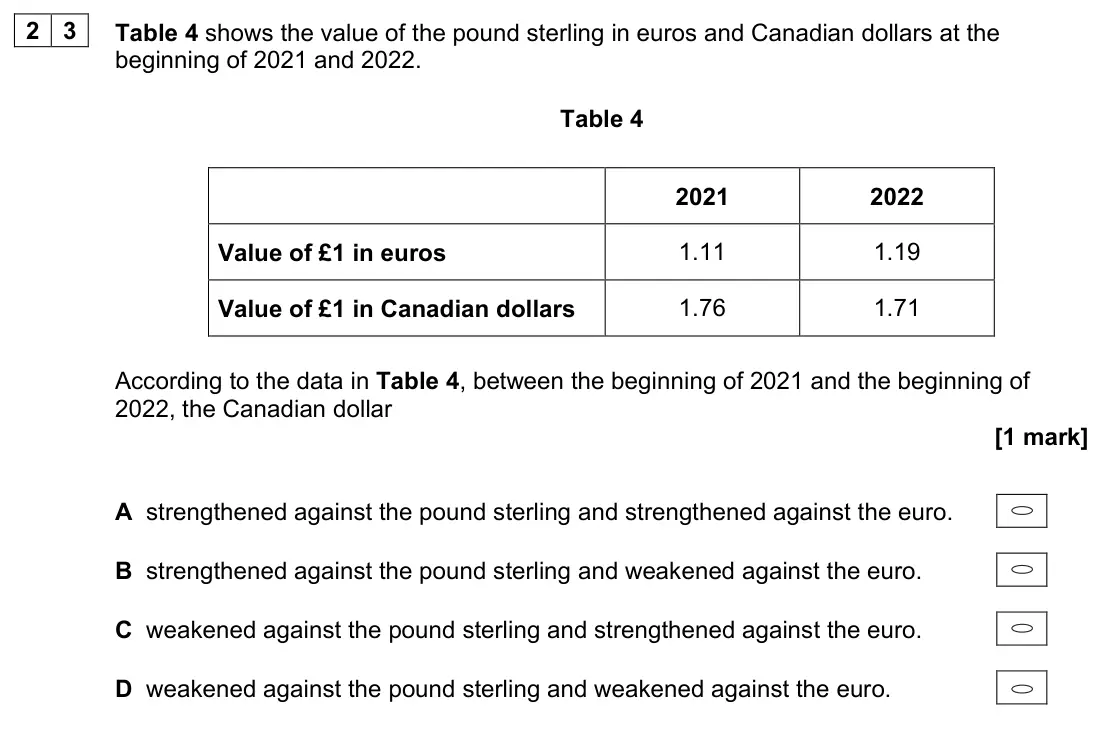
    June 2023 Paper 3, question 23: Table 4 shows the value of the pound sterling in euros and Canadian dollars at the beginning of 2021 and 2022. Table 4 2021 2022 Value of £1 in euros 1.11 1.19
  8. Q10

    June 2022 · Paper 2

    The whole paper ↗
    June 2022 Paper 2, question 10: Assess the view that floating exchange rates are always better than fixed exchange rates. [25 marks] Essay 1 The UK has been running a deficit on its balance of
  9. Q09

    November 2021 · Paper 2

    The whole paper ↗
    November 2021 Paper 2, question 09: Explain how a government or central bank can intervene to prevent the value of its currency rising. [15 marks] Essay 1 Since 1992, the UK has had a floating exc
  10. Q10

    November 2021 · Paper 2

    The whole paper ↗
    November 2021 Paper 2, question 10: Evaluate the possible impact on the cost of living and the standard of living in the UK of a sustained rise in the value of the pound sterling against other cur
  11. Q13

    November 2020 · Paper 2

    The whole paper ↗
    November 2020 Paper 2, question 13: Explain how an appreciation of its currency is likely to affect a country’s rate of economic growth. [15 marks] Essay 3 In 2015, Lithuania joined the eurozone,
  12. Q14

    November 2020 · Paper 2

    The whole paper ↗
    November 2020 Paper 2, question 14: Evaluate the costs and benefits for a country of joining a currency union, such as the eurozone. [25 marks] Essay 3 In 2015, Lithuania joined the eurozone, adop
  13. Q29

    November 2020 · Paper 3

    The whole paper ↗
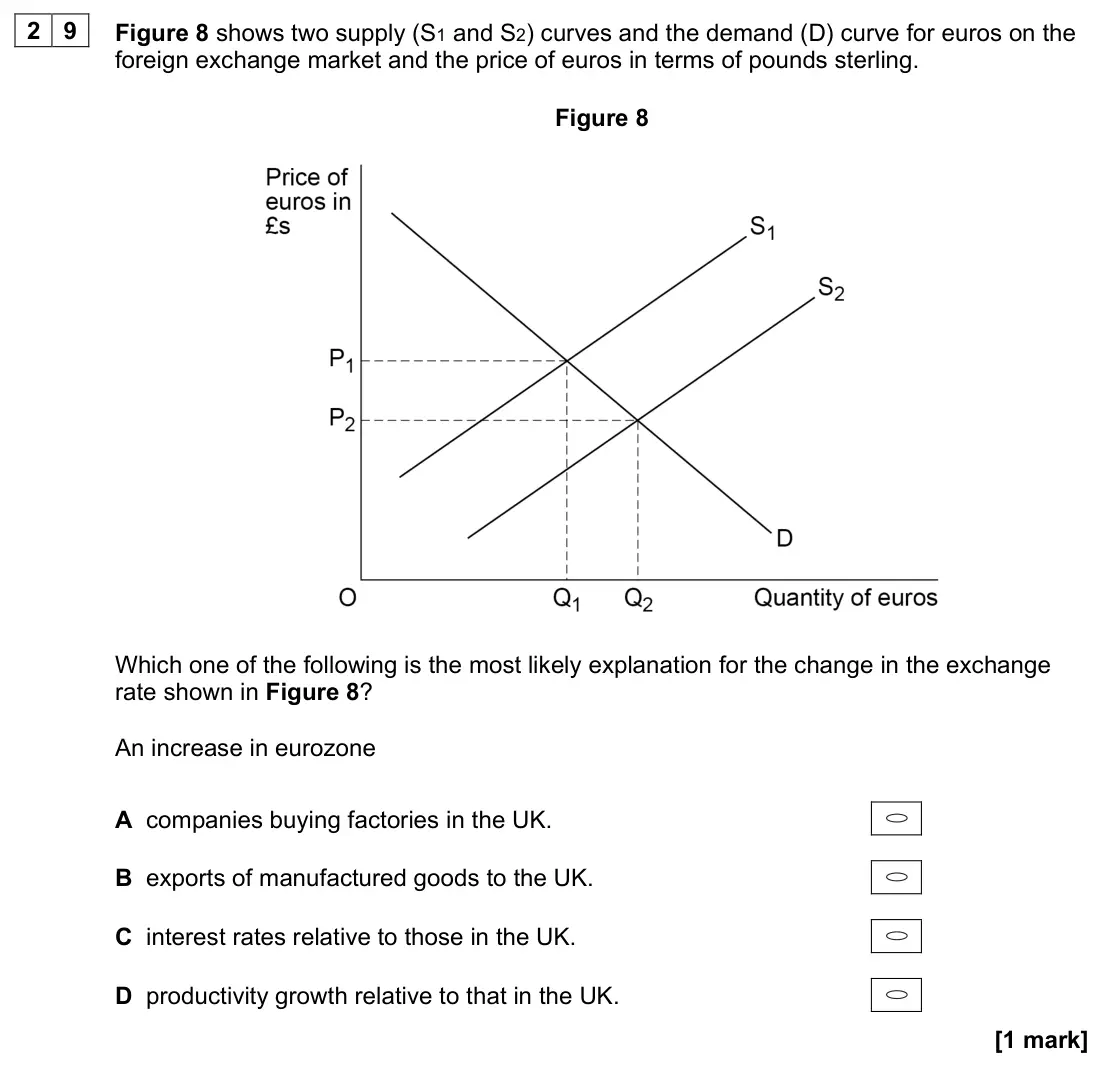
    November 2020 Paper 3, question 29: Figure 8 shows two supply (S1 and S2) curves and the demand (D) curve for euros on the foreign exchange market and the price of euros in terms of pounds sterlin
All 13 questions on Exchange rate systems, as a list
  1. June 2025, Paper 2, Q01 (2 marks): Using the data in Extract A (Figure 1), calculate how the value of the Norwegian krone has changed compared to the Singapore dollar between 26 October 2021 and
  2. June 2025, Paper 2, Q02 (4 marks): Explain how the data in Extract A (Figure 2) show that Singapore may have benefitted from managing its exchange rate compared to Germany and Norway. [4 marks] C
  3. June 2025, Paper 2, Q03 (9 marks): Extract B (lines 6–7) states: ‘Some analysts hope that, before long, the currency will start to appreciate which could help Norway reduce inflation.’ With the h
  4. June 2025, Paper 2, Q04 (25 marks): Extract C (lines 1–2) states: ‘An economy that has seen considerable success by intervening in the foreign exchange market to manage its currency is Singapore.’
  5. June 2024, Paper 2, Q03 (9 marks): Extract C (lines 4–5) states ‘Energy and food bills had risen dramatically due to shocks to the economy, such as labour shortages, a depreciation of the pound…’
  6. June 2024, Paper 3, Q26 (1 mark): Which one of the following helps to explain why, in a freely floating exchange rate system, market forces are likely to automatically reduce a deficit or surplu
  7. June 2023, Paper 3, Q23 (1 mark): Table 4 shows the value of the pound sterling in euros and Canadian dollars at the beginning of 2021 and 2022. Table 4 2021 2022 Value of £1 in euros 1.11 1.19
  8. June 2022, Paper 2, Q10 (25 marks): Assess the view that floating exchange rates are always better than fixed exchange rates. [25 marks] Essay 1 The UK has been running a deficit on its balance of
  9. November 2021, Paper 2, Q09 (15 marks): Explain how a government or central bank can intervene to prevent the value of its currency rising. [15 marks] Essay 1 Since 1992, the UK has had a floating exc
  10. November 2021, Paper 2, Q10 (25 marks): Evaluate the possible impact on the cost of living and the standard of living in the UK of a sustained rise in the value of the pound sterling against other cur
  11. November 2020, Paper 2, Q13 (15 marks): Explain how an appreciation of its currency is likely to affect a country’s rate of economic growth. [15 marks] Essay 3 In 2015, Lithuania joined the eurozone,
  12. November 2020, Paper 2, Q14 (25 marks): Evaluate the costs and benefits for a country of joining a currency union, such as the eurozone. [25 marks] Essay 3 In 2015, Lithuania joined the eurozone, adop
  13. November 2020, Paper 3, Q29 (1 mark): Figure 8 shows two supply (S1 and S2) curves and the demand (D) curve for euros on the foreign exchange market and the price of euros in terms of pounds sterlin

Questions, mark schemes and examiner’s reports are © AQA, from their published past papers. Plumi isn’t affiliated with any exam board. Want whole papers? Full past papers.

Rather write your answers by hand on iPad? Plumi marks them against the same mark schemes.