 plumi
Transition metals: AQA A‑Level Chemistry questions
Every AQA A-Level Chemistry exam question on 3.2.5 Transition metals, 2016–2025, with its mark scheme and examiner’s report.
Find questions2,301
Calculations
Q03.1
The whole paper ↗
Q03.2
The whole paper ↗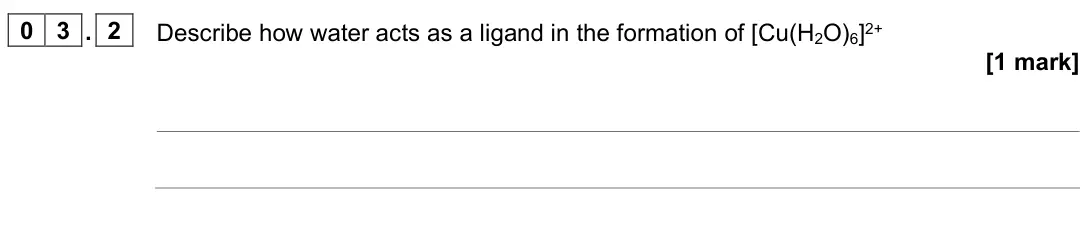
Q03.4
The whole paper ↗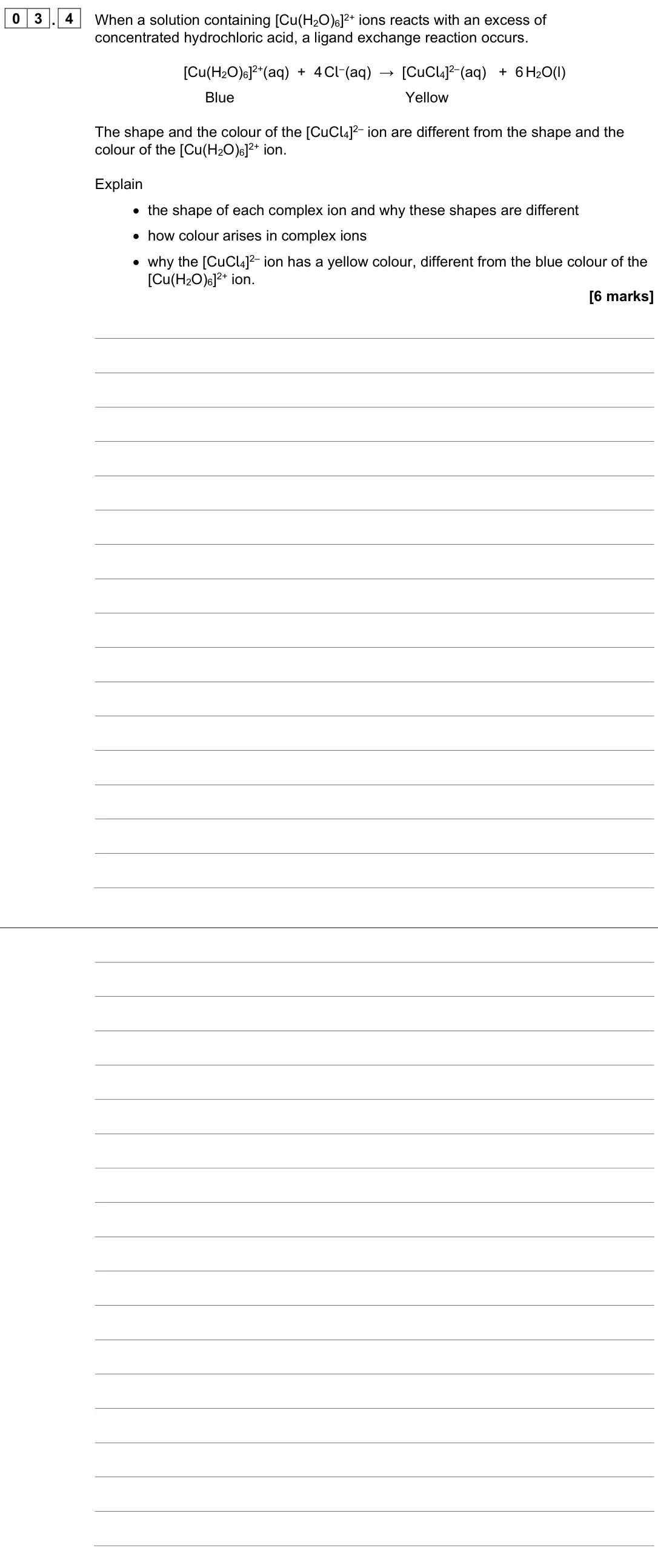
Q03.5
The whole paper ↗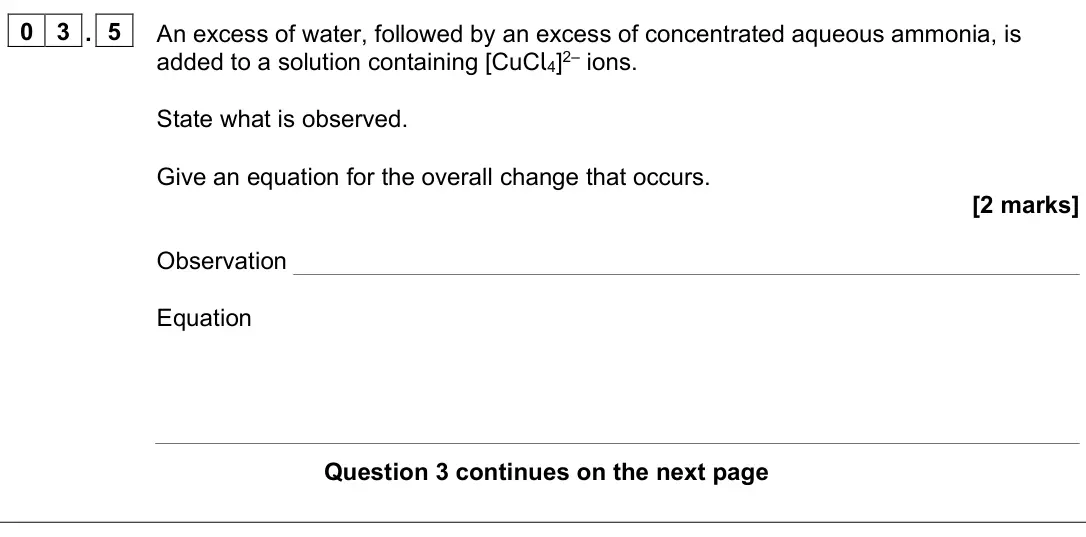
Q03.9
The whole paper ↗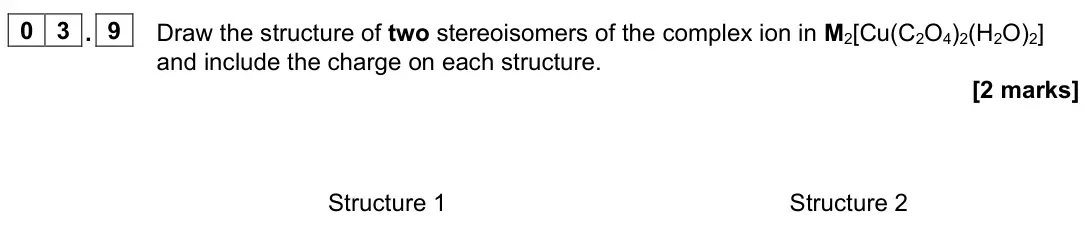
Q07.1
The whole paper ↗
Q07.3
The whole paper ↗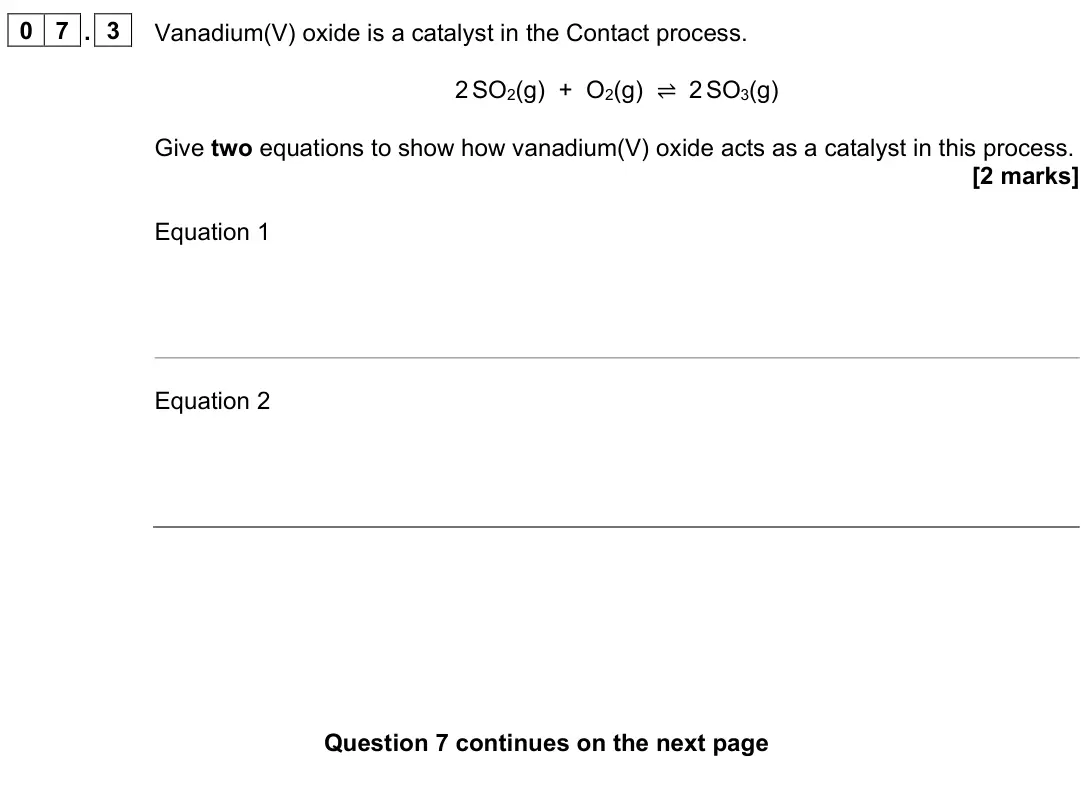
Q03.1
The whole paper ↗
Q03.2
The whole paper ↗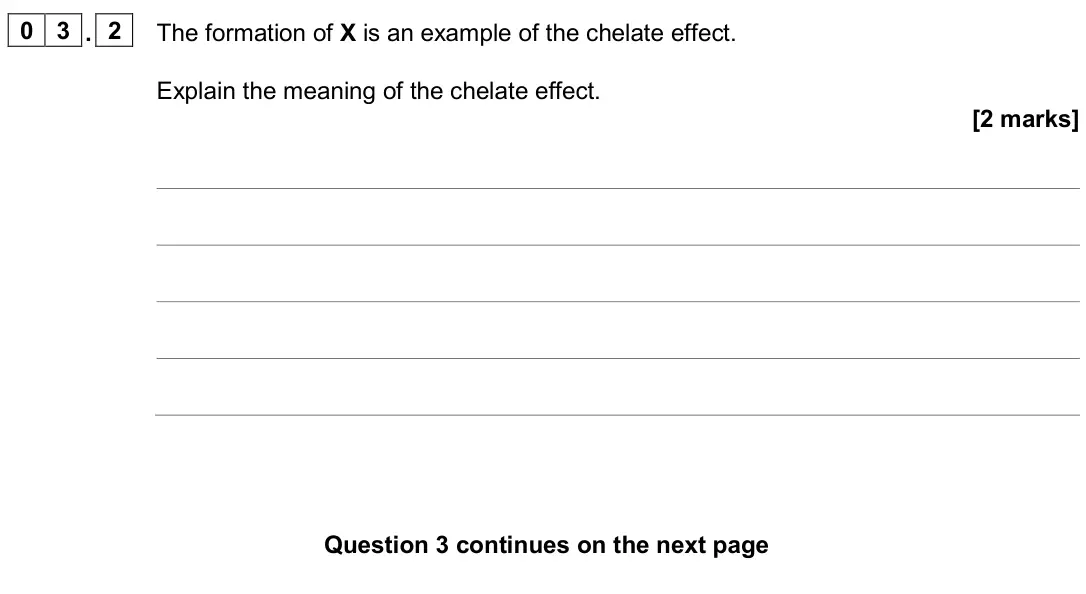
Q03.3
The whole paper ↗
Q05.1
The whole paper ↗
Q05.2
The whole paper ↗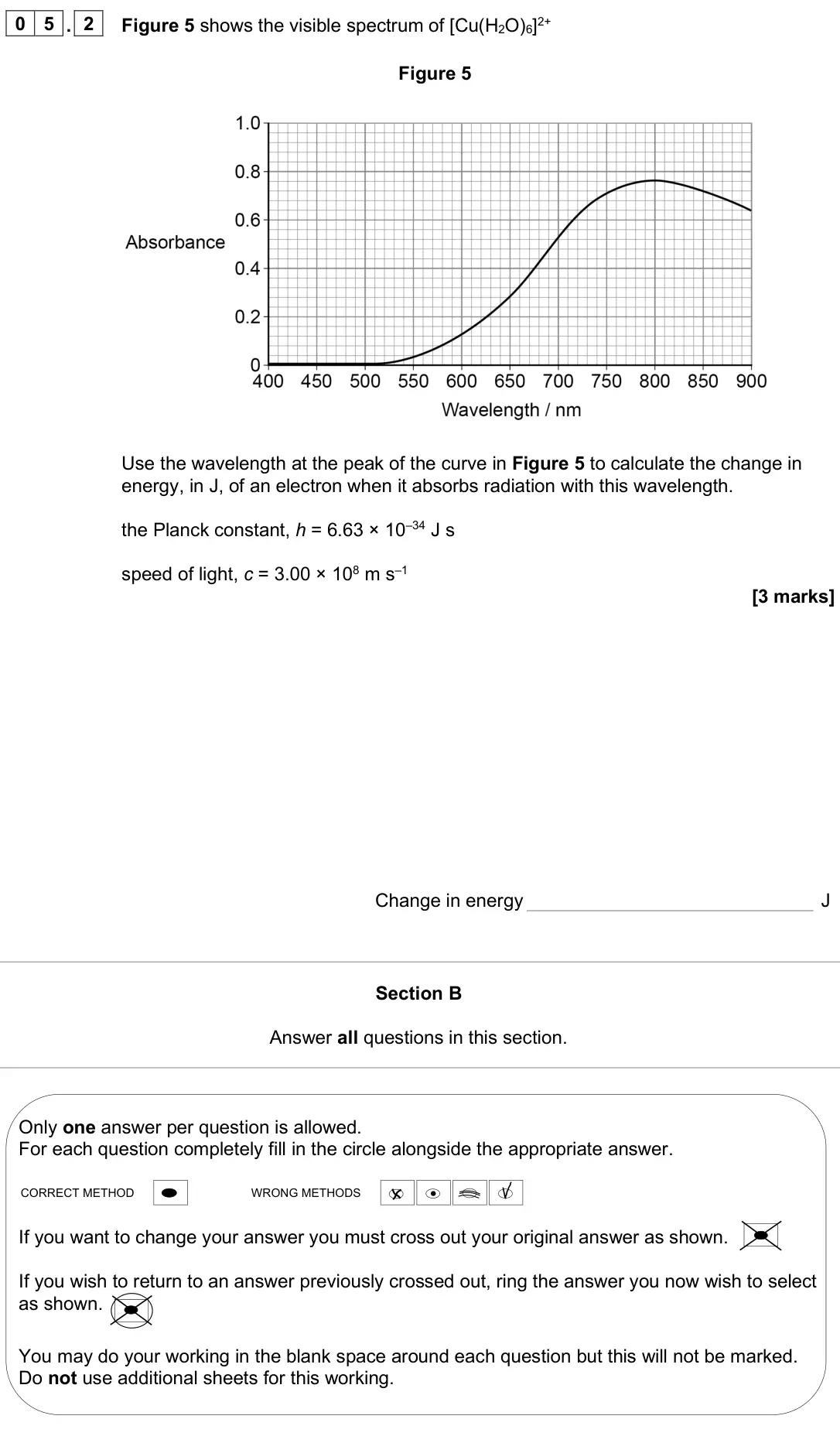
Q01.1
The whole paper ↗
Q01.6
The whole paper ↗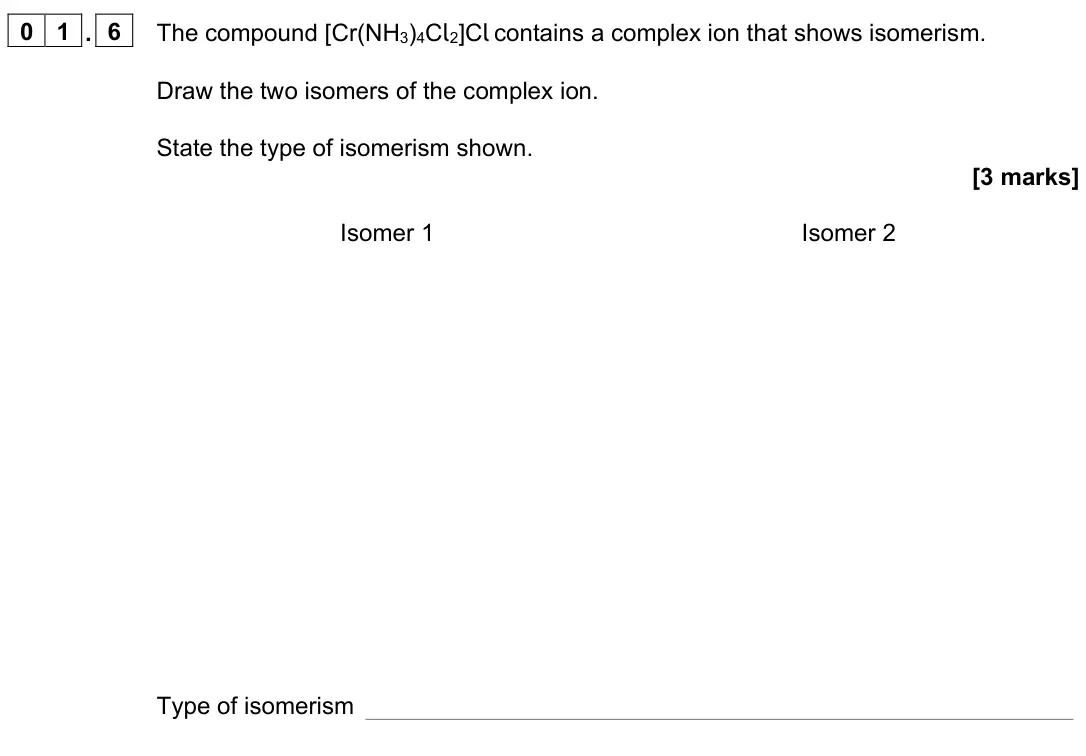
All 101 questions on Transition metals, as a list
- June 2025, Paper 1, Q03.1 (1 mark): Deduce the number of unpaired electrons in a Cu2+ ion. [1 mark]
- June 2025, Paper 1, Q03.2 (1 mark): Describe how water acts as a ligand in the formation of [Cu(H2O)6]2+ [1 mark]
- June 2025, Paper 1, Q03.4 (6 marks): When a solution containing [Cu(H2O)6]2+ ions reacts with an excess of concentrated hydrochloric acid, a ligand exchange reaction occurs. [Cu(H2O)6]2+(aq) + 4 Cl
- June 2025, Paper 1, Q03.5 (2 marks): An excess of water, followed by an excess of concentrated aqueous ammonia, is added to a solution containing [CuCl4]2– ions. State what is observed. Give an equ
- June 2025, Paper 1, Q03.9 (2 marks): Draw the structure of two stereoisomers of the complex ion in M2[Cu(C2O4)2(H2O)2] and include the charge on each structure. [2 marks] Structure 1 Structure 2
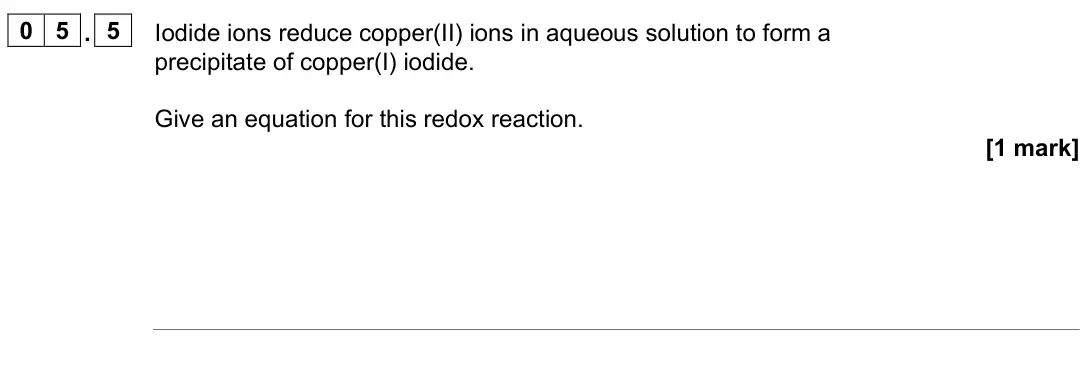
- June 2025, Paper 1, Q05.5 (1 mark): Iodide ions reduce copper(II) ions in aqueous solution to form a precipitate of copper(I) iodide. Give an equation for this redox reaction. [1 mark]
- June 2025, Paper 1, Q07.1 (1 mark): State the block in the Periodic Table that contains vanadium. [1 mark]
- June 2025, Paper 1, Q07.3 (2 marks): Vanadium(V) oxide is a catalyst in the Contact process. 2 SO2(g) + O2(g) ⇌ 2 SO3(g) Give two equations to show how vanadium(V) oxide acts as a catalyst in this
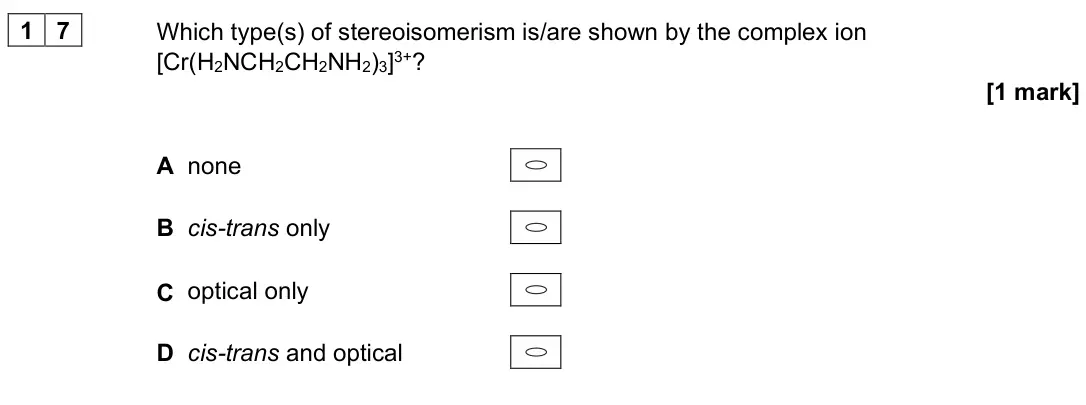
- June 2025, Paper 3, Q17 (1 mark): Which type(s) of stereoisomerism is/are shown by the complex ion [Cr(H2NCH2CH2NH2)3]3+? [1 mark] A none B cis-trans only C optical only D cis-trans and optical
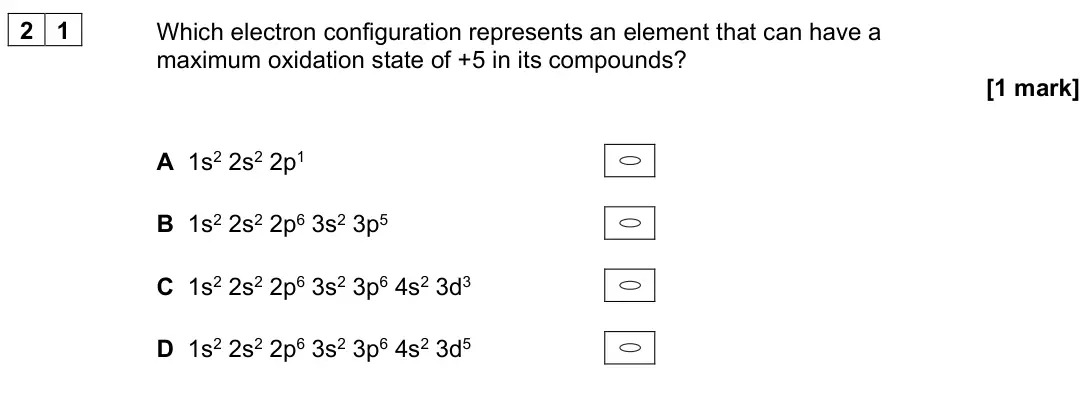
- June 2025, Paper 3, Q21 (1 mark): Which electron configuration represents an element that can have a maximum oxidation state of +5 in its compounds? [1 mark] A 1s2 2s2 2p1 B 1s2 2s2 2p6 3s2 3p5
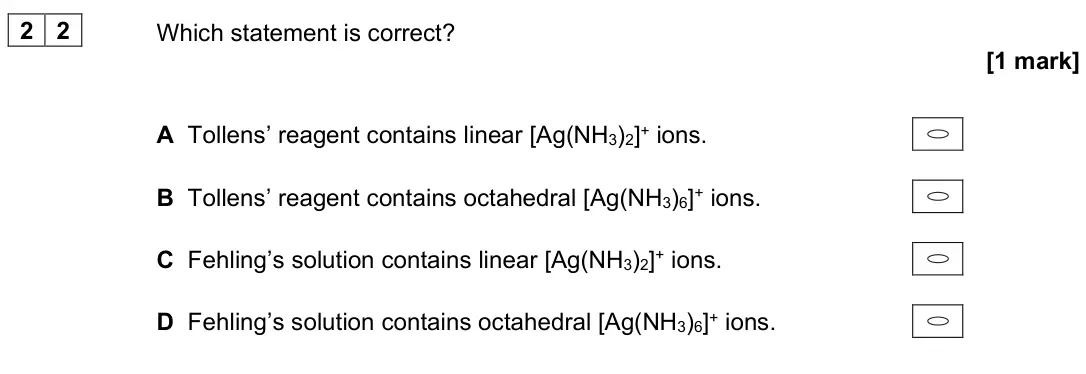
- June 2025, Paper 3, Q22 (1 mark): Which statement is correct? [1 mark] A Tollens’ reagent contains linear [Ag(NH3)2]+ ions. B Tollens’ reagent contains octahedral [Ag(NH3)6]+ ions. C Fehling’s s
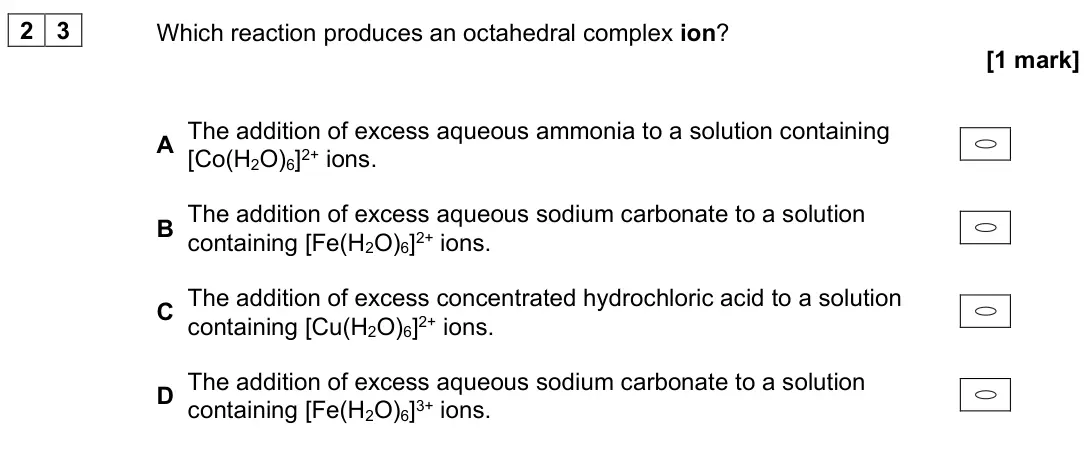
- June 2025, Paper 3, Q23 (1 mark): Which reaction produces an octahedral complex ion? [1 mark] A The addition of excess aqueous ammonia to a solution containing [Co(H2O)6]2+ ions. B The addition
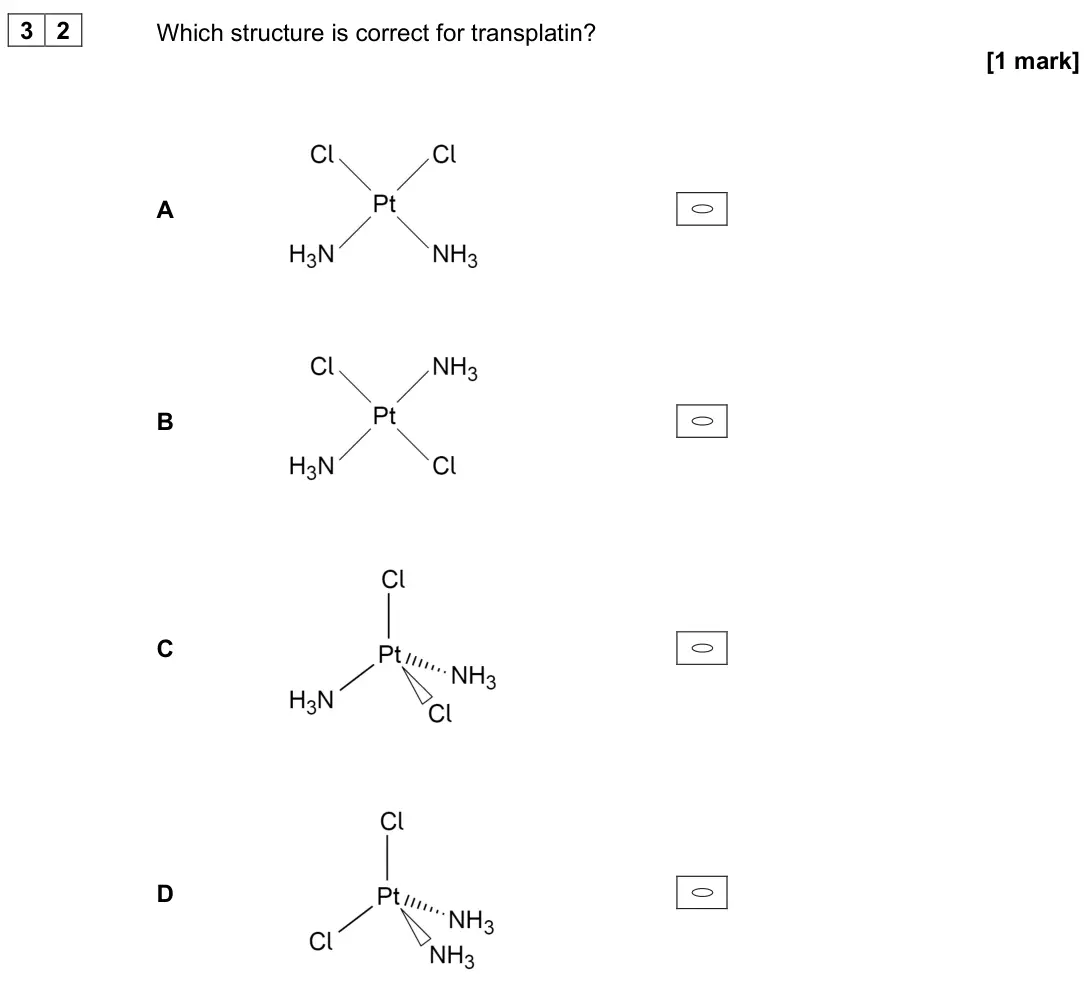
- June 2025, Paper 3, Q32 (1 mark): Which structure is correct for transplatin? [1 mark] A B C D
- June 2024, Paper 1, Q03.1 (2 marks): Draw the structure of X. Include the charge. [2 marks]
- June 2024, Paper 1, Q03.2 (2 marks): The formation of X is an example of the chelate effect. Explain the meaning of the chelate effect. [2 marks]
- June 2024, Paper 1, Q03.3 (6 marks): Outline how Fe2+ ions catalyse the reaction between S2O82– ions and I– ions in aqueous solution. In your answer you should include • a sketch graph to show how
- June 2024, Paper 3, Q05.1 (6 marks): Some complexes containing transition metal ions are coloured. • Explain why some complexes containing transition metal ions are coloured. • List the factors tha
- June 2024, Paper 3, Q05.2 (3 marks): Figure 5 shows the visible spectrum of [Cu(H2O)6]2+ Figure 5 Use the wavelength at the peak of the curve in Figure 5 to calculate the change in energy, in J, of
- June 2023, Paper 1, Q01.1 (1 mark): State the meaning of the term transition metal complex. [1 mark] Cr(PF3)6 is a complex of chromium that contains molecules of PF3
- June 2023, Paper 1, Q01.6 (3 marks): The compound [Cr(NH3)4Cl2]Cl contains a complex ion that shows isomerism. Draw the two isomers of the complex ion. State the type of isomerism shown. [3 marks]
- June 2023, Paper 1, Q01.7 (1 mark): Complete the equation to show the formation of one complex that contains chromium in its +3 oxidation state. [1 mark] CrCl3 + 5 H2O →
- June 2023, Paper 1, Q07.4 (1 mark): State why the concentration of aluminium sulfate solution can not be determined by colorimetry. [1 mark]
- June 2023, Paper 1, Q07.7 (2 marks): Figure 3 shows the structure of the EDTA4 – ion. Figure 3 Atoms of two different elements in EDTA4– can form co-ordinate bonds with an aluminium ion. On Figure
- June 2023, Paper 1, Q07.8 (7 marks): Hydrated aluminium sulfate, Al2(SO4)3.xH2O, is soluble in water. The relative formula mass and value of x can be found from a titration experiment. Aqueous [Al(
- June 2023, Paper 3, Q23 (1 mark): Which statement about the shapes of ions is not correct? [1 mark] A [CoCl4]2– is square planar. B NH4+ is tetrahedral. C [Co(H2NCH2CH2NH2)3]2+ is octahedral. D
- June 2023, Paper 3, Q24 (1 mark): Which compound can decolourise acidified potassium manganate(VII) solution? [1 mark] A AgNO3 B CuSO4 C FeSO4 D Fe2(SO4)3
- June 2023, Paper 3, Q27 (1 mark): Which process does not involve a heterogeneous catalyst? [1 mark] A catalytic cracking of alkanes B Contact process C decomposition of ozone D Haber process
- June 2023, Paper 3, Q36 (1 mark): Cisplatin has the formula [Pt(NH3)2Cl2] Cisplatin is an anti-cancer drug that prevents replication of DNA. When cisplatin bonds to DNA, which is the correct lig
- June 2022, Paper 1, Q03.2 (1 mark): State why an indicator is not added in this titration. [1 mark]
- June 2022, Paper 1, Q07.1 (2 marks): Explain why aqueous solutions containing [CuCl4] 2– ions are yellow. [2 marks]
- June 2022, Paper 1, Q07.2 (2 marks): When a d electron moves from the ground state to the excited state in a copper complex, the energy change is 3.98 x 10⁻¹⁹ J The Planck constant, h = 6.63 × 10⁻³
- June 2022, Paper 1, Q07.3 (3 marks): State three ways in which a transition metal complex can be changed to alter its colour. [3 marks] 1 2 3
- June 2022, Paper 1, Q07.4 (1 mark): Name the shape of the [CuCl4] 2– ion. [1 mark]
- June 2022, Paper 1, Q07.5 (1 mark): Give an ionic equation for the conversion of [CuCl4] 2– to complex ion P. [1 mark]
- June 2022, Paper 1, Q07.6 (2 marks): State the colour of the solution containing the complex ion Q. Give an ionic equation for the conversion of [CuCl4] 2– to Q. [2 marks] Colour Equation
- June 2022, Paper 1, Q07.7 (1 mark): Identify complex ion R. [1 mark]
- June 2022, Paper 3, Q05.2 (6 marks): A student determines the concentration of ethanedioate ions in an acidified solution by titration with potassium manganate(VII) solution. 2 MnO4– + 5 C2O42– + 1
- June 2022, Paper 3, Q05.3 (3 marks): The reaction between peroxodisulfate ions and iodide ions in aqueous solution can be catalysed by Co2+ ions. S2O82– + 2 I– → 2 SO42– + I2 Table 6 gives relevant
- June 2022, Paper 3, Q19 (1 mark): Which pair of reagents reacts to form a tetrahedral complex? [1 mark] A CoCl2(aq) and concentrated NH3(aq) B CuSO4(aq) and concentrated NH3(aq) C CuSO4(aq) and
- June 2022, Paper 3, Q20 (1 mark): Cobalt(II) chloride solution changes colour when an excess of concentrated hydrochloric acid is added. What type of reaction takes place? [1 mark] A hydrolysis
- June 2022, Paper 3, Q21 (1 mark): The reaction between vanadium(IV) ions and manganate(VII) ions in acidic solution can be represented by the equation 5 V4+ + MnO4− + 8 H+ → 5 V5+ + Mn2+ + 4 H2O
- November 2021, Paper 1, Q04.1 (6 marks): Discuss the role of iron as a heterogeneous catalyst in the Haber process. 3 H2 + N2 ⇌ 2 NH3 Your answer should include: • the meaning of the term heterogeneous
- November 2021, Paper 1, Q04.2 (4 marks): Fe2+ ions catalyse the reaction between peroxodisulfate(VI) ions and iodide ions in aqueous solution. S2O82–(aq) + 2 I–(aq) → 2 SO42–(aq) + I2(aq) Explain why t
- November 2021, Paper 1, Q04.3 (1 mark): Give a reason why Zn2+ ions do not catalyse the reaction in Question 04.2. [1 mark]
- November 2021, Paper 3, Q01.6 (1 mark): State the colour change seen at the end point of each titration. [1 mark]
- November 2021, Paper 3, Q01.8 (6 marks): When Na2C2O4(aq) is added to a solution containing [Fe(H2O)6]3+ ions, a reaction occurs in which all six water ligands are replaced by ethanedioate ions. Explai
- November 2021, Paper 3, Q07 (1 mark): Which does not involve the absorption of ultraviolet radiation or visible light? [1 mark] A The blue appearance of copper(II) sulfate solution in daylight. B Th
- November 2020, Paper 3, Q01.4 (2 marks): Petrol vehicles have a catalytic converter which decreases emissions of oxides of nitrogen. Platinum in the catalytic converter acts as a heterogeneous catalyst
- November 2020, Paper 3, Q02.3 (2 marks): In the Contact process, sulfur(IV) oxide is converted into sulfur(VI) oxide using vanadium(V) oxide as a catalyst. Give two equations to show how the vanadium(V
- November 2020, Paper 3, Q03.1 (3 marks): Explain why complexes formed from transition metal ions are coloured. [3 marks]
- November 2020, Paper 3, Q03.2 (3 marks): Calculate the energy, in J, gained by each excited electron in the absorption at 490 nm Speed of light, c = 3.00 x 10⁸ m s–1 Planck constant, h = 6.63 x 10⁻³⁴ J
- November 2020, Paper 3, Q03.3 (3 marks): Describe how a calibration graph is produced and used to find the concentration of the iron(III) complex. [3 marks]
- November 2020, Paper 3, Q03.4 (2 marks): The concentration of iron(III) in the solution is 4.66 x 10⁻³ mol dm–3 Calculate the mass, in mg, of iron in the tablet used to make the 250 cm3 of solution. [2
- November 2020, Paper 3, Q04.1 (1 mark): Cisplatin works by causing the death of rapidly dividing cells. Name the process that is prevented by cisplatin during cell division. [1 mark]
- November 2020, Paper 3, Q04.2 (2 marks): Give the equation for this reaction. [2 marks]
- November 2020, Paper 3, Q04.3 (2 marks): When the complex ion B reacts with DNA, the water molecule is replaced as a bond forms between platinum and a nitrogen atom in a guanine nucleotide. The remaini
- November 2020, Paper 3, Q17 (1 mark): Which shows the electron configuration of an atom of a transition metal? [1 mark] A [Ar] 4s23d0 B [Ar] 4s23d8 C [Ar] 4s23d10 D [Ar] 4s23d104p1
- November 2020, Paper 3, Q18 (1 mark): Which will not act as a ligand in the formation of a complex ion? [1 mark] A CH4 B CO C H2O D NH3
- November 2020, Paper 3, Q19 (1 mark): Which shows the correct oxidation state and co-ordination number of cobalt in [Co(NH3)5Cl]Cl2? [1 mark] oxidation state co-ordination number A +2 5 B +2 6 C +3
- November 2020, Paper 3, Q20 (1 mark): Which statement is not correct? [1 mark] A CuCl42– is square planar. B NH4+ is tetrahedral. C [Co(H2NCH2CH2NH2)3]2+ is octahedral. D [Fe(H2O)6]2+ is octahedral.
- November 2020, Paper 3, Q21 (1 mark): Which compound decolourises acidified potassium manganate(VII) solution? [1 mark] A Al2(SO4)3 B CuSO4 C FeSO4 D Fe2(SO4)3
- November 2020, Paper 3, Q31 (1 mark): What is the minimum volume, in cm3, of 0.02 mol dm–3 KMnO4 solution needed to oxidise 0.01 mol of VO2+? 5 VO2+ + MnO4– + H2O → 5 VO2+ + Mn2+ + 2 H+ [1 mark] A 1
- June 2019, Paper 1, Q04.5 (6 marks): Transition metal complexes have different shapes and many show isomerism. Describe the different shapes of complexes and show how they lead to different types o
- June 2019, Paper 1, Q06.1 (6 marks): Calculate the percentage of copper by mass in the alloy. Give your answer to the appropriate number of significant figures. [6 marks] % copper
- June 2019, Paper 1, Q06.2 (2 marks): Suggest two ways that the student could reduce the percentage uncertainty in the measurement of the volume of sodium thiosulfate solution, using the same appara
- June 2019, Paper 1, Q06.3 (1 mark): State the role of iodine in the reaction with sodium thiosulfate. [1 mark]
- June 2019, Paper 1, Q06.4 (1 mark): Give the full electron configuration of a copper(II) ion. [1 mark]
- June 2019, Paper 1, Q06.5 (2 marks): Copper(I) iodide is a white solid. Explain why copper(I) iodide is white. [2 marks]
- June 2019, Paper 3, Q05.4 (1 mark): State the colour change seen at the end point of the titration. [1 mark]
- June 2019, Paper 3, Q18 (1 mark): What is observed when concentrated hydrochloric acid is added to an aqueous solution of CuSO4 until no further change occurs? [1 mark] A A colourless gas is evo
- June 2018, Paper 1, Q03.4 (3 marks): Platinum acts as a heterogeneous catalyst in the reaction between ammonia and oxygen. It provides an alternative reaction route with a lower activation energy.
- June 2018, Paper 1, Q09.2 (1 mark): Give the oxidation state of vanadium in [VO(H2O)5]2+ [1 mark]
- June 2018, Paper 1, Q09.3 (2 marks): The [V(H2O)4Cl2]+ ion exists as two isomers. One isomer is shown. Draw the structure of the other isomer and state the type of isomerism. [2 marks] Type of isom
- June 2018, Paper 1, Q09.4 (1 mark): Heating NH4VO3 produces vanadium(V) oxide, water and one other product. Give an equation for the reaction. [1 mark]
- June 2018, Paper 1, Q09.5 (1 mark): Vanadium(V) oxide is the catalyst used in the manufacture of sulfur trioxide. Give two equations to show how the catalyst is used and regenerated. [1 mark]
- June 2018, Paper 3, Q26 (1 mark): Which statement is correct about this reaction? [Co(NH3)6]2+ + 3H2NCH2CH2NH2 [Co(H2NCH2CH2NH2)3]2+ + 6NH3 [1 mark] A The co-ordination number of cobalt decrea
- June 2018, Paper 3, Q27 (1 mark): Which complex exists as optical isomers? [1 mark] A [Ag(NH3)2]+ B [Co(C2O4)3]4– C [Cu(EDTA)]2– D [Cu(NH3)4(H2O)2]2+
- June 2018, Paper 3, Q29 (1 mark): Which ion cannot catalyse the reaction between iodide (I–) and peroxodisulfate (S2O8 2–)? Use the data below to help you answer this question. [1 mark] Half-equ
- June 2017, Paper 1, Q07.1 (1 mark): State the type of bonding between the oxygen and hydrogen in this compound [1 mark
- June 2017, Paper 1, Q07.2 (1 mark): State why the chloride ions in this compound are not considered to be ligands [1 mark
- June 2017, Paper 1, Q07.3 (2 marks): An excess of ammonia was added to a sample of solution A to form solution B Write an ionic equation for the reaction that occurs when solution A is converted in
- June 2017, Paper 1, Q07.4 (1 mark): Aqueous sodium carbonate was added to another sample of solution A to form a blue-green solid C. Identify the blue-green solid C. [1 mark
- June 2017, Paper 1, Q07.5 (2 marks): Reagent D was added to another sample of solution A to form a yellow-green solution. Identify reagent D and write an ionic equation for the reaction that occurs
- June 2017, Paper 1, Q07.6 (2 marks): Explain why colorimetry cannot be used to determine the concentration of solutions containing [CuCl2]− In your answer refer to the electron configuration of the
- June 2017, Paper 1, Q11.2 (2 marks): Ethanedioate ions react with aqueous iron(III) ions in a ligand substitution reaction. Write an equation for this reaction. Suggest why the value of the enthalp
- June 2017, Paper 1, Q11.3 (3 marks): Draw the displayed formula of the iron complex produced in the reaction in Question 11.2 Indicate the value of the O—Fe—O bond angle. State the type of isomeris
- June 2017, Paper 1, Q11.4 (1 mark): Ethanedioate ions are poisonous because they react with iron ions in the body. Ethanedioate ions are present in foods such as broccoli and spinach. Suggest one
- June 2017, Paper 3, Q07 (1 mark): Which is not a correct statement? [1 mark] A Transition metals form coloured ions and complexes B Transition metals display variable oxidation states C A ligand
- June 2017, Paper 3, Q15 (1 mark): Cisplatin is an anti-cancer drug. Which structure represents a stereoisomer of cisplatin? [1 mark] A B C D
- June 2017, Paper 3, Q17 (1 mark): V2O5 can be used as a catalyst in the Contact Process. Which is a step in the Contact Process in which the vanadium is oxidised? [1 mark] A SO2 + V2O5 → SO3 + 2
- June 2017, Paper 3, Q31 (1 mark): A solution absorbs light with wavelengths corresponding to red, yellow and green light. Which ion is most likely to be in the solution? [1 mark] A Cr2O7 2−(aq)
- Specimen, Paper 1, Q01.3 (1 mark): Suggest one reason why electron pair repulsion theory cannot be used to predict the shape of the [CoCl4] 2– ion. [1 mark] 0 1 . 3
- Specimen, Paper 1, Q01.4 (2 marks): Shape Bond angle
- Specimen, Paper 1, Q07.4 (2 marks): 0
- Specimen, Paper 1, Q08.1 (2 marks): A co-ordinate bond is formed when a transition metal ion reacts with a ligand. Explain how this co-ordinate bond is formed. [2 mark 0 8 . 1
- Specimen, Paper 1, Q08.3 (1 mark): When the complex ion [Cu(NH3)4(H2O)2] 2+ reacts with 1,2-diaminoethane, the ammonia molecules but not the water molecules are replaced. Write an equation for th
- Specimen, Paper 1, Q08.4 (2 marks): Suggest why the enthalpy change for the reaction in Question 8.3 is approximately zero. [2 marks] 0 8 . 4
- Specimen, Paper 1, Q08.5 (2 marks): Explain why the reaction in Question 8.3 occurs despite having an enthalpy change that is approximately zero. [2 marks] 0 8 . 5
- Specimen, Paper 3, Q04.3 (4 marks): Original concentration = Equation Calculation mol dm 3
- Specimen, Paper 3, Q21 (1 mark): 0
- Specimen, Paper 3, Q23: The following equation represents the oxidation of vanadium(IV) ions by manganate(VII) ions in acid solution. 5V4+ + MnO4 – + 8H+ 5V5+ + Mn2+ + 4H2O What volume
Questions, mark schemes and examiner’s reports are © AQA, from their published past papers. Plumi isn’t affiliated with any exam board. Want whole papers? Every AQA A-Level Chemistry paper.
Rather write your answers by hand on iPad? Plumi marks them against the same mark schemes.