 plumi
Equilibrium constant Kc for homogeneous systems: AQA A‑Level Chemistry questions
AQA A-Level Chemistry past-paper questions on 3.1.6.2 Equilibrium constant Kc for homogeneous systems, 2008–2025, with mark schemes and examiner’s reports where available.
Paper
All papers
Exam
All years
Calculations
Q04.1
The whole paper ↗
Q04.2
The whole paper ↗Q04.3
The whole paper ↗Q07.3
The whole paper ↗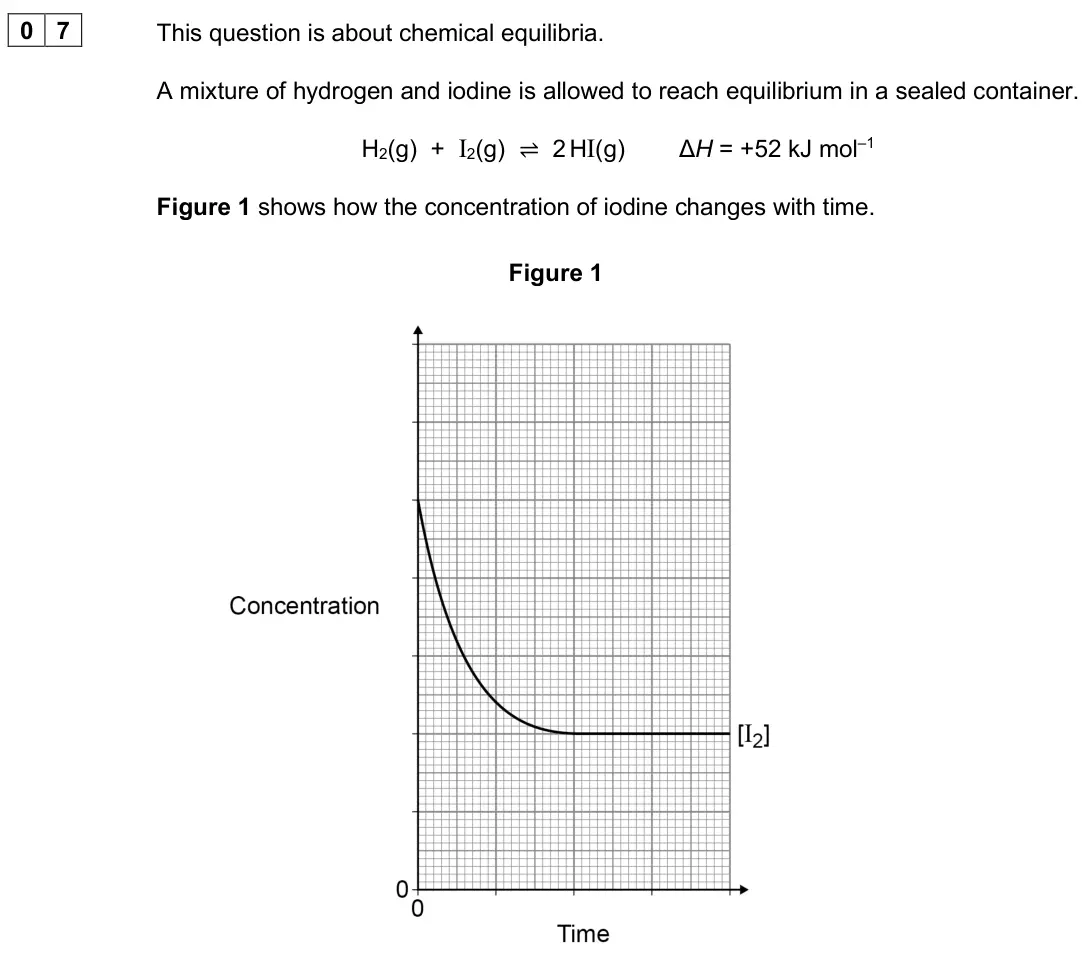
Q02.1
The whole paper ↗
Q02.2
The whole paper ↗Q07.6
The whole paper ↗
Q07.7
The whole paper ↗Q08.1
The whole paper ↗
Q08.2
The whole paper ↗Q08.3
The whole paper ↗Q08.4
The whole paper ↗Q02.1
The whole paper ↗
Q02.2
The whole paper ↗Q02.3
The whole paper ↗Q07.4
The whole paper ↗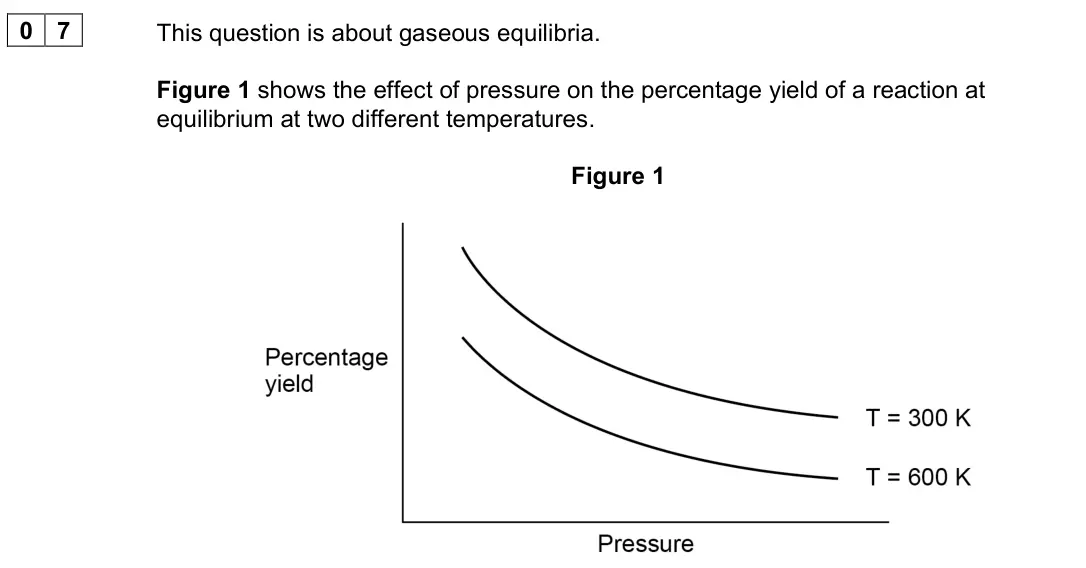
Q07.5
The whole paper ↗
All 106 questions on Equilibrium constant Kc for homogeneous systems, as a list
- June 2025, Paper 3, Q04.1 (1 mark): Give the expression for the equilibrium constant, Kc, for the equilibrium. [1 mark] Kc
- June 2025, Paper 3, Q04.2 (2 marks): Before the titration, the sample is ‘quenched’ by adding 50 cm3 of ice-cold water. Suggest why the sample is ‘quenched’ in this way before the titration. Explai
- June 2025, Paper 3, Q04.3 (6 marks): The amount of I–(aq) in the equilibrium mixture is found to be 3.00 × 10⁻⁴ mol Calculate the value of Kc at 40 °C for the equilibrium. 2 Fe3+(aq) + 2 I–(aq) ⇌ 2
- June 2025, AS Paper 1, Q07.3 (6 marks): Give an expression for the equilibrium constant, Kc, for this reaction. Calculate a value for the equilibrium constant at this fixed temperature. Give the units
- June 2024, Paper 2, Q02.1 (2 marks): Calculate the amount, in moles, of P before the reaction with Q. Use your answer to calculate the concentration, in mol dm–3, of P in the initial 25.0 cm3 sampl
- June 2024, Paper 2, Q02.2 (4 marks): Give the expression for the equilibrium constant, Kc Calculate the value of Kc and deduce its units. [4 marks] Kc Value of Kc Units
- June 2024, AS Paper 2, Q07.6 (1 mark): Give an expression for the equilibrium constant (Kc) for this reaction. [1 mark] Kc =
- June 2024, AS Paper 2, Q07.7 (4 marks): Table 3 shows the amount of each substance in an equilibrium mixture in a container of volume 1.20 dm3 at a constant temperature. Table 3 Substance C2H4(g) H2O(
- June 2023, Paper 3, Q13 (1 mark): When HF is added to water at 298 K, this equilibrium is established. HF(aq) ⇌ H+(aq) + F–(aq) At equilibrium, [HF] = 7.70 × 10⁻³ mol dm–3 and [F–] = 2.30 × 10⁻³
- June 2023, AS Paper 1, Q08.1 (2 marks): A solution containing 0.60 mol of A is added to a solution containing 0.60 mol of B. The amount of C formed at equilibrium is 0.28 mol Deduce the amounts, in mo
- June 2023, AS Paper 1, Q08.2 (1 mark): Give an expression for the equilibrium constant (Kc) for this reaction. [1 mark] Kc
- June 2023, AS Paper 1, Q08.3 (3 marks): The temperature of the equilibrium mixture is decreased. Predict the effect, if any, on the value of Kc Give a reason for your prediction. [3 marks] Prediction
- June 2023, AS Paper 1, Q08.4 (3 marks): In another mixture at equilibrium [A] = 0.48 mol dm–3 [C] = 0.62 mol dm–3 For this reaction, the equilibrium constant Kc = 7.8 mol–2 dm6 Calculate [B] at equili
- June 2022, Paper 2, Q02.1 (2 marks): Calculate the amount, in moles, of C2F4 and of HCl in the equilibrium mixture. [2 marks] Amount of C2F4 mol Amount of HCl mol
- June 2022, Paper 2, Q02.2 (1 mark): Give an expression for Kc for this equilibrium. [1 mark] Kc
- June 2022, Paper 2, Q02.3 (3 marks): Calculate a value for Kc Give its units. [3 marks] Kc Units
- June 2022, AS Paper 1, Q07.4 (5 marks): At 745 K, 0.150 dm3 of an equilibrium mixture contains 0.0285 mol of hydrogen and 0.0870 mol of nitrogen. Calculate the amount, in moles, of ammonia present in
- June 2022, AS Paper 1, Q07.5 (2 marks): Calculate the value, at 745 K, for the equilibrium constant Kc for this dissociation of ammonia to give hydrogen and nitrogen. State the units. 2 NH3(g) ⇌ 3 H2(
- June 2022, AS Paper 2, Q18 (1 mark): The reaction reaches equilibrium in a container of fixed volume. Which is the expression for Kc for this equilibrium? [1 mark] A Kc = [CH3OH] [CO] + [H2]2 B Kc
- June 2022, AS Paper 2, Q19 (1 mark): 2.0 mol of carbon monoxide is mixed with 3.0 mol of hydrogen and allowed to reach equilibrium. The equilibrium mixture contains 0.6 mol of methanol. What is the
- November 2021, Paper 2, Q05.1 (3 marks): 1 mol of a diester with molecular formula C7H12O4 is added to 1 mol of water in the presence of a small amount of catalyst. The mixture is left to reach equilib
- November 2021, Paper 2, Q05.3 (3 marks): A new equilibrium mixture of the substances from Question 05.1 is prepared at a different temperature. C7H12O4(l) + 2 H2O(l) ⇌ 2 CH3COOH(l) + HO(CH2)3OH(l) Tabl
- November 2021, AS Paper 1, Q10.1 (1 mark): Give an expression for the equilibrium constant (Kc) for this reaction. [1 mark] Kc
- November 2021, AS Paper 1, Q10.2 (3 marks): A mixture of sulfur dioxide and oxygen is allowed to reach equilibrium in a container of volume 1800 cm3 at temperature T. At equilibrium, the mixture contains
- November 2020, Paper 2, Q09.1 (2 marks): Calculate the amount of A and the amount of B, in moles, in the equilibrium mixture. [2 marks] Amount of A mol Amount of B mol
- November 2020, Paper 2, Q09.2 (4 marks): At a different temperature, another equilibrium mixture contains 0.30 mol of A, 0.25 mol of B and 0.020 mol of C in 350 cm3 of solution. Calculate the value of
- November 2020, Paper 2, Q09.3 (1 mark): Suggest why an expression for K can be written without the concentration of water. [1 mark]
- November 2020, Paper 2, Q09.4 (5 marks): Distilled water is added to 4.71 g of chloroethanal (Mr = 78.5) to make 50.0 cm3 of solution. The mixture is allowed to reach equilibrium. The value of the equi
- November 2020, AS Paper 2, Q08.1 (2 marks): Give an expression for Kc for this equilibrium. State its units. [2 marks] Kc Units of Kc
- November 2020, AS Paper 2, Q08.2 (3 marks): Table 4 shows the amount of each substance in an equilibrium mixture in a container of volume 750 cm3 Table 4 Substance C2H5OH(g) H2O(g) CO(g) H2(g) Amount of s
- June 2019, AS Paper 1, Q05.1 (2 marks): 1.50 mol of NO are mixed with 1.00 mol of Cl2 and the mixture is left to reach equilibrium at a given temperature. The equilibrium mixture contains 0.350 mol of
- June 2019, AS Paper 1, Q05.2 (1 mark): Give the expression for the equilibrium constant, Kc, for the reaction between nitrogen monoxide and chlorine to form nitrosyl chloride. [1 mark] Kc =
- June 2019, AS Paper 1, Q05.3 (4 marks): A different equilibrium mixture is prepared in a flask of volume 800 cm3 at a different temperature. At equilibrium this mixture contains 0.850 mol of NO and 0.
- June 2019, AS Paper 2, Q12 (1 mark): When one mole of ammonia is heated to a given temperature, 50 % of it dissociates and the following equilibrium is established. NH3(g) ⇌ 1 2 N2(g) + 3 2 H2(g) W
- June 2018, Paper 2, Q04.1 (5 marks): A beaker contained 40 cm3 of a 0.16 mol dm–3 aqueous solution of A. 9.5 × 10⁻³ mol of B and 2.8 × 10⁻² mol of C were added to the beaker and the mixture was lef
- June 2018, Paper 2, Q04.2 (2 marks): Give the expression for the equilibrium constant (Kc) for this equilibrium and its units. [2 marks] Kc Units
- June 2018, Paper 2, Q04.3 (3 marks): A different equilibrium mixture of these four compounds, at a different temperature, contained 0.21 mol of B, 1.05 mol of C and 0.076 mol of D in a total volume
- June 2018, Paper 2, Q04.4 (3 marks): Justify the statement that adding more water to the equilibrium mixture in Question 04.3 will lower the amount of A in the mixture. [3 marks]
- June 2018, AS Paper 2, Q08.2 (1 mark): Give an expression for the equilibrium constant (Kc) for this reaction. [1 mark]
- June 2018, AS Paper 2, Q08.3 (3 marks): A mixture of carbon monoxide and hydrogen was allowed to reach equilibrium in a container of volume 250 cm3 at temperature T. At equilibrium, the mixture contai
- June 2018, AS Paper 2, Q08.4 (2 marks): Methanol decomposes on heating in a reaction that is the reverse of that used in its manufacture. CH3OH(g) ⇌ CO(g) + 2H2(g) Use your answer from Question 08.3 t
- June 2017, Paper 2, Q05.2 (3 marks): A small amount of catalyst was added to a mixture of 0.470 mol of ethanoic acid and 0.205 mol of ethane-1,2-diol. The mixture was left to reach equilibrium at a
- June 2017, Paper 2, Q05.3 (2 marks): Write an expression for the equilibrium constant, Kc, for the reaction. The total volume of the mixture does not need to be measured to allow a correct value fo
- June 2017, Paper 2, Q05.4 (3 marks): A different mixture of ethanoic acid, ethane-1,2-diol and water was prepared and left to reach equilibrium at a different temperature from the experiment in Que
- June 2017, AS Paper 1, Q04.1 (1 mark): The amount, in moles, of each of P and Q at equilibrium is (1− x). Deduce in terms of x the amount, in moles, of R in the equilibrium mixture. [1 mark
- June 2017, AS Paper 1, Q04.2 (3 marks): At 298 K the value of the equilibrium constant Kc = 3.6 Calculate a value for the equilibrium concentration, in mol dm−3, of R. [3 marks Equilibrium concentrati
- June 2017, AS Paper 2, Q21 (1 mark): Hydrogen can be produced by this reaction. CO(g) + H2O(g) ⇌ CO2(g) + H2(g) In an experiment 4.20 mol of carbon monoxide were mixed with 2.00 mol of steam. When
- June 2016, AS Paper 2, Q01.1 (2 marks): Write an expression for the equilibrium constant Kc for this equilibrium. Deduce the units of Kc. [2 marks] Expression Units
- June 2016, AS Paper 2, Q01.2 (2 marks): An equilibrium mixture was found to contain 0.700 mol of ethene, 1.20 mol of steam and 4.40 mol of ethanol at a temperature T. The volume of the container was 2
- June 2016, AS Paper 2, Q19 (1 mark): A and B react together in this reversible reaction. A + 3B ⇌ C + 2D A mixture of 10 mol of A and 10 mol of B were left to reach equilibrium. The equilibrium mix
- June 2016, AS Paper 2, Q21 (1 mark): Which of the following shows how the equilibrium yield of hydrogen and the value of the equilibrium constant are affected by the changes shown? [1 mark] Change
- Specimen, Paper 3, Q02.1 (6 marks): Kc = 6 A student obtained the titration results given in Table 2. Table 2 Rough 1 2 3 Final burette reading / cm3 4.60 8.65 12.85 16.80 Initial burette reading
- Specimen, Paper 3, Q11 (1 mark): When one mole of ammonia is heated to a given temperature, 50% of the compound dissociates and the following equilibrium is established. NH3(g) 1 2N2(g) + 3 2H2
- June 2016, CHEM4 (old spec), Q2(c)(i) (2 marks): Calculate the amount, in moles, of ethanal and of ethanol in this equilibrium mixture. [2 marks] Amount of ethanal mol Amount of ethanol mol Space for working
- June 2016, CHEM4 (old spec), Q2(c)(ii) (4 marks): In a different experiment using the same reaction as in part (c), an equilibrium mixture was established at a given temperature. This mixture contained 0.58 mol
- June 2015, CHEM4 (old spec), Q2(a) (2 marks): Write an expression for the equilibrium constant, Kc, for this reaction and deduce its units. [2 marks] Kc Units
- June 2015, CHEM4 (old spec), Q2(b) (3 marks): Samples of sulfur dioxide, oxygen and sulfur trioxide were added to a flask of volume 1.40 dm3 and allowed to reach equilibrium at a given temperature. The flas
- June 2015, CHEM4 (old spec), Q2(c)(i) (1 mark): State the effect, if any, of using a smaller flask on the value of Kc [1 mark]
- June 2014, CHEM4 (old spec), Q1(a) (2 marks): A 2.0 mol sample of E was heated in a sealed container with a 1.0 mol sample of F. Equilibrium was established at a given temperature and the equilibrium mixtur
- June 2014, CHEM4 (old spec), Q1(b) (2 marks): Write an expression for the equilibrium constant Kc for this equilibrium. State the units of Kc [2 marks] Expression Units
- June 2014, CHEM4 (old spec), Q1(c) (2 marks): A different mixture of E and F reached equilibrium at temperature T1 in a container of volume 1.50 dm3. This equilibrium mixture contained 2.50 mol of E, 1.20 m
- June 2014, CHEM4 (old spec), Q1(e) (3 marks): The mixture in Question 1 (c) was allowed to reach equilibrium at temperature T2 in the original container of volume 1.50 dm3. The value of Kc for the equilibri
- June 2013, CHEM4 (old spec), Q2(a) (2 marks): A 2.50 mol sample of NOCl was heated in a sealed container and equilibrium was established at a given temperature. The equilibrium mixture formed contained 0.80
- June 2013, CHEM4 (old spec), Q2(b)(i) (1 mark): Write an expression for the equilibrium constant Kc (1 mark)
- June 2013, CHEM4 (old spec), Q2(b)(ii) (4 marks): Calculate the amount, in moles, of Cl2 in this equilibrium mixture.
- June 2013, CHEM4 (old spec), Q2(b)(iii) (2 marks): Consider this alternative equation for the equilibrium at temperature T. NOCl(g) NO(g) + – Cl2(g) Calculate a value for the different equilibrium constant Kc fo
- January 2013, CHEM4 (old spec), Q3(b)(i) (3 marks): A mixture of 2.50 mol of A and 10.0 mol of ethanol was left to reach equilibrium in an inert solvent in the presence of a small amount of concentrated sulfuric
- January 2013, CHEM4 (old spec), Q3(b)(iii) (1 mark): Using A to represent the acid and DEM to represent the ester, write an expression for the equilibrium constant Kc for the reaction. (1 mark)
- January 2013, CHEM4 (old spec), Q3(b)(iv) (3 marks): In a second experiment, the equilibrium mixture was found to contain 0.85 mol of A, 7.2 mol of ethanol, 2.1 mol of DEM and 3.4 mol of water. Calculate a value o
- June 2012, CHEM4 (old spec), Q1(a)(i) (2 marks): Calculate the amounts, in moles, of hydrogen and of iodine in the equilibrium mixture. Moles of hydrogen Moles of iodine (2 marks)
- June 2012, CHEM4 (old spec), Q1(a)(ii) (1 mark): Write an expression for the equilibrium constant (Kc) for this equilibrium. (1 mark)
- June 2012, CHEM4 (old spec), Q1(a)(iii) (1 mark): Kc for this equilibrium has no units. State why the units cancel in the expression for Kc (1 mark)
- June 2012, CHEM4 (old spec), Q1(a)(iv) (2 marks): A different mixture of hydrogen, iodine and hydrogen iodide was left to reach equilibrium at the same temperature in a container of the same volume. This second
- June 2012, CHEM4 (old spec), Q1(b)(i) (1 mark): Change: increase the temperature of the equilibrium mixture at constant pressure. H2(g) + l2(g) 2Hl(g) ΔH = +52 kJ mol–1 (1 mark)
- June 2012, CHEM4 (old spec), Q1(b)(ii) (1 mark): Change: increase the total pressure of the equilibrium mixture at constant temperature. 3H2(g) + N2(g) 2NH3(g) ΔH = –92 kJ mol–1 (1 mark)
- June 2012, CHEM4 (old spec), Q1(b)(iii) (1 mark): Change: add a catalyst to the equilibrium mixture at constant temperature. CO(g) + H2O(g) CO2(g) + H2(g) ΔH = – 41 kJ mol–1 (1 mark)
- June 2012, CHEM4 (old spec), Q1(b)(iv) (1 mark): Change: add chlorine to the equilibrium mixture at constant temperature. PCl5(g) PCl3(g) + Cl2(g) ΔH = +93 kJ mol–1 (1 mark)
- January 2012, CHEM4 (old spec), Q2(a)(i) (2 marks): Calculate the amount, in moles, of sulfur trioxide and of sulfur dioxide in the equilibrium mixture. Amount of sulfur trioxide Amount of sulfur dioxide (2 marks
- January 2012, CHEM4 (old spec), Q2(a)(ii) (1 mark): Write an expression for the equilibrium constant, Kc, for this equilibrium. (1 mark)
- January 2012, CHEM4 (old spec), Q2(a)(iii) (1 mark): Deduce the units of Kc for this equilibrium. (1 mark)
- January 2012, CHEM4 (old spec), Q2(a)(iv) (3 marks): Calculate a value of Kc for this equilibrium at temperature T1 (If you were unable to complete the calculations in part (a) (i) you should assume that the amoun
- January 2012, CHEM4 (old spec), Q2(b)(ii) (1 mark): the value of Kc (1 mark)
- January 2012, CHEM4 (old spec), Q2(c) (3 marks): The experiment was repeated in the original container but at temperature T2 The value of Kc was smaller than the value at temperature T1 State which is the high
- June 2011, CHEM4 (old spec), Q3(b) (1 mark): Write an expression for Kc for this reaction. (1 mark) 3
- June 2011, CHEM4 (old spec), Q3(c) (4 marks): The volume of the container was 10.0 dm3. Calculate the concentration, in mol dm–3, of Q in the equilibrium mixture.
- June 2011, CHEM4 (old spec), Q3(f) (1 mark): State the effect, if any, on the value of Kc of increasing the temperature. All other factors are unchanged. (1 mark)
- June 2011, CHEM4 (old spec), Q3(g) (1 mark): State the effect, if any, on the value of Kc of using a container of larger volume. All other factors are unchanged. (1 mark)
- June 2011, CHEM4 (old spec), Q3(h) (1 mark): Deduce the value of the equilibrium constant, at temperature T, for the reaction 2R(g) P(g) + 2Q(g) (1 mark)
- January 2011, CHEM4 (old spec), Q3(a) (2 marks): A sample of synthesis gas containing 0.240 mol of carbon monoxide and 0.380 mol of hydrogen was sealed together with a catalyst in a container of volume 1.50 dm
- January 2011, CHEM4 (old spec), Q3(b)(i) (1 mark): Write an expression for the equilibrium constant Kc for this reaction. (1 mark)
- January 2011, CHEM4 (old spec), Q3(b)(ii) (4 marks): Calculate a value for Kc for the reaction at temperature T1 and state its units. Calculation
- January 2011, CHEM4 (old spec), Q3(b)(iii) (1 mark): State the effect, if any, on the value of Kc of adding more hydrogen to the equilibrium mixture. (1 mark)
- June 2010, CHEM4 (old spec), Q2(a)(i) (3 marks): Calculate the amounts, in moles, of methane, steam and hydrogen in the equilibrium mixture. Moles of methane Moles of steam Moles of hydrogen (3 marks) 3 3
- June 2010, CHEM4 (old spec), Q2(a)(ii) (1 mark): The volume of the flask was 5.0dm3. Calculate the concentration, in moldm–3, of methane in the equilibrium mixture. (1 mark)
- June 2010, CHEM4 (old spec), Q2(b)(i) (1 mark): Write an expression for the equilibrium constant, Kc, for this reaction. (1 mark)
- June 2010, CHEM4 (old spec), Q2(b)(ii) (3 marks): Calculate a value for Kc at temperature T and give its units. Calculation
- January 2010, CHEM4 (old spec), Q1(a)(i) (3 marks): Calculate the amounts, in moles, of propanoic acid, of ethanol and of water in this equilibrium mixture. Moles of propanoic acid Moles of ethanol Moles of water
- January 2010, CHEM4 (old spec), Q1(a)(ii) (1 mark): Write an expression for the equilibrium constant, Kc, for this equilibrium. (1 mark)
- January 2010, CHEM4 (old spec), Q1(a)(iii) (3 marks): Calculate a value for Kc for this equilibrium at this temperature. Explain why this Kc value has no units. Calculation
- January 2010, CHEM4 (old spec), Q1(b)(iii) (1 mark): the value of Kc (1 mark)
- June 2008, CHM5 (2008 spec), Q9(b) (7 marks): 9 (b) Methanol can be produced by using a reversible reaction between carbon monoxide and hydrogen. 2H2(g) + CO(g) CH3OH(g) When 2.00 mol of hydrogen and 1.00mo
- January 2008, CHM4 (2008 spec), Q3(a) (1 mark): (a) Write an expression for the equilibrium constant, Kc, for this reaction. (1 mark)
- January 2008, CHM4 (2008 spec), Q3(b) (4 marks): (b) At a given temperature and pressure, the equilibrium mixture contained 0.44 mol of methane, 0.28 mol of hydrogen and 0.12 mol of ethyne (C2H2) in a containe
- January 2008, CHM4 (2008 spec), Q3(c) (2 marks): (c) State the effect of an increase in temperature on the position of this equilibrium and on the value of Kc for this reaction. Effect on position of equilibri
- January 2008, CHM4 (2008 spec), Q3(d) (2 marks): (d) State the effect of an increase in pressure on the position of this equilibrium and on the value of Kc for this reaction. Effect on position of equilibrium
- January 2008, CHM4 (2008 spec), Q3(g) (2 marks): (g) A different equilibrium mixture was produced starting from methane alone. 2CH4(g) 3H2(g) + C2H2(g) When 3.0 mol of methane were used, the equilibrium mixtur
Questions, mark schemes and examiner’s reports are © AQA, from their published past papers. Plumi isn’t affiliated with any exam board. Want whole papers? AQA A-Level Chemistry past papers.
The Plumi iPad app also offers exam-style questions with AI feedback on your handwritten working.