 plumi
What happens when light and sound meet different materials?: OCR GCSE Physics B questions
Every OCR GCSE Physics B exam question on P1.4 What happens when light and sound meet different materials?, 2018–2025, with its mark scheme and examiner’s report.
Paper
All papers
Exam
All years
Calculations
Q3(b)(ii)
The whole paper ↗
Q3(b)(iii)
The whole paper ↗Q4(a)
The whole paper ↗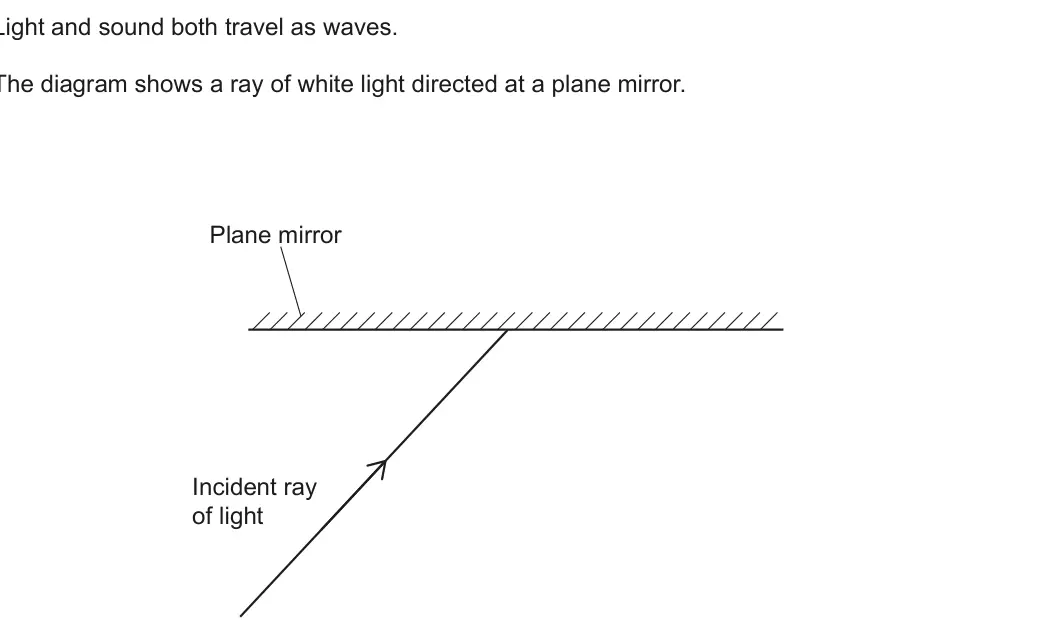
Q4(c)
The whole paper ↗Q2(f)(i)
The whole paper ↗
Q2(f)(ii)
The whole paper ↗Q7(a)(i)
The whole paper ↗
Q7(a)(ii)
The whole paper ↗Q4(a)(i)
The whole paper ↗
Q4(a)(ii)
The whole paper ↗Q4(b)
The whole paper ↗Q4(c)
The whole paper ↗Q4(d)
The whole paper ↗Q12(a)
The whole paper ↗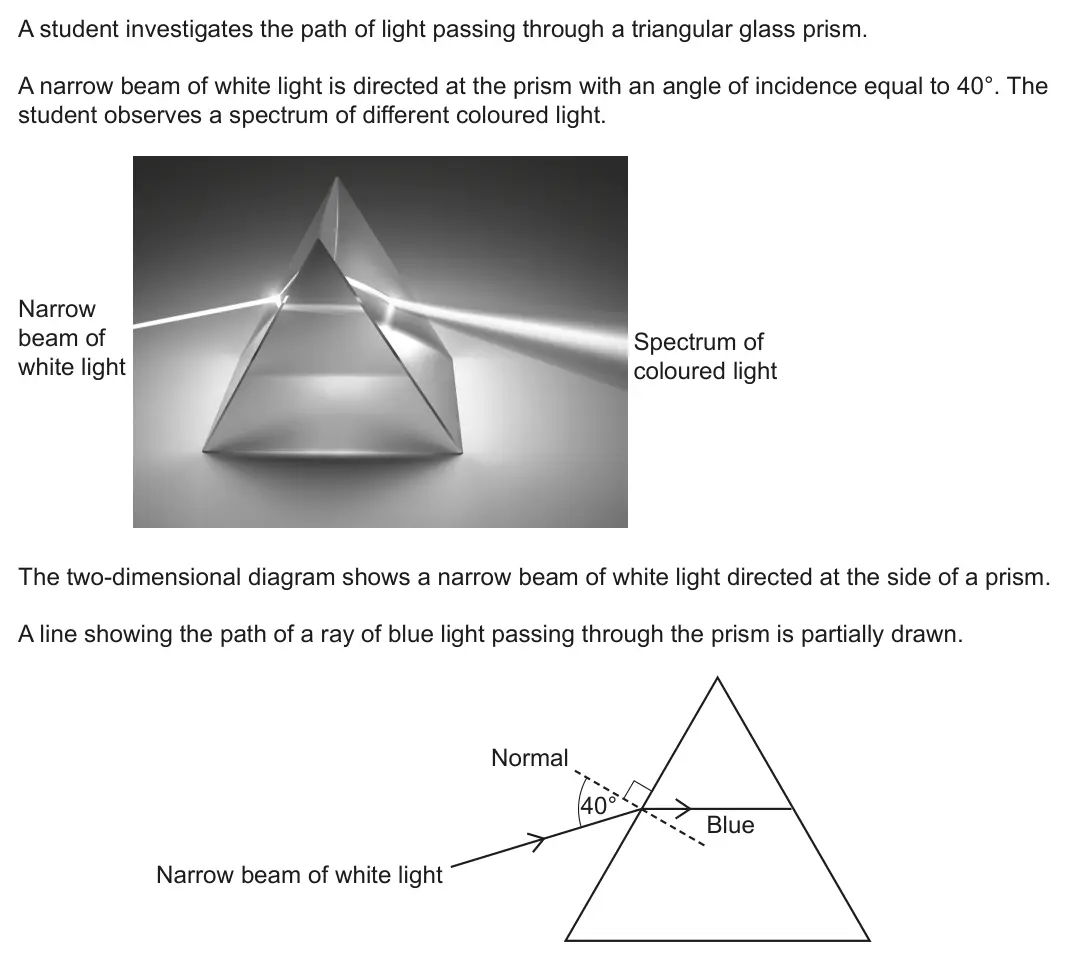
Q12(b)
The whole paper ↗Q12(c)
The whole paper ↗Q1(a)
The whole paper ↗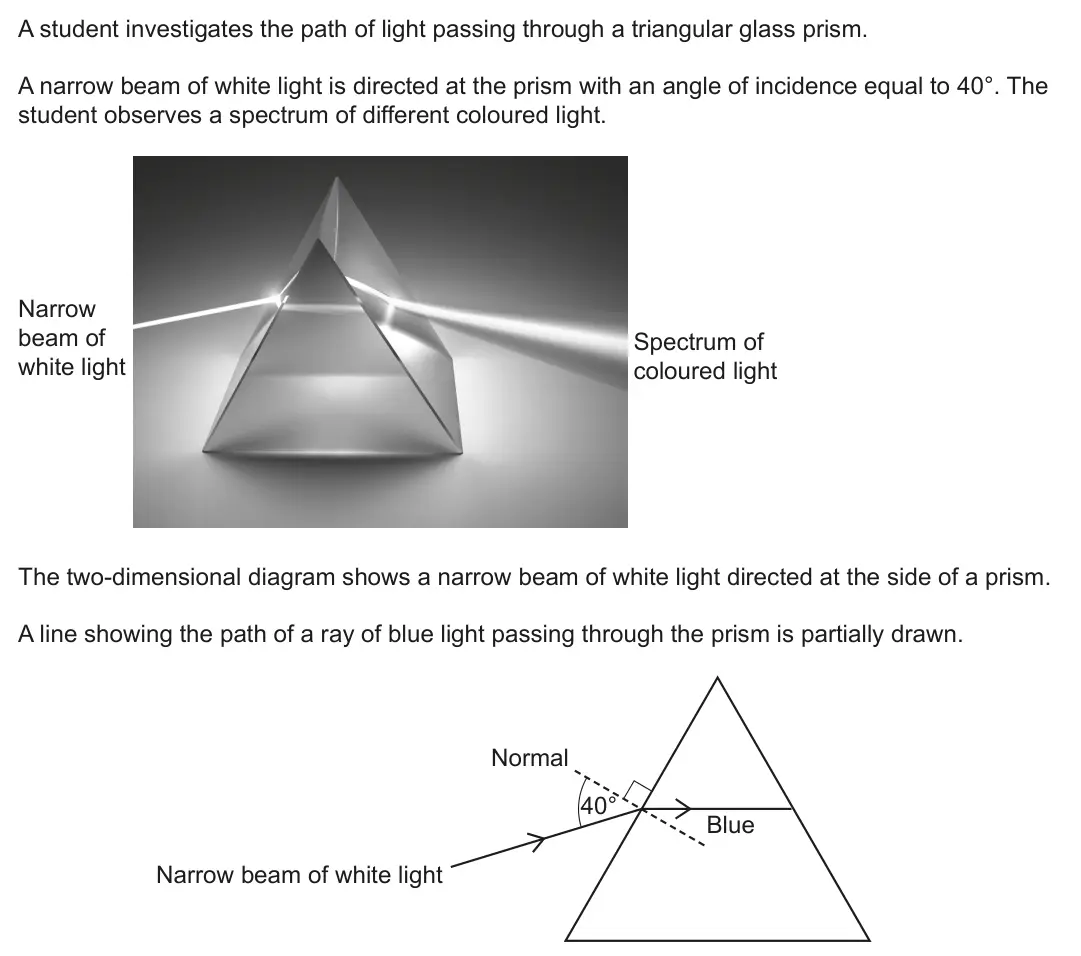
Q1(b)
The whole paper ↗Q1(c)
The whole paper ↗Q3(a)
The whole paper ↗
All 65 questions on What happens when light and sound meet different materials?, as a list
- June 2025, Paper 1 Foundation, Q3(b)(ii) (2 marks): The laser is directed towards the mirror at different angles of incidence and the student measures the angle of reflection. The table shows the student’s result
- June 2025, Paper 1 Foundation, Q3(b)(iii) (2 marks): The laser is now directed at the mirror so that the angle of incidence is 60°. Predict the angle of reflection. Explain how the data in the table supports your
- June 2025, Paper 3 Higher, Q4(a) (3 marks): Draw on the diagram: • the reflected ray of light • the normal, labelled N • the angle of incidence, labelled i • the angle of reflection, labelled r. [3]
- June 2025, Paper 3 Higher, Q4(c) (2 marks): The diagram shows a ray of white light passing through a glass prism. The white light is split into the spectrum of different colours. Glass prism Red Orange Wh
- June 2024, Paper 1 Foundation, Q2(f)(i) (1 mark): What does this symbol in the diagram mean? [1]
- June 2024, Paper 1 Foundation, Q2(f)(ii) (1 mark): The angle of reflection, r, is labelled on the diagram. Label the angle of incidence, i, on the diagram. [1]
- June 2024, Paper 4 Higher, Q7(a)(i) (3 marks): P-waves can travel through solids and liquids. S-waves can only travel through solids. Complete the table to show what conclusions scientists make about the str
- June 2024, Paper 4 Higher, Q7(a)(ii) (2 marks): The density of the mantle is not constant. Suggest why the path of the waves from the earthquake to A is curved. [2]
- June 2023, Paper 1 Foundation, Q4(a)(i) (1 mark): Why do the clear buttons look clear when light is shone at them? [1]
- June 2023, Paper 1 Foundation, Q4(a)(ii) (1 mark): Why do the black buttons look black when light is shone at them? [1]
- June 2023, Paper 1 Foundation, Q4(b) (2 marks): Fig. 4.1 shows the path of some rays of light passing through two different types of glass lens. Fig. 4.1 State one similarity and one difference between these
- June 2023, Paper 1 Foundation, Q4(c) (2 marks): White light is shone at a glass prism, as shown in Fig. 4.2. Fig. 4.2 Air Glass Describe what happens to the light as it travels from the air, through the glass
- June 2023, Paper 1 Foundation, Q4(d) (3 marks): A student investigates the relationship between the angle of incidence and angle of refraction for a ray of light passing through a glass block. This is the stu
- June 2023, Paper 2 Foundation, Q12(a) (1 mark): Complete the line to show the path of blue light as it passes out the other side. [1]
- June 2023, Paper 2 Foundation, Q12(b) (1 mark): Estimate the size of the angle of refraction of the ray of blue light as it enters the prism. Angle of refraction = ° [1]
- June 2023, Paper 2 Foundation, Q12(c) (2 marks): Add another line to the diagram to show the path of a ray of red light as it passes through the prism and out the other side. [2]
- June 2023, Paper 4 Higher, Q1(a) (1 mark): Complete the line to show the path of blue light as it passes out the other side. [1]
- June 2023, Paper 4 Higher, Q1(b) (1 mark): Estimate the size of the angle of refraction of the ray of blue light as it enters the prism. Angle of refraction = ° [1]
- June 2023, Paper 4 Higher, Q1(c) (2 marks): Add another line to the diagram to show the path of a ray of red light as it passes through the prism and out the other side. [2]
- June 2023, Paper 4 Higher, Q3(a) (2 marks): A green filter is placed between the lamp and the ball. Explain why the ball appears green. [2]
- June 2022, Paper 1 Foundation, Q5(a) (1 mark): What is the name of the dotted line P in Fig. 5.1? Tick (✓) one box. Boundary line Incident ray Normal line Reflected ray [1]
- June 2022, Paper 1 Foundation, Q5(b) (2 marks): Eve records the position of the ray by marking crosses on the paper and then joining them together. Describe two things that Eve should do to record the positio
- June 2022, Paper 1 Foundation, Q5(c) (1 mark): Fig. 5.2 shows the expected result from Eve’s investigation. A B C D Fig. 5.2 Write the letter (A, B, C or D) of the correct diagram. [1]
- June 2022, Paper 1 Foundation, Q5(d) (2 marks): Eve wants to extend her experiment. Eve White light is a mixture of different wavelengths. I want to investigate the reflection of just one wavelength of light.
- June 2022, Paper 2 Foundation, Q5(a) (2 marks): Which statements about the experiment are true and which are false? Tick (3) one box in each row. Statement True False A protractor is used to measure angle i.
- June 2022, Paper 2 Foundation, Q5(b) (2 marks): Suggest one hazard in this experiment, and one way of reducing the risk of this hazard. Hazard Reducing risk of hazard [2]
- June 2022, Paper 2 Foundation, Q5(c) (2 marks): Sam’s results are shown in the table. Angle of incidence, i° Angle of refraction, r° 10 7 20 13 30 19 40 25 50 30 60 34 70 38 80 40 Give two conclusions that Sa
- June 2022, Paper 2 Foundation, Q5(d) (1 mark): Sam repeats the experiment with a ray of red light. Which diagram shows the correct path for the ray of red light? A B Normal Normal Blue Blue Prism Prism Red R
- June 2022, Paper 2 Foundation, Q5(e) (1 mark): Give one reason for your answer to (d). [1]
- June 2022, Paper 3 Higher, Q8(a) (2 marks): Describe a method to record the path of the ray of light shown in Fig. 8.1. [2]
- June 2022, Paper 3 Higher, Q8(b) (2 marks): Fig. 8.2 shows a ray of light striking the mirror. Fig. 8.2 Complete Fig. 8.2 to show the ray of light reflected from the mirror. [2]
- June 2022, Paper 3 Higher, Q11(b) (2 marks): Describe how sounds are transmitted through the middle ear and suggest how this could affect the perceived loudness of different frequency sounds. [2]
- June 2022, Paper 4 Higher, Q6(a) (1 mark): Which ray diagram in Fig. 6.1 shows how rays of light are refracted by a concave lens? A B C D Fig. 6.1 Tick (3) one box. A B C D [1]
- June 2022, Paper 4 Higher, Q6(b)(i) (2 marks): Complete the path of ray B. [2]
- June 2022, Paper 4 Higher, Q6(b)(ii) (3 marks): Ray A enters the lens at point X and leaves the lens at point Y. Explain why ray A changes direction at the points X and Y. Use ideas about wave speed and wavel
- June 2022, Paper 4 Higher, Q6(c) (2 marks): Red light has a longer wavelength than blue light. Explain how the path of ray A in Fig. 6.2 would be different if red light was used. [2]
- November 2021, Paper 1 Foundation, Q4(b) (2 marks): When the lamp is switched on, visible light passes through the salt as it leaves the lamp. The salt lamp appears yellow. Complete the sentence to explain why th
- November 2021, Paper 1 Foundation, Q4(c) (2 marks): Jamal sees this claim on the packaging for the salt lamp. The lamp emits negative ions that will help you to sleep. I don’t trust this claim. It has not been pe
- November 2021, Paper 3 Higher, Q8(a) (2 marks): Complete Fig. 8.2 to show how rays of light are refracted by a convex lens. Clearly label the focus of the lens. [2]
- November 2021, Paper 3 Higher, Q8(b) (2 marks): Ali looks at three more lenses, as shown in Fig. 8.3. Lens A Lens B Lens C Fig. 8.3 Lenses A, B and C will make parallel rays of light spread out, because they
- November 2021, Paper 3 Higher, Q8(c) (2 marks): Ali wants to make a lens to focus sound waves. He uses a large convex glass lens that is designed to focus light. Sound travels faster in glass than in air. Sug
- November 2020, Paper 2 Foundation, Q1(a) (1 mark): Which diagram, A, B, C or D, shows the correct path of the ray of white light through the glass block? A B :Normal :Normal Light ray Light ray Glass Glass block
- November 2020, Paper 2 Foundation, Q1(b) (1 mark): Nina then shines the ray of white light through a triangular prism, and observes that the white light spreads out into a band of colours, as shown in Fig. 1.1.
- November 2020, Paper 2 Foundation, Q1(c)(i) (1 mark): Which colour of white light refracts the most? Tick (V) one box. Red Green Violet Yellow [1]
- November 2020, Paper 2 Foundation, Q1(c)(ii) (1 mark): Which colour of white light refracts the least? Tick (V) one box. Red Green Violet Yellow [1]
- November 2020, Paper 2 Foundation, Q1(c)(iii) (1 mark): Why do the different colours of white light refract by different amounts in Fig. 1.1?
- November 2020, Paper 3 Higher, Q10(b)(i) (2 marks): Explain why Sundip is correct. Use the information in the table to support your answer. [2]
- November 2020, Paper 3 Higher, Q10(b)(ii) (2 marks): Sundip detected some S-waves in the UK later, but these did not travel through the centre of the Earth. Suggest how these S-waves reached Sundip’s detector in t
- November 2020, Paper 4 Higher, Q3(a) (2 marks): Complete the ray diagram to show what happens when a ray of white light enters and leaves a prism. You should include the normal lines on your diagram. [2]
- November 2020, Paper 4 Higher, Q3(b) (2 marks): Nina investigates whether to use a glass prism or a crystal prism for her rainbow maker. Nina measures the refracted angles of red light and violet light as the
- June 2019, Paper 2 Foundation, Q3(a)(i) (2 marks): Complete the following sentences about the observation in Fig. 3.2. Use words from the list. You may use each word once, more than once, or not at all. absorbs
- June 2019, Paper 2 Foundation, Q3(a)(ii) (1 mark): What colour light can Sarah shine on the red and green cards to make them both appear black? Put a ring around the correct colour. blue green red white [1]
- June 2019, Paper 2 Foundation, Q3(b) (2 marks): Sarah is now investigating the refraction of light. A narrow beam of green light is incident on a plastic block. She measures the angle of incidence, i, and the
- June 2019, Paper 4 Higher, Q5(b) (4 marks): Fig. 5.2 is a diagram of a human eye. Ultrasound can be used to determine the length of an eyeball. Pulses of ultrasound are sent into the eye. retina pulses of
- June 2019, Paper 4 Higher, Q5(c) (2 marks): Fig. 5.3 shows the ultrasound pulses that were sent into the eye, as described in part (b). ultrasound sent into the eye ultrasound reflected at retina time Fig
- June 2018, Paper 1 Foundation, Q6(a) (2 marks): Complete the diagram to show the path taken by the reflected light. mirror light bulb [2]
- June 2018, Paper 1 Foundation, Q6(b)(ii) (2 marks): Explain why the water droplets covering the mirror make it look white. [2]
- June 2018, Paper 2 Foundation, Q2(a) (3 marks): Complete the following sentences using the words below. absorption frequency reflection refraction speed transmission When light goes from air into glass, it ch
- June 2018, Paper 2 Foundation, Q2(b)(ii) (2 marks): Explain how the ripple tank diagram helps to explain the behaviour of light shown in part (a). [2]
- June 2018, Paper 3 Higher, Q6(a) (2 marks): Explain why Mia finds it easier to hear some of these frequencies. [2]
- June 2018, Paper 3 Higher, Q6(b)(i) (1 mark): Suggest one variable that should be controlled to make this new experiment a fair comparison with the first experiment. [1]
- June 2018, Paper 3 Higher, Q6(b)(ii) (2 marks): The volume setting needed for each frequency is higher in the new experiment. Describe how the sound waves reach Mia and why they sound more faint. [2]
- June 2018, Paper 4 Higher, Q9(a) (2 marks): Layla uses a ray-box to send a ray of white light into a triangular glass prism at point A. She cannot see clearly what happens inside the prism, but she sees a
- June 2018, Paper 4 Higher, Q9(b)(i) (2 marks): Look at path A. The wave direction changes suddenly at the place ringed. Explain what this shows about the speed of the earthquake wave as it moves from the man
- June 2018, Paper 4 Higher, Q9(b)(ii) (2 marks): Look at path B. The wave direction changes continuously. Explain what this shows about the speed of the earthquake waves in the mantle at different depths below
Questions, mark schemes and examiner’s reports are © OCR, from their published past papers. Plumi isn’t affiliated with any exam board. Want whole papers? Every OCR GCSE Physics B paper.
Rather write your answers by hand on iPad? Plumi marks them against the same mark schemes.