 plumi
How do waves behave?: OCR GCSE Physics B questions
Every OCR GCSE Physics B exam question on P1.3 How do waves behave?, 2018–2025, with its mark scheme and examiner’s report.
Paper
All papers
Exam
All years
Calculations
Q3(a)(i)
The whole paper ↗
Q3(a)(ii)
The whole paper ↗Q3(a)(iii)
The whole paper ↗Q3(c)
The whole paper ↗Q3(a)(i)
The whole paper ↗
Q3(a)(ii)
The whole paper ↗Q3(b)
The whole paper ↗Q3(c)
The whole paper ↗Q4(b)
The whole paper ↗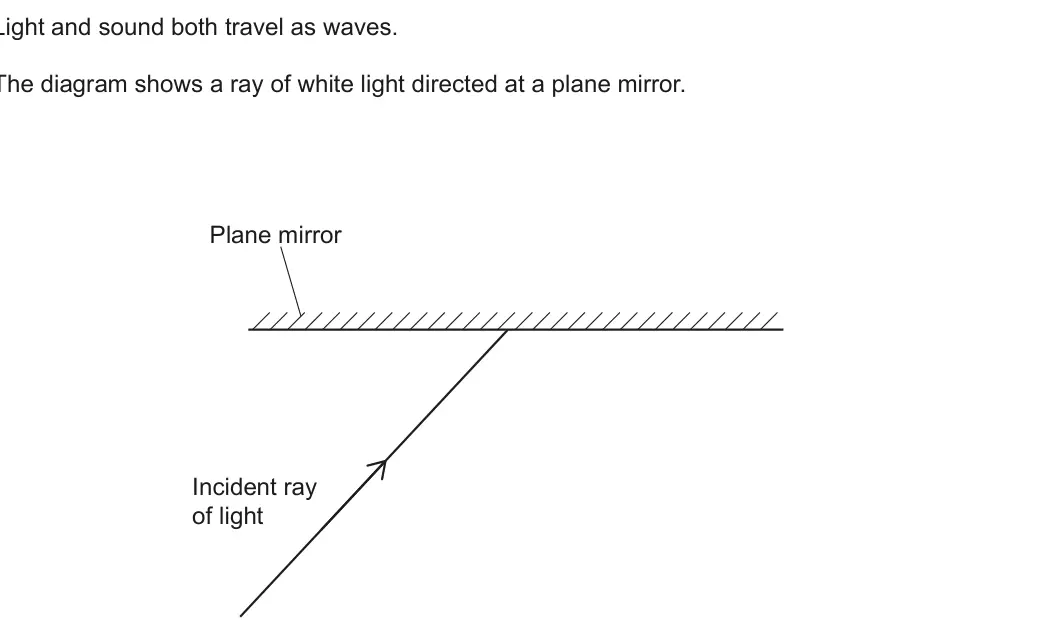
Q4(d)
The whole paper ↗Q4(e)
The whole paper ↗Q2(a)
The whole paper ↗
Q2(b)
The whole paper ↗Q2(c)
The whole paper ↗Q4(a)(i)
The whole paper ↗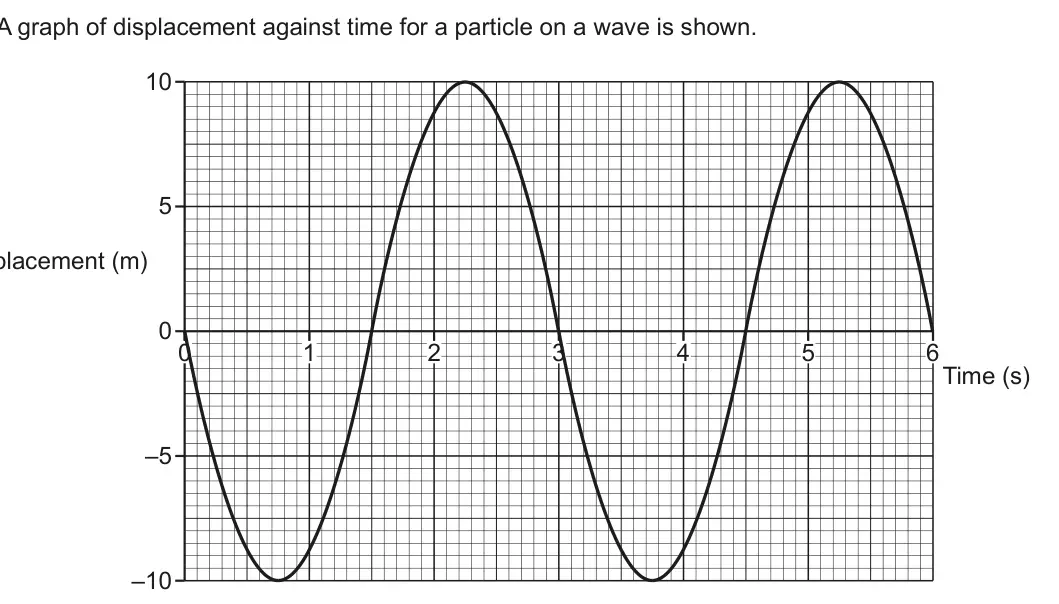
Q4(a)(ii)
The whole paper ↗Q4(a)(iii)
The whole paper ↗Q4(a)(iv)
The whole paper ↗Q4(b)
The whole paper ↗Q4(c)
The whole paper ↗
All 94 questions on How do waves behave?, as a list
- June 2025, Paper 1 Foundation, Q3(a)(i) (1 mark): Which letter, A, B, C or D, shows the wavelength of the wave? [1]
- June 2025, Paper 1 Foundation, Q3(a)(ii) (1 mark): Which letter, A, B, C or D, shows the amplitude of the wave? [1]
- June 2025, Paper 1 Foundation, Q3(a)(iii) (1 mark): Which property of a wave gives the time it takes to complete one full cycle? Tick (✓) one box. Frequency Period Speed Wavelength [1]
- June 2025, Paper 1 Foundation, Q3(c) (3 marks): A laser produces a beam of red light. The wave speed of the red light is 3.0 × 10⁸ m / s. The wavelength of the red light is 750 × 10–9 m. Calculate the frequen
- June 2025, Paper 2 Foundation, Q3(a)(i) (2 marks): Which statements about sound waves are true? Tick (✓) two boxes. Sound waves can only travel in air. Sound waves transfer energy. Sound waves travel at the same
- June 2025, Paper 2 Foundation, Q3(a)(ii) (2 marks): Which statements about longitudinal waves are true? Tick (✓) two boxes. Longitudinal waves are a series of compressions. Longitudinal waves can travel in space.
- June 2025, Paper 2 Foundation, Q3(b) (4 marks): A student does an experiment to calculate the speed of a water wave. They fill a tray with water and take measurements of a wave travelling across the water. Th
- June 2025, Paper 2 Foundation, Q3(c) (6 marks): This question is about waves. (c)* Describe a method for finding the speed of sound in air. Include in your answer: • the apparatus used • possible sources of e
- June 2025, Paper 3 Higher, Q4(b) (2 marks): Which two of these words can be used to describe light waves? Tick (✓) two boxes. Compression Electromagnetic Longitudinal Radioactive Seismic Transverse [2]
- June 2025, Paper 3 Higher, Q4(d) (3 marks): An orange light wave has a frequency of 5.0 × 10¹⁴ Hz. Its wavelength in the glass prism is 400 × 10–9 m. Calculate the speed of the wave in the glass prism. Us
- June 2025, Paper 3 Higher, Q4(e) (3 marks): D raw lines to connect each medium a sound wave is travelling in with its correct speed. Medium Speed of sound wave Air 0 m / s Steel 330 m / s Vacuum 1500 m /
- June 2024, Paper 1 Foundation, Q2(a) (1 mark): Which length, A, B or C, on the diagram represents the wavelength of the wave? Displacement A C Distance B [1]
- June 2024, Paper 1 Foundation, Q2(b) (1 mark): Which wave has the greatest amplitude? Tick (3) one box. 4 Displacement (mm) Distance (mm) 1 2 – 4 4 Displacement (mm) Distance (mm) 1 2 – 4 4 Displacement (mm)
- June 2024, Paper 1 Foundation, Q2(c) (3 marks): Some waves are formed on the surface of water. In 2 seconds, 7 waves pass a point. Calculate the frequency of the wave. Give the unit. Frequency = Unit [3]
- June 2024, Paper 2 Foundation, Q4(a)(i) (1 mark): State the amplitude of the wave. m [1]
- June 2024, Paper 2 Foundation, Q4(a)(ii) (1 mark): State the number of wavelengths shown. [1]
- June 2024, Paper 2 Foundation, Q4(a)(iii) (1 mark): State the period for the wave. s [1]
- June 2024, Paper 2 Foundation, Q4(a)(iv) (1 mark): Calculate the frequency of the wave. 1 Use the equation: frequency = period Frequency of the wave = Hz [1]
- June 2024, Paper 2 Foundation, Q4(b) (1 mark): A wave travels at a constant speed. Complete the sentence to describe the relationship between the frequency and wavelength of the wave. Put a ring around the c
- June 2024, Paper 2 Foundation, Q4(c) (3 marks): Another wave has a wavelength of 2 cm and a frequency of 7.5 Hz. Calculate the speed of this wave, in cm / s. Use the Equation Sheet. Wave speed = cm / s [3]
- June 2024, Paper 3 Higher, Q4(a) (2 marks): Describe a transverse wave. [2]
- June 2024, Paper 3 Higher, Q4(b) (2 marks): The signal strength on a mobile device is shown by the symbols below. Good signal strength means that the microwaves have a high amplitude. Define the amplitude
- June 2024, Paper 3 Higher, Q4(c) (1 mark): The graph of a microwave signal is drawn with time on the x-axis. The wave has a time period of 0.3 ns. Which is the correct graph for this wave? Tick (3) one b
- June 2023, Paper 1 Foundation, Q5(a) (1 mark): The speed of the sound wave in the metal rails is 3300 m / s. Write down the distance the sound wave travels through the metal rails in 1 second. Distance = m [
- June 2023, Paper 1 Foundation, Q5(b) (3 marks): The frequency of the sound wave in the metal rails is 110 Hz. Calculate the wavelength of the sound wave in the metal rails. Use the equation: wave speed = freq
- June 2023, Paper 1 Foundation, Q5(c)(i) (1 mark): Calculate the speed of the sound wave in the air. Speed = m / s [1]
- June 2023, Paper 1 Foundation, Q5(c)(ii) (1 mark): Complete the sentence about the wavelength of the sound wave in the air. Put a ring around the correct option. The sound wave in the air has a longer / a shorte
- June 2023, Paper 1 Foundation, Q11(a) (1 mark): Which row gives the correct definitions of wavelength and frequency? Tick (3) one box. Wavelength Frequency The distance a wave travels in 1 second. The number
- June 2023, Paper 1 Foundation, Q11(b)(i) (1 mark): The student takes a photograph of the wave pattern. State one piece of equipment which needs to be included in the photograph to find the wavelength of the wate
- June 2023, Paper 1 Foundation, Q11(b)(ii) (2 marks): The student then uses a smart phone to record a video of the movement of the water waves for a few seconds. Describe how the student could use a video to find t
- June 2023, Paper 1 Foundation, Q11(b)(iii) (1 mark): How can the student now calculate the speed of the water waves? [1]
- June 2023, Paper 3 Higher, Q2(a) (1 mark): Which row gives the correct definitions of wavelength and frequency? Tick (3) one box. Wavelength Frequency The distance a wave travels in 1 second. The number
- June 2023, Paper 3 Higher, Q2(b)(i) (1 mark): The student takes a photograph of the wave pattern. State one piece of equipment which needs to be included in the photograph to find the wavelength of the wate
- June 2023, Paper 3 Higher, Q2(b)(ii) (2 marks): The student then uses a smart phone to record a video of the movement of the water waves for a few seconds. Describe how the student could use a video to find t
- June 2023, Paper 3 Higher, Q2(b)(iii) (1 mark): How can the student now calculate the speed of the water waves? [1]
- June 2023, Paper 3 Higher, Q6(a) (2 marks): Ben records his observations from two wave demonstrations. Sound Waves When a can is sprayed, we hear it across the classroom 0.1 s later. We can smell it 30 s
- June 2023, Paper 3 Higher, Q6(b)(i) (1 mark): State the amplitude of this wave. Amplitude = m [1]
- June 2023, Paper 3 Higher, Q6(b)(ii) (1 mark): State the wavelength of this wave. Wavelength = m [1]
- June 2023, Paper 3 Higher, Q6(b)(iii) (1 mark): The student makes 10 waves in 20 seconds. State the time period of this wave. Time period = s [1]
- June 2023, Paper 3 Higher, Q6(c) (2 marks): Describe how waves on a rope are an example of transverse waves. [2]
- June 2022, Paper 3 Higher, Q11(a) (1 mark): Use Fig. 11.1 to determine the frequency at which the human ear is most sensitive. Frequency = kHz [1]
- June 2022, Paper 3 Higher, Q11(c) (2 marks): Eve’s hearing is tested and is typical for the human ear. Describe how the loudness of the sound she hears changes when she listens to a sound, with constant am
- November 2021, Paper 1 Foundation, Q3(a) (2 marks): The amplitude is 80 cm. The wavelength is 6 m. Beth’s description of the wave is incorrect. State the correct amplitude and wavelength. The amplitude is cm. The
- November 2021, Paper 1 Foundation, Q3(b) (1 mark): Kareem moves his hand up and down to make 2 waves every second. What is the frequency of the wave? Put a ring around the correct answer. 0.5 Hz 0.5 s 2.0 Hz 2.0
- November 2021, Paper 1 Foundation, Q3(c)(i) (2 marks): Describe how the waves on the rope are an example of transverse waves. [2]
- November 2021, Paper 1 Foundation, Q3(c)(ii) (1 mark): How are sound waves in air different to the waves on the rope? [1]
- November 2021, Paper 1 Foundation, Q14(b) (3 marks): The frequency of electromagnetic radiation emitted from caesium atoms is 9.19 × 10⁹ Hz. Calculate the wavelength of this radiation. Speed of light = 3.0 × 10⁸ m
- November 2021, Paper 2 Foundation, Q8(a)(i) (3 marks): Describe how Sarah can accurately measure the wavelength of the wave. Include an accurate measurement of the wavelength in your answer. [3]
- November 2021, Paper 2 Foundation, Q8(a)(ii) (3 marks): Describe how Sarah can calculate the speed of the wave. Include in your answer any equipment and equations that she would need to use. [3]
- November 2021, Paper 2 Foundation, Q8(b)(i) (3 marks): Plot a graph of the results from the table. Use an appropriate scale and draw a line of best fit. [3] 0.25 0.20 0.15 Wavelength (m) 0.10 0.05 0 Depth of water (
- November 2021, Paper 2 Foundation, Q8(b)(ii) (2 marks): Sarah concludes The wavelength increases with the depth of water but the relationship is not proportional. Is Sarah correct? Yes No Use data from the table to e
- November 2021, Paper 3 Higher, Q3(b) (3 marks): The frequency of electromagnetic radiation emitted from caesium atoms is 9.19 × 10⁹ Hz. Calculate the wavelength of this radiation. Speed of light = 3.0 × 10⁸ m
- November 2021, Paper 3 Higher, Q4(b)(i) (3 marks): The radio waves emitted by Voyager 1 have a wavelength of approximately 14 cm. The distance between the Earth and Voyager 1 is approximately 2 × 10¹⁰ km. Estima
- November 2021, Paper 3 Higher, Q4(b)(ii) (2 marks): Define the wavelength of a radio wave. You can draw a diagram to support your answer. [2]
- November 2021, Paper 4 Higher, Q9(d)(i) (1 mark): Describe the motion of the particles in a soundwave. [1]
- November 2020, Paper 1 Foundation, Q3(a) (2 marks): The ripples on the surface of the water in the ripple tank are an example of transverse waves. Describe the difference between transverse and longitudinal waves
- November 2020, Paper 1 Foundation, Q3(b)(i) (2 marks): The ruler next to the ripple tank is 0.30 m long. The ruler is the same length as 6 of the waves. Calculate the wavelength of the waves. Wavelength = m [2]
- November 2020, Paper 1 Foundation, Q3(b)(ii) (1 mark): Suggest how Jane could use a stopwatch to measure the frequency of the waves in the ripple tank. [1]
- November 2020, Paper 1 Foundation, Q3(c) (2 marks): Ben measures the wavelength of the waves to be 0.08 m. The frequency of the waves is 3.0Hz. Calculate the speed of the waves that Ben measures. Use the equation
- November 2020, Paper 1 Foundation, Q3(d) (2 marks): Jane and Ben talk about the experiment. Jane I think that it is only the waves that travel along the tank, not the water itself. Ben I think that the water trav
- November 2020, Paper 1 Foundation, Q9(a) (2 marks): Calculate the speed of sound for Attempt 5. Use the equation: speed = distance + time Speed = m/s [2]
- November 2020, Paper 1 Foundation, Q9(b)(i) (1 mark): State why the data in Table 9.1 is inaccurate. [1]
- November 2020, Paper 1 Foundation, Q9(b)(ii) (1 mark): State why the data in Table 9.1 is imprecise. [1]
- November 2020, Paper 1 Foundation, Q9(c)(i) (1 mark): Describe one improvement to the method. [1]
- November 2020, Paper 1 Foundation, Q9(c)(ii) (1 mark): State how your improvement in (c)(i) will produce better data. [1]
- November 2020, Paper 2 Foundation, Q7 (6 marks): 7* Sarah is investigating how to measure the speed of sound, and knows that sound is produced when there is a lightning flash during a thunder storm. Sarah It t
- November 2020, Paper 3 Higher, Q8(a)(i) (3 marks): Describe how to accurately determine the speed of the waves. You should include in your answer how accurate measurements can be obtained from the apparatus used
- November 2020, Paper 3 Higher, Q8(a)(ii) (1 mark): Amaya finds that she gets a different result every time she repeats the measurements. She thinks this is because her method makes slightly different waves every
- November 2020, Paper 3 Higher, Q8(b)(i) (1 mark): Plot the missing point on the graph. [1]
- November 2020, Paper 3 Higher, Q8(b)(ii) (2 marks): Describe two key features of the pattern shown by the data. [2]
- November 2020, Paper 3 Higher, Q8(b)(iii) (2 marks): Estimate the speed of waves in a depth of water of 0.5 cm. Show your working on the graph. Speed = m / s [2]
- November 2020, Paper 3 Higher, Q10(a) (2 marks): Compare the vibration of particles in P-waves and S-waves. [2]
- November 2020, Paper 4 Higher, Q10(a)(ii) (5 marks): When Ben's mobile phone is connected to the loudspeaker it produces a sound which has a wavelength of 24 cm. Calculate the frequency of the sound produced. Give
- June 2019, Paper 1 Foundation, Q6(a) (2 marks): Calculate the wavelength of the wave shown in Fig 6.2. Give your answer to 3 significant figures. Wavelength = cm [2]
- June 2019, Paper 1 Foundation, Q6(b)(i) (2 marks): Explain how Fig. 6.2 shows that the wave is a transverse wave. [2]
- June 2019, Paper 1 Foundation, Q6(b)(ii) (2 marks): Explain how the sound waves produced by the violin are different to the waves on the string. [2]
- June 2019, Paper 2 Foundation, Q3(c) (3 marks): Green light has wavelength 5.6 × 10⁻⁷ m and frequency 5.4 × 10¹⁴ Hz. Calculate the wave speed of the green light. Use the equation: wave speed = frequency × wav
- June 2019, Paper 3 Higher, Q8(b)(i) (3 marks): Use the data to calculate the typical frequency of X-rays. Frequency = Hz [3]
- June 2019, Paper 4 Higher, Q5(a) (3 marks): Describe what happens to the speed, frequency and wavelength of the ultrasound wave as it travels from air to skin. Speed: Frequency: Wavelength: [3]
- June 2018, Paper 1 Foundation, Q1(a) (1 mark): He can hear a musical instrument playing a steady note. What type of wave is the sound that Jamal hears? Put a ring around the correct answer. electromagnetic l
- June 2018, Paper 1 Foundation, Q1(b) (2 marks): The sound waves that Jamal hears have a frequency of 400 Hz and a wavelength of 0.84 m. Calculate the speed of the sound waves. Use the equation: wave speed = f
- June 2018, Paper 2 Foundation, Q1(a)(i) (1 mark): What time was the sound of the clap recorded? Time = seconds [1]
- June 2018, Paper 2 Foundation, Q1(a)(ii) (1 mark): What time was the sound of the echo recorded? Time = seconds [1]
- June 2018, Paper 2 Foundation, Q1(a)(iii) (1 mark): Calculate the time of travel for the sound wave to go from Eve to the wall and to return to the computer. Time of travel = seconds [1]
- June 2018, Paper 2 Foundation, Q1(b) (2 marks): The distance from Eve to the reflecting wall is 64 m. Explain how you can use the distance, together with a time from part (a), to calculate the speed of sound.
- June 2018, Paper 2 Foundation, Q1(c) (2 marks): Isaac Newton’s value for the speed of sound was less accurate than the one given by this method. Suggest and explain why Newton could not get an accurate answer
- June 2018, Paper 2 Foundation, Q2(b)(i) (2 marks): The waves were produced at a frequency of 2.5 hertz (Hz). Calculate the speed of the waves in the deeper water. Use the equation: wave speed = frequency × wavel
- June 2018, Paper 3 Higher, Q5(a) (2 marks): How do the speed, frequency and wavelength of the sound waves change when they leave the air and enter the string? Put one tick (✓) in each row. One has been do
- June 2018, Paper 3 Higher, Q5(b) (3 marks): The speed of sound in the string is 600 m / s. Calculate the frequency of a sound with wavelength 1.2 m in the string. Frequency = Hz [3]
- June 2018, Paper 3 Higher, Q6(c) (3 marks): Mia reads on the internet that the human ear is most sensitive at a frequency about 2000 Hz. Describe how James and Mia could improve their experiment to test t
- June 2018, Paper 4 Higher, Q4(a)(i) (3 marks): Newton showed that the time of one swing, T, was given by the equation: T 2 = kL L = the length of the pendulum k = 4.02 s2/m. Calculate the swing time T of his
- June 2018, Paper 4 Higher, Q4(a)(ii) (3 marks): Use Newton’s data to calculate the speed of sound. Distance to wall = 64 m Speed of sound = m/s [3]
- June 2018, Paper 4 Higher, Q4(b)(i) (1 mark): Explain which of Newton’s measurements (distance or time) was likely to be the least accurate. [1]
- June 2018, Paper 4 Higher, Q4(b)(ii) (2 marks): Explain why Newton’s value for the speed was too low. [2]
Questions, mark schemes and examiner’s reports are © OCR, from their published past papers. Plumi isn’t affiliated with any exam board. Want whole papers? Every OCR GCSE Physics B paper.
Rather write your answers by hand on iPad? Plumi marks them against the same mark schemes.