 plumi
How much energy do we use?: OCR GCSE Physics B questions
Every OCR GCSE Physics B exam question on P2.1 How much energy do we use?, 2018–2025, with its mark scheme and examiner’s report.
Paper
All papers
Exam
All years
Calculations
Q2(a)
The whole paper ↗
Q2(b)(i)
The whole paper ↗Q2(b)(ii)
The whole paper ↗Q2(c)
The whole paper ↗Q2(d)
The whole paper ↗Q2(e)(i)
The whole paper ↗Q2(e)(ii)
The whole paper ↗Q4(a)
The whole paper ↗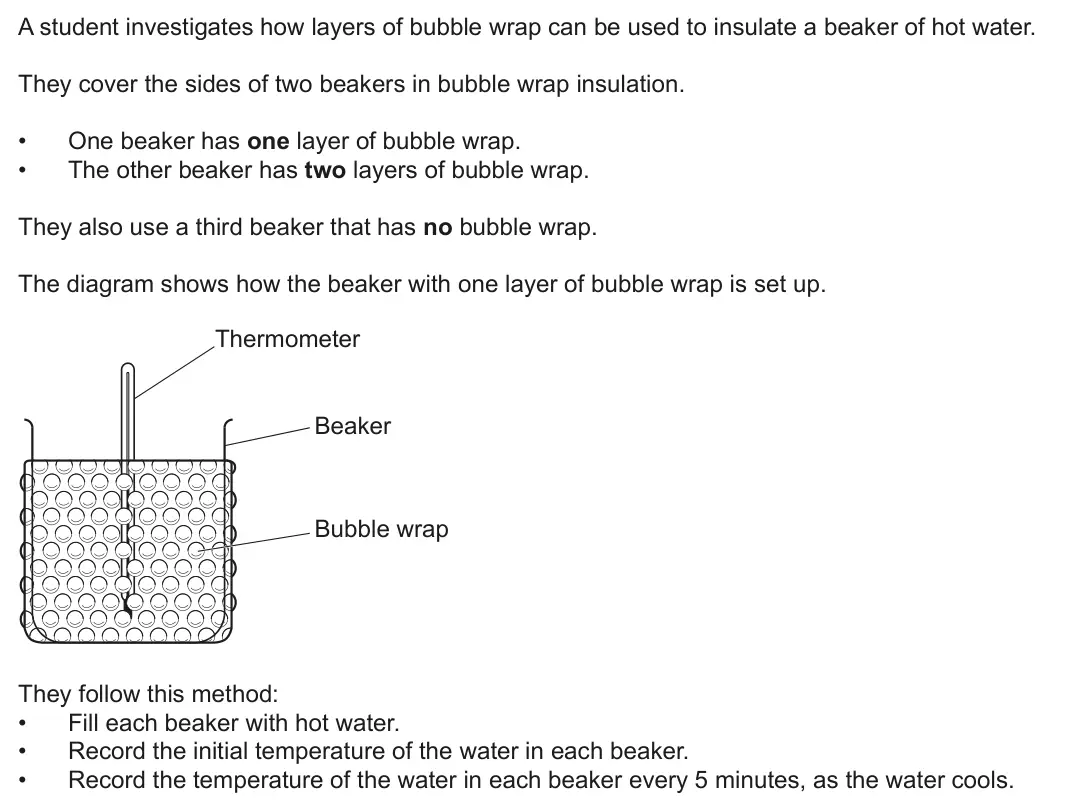
Q4(b)
The whole paper ↗Q4(c)
The whole paper ↗Q4(a)(i)
The whole paper ↗
Q4(a)(ii)
The whole paper ↗Q4(b)(i)
The whole paper ↗Q4(b)(ii)
The whole paper ↗Q4(b)(iii)
The whole paper ↗Q4(b)(iv)
The whole paper ↗Q3(a)
The whole paper ↗
Q3(d)
The whole paper ↗Q3(e)
The whole paper ↗Q7(b)
The whole paper ↗
All 107 questions on How much energy do we use?, as a list
- June 2025, Paper 1 Foundation, Q2(a) (1 mark): What is the useful output energy store of a kettle? Tick (✓) one box. Gravitational Magnetic Nuclear Thermal [1]
- June 2025, Paper 1 Foundation, Q2(b)(i) (1 mark): Which piece of information gives the power rating of the mains electric kettle? Tick (✓) one box. 10 A 230 V 2000 W [1]
- June 2025, Paper 1 Foundation, Q2(b)(ii) (2 marks): Both kettles are used to boil the same volume of water. Complete the sentence to explain the time taken for each kettle. Use words from the list. energy frequen
- June 2025, Paper 1 Foundation, Q2(c) (2 marks): Hot water is poured from a kettle into an insulated flask. The water fills the flask. The lid is screwed on. The diagram shows a cross-section through the flask
- June 2025, Paper 1 Foundation, Q2(d) (1 mark): Some household appliances are operated for a longer time than a kettle. Which of these is the correct calculation to find the energy transferred, in kWh, when a
- June 2025, Paper 1 Foundation, Q2(e)(i) (2 marks): Complete the sentences to describe the energy transfer of the appliances. Put a ring around each correct option. The wasted energy store of the desk fan is elec
- June 2025, Paper 1 Foundation, Q2(e)(ii) (2 marks): All the appliances in the table are used for different amounts of time per day, but they each transfer 0.5 kWh of energy per day. Calculate the average time use
- June 2025, Paper 2 Foundation, Q4(a) (2 marks): Suggest two variables that the student needs to control. 1 2 [2]
- June 2025, Paper 2 Foundation, Q4(b) (2 marks): The graph shows how the temperature changes with time for the three beakers. Key: Beaker with two layers of bubble wrap Beaker with one layer of bubble wrap Bea
- June 2025, Paper 2 Foundation, Q4(c) (1 mark): Suggest one improvement that the student can make to their investigation. [1]
- June 2025, Paper 4 Higher, Q4(a)(i) (2 marks): State two variables that need to be controlled in this experiment. 1 2 [2]
- June 2025, Paper 4 Higher, Q4(a)(ii) (1 mark): Explain why putting a lid on the beakers will make the water stay warmer for longer. [1]
- June 2025, Paper 4 Higher, Q4(b)(i) (1 mark): Describe how the number of layers of bubble wrap affects the change in temperature over the 25 minutes. [1]
- June 2025, Paper 4 Higher, Q4(b)(ii) (1 mark): How does the rate of change in temperature of the water in each beaker change over the 25 minutes? Use the graph. Tick (✓) one box. Decreases Increases Stays th
- June 2025, Paper 4 Higher, Q4(b)(iii) (1 mark): Explain how the graph shows this. [1]
- June 2025, Paper 4 Higher, Q4(b)(iv) (1 mark): The student repeats the experiment with a different material for the insulation. This new material has the same thickness but a greater thermal conductivity in
- June 2024, Paper 1 Foundation, Q3(a) (1 mark): A petrol generator provides electricity for the ride. How is the useful energy stored in petrol? Tick (3) one box. Chemical store Electromagnetic store Electros
- June 2024, Paper 1 Foundation, Q3(d) (1 mark): The pulley lifts the carriage and riders at a power of 15 000 W. What is the definition of power? Tick (3) one box. The energy transferred in 10 seconds. The he
- June 2024, Paper 1 Foundation, Q3(e) (4 marks): The carriage has brakes to slow it down before it stops at the bottom. The brakes transfer 20 kJ of energy during a 2 s time period. Calculate the power of the
- June 2024, Paper 1 Foundation, Q7(b) (3 marks): Transformers get hot. The thermal energy store from large transformers in the National Grid can be used to provide heating for nearby homes. This is known as a
- June 2024, Paper 2 Foundation, Q6(c)(i) (2 marks): It takes 8 hours to fully charge the battery in the electric car using a 7 kW power source. Calculate the energy transferred to the battery. Use the equation: e
- June 2024, Paper 2 Foundation, Q6(c)(ii) (2 marks): The cost of the energy supplied by electricity is 34p per kWh. Calculate the cost to fully charge the battery. Give your answer in pounds. Use your answer from
- June 2024, Paper 2 Foundation, Q9(a) (3 marks): Sasha closes the switch and holds the hand warmer. Describe the transfer between energy stores when the switch is closed. [3]
- June 2024, Paper 3 Higher, Q5(c) (3 marks): The table shows information for two types of lamp which have the same brightness. Type Lifetime in h Energy transferred in one lifetime, in kWh LED 24 000 432 H
- June 2024, Paper 3 Higher, Q6(a) (4 marks): The ride takes 30 s to get to the top of the tower. The pulley operates at a power of 40 kW. Calculate the energy transferred by the pulley. Use the Equation Sh
- June 2024, Paper 4 Higher, Q5(b)(i) (4 marks): Zayn has a 7 kW car charger. Calculate the time it would take to charge the battery. Use the equation: energy transferred = power × time Give your answer to 2 s
- June 2024, Paper 4 Higher, Q5(b)(ii) (3 marks): Zayn completes a 420 km journey using all the energy stored in the fully charged battery. Sara completes the same journey in a petrol car. The petrol car uses 3
- June 2023, Paper 1 Foundation, Q1(c)(i) (1 mark): Calculate the total energy wasted every hour. Wasted energy = MJ [1]
- June 2023, Paper 1 Foundation, Q1(c)(ii) (1 mark): Suggest how to reduce the unwanted energy transfer due to friction as the turbine rotates. [1]
- June 2023, Paper 1 Foundation, Q1(d) (2 marks): Calculate the power output of the hydroelectric power station. Use: the equation: power = energy transferred • time • the data in the Sankey diagram • the infor
- June 2023, Paper 3 Higher, Q5(a)(i) (1 mark): Describe how the Sankey diagram shows that all the energy transfers to and from the mixer are a closed system. [1]
- June 2023, Paper 3 Higher, Q5(a)(ii) (1 mark): Calculate the power wasted when the mixer is in use. Power = W [1]
- June 2023, Paper 3 Higher, Q5(b) (2 marks): A cook makes two cakes, using a different mixer for each one. The mixers and their power ratings are shown in the two images. 200 W hand mixer 600 W stand mixer
- June 2022, Paper 1 Foundation, Q1(a)(i) (1 mark): What is the energy store of the battery? Tick (✓) one box. Chemical Electrical Nuclear Thermal [1]
- June 2022, Paper 1 Foundation, Q1(a)(ii) (1 mark): How is energy transferred from the battery to the motor? Tick (✓) one box. By heating By radiation Electrically Mechanically [1]
- June 2022, Paper 1 Foundation, Q1(b)(ii) (2 marks): Layla repeats the experiment. She measures the power three times in total. Her three measurements are: 13 W 17 W 12 W Calculate the mean (average) power. Mean p
- June 2022, Paper 1 Foundation, Q1(c) (1 mark): Layla’s teacher says that the motor transfers too much energy to thermal energy. How could Layla reduce this unwanted energy transfer? Tick (✓) one box. Use a h
- June 2022, Paper 1 Foundation, Q6(a) (2 marks): When the shaver is switched on, energy is transferred. Which two statements correctly describe changes in the energy stores when the shaver is switched on? Tick
- June 2022, Paper 2 Foundation, Q3(b)(i) (1 mark): Calculate how much energy the solar panel transfers to the surroundings. Energy transferred to surroundings = J [1]
- June 2022, Paper 2 Foundation, Q3(b)(ii) (1 mark): Kareem draws an outline of a Sankey diagram for this solar panel. Total energy transferred from the Sun Complete the Sankey diagram for this solar panel. [1]
- June 2022, Paper 2 Foundation, Q3(b)(iii) (2 marks): Calculate the efficiency of the solar panel. Use the equation: efficiency = useful energy transferred ÷ total energy transferred Efficiency = [2]
- June 2022, Paper 3 Higher, Q5(a)(ii) (3 marks): Calculate the efficiency of the motor when lifting the weight. Use the Data Sheet. Efficiency = % [3]
- June 2022, Paper 3 Higher, Q5(b)(i) (2 marks): Explain why Alex is wrong. [2]
- June 2022, Paper 3 Higher, Q5(b)(ii) (1 mark): Suggest a better method to increase the efficiency of the energy transfer. [1]
- June 2022, Paper 3 Higher, Q10(a) (2 marks): Describe the changes in stored energy when the shaver is switched on. [2]
- June 2022, Paper 4 Higher, Q5(a)(iii) (2 marks): Calculate the efficiency of Alex to get to the top of the hill. Use the equation: efficiency = useful energy transferred ÷ total energy transferred Efficiency =
- June 2022, Paper 4 Higher, Q5(d) (3 marks): Alex says ‘If I cycle more slowly, I will use less power to reach the top of the hill’. Explain why Alex is correct. [3]
- June 2022, Paper 4 Higher, Q9(a)(i) (3 marks): Calculate the power output when the current is 2.0 A. Use the equation: power = work done ÷ time Use the Data Sheet. Power output = W [3]
- June 2022, Paper 4 Higher, Q9(a)(ii) (2 marks): Plot the power output against the current on the graph. 12.0 10.0 Power output 8.0 (W) 6.0 4.0 2.0 0 0 0.5 1.0 1.5 2.0 Current (A) [2]
- June 2022, Paper 4 Higher, Q9(c) (2 marks): Write a conclusion that Kai can make about the electric motor. Use data from the graph to support your answer. [2]
- November 2021, Paper 1 Foundation, Q7(c)(i) (1 mark): Explain what is meant by the power of the conveyor system. [1]
- November 2021, Paper 1 Foundation, Q7(c)(ii) (1 mark): Suggest how a higher power conveyor system could help Kai lift bricks up to the roof of a house. [1]
- November 2021, Paper 1 Foundation, Q9(c) (3 marks): A typical nuclear power station has a useful power output of 1600 MW. The total power input is 4000 MW. Calculate the efficiency of a typical nuclear power stat
- November 2021, Paper 2 Foundation, Q10(a) (4 marks): Identify two sources of error in Kai’s experiment, and describe how each error can be reduced. Error 1 How to reduce error 1 Error 2 How to reduce error 2 [4]
- November 2021, Paper 2 Foundation, Q10(b)(i) (2 marks): Complete the table. Use the equation: power = energy ÷ time [2]
- November 2021, Paper 2 Foundation, Q10(b)(ii) (3 marks): Kai makes a hypothesis. Kai When the distance doubles the efficiency of the solar panel halves. Explain why Kai’s hypothesis is incorrect. Use calculations to s
- November 2021, Paper 2 Foundation, Q11(a)(i) (2 marks): The electric car has a power of 80 kW. Define power, with reference to the energy store of the car’s battery. [2]
- November 2021, Paper 2 Foundation, Q11(a)(ii) (2 marks): Work is done when electric current passes from the battery to the motor, but some energy is wasted. Describe how this energy is wasted and where this energy is
- November 2021, Paper 2 Foundation, Q11(b)(i) (2 marks): 1 kWh of electricity costs 16p. Calculate the cost of fully charging the car, in £. Cost = £ [2]
- November 2021, Paper 2 Foundation, Q11(b)(ii) (2 marks): Calculate the time taken, in hours, to fully charge the battery using a 7 kW charger. Use the equation: power = energy ÷ time Time = hours [2]
- November 2021, Paper 2 Foundation, Q11(b)(iii) (2 marks): The manufacturer claims the car uses 1 kWh of energy to travel 6 km. When the battery is fully charged Amir travels 220 km before the charge on the battery runs
- November 2021, Paper 2 Foundation, Q11(c) (2 marks): Amir makes a hypothesis about the performance of the car’s battery. Travelling with more passengers in the car would cause the battery to discharge more quickly
- November 2021, Paper 3 Higher, Q5(c) (4 marks): The efficiency of the hydroelectric power station is 75%. On one occasion, the hydroelectric power station has an output power of 140 MW for a time of 1 hour. C
- November 2021, Paper 4 Higher, Q1(a)(i) (2 marks): The electric car has a power of 80 kW. Define power, with reference to the energy store of the car’s battery. [2]
- November 2021, Paper 4 Higher, Q1(a)(ii) (2 marks): Work is done when electric current passes from the battery to the motor, but some energy is wasted. Describe how this energy is wasted and where this energy is
- November 2021, Paper 4 Higher, Q1(b)(i) (2 marks): 1 kWh of electricity costs 16p. Calculate the cost of fully charging the car, in £. Cost = £ [2]
- November 2021, Paper 4 Higher, Q1(b)(ii) (2 marks): Calculate the time taken, in hours, to fully charge the battery using a 7 kW charger. Use the equation: power = energy ÷ time Time = hours [2]
- November 2021, Paper 4 Higher, Q1(b)(iii) (2 marks): The manufacturer claims the car uses 1 kWh of energy to travel 6 km. When the battery is fully charged Amir travels 220 km before the charge on the battery runs
- November 2021, Paper 4 Higher, Q1(c) (2 marks): Amir makes a hypothesis about the performance of the car’s battery. Travelling with more passengers in the car would cause the battery to discharge more quickly
- November 2020, Paper 1 Foundation, Q4(a)(ii) (1 mark): Name the form of stored energy in a battery. [1]
- November 2020, Paper 1 Foundation, Q4(b) (2 marks): Vacuum cleaner B runs out of battery after two hours. Describe what has happened to the energy which was stored in the battery. [2]
- November 2020, Paper 1 Foundation, Q4(d)(i) (3 marks): Calculate the energy transferred by vacuum cleaner A when it is operated for 600 seconds. Energy transferred = J [3]
- November 2020, Paper 1 Foundation, Q4(d)(ii) (2 marks): When both vacuum cleaners are operated for 600 seconds, vacuum cleaner A transfers more energy. Explain why. [2]
- November 2020, Paper 1 Foundation, Q6(a) (1 mark): Calculate the wasted energy output. Wasted energy output = J [1]
- November 2020, Paper 1 Foundation, Q6(b) (3 marks): Calculate the efficiency of the car. Use values from the Sankey diagram. Use the equation: efficiency = useful energy transferred ÷ total energy transferred Giv
- November 2020, Paper 1 Foundation, Q11(a) (2 marks): Predict which experiment will cool down the slowest. Explain your answer. Experiment: Explanation: [2]
- November 2020, Paper 1 Foundation, Q11(b)(i) (2 marks): Explain the meaning of the word reproducible. [2]
- November 2020, Paper 1 Foundation, Q11(b)(ii) (1 mark): Give one piece of additional information that you would need to reproduce Amir’s experiment. [1]
- November 2020, Paper 2 Foundation, Q11(b) (4 marks): Calculate the total energy supplied by the kettle. Use the equation: energy = power x time Energy = ..J [4]
- November 2020, Paper 2 Foundation, Q11(c)(i) (2 marks): Calculate the efficiency of the kettle. Use your answer to (b). Use the equation: efficiency = useful energy transferred ÷ total energy transferred Efficiency =
- November 2020, Paper 2 Foundation, Q11(d)(i) (1 mark): Suggest why the energy supplied by the 2.4 kW kettle is more than the energy transferred to the 1 kg of water. [1]
- November 2020, Paper 3 Higher, Q1(a) (2 marks): Predict which experiment will cool down the slowest. Explain your answer. Experiment: Explanation: [2]
- November 2020, Paper 3 Higher, Q1(b)(i) (2 marks): Explain the meaning of the word reproducible. [2]
- November 2020, Paper 3 Higher, Q1(b)(ii) (1 mark): Give one piece of additional information that you would need to reproduce Amir’s experiment. [1]
- June 2019, Paper 1 Foundation, Q8(b)(i) (3 marks): Calculate the efficiency of charger B. Give your answer as a percentage. Efficiency = % [3]
- June 2019, Paper 1 Foundation, Q8(b)(ii) (2 marks): Suggest which charger Layla should buy. Justify your answer using the data from the table. [2]
- June 2019, Paper 2 Foundation, Q2(a)(iii) (1 mark): The power of the kettle is 2000 W. How many joules of energy are transferred by the kettle in a time of 1 second? Energy = J [1]
- June 2019, Paper 2 Foundation, Q2(b)(i) (3 marks): Calculate the total energy, in kilowatt hours (kW h), transferred by kettle A during its lifetime. Use the equation: energy transferred = power × time Total ene
- June 2019, Paper 2 Foundation, Q2(b)(ii) (2 marks): Which kettle, A, B or C, will take the longest time to boil one litre of water? Give one reason for your answer. Kettle Reason [2]
- June 2019, Paper 3 Higher, Q1(b) (2 marks): Explain why the ice cubes take different times to melt on different materials. [2]
- June 2019, Paper 3 Higher, Q1(c)(i) (2 marks): Suggest improvements to the experiment to solve each of these problems. Amir’s problem Nina’s problem [2]
- June 2019, Paper 3 Higher, Q1(c)(ii) (1 mark): Amir wants to speed up the experiment so it can be repeated more quickly. Suggest one way he can change the experiment so that the ice melts more quickly, witho
- June 2019, Paper 3 Higher, Q9(b) (3 marks): The table shows the results of Jane’s experiment. Cell Maximum power (W) X 25 Y 32 Ben Cell X is the most effective because it has the greatest maximum power. J
- June 2019, Paper 3 Higher, Q12(a)(ii) (3 marks): Calculate the total power supplied for a twistron to transfer a useful output power of 10 W. Give your answer to 2 significant figures. Total power = W [3]
- June 2019, Paper 4 Higher, Q6(a) (2 marks): Kareem makes the following comment about the information in Table 6.1 to his grandad. Kareem LED bulbs are the best for you grandad. They save the environment a
- June 2019, Paper 4 Higher, Q6(b) (2 marks): Calculate the number of incandescent bulbs that would be required to do the same job as a single LED bulb, in 50 000 hours. Use information from Table 6.1. Numb
- June 2019, Paper 4 Higher, Q6(c) (4 marks): Calculate the total cost, in pence, of using one LED bulb for its lifetime. The cost of one kWh of energy is 13 p. Use information from Table 6.1. Total cost =
- June 2018, Paper 1 Foundation, Q13(a) (1 mark): The energy that is stored in the battery comes from a power station. State how the energy is transferred from the power station to the chemical store in the bat
- June 2018, Paper 1 Foundation, Q14(b)(i) (3 marks): Use your answer to (a) to calculate the minimum time for the oil to reach a temperature of 120 °C, starting at 20 °C. Minimum time = s [3]
- June 2018, Paper 1 Foundation, Q14(b)(ii) (1 mark): In practice, it will take longer than this for the heater to reach 120 °C. State the reason for this. [1]
- June 2018, Paper 2 Foundation, Q3(b)(iii) (2 marks): A typical home needs a power of 10 kilowatts (kW). 1 kW = 1000 W. Calculate the number of homes that this power station could supply. Use your answer to (b)(ii)
- June 2018, Paper 2 Foundation, Q5(b)(i) (3 marks): Calculate, as a percentage, the efficiency of the solar panels. Use the equation: efficiency = (useful energy transferred ÷ total energy transferred) × 100 Effi
- June 2018, Paper 2 Foundation, Q5(b)(ii) (2 marks): The rechargeable battery stores 18 kWh of energy. Use data from Fig. 5.1 to show that the solar panels need more than 10 hours to recharge the battery. [2]
- June 2018, Paper 3 Higher, Q2(a) (1 mark): The energy that is stored in the battery comes from a power station. State how the energy is transferred from the power station to the chemical store in the bat
- June 2018, Paper 3 Higher, Q3(b)(i) (3 marks): Use your answer to (a) to calculate the minimum time for the oil to reach a temperature of 120 °C, starting at 20 °C. Minimum time = s [3]
- June 2018, Paper 3 Higher, Q3(b)(ii) (1 mark): In practice, it will take longer than this for the heater to reach 120 °C. State the reason for this. [1]
- June 2018, Paper 4 Higher, Q7(a) (3 marks): A large solar farm in England has a total area of 216 000 m2 covered by PV panels. Every square metre of the solar panels receives about 1000 W of power from th
Questions, mark schemes and examiner’s reports are © OCR, from their published past papers. Plumi isn’t affiliated with any exam board. Want whole papers? Every OCR GCSE Physics B paper.
Rather write your answers by hand on iPad? Plumi marks them against the same mark schemes.