 plumi
Why are nanoparticles so useful?: OCR GCSE Combined Science B questions
Every OCR GCSE Combined Science B exam question on C4.3 Why are nanoparticles so useful?, 2018–2025, with its mark scheme and examiner’s report.
Paper
All papers
Exam
All years
Calculations
Q2(a)(iii)
The whole paper ↗
Q2(b)
The whole paper ↗Q7(b)(i)
The whole paper ↗
Q7(b)(ii)
The whole paper ↗Q9(a)(i)
The whole paper ↗Q9(a)(ii)
The whole paper ↗Q9(b)
The whole paper ↗Q9(c)
The whole paper ↗Q5(a)
The whole paper ↗
Q5(b)
The whole paper ↗Q1(a)(i)
The whole paper ↗Q1(a)(ii)
The whole paper ↗Q1(b)
The whole paper ↗Q1(c)
The whole paper ↗Q8(a)
The whole paper ↗
Q8(b)
The whole paper ↗Q6(a)
The whole paper ↗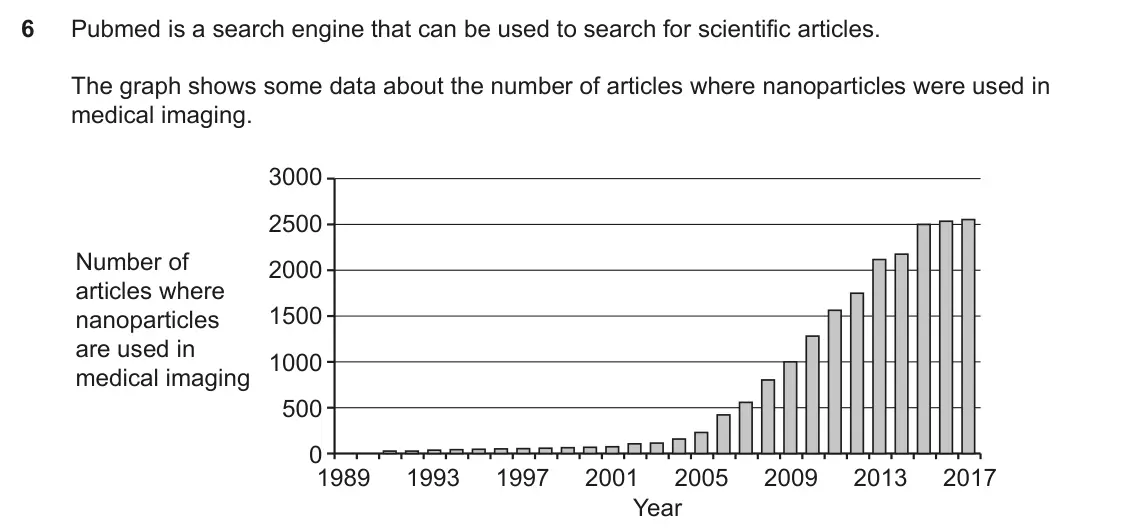
Q6(b)(i)
The whole paper ↗Q6(b)(ii)
The whole paper ↗Q6(c)
The whole paper ↗
All 50 questions on Why are nanoparticles so useful?, as a list
- June 2025, Chemistry Paper 2 Foundation, Q2(a)(iii) (2 marks): Fullerene can be used to carry drugs into the body. Which two properties of the structure makes this possible? Tick (3) two boxes. It is hollow. It is made up o
- June 2025, Chemistry Paper 2 Foundation, Q2(b) (2 marks): Some scientists are worried about the use of fullerenes to carry drugs into the body. State one benefit and one risk of using fullerenes in this way. Benefit Ri
- June 2025, Chemistry Paper 6 Higher, Q7(b)(i) (1 mark): Which two particles are the same order of magnitude? and [1]
- June 2025, Chemistry Paper 6 Higher, Q7(b)(ii) (2 marks): Nanoparticles are between 1 × 10⁻⁹ and 1 × 10⁻⁷ m in size. Which two particles could be nanoparticles? and [2]
- June 2024, Chemistry Paper 2 Foundation, Q9(a)(i) (1 mark): Which two particles have diameters with the same order of magnitude? and [1]
- June 2024, Chemistry Paper 2 Foundation, Q9(a)(ii) (2 marks): Write down the particles in order of diameter. Smallest Largest [2]
- June 2024, Chemistry Paper 2 Foundation, Q9(b) (2 marks): Nanoparticles make effective catalysts because they have a high surface area to volume ratio. Table 9.2 shows the surface area to volume ratio of some different
- June 2024, Chemistry Paper 2 Foundation, Q9(c) (3 marks): The nanoparticle shown is a cube. This nanoparticle has a volume of 1000 nm3. h w l NOT TO SCALE Calculate the surface area of the nanoparticle. Use the formula
- June 2024, Combined Science Paper 4 Foundation, Q5(a) (3 marks): Indium tin oxide is an important component of smartphones. The diagram shows a layer of indium tin oxide on a glass screen. Indium atoms are approximately 3.9 ×
- June 2024, Combined Science Paper 4 Foundation, Q5(b) (1 mark): Suggest why the actual number of whole indium atoms across the thickness of the indium tin oxide layer is less than the number of whole indium atoms calculated
- June 2024, Chemistry Paper 6 Higher, Q1(a)(i) (1 mark): Which two particles have diameters with the same order of magnitude? and [1]
- June 2024, Chemistry Paper 6 Higher, Q1(a)(ii) (2 marks): Write down the particles in order of diameter. Smallest Largest [2]
- June 2024, Chemistry Paper 6 Higher, Q1(b) (2 marks): Nanoparticles make effective catalysts because they have a high surface area to volume ratio. Table 1.2 shows the surface area to volume ratio of some different
- June 2024, Chemistry Paper 6 Higher, Q1(c) (3 marks): The nanoparticle shown is a cube. This nanoparticle has a volume of 1000 nm3. h w l NOT TO SCALE Calculate the surface area of the nanoparticle. Use the formula
- June 2023, Chemistry Paper 2 Foundation, Q8(a) (1 mark): What is the typical size of atoms and small molecules? Put a ring around the correct option. 1 × 10⁻¹⁰ m 1 × 10⁻⁶ m 1 × 10⁻² m 1 m [1]
- June 2023, Chemistry Paper 2 Foundation, Q8(b) (3 marks): A sphere with a diameter of 2 cm is used as a model of an atom. Calculate the diameter of a model of a tennis ball on the same scale. Give your answer in metres
- June 2023, Combined Science Paper 4 Foundation, Q6(a) (2 marks): What can you conclude from the data in the graph? [2]
- June 2023, Combined Science Paper 4 Foundation, Q6(b)(i) (2 marks): Suggest two reasons why scientists in the nanotechnology company might disagree with this conclusion. 1 2 [2]
- June 2023, Combined Science Paper 4 Foundation, Q6(b)(ii) (2 marks): Describe what the group of scientists should have done to improve their study. [2]
- June 2023, Combined Science Paper 4 Foundation, Q6(c) (1 mark): Nanoparticles have been used in medicine alongside MRI scans to help detect cancer in patients. Why are health professionals and patients happy to be part of na
- June 2022, Chemistry Paper 2 Foundation, Q6(b)(i) (1 mark): What is the approximate size of a nanoparticle? Put a ring around the correct answer. ≤100 nm 1000 nm 10 000 nm ≥10 000 nm [1]
- June 2022, Chemistry Paper 2 Foundation, Q6(b)(ii) (2 marks): Fullerenes can be used to carry drugs into the body. Which two statements explain why? Tick (3) two boxes. They are small enough to pass through body tissues. T
- June 2022, Chemistry Paper 2 Foundation, Q6(b)(iii) (2 marks): Some people do not agree with the use of nanoparticles to carry drugs into the human body. Others think that the benefits outweigh the risks. Suggest one risk a
- June 2022, Chemistry Paper 6 Higher, Q8(a)(iii) (1 mark): Graphene sheets are one atom deep. What is the depth of a graphene sheet? Put a ring around the correct answer. 1 × 10–11 m 1 × 10⁻¹⁰ m 1 × 10⁻⁹ m 1 × 10⁻⁸ m 1
- June 2022, Chemistry Paper 6 Higher, Q8(b)(i) (2 marks): Which two statements explain why nanotubes can be used to carry drugs into the body? Tick (3) two boxes. They act as molecular sieves. They are good catalysts.
- June 2022, Chemistry Paper 6 Higher, Q8(b)(ii) (2 marks): Give one risk and one benefit of using nanoparticles to carry drugs into the body. Risk Benefit [2]
- June 2022, Combined Science Paper 8 Higher, Q8(a)(i) (3 marks): Calculate the surface area of a gold nanoparticle. Use information from the table and the equation: surface area of a sphere = 4πr 2 Use π = 3.14 Give the corre
- June 2022, Combined Science Paper 8 Higher, Q8(a)(ii) (1 mark): Which statement would be a reason to use gold nanoparticles to deliver drugs to cells in the human body? Tick (✓) one box. Gold is very valuable Gold has the sm
- June 2022, Combined Science Paper 8 Higher, Q8(b) (2 marks): Explain why silver oxide nanoparticles make an effective catalyst. Use information from the table to support your answer. [2]
- June 2022, Combined Science Paper 8 Higher, Q8(c) (4 marks): Suggest why titanium dioxide nanoparticles might be a risk to marine ecosystems. Use information from the table and your own knowledge to support your answer. [
- November 2021, Chemistry Paper 2 Foundation, Q10(a) (3 marks): Discuss James’ comment. Use Table 10.1 to support your answer. [3]
- November 2021, Chemistry Paper 2 Foundation, Q10(b)(i) (1 mark): Which type of powder in Table 10.2 provides the biggest surface area for a given volume of silver? Give one reason for your answer. Type of powder Reason [1]
- November 2021, Chemistry Paper 2 Foundation, Q10(b)(ii) (2 marks): James thinks that the data in Table 10.2 gives this relationship. surface area to volume ratio ∝ size of particle Is James correct? Yes No Explain your answer.
- November 2021, Chemistry Paper 2 Foundation, Q10(c) (2 marks): The different ways that nanoparticles are used depends on their properties. Draw lines to connect each property of nanoparticles with the use that depends on it
- November 2021, Chemistry Paper 6 Higher, Q2(a) (3 marks): Discuss James’ comment. Use Table 2.1 to support your answer. [3]
- November 2021, Chemistry Paper 6 Higher, Q2(b)(i) (1 mark): Which type of powder in Table 2.2 provides the biggest surface area for a given volume of silver? Give one reason for your answer. Type of powder Reason [1]
- November 2021, Chemistry Paper 6 Higher, Q2(b)(ii) (2 marks): James thinks that the data in Table 2.2 gives this relationship. surface area to volume ratio ∝ size of particle Is James correct? Yes No Explain your answer. [
- November 2021, Chemistry Paper 6 Higher, Q2(c) (2 marks): The different ways that nanoparticles are used depends on their properties. Draw lines to connect each property of nanoparticles with the use that depends on it
- June 2019, Chemistry Paper 2 Foundation, Q11(a)(i) (1 mark): Nanotubes are nanoparticles. Which statement explains why nanotubes are nanoparticles? Tick (3) one box. They have covalent bonds. Their diameters are between 1
- June 2019, Chemistry Paper 2 Foundation, Q11(a)(ii) (2 marks): Which two statements explain why nanotubes are very strong? Tick (3) two boxes. Bonds between carbon atoms are strong. Lots of bonds must be broken to break the
- June 2019, Chemistry Paper 2 Foundation, Q11(a)(iii) (3 marks): Nanotubes are a similar shape to a human hair but they are much smaller. A human hair has a diameter of 0.001 mm. A nanotube has a diameter of 2 nm and a length
- June 2019, Chemistry Paper 2 Foundation, Q11(b) (2 marks): Short nanotubes can also be used to carry medicines into the body. The medicine is put inside the tube and the tube is injected into the body. Give one benefit
- June 2019, Chemistry Paper 6 Higher, Q2(a)(i) (1 mark): Nanotubes are nanoparticles. Which statement explains why nanotubes are nanoparticles? Tick (3) one box. They have covalent bonds. Their diameters are between 1
- June 2019, Chemistry Paper 6 Higher, Q2(a)(ii) (2 marks): Which two statements explain why nanotubes are very strong? Tick (3) two boxes. Bonds between carbon atoms are strong. Lots of bonds must be broken to break the
- June 2019, Chemistry Paper 6 Higher, Q2(a)(iii) (3 marks): Nanotubes are a similar shape to a human hair but they are much smaller. A human hair has a diameter of 0.001 mm. A nanotube has a diameter of 2 nm and a length
- June 2019, Chemistry Paper 6 Higher, Q2(b) (2 marks): Short nanotubes can also be used to carry medicines into the body. The medicine is put inside the tube and the tube is injected into the body. Give one benefit
- June 2018, Chemistry Paper 2 Foundation, Q10(c)(i) (1 mark): The surface area to volume ratio of a particle of a catalyst can be calculated by using this formula: surface area to volume ratio = surface area of particle ÷
- June 2018, Chemistry Paper 2 Foundation, Q10(c)(ii) (4 marks): Catalysts are now made from nanoparticles. A nanoparticle in a catalyst is shown in the diagram. 10 nm 10 nm 10 nm Calculate the surface area to volume ratio of
- June 2018, Chemistry Paper 6 Higher, Q2(c)(i) (1 mark): The surface area to volume ratio of a particle of a catalyst can be calculated by using this formula: surface area to volume ratio = surface area of particle ÷
- June 2018, Chemistry Paper 6 Higher, Q2(c)(ii) (4 marks): Catalysts are now made from nanoparticles. A nanoparticle in a catalyst is shown in the diagram. 10 nm 10 nm 10 nm Calculate the surface area to volume ratio of
Questions, mark schemes and examiner’s reports are © OCR, from their published past papers. Plumi isn’t affiliated with any exam board. Want whole papers? Full past papers.
Rather write your answers by hand on iPad? Plumi marks them against the same mark schemes.